Authors
Héctor Fuentes
News Type
News
Date
Paragraphs

Less than 24 hours after Colombians cast their first-round ballots in the presidential election, CDDRL’s Democracy Action Lab (DAL) convened four scholars for a webinar launching its new series, “Democracy at the Ballot Box: The 2026 Electoral Cycle in Latin America.” Alberto Díaz-Cayeros, DAL's co-director, moderated a conversation with Michael Weintraub (Universidad de los Andes, director of CESED, the Center for the Study of Security and Drugs), Javier Mejía Cubillos (Stanford University, Department of Political Science and the Stanford Civics Initiative), Oliver Kaplan (University of Denver's Korbel School, 2025-26 Visiting Scholar at CDDRL), and María Ignacia Curiel (Stanford University, research scholar at CDDRL and research manager of DAL).

The election results were jarring. Abelardo de la Espriella, an independent lawyer running hard on security, had taken 43.75 percent of the vote to Iván Cepeda's 40.90 percent — with Uribista Paloma Valencia a distant third at roughly 7 percent, and centrists Sergio Fajardo and Claudia López splitting another 5 percent between them. A runoff was set for June 21. The panel had one day to make sense of it.

The numbers and the map beneath them


Weintraub opened with data he had scraped that morning, and the maps told a story of a country voting almost exactly along the lines it already knew. Cepeda's support mapped with striking precision onto Gustavo Petro's 2022 coalition — he flipped essentially no municipality where the combined right-wing vote had exceeded Petro's four years earlier — while De la Espriella's strength traced the same geography as the “No” vote in Colombia's 2016 referendum on the FARC peace agreement. Turnout, oddly, had risen more in Petro's 2022 strongholds than in the right's, which Weintraub read less as good news for Cepeda than as a sign his coalition may already be close to its ceiling, with more untapped voters available to De la Espriella heading into the runoff. Modeling out several scenarios for how Valencia's, Fajardo's, and López's voters might split, most of his projections had De la Espriella winning comfortably — though, as he noted, Colombian elections have a way of moving in the three weeks between rounds.

What the numbers don't show


Mejía pushed back on two points he felt the quantitative read was missing. First, the Pacto Histórico's cohesion: a Colombian left with a long history of fragmentation had, remarkably, stayed unified behind a famously self-centered leader in Petro — though Mejía flagged early signs that some in the movement were quietly urging Cepeda to distance himself, a tension he expected to shape the run-up to the runoff and, potentially, Colombian politics well past this election cycle.

Second, and more pointedly, Mejía argued against reading De la Espriella as simply Colombia's version of an internationally franchised populism — Bukele, Milei, Trump — with the usual explanations about fear and security anxiety layered on top. There's some of that, he allowed. But he made the case that De la Espriella had tapped something more specifically Colombian: a cultural premium on hard work as the individual, personally-earned marker of social standing — a value Mejía argued Petrismo's more abstract, structural language about labor and capital simply doesn't speak to — paired with a live-and-let-live, self-reliant streak that runs across class lines. He pointed to a viral interview De la Espriella gave the streamer Westcol, where he defended a truck driver's right to carry a gun against highway robbers in strikingly plain, non-ideological terms, as the clearest illustration of a message landing well beyond the demographic most analysts assumed was his base.

A clean vote, an anxious moment


Kaplan drew on firsthand observation, having been in Colombia both eighteen months earlier and again just weeks before the vote, where he watched supporters of every camp convince themselves their candidate would win. He was careful to note the good news first: Colombia's electoral authority and EU observers both called the vote clean, turnout was strong, and — in a detail that made the local news cycle that morning — Colombian voters get paid time off work for each round they vote in. But the deeper story, in his read, was a political system whipsawed by unmet expectations since the 2016 peace deal, Petro's stalled “total peace” negotiations, and a personal, legal feud between Cepeda and former president Álvaro Uribe layered on top of an election that had become, in effect, a referendum on Petro himself. Cepeda's central problem, Kaplan argued, echoed Kamala Harris's in the 2024 U.S. election: tied to an unpopular incumbent's record without ever having been able to fully break from it. Whether he could move toward the center — a softer task against De la Espriella than it might have been against the more centrist Valencia — was, in Kaplan's view, the pivotal question of the next three weeks. He closed by naming the deeper worry running under both campaigns: real, if differently shaped, concerns about what either winner might do to Colombia's political institutions.

A regional pattern, and a geopolitical wildcard


Curiel widened the lens. She was careful not to flatten every recent right-populist surge in Latin America into a single story, but she argued it's hard to ignore a regional pattern all the same — strikingly similar candidates, rhetorical strategies, and now fraud allegations recurring across countries (Honduras, Peru, Bolivia among them) whose underlying security and political problems differ substantially. She suggested it might be worth studying today's crop of outsider-right figures the way scholars once studied the diffusion of Latin America's leftist movements in the 1960s and '70s — as a phenomenon with its own cross-border mechanics, not just parallel domestic stories.

On the United States, Curiel expected rhetorical engagement from the Trump administration — De la Espriella is an open admirer who had already met with Trump officials in Miami — but was skeptical it would prove decisive; Cepeda, by contrast, might govern more in the pragmatic, arm's-length mode of Mexico's Claudia Sheinbaum, building on the more accommodating turn Petro's own relationship with Washington had taken since earlier in the year. She also flagged a looming energy question neither candidate had addressed in any detail: an anticipated El Niño-driven drop in hydroelectric capacity, and the resulting scramble for imported natural gas — from the United States or, potentially, Venezuela — that whoever won would inherit almost immediately. And she pointed to a genuine irony in De la Espriella's biography: a right-wing candidate whose past legal work had tied him personally to a figure associated with the Maduro government, complicating any simple ideological reading of what a De la Espriella presidency would mean for Colombia–Venezuela relations.

Where the center went, and what comes next


The discussion that followed ranged widely: why Paloma Valencia's campaign collapsed after polling near 20 percent just weeks earlier (the panel's rough consensus: a hard right that structurally tends to outflank the establishment right across the region, compounded by a Petrista strategy that concentrated its fire on De la Espriella as the tougher runoff opponent, leaving Valencia to absorb collateral damage); whether Colombia's center had simply disappeared with the 2016 peace agreement; and how much weight to put on U.S. involvement or even World Cup-driven national sentiment as runoff wildcards. Nobody thought either would be decisive on its own.

Asked directly what a De la Espriella or a Cepeda presidency would mean for the health of Colombian democracy, Weintraub was candid about his concern — less because either candidate is uniquely dangerous, he said, than because Colombia's political system has grown exhausted, its 1991 constitutional settlement showing diminishing returns and a public “willing to experiment” after the unfulfilled promise of Petro's own presidency. Curiel and Kaplan both located genuine grounds for hope in the same place: an unusually fragmented political landscape, without a single unchallenged caudillo on either side, and courts and regulatory institutions that had — so far — held their independence through repeated stress tests. On violence specifically, the panel's closing predictions diverged by scenario. Under De la Espriella, Weintraub and Kaplan worried that a rupture in Petro's ongoing peace talks would trigger retaliatory violence, that a return to aerial coca fumigation would collide head-on with the Constitutional Court, and that elite or paramilitary backlash would follow if Cepeda had instead pursued land reform and a constituent assembly. Under Cepeda, the concern ran more toward armed groups continuing to exploit ceasefires and extortion economies, and toward the durability of institutional checks on a government still tied to Petro's unfinished agenda.

Díaz-Cayeros closed the session on a note that has stayed with the panel since: a viewer's comment in the chat had framed the choice as one between “the devil you know and the devil you don't.” Fair enough, he said — but democracy remains one of the few systems humanity has built that lets a society get rid of either devil, peacefully, and try again.

Postscript: what actually happened


Set against the news since, the panel's read holds up better in its worries than in its point estimates.

The margin was the first surprise. Weintraub's scenario modeling, built the morning after round one, had De la Espriella winning comfortably in most transfer scenarios. The actual runoff, held as scheduled on June 21, was instead a nail-biter: 49.66 percent to 48.70 percent, a gap of roughly 246,000 votes out of some 26 million cast — under one percentage point, and close enough that Cepeda initially declined to concede, contesting results from close to a quarter of polling stations before formally accepting the outcome on June 24 with a pledge to “exercise a democratic, vigilant and constructive opposition.” Election night itself brought clashes between protesters and police in Cali, an early sign of the social tension the panel had flagged as a risk under either outcome.

Weintraub's own post-election analysis, published the day of the runoff, put hard numbers behind the panel's “entrenched spatial blocks” thesis — and, in the process, revised one of the panel's own central premises. Only 26 of Colombia's more than eleven hundred municipalities changed which candidate won between the two rounds (14 flipping to De la Espriella, 12 to Cepeda), and nearly all of those flips came in places that were already razor-thin in round one. The country that voted for De la Espriella — Norte de Santander at 77 percent, Casanare at 69, Santander at 65, Antioquia at 64 — and the country that voted for Cepeda — Chocó and Vaupés both above 80 percent, Putumayo at 79, Nariño at 77, Cauca at 76 — barely overlapped at all. Bogotá told a version of the story Weintraub had flagged live on the panel, now with exact numbers: Cepeda carried the capital 52.5 percent to 45.4, a margin of about 302,000 votes, solid but well short of what Petro had won there in 2022, even as Cepeda gained ground in every other major city between rounds — up 8.7 points in Medellín, 8.2 in Cali, 8.0 in Cartagena, 7.1 in Barranquilla.

The more important correction concerns the “pivotal center” the panel spent so much of its discussion on the day after round one — the roughly 2.8 million voters who had backed Valencia, Fajardo, and López. Weintraub's later numbers show both campaigns' gains between rounds exceeded that entire pool on their own: De la Espriella added nearly 2.6 million votes beyond his first-round total, more than Valencia's whole first-round universe by itself, while Cepeda added over 3 million, more than the combined Fajardo-López vote. The runoff, in other words, wasn't decided mainly by which side won over centrist defectors but by each campaign's ability to pull entirely new voters to the polls, a dynamic already visible in round one, when turnout had risen 2.25 million over 2022, disproportionately in Cepeda's Caribbean and Pacific strongholds. Between rounds, turnout climbed further, up 5.6 points to 63.5 percent (3.6 million more voters than the 2022 runoff), and Cepeda's operation mobilized more of them in absolute terms than De la Espriella's. It simply wasn't enough to close a gap that had already opened in round one. As Weintraub summarized: De la Espriella won a close, high-turnout election on the strength of an intact regional coalition plus modest gains in the center; Cepeda outgrew his first-round vote proportionally, but never closed the gap he faced.

Washington reacted exactly as Curiel expected, if more enthusiastically than her cautious framing implied: Trump declared on Truth Social that De la Espriella had “Won, BIG!,” and Secretary of State Marco Rubio called the president-elect to discuss regional security cooperation, immigration, and trade. Precisely, the rhetorical engagement Curiel predicted, delivered with more warmth than skepticism.

Despite initial post-election tensions, transfer of power went ahead on schedule, if uneasily. De la Espriella was sworn in on August 7, not in Bogotá, but in Cali, under an unprecedented security operation of some 11,000 troops and a drone ban, with Javier Milei and José Antonio Kast among the foreign leaders in attendance.

On policy, the new president has moved fast to confirm Weintraub's most specific fears. He has vowed to end the Petro government's peace negotiations with armed groups, resume aerial fumigation of coca crops (a practice suspended for more than a decade), and the exact flashpoint Weintraub predicted would trigger a “choque” with the Constitutional Court — and expand the military's role against criminal organizations, alongside new large-scale prison construction. Analysts are now warning, in terms that echo Weintraub and Kaplan's closing remarks almost exactly, that abandoning negotiations could backfire: an estimated 27,000 members of armed groups currently have no reintegration pathway if talks collapse entirely. On foreign policy, De la Espriella has aligned closely with the Trump administration, backing its military strikes on suspected drug vessels in the Caribbean, expediting extraditions, severing relations with Cuba, and restoring ties with Israel. 

Six weeks into the new administration, the question the panel closed on that afternoon has stopped being hypothetical and started being lived: can Colombia's institutions absorb what comes next? It's the story DAL's "Democracy at the Ballot Box" series intends to keep following.

Read More

Dr. Beatriz Magaloni (right) meets with members of the Afro-Descendant Farmers’ Association of María la Baja (ASOCAAFRO) in Colombia’s Caribbean region.
Blogs

Elections in the Shadow of Violence: Democratic Resilience in Colombia

Reflecting on a Democracy Action Lab fieldwork mission to Bogotá and the Caribbean coast in the run-up to Colombia's 2026 electoral cycle.
Elections in the Shadow of Violence: Democratic Resilience in Colombia
Beatriz Magaloni interviews a voter on April 12, election day, at a polling station in the province of Anta, Cusco. Several interviews were conducted that same day inside and outside polling stations in this southern Andean region.
Blogs

Colonialism, Extractivism, and Institutional Fragility Shaped the Elections in Peru

A Democracy Action Lab fieldwork mission to Lima and Cusco around Peru's first-round 2026 election finds a democracy whose deepest fractures predate the ballot.
Colonialism, Extractivism, and Institutional Fragility Shaped the Elections in Peru
man holds a portrait of nicolas maduro during a march
News

Venezuela After Maduro, Explained

A Democracy Action Lab panel weighed competing scenarios for Venezuela’s political future amid elite continuity, economic crisis, and international intervention.
Venezuela After Maduro, Explained
Hero Image
A man in a Colombian football jersey casts his vote in the presidential election on May 31, 2026, in Bogotá, Colombia.
A man in a Colombian football jersey casts his vote in the presidential election on May 31, 2026, in Bogotá, Colombia. | Leonardo Castañeda/Getty Images
All News button
1
Subtitle

Convened one day after the first round, four scholars forecast a referendum on Petro's presidency and a system running out of patience. The vote that followed was far closer than their models predicted.

Image
A man in a Colombian football jersey casts his vote in the presidential election on May 31, 2026, in Bogotá, Colombia.
Caption A man in a Colombian football jersey casts his vote in the presidential election on May 31, 2026, in Bogotá, Colombia. | Photo credit Leonardo Castañeda/Getty Images
Date Label
In Brief
  • One day after Colombia's first-round vote, four scholars from CDDRL's Democracy Action Lab and partner institutions analyzed the results and projected a comfortable win for Abelardo de la Espriella.
  • Their broader diagnosis — that Colombia's political system was showing diminishing returns after years of unmet expectations — held up better than their projected margin, as the runoff was decided by under one percentage point.
  • Since taking office, the new administration has ended peace talks and resumed coca fumigation, triggering a clash with the Constitutional Court that one panelist had specifically predicted.
Display Hero Image Wide (1320px)
Yes
News Type
News
Date
Paragraphs

For the second time in history, UN Member States adopted a Political Declaration on AMR in 2024. This declaration outlines ambitious commitments to tackle one of the most pressing health challenges of our time. These commitments will only be successful if the public understands, supports, and ultimately changes behavior to make them work.

Ahead of UNGA, we asked citizens in six countries what they thought about different policy proposals across six themes: Equity, Access and Stewardship; Infection Prevention; Food Security; Awareness and Education; Target setting; and Surveillance.

Working with the Trinity Challenge, we brought together 2,419 citizens from Brazil, Colombia, Nigeria, Tanzania, India, and Indonesia using Deliberative Polling®, a method that assesses what a representative and informed sample would think about policy proposals after extended, evidence-based discussions. Deliberations took place on the innovative Artificial Intelligence (AI)-assisted Stanford University Online Deliberation Platform across two days.

Citizens left the process not just more informed, but more engaged with the solutions required.

What is Deliberative Polling® ?


Deliberative Polling® is a research methodology developed by Professor James Fishkin at Stanford University's Deliberative Democracy Lab. Unlike standard opinion polling, it measures not just initial public opinion but informed public opinion - what people think after genuine engagement with the issues, trade-offs, and expert perspectives.

It has been applied in over 160 cases around the world, from national referendums to climate policy.

Learn more about the Deliberative Polling® methodology.

"Deliberative Polling® doesn't just ask what people think - it asks what they would think if they had the chance to really engage with the evidence."
Professor James Fishkin
Stanford Deliberative Democracy Lab

Key Findings


The results were striking - and they matter for policymakers, health leaders, and the public alike.

🌍 2,419 citizens across six middle-income countries participated
📈 43 out of 45 policy proposals saw increased support after deliberation
✅ The most popular proposals were those relating to infection prevention
🌐 Regional differences emerged — particularly around attitudes to restricting antibiotic use in food production.

Antimicrobial resistance is not only a scientific challenge but a societal one. This project shows that when citizens are given balanced information, diverse perspectives, and the opportunity to deliberate, they can engage meaningfully with the complexity of AMR and support the action it requires. Building public trust and community engagement is essential to reducing the global impact of AMR. We hope these findings and resources will help advance public engagement on AMR and strengthen deliberative approaches across global health.

Support increased for 43 out of 45 proposals following deliberation. Beyond the data, participants left better informed about AMR and more engaged with the solutions on the table. That is whole-of-society action in practice.
Dame Sally Davies
Master of Trinity College Cambridge and Executive Chair of the Trinity Challenge

From Understanding to Action


This study demonstrates something important: when citizens are given the chance to engage seriously with a complex global health challenge, they rise to it.

Across all six countries, deliberation moved public opinion towards greater support for ambitious AMR action — on prescription practices, agricultural use, access to medicines, and prevention. The 2024 UN Political Declaration set out what governments have committed to. This research shows that the public, when informed, is ready to support it.

The findings have direct relevance for:

  • Policymakers designing national AMR action plans, particularly in middle-income countries
  • Health communicators seeking evidence-based approaches to public engagement on AMR
  • Researchers building the evidence base for deliberative approaches in global health
  • Civil society organizations advocating for community-level AMR action
     

We are committed to sharing these findings as widely as possible — with governments, health bodies, and the communities that took part.

Thanks to our funders


With thanks to the Novo Nordisk Foundation and Wellcome.

Contact and Media


For media inquiries and further information about the research, please contact Louise Gough (Chief Operating Officer) at info@thetrinitychallenge.org.

Read our press release.

Hero Image
Person in blue shirt washing hands
Melissa Jeanty
All News button
1
Subtitle

The Deliberative Democracy Lab and the Trinity Challenge asked 2419 people in six countries through the first-ever deliberative poll on AMR.

Image
Person in blue shirt washing hands
Photo credit Melissa Jeanty
Date Label
Display Hero Image Wide (1320px)
Yes
Authors
News Type
News
Date
Paragraphs

Introduction and Contribution


Democracies face a host of ongoing challenges, including the rise of elected autocrats, income inequality, mainstreamed forms of xenophobic nationalism, and political apathy. All of these challenges pose threats to democratic participation — elected autocrats restrict it, inequality makes it easier for oligarchs to sway election outcomes, and xenophobia can discourage cultural outsiders from voting.

Apart from practical threats to democratic participation, an established intellectual tradition has viewed participation with deep skepticism. In this view, democracy is good simply because it ensures peaceful transfers of power and protects individual rights. Collective decisions, however, cannot be meaningfully viewed as representing the “will of the people” owing to manipulation, apathy, and the high costs of acquiring political knowledge. Is this “realist” vision the best one can hope for in democratic life?

In “Can deliberation have lasting effects?,” James FishkinValentin Bolotnyy, Joshua Lerner, Alice Siu, and Norman Bradburn show how a three-day deliberative experiment in late 2019 had large and long-term effects on turnout and voting behavior. Those most likely to exhibit these civic behaviors nearly a year later had come to follow politics more closely and see their political opinions as valuable. At the same time, the experiment’s effects on participants’ policy views were significant only in the short term — most deliberators eventually reverted to their previously held policy positions.

That three days of deliberation had such lasting civic effects suggests that efforts to create more inclusive forms of democratic participation are both possible and scalable. Moreover, it suggests that academic skepticism about democratic participation is not an argument against citizens’ capacities for reasonable decision-making; rather, it is an argument against our imperfect contexts of participation. Deliberative experiments may offer hope for improving these contexts.

Academic skepticism about democratic participation is not an argument against citizens’ capacities for reasonable decision-making; rather, it is an argument against our imperfect contexts of participation.

The Deliberative Experiment and Its Effects on Policy Views


In September 2019 — one week prior to the experiment — a treatment group (i.e., those who would deliberate) of 523 registered voters from around the US and a control group of 844 voters were surveyed on their political attitudes. Members of the treatment group then deliberated on five issue domains (the economy, environment, immigration, health care, foreign policy) in small groups and on 47 policy proposals (e.g., redistributing wealth in some way). 26 of these proposals were characterized by extreme partisan polarization, meaning significant numbers of those who identified as Democrats or Republicans held the most extreme views. After the deliberations ended, both the treatment and control groups were surveyed. Then, three subsequent surveys were conducted in late 2020.

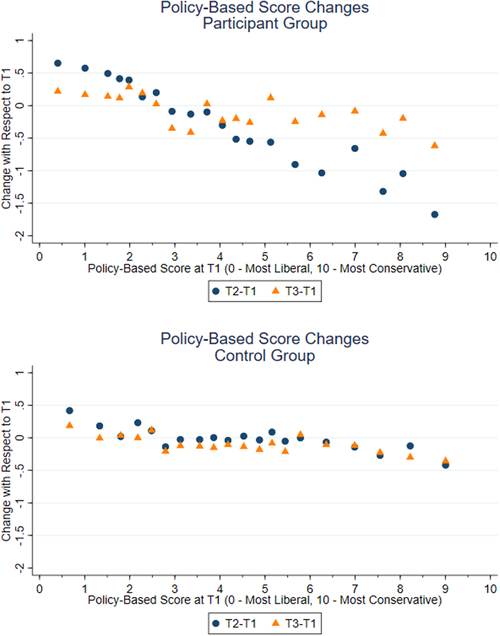
Among the treatment group, deliberation produced significant, short-term depolarization on 20 of the 26 (polarized) policy proposals. In other words, the averages for participants who identified with each party moved closer together (though not necessarily toward the center). These changes were large, sometimes 40 percentage points, as in the case of Republicans abandoning extreme positions on immigration. Meanwhile, the control group’s policy positions changed hardly at all — pointing to the key role played by deliberation. Within the five issue areas, averages among deliberators shifted leftward on all but the economy.


Image
Figure 1. Policy-Based Score (PBS) Changes over Time


Figure 1. Policy-Based Score (PBS) Changes over Time
Note: Policy-based score (PBS) is constructed for each individual based on responses to 26 questions identified as the most polarizing. The upper chart shows the participant group, and the lower chart shows the control group. T1 is the survey wave prior to the deliberations, T2 is right after the deliberations, and T3 is 10 months after, in July 2020.


By late 2020, however, the treatment group’s policy positions mostly reverted to their pre-deliberation levels. The differences between these two points in time were still significant compared with the control group, yet relatively small in absolute terms. These policy reversions are perhaps unsurprising: deliberators returned to an environment of heightened polarization and aggressive campaigning during the 2020 election cycle. (To be sure, and from the standpoint of finding solutions to collective problems, policy reversion is not especially concerning — the aim of deliberation is to bring citizens together to reason and compromise, which the experiment accomplished.)

A Civic Awakening?


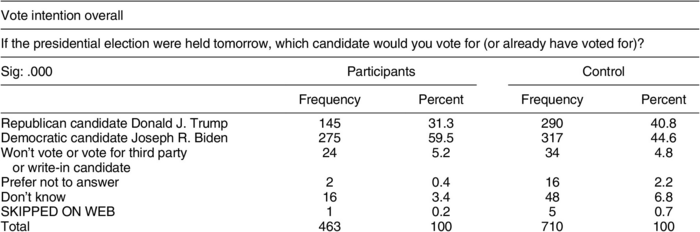
The lack of long-term policy effects suggests that three-day deliberations may be limited in their ability to create a more encompassing, participatory society. However, the treatment group demonstrated large and persistent changes in their intention to vote (i.e., turnout) and their candidate of choice. Among the control group, Joe Biden was favored over Donald Trump by about four percentage points — very close to Biden’s actual margin in the popular vote. Among the treatment group, however, Biden was favored by 28 percentage points. The gaps in turnout were similarly large. (Note that these are intentions, not reports of actual decisions. However, Tables 6 and 7 in the article show similar effects for recollected votes after the election.)


Image
Table 2. Voting Intention for Participant and Control Groups, Time 4


Table 2. Voting Intention for Participant and Control Groups, Time 4


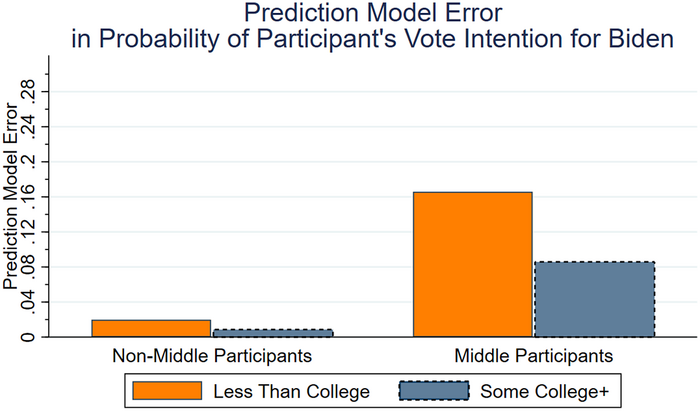
These civic outcomes are especially surprising because (a) voting behavior is thought to be stable and deeply rooted in one’s psychology and social context, and (b) experimental efforts to increase turnout have been most successful when undertaken shortly before elections, as opposed to one whole year prior. The effects were most pronounced among political moderates and those without college degrees — perhaps pointing to the educative effects of deliberation.


Image
Figure 5. Effects on Vote Intention Captured by Predictive Modeling, by Education


Figure 5. Effects on Vote Intention Captured by Predictive Modeling, by Education
Note: Middle are those participants who have Policy-Based Scores between 3 and 5 (inclusive) at Time 1. Non-middle participants are all other participants. Positive prediction error shows that, on average, participants were more likely to vote for Biden than predicted by the model. Vote intention data are collected at Time 4, in October, 2020. Full calibrated model used to construct this figure can be found in the APSR Dataverse.


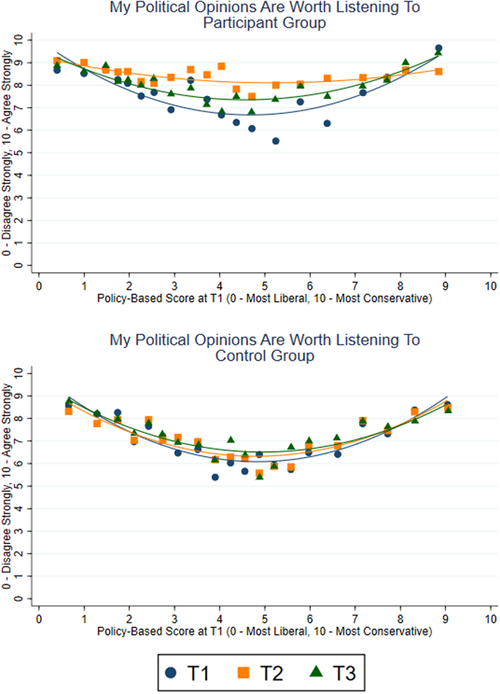
Why did deliberation produce only short-term policy effects but long-term effects on voting behavior? The authors posit that deliberation caused an “awakening of civic capacities.” They reason that deliberation was a transformative experience in terms of stimulating political engagement and a sense of efficacy. And indeed, the treatment group was, in the long term, more likely than the control group to follow the 2020 election campaign, believe their political opinions mattered, and acquire general information about American politics. (The latter is measured in terms of knowing which party controlled the House and Senate.)


Image
Figure 9. Having “Political Opinions Worth Listening to”


Figure 9. Having “Political Opinions Worth Listening to”
Note: Policy-based score is constructed for each individual based on responses to 26 questions identified as the most polarizing. Responses to the question “How strongly would you disagree or agree with the following statement?”[I have opinions about politics that are worth listening to.] were collected at T1 (just before deliberations), T2 (just after), and T3 (10 months later, July 2020).


The authors close by discussing efforts to scale up civic engagement, such as the Stanford Online Deliberation Platform. In all, “Can deliberation have lasting effects?” provides a rigorous case for the value of deliberation in strengthening democratic participation.

*Brief prepared by Adam Fefer.

Hero Image
Group of people deliberating around a table
A group deliberating during the America in One Room national Deliberation Poll in Dallas, TX, 2019
All News button
1
Subtitle

CDDRL Research-in-Brief [4-minute read]

Terms
Image
Group of people deliberating around a table
Caption A group deliberating during the America in One Room national Deliberation Poll in Dallas, TX, 2019
Date Label
Display Hero Image Wide (1320px)
No
News Type
News
Date
Paragraphs

For over 25 years, Stanford’s Kimberly Babiarz has felt fiercely devoted to addressing the complex injustice of human trafficking, a crime she is quick to point out, “is everywhere.” 

Modern slavery, which includes sex and labor trafficking, forced labor, domestic servitude, debt bondage, and forced marriage, is “a big, systemic problem in need of big, systemic solutions,” she notes.

Those kinds of solutions typically require a diverse array of skillsets and experience – not to mention a great deal of dedication to the work, both of which Babiarz found when she and longtime collaborator Grant Miller, Henry J. Kaiser, Jr. Professor in the Department of Health Policy at Stanford School of Medicine, linked up with Jessie Brunner of Stanford’s Center for Human Rights and International Justice, Clinical Associate Professor of Pediatrics Vicki Ward, and Luis Assis, labor prosecutor and Chief Data Scientist at Brazil’s Federal Labor Prosecution Office.

The group coalesced around a shared sense of frustration at the lack of an evidence base undergirding decades of anti-trafficking interventions and the Stanford Human Trafficking Data Lab was born in 2019 with a mission to bring data and evidence to the fight against human trafficking.

“Few things give me more satisfaction than gathering folks with disparate backgrounds and skillsets towards achieving a common goal to advance human rights,” said Brunner. “Forming the Lab was a unique opportunity to leverage advances in data science and technological innovation to bear on one of the most grievous abuses of our time.”

Fairly quickly, the team identified a gap they could fill in and around the remote Amazon region in northeastern Brazil.

“The steady pace of deforestation and land conversion in the Amazon relies on the exploitation of people, including some children, who work strenuous 16-hour days, often without pay, burning trees at extremely high temperatures and converting them into charcoal,” explains Miller, the Lab’s Principal Investigator. “This all takes place at illegal work sites, where laborers live without adequate shelter or clean water, that are intentionally hidden from view in remote areas.”

Because these sites consist of an almost geometric line-up of dome-shaped kilns devoted to burning trees and an output of thick smoke, the researchers realized their footprints are uniquely visible from space. 

Using geospatial data and remote detection algorithms, the lab was able to pinpoint a clear way in which data science could be leveraged to help Brazilian prosecutors locate and investigate the stealth work sites where laborers are often exploited in conditions analogous to slavery. 

At a Stanford Impact Labs storytelling event in April, Babiarz vividly described the thrill of realizing that an algorithm could be put to work against this severe, yet frequently invisible, human rights issue plaguing Brazil. By building a data-driven tool to find and map illegal charcoal production sites, she described how her team helped law enforcement uncover nearly 200 previously unknown sites.

Most exciting of all, prosecutors were able to inspect 130 of those sites and carried out 10 times more task force raids than historically observed. Most importantly, the team observed a surge in the number of workers rescued from conditions of modern slavery, a more than 10-fold increase compared to typical years. The team is now rolling the tool out to every charcoal producing region in Brazil and exploring the tool’s applicability potential in other geographies and sectors. 

“We found a way to build a solution big enough to meet the scale of the problem in a corner of the world that really needs it,” Babiarz notes. "We also found a great deal of hope in being a part of this solution. By harnessing powerful technology in the context of a trusted partnership, we were able to deliver real impact to people in need of real help.”

The steady pace of deforestation and land conversion in the Amazon relies on the exploitation of people.
Grant Miller, PhD
Professor of Health Policy and Director of the Trafficking Lab

The team's work in Brazil is far from over. 

With funding from Stanford Impact Labs, the Lab is expanding the impact of their work in Brazil’s charcoal sector, working with Brazil’s Federal Labor Prosecution Office to create a new data-driven technical tool to map exploitative supply chains. The tool will identify labor trafficking and illegal deforestation in distant tiers of the supply chain by integrating data from siloed publicly available administrative and legal records, making it easier for private sector steel manufacturers to address both trafficking and deforestation in their supply chains.

“The supply chain tracing tool is yet another example of the way our Lab is leveraging advances in data and social sciences to reach more trafficking victims and hold their exploiters accountable,” said Assis. “This has the potential to really change the game.”

This story was originally published by Stanford Impact Labs Director of Strategic Communications & Outreach Kate Green Tripp.


Read More

Illustration of charcoal kilns in Brazil
News

Launching AI-Driven Initiatives to Combat Labor Trafficking in Brazil

The Stanford Human Trafficking Data Lab, in partnership with Brazil’s Federal Labor Prosecution Office (FLPO), is developing Chain-Link, a new data-driven technical tool to map exploitative supply chains.
Launching AI-Driven Initiatives to Combat Labor Trafficking in Brazil
Grant Miller charcoal baking site in Brazil
News

Stanford Researchers Investigate Human Trafficking Alongside Brazilian Partners

Grant Miller and members of his Stanford Human Trafficking Data Lab travel to Brazil to investigate possible trafficking sites while working with their Brazilian counterparts to expand an AI database.
Stanford Researchers Investigate Human Trafficking Alongside Brazilian Partners
Stanford Students-Brazil
News

Students Devote Their Summer to Combating Human Trafficking in Brazil

Three Stanford students spend their summer in Brazil with Stanford faculty and researchers, all of whom are members of the Stanford Human Trafficking Data Lab.
Students Devote Their Summer to Combating Human Trafficking in Brazil
Hero Image
Brazil Aerial
Getty Images
All News button
1
Subtitle

Meet the team behind an ambitious anti-trafficking research agenda, including SHP's Kim Babiarz and Grant Miller.

Terms
Image
Brazil Aerial
Photo credit Getty Images
Title
The Data-Driven Fight Against Modern Slavery in Brazil
Date Label
Display Hero Image Wide (1320px)
Yes
Subscribe to The Americas