
Brazil's Democratic Pact Is on the Brink of Collapse
Brazil's Democratic Pact Is on the Brink of Collapse
Natália Neris and Sami Sternberg, representatives of Pacto pela Democracia, an inaugural participant in DAL’s Democracy Garage, argue that whoever wins the October 25 runoff, Brazil’s democratic pact faces its gravest threat since the 1988 Constitution was enacted.
In Brief
- In Brazil’s 2026 presidential election, Senator Flávio Bolsonaro edged out President Lula in the October 4 first round (47% to 45% of valid votes), sending the race to an October 25 runoff, while abstention reached its highest level since 1998. Natália Neris and Sami Sternberg of Pacto pela Democracia argue that, whoever wins, Brazil’s democratic pact faces its gravest threat since the 1988 Constitution.
- The authors trace how the balance among the three branches has eroded since 2014: Congress has steadily expanded its control over the federal budget through mandatory and opaque amendments, weakening the Executive, while the Supreme Court, once a bulwark against democratic setbacks, now faces distrust amid the Banco Master corruption scandal.
- With the far right set to hold over half the seats in both chambers and the next president positioned to appoint four Supreme Court justices, the authors warn that threats to the Court are becoming more concrete, and they call for institutions to earn back public trust and for a society that keeps contesting how they are shaped while defending the rules of the game.

On Sunday, October 4, 125 million Brazilians went to the polls to say what future they envision for their country. Their votes renewed state legislatures, the Chamber of Deputies, and two-thirds of the Federal Senate; elected governors in several states; and sent the presidential race to a runoff. Senator Flávio Bolsonaro, the son of former President Jair Bolsonaro, finished first, with 47% of the valid votes to President Lula's 45%, a result that defied polls showing the incumbent ahead. Another 33 million voters stayed home, the highest abstention rate since 1998.
The picture that emerges is one of deep dissatisfaction with the current state of democracy, and of a country turning to the far right. Given the new makeup of Congress — in which the far right and its closest allies will occupy over half of the seats in both chambers — the profound crisis surrounding the Supreme Federal Court, and the risk of an anti-democratic government rising to power, Brazil has never been so close to shattering the democratic pact enshrined in its 1988 Constitution.
To international observers, Brazilian voters' sense that their democracy is not doing well may seem counterintuitive. After all, over the past four years, many have pointed to Brazil as an example of democratic resilience — a reputation largely tied to holding accountable those who attempted a coup in January 2023 and to the country's return to its diplomatic tradition. But Brazilian democracy goes far beyond what happened in 2023, and we need to take a step back to grasp the size of the challenge ahead.
The Citizen Constitution
The 1988 Constitution established a legal framework characterized by broad guarantees of universal rights and an unprecedented opening for civil society participation in shaping the country's institutions. During the constituent process, around 10,000 people circulated through the National Congress each day, about 9 million visited Congress over the course of the proceedings, and 122 popular amendments were submitted, gathering more than 12 million signatures. But the Constitution did more than expand rights and channels for participation: it also laid the foundations for a balance among the three branches of government — the Executive, the Legislature, and the Judiciary — by distributing powers, establishing mechanisms of mutual oversight, and seeking to prevent the concentration of power.
The arrangement that emerged from this design became known as “coalition presidentialism,” a term coined by political scientist Sérgio Abranches. Under this model, the federal Executive plays a strong role in controlling the budget but depends on a multiparty coalition to carry out its agenda for the country. Since it is virtually impossible for a single party to win a majority on its own in either chamber, coalitions are needed to build majorities in Congress capable of passing the elected government's agenda. The Judiciary, for its part, historically acted to resolve constitutional questions that the other two branches had left unsettled.
The Scales Begin to Tip: Electoral Challenges and the Rise of Congress
This balance began to crack in earnest in 2014. For the first time since Brazil's return to democracy, the losing presidential candidate cast doubt on the integrity of the electoral system, which until then had been a source of national pride. This serious precedent left its mark on our democracy and paved the way for anti-democratic narratives that have since grown ever more sophisticated.
Shortly afterward, the historic rupture between then-Speaker of the Chamber of Deputies Eduardo Cunha and President Dilma Rousseff led to the opening of impeachment proceedings over alleged “crimes of responsibility,” Brazil's equivalent of impeachable offenses, tied to fiscal practices that, on closer inspection, had precedents in previous administrations without ever having triggered a process of this kind. In this sense, Rousseff's impeachment differs from the one faced by former President Fernando Collor de Mello in 1992, which uncovered a corruption scheme that paid for the president's personal expenses.
In other words, the practice itself was not the reason for the process; it was the political discontent of part of the governing coalition that decided, for the first time, to punish a fiscal practice until then widely accepted across the political class. The revolt of part of Rousseff's base in Congress did not merely remove her from office: it opened an era of open confrontation between the Legislature and the Executive, with the acquiescence, at the time, of the Judiciary, in what came to be described as a “grand national agreement.”
That period left another important legacy of imbalance between the branches. In 2015, Congress passed a constitutional amendment requiring the Executive to fund individual budget amendments. Budget amendments are instruments that allow deputies and senators to change the annual budget law, directing public funds to public works, projects, and improvements in the states and municipalities they represent, much like what Americans know as earmarks. They are classified by who proposes them. Individual amendments come from each legislator. State delegation amendments come from the lawmakers of each state acting together. Committee amendments come from the standing committees of Congress. Rapporteur amendments come from the general rapporteur, the legislator in charge of the budget bill. The 2015 requirement, known as the “mandatory budget,” applied only to individual amendments, capped at 1.2% of the federal government's net current revenue.
With Jair Bolsonaro's rise to power, this imbalance took on a new dimension. In 2019, two new constitutional amendments deepened the trend. The first made funding for amendments from state congressional delegations mandatory as well. The second split individual amendments in two. Amendments with a defined purpose remained tied to a specific project, such as a health clinic or a paved road. The new “special transfers,” nicknamed “Pix amendments” after Brazil's instant payment system, allow money to flow from Congress directly to states and municipalities without clear transparency mechanisms.
Rapporteur amendments changed even more. Until then, the general rapporteur had used them mostly for technical adjustments to the bill, often to restore funding for the Executive's own programs. In 2020, they received their own budget code, RP9, and became the core of the so-called “secret budget”: billions of reais distributed at the request of lawmakers whose names were not disclosed. After the Supreme Court struck down the practice in December 2022, Congress raised the cap on individual amendments to 2% of net current revenue. It also turned to committee amendments, which, until then, had carried little weight, as the new channel for these funds.
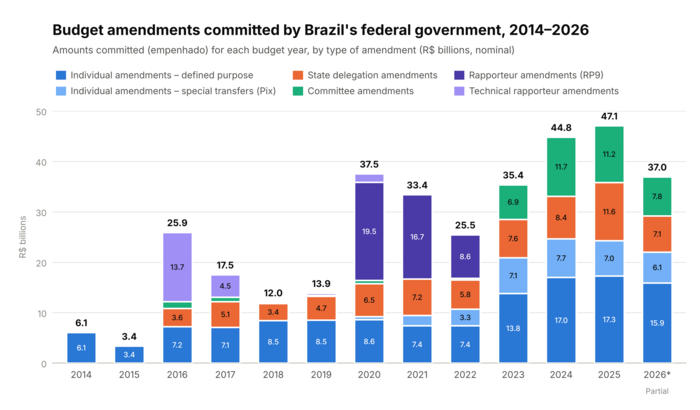
Budget amendments committed by type, 2014—2026. Source: Central das Emendas, adapted. Painel de Dados accessed on October 7, 2026; it draws on Portal da Transparência (CGU) amendment and expenditure-document data.
The Executive's consent, then under Bolsonaro's leadership, to this surrender of control over the federal budget gave Congress a power never foreseen in the balance designed in 1988 and transformed the country's political dynamics. Congressional blocs lost interest in joining the governing coalition and began to prioritize influence within Congress itself, where they could access large sums of money without transparency or Executive mediation.
Greater control over the budget, however, does not fully account for the Legislature's growing power: a recent report by the Fernando Henrique Cardoso Foundation shows that Congress has been gaining ground on the Executive for two decades, helped by a 2001 reform that limited the president's power to rule by decree, stronger in-house technical staff, and informal practices that concentrated power in the Speaker's hands.
Together, these developments entrenched a new balance of forces among the branches of government. By the time Lula da Silva returned to power in 2023, the Executive was far more dependent on the Legislature to manage the federal budget and advance its agenda.
The Judiciary: From Bulwark of Democracy to Target of Distrust
During Jair Bolsonaro's administration, the Judiciary played a central role in containing setbacks, as the Executive and Legislative branches advanced agendas flagrantly at odds with the 1988 Constitution. This expanded role is consistent with the concept of militant democracy coined by Karl Loewenstein in 1937, in which an institutional mechanism of the State is activated to defend the democratic order against actors who use their democratic freedoms to destroy the system itself.
This activation, however, took place without the involvement of the Office of the Prosecutor General of the Republic (Procuradoria-Geral da República, PGR), the body legally empowered to bring criminal proceedings against authorities entitled to special jurisdiction (foro privilegiado), including the President of the Republic. For most of Bolsonaro's term, the Prosecutor General was Augusto Aras, a prosecutor hand-picked by the President whose tenure was marked by inaction in the face of measures taken by the Federal Government and the Legislature. It fell to civil society and other key sectors of the country to use strategic litigation to activate this cordon sanitaire, spearheaded by the Federal Supreme Court (STF). As a result, the serious erosion of economic, social, cultural, environmental, and political rights slowed during that period.
In response to the Judiciary's more forceful actions, the Bolsonaro government and its base launched serious attacks against the Supreme Court and its justices, opening a new phase in which one political camp openly questions the integrity of the Judiciary and has even gone as far as persecuting specific justices. In 2021 alone, Bolsonaro called Justice Luís Roberto Barroso, then head of the Superior Electoral Court, "an imbecile" for opposing printed ballots, and asked the Senate to impeach Justice Alexandre de Moraes.
Tensions between the former president's political camp and the Judiciary reached new heights in the 2022 elections and the subsequent coup attempt, which culminated in the storming of the buildings that house the three branches of government, a Brazilian echo of January 6. The decisive actions of the Superior Electoral Court and the Supreme Federal Court were central to preventing a breakdown of the institutional order, ensuring both the security of an election directly affected by the sitting government and the legal accountability of those involved in the coup attempt.
What had been the main barrier against the crises up to that point came to face public distrust and became the target of a new weapon of the far right: the threat of impeachment of Supreme Court justices by the Senate, which holds this constitutional prerogative, provided that a conviction is approved by two-thirds of its members.
If the far right's accusations against the Supreme Court found no basis in fact when it came to defending the elections and holding accountable those who committed crimes against democracy, a massive corruption scandal would complicate that picture. In 2025, Brazilians learned of the case of Banco Master, a financial institution used to sell unbacked bank securities and associated with the diversion of billions in public funds from various sources, as well as with suspicious ties to people across all branches of government, including Supreme Court justices. One of the names mentioned in the investigation is that of Alexandre de Moraes, the very justice who presided over the Superior Electoral Court in the 2022 elections and led the cases on crimes against the rule of law after the coup attempt. Although he is commonly associated with President Lula, Moraes was appointed years earlier by then-President Michel Temer. Reporting on the investigation has also named five other justices or their relatives: Dias Toffoli, who stepped down as rapporteur of the Banco Master case in February; André Mendonça; Gilmar Mendes; Kassio Nunes Marques; and Luiz Fux. All deny wrongdoing.
This leaves Brazilians with a dilemma: how could the Judiciary's correct actions to protect democracy in 2022 and 2023 have been carried out by the same Court whose members now face scrutiny over alleged ties with private actors responsible for diverting billions of reais from taxpayers?
2026: The Perfect Storm and the Voters' Response
Brazil entered 2026 amid a perfect storm: a Legislature with sweeping powers over the federal budget, a weakened Executive, a Judiciary exposed in its contradictions, and a population exhausted by a war of narratives fueled by disinformation and the intensive use of technology to amplify it. This scenario is further exacerbated by the immense power concentrated in Big Tech companies, whose practices remain marked by a lack of transparency regarding content moderation criteria and the algorithmic choices that shape public debate. Amid this environment of fragmentation, echo chambers, distrust, and constant conflict, there is increasingly little room to discuss visions for the country's future, build minimum consensus, or collectively imagine ways out of the crisis.
A concrete example of the breakdown in the balance between the branches was the Senate's rejection of the President's nominee to the Supreme Federal Court in April of this year, something that had not happened since 1894. Brazil is showing clear signs that the 1988 pact is unraveling, and the winners of the 2026 elections will determine what comes next.
With the October 4 results, voters consolidated the far right as the largest force in both the Chamber of Deputies and the Senate. Threats to impeach Supreme Court justices are becoming more concrete, and the next president will have the power to appoint four justices to the Court: the seat left by Luís Roberto Barroso's retirement, still unfilled, and three more that will open as justices reach the mandatory retirement age of 75.
At a time when Supreme Court justices have increasingly been chosen for their political affinity with the president, a potential Flávio Bolsonaro administration, combined with a large extremist base in the Senate, could consolidate a solid conservative majority on the country's highest court.
October 25 and the Day After
President Luiz Inácio Lula da Silva and Senator Flávio Bolsonaro will face each other in the runoff on October 25. If the far-right candidate prevails, the balance between the branches designed in 1988 is unlikely to survive, as threats to change the constitutional text begin to take public form. If Lula's democratic project wins, the fractures in our democracy will still run so deep that there is no guarantee this order will endure either.
The choice on the 25th is not a difficult one. The hard part begins on the 26th: finding a path that keeps one of the world's most pioneering democratic experiments from collapsing.
This path begins by taking seriously the discontent that the first round laid bare. Some of Brazilians' distrust of their institutions has been deliberately manufactured, as demonstrated by a decade-long campaign of attacks on the electoral system. But some of it is also rooted in the country's concrete realities. We are a profoundly unequal society, shaped by social relations forged through nearly four centuries of slavery and, consequently, by persistent structures of authoritarianism, violence, and concentrations of power rooted in class, race, gender, and hetero-cisnormativity. Added to this are institutions that still lack transparency, a Congress that has come to control a growing share of the federal budget through mechanisms frequently questioned for their opacity, and successive corruption cases involving different branches and levels of the state — institutional weaknesses that recent scandals, such as the Banco Master case, have once again brought to the center of public debate.
The far right did not create this frustration, but it skillfully tapped into the resentments that underpin our social relations and our relationship with institutions, learning how to channel them and turn them into political force. And the 33 million Brazilians who did not go to the polls on October 4, along with the nearly 6 million blank and invalid ballots — a figure that is higher than the population of many US states — remind us that disillusionment can also take the form of silence or a protest vote.
Our institutions are not immune to criticism, and defending democracy cannot mean defending them as they are, with all their shortcomings, failures, and contradictions. No government, and no one who leads it, can find that path alone. Rebuilding the balance struck in 1988 will depend on institutions capable of earning back the trust they have lost, and on a society willing to continue contesting how these institutions and public policies are shaped, as well as defending the rules of the game, even when they do not favor its side.
Natália Neris is the Advocacy Manager at Pacto pela Democracia, and holds a PhD in Human Rights from the University of São Paulo. Sami Sternberg is the International Affairs Coordinator at Pacto pela Democracia, and holds a master's degree in international affairs from Columbia University.


