Authors
News Type
Commentary
Date
Paragraphs

On Sunday, October 4, 125 million Brazilians went to the polls to say what future they envision for their country. Their votes renewed state legislatures, the Chamber of Deputies, and two-thirds of the Federal Senate; elected governors in several states; and sent the presidential race to a runoff. Senator Flávio Bolsonaro, the son of former President Jair Bolsonaro, finished first, with 47% of the valid votes to President Lula's 45%, a result that defied polls showing the incumbent ahead. Another 33 million voters stayed home, the highest abstention rate since 1998.

The picture that emerges is one of deep dissatisfaction with the current state of democracy, and of a country turning to the far right. Given the new makeup of Congress — in which the far right and its closest allies will occupy over half of the seats in both chambers — the profound crisis surrounding the Supreme Federal Court, and the risk of an anti-democratic government rising to power, Brazil has never been so close to shattering the democratic pact enshrined in its 1988 Constitution.

To international observers, Brazilian voters' sense that their democracy is not doing well may seem counterintuitive. After all, over the past four years, many have pointed to Brazil as an example of democratic resilience — a reputation largely tied to holding accountable those who attempted a coup in January 2023 and to the country's return to its diplomatic tradition. But Brazilian democracy goes far beyond what happened in 2023, and we need to take a step back to grasp the size of the challenge ahead.

The Citizen Constitution


The 1988 Constitution established a legal framework characterized by broad guarantees of universal rights and an unprecedented opening for civil society participation in shaping the country's institutions. During the constituent process, around 10,000 people circulated through the National Congress each day, about 9 million visited Congress over the course of the proceedings, and 122 popular amendments were submitted, gathering more than 12 million signatures. But the Constitution did more than expand rights and channels for participation: it also laid the foundations for a balance among the three branches of government — the Executive, the Legislature, and the Judiciary — by distributing powers, establishing mechanisms of mutual oversight, and seeking to prevent the concentration of power.

The arrangement that emerged from this design became known as “coalition presidentialism,” a term coined by political scientist Sérgio Abranches. Under this model, the federal Executive plays a strong role in controlling the budget but depends on a multiparty coalition to carry out its agenda for the country. Since it is virtually impossible for a single party to win a majority on its own in either chamber, coalitions are needed to build majorities in Congress capable of passing the elected government's agenda. The Judiciary, for its part, historically acted to resolve constitutional questions that the other two branches had left unsettled.

The Scales Begin to Tip: Electoral Challenges and the Rise of Congress


This balance began to crack in earnest in 2014. For the first time since Brazil's return to democracy, the losing presidential candidate cast doubt on the integrity of the electoral system, which until then had been a source of national pride. This serious precedent left its mark on our democracy and paved the way for anti-democratic narratives that have since grown ever more sophisticated.

Shortly afterward, the historic rupture between then-Speaker of the Chamber of Deputies Eduardo Cunha and President Dilma Rousseff led to the opening of impeachment proceedings over alleged “crimes of responsibility,” Brazil's equivalent of impeachable offenses, tied to fiscal practices that, on closer inspection, had precedents in previous administrations without ever having triggered a process of this kind. In this sense, Rousseff's impeachment differs from the one faced by former President Fernando Collor de Mello in 1992, which uncovered a corruption scheme that paid for the president's personal expenses.

In other words, the practice itself was not the reason for the process; it was the political discontent of part of the governing coalition that decided, for the first time, to punish a fiscal practice until then widely accepted across the political class. The revolt of part of Rousseff's base in Congress did not merely remove her from office: it opened an era of open confrontation between the Legislature and the Executive, with the acquiescence, at the time, of the Judiciary, in what came to be described as a “grand national agreement.”

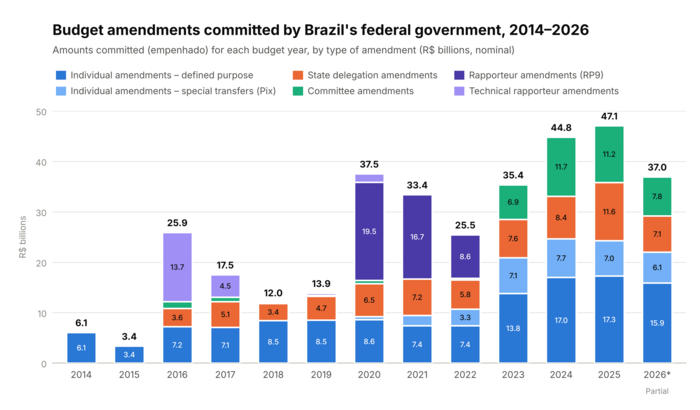
That period left another important legacy of imbalance between the branches. In 2015, Congress passed a constitutional amendment requiring the Executive to fund individual budget amendments. Budget amendments are instruments that allow deputies and senators to change the annual budget law, directing public funds to public works, projects, and improvements in the states and municipalities they represent, much like what Americans know as earmarks. They are classified by who proposes them. Individual amendments come from each legislator. State delegation amendments come from the lawmakers of each state acting together. Committee amendments come from the standing committees of Congress. Rapporteur amendments come from the general rapporteur, the legislator in charge of the budget bill. The 2015 requirement, known as the “mandatory budget,” applied only to individual amendments, capped at 1.2% of the federal government's net current revenue.

With Jair Bolsonaro's rise to power, this imbalance took on a new dimension. In 2019, two new constitutional amendments deepened the trend. The first made funding for amendments from state congressional delegations mandatory as well. The second split individual amendments in two. Amendments with a defined purpose remained tied to a specific project, such as a health clinic or a paved road. The new “special transfers,” nicknamed “Pix amendments” after Brazil's instant payment system, allow money to flow from Congress directly to states and municipalities without clear transparency mechanisms.

Rapporteur amendments changed even more. Until then, the general rapporteur had used them mostly for technical adjustments to the bill, often to restore funding for the Executive's own programs. In 2020, they received their own budget code, RP9, and became the core of the so-called “secret budget”: billions of reais distributed at the request of lawmakers whose names were not disclosed. After the Supreme Court struck down the practice in December 2022, Congress raised the cap on individual amendments to 2% of net current revenue. It also turned to committee amendments, which, until then, had carried little weight, as the new channel for these funds.


Image
Budget amendments committed by type, 2014—2026. Source: Central das Emendas, adapted. Painel de Dados accessed on October 7, 2026; it draws on Portal da Transparência (CGU) amendment and expenditure-document data.


Budget amendments committed by type, 2014—2026. Source: Central das Emendas, adapted. Painel de Dados accessed on October 7, 2026; it draws on Portal da Transparência (CGU) amendment and expenditure-document data.


The Executive's consent, then under Bolsonaro's leadership, to this surrender of control over the federal budget gave Congress a power never foreseen in the balance designed in 1988 and transformed the country's political dynamics. Congressional blocs lost interest in joining the governing coalition and began to prioritize influence within Congress itself, where they could access large sums of money without transparency or Executive mediation.

Greater control over the budget, however, does not fully account for the Legislature's growing power: a recent report by the Fernando Henrique Cardoso Foundation shows that Congress has been gaining ground on the Executive for two decades, helped by a 2001 reform that limited the president's power to rule by decree, stronger in-house technical staff, and informal practices that concentrated power in the Speaker's hands.

Together, these developments entrenched a new balance of forces among the branches of government. By the time Lula da Silva returned to power in 2023, the Executive was far more dependent on the Legislature to manage the federal budget and advance its agenda.

The Judiciary: From Bulwark of Democracy to Target of Distrust


During Jair Bolsonaro's administration, the Judiciary played a central role in containing setbacks, as the Executive and Legislative branches advanced agendas flagrantly at odds with the 1988 Constitution. This expanded role is consistent with the concept of militant democracy coined by Karl Loewenstein in 1937, in which an institutional mechanism of the State is activated to defend the democratic order against actors who use their democratic freedoms to destroy the system itself.

This activation, however, took place without the involvement of the Office of the Prosecutor General of the Republic (Procuradoria-Geral da República, PGR), the body legally empowered to bring criminal proceedings against authorities entitled to special jurisdiction (foro privilegiado), including the President of the Republic. For most of Bolsonaro's term, the Prosecutor General was Augusto Aras, a prosecutor hand-picked by the President whose tenure was marked by inaction in the face of measures taken by the Federal Government and the Legislature. It fell to civil society and other key sectors of the country to use strategic litigation to activate this cordon sanitaire, spearheaded by the Federal Supreme Court (STF). As a result, the serious erosion of economic, social, cultural, environmental, and political rights slowed during that period.

In response to the Judiciary's more forceful actions, the Bolsonaro government and its base launched serious attacks against the Supreme Court and its justices, opening a new phase in which one political camp openly questions the integrity of the Judiciary and has even gone as far as persecuting specific justices. In 2021 alone, Bolsonaro called Justice Luís Roberto Barroso, then head of the Superior Electoral Court, "an imbecile" for opposing printed ballots, and asked the Senate to impeach Justice Alexandre de Moraes.

Tensions between the former president's political camp and the Judiciary reached new heights in the 2022 elections and the subsequent coup attempt, which culminated in the storming of the buildings that house the three branches of government, a Brazilian echo of January 6. The decisive actions of the Superior Electoral Court and the Supreme Federal Court were central to preventing a breakdown of the institutional order, ensuring both the security of an election directly affected by the sitting government and the legal accountability of those involved in the coup attempt.

What had been the main barrier against the crises up to that point came to face public distrust and became the target of a new weapon of the far right: the threat of impeachment of Supreme Court justices by the Senate, which holds this constitutional prerogative, provided that a conviction is approved by two-thirds of its members.

If the far right's accusations against the Supreme Court found no basis in fact when it came to defending the elections and holding accountable those who committed crimes against democracy, a massive corruption scandal would complicate that picture. In 2025, Brazilians learned of the case of Banco Master, a financial institution used to sell unbacked bank securities and associated with the diversion of billions in public funds from various sources, as well as with suspicious ties to people across all branches of government, including Supreme Court justices. One of the names mentioned in the investigation is that of Alexandre de Moraes, the very justice who presided over the Superior Electoral Court in the 2022 elections and led the cases on crimes against the rule of law after the coup attempt. Although he is commonly associated with President Lula, Moraes was appointed years earlier by then-President Michel Temer. Reporting on the investigation has also named five other justices or their relatives: Dias Toffoli, who stepped down as rapporteur of the Banco Master case in February; André Mendonça; Gilmar Mendes; Kassio Nunes Marques; and Luiz Fux. All deny wrongdoing.

This leaves Brazilians with a dilemma: how could the Judiciary's correct actions to protect democracy in 2022 and 2023 have been carried out by the same Court whose members now face scrutiny over alleged ties with private actors responsible for diverting billions of reais from taxpayers?

2026: The Perfect Storm and the Voters' Response


Brazil entered 2026 amid a perfect storm: a Legislature with sweeping powers over the federal budget, a weakened Executive, a Judiciary exposed in its contradictions, and a population exhausted by a war of narratives fueled by disinformation and the intensive use of technology to amplify it. This scenario is further exacerbated by the immense power concentrated in Big Tech companies, whose practices remain marked by a lack of transparency regarding content moderation criteria and the algorithmic choices that shape public debate. Amid this environment of fragmentation, echo chambers, distrust, and constant conflict, there is increasingly little room to discuss visions for the country's future, build minimum consensus, or collectively imagine ways out of the crisis.

A concrete example of the breakdown in the balance between the branches was the Senate's rejection of the President's nominee to the Supreme Federal Court in April of this year, something that had not happened since 1894. Brazil is showing clear signs that the 1988 pact is unraveling, and the winners of the 2026 elections will determine what comes next.

With the October 4 results, voters consolidated the far right as the largest force in both the Chamber of Deputies and the Senate. Threats to impeach Supreme Court justices are becoming more concrete, and the next president will have the power to appoint four justices to the Court: the seat left by Luís Roberto Barroso's retirement, still unfilled, and three more that will open as justices reach the mandatory retirement age of 75.

At a time when Supreme Court justices have increasingly been chosen for their political affinity with the president, a potential Flávio Bolsonaro administration, combined with a large extremist base in the Senate, could consolidate a solid conservative majority on the country's highest court.

October 25 and the Day After


President Luiz Inácio Lula da Silva and Senator Flávio Bolsonaro will face each other in the runoff on October 25. If the far-right candidate prevails, the balance between the branches designed in 1988 is unlikely to survive, as threats to change the constitutional text begin to take public form. If Lula's democratic project wins, the fractures in our democracy will still run so deep that there is no guarantee this order will endure either.

The choice on the 25th is not a difficult one. The hard part begins on the 26th: finding a path that keeps one of the world's most pioneering democratic experiments from collapsing.

This path begins by taking seriously the discontent that the first round laid bare. Some of Brazilians' distrust of their institutions has been deliberately manufactured, as demonstrated by a decade-long campaign of attacks on the electoral system. But some of it is also rooted in the country's concrete realities. We are a profoundly unequal society, shaped by social relations forged through nearly four centuries of slavery and, consequently, by persistent structures of authoritarianism, violence, and concentrations of power rooted in class, race, gender, and hetero-cisnormativity. Added to this are institutions that still lack transparency, a Congress that has come to control a growing share of the federal budget through mechanisms frequently questioned for their opacity, and successive corruption cases involving different branches and levels of the state — institutional weaknesses that recent scandals, such as the Banco Master case, have once again brought to the center of public debate.

The far right did not create this frustration, but it skillfully tapped into the resentments that underpin our social relations and our relationship with institutions, learning how to channel them and turn them into political force. And the 33 million Brazilians who did not go to the polls on October 4, along with the nearly 6 million blank and invalid ballots — a figure that is higher than the population of many US states — remind us that disillusionment can also take the form of silence or a protest vote.

Our institutions are not immune to criticism, and defending democracy cannot mean defending them as they are, with all their shortcomings, failures, and contradictions. No government, and no one who leads it, can find that path alone. Rebuilding the balance struck in 1988 will depend on institutions capable of earning back the trust they have lost, and on a society willing to continue contesting how these institutions and public policies are shaped, as well as defending the rules of the game, even when they do not favor its side.

Natália Neris is the Advocacy Manager at Pacto pela Democracia, and holds a PhD in Human Rights from the University of São Paulo. Sami Sternberg is the International Affairs Coordinator at Pacto pela Democracia, and holds a master's degree in international affairs from Columbia University.

Read More

A man in a Colombian football jersey casts his vote in the presidential election on May 31, 2026, in Bogotá, Colombia.
News

What a DAL Panel Got Right About Colombia's Election — and What It Didn't See Coming

Convened one day after the first round, four scholars forecast a referendum on Petro's presidency and a system running out of patience. The vote that followed was far closer than their models predicted.
What a DAL Panel Got Right About Colombia's Election — and What It Didn't See Coming
Beatriz Magaloni interviews a voter on April 12, election day, at a polling station in the province of Anta, Cusco. Several interviews were conducted that same day inside and outside polling stations in this southern Andean region.
Blogs

Colonialism, Extractivism, and Institutional Fragility Shaped the Elections in Peru

A Democracy Action Lab fieldwork mission to Lima and Cusco around Peru's first-round 2026 election finds a democracy whose deepest fractures predate the ballot.
Colonialism, Extractivism, and Institutional Fragility Shaped the Elections in Peru
Illustration of diverse young activists emerging from a garage carrying books and a raised-fist flag, with a network of connected stars overhead, symbolizing the Democracy Garage.
News

Democracy Action Lab Launches First Cohort of the Democracy Garage

The first democracy accelerator of its kind in Latin America and the Caribbean.
Democracy Action Lab Launches First Cohort of the Democracy Garage
Hero Image
Property damage to the National Congress building, invaded January 8, 2023, by Bolsonaro supporters.
Property damage to the National Congress building, invaded on January 8, 2023, by Bolsonaro supporters. | Pedro França/Agência Senado
All News button
1
Subtitle

Natália Neris and Sami Sternberg, representatives of Pacto pela Democracia, an inaugural participant in DAL’s Democracy Garage, argue that whoever wins the October 25 runoff, Brazil’s democratic pact faces its gravest threat since the 1988 Constitution was enacted.

Image
Property damage to the National Congress building, invaded January 8, 2023, by Bolsonaro supporters.
Caption Property damage to the National Congress building, invaded on January 8, 2023, by Bolsonaro supporters. | Photo credit Pedro França/Agência Senado
Date Label
In Brief
  • In Brazil’s 2026 presidential election, Senator Flávio Bolsonaro edged out President Lula in the October 4 first round (47% to 45% of valid votes), sending the race to an October 25 runoff, while abstention reached its highest level since 1998. Natália Neris and Sami Sternberg of Pacto pela Democracia argue that, whoever wins, Brazil’s democratic pact faces its gravest threat since the 1988 Constitution.
  • The authors trace how the balance among the three branches has eroded since 2014: Congress has steadily expanded its control over the federal budget through mandatory and opaque amendments, weakening the Executive, while the Supreme Court, once a bulwark against democratic setbacks, now faces distrust amid the Banco Master corruption scandal.
  • With the far right set to hold over half the seats in both chambers and the next president positioned to appoint four Supreme Court justices, the authors warn that threats to the Court are becoming more concrete, and they call for institutions to earn back public trust and for a society that keeps contesting how they are shaped while defending the rules of the game.
Display Hero Image Wide (1320px)
Yes
Authors
News Type
News
Date
Paragraphs

Introduction and Contribution


Most authoritarian regimes hold elections where there is some possibility — albeit a small one — that the incumbent will be voted out of office. Autocrats have many tools at their disposal to guard against this possibility, from controlling the media narrative to exploiting public funds and outright election-rigging. A central question for pro-democracy actors is how autocrats can be challenged on such uneven playing fields. Some proposed remedies include forming opposition coalitions, strengthening local-level party organization, and boycotting elections.

Hungary has served as an important battleground for global pro-democracy efforts. After Viktor Orbán and his Fidesz party’s 2010 election victory, the country was gradually transformed into an electoral autocracy. Observers have pointed to Fidesz’s adeptness in gerrymandering electoral districts to its advantage, creating fake parties to overwhelm opponents, and leveraging media control to discredit its rivals. However, the Tisza Party, led by former Fidesz member Péter Magyar, won Hungary’s 2026 parliamentary elections. This raises two questions: How did Tisza achieve this, and what can democrats learn from it?

In “Civic Mobilization to Defend Electoral Integrity in Hungary,” Hanna Folsz argues that civil society organizations (CSOs) played a critical role in Tisza’s victory through efforts to combat Fidesz’s electoral manipulation. A broad-front campaign called DE Action Community exposed and countered Fidesz’s vote-buying and voter intimidation practices, which existing accounts of Hungary’s democratic decline and its reversal often underemphasize.

Hanna Folsz argues that civil society organizations (CSOs) played a critical role in Tisza’s victory through efforts to combat Fidesz’s electoral manipulation.

DE’s efforts included mapping vote-buying and voter-intimidation patterns in areas where voters were most likely to be manipulated, releasing a documentary on Fidesz’s practices that was viewed by millions of Hungarians, and dispatching thousands of observers to polling stations on election day. Preliminary evidence from statistical analyses of election results and on-the-ground reporting suggests that these interventions improved electoral competitiveness and reduced manipulation. Naturally, other factors played crucial roles in Tisza’s victory. Tisza ran an effective campaign, and Fidesz had been discredited by economic woes and corruption. Nevertheless, DE’s grassroots efforts appear to have been notably consequential.

Folsz’s argument is noteworthy in two ways: it underscores the significance of (1) nonstate actors in resisting democratic backsliding and (2) vote buying and voter intimidation as central elements in Fidesz’s authoritarian toolkit. Hungary’s recent experience suggests that grassroots organization — even in places where CSOs have been weakened and maligned — can help defeat long-tenured authoritarian parties. Because electoral autocrats remain vulnerable at the ballot box, interventions aimed at constraining manipulation should be central to global democracy promotion.

Fidesz’s Electoral Manipulation


It is commonly assumed that vote buying and voter intimidation were of marginal importance in explaining Fidesz’s dominance, compared with the institutional changes it made through parliamentary supermajorities. Yet these practices were arguably critical: journalists estimate that in previous elections, Fidesz gained between 200,000 and 300,000 votes by using its local networks to compel and coerce extremely marginalized voters. This quantity was decisive in a country where turnout reached about 6 million. Ethnic Roma communities, who often live in de facto segregation, were frequent targets.

The vote-buying and intimidation system worked through ‘patrons’ or local intermediaries — mayors, state employers, and informal brokers — to whom Fidesz elites in Budapest dispensed state resources. Intermediaries rewarded their ‘clients’ with cash, food, firewood, and even alcohol and drugs in exchange for votes. Exploited voters and their patrons did not interact in a one-off manner, but rather were connected in broader relationships of control and dependency. Indeed, Fidesz’s proxies often shaped locals’ access to state jobs, welfare, and medical care. In some cases, intermediaries threatened to call child protective services on noncompliant parents.

As is common in peripheral regions, formal democratic institutions such as secret ballots were not respected in targeted areas. Voters had their ballots photographed or would be followed into voting booths by intermediaries under the guise of assisting illiterate voters. Countering these practices was no small task for Hungarian CSOs, which the Fidesz government had harassed and targeted. 

The Campaign and its Outcome


The DE Action Community network brought together a range of individuals and groups in its campaign to expose and combat Fidesz’s electoral malpractice. This included legal organizations, data analysts, Roma activists, thousands of volunteers, and the Hungarian Civil Liberties Union. 

The campaign proceeded in several steps: First, DE spent months mapping out where vote buying operated and which communities were most vulnerable, as well as identifying intermediaries and their tactics. Second, it directed public attention to Fidesz’s authoritarianism by releasing the documentary Price of a Vote three weeks before the elections, which garnered over two million views. Third, DE communicated directly with brokers and informed them they would be monitored; even if state resources had already been dispensed, activists worked to prevent them from reaching voters, for example, by writing letters to mayors and speaking with intermediaries directly. DE also coordinated its efforts with Tisza.

On election day, DE deployed over 2400 trained observers to about 500 high-risk polling stations across 150 localities. The observers documented irregularities and deliberately avoided direct confrontation with state authorities and intermediaries. DE also built a centralized, real-time response system and reporting app, enabling rapid, targeted deployment of observers on motorbikes. 

Ultimately, areas targeted by DE’s campaign had lower Fidesz vote shares than in previous years and in comparable areas. Turnout was lower, consistent with reduced voter coercion. There were also fewer sharp spikes in turnout, which are associated with busing clients en masse to polls at specific times. DE’s campaign not only improved the quality of elections on Hungary’s periphery but also strengthened anti-Fidesz sentiment across the country. The Hungary case suggests that defending electoral integrity can be as important as campaigning against autocrats.

*Brief prepared by Adam Fefer.

Hero Image
Hungarian forint with ballot box in foreground
All News button
1
Subtitle

CDDRL Research-in-Brief [4-minute read]

Image
Hungarian forint with ballot box in foreground
Date Label
Display Hero Image Wide (1320px)
No
Authors
Héctor Fuentes
News Type
News
Date
Paragraphs

Less than 24 hours after Colombians cast their first-round ballots in the presidential election, CDDRL’s Democracy Action Lab (DAL) convened four scholars for a webinar launching its new series, “Democracy at the Ballot Box: The 2026 Electoral Cycle in Latin America.” Alberto Díaz-Cayeros, DAL's co-director, moderated a conversation with Michael Weintraub (Universidad de los Andes, director of CESED, the Center for the Study of Security and Drugs), Javier Mejía Cubillos (Stanford University, Department of Political Science and the Stanford Civics Initiative), Oliver Kaplan (University of Denver's Korbel School, 2025-26 Visiting Scholar at CDDRL), and María Ignacia Curiel (Stanford University, research scholar at CDDRL and research manager of DAL).

The election results were jarring. Abelardo de la Espriella, an independent lawyer running hard on security, had taken 43.75 percent of the vote to Iván Cepeda's 40.90 percent — with Uribista Paloma Valencia a distant third at roughly 7 percent, and centrists Sergio Fajardo and Claudia López splitting another 5 percent between them. A runoff was set for June 21. The panel had one day to make sense of it.

The numbers and the map beneath them


Weintraub opened with data he had scraped that morning, and the maps told a story of a country voting almost exactly along the lines it already knew. Cepeda's support mapped with striking precision onto Gustavo Petro's 2022 coalition — he flipped essentially no municipality where the combined right-wing vote had exceeded Petro's four years earlier — while De la Espriella's strength traced the same geography as the “No” vote in Colombia's 2016 referendum on the FARC peace agreement. Turnout, oddly, had risen more in Petro's 2022 strongholds than in the right's, which Weintraub read less as good news for Cepeda than as a sign his coalition may already be close to its ceiling, with more untapped voters available to De la Espriella heading into the runoff. Modeling out several scenarios for how Valencia's, Fajardo's, and López's voters might split, most of his projections had De la Espriella winning comfortably — though, as he noted, Colombian elections have a way of moving in the three weeks between rounds.

What the numbers don't show


Mejía pushed back on two points he felt the quantitative read was missing. First, the Pacto Histórico's cohesion: a Colombian left with a long history of fragmentation had, remarkably, stayed unified behind a famously self-centered leader in Petro — though Mejía flagged early signs that some in the movement were quietly urging Cepeda to distance himself, a tension he expected to shape the run-up to the runoff and, potentially, Colombian politics well past this election cycle.

Second, and more pointedly, Mejía argued against reading De la Espriella as simply Colombia's version of an internationally franchised populism — Bukele, Milei, Trump — with the usual explanations about fear and security anxiety layered on top. There's some of that, he allowed. But he made the case that De la Espriella had tapped something more specifically Colombian: a cultural premium on hard work as the individual, personally-earned marker of social standing — a value Mejía argued Petrismo's more abstract, structural language about labor and capital simply doesn't speak to — paired with a live-and-let-live, self-reliant streak that runs across class lines. He pointed to a viral interview De la Espriella gave the streamer Westcol, where he defended a truck driver's right to carry a gun against highway robbers in strikingly plain, non-ideological terms, as the clearest illustration of a message landing well beyond the demographic most analysts assumed was his base.

A clean vote, an anxious moment


Kaplan drew on firsthand observation, having been in Colombia both eighteen months earlier and again just weeks before the vote, where he watched supporters of every camp convince themselves their candidate would win. He was careful to note the good news first: Colombia's electoral authority and EU observers both called the vote clean, turnout was strong, and — in a detail that made the local news cycle that morning — Colombian voters get paid time off work for each round they vote in. But the deeper story, in his read, was a political system whipsawed by unmet expectations since the 2016 peace deal, Petro's stalled “total peace” negotiations, and a personal, legal feud between Cepeda and former president Álvaro Uribe layered on top of an election that had become, in effect, a referendum on Petro himself. Cepeda's central problem, Kaplan argued, echoed Kamala Harris's in the 2024 U.S. election: tied to an unpopular incumbent's record without ever having been able to fully break from it. Whether he could move toward the center — a softer task against De la Espriella than it might have been against the more centrist Valencia — was, in Kaplan's view, the pivotal question of the next three weeks. He closed by naming the deeper worry running under both campaigns: real, if differently shaped, concerns about what either winner might do to Colombia's political institutions.

A regional pattern, and a geopolitical wildcard


Curiel widened the lens. She was careful not to flatten every recent right-populist surge in Latin America into a single story, but she argued it's hard to ignore a regional pattern all the same — strikingly similar candidates, rhetorical strategies, and now fraud allegations recurring across countries (Honduras, Peru, Bolivia among them) whose underlying security and political problems differ substantially. She suggested it might be worth studying today's crop of outsider-right figures the way scholars once studied the diffusion of Latin America's leftist movements in the 1960s and '70s — as a phenomenon with its own cross-border mechanics, not just parallel domestic stories.

On the United States, Curiel expected rhetorical engagement from the Trump administration — De la Espriella is an open admirer who had already met with Trump officials in Miami — but was skeptical it would prove decisive; Cepeda, by contrast, might govern more in the pragmatic, arm's-length mode of Mexico's Claudia Sheinbaum, building on the more accommodating turn Petro's own relationship with Washington had taken since earlier in the year. She also flagged a looming energy question neither candidate had addressed in any detail: an anticipated El Niño-driven drop in hydroelectric capacity, and the resulting scramble for imported natural gas — from the United States or, potentially, Venezuela — that whoever won would inherit almost immediately. And she pointed to a genuine irony in De la Espriella's biography: a right-wing candidate whose past legal work had tied him personally to a figure associated with the Maduro government, complicating any simple ideological reading of what a De la Espriella presidency would mean for Colombia–Venezuela relations.

Where the center went, and what comes next


The discussion that followed ranged widely: why Paloma Valencia's campaign collapsed after polling near 20 percent just weeks earlier (the panel's rough consensus: a hard right that structurally tends to outflank the establishment right across the region, compounded by a Petrista strategy that concentrated its fire on De la Espriella as the tougher runoff opponent, leaving Valencia to absorb collateral damage); whether Colombia's center had simply disappeared with the 2016 peace agreement; and how much weight to put on U.S. involvement or even World Cup-driven national sentiment as runoff wildcards. Nobody thought either would be decisive on its own.

Asked directly what a De la Espriella or a Cepeda presidency would mean for the health of Colombian democracy, Weintraub was candid about his concern — less because either candidate is uniquely dangerous, he said, than because Colombia's political system has grown exhausted, its 1991 constitutional settlement showing diminishing returns and a public “willing to experiment” after the unfulfilled promise of Petro's own presidency. Curiel and Kaplan both located genuine grounds for hope in the same place: an unusually fragmented political landscape, without a single unchallenged caudillo on either side, and courts and regulatory institutions that had — so far — held their independence through repeated stress tests. On violence specifically, the panel's closing predictions diverged by scenario. Under De la Espriella, Weintraub and Kaplan worried that a rupture in Petro's ongoing peace talks would trigger retaliatory violence, that a return to aerial coca fumigation would collide head-on with the Constitutional Court, and that elite or paramilitary backlash would follow if Cepeda had instead pursued land reform and a constituent assembly. Under Cepeda, the concern ran more toward armed groups continuing to exploit ceasefires and extortion economies, and toward the durability of institutional checks on a government still tied to Petro's unfinished agenda.

Díaz-Cayeros closed the session on a note that has stayed with the panel since: a viewer's comment in the chat had framed the choice as one between “the devil you know and the devil you don't.” Fair enough, he said — but democracy remains one of the few systems humanity has built that lets a society get rid of either devil, peacefully, and try again.

Postscript: what actually happened


Set against the news since, the panel's read holds up better in its worries than in its point estimates.

The margin was the first surprise. Weintraub's scenario modeling, built the morning after round one, had De la Espriella winning comfortably in most transfer scenarios. The actual runoff, held as scheduled on June 21, was instead a nail-biter: 49.66 percent to 48.70 percent, a gap of roughly 246,000 votes out of some 26 million cast — under one percentage point, and close enough that Cepeda initially declined to concede, contesting results from close to a quarter of polling stations before formally accepting the outcome on June 24 with a pledge to “exercise a democratic, vigilant and constructive opposition.” Election night itself brought clashes between protesters and police in Cali, an early sign of the social tension the panel had flagged as a risk under either outcome.

Weintraub's own post-election analysis, published the day of the runoff, put hard numbers behind the panel's “entrenched spatial blocks” thesis — and, in the process, revised one of the panel's own central premises. Only 26 of Colombia's more than eleven hundred municipalities changed which candidate won between the two rounds (14 flipping to De la Espriella, 12 to Cepeda), and nearly all of those flips came in places that were already razor-thin in round one. The country that voted for De la Espriella — Norte de Santander at 77 percent, Casanare at 69, Santander at 65, Antioquia at 64 — and the country that voted for Cepeda — Chocó and Vaupés both above 80 percent, Putumayo at 79, Nariño at 77, Cauca at 76 — barely overlapped at all. Bogotá told a version of the story Weintraub had flagged live on the panel, now with exact numbers: Cepeda carried the capital 52.5 percent to 45.4, a margin of about 302,000 votes, solid but well short of what Petro had won there in 2022, even as Cepeda gained ground in every other major city between rounds — up 8.7 points in Medellín, 8.2 in Cali, 8.0 in Cartagena, 7.1 in Barranquilla.

The more important correction concerns the “pivotal center” the panel spent so much of its discussion on the day after round one — the roughly 2.8 million voters who had backed Valencia, Fajardo, and López. Weintraub's later numbers show both campaigns' gains between rounds exceeded that entire pool on their own: De la Espriella added nearly 2.6 million votes beyond his first-round total, more than Valencia's whole first-round universe by itself, while Cepeda added over 3 million, more than the combined Fajardo-López vote. The runoff, in other words, wasn't decided mainly by which side won over centrist defectors but by each campaign's ability to pull entirely new voters to the polls, a dynamic already visible in round one, when turnout had risen 2.25 million over 2022, disproportionately in Cepeda's Caribbean and Pacific strongholds. Between rounds, turnout climbed further, up 5.6 points to 63.5 percent (3.6 million more voters than the 2022 runoff), and Cepeda's operation mobilized more of them in absolute terms than De la Espriella's. It simply wasn't enough to close a gap that had already opened in round one. As Weintraub summarized: De la Espriella won a close, high-turnout election on the strength of an intact regional coalition plus modest gains in the center; Cepeda outgrew his first-round vote proportionally, but never closed the gap he faced.

Washington reacted exactly as Curiel expected, if more enthusiastically than her cautious framing implied: Trump declared on Truth Social that De la Espriella had “Won, BIG!,” and Secretary of State Marco Rubio called the president-elect to discuss regional security cooperation, immigration, and trade. Precisely, the rhetorical engagement Curiel predicted, delivered with more warmth than skepticism.

Despite initial post-election tensions, transfer of power went ahead on schedule, if uneasily. De la Espriella was sworn in on August 7, not in Bogotá, but in Cali, under an unprecedented security operation of some 11,000 troops and a drone ban, with Javier Milei and José Antonio Kast among the foreign leaders in attendance.

On policy, the new president has moved fast to confirm Weintraub's most specific fears. He has vowed to end the Petro government's peace negotiations with armed groups, resume aerial fumigation of coca crops (a practice suspended for more than a decade), and the exact flashpoint Weintraub predicted would trigger a “choque” with the Constitutional Court — and expand the military's role against criminal organizations, alongside new large-scale prison construction. Analysts are now warning, in terms that echo Weintraub and Kaplan's closing remarks almost exactly, that abandoning negotiations could backfire: an estimated 27,000 members of armed groups currently have no reintegration pathway if talks collapse entirely. On foreign policy, De la Espriella has aligned closely with the Trump administration, backing its military strikes on suspected drug vessels in the Caribbean, expediting extraditions, severing relations with Cuba, and restoring ties with Israel. 

Six weeks into the new administration, the question the panel closed on that afternoon has stopped being hypothetical and started being lived: can Colombia's institutions absorb what comes next? It's the story DAL's "Democracy at the Ballot Box" series intends to keep following.

Read More

Dr. Beatriz Magaloni (right) meets with members of the Afro-Descendant Farmers’ Association of María la Baja (ASOCAAFRO) in Colombia’s Caribbean region.
Blogs

Elections in the Shadow of Violence: Democratic Resilience in Colombia

Reflecting on a Democracy Action Lab fieldwork mission to Bogotá and the Caribbean coast in the run-up to Colombia's 2026 electoral cycle.
Elections in the Shadow of Violence: Democratic Resilience in Colombia
Beatriz Magaloni interviews a voter on April 12, election day, at a polling station in the province of Anta, Cusco. Several interviews were conducted that same day inside and outside polling stations in this southern Andean region.
Blogs

Colonialism, Extractivism, and Institutional Fragility Shaped the Elections in Peru

A Democracy Action Lab fieldwork mission to Lima and Cusco around Peru's first-round 2026 election finds a democracy whose deepest fractures predate the ballot.
Colonialism, Extractivism, and Institutional Fragility Shaped the Elections in Peru
man holds a portrait of nicolas maduro during a march
News

Venezuela After Maduro, Explained

A Democracy Action Lab panel weighed competing scenarios for Venezuela’s political future amid elite continuity, economic crisis, and international intervention.
Venezuela After Maduro, Explained
Hero Image
A man in a Colombian football jersey casts his vote in the presidential election on May 31, 2026, in Bogotá, Colombia.
A man in a Colombian football jersey casts his vote in the presidential election on May 31, 2026, in Bogotá, Colombia. | Leonardo Castañeda/Getty Images
All News button
1
Subtitle

Convened one day after the first round, four scholars forecast a referendum on Petro's presidency and a system running out of patience. The vote that followed was far closer than their models predicted.

Image
A man in a Colombian football jersey casts his vote in the presidential election on May 31, 2026, in Bogotá, Colombia.
Caption A man in a Colombian football jersey casts his vote in the presidential election on May 31, 2026, in Bogotá, Colombia. | Photo credit Leonardo Castañeda/Getty Images
Aria Label
Read More What a DAL Panel Got Right About Colombia's Election
Date Label
In Brief
  • One day after Colombia's first-round vote, four scholars from CDDRL's Democracy Action Lab and partner institutions analyzed the results and projected a comfortable win for Abelardo de la Espriella.
  • Their broader diagnosis — that Colombia's political system was showing diminishing returns after years of unmet expectations — held up better than their projected margin, as the runoff was decided by under one percentage point.
  • Since taking office, the new administration has ended peace talks and resumed coca fumigation, triggering a clash with the Constitutional Court that one panelist had specifically predicted.
Display Hero Image Wide (1320px)
Yes
Authors
Noa Ronkin
News Type
News
Date
Paragraphs

In May 2023, Thai pro-democracy reformer and lawmaker Pita Limjaroenrat led Thailand’s Move Forward Party to a stunning victory in the general election on a platform of progressive change. The party won a clear mandate from over 14 million voters, but conservative powers and military-appointed senators blocked Pita’s path to the prime ministership. Fifteen months later, Thailand’s Constitutional Court dissolved the Move Forward Party – the same fate its predecessor, the Future Forward Party, met in 2020. The court also barred Pita from politics for a decade.

It is a story he recounts in his political memoir, The Almost Prime Minister, and one he discussed at a February 2025 fireside chat hosted by APARC’s Southeast Asia Program. In his current role as a Senior Democracy Fellow back at his alma mater, the Harvard Kennedy School, Pita continues to champion transparent and equitable governance, coaches a new generation of political leaders, and strategizes a democratic path forward for Thailand. 

On May 29, 2026, Pita returned to Stanford for a follow-up discussion with APARC Director Kiyoteru Tsutsui, who also serves as co-director of the Southeast Asia Program. Pita examined political developments in Thailand since the contentious 2023 election, the tensions between Thailand and Cambodia, the crisis in Myanmar, ASEAN’s role in the region, and how Thailand and other middle powers should hedge their bets amid the U.S.-China competition and a fragmenting world order. 


Get APARC event invites and guest speakers’ insights delivered to your inbox >


Autocrats want to make sure that politics is dramatized, boring, or irrelevant. And you guys get tired when you talk about politics. And that's what we call 'voter fatigue by design.'
Pita Limjaroenrat

Anatomy of a Defeat


Pita’s opening remarks focused on the outcome of Thailand’s recent general election, in which the People’s Party – the successor to the dissolved Move Forward Party – suffered a decisive defeat. Entering the February 8, 2026, election, the People’s Party had hoped to convert widespread calls for democratic reform into power. Instead, the conservative Bhumjaithai Party secured a clear victory and then joined forces with the third-place populist Pheu Thai Party to form a coalition government.

Pita, who had campaigned for the People’s Party ahead of the election – a political activity he remains eligible to undertake despite being barred from seeking office – offered a candid assessment of the party’s loss.

Lower voter turnout was a key determinant of the February 8 election results, he argued: at 65 percent, it was sharply down from 76 percent in the 2023 general election that he won. Many voters came to believe that the costs of participating in the political process outweighed the potential benefits, Pita said.

That is the calculus of autocrats when they manipulate elections, he argued. Recognizing that electoral participation is the linchpin of a representative democracy's legitimacy and power, and that voter turnout of upward of 70 percent would all but guarantee a People Party victory, "they want to make sure that the cost of going to an election is higher than the benefit."

Pita pointed to his experience as evidence. Despite winning the 2023 election, Thai supporters now see him, three years later, living in Boston rather than governing from Bangkok. The message to voters, he said, is clear: If you keep voting and nothing changes, then why bother?

Pita calls this "voter fatigue by design" – a tactic used by autocrats to make politics seem “dramatized, boring, or irrelevant.”

He labels this Thai establishment's effort to convince voters that political participation is futile as “constituency.” It is one element in a “five C’s framework” that explains the People’s Party’s recent election defeat, he says.

A second factor, which he names “competitive collusion,” was evident in the decision by conservative candidates to coordinate their efforts – whether by merging campaigns or stepping aside – to avoid splitting the vote and present a unified front against the reformist People’s Party.

Third, conflict – by which Pita refers to the recent flare-up of tensions between Thailand and Cambodia – rallied nationalistic sentiment, lending greater legitimacy to the military and thus benefiting the conservative parties associated with it.

The fourth element, according to Pita, is Thailand’s Constitution, under which the Election Commission – the country’s sole election management body – is effectively appointed by the King on the recommendation of the Senate. “So I felt the [February 2026] election was not fair,” Pita said. “There was no linkage to the people, and there were no checks and balances.”

Finally, Pita pointed to the People Party's own missteps, which he categorizes as “candidacy.” He described a “Brahmin left versus merchant right” dynamic, arguing that the party became overly focused on technocratic, urban-centered policies and lost touch with the rural grassroots base that had been crucial to the Move Forward Party’s 2023 electoral success.

We have to aim for a durable peace between Thailand and Cambodia, and I think the only mechanism to do that is to return back to the JBC, the Joint Boundary Commission.
Pita Limjaroenrat

Regional Flashpoints: Cambodia and Myanmar


On the Thailand-Cambodia border dispute, Pita called for a renewed commitment to diplomacy, arguing that lasting peace can only be achieved through dialogue. He pointed to the Joint Boundary Commission, the bilateral body the two countries established in 1997 to oversee the demarcation of their border, as the most viable mechanism for resolving the dispute.

“If we return to the table and try to negotiate that out, I think that could be a path toward durable peace between Thailand and Cambodia.”

Turning to Myanmar, Pita stressed the need for Thailand and the Association of Southeast Asian Nations (ASEAN) to take a more active role in addressing the civil war that has devastated the country since the military coup of February 2021. The conflict’s spillover effects, he noted, extend well beyond Myanmar’s borders, fueling cyber scam operations, human trafficking, and illicit financial activity that directly affect Thailand.

“If the ASEAN core, especially Thailand, with its geographic proximity, doesn't do anything, it's going to keep going in a dangerous drift like that.” 

Pita noted, however, that the crisis in Myanmar has grown more complex in recent years. Beyond the struggle among ethnic armed groups and between the military and pro-democracy forces, it now encompasses resource politics as part of a broader competition over rare earths and China’s expanding strategic interests linked to trade corridors and energy infrastructure.

As China’s involvement in the region deepens through its trade routes and gas pipeline interests, the conflict in Myanmar has become much harder to resolve, he said.

As a way forward, Pita proposed a minilateral coalition comprising key ASEAN states, along with India, China, and possibly Japan and South Korea. The goal, he said, would be to work with Myanmar’s opposition forces to “turn resistance into governance” and lay the groundwork for a viable political transition toward a post-conflict Myanmar.

Once you choose sides, that's the end of everything that you have. So how do you think about neutrality? Not as a position, but as a capability.
Pita Limjaroenrat

The Middle Power Moment and U.S.-China Rivalry


Zooming out to the global stage, Pita spoke of his interest in the prospects of a "middle power moment" taking shape, citing Canadian Prime Minister Mark Carney’s recent diplomatic tour of the Indo-Pacific region to urge middle power nations, including India, Australia, and Japan, to unite in response to the U.S.-China great power rivalry and the transformation of U.S. foreign policy under the Trump administration.

“Thailand is still the second-largest country in ASEAN,” Pita said. “So we have agency and autonomy. Whether we use it or not, that is something that remains to be seen.”

“You realize that if you rely on the Americans for security and the Chinese for the economy, you are going to be forced to choose sides. And once you choose sides, that's the end of everything that you have.” He argued that, if nations are to avoid being forced to choose sides, they must redefine neutrality as an active capability rather than a passive position.

Here, too, he suggested, flexible, issue-based minilaterals could be beneficial. “So I think we'll see a rise of multilaterals on various issues, whether it's AI governance, semiconductors, maritime management, cybersecurity, or critical minerals.”

I think about it every single night, to return to the arena and become a player. But I can wait [...] And when I return, I will change Thailand for good.
Pita Limjaroenrat

From Player to Coach


Forced to the sidelines of Thai politics, Pita has embraced a new role. "My calling now is to groom next-gen leaders. I used to be a player, and I did a good job. And then they stopped me. They forced me to sit down. So I decided to become a coach instead.” At Harvard Kennedy School, he now co-teaches a class on running for public office in developing countries, turning his recent, raw experiences into a textbook for the next generation.

Despite the setbacks, Pita’s message remains one of resilience and determination. When asked if he could still win, he was unequivocal. "I think I can," he stated. “I think about it every single night, to return to the arena and become a player. But I can wait. I could strategize, I could accumulate small victories until I'm strong, vigorous, and capable. And when I return, I will change Thailand for good.”.

In His Own Words: Pita's Column in Matichon Weekly


Pita contributes a regular column to the Thai-language news magazine Matichon Weekly (มติชนสุดสัปดาห์), providing analysis on topics ranging from global economic shifts and international politics to urban development and his experiences engaging with leaders in politics, technology, business, and social activism. In his column of June 12, 2026, he reflects on his May 29 visit to Stanford and APARC.

Below is an English version of the column, generated by Google Translate. It has been mildly edited for accuracy and style.


Palo Alto Annual Event


I'm back at Stanford University and Palo Alto again, after visiting last year. I was so impressed that I've decided I'd like to visit every year if I can, not just because of the good weather and pleasant atmosphere, but because this place is a hub of knowledge, conversation, and unique perspectives on the world that are hard to find elsewhere.

I spent three days as a guest of APARC, or the Walter H. Shorenstein Asia-Pacific Research Center, Stanford University's Asia-Pacific research center, which is part of the Freeman Spogli Institute for International Studies (FSI), one of the world's most influential institutions in international relations and public policy, as well as the Hoover Institution, a public policy institute that brings together thinkers, historians, economists, and former policymakers from around the globe.

These three institutions set Stanford apart from typical universities, creating a space where the academic and policy worlds converge tangibly. The people you pass each day might be Larry Diamond, who has studied democratic transitions and declines for decades; Francis Fukuyama, author of The End of History and the Last Man; Gi-Wook Shin, an expert on East Asia; or Kiyoteru Tsutsui, who studies human rights issues. On the other side of the university is a collection of former top U.S. policymakers, from Condoleezza Rice to Michael McFaul, making conversations here both academic and practical. Importantly, the questions I'm asked at Stanford are always more difficult than anywhere else.

Many conversations this year have revolved around the same question: Is the world entering an era where geopolitics and technology are increasingly intertwined? While in the past, technology companies competed to create superior products, today they face geopolitical questions similar to those governments do. From restrictions on chip exports and access to rare earth minerals to energy security and the restructuring of international supply chains, the names Nvidia, TSMC, and ASML are frequently mentioned alongside those of major powers, as the ability to design, manufacture, and control advanced technology has become an integral part of state power.

In the world of AI, the question has changed significantly this year. At Stanford and Silicon Valley, I hear less talk about frontier models than I expected, but more and more talk about inference, compute, and energy. The excitement isn't about how well the next model will perform, but about who can get these models out of the lab and into real-world economic applications first.

On the other hand, competition is shifting from the digital world to the physical world. Waymo's self-driving cars are becoming commonplace on San Francisco streets, while Amazon's Zoox is beginning to enter the fray as a major player. The development of humanoid robots is also being discussed more seriously than ever before. Many believe that the next decade will be the time when AI begins to develop its own "arms and legs," no longer confined to computer screens.

As technology has advanced to this point, the conversation has once again turned to geopolitics. This includes issues such as controls on the export of advanced chips, competition to attract leading researchers, access to energy for hyperscale data centers, and concerns about the concentration of computing power in the hands of a few companies and countries. If in the 20th century, oil was the strategic resource of superpowers, many are beginning to see that in the 21st century, computing may be heading towards a similar status. The world is therefore not just witnessing a technological competition, but a new restructuring of power through technology.

Another thing I always try to do whenever I come to Stanford and Silicon Valley is to meet Thai students, researchers, entrepreneurs, and Thais working in the technology industry. Because, if you look closely, Thais are already a part of the global competitiveness we talk about.

Over the past two years, since being disqualified from politics, I have dedicated part of my time to traveling, meeting, and systematically building a database of Thai talent abroad. This includes scientists, engineers, economists, artificial intelligence researchers, and executives in global technology companies. This trip was no exception. I had the opportunity to meet Thais working at Google, Meta, Apple, Salesforce, Nvidia, OpenAI, and many other leading technology companies. Some work in semiconductors, some develop AI models, and some manage products with hundreds of millions of users worldwide. Many may not be well-known in Thailand, but they are part of the workforce driving the world's future economy today.

Every time I speak with this group of Thais, I leave feeling hopeful. Hopeful to see that Thais can stand at the forefront of industries that are shaping the future of the world, on par with anyone else. And hopeful that their knowledge, experience, and networks can connect and create even more value for Thailand in the future. I can only hope that one day I will have the opportunity to work with them for the future of our nation.

Read More

Kimberly Hoang and Kiyoteru Tsutsui seated in an office during a recorded podcast conversation.
News

Weaponized Corruption, Extreme Wealth, and Democratic Reordering: Insights from Asia

Speaking on the APARC Briefing video series, University of Chicago sociologist Kimberly Kay Hoang examines the architecture of global capital and how corruption discourse is transforming governance and political order in Asia and the United States.
Weaponized Corruption, Extreme Wealth, and Democratic Reordering: Insights from Asia
Portrait photo of Shibani Mahtan, winner of the 2026 Shorenstein Journalism Award.
News

Singapore-Based Investigative Journalist Shibani Mahtani Wins 2026 Shorenstein Journalism Award for Excellence in Asia-Pacific Coverage

Sponsored by Stanford University’s Shorenstein Asia-Pacific Research Center, the 25th annual Shorenstein Journalism Award honors Mahtani for her exemplary investigations into the erosion of democracy in Hong Kong and China's growing global influence.
Singapore-Based Investigative Journalist Shibani Mahtani Wins 2026 Shorenstein Journalism Award for Excellence in Asia-Pacific Coverage
Portrait photo of Gaea Morales.
Q&As

How Cities Are Rewriting Global Climate Governance

Political scientist Gaea Morales, APARC’s 2025-26 Shorenstein postdoctoral fellow on contemporary Asia, studies questions at the nexus of global policy and local action and how Southeast Asian megacities build climate resilience by drawing on local knowledge and global networks to drive change from the ground up, even in the absence of central government support.
How Cities Are Rewriting Global Climate Governance
Hero Image
All News button
1
Subtitle

Banned from political office but unbowed, the Thai pro-democracy leader revisited Stanford to analyze the recent electoral defeat of his progressive party, weigh in on regional tensions in Southeast Asia and Thailand’s geopolitical balancing act, and consider the prospects for the country’s future and his political comeback.

Image
Pita Limjaroenrat speaks at a fireside chat hosted by APARC's Southeast Asia Program.
Title
Pro-Democracy Leader Pita Limjaroenrat Strategizes a Path Forward for Thailand
Aria Label
Read More Pita Limjaroenrat Strategizes a Path Forward for Thailand
Date Label
Display Hero Image Wide (1320px)
Yes
Authors
Surina Naran
News Type
News
Date
Paragraphs

On Thursday, April 16, Daniel Kelemen (UC Merced) and CDDRL predoctoral fellow Hanna Folsz discussed the consequential outcome of the April 2026 Hungarian election: the victory of Peter Magyar’s Tisza Party over Viktor Orbán’s Fidesz Party in a Rethinking European Development and Security (REDS) seminar co-hosted by the Center on Democracy, Development and the Rule of Law and The Europe Center.

Daniel Kelemen opened the talk, first offering an overview of Viktor Orbán's rise to power. In 2010, Orbán won Hungary’s nationwide election with over two-thirds majority, a majority large enough to allow him to amend the constitution. Having suffered an electoral defeat in the past, Orbán worked to centralize his power. He captured referees — courts and independent bodies — seized control of the media, and demonized and undermined the opposition. Orbán effectively changed the rules of the game, tilting the electoral playing field. 

Kelemen states that there are cases in which smaller authoritarian groups within a larger system are tolerated or protected by national parties because they deliver votes. Orbán operated with the support of Angela Merkel, the former Chancellor of Germany, who largely stopped the EU from taking action against Orbán. Orbán’s party, the Fidesz Party, was a part of Merkel’s EU-wide party, the European People’s Party (EPP), a center-right, Christian party. This support, along with the emigration of dissatisfied voters and continued funding from the EU, helped Orbán stay in power. 

However, Orbán’s Fidesz Party was kicked out of the EPP in 2021. Merkel, who was a strong supporter of Orbán, left office in 2022. Orbán’s policy also became more extreme, raising more concern from European member states. In 2022, the EU Commission cut funding to Hungary, suspending 32 billion euros. Kelemen identifies this suspension of funds as an effective step against Hungary’s regime. 

Kelemen then outlined the implications of Orbán’s fall for Hungary, the EU, and international actors, including Russia and the United States. For Hungary, it means full regime change, as the Tisza Party will likely take efforts to undo Orbán’s autocratic policy changes. For the EU, it means that policy on Ukraine and Russia will be different, because Orbán was using his veto to prevent support for Ukraine and sanctions on Russia. For the US and Russia, Russia lost its supporter and ear in the EU, and the Trump administration lost its closest ally in Europe. On a global note, Orbán was a key figure in trying to bring together far-right populists. After he was kicked out of the EPP, he formed a more autocratic-focused party called MEGA (Make Europe Great Again). 

Daniel Keleman presented his research in a CDDRL seminar on April 16, 2026.
Daniel Keleman presented his research in a REDS seminar on April 16, 2026. | Emil Kamalov

Hanna Folsz then took a closer, domestic look at the Tisza Party and how they triumphed over Orbán. As Kelemen discussed, Orbán's new electoral rules strongly favored large parties with rural bases, the characteristics of the Fidesz party. The Fidesz Party also controlled the media and enjoyed advantages in party financing. However, the Tisza Party, led by Peter Magyar, dominated the 2026 election, despite the electoral system being stacked against opposition parties. 

Economic woes, corruption, and scandals surrounding Fidesz created broad voter discontent and set the stage for the Tisza Party’s victory. Tisza worked to create a broad coalition through extensive group-level campaigning, messaging that focused on competent economic governance and anti-corruption, and the idea of reclaiming patriotism. Magyar also extensively campaigned, holding rallies all over Hungary in localities of all sizes. The district candidates within the Tisza Party campaigned in a similar manner. 

The Tisza Party focused its policy proposals on extensive welfare, public services improvement, the elimination of corruption, strengthening relationships with the EU and neighbors, and largely avoided divisive topics. The Party also distanced itself from the discredited and divisive established opposition parties, and they did not coordinate with past opposition parties. 

Folsz outlined the lessons Hungary’s electoral outcome shows for democratic resistance against autocratization. The Hungarian case demonstrated the importance of connecting with voters and building credibility by campaigning a lot and across the country, including in rural constituencies. The Tisza Party also smartly presented a vision for a better future with concrete proposals, rooted in citizens’ core concerns– in this case, the economy and corruption, and distanced themselves from divisive opposition politicians and parties. The Tisza Party focused its messaging on unity and reclaiming patriotism from the far right.

Hanna Folsz presented her research in a REDS seminar on April 16, 2026.
Hanna Folsz presented her research in a REDS seminar on April 16, 2026. | Hesham Sallam

The 2026 Hungarian election offered a rare example of democratic recovery in a system widely considered entrenched, raising important lessons for opposition movements confronting democratic erosion.

Read More

Nate Persily presented his research in a CDDRL seminar on December 4, 2025.
News

Election Administration, 2024 to 2026: Lessons Learned and Causes for Concern

In a CDDRL research seminar, Nate Persily, the James B. McClatchy Professor of Law at Stanford Law School and Senior Fellow at the Freeman Spogli Institute, discussed revelations from the 2024 election and how the 2024 election can forecast the upcoming 2026 midterm election cycle.
Election Administration, 2024 to 2026: Lessons Learned and Causes for Concern
Clémence Tricaud presented her research in a CDDRL seminar on May 15, 2025.
News

Margins That Matter: Understanding the Changing Nature of U.S. Elections

In a CDDRL research seminar, Clémence Tricaud, Assistant Professor of Economics at the UCLA Anderson School of Management, shared her research on the evolving nature of electoral competition in the United States. She explored a question of growing political and public interest: Are U.S. elections truly getting closer—and if so, why does that matter?
Margins That Matter: Understanding the Changing Nature of U.S. Elections
Ali Çarkoğlu
News

Polarization, Cleavages, and Democratic Backsliding: Electoral Dynamics in Turkey (1990-2023)

Using data from the World Values Survey and Turkish Election Studies, CDDRL Visiting Scholar Ali Çarkoğlu explores the rise of the Justice and Development Party (AKP) and the enduring influence of cultural divides on Turkey’s political landscape.
Polarization, Cleavages, and Democratic Backsliding: Electoral Dynamics in Turkey (1990-2023)
Hero Image
Peter Magyar, lead candidate of the Tisza party, speaks to supporters after the Tisza party won the parliamentary elections on April 12, 2026 in Budapest, Hungary.
Peter Magyar, lead candidate of the Tisza party, speaks to supporters after the Tisza party won the parliamentary elections on April 12, 2026, in Budapest, Hungary. | Getty Images
All News button
1
Subtitle

Scholars Daniel Keleman and Hanna Folsz examine the defeat of Viktor Orbán’s Fidesz Party and the implications for Hungary and Europe.

Image
Peter Magyar, lead candidate of the Tisza party, speaks to supporters after the Tisza party won the parliamentary elections on April 12, 2026 in Budapest, Hungary.
Caption Peter Magyar, lead candidate of the Tisza party, speaks to supporters after the Tisza party won the parliamentary elections on April 12, 2026, in Budapest, Hungary. | Photo credit Getty Images
Title
Hungary’s 2026 Election Signals Democratic Shift
Aria Label
Read More Hungary’s 2026 Election Signals Democratic Shift
Date Label
In Brief
  • At a REDS Seminar hosted by the Center on Democracy, Development and the Rule of Law and The Europe Center seminar on April 16, 2026, Daniel Kelemen and Hanna Folsz discussed Hungary’s 2026 election and Viktor Orbán’s defeat by Peter Magyar’s Tisza Party.
  • They analyzed how Tisza overcame media control, electoral rules, and institutional advantages favoring Fidesz through broad-based campaigning.
  • The case highlights how opposition movements can challenge entrenched regimes and offers lessons for democratic recovery amid backsliding.
Display Hero Image Wide (1320px)
No
Authors
News Type
News
Date
Paragraphs

Introduction and Argument:


Many authoritarian countries hold elections where the incumbent might lose. The odds tend to be quite narrow, however, owing to the autocrat’s asymmetric control over economic resources, security forces, media, and so on. An important practical and theoretical question, then, is how the opposition can beat these narrow odds. 

Some scholars have argued that oppositions can defeat authoritarian incumbents by building broad, multiparty coalitions. Doing so should not only decrease the autocrat’s vote share but should also deter him from deploying state repression against the opposition’s supporters. Indeed, security forces will struggle or be hesitant to shoot at such large numbers of people, and doing so will likely attract international condemnation. All of this sounds intuitively plausible. 

In “When you come at the king,” Oren Samet shows how arguments for building big coalitions overlook a crucial possibility: If the opposition unites and performs well but still fails to defeat the autocrat, he may be “spooked” and react by doubling down on repression. This is because elections provide the government with information about its own and the opposition’s popularity. Too much opposition success further decreases the autocrat’s willingness to tolerate popular elections and freedoms. Therefore, the same strategy enabling oppositions to achieve a “stunning election” can — if the coalition fails to take power — lead to a “nearly stunning” election that further entrenches authoritarianism. Hence the paper’s title, a quote from The Wire’s Omar Little: when “you come at the king, you best not miss.” 

The paper provides both cross-national data and an in-depth case study of Cambodia to show how the logic of nearly stunning elections poses a serious dilemma for democracy promoters: When oppositions cannot defeat autocrats, then they must achieve a “sweet spot” of neither too many votes (which scares the incumbent into autocratizing) nor too few (which fails to threaten the incumbent and compel him to make democratic concessions). Yet deliberately planning to hit this sweet spot is simply not possible. Samet thus offers an important challenge to the claim that bigger is better in authoritarian elections.

Oren Samet shows how arguments for building big coalitions overlook a crucial possibility: If the opposition unites and performs well but still fails to defeat the autocrat, he may be “spooked” and react by doubling down on repression.

Cross-National Findings:


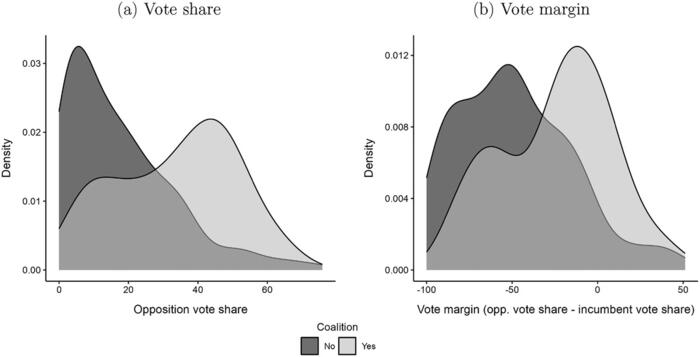
Samet’s argument about the pitfalls of nearly stunning elections implies three hypotheses. First, and as previous scholarship suggests, coalitions should outperform individual opposition parties in authoritarian elections. Second, absent the incumbent’s defeat, autocratization is more likely as the opposition’s vote share increases. And third, absent the incumbent’s defeat, countries with high-performing oppositions should witness (a) an increase in state repression and (b) decreases in the quality of elections in the years following a nearly stunning election. Samet then analyzes all elections from 1990 to 2022 in cases where the same authoritarian leader or party had ruled for at least 10 years. This yields 286 elections: 58 (20%) featured coalitions, and 28 (10%) featured electoral turnovers. These numbers alone paint a bleak picture of the prospects for beating dictators. 

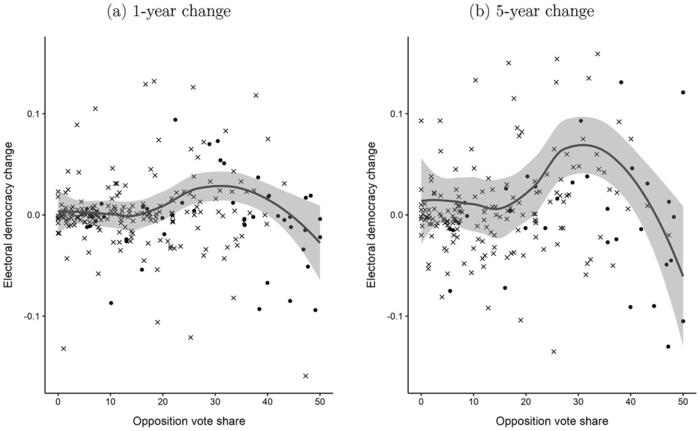
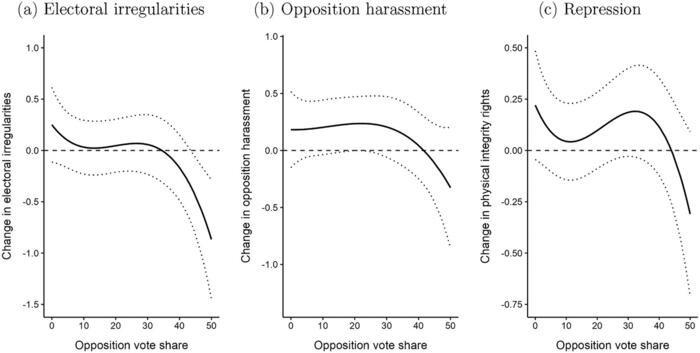
The statistical results broadly support Samet’s hypotheses. Coalitions do in fact perform better at the ballot box, winning a median vote share of 36% (compared to just 13% for individual parties). In addition, and consistent with the idea that hitting the “sweet spot” will encourage autocrats to make concessions, Samet finds a positive association between moderately strong opposition performance and democratic change. Importantly, however, levels of democracy decline sharply as the opposition vote share approaches 50%. Nearly stunning elections thus appear to provoke autocratization, both in the short- and medium-term. Finally, the relationship between nearly stunning elections and repression or electoral fraud is somewhat weaker. This may be because the autocrat has more than just these two tools at his disposal — he might limit the number of seats that can be contested in future elections, prevent the opposition from accessing state media, and so on.


Image
FIGURE 2: Opposition performance in authoritarian elections.


FIGURE 2: Opposition performance in authoritarian elections. Note: Density plots display the frequency of specific opposition (opp.) vote shares (left) and vote margins (right) broken down by coalition status.


Image
FIGURE 3: Opposition performance and electoral democracy change.


FIGURE 3: Opposition performance and electoral democracy change. Note: Displays elections that did not feature turnovers, plotted along two dimensions: opposition vote share and change in electoral democracy. ∙ (dot) denotes election with coalitions; × denotes election without. The gray lines plot LOESS regressions fit to the data, with gray shading indicating 95% confidence intervals.


Image
FIGURE 6: Predicted change in repression and electoral manipulation, with controls.


FIGURE 6: Predicted change in repression and electoral manipulation, with controls. Note: Displays predicted post-election changes in (1) V-Dem measure of electoral irregularities, comparing election at t with election at t + 1; (2) V-Dem measure of government intimidation of opposition, comparing election at t with election at t + 1; (3) Fariss (2014) physical integrity rights measure 3 years after election, using the lagged score as a baseline. Includes all elections that did not result in turnovers. Dotted lines indicate 95% confidence intervals.


The Cambodia Case:


Samet concludes by showing how his theoretical process — oppositions uniting, nearly winning an election, frightening the incumbent, then increasing authoritarianism — is borne out in Cambodia’s recent political history. Throughout the 2000s, Cambodia’s opposition was fragmented, in part due to deliberate actions by its authoritarian Prime Minister, Hun Sen. Ahead of the 2013 elections, in the face of mounting popular dissatisfaction with the government, the two largest opposition parties coalesced. Hun Sen was confident in his position, in part because Cambodia’s strongest opposition party had won just 22% of the vote in 2008. As such, he pardoned Sam Rainsy, one of the country’s most prominent opposition leaders, whom he invited to return from exile. 

The coalition did remarkably well in 2013, winning around 45% of the vote, but then alleged fraud and refused to take their seats in parliament. Opposition supporters then took to the streets in protest, where they were met with state violence. Yet Hun Sen made a number of concessions to successfully quell the protest crisis, including reforming the election commission.

By 2015, however, signs of autocratization became glaring. Opposition lawmakers were publicly beaten by the personal bodyguards of Hun Sen, who withdrew his prior pardon of Rainsy. Other opposition leaders faced politically motivated legal cases. Ahead of the 2018 elections, Hun Sen’s government hired an external survey firm, which found the opposition had become even more popular among Cambodians since 2013. Hun Sen’s fears were aggravated by a strong opposition performance in the 2017 local elections. 

Samet argues that this was the last straw: the government responded by promptly arresting and exiling opposition leaders and dissolving their coalition. All of this constituted the most dramatic instance of autocratization in Cambodia since the 1990s. Hun Sen’s allies then ran unopposed in the 2018 elections. By this time, the opposition was once again divided — particularly as regards how to face a government whose elections could barely be characterized as anything other than window-dressing. “When you come at the king” offers an important if distressing lesson for practitioners and scholars of democracy.

*Brief prepared by Adam Fefer

Hero Image
King of hearts playing card
Crystal Berdion / Unsplash
All News button
1
Subtitle

CDDRL Research-in-Brief [3.5-minute read]

Image
King of hearts playing card
Photo credit Crystal Berdion / Unsplash
Title
A Dangerous Dilemma for Strong Oppositions Under Authoritarianism
Aria Label
Read More A Dangerous Dilemma for Strong Oppositions Under Authoritarianism
Date Label
Display Hero Image Wide (1320px)
No
Subscribe to The Future of Global Democracy