News Type
News
Date
Paragraphs

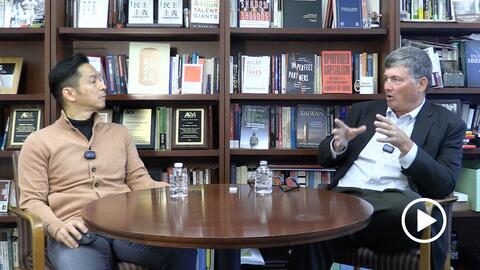
At a moment marked by war, regional fragmentation, and mounting uncertainty across the Middle East, the Program on Arab Reform and Development (ARD) at Stanford University’s Center on Democracy, Development and the Rule of Law hosted a wide-ranging conversation between historian and Middle East scholar Joel Beinin and Hesham Sallam, CDDRL Senior Research Scholar and ARD Associate Director.

The discussion explored how the region’s current crises fit within longer historical trajectories, and what they may signal for the future of political order, state power, and social movements in the Arab world.

Throughout the conversation, Beinin situated contemporary wars and political ruptures within broader histories of authoritarianism, imperial intervention, and the erosion of regional political cohesion. The discussion ranged from the legacies of the post-9/11 era to the fragmentation of the Arab regional order, the failures of democratization, and the global rise of the far right.

Here are five major takeaways from the discussion:

1. The current moment is not simply another regional crisis — it reflects the fragmentation of the Arab order itself.


One of the central themes of the discussion was that today’s regional turmoil differs fundamentally from earlier periods of instability. Beinin argued that while the Arab world has long experienced cycles of war, authoritarianism, and external intervention, the current period is distinctive because the very idea of a coherent “Arab world” has weakened dramatically.

As Beinin put it, “A quarter of a century ago, you could still talk about the Arab world with a certain sense of unity… and today, increasingly, it doesn’t.” He stressed that this fragmentation is not merely geopolitical but also political and ideological. Regional powers now pursue sharply divergent agendas, while many traditional centers of Arab political and cultural influence have declined.

Egypt occupied a central place in this analysis. Beinin argued that Egypt, historically viewed as a political and cultural anchor of the Arab world, can no longer plausibly play a regional leadership role. He described the Egyptian regime as deeply constrained by debt crises, Gulf dependency, and intensifying authoritarian rule. Meanwhile, Gulf states such as Saudi Arabia and the United Arab Emirates (UAE) increasingly shape regional politics, albeit without the broader political legitimacy or cultural influence once associated with Cairo.

The result, according to Beinin, is a region characterized less by shared political trajectories than by fragmentation, competing alignments, and increasingly localized struggles for survival and authority.

2. The legacies of the post-9/11 era continue to shape U.S. policy toward the Middle East.


Early in the conversation, Sallam read aloud a passage from President George W. Bush’s 2002 State of the Union address, warning that the United States “will not permit the world’s most dangerous regimes to threaten us with the world’s most destructive weapons.” Sallam then revealed that the quotation was not from President Donald Trump, but from Bush in the lead-up to the Iraq War.

The exchange set up one of the discussion’s recurring themes: the persistence of interventionist frameworks in American political discourse on the Middle East.

Beinin argued that much of contemporary U.S. rhetoric surrounding Iran reproduces assumptions and narratives that shaped the run-up to the Iraq War. “None of it was true when they said it about Iraq,” he remarked, “and none of it is true when they’re saying it about Iran.”

More broadly, he suggested that the post-9/11 political climate fundamentally reshaped how the United States discussed the region. Reflecting on the years after the September 11 attacks, Beinin described g a political atmosphere in which attempts to contextualize regional dynamics were frequently dismissed as apologetics for extremism.

The conversation repeatedly returned to the dangers of reducing regional politics to moral binaries or civilizational narratives. Instead, Beinin emphasized the importance of historically grounded analysis attentive to state interests, political economy, and international power relations.

3. The authoritarian restoration after the Arab uprisings has become deeper and more punitive.


Another major takeaway concerned the aftermath of the Arab uprisings of 2010-2011 and the broader trajectory of authoritarianism in the region.

Beinin argued that states such as Egypt and Tunisia have emerged from the post-uprising period with harsher and more consolidated forms of authoritarian rule than existed prior to 2011. “Any kind of political, civil, even to some degree cultural resistance has been stamped out,” he said, citing the expansion of surveillance, imprisonment, and repression.

Yet the discussion also rejected the simplistic notion that the Arab uprisings were meaningless failures. Beinin pointed to later protest waves in Sudan and Algeria during 2019–2020 as evidence that activists and civil movements had absorbed important lessons from the earlier uprisings.

In Sudan in particular, he argued, protest movements understood that “the army is not on the side of the people,” reflecting a deeper awareness of how military institutions could derail revolutionary transitions. At the same time, Beinin stressed that regional interventions by Gulf powers played a major role in undermining these movements. He described how competing regional actors backed rival military factions, contributing to fragmentation and ultimately overwhelming civilian political forces.

The broader implication was that authoritarian resilience in the Arab world cannot be understood solely through domestic dynamics. Regional rivalries, external funding networks, and transnational counterrevolutionary alliances all play a central role in shaping political outcomes.

4. The Middle East’s crises are increasingly tied to a broader global rightward shift.


While much of the conversation focused specifically on the Arab world, Beinin consistently situated regional developments within broader international trends.

He argued that the current moment reflects not only regional disarray but also the rise of increasingly exclusionary and authoritarian political currents globally. Beinin pointed to “a hard lurch to the right” in multiple countries, including Israel, India, and parts of Europe.

This international dimension, he suggested, has profound implications for the Middle East. The rise of nationalist and authoritarian politics globally has helped normalize more extreme forms of militarism, ethnonationalism, and state violence. It has also weakened many of the international norms and institutions that once constrained state behavior, however imperfectly.

The discussion of Israel occupied a particularly important place here. Beinin linked Israel’s rightward shift to broader transformations in global politics. At several points, the conversation underscored how the wars in Gaza and Lebanon cannot be understood in isolation from these wider ideological and geopolitical currents.

Rather than treating the Middle East as uniquely unstable or exceptional, Beinin repeatedly encouraged the audience to see the region as deeply connected to broader crises of democracy, inequality, nationalism, and authoritarianism unfolding globally.

5. Historical perspective remains essential in moments of upheaval.


Perhaps the most important theme running through the conversation was methodological rather than purely political: the insistence on historical perspective in moments of crisis.

At the outset of the event, Sallam emphasized that the purpose of the discussion was “not to chase after the headlines,” but rather to “take the long view” and place contemporary developments “in conversation with scholarly research and debates.”

Throughout the conversation, Beinin repeatedly cautioned against analyses driven solely by immediate events, media cycles, or simplistic geopolitical narratives. Instead, he urged audiences to understand contemporary wars and political transformations as products of longer histories involving colonial legacies, state formation, authoritarian restructuring, social movements, and international intervention.

The discussion ultimately offered no easy optimism about the region’s future. Yet it also rejected fatalistic portrayals of the Arab world as uniquely doomed to instability. Instead, the conversation highlighted the importance of historical memory, critical scholarship, and political analysis capable of connecting contemporary crises to deeper structural processes.

A full recording of the conversation can be viewed below:

Read More

Smoke rises over buildings on March 3, 2026, in Tehran, Iran.
News

Six Takeaways on the War and the Arab World

Scholars convened by the Center on Democracy, Development and the Rule of Law’s Program on Arab Reform and Development identify six ways the conflict is testing the limits of Arab states' alliances, economic ambitions, and prospects for reform.
Six Takeaways on the War and the Arab World
Bassam Haddad
News

Syria in Transition: Historical Origins and Prospects

In a conversation with ARD Associate Director Hesham Sallam, Bassam Haddad, a leading expert on Syria and Associate Professor at George Mason University, addressed the factors that led to Assad’s fall, the role of international actors, and the uncertain prospects of Syria under its new leadership.
Syria in Transition: Historical Origins and Prospects
Hesham Sallam speaks at a podium with panelists Samia Errazzouki and Joel Beinin
News

Stanford experts detail democratic decline, authoritarian trends in the Middle East

Stanford scholars urged historical approaches to examine the impact of regional conflict in the Middle East and North Africa on authoritarian stability and dissent.
Stanford experts detail democratic decline, authoritarian trends in the Middle East
Hero Image
The Albina Bulk carrier sits anchored on March 22, 2026, at Sultan Qaboos Port in Muscat, Oman.
The Albina Bulk carrier sits anchored on March 22, 2026, at Sultan Qaboos Port in Muscat, Oman. Maritime traffic through the Strait of Hormuz, which conveys about 20% of the world's oil and gas, has mostly come to a halt after the joint U.S.-Israeli war with Iran that began on February 28. | Getty Images
All News button
1
Subtitle

In a discussion convened by the Program on Arab Reform and Development, Stanford scholars situate regional upheaval within longer trajectories of imperial intervention, authoritarian rule, and global political shifts.

Image
saudi arabia 84016 1920
Title
How War is Reshaping the Arab World
Aria Label
Read How War is Reshaping the Arab World
Date Label
In Brief
  • Stanford scholars Joel Beinin and Hesham Sallam examined the state of conflict and fragmentation in the Arab world, arguing that the current moment differs fundamentally from past instability in the region.
  • Beinin connected current U.S. rhetoric on Iran to post-9/11 interventionism while analyzing deepening authoritarianism following the Arab uprisings.
  • The discussion situated the Middle East upheaval within global rightward shifts, emphasizing historical perspective over headline-driven analysis of regional crises.
Display Hero Image Wide (1320px)
Yes
Authors
Michael Breger
News Type
News
Date
Paragraphs

Rapid technological advances are reshaping how nations project power, deter adversaries, and work with allies. Against this background, wars are becoming faster, more autonomous, and increasingly dependent on commercial technologies once considered outside the scope of national defense.

This was the central message of “Frontiers of Defense Tech in the Shifting U.S. Alliances with Japan and Beyond: AI, Cyber, and Space,” a conference held May 4 and organized by the Shorenstein Asia-Pacific Research Center’s (APARC) Japan Program. The event brought together diplomats, military officials, scholars, and technology executives to examine how emerging technologies are reshaping deterrence, alliance coordination, and strategic competition across the Asia-Pacific.

Policymakers and military officials today face a herculean task of adapting to the rapidly developing technological landscape, as U.S. allies are forced to reassess their long-held national security assumptions at a time of momentous changes in U.S. foreign and trade policies and Washington’s turn away from the international rules-based order, said Stanford sociologist Kiyoteru Tsutsui, the director of APARC and the Japan Program, in his welcome remarks.

Sign up for APARC newsletters to receive expert analysis and insights from our scholars and guests >


The conference agenda was designed to address urgent questions, explained Tsutsui, the Henri H. and Tomoye Takahashi Professor in Japanese Studies and a senior fellow at the Freeman Spogli Institute for International Studies (FSI). These include how to formulate effective policies on export controls, data and technology sovereignty, and the integration of commercial technologies into defense systems; how to maintain interoperability, trust, and institutional frameworks that underpin deterrence; and how to ensure that norms, standards, and safety measures keep up with the pace of innovation  – all while alliance commitments are questioned and government leadership in stimulating innovation and technological cooperation is declining.

Across the domains of artificial intelligence, cyber conflict, defense manufacturing, and space infrastructure, speakers returned to a common theme:  technological threats are no longer adjacent to geopolitics. They are increasingly at its center.

Kotaro Otsuki, Japan’s consul general in San Francisco, framed the discussion in terms of democratic governance and alliance cohesion. Maintaining an international order grounded in the rule of law, democracy, and human rights, he argued, remains essential to the U.S.-Japan alliance. He noted that Japan has identified 17 strategic areas for cooperation with the United States, including AI and space technologies, to strengthen deterrence and preserve technological competitiveness.

Alliances in a Time of Crisis


The first panel focused on Pacific alliances and the growing instability created by technological acceleration. Rui Matsukawa, a member of Japan’s House of Councilors, described the current moment as an “era of crisis” requiring greater resilience across economic, military, and technological systems. “We’re trying to strengthen sustainability and resilience – and it’s about survival,” Matsukawa said.

Speakers repeatedly pointed to the wars in Ukraine and the Middle East as evidence that low-cost drones, cyber capabilities, and AI-enabled intelligence systems are rapidly changing the character of warfare. Victor Cha, professor of government and director of Asian studies at Georgetown University, argued that alliances may increasingly become the primary venue for establishing norms governing autonomous technologies and AI systems. “If the U.S. and allies can work together, someone needs to set the rules and norms for the use of tech,” Cha said.

Former U.S. Ambassador Tom Schieffer warned that technological sophistication can also accelerate miscalculation. Drawing comparisons to Cold War crisis communications, Schieffer emphasized that diplomacy and trust remain indispensable even in highly digitized conflicts. “We’re human, and we’re going to make mistakes – and tech is also going to make mistakes,” he said.

Dual-Use Innovation Reshaping Defense Strategy


The conference’s second panel turned to defense innovation and the growing integration of commercial technology into military operations. Several speakers described the 2026 Iran conflict as the first major war fundamentally shaped by AI-enabled targeting and intelligence fusion systems.

Michael Brown, former director of the Defense Innovation Unit at the U.S. Department of Defense, outlined how AI systems can integrate satellite imagery, drone feeds, radar, and signals intelligence into a unified operational interface capable of generating strike recommendations in near real time.

Yet, speakers also cautioned against overreliance on automated systems. Brown referenced reports that faulty data contributed to civilian casualties during early strikes in the Iran conflict, raising questions about accountability, targeting accuracy, and the ethics of AI-enabled military decision-making.

The panel also highlighted the industrial consequences of technological competition. Multiple speakers argued that the United States and its allies are struggling to produce defense systems, drones, and critical technologies at the scale required for prolonged conflict.

Arthur Dubois, co-founder and CEO of GridAero, described logistics as a central vulnerability in the Indo-Pacific theater, where geographic distance complicates military operations and supply chains. “If you don’t have logistics, everything breaks down,” he said.

Perspectives from Two National Security Advisors


The conference’s keynote fireside chat, moderated by FSI Director Colin Kahl, featured Lieutenant General H.R. McMaster, the 25th U.S. national security advisor, and Masataka Okano, former national security advisor and vice minister for foreign affairs of Japan. Both emphasized that technological dependence has blurred the line between economic security and military security.

“We are in a period of urgency,” McMaster said, arguing that strategic competitors increasingly view democratic alliances as “weak, decadent, and divided.” McMaster identified four major priorities for the United States and its allies: maintaining military technological advantages, rebuilding manufacturing capacity, securing critical supply chains, and strengthening energy security. Future wars, he argued, will increasingly involve attacks on information systems and communications infrastructure. “The first battle of the next war will be to blind the enemy and corrupt data,” McMaster said.

Okano focused on the vulnerabilities exposed by prolonged conflict and interconnected digital systems. Cloud infrastructure, transportation networks, semiconductors, and access to energy resources, he argued, must now be treated as core components of national defense. “How can we be confident about the security of the cloud?” Okano asked. “Can we trust the safety of the data and the company of the allied country?”

Rethinking Cybersecurity for the AI Era


A later panel on cyber and AI threats explored how frontier AI models are changing both offensive and defensive security operations. Mihoko Matsubara, chief cybersecurity strategist at NTT, argued that governments remain overly focused on offensive capabilities while underinvesting in resilience. Matsubara stated that “we tend to focus on the offensive rather than the defensive capabilities […] but isn’t it the same side of the coin?”

Panelists also discussed the role of private firms in shaping cybersecurity governance, particularly as AI systems become more capable of identifying software vulnerabilities, automating attacks, and influencing public narratives.

Space as a Force Multiplier


The conference concluded with a panel on space technologies and their expanding role in military and civilian infrastructure. Speakers emphasized that satellite systems now underpin communications, navigation, financial transactions, weather forecasting, and missile defense architectures.

General John “Jay” Raymond, the first chief of space operations for the U.S. Space Force, described space as “a huge force multiplier” that underpins economic and military power alike.

Jeff Thornburg, CEO and co-founder of Portal Space Systems, stressed how dependent modern societies have become on orbital infrastructure, stating how “without access to GPS, you can’t pump gas or withdraw money at the ATM.”

Throughout the day, speakers argued that alliances are increasingly being redefined through technological interoperability, industrial coordination, and shared infrastructure rather than traditional treaty arrangements alone.

In closing remarks, Tsutsui said the conference reflected a broader shift in global politics – one in which technological resilience, supply chain security, and coordinated innovation are becoming central to alliance strategy. “There are a lot of pain points and bottlenecks that need to be resolved,” Tsutsui said. “There needs to be more collaboration.”

Read More

Illustration of a semiconductor chip with the Japanese flag superimposed on top.
Working Papers

Japan’s Economic Security and the Semiconductor Industry

The Validity of the Revitalization Strategy
Japan’s Economic Security and the Semiconductor Industry
People walk through a shopping street in Osaka, Japan, 2024.
News

Japan Has Become Very Cautious About Accepting Foreign Workers in Recent Years, According to a Stanford University Survey

The Asahi Shimbun's GLOBE+ features the latest findings from the Stanford Japan Barometer, a periodic public opinion survey co-developed by Stanford sociologist Kiyoteru Tsutsui, which unveils nuanced preferences and evolving attitudes of the Japanese public on political, economic, and social issues. Its recent experiment revealed that Japanese people have become wary about accepting foreign workers in recent years. Political influences are behind this trend.
Japan Has Become Very Cautious About Accepting Foreign Workers in Recent Years, According to a Stanford University Survey
A woman walks past signs displaying gasoline prices outside a gas station on March 13, 2026, in Kobe, Japan.
News

Energy Security Nudges Japanese Opinion on Military Deployment in Iran, but Baseline Opposition Persists

A Stanford Japan Barometer experiment reveals that invoking Japan's energy dependence on Middle Eastern oil, rather than the Japan-U.S. alliance, increases the Japanese public’s support of deploying the Self-Defense Forces to the Strait of Hormuz, but does not overcome the underlying opposition to military action in the crisis.
Energy Security Nudges Japanese Opinion on Military Deployment in Iran, but Baseline Opposition Persists
Hero Image
A collage of 8 photos of speakers and panels from the Stanford Japan Conferece, “Frontiers of Defense Tech in the Shifting U.S. Alliances with Japan and Beyond: AI, Cyber, and Space."
Panelists and speakers at the Japan Program's conference, “Frontiers of Defense Tech in the Shifting U.S. Alliances with Japan and Beyond: AI, Cyber, and Space,” May 4, 2026. | Rod Searcey
All News button
1
Subtitle

The next-gen battlefield is already here, emphasized policymakers and defense leaders at a Japan Program conference on the implications of critical AI, cyber, and space technologies for the alliance network in the Asia-Pacific region. Panelists warned that future conflicts will be shaped as much by data, supply chains, and autonomous systems as by conventional military power.

Image
Image of a drone
Photo credit Ethan Miller via Getty Images
Title
Defense Tech Revolution Demands New Alliance Strategies
Aria Label
Defense Tech
Date Label
In Brief
  • Future wars will be fought with AI, data, cyber tools, and autonomous systems as much as traditional weapons.
  • The U.S.-Japan alliance is increasingly defined by technological cooperation and shared infrastructure.
  • AI-powered military systems can improve speed and precision, but also raise serious ethical and accountability risks.
  • Supply chains, semiconductors, cloud systems, and energy networks are now core national security assets.
  • Resilience in cybersecurity, logistics, and infrastructure is becoming just as important as offensive military strength.
Display Hero Image Wide (1320px)
Yes
Authors
Melissa Morgan
News Type
Commentary
Date
Paragraphs

As Americans were waking up on the morning of February 28, 2026, the United States and Israel had already begun wide-spread, coordinated attacks against Iran which struck military, naval, and nuclear infrastructure. Many of the country’s senior leaders were killed, including Ayatollah Ali Khamenei, Iran’s supreme leader, and Mohammad Pakpour, commander-in-chief of the Islamic Revolutionary Guard Corps (IRGC).

As developments in the conflict unfold at a rapid pace, scholars from the Freeman Spogli Institute for International Studies (FSI) shared their analysis of the war through media interviews, essays, and event panels. Here are several of their key insights into what is happening, and what to expect as the war begins to reverberate around the world.


A Democratic Iran is Desirable, but Achieving That is Difficult


In President Trump’s initial remarks announcing the military action, he called on the Iranian public to “to seize this moment, to be brave, be bold, be heroic, and take back your country.”

FSI Senior Fellow Michael McFaul supports the impulse for a democratic Iran, both for the improvement it would bring to the civil rights and liberties of Iranians, and for the advancement of U.S. national interests.

“If Iran is a democracy, they’ll become one of our closest allies in the region. We won’t have to worry about nuclear weapons and support for terrorism. That long-term strategic objective should have always been our goal,” he told Katie Couric in an interview.

Getting there, however, is easier said than done. Writing on his Substack, McFaul emphasizes:

“The fall of tyrants must always be celebrated. But the end of dictatorships rarely leads smoothly to the emergence of democracies. They take a lot of work to achieve success, often with protected engagement from international mediators and supporters. U.S. military intervention is rarely an effective instrument for fostering democratic regime change.”

But there are avenues the U.S. could pursue if it is serious about supporting democracy in Iran, stresses McFaul. Sanctions, steering oil profits into escrow funds earmarked for use by a future democratic movement, and raising the profile of Iranian human rights leaders and other significant ex-pats could all go a long way in bolstering a democratic transition, he says.

“Unfortunately, I don’t see a lot of evidence that we’re focused on that right now,” says McFaul.


Expect Internal Instability in Iran


Just because Khamenei has been killed does not mean the regime is imminently about to crumble, cautions Francis Fukuyama, the Olivier Nomellini Senior Fellow at FSI.

“Unlike the snatching of Maduro or the attack on the Fordow enrichment facility, this is going to lead to a lot of internal instability. I think this is generally true if you take out the senior leadership,” Fukuyama explains to Yascha Mounk of Persuasion.

“You still have a very well-organized and very well-armed IRGC that has a real interest in the outcome of this because their lives are on the line,” Fukuyama continues. “I think that what you’re going to get is a lot of internal conflict. You could get into conflict within the regime. Different parts of the regime seek to assert dominance over the whole thing and then between the population and the regime. That is going to be extremely difficult to control.”


The fall of tyrants must always be celebrated. But the end of dictatorships rarely leads smoothly to the emergence of democracies. They take a lot of work to achieve success.
MIchael McFaul
FSI Senior Fellow


Iran’s Revolution and Economy Are Intertwined


Taking a broad view of Iran’s revolution, Abbas Milani, the Hamid and Christina Moghadam Director of Iranian Studies, says that understanding the country’s future requires understanding its past.

“The 1979 Iranian revolution was no revolution at all. It was a cunning bait-and-switch game cleverly played by Ayatollah Ruhollah Khomeini, who put himself at the head of the movement,” Milani writes in the New York Times.

For decades, this regime, first led by Khomeini and until recently his successor, Khamenei, has successfully kept its population under repressive control through a combination of fear, violence, and brutality, says Milani. But that stronghold has shown cracks, and fear of the regime had begun waning prior to the U.S.-Israel attacks. Coupled with frustrations with a failing economy, skyrocketing inflation, and plummeting currency, Milani sees opportunity for real change within Iran.

“The economy is a clear source of constant threat to the regime, and the new secular women and men of Iran are unwilling to accept anything less than what they were initially promised before being deceived nearly half a century ago. The machinery of the regime may survive today. But the counterrevolution of yesteryear is begetting the revolution of tomorrow.”
 

America’s Firepower Is Superior, but Not Infinite


Speaking at a panel discussion hosted by the Center for International Security and Cooperation (CISAC), FSI Director Colin Kahl, a former under secretary of defense for policy at the U.S. Department of Defense, acknowledged the magnitude and deft execution of the unfolding military operation.

“The U.S. and Israeli militaries are doing things that no militaries in the history of the world have been capable of doing. From a kind of tactical and operational sense, it is extraordinarily impressive,” he said.

But Kahl also warns that an extended military campaign could spell trouble for the United States both in the current conflict and for future readiness.

“Iran has what is basically an inexhaustible supply of short-range, one-way attack drones that only cost about $35,000 apiece. We are shooting them down with $2 million missiles. That is an exchange rate Iran will take any day of the week.”

China and Russia are also watching this conflict and America’s artillery usage, says Kahl:

“We are expending a lot of long range precision munitions and a lot of air interceptors. And a lot of these weapons are exactly the systems you need for a contingency in North Korea, across the Taiwan Strait, or in the Baltics,” he says. “If you're in Moscow and Beijing, you’re counting those, and you know that for the next two or three years, the United States' cupboard is going to be bare and a more confrontational posture will not be viable.”

U.S. Navy members prepare to stage ordnance on the flight deck of Nimitz-class aircraft carrier USS Abraham Lincoln in support of Operation Epic Fury.
U.S. Navy members prepare to stage ordnance on the flight deck of Nimitz-class aircraft carrier USS Abraham Lincoln in support of Operation Epic Fury. | Getty

U.S.-Israel Interests are Aligned but Not Identical


Unlike in previous conflicts when the U.S. was joined in combat with NATO allies or other partners, the strikes on Iran were conducted in tandem with only one other nation, Israel.

Amichai Magen, the director of the Jan Koum Israel Studies Program, believes some of the impetus for the strikes is to send a message to anti-American and anti-Israel actors.

“If you can take out Maduro or undermine the regime in Iran, you are signaling to Russia and China that America is repositioning and re-establishing deterrence against its peer competitors,” Magen told NBC Bay Area.

Or Rabinowitz, a visiting scholar of Israel studies, also points to Iran’s insistence in recent negotiations on keeping its ability to produce advanced centrifuges as being particularly significant in the decision to execute military action.

But there is the possibility of divergence in the United States and Israel’s overarching goals as well, Rabinowitz says, especially when it comes to questions of nuclear capabilities. 

“Take Qatar as an example,” she told the CISAC panel. “Qatar is an actor that the Trump administration is very at home with, even though they are an anti-Israel actor. Something similar could emerge in Iran that feels malleable enough for the U.S. to work with on the nuclear issue, but they don’t forgo their ideology, their anti-Israel rhetoric, or their support for destabilizing Israeli-Arab normalization. The U.S. may choose to live with that even if Israel isn’t happy about it. That’s where you’ll see divergence.”


China Is Likely to Sit This One Out


When it comes to Iran’s partnerships and allies, experts believe Tehran is unlikely to see much help from Moscow or Beijing. Writing for Foreign Affairs, Michael McFaul and Abbas Milani track how Russia’s focus on Ukraine has diverted its ability to engage with players in the Middle East, citing its meager response to the fall of Bashar al-Assad’s regime in Syria and limited engagement with Iran in the aftermath of the airstrikes in June 2025 targeting nuclear facilities.

Lisa Blaydes, an FSI senior fellow, thinks China—Iran’s major trading partner—will take a similar backseat approach to the current conflict. 

“We think that China might have some leverage over Iran. But it's not clear how much will there is in China to get involved in this,” she explained at an event hosted by the The Program on Arab Reform and Development. “We know one of the only planes to land in Tehran recently was a Chinese plane that was bringing weapons to support the Iranian regime. Will this continue? Is it a one-off? Is it a pattern? I don't think we know yet.”

While a majority of Iran’s oil does end up in Chinese markets, China also has important economic and trade interests in the Gulf, says Blaydes, where all six Gulf Cooperation Council nations have been hit by retaliatory Iranian missile strikes.

“The Gulf is an important part of the Belt and Road Initiative. And there's a lot of money at stake. Disturbances in a place like the Strait of Hormuz would cause major disruptions to global supply chains. So I don't know if the Chinese want to weigh in strongly on either side.”


If you can take out Maduro or undermine the regime in Iran, you are signaling to Russia and China that America is repositioning and re-establishing deterrence against its peer competitors.
Amichai Magen
Director of the Jan Koum Israel Studies Program


The Risk of Global Destabilization Is Real


The question on most people’s minds in regards to the war is, “What happens next?” Hesham Sallam, a senior research scholar at the Center on Democracy, Development and the Rule of Law, acknowledges the complexity and gravity of the situation.

“This is a very unpredictable situation. And it is concerning that multiple U.S. officials don’t seem to have a consistent answer about a situation that is so consequential and that puts so many people in harm's way,” says Sallam.

If not handled carefully, Sallam warns that the threat of escalation is very real. Faced with a potentially existential risk, leaders in what remains of the regime may seek broad global destabilization. 

“There’s a logic here for the regime that if you don’t exact more costs and prolong the conflict and make this as inconvenient as possible for everyone, Iran will not be dealt with on equal footing,” he says. “So they may be looking to exact huge costs not just on the U.S. and Israel and countries in the region, but to disrupt global energy markets and the flow of trade as a means of ensuring something like this never happens again.”


For more commentary from our scholars and to stay informed about new analysis and upcoming events, subscribe to our newsletters.

Read More

Judea Pearl (R) in conversation with Amichai Magen (L) at the 2026 Daniel Pearl Memorial Lecture.
News

Judea Pearl Examines Coexistence, Sovereignty Among Israelis, Palestinians

UCLA scholar reflects on history, legitimacy, and the prospects for two states at the Jan Koum Israel Studies Program’s annual Daniel Pearl Memorial Lecture.
Judea Pearl Examines Coexistence, Sovereignty Among Israelis, Palestinians
Large audience at Encina Hall listens to a discussion about global trends and geopolitics in 2026 by scholars at the Freeman Spogli Institute.
News

How U.S. Competition with China is Shaping the Global Political Landscape

In the first of a new quarterly series of events, scholars from the Freeman Spogli Institute evaluated recent developments in world affairs, and offered an outlook for 2026.
How U.S. Competition with China is Shaping the Global Political Landscape
Hero Image
An Iranian flag is planted in the rubble of a police station, damaged in airstrikes on March 3, 2026 in Tehran, Iran.
An Iranian flag is planted in the rubble of a police station, damaged in airstrikes on March 3, 2026 in Tehran, Iran. | Getty
All News button
1
Subtitle

Scholars from FSI offer insights into the war between Iran and U.S.-Israel forces, and the risk of the conflict expanding beyond the Middle East.

Image
An Iranian flag is planted in the rubble of a police station, damaged in airstrikes on March 3, 2026 in Tehran, Iran.
Caption An Iranian flag is planted in the rubble of a police station, damaged in airstrikes on March 3, 2026 in Tehran, Iran. | Photo credit Getty
Date Label
Display Hero Image Wide (1320px)
No
Authors
News Type
News
Date
Paragraphs

The year is young, and yet the U.S. is already involved in a dizzying array of foreign and domestic developments, from capturing Venezuela’s President Nicolas Maduro and threats of force against Iran, to the Trump administration’s critiques of European allies, and accusations of overreach by Immigration and Customs Enforcement (ICE) stateside.

Simmering just below the surface is the U.S.-China relationship, which has been relatively quiet of late but could become confrontational, as the powers compete for dominance in technological advancement, trade, and influence.

On February 12, 2026, the Freeman Spogli Institute for International Studies (FSI) presented Global Trends and Geopolitics in 2026: A Look Ahead, a discussion on the forces shaping the world. The panel was moderated by FSI’s new director, Colin Kahl.

At the start of 2026, Kahl assumed leadership of FSI from Michael McFaul, who had served as the institute’s director for eleven years. Kahl is deeply familiar with national security and geopolitics at the highest levels, having recently served as the U.S. Department of Defense’s under secretary of defense for policy, and as national security advisor to Vice President Joe Biden during the Obama Administration. 

The conversation featured leading FSI scholars Harold Trinkunas, deputy director and senior research scholar at the Center for International Security and Cooperation (CISAC); Anna Grzymala-Busse, director of FSI's Europe Center; Larry Diamond, Mosbacher Senior Fellow of Global Democracy at FSI; and Or Rabinowitz, a visiting fellow at FSI’s new Jan Koum Israel Studies Program.

As assessed by the panel, the competition between the United States and China has significant global repercussions, as seen across the following key regions and issues.

Latin America and the Arrest of Maduro

At the start of the year, U.S. military forces captured Venezuelan president Nicolás Maduro in Caracas, charging him with narcoterrorism. While Delcy Rodríguez, formerly the country’s vice president, is now acting president, questions persist as to who is  in charge of the northern coastal country.

The U.S. would like to reduce China’s influence on Latin America, but, observed Harold Trinkunas, China is an easy trade partner and helps Latin America with infrastructure by providing bank loans that are simpler to secure than those offered by the U.S..

The Trump administration’s desire to revive the Venezuelan oil sector has been met with skepticism, with Chevron the only major U.S. oil company currently operating there. Oil sales were a key financial resource for Maduro’s government, but the current government lacks access to the revenue, with sales now controlled by the U.S..

Colin Kahl summarized the Trump administration’s actions as “a strange combination of drug enforcement and imperial oil extraction.”

The Fragile Alliance Between the U.S. and Europe

Friction between the U.S. and Europe is higher than it has been in recent memory, with disagreements over global trade, President Donald Trump’s interest in acquiring Greenland, and the Russia-Ukraine War.

According to Anna Grzymala-Busse, despite their status as a longtime ally, Europe feels the U.S. has unfairly been treating them like an enemy, while withholding criticism toward China over human rights abuses and security risks.

Europe is divided on how much it should rely on Chinese goods and technology. Some European countries, like the Netherlands, want to increase trade with China, while others, such as Germany, wish to scale back.

The U.S. has further obfuscated matters by playing European countries off of one another, criticizing some while heralding others. As a result, Trump is losing support in Europe, where Washington’s critiques are seen as “a violation of European sovereignty,” and have managed to unite the continent, said Grzymala-Busse.

“With the first Trump administration, there was a general feeling of, we can wait this out,” observed Grzymala-Busse. “With the second Trump administration, there's a feeling of, this is just what the United States is like.”

The Looming Threat of War in the Middle East

Or Rabinowitz pegs the likelihood of a U.S. attack on Iran in the coming six months at 60%, if the two countries can’t make a deal on restrictions around Iran’s nuclear and missile programs. It’s unclear if such a strike would actually topple the Iranian regime, or if it would merely be “a symbolic slap on the wrist,” said Rabinowitz.

President Trump’s decision making is difficult to predict, noted Rabinowitz: “Changing his mind is actually a very significant part of his political DNA.” Meanwhile, Iran is wary of agreeing to any deal that could be beneficial to Israel.

Often viewed as a strong ally of Iran, China is the number one buyer of Iranian oil. “But the problem is that in many aspects, it's the best friend that you don't want,” observed Rabinowitz, calling China “a fair weather friend.” China is primarily interested in stability because it benefits them as a trade partner when the region is calm.

Saudi Arabia and other Gulf states openly prioritize stability, de-escalation, and economic continuity. However, privately, Saudi officials have hinted that the Iranian regime could be emboldened if the U.S. does not attack, according to Rabinowitz.

Backsliding Democracy at Home and Abroad

There are grounds for both optimism and alarm in assessing the current global state of democracy, said Larry Diamond.

Developments in the U.S. such as the controversy over deployment of ICE forces in the streets of Minneapolis, and the Trump administration’s threats to withhold federal funding from universities, are, according to Diamond, “elements of creeping authoritarianism.”

U.S. democracy will face a big test in the upcoming midterm elections, one that Diamond thinks the country will pass. However, “if federal power is used to suppress or negate a free and fair election in the United States…I don't think you could call the United States an electoral democracy anymore.”

Outside of the U.S., Diamond predicts the future of democracy will be determined in Ukraine, as it enters its fifth year of war with Russia, and in Taiwan, where Chinese president Xi Jinping is considering the use of military force against Taiwan, potentially without substantial intervention from the U.S..

The Race to Unlock the Power of New Technologies

China is not dedicated to turning democracies into autocracies, even though it might welcome that, explained Colin Kahl. The country’s global focus is on trade, which is President Trump’s main interest when it comes to China as well.

Diamond deems the race between China and the U.S. to unlock the power of artificial intelligence, quantum, bioengineering, and fusion energy technologies as highly consequential.

If China pulls ahead in quantum and AI, Diamond warns, “This would be a disaster for the future of freedom in the world… there's nothing more important to the future of global democracy than the democracies collectively of the world winning this technological race.”

According to Kahl, this race will determine “whose technological backbone do most people on Earth use to access the information through which their entire lives are mediated?”

Just the Beginning

Every quarter the world will be quite different than the quarter before, noted Kahl. “It’s hard to believe we’re only six weeks into 2026,” he said. “It feels like we’ve had six years worth of foreign policy developments.”

The Global Trends and Geopolitics in 2026: A Look Ahead panel was the first in a new quarterly series of discussions hosted by FSI that will examine the state of the world. To join FSI at upcoming events focused on the latest developments in international affairs, register for invitations on the institute’s website.

Read More

Jake Sullivan and H.R. McMaster on the World Class podcast
Commentary

Former National Security Advisors Examine America's Evolving National Security Strategy

H.R. McMaster and Jake Sullivan join Colin Kahl on the World Class podcast to break down the 2025 National Security Strategy and discuss how questions around Venezuela, Iran, Russia, China, Ukraine, and U.S. partnerships with Europe may shape the rest of 2026.
Former National Security Advisors Examine America's Evolving National Security Strategy
photo of ross, mcfaul, and magen
News

Dennis Ross and Michael McFaul on American Leadership in a Multipolar World

Former ambassadors discuss statecraft, autocracy versus democracy, and the future of liberal internationalism in an era of geopolitical upheaval
Dennis Ross and Michael McFaul on American Leadership in a Multipolar World
Colin H. Kahl standing in Stanford's main quad
News

Colin Kahl Named Director of the Freeman Spogli Institute for International Studies

The political scientist and former U.S. defense official will lead Stanford’s hub for nonpartisan, interdisciplinary research and teaching in global affairs.
Colin Kahl Named Director of the Freeman Spogli Institute for International Studies
Hero Image
Large audience at Encina Hall listens to a discussion about global trends and geopolitics in 2026 by scholars at the Freeman Spogli Institute.
All News button
1
Subtitle

In the first of a new quarterly series of events, scholars from the Freeman Spogli Institute evaluated recent developments in world affairs, and offered an outlook for 2026.

Image
A depiction of a computer chip overlaid with half of the flag of the United States and half of the flag of the People's Republic of China.
Photo credit Getty
Title
U.S. Competition with China is Shaping the Global Political Landscape
Date Label
In Brief
  • U.S.-China competition is a quiet undercurrent in geopolitics, with global repercussions in 2026.
  • U.S. actions and trade pressures are straining Europe, and China’s economic pull could divide previously allied countries.
  • The future of global democracy and security hinge on U.S. domestic politics, tensions with Iran, and a decisive U.S.-China technology race.
Display Hero Image Wide (1320px)
Yes
Subscribe to The New Geopolitics