Authors
News Type
Commentary
Date
Paragraphs

No último domingo (4), 125 milhões de brasileiros e brasileiras foram às urnas para dizer que futuro vislumbram para o país. Seus votos renovaram as Assembleias Legislativas, a Câmara dos Deputados e dois terços do Senado Federal, elegeram governadores em parte dos estados e levaram a disputa presidencial ao segundo turno. O senador Flávio Bolsonaro, filho do ex-presidente Jair Bolsonaro, terminou em primeiro lugar, com 47% dos votos válidos, contra 45% do presidente Lula, resultado que contrariou as pesquisas que apontavam o petista à frente. Outros 33 milhões de eleitores não compareceram, a maior abstenção desde 1998.

O retrato que emerge é o de uma enorme insatisfação com o estado atual da democracia e de um país voltado à extrema direita. Com o novo desenho do Congresso — em que a extrema direita e seus aliados mais próximos ocuparão mais da metade das cadeiras nas duas Casas —, a profunda crise em torno do Supremo Tribunal Federal e o risco de ascensão de um governo antidemocrático ao poder, o Brasil nunca esteve tão perto de esfacelar o pacto democrático consagrado na Constituição de 1988.

Para o público internacional, a percepção do eleitorado de que a democracia brasileira não vai bem pode soar contraintuitiva. Afinal, nos últimos quatro anos, o Brasil foi apontado por muitos como exemplo de resiliência democrática — reputação associada, em grande parte, à responsabilização daqueles que tentaram um golpe de Estado em janeiro de 2023 e ao retorno do país à sua tradição diplomática. Mas a democracia brasileira vai muito além do que ocorreu em 2023, e é preciso dar um passo atrás para compreender o tamanho do desafio que se aproxima.

A Constituição Cidadã


A Constituição de 1988 estabeleceu um ordenamento jurídico marcado pela ampla garantia de direitos universais e por uma abertura inédita à participação da sociedade civil na construção das instituições do país. Durante o processo constituinte, cerca de 10 mil pessoas circulavam diariamente pelo Congresso Nacional, cerca de 9 milhões visitaram o Congresso ao longo dos trabalhos e foram apresentadas 122 emendas populares, que reuniram mais de 12 milhões de assinaturas. Mas a Constituição não se limitou a ampliar direitos e canais de participação: também lançou as bases para o equilíbrio entre os Três Poderes da República — Executivo, Legislativo e Judiciário —, ao distribuir competências, estabelecer mecanismos de controle mútuo e buscar evitar a concentração de poder.

O arranjo que emergiu desse desenho ficou conhecido como presidencialismo de coalizão, expressão cunhada pelo cientista político Sérgio Abranches. Nesse modelo, o Executivo federal tem papel forte no controle do orçamento, mas depende de uma coalizão pluripartidária para levar adiante seu projeto de país. Como é praticamente impossível para um único partido obter maioria isolada nas duas Casas, as coalizões são necessárias para construir, no Congresso Nacional, maiorias capazes de aprovar a agenda do governo eleito. O Judiciário, por sua vez, atuou historicamente para solucionar questões constitucionais que não haviam sido resolvidas pelos outros dois Poderes.

A balança começa a se inclinar: a contestação eleitoral e a ascensão do Legislativo


Esse equilíbrio começou a rachar de maneira contundente em 2014. Pela primeira vez desde a redemocratização, o candidato derrotado na eleição presidencial colocou em dúvida a lisura do sistema eleitoral, até então motivo de orgulho nacional. Esse grave precedente deixou marcas em nossa democracia e abriu caminho para narrativas antidemocráticas que, desde então, se reproduzem de maneira cada vez mais sofisticada.

Pouco tempo depois, o rompimento histórico entre o então presidente da Câmara dos Deputados, Eduardo Cunha, e a presidenta Dilma Rousseff resultou na deflagração de um processo de impeachment por supostos crimes de responsabilidade ligados a práticas fiscais que, quando analisadas, tinham precedentes em gestões anteriores sem que jamais tivessem motivado um processo dessa natureza. Nesse sentido, o impeachment de Rousseff diverge do processo sofrido pelo ex-presidente Fernando Collor de Mello em 1992, no qual veio à tona um esquema de corrupção que custeava despesas pessoais do presidente.

Em outras palavras, não era a prática em si o motivo do processo, mas a insatisfação política de parte da base governista que decidiu, pela primeira vez, punir uma prática fiscal até então amplamente aceita por toda a classe política. A insurreição de parte da base de Rousseff no Congresso não apenas a tirou do poder: inaugurou um choque aberto entre o Legislativo e o Executivo, com a anuência, à época, do Judiciário, no que se desenhou como um “grande acordo nacional”.

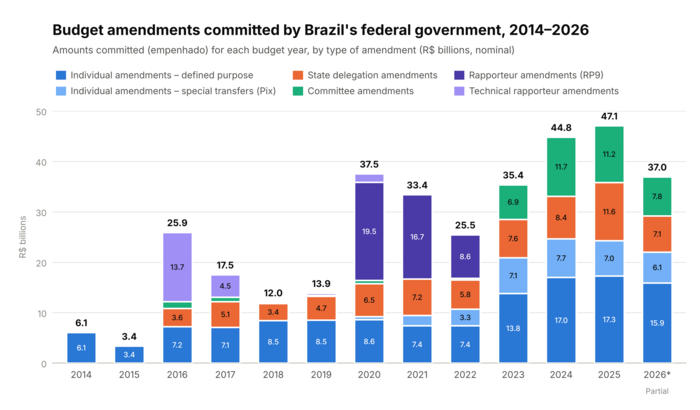
Aquele período deixou outro legado importante de desequilíbrio entre os Poderes. Em 2015, o Congresso Nacional aprovou uma emenda constitucional que obrigava o Executivo a executar as emendas parlamentares individuais. Emendas parlamentares são instrumentos que permitem a deputados e senadores propor alterações na Lei Orçamentária Anual, direcionando recursos públicos para obras, projetos e benfeitorias nos estados e municípios que representam. Elas se dividem de acordo com quem as propõe: as emendas individuais são apresentadas por cada parlamentar; as de bancada estadual, pelos deputados e senadores de cada estado em conjunto; as de comissão, pelas comissões permanentes do Congresso; e as de relator, pelo relator-geral, parlamentar responsável pelo projeto de lei orçamentária. A obrigatoriedade aprovada em 2015 — o chamado orçamento impositivo — alcançava apenas as emendas individuais, limitadas a 1,2% da receita corrente líquida da União.

Com a chegada de Jair Bolsonaro ao poder, esse desequilíbrio ganha outra proporção. Em 2019, duas novas emendas constitucionais aprofundam o movimento. A primeira torna obrigatória também a execução das emendas de bancada estadual. A segunda divide as emendas individuais em duas modalidades. As emendas com finalidade definida continuam vinculadas a um projeto específico, como um posto de saúde ou a pavimentação de uma rua. Já as novas transferências especiais, apelidadas de “emendas Pix”, permitem enviar recursos do Congresso diretamente a estados e municípios sem mecanismos claros de transparência.

As emendas de relator mudam ainda mais. Até então, o relator-geral as utilizava sobretudo para ajustes técnicos no projeto, muitas vezes para recompor recursos de programas do próprio Executivo. Em 2020, elas ganham um identificador próprio no orçamento, o RP9, e se tornam o núcleo do chamado “orçamento secreto”: bilhões de reais distribuídos a pedido de parlamentares cujos nomes não eram divulgados. Depois que o Supremo declara a prática inconstitucional, em dezembro de 2022, o Congresso eleva o teto das emendas individuais para 2% da receita corrente líquida. Também passa a usar as emendas de comissão, até então pouco relevantes, como o novo canal desses recursos.


Image
Budget amendments committed by type, 2014—2026. Source: Central das Emendas, adapted. Painel de Dados accessed on October 7, 2026; it draws on Portal da Transparência (CGU) amendment and expenditure-document data.


Emendas parlamentares empenhadas por tipo, 2014—2026. Fonte: Central das Emendas, adaptado. Painel de Dados acessado em 7 de outubro de 2026, com base em dados de emendas e de documentos de despesa do Portal da Transparência (CGU).


A anuência do Executivo, então sob a liderança de Bolsonaro, a essa cessão de controle sobre o orçamento federal deu ao Congresso Nacional um poder jamais previsto no equilíbrio desenhado em 1988 e transformou a dinâmica política do país. As bancadas parlamentares perdem o interesse em compor a base governista e passam a priorizar a influência dentro do próprio Congresso, onde acessam grandes montantes de recursos sem transparência nem intermediação do Executivo.

O maior controle do orçamento, porém, não explica todo o processo de empoderamento do Legislativo: um relatório recente da Fundação FHC mostra que o Congresso vem ganhando terreno sobre o Executivo há duas décadas, impulsionado pela emenda constitucional de 2001 que pôs fim à reedição indefinida de medidas provisórias, pelo fortalecimento de sua capacidade técnica e por práticas informais que concentraram poder nas mãos do presidente da Câmara.

Esse conjunto de elementos consolidou uma nova correlação de forças entre os Poderes da República. Quando Lula da Silva retorna ao poder em 2023, o Executivo está muito mais dependente do Legislativo para operar o orçamento federal e avançar sua agenda de governo.

Judiciário: de bastião da democracia a alvo de descrédito


Durante o governo de Jair Bolsonaro, o Judiciário teve papel central na contenção de retrocessos, à medida que Executivo e Legislativo avançavam com pautas flagrantemente contrárias à Constituição de 1988. Esse crescimento de atuação é compatível com o conceito de democracia militante de Karl Loewenstein, cunhado em 1937, no qual um mecanismo institucional do Estado é ativado para defender a ordem democrática de atores que usam de suas liberdades democráticas para destruir o próprio sistema.

Essa ativação, porém, não contou com a ação da Procuradoria-Geral da República (PGR), órgão com a prerrogativa legal de promover ações penais contra autoridades com foro privilegiado — inclusive o Presidente da República. O procurador-geral da República durante a maior parte do mandato de Bolsonaro foi Augusto Aras, procurador escolhido pelo Presidente que teve sua gestão marcada pela omissão sobre ações perpetradas pelo Governo Federal e pelo Legislativo. Coube à sociedade civil, e outros setores importantes do país, o uso da litigância estratégica para ativar esse cordão de isolamento protagonizado pelo Supremo Tribunal Federal. Como resultado, houve uma desaceleração no grave processo de desintegração de direitos econômicos, sociais, culturais, ambientais e políticos naquele período.

Em resposta às ações mais robustas do Judiciário, o governo Bolsonaro e sua base passaram a promover sérios ataques contra o STF e seus ministros, inaugurando uma etapa em que um campo político questiona abertamente a lisura do Judiciário e chega a perseguir determinados juízes da Corte. Só em 2021, Bolsonaro chamou de “imbecil” o ministro Luís Roberto Barroso, então presidente do Tribunal Superior Eleitoral, por se opor ao voto impresso, e pediu ao Senado o impeachment do ministro Alexandre de Moraes.

A tensão entre o campo político do ex-presidente e o Judiciário atingiu novos patamares nas eleições de 2022 e na subsequente tentativa de golpe de Estado, que culminou no ataque às sedes dos Três Poderes. As ações incisivas do Tribunal Superior Eleitoral e do Supremo Tribunal Federal foram centrais para evitar a ruptura da ordem institucional, garantindo tanto a segurança de um pleito diretamente afetado pelo governo em exercício quanto a responsabilização jurídica dos envolvidos na tentativa de golpe.

A maior barreira de contenção das crises até então passou a enfrentar o descrédito da opinião pública e a ser alvo de uma nova arma da extrema direita: a ameaça de impeachment de ministros do Supremo pelo Senado, que detém essa prerrogativa constitucional, desde que a condenação seja aprovada por dois terços de seus membros.

Se as acusações da extrema direita contra a Suprema Corte não encontravam respaldo nos fatos quando se tratava da defesa das eleições e da responsabilização pelos crimes contra a democracia, um enorme escândalo de corrupção complicaria esse cenário. Em 2025, o país conheceu o caso do Banco Master, instituição financeira utilizada para a venda de títulos bancários sem lastro e associada ao desvio bilionário de recursos públicos de diversas origens, além de relações suspeitas com pessoas em todos os Poderes da República, incluindo ministros do Supremo. Um dos nomes mencionados na investigação é o de Alexandre de Moraes, o mesmo ministro que presidiu o Tribunal Superior Eleitoral nas eleições de 2022 e conduziu os processos de responsabilização pelos crimes contra o Estado de Direito após a tentativa de golpe — e que, embora seja comumente associado ao presidente Lula, foi indicado anos antes pelo então presidente Michel Temer. A cobertura da investigação também citou outros cinco ministros ou seus familiares: Dias Toffoli, que deixou a relatoria do caso Master em fevereiro, André Mendonça, Gilmar Mendes, Kassio Nunes Marques e Luiz Fux. Todos negam irregularidades.

Isso coloca a população brasileira diante de um dilema: como podem as ações corretas do Judiciário na proteção da democracia em 2022 e 2023 terem sido conduzidas pela mesma Corte cujos integrantes hoje estão sob escrutínio por supostas ligações com atores privados responsáveis pelo desvio de bilhões de reais dos contribuintes?

2026: a tempestade perfeita e a resposta das urnas


O Brasil chega a 2026 sob uma tempestade perfeita: um Legislativo com amplos poderes sobre o orçamento federal, um Executivo enfraquecido, um Judiciário exposto em suas contradições e uma população esgotada por uma guerra de narrativas alimentada pela desinformação e pelo uso intensivo de recursos tecnológicos para amplificá-la. Esse cenário é agravado pelo imenso poder concentrado nas big techs, cujas práticas seguem marcadas pela falta de transparência sobre os critérios de moderação de conteúdo e as escolhas algorítmicas que moldam o debate público. Em meio a esse ambiente de fragmentação, bolhas, desconfiança e conflito permanente, há cada vez menos espaço para discutir projetos de país, construir consensos mínimos ou imaginar coletivamente saídas para a crise.

Um exemplo concreto do esfacelamento do equilíbrio entre os Poderes foi a rejeição, pelo Senado, do nome indicado pelo Presidente da República ao Supremo Tribunal Federal em abril deste ano — algo que não acontecia desde 1894. O Brasil dá sinais claros de que o pacto de 1988 está se desfazendo, e serão as forças vencedoras das eleições de 2026 que ditarão o que virá depois.

Com o resultado de 4 de outubro, o eleitorado consolidou a extrema direita como a maior força na Câmara dos Deputados e no Senado. As ameaças de impeachment de ministros do Supremo ganham concretude, e o próximo Presidente da República terá a prerrogativa de nomear quatro ministros para a Corte: a vaga aberta com a aposentadoria de Luís Roberto Barroso, ainda não preenchida, e outras três que se abrirão à medida que ministros atingirem a idade de aposentadoria compulsória, 75 anos.

Em um contexto em que os ministros do Supremo têm sido escolhidos cada vez mais por afinidade política com o Presidente da República, um eventual governo de Flávio Bolsonaro, somado a uma ampla base extremista no Senado, poderá consolidar uma maioria sólida de juízes conservadores na Suprema Corte do país.

O 25 de outubro e o dia seguinte


O presidente Luiz Inácio Lula da Silva e o senador Flávio Bolsonaro disputarão o segundo turno em 25 de outubro. Se a candidatura de extrema direita prevalecer, o equilíbrio entre os Poderes desenhado em 1988 dificilmente resistirá, já que as ameaças de alterar o texto constitucional começam a ser feitas às claras. Se o projeto democrático de Lula vencer, as fraturas em nossa democracia continuarão tão profundas que tampouco haverá garantia de que essa ordem se mantenha.

A decisão a ser tomada no próximo dia 25 não é difícil. O difícil começa no dia 26: encontrar um caminho que impeça uma das experiências democráticas mais vanguardistas do mundo de entrar em colapso.

Esse caminho começa por levar a sério o descontentamento que o primeiro turno escancarou. Parte da desconfiança dos brasileiros em relação às suas instituições foi deliberadamente fabricada, como demonstra a campanha de ataques ao sistema eleitoral ao longo da última década. Mas parte dela também está enraizada na realidade concreta do país. Somos uma sociedade profundamente desigual, marcada por relações sociais forjadas em quase quatro séculos de escravidão e, consequentemente, por estruturas persistentes de autoritarismo, violência e concentração de poder baseadas em classe, raça, gênero e heterocisnormatividade. Somam-se a isso instituições que ainda carecem de transparência, um Congresso que passou a controlar uma fatia crescente do orçamento federal por meio de mecanismos frequentemente questionados por sua opacidade e sucessivos casos de corrupção envolvendo diferentes Poderes e esferas do Estado — fragilidades institucionais que escândalos recentes, como o caso do Banco Master, voltaram a trazer ao centro do debate público.

A extrema direita não criou essa frustração, mas soube explorar com habilidade os ressentimentos que sustentam nossas relações sociais e nossa relação com as instituições, aprendendo a canalizá-los e a transformá-los em força política. E os 33 milhões de brasileiros que não foram às urnas em 4 de outubro, assim como os quase 6 milhões de votos brancos e nulos — mais do que o número de votos obtidos pelo candidato Augusto Cury, terceiro colocado na disputa presidencial — nos lembram que a desilusão também pode assumir a forma do silêncio ou do voto de protesto.

Nossas instituições não são imunes a críticas, e defender a democracia não pode significar defendê-las como estão, com todas as suas deficiências, falhas e contradições. Nenhum governo, ou quem quer que o lidere, encontrará esse caminho sozinho. Reconstruir o equilíbrio estabelecido em 1988 dependerá de instituições capazes de reconquistar a confiança perdida e de uma sociedade disposta a continuar disputando a forma como essas instituições e as políticas públicas são construídas, bem como a defender as regras do jogo, mesmo quando elas não favorecem o seu lado.

Natália Neris é Gerente de Advocacy no Pacto pela Democracia e doutora em Direitos Humanos pela Universidade de São Paulo. Sami Sternberg é Coordenador de Articulação Internacional no Pacto pela Democracia e mestre em Relações Internacionais pela Columbia University.

Read More

A man in a Colombian football jersey casts his vote in the presidential election on May 31, 2026, in Bogotá, Colombia.
News

What a DAL Panel Got Right About Colombia's Election — and What It Didn't See Coming

Convened one day after the first round, four scholars forecast a referendum on Petro's presidency and a system running out of patience. The vote that followed was far closer than their models predicted.
What a DAL Panel Got Right About Colombia's Election — and What It Didn't See Coming
Beatriz Magaloni interviews a voter on April 12, election day, at a polling station in the province of Anta, Cusco. Several interviews were conducted that same day inside and outside polling stations in this southern Andean region.
Blogs

Colonialism, Extractivism, and Institutional Fragility Shaped the Elections in Peru

A Democracy Action Lab fieldwork mission to Lima and Cusco around Peru's first-round 2026 election finds a democracy whose deepest fractures predate the ballot.
Colonialism, Extractivism, and Institutional Fragility Shaped the Elections in Peru
Illustration of diverse young activists emerging from a garage carrying books and a raised-fist flag, with a network of connected stars overhead, symbolizing the Democracy Garage.
News

Democracy Action Lab Lanza Oficialmente La Primera Cohorte de The Democracy Garage

El Primer Acelerador de Democracia de Este Tipo en América Latina y el Caribe.
Democracy Action Lab Lanza Oficialmente La Primera Cohorte de The Democracy Garage
Hero Image
Property damage to the National Congress building, invaded January 8, 2023, by Bolsonaro supporters.
Property damage to the National Congress building, invaded on January 8, 2023, by Bolsonaro supporters. | Pedro França/Agência Senado
All News button
1
Subtitle

Natália Neris e Sami Sternberg, representantes do Pacto pela Democracia — organização que participou da edição inaugural do Democracy Garage, da DAL —, argumentam que, independentemente de quem vença o segundo turno de 25 de outubro, o pacto democrático brasileiro enfrenta sua ameaça mais grave desde a promulgação da Constituição de 1988.

Date Label
Display Hero Image Wide (1320px)
Yes
Authors
News Type
Commentary
Date
Paragraphs

On Sunday, October 4, 125 million Brazilians went to the polls to say what future they envision for their country. Their votes renewed state legislatures, the Chamber of Deputies, and two-thirds of the Federal Senate; elected governors in several states; and sent the presidential race to a runoff. Senator Flávio Bolsonaro, the son of former President Jair Bolsonaro, finished first, with 47% of the valid votes to President Lula's 45%, a result that defied polls showing the incumbent ahead. Another 33 million voters stayed home, the highest abstention rate since 1998.

The picture that emerges is one of deep dissatisfaction with the current state of democracy, and of a country turning to the far right. Given the new makeup of Congress — in which the far right and its closest allies will occupy over half of the seats in both chambers — the profound crisis surrounding the Supreme Federal Court, and the risk of an anti-democratic government rising to power, Brazil has never been so close to shattering the democratic pact enshrined in its 1988 Constitution.

To international observers, Brazilian voters' sense that their democracy is not doing well may seem counterintuitive. After all, over the past four years, many have pointed to Brazil as an example of democratic resilience — a reputation largely tied to holding accountable those who attempted a coup in January 2023 and to the country's return to its diplomatic tradition. But Brazilian democracy goes far beyond what happened in 2023, and we need to take a step back to grasp the size of the challenge ahead.

The Citizen Constitution


The 1988 Constitution established a legal framework characterized by broad guarantees of universal rights and an unprecedented opening for civil society participation in shaping the country's institutions. During the constituent process, around 10,000 people circulated through the National Congress each day, about 9 million visited Congress over the course of the proceedings, and 122 popular amendments were submitted, gathering more than 12 million signatures. But the Constitution did more than expand rights and channels for participation: it also laid the foundations for a balance among the three branches of government — the Executive, the Legislature, and the Judiciary — by distributing powers, establishing mechanisms of mutual oversight, and seeking to prevent the concentration of power.

The arrangement that emerged from this design became known as “coalition presidentialism,” a term coined by political scientist Sérgio Abranches. Under this model, the federal Executive plays a strong role in controlling the budget but depends on a multiparty coalition to carry out its agenda for the country. Since it is virtually impossible for a single party to win a majority on its own in either chamber, coalitions are needed to build majorities in Congress capable of passing the elected government's agenda. The Judiciary, for its part, historically acted to resolve constitutional questions that the other two branches had left unsettled.

The Scales Begin to Tip: Electoral Challenges and the Rise of Congress


This balance began to crack in earnest in 2014. For the first time since Brazil's return to democracy, the losing presidential candidate cast doubt on the integrity of the electoral system, which until then had been a source of national pride. This serious precedent left its mark on our democracy and paved the way for anti-democratic narratives that have since grown ever more sophisticated.

Shortly afterward, the historic rupture between then-Speaker of the Chamber of Deputies Eduardo Cunha and President Dilma Rousseff led to the opening of impeachment proceedings over alleged “crimes of responsibility,” Brazil's equivalent of impeachable offenses, tied to fiscal practices that, on closer inspection, had precedents in previous administrations without ever having triggered a process of this kind. In this sense, Rousseff's impeachment differs from the one faced by former President Fernando Collor de Mello in 1992, which uncovered a corruption scheme that paid for the president's personal expenses.

In other words, the practice itself was not the reason for the process; it was the political discontent of part of the governing coalition that decided, for the first time, to punish a fiscal practice until then widely accepted across the political class. The revolt of part of Rousseff's base in Congress did not merely remove her from office: it opened an era of open confrontation between the Legislature and the Executive, with the acquiescence, at the time, of the Judiciary, in what came to be described as a “grand national agreement.”

That period left another important legacy of imbalance between the branches. In 2015, Congress passed a constitutional amendment requiring the Executive to fund individual budget amendments. Budget amendments are instruments that allow deputies and senators to change the annual budget law, directing public funds to public works, projects, and improvements in the states and municipalities they represent, much like what Americans know as earmarks. They are classified by who proposes them. Individual amendments come from each legislator. State delegation amendments come from the lawmakers of each state acting together. Committee amendments come from the standing committees of Congress. Rapporteur amendments come from the general rapporteur, the legislator in charge of the budget bill. The 2015 requirement, known as the “mandatory budget,” applied only to individual amendments, capped at 1.2% of the federal government's net current revenue.

With Jair Bolsonaro's rise to power, this imbalance took on a new dimension. In 2019, two new constitutional amendments deepened the trend. The first made funding for amendments from state congressional delegations mandatory as well. The second split individual amendments in two. Amendments with a defined purpose remained tied to a specific project, such as a health clinic or a paved road. The new “special transfers,” nicknamed “Pix amendments” after Brazil's instant payment system, allow money to flow from Congress directly to states and municipalities without clear transparency mechanisms.

Rapporteur amendments changed even more. Until then, the general rapporteur had used them mostly for technical adjustments to the bill, often to restore funding for the Executive's own programs. In 2020, they received their own budget code, RP9, and became the core of the so-called “secret budget”: billions of reais distributed at the request of lawmakers whose names were not disclosed. After the Supreme Court struck down the practice in December 2022, Congress raised the cap on individual amendments to 2% of net current revenue. It also turned to committee amendments, which, until then, had carried little weight, as the new channel for these funds.


Image
Budget amendments committed by type, 2014—2026. Source: Central das Emendas, adapted. Painel de Dados accessed on October 7, 2026; it draws on Portal da Transparência (CGU) amendment and expenditure-document data.


Budget amendments committed by type, 2014—2026. Source: Central das Emendas, adapted. Painel de Dados accessed on October 7, 2026; it draws on Portal da Transparência (CGU) amendment and expenditure-document data.


The Executive's consent, then under Bolsonaro's leadership, to this surrender of control over the federal budget gave Congress a power never foreseen in the balance designed in 1988 and transformed the country's political dynamics. Congressional blocs lost interest in joining the governing coalition and began to prioritize influence within Congress itself, where they could access large sums of money without transparency or Executive mediation.

Greater control over the budget, however, does not fully account for the Legislature's growing power: a recent report by the Fernando Henrique Cardoso Foundation shows that Congress has been gaining ground on the Executive for two decades, helped by a 2001 reform that limited the president's power to rule by decree, stronger in-house technical staff, and informal practices that concentrated power in the Speaker's hands.

Together, these developments entrenched a new balance of forces among the branches of government. By the time Lula da Silva returned to power in 2023, the Executive was far more dependent on the Legislature to manage the federal budget and advance its agenda.

The Judiciary: From Bulwark of Democracy to Target of Distrust


During Jair Bolsonaro's administration, the Judiciary played a central role in containing setbacks, as the Executive and Legislative branches advanced agendas flagrantly at odds with the 1988 Constitution. This expanded role is consistent with the concept of militant democracy coined by Karl Loewenstein in 1937, in which an institutional mechanism of the State is activated to defend the democratic order against actors who use their democratic freedoms to destroy the system itself.

This activation, however, took place without the involvement of the Office of the Prosecutor General of the Republic (Procuradoria-Geral da República, PGR), the body legally empowered to bring criminal proceedings against authorities entitled to special jurisdiction (foro privilegiado), including the President of the Republic. For most of Bolsonaro's term, the Prosecutor General was Augusto Aras, a prosecutor hand-picked by the President whose tenure was marked by inaction in the face of measures taken by the Federal Government and the Legislature. It fell to civil society and other key sectors of the country to use strategic litigation to activate this cordon sanitaire, spearheaded by the Federal Supreme Court (STF). As a result, the serious erosion of economic, social, cultural, environmental, and political rights slowed during that period.

In response to the Judiciary's more forceful actions, the Bolsonaro government and its base launched serious attacks against the Supreme Court and its justices, opening a new phase in which one political camp openly questions the integrity of the Judiciary and has even gone as far as persecuting specific justices. In 2021 alone, Bolsonaro called Justice Luís Roberto Barroso, then head of the Superior Electoral Court, "an imbecile" for opposing printed ballots, and asked the Senate to impeach Justice Alexandre de Moraes.

Tensions between the former president's political camp and the Judiciary reached new heights in the 2022 elections and the subsequent coup attempt, which culminated in the storming of the buildings that house the three branches of government, a Brazilian echo of January 6. The decisive actions of the Superior Electoral Court and the Supreme Federal Court were central to preventing a breakdown of the institutional order, ensuring both the security of an election directly affected by the sitting government and the legal accountability of those involved in the coup attempt.

What had been the main barrier against the crises up to that point came to face public distrust and became the target of a new weapon of the far right: the threat of impeachment of Supreme Court justices by the Senate, which holds this constitutional prerogative, provided that a conviction is approved by two-thirds of its members.

If the far right's accusations against the Supreme Court found no basis in fact when it came to defending the elections and holding accountable those who committed crimes against democracy, a massive corruption scandal would complicate that picture. In 2025, Brazilians learned of the case of Banco Master, a financial institution used to sell unbacked bank securities and associated with the diversion of billions in public funds from various sources, as well as with suspicious ties to people across all branches of government, including Supreme Court justices. One of the names mentioned in the investigation is that of Alexandre de Moraes, the very justice who presided over the Superior Electoral Court in the 2022 elections and led the cases on crimes against the rule of law after the coup attempt. Although he is commonly associated with President Lula, Moraes was appointed years earlier by then-President Michel Temer. Reporting on the investigation has also named five other justices or their relatives: Dias Toffoli, who stepped down as rapporteur of the Banco Master case in February; André Mendonça; Gilmar Mendes; Kassio Nunes Marques; and Luiz Fux. All deny wrongdoing.

This leaves Brazilians with a dilemma: how could the Judiciary's correct actions to protect democracy in 2022 and 2023 have been carried out by the same Court whose members now face scrutiny over alleged ties with private actors responsible for diverting billions of reais from taxpayers?

2026: The Perfect Storm and the Voters' Response


Brazil entered 2026 amid a perfect storm: a Legislature with sweeping powers over the federal budget, a weakened Executive, a Judiciary exposed in its contradictions, and a population exhausted by a war of narratives fueled by disinformation and the intensive use of technology to amplify it. This scenario is further exacerbated by the immense power concentrated in Big Tech companies, whose practices remain marked by a lack of transparency regarding content moderation criteria and the algorithmic choices that shape public debate. Amid this environment of fragmentation, echo chambers, distrust, and constant conflict, there is increasingly little room to discuss visions for the country's future, build minimum consensus, or collectively imagine ways out of the crisis.

A concrete example of the breakdown in the balance between the branches was the Senate's rejection of the President's nominee to the Supreme Federal Court in April of this year, something that had not happened since 1894. Brazil is showing clear signs that the 1988 pact is unraveling, and the winners of the 2026 elections will determine what comes next.

With the October 4 results, voters consolidated the far right as the largest force in both the Chamber of Deputies and the Senate. Threats to impeach Supreme Court justices are becoming more concrete, and the next president will have the power to appoint four justices to the Court: the seat left by Luís Roberto Barroso's retirement, still unfilled, and three more that will open as justices reach the mandatory retirement age of 75.

At a time when Supreme Court justices have increasingly been chosen for their political affinity with the president, a potential Flávio Bolsonaro administration, combined with a large extremist base in the Senate, could consolidate a solid conservative majority on the country's highest court.

October 25 and the Day After


President Luiz Inácio Lula da Silva and Senator Flávio Bolsonaro will face each other in the runoff on October 25. If the far-right candidate prevails, the balance between the branches designed in 1988 is unlikely to survive, as threats to change the constitutional text begin to take public form. If Lula's democratic project wins, the fractures in our democracy will still run so deep that there is no guarantee this order will endure either.

The choice on the 25th is not a difficult one. The hard part begins on the 26th: finding a path that keeps one of the world's most pioneering democratic experiments from collapsing.

This path begins by taking seriously the discontent that the first round laid bare. Some of Brazilians' distrust of their institutions has been deliberately manufactured, as demonstrated by a decade-long campaign of attacks on the electoral system. But some of it is also rooted in the country's concrete realities. We are a profoundly unequal society, shaped by social relations forged through nearly four centuries of slavery and, consequently, by persistent structures of authoritarianism, violence, and concentrations of power rooted in class, race, gender, and hetero-cisnormativity. Added to this are institutions that still lack transparency, a Congress that has come to control a growing share of the federal budget through mechanisms frequently questioned for their opacity, and successive corruption cases involving different branches and levels of the state — institutional weaknesses that recent scandals, such as the Banco Master case, have once again brought to the center of public debate.

The far right did not create this frustration, but it skillfully tapped into the resentments that underpin our social relations and our relationship with institutions, learning how to channel them and turn them into political force. And the 33 million Brazilians who did not go to the polls on October 4, along with the nearly 6 million blank and invalid ballots — a figure that is higher than the population of many US states — remind us that disillusionment can also take the form of silence or a protest vote.

Our institutions are not immune to criticism, and defending democracy cannot mean defending them as they are, with all their shortcomings, failures, and contradictions. No government, and no one who leads it, can find that path alone. Rebuilding the balance struck in 1988 will depend on institutions capable of earning back the trust they have lost, and on a society willing to continue contesting how these institutions and public policies are shaped, as well as defending the rules of the game, even when they do not favor its side.

Natália Neris is the Advocacy Manager at Pacto pela Democracia, and holds a PhD in Human Rights from the University of São Paulo. Sami Sternberg is the International Affairs Coordinator at Pacto pela Democracia, and holds a master's degree in international affairs from Columbia University.

Read More

A man in a Colombian football jersey casts his vote in the presidential election on May 31, 2026, in Bogotá, Colombia.
News

What a DAL Panel Got Right About Colombia's Election — and What It Didn't See Coming

Convened one day after the first round, four scholars forecast a referendum on Petro's presidency and a system running out of patience. The vote that followed was far closer than their models predicted.
What a DAL Panel Got Right About Colombia's Election — and What It Didn't See Coming
Beatriz Magaloni interviews a voter on April 12, election day, at a polling station in the province of Anta, Cusco. Several interviews were conducted that same day inside and outside polling stations in this southern Andean region.
Blogs

Colonialism, Extractivism, and Institutional Fragility Shaped the Elections in Peru

A Democracy Action Lab fieldwork mission to Lima and Cusco around Peru's first-round 2026 election finds a democracy whose deepest fractures predate the ballot.
Colonialism, Extractivism, and Institutional Fragility Shaped the Elections in Peru
Illustration of diverse young activists emerging from a garage carrying books and a raised-fist flag, with a network of connected stars overhead, symbolizing the Democracy Garage.
News

Democracy Action Lab Launches First Cohort of the Democracy Garage

The first democracy accelerator of its kind in Latin America and the Caribbean.
Democracy Action Lab Launches First Cohort of the Democracy Garage
Hero Image
Property damage to the National Congress building, invaded January 8, 2023, by Bolsonaro supporters.
Property damage to the National Congress building, invaded on January 8, 2023, by Bolsonaro supporters. | Pedro França/Agência Senado
All News button
1
Subtitle

Natália Neris and Sami Sternberg, representatives of Pacto pela Democracia, an inaugural participant in DAL’s Democracy Garage, argue that whoever wins the October 25 runoff, Brazil’s democratic pact faces its gravest threat since the 1988 Constitution was enacted.

Image
Property damage to the National Congress building, invaded January 8, 2023, by Bolsonaro supporters.
Caption Property damage to the National Congress building, invaded on January 8, 2023, by Bolsonaro supporters. | Photo credit Pedro França/Agência Senado
Date Label
In Brief
  • In Brazil’s 2026 presidential election, Senator Flávio Bolsonaro edged out President Lula in the October 4 first round (47% to 45% of valid votes), sending the race to an October 25 runoff, while abstention reached its highest level since 1998. Natália Neris and Sami Sternberg of Pacto pela Democracia argue that, whoever wins, Brazil’s democratic pact faces its gravest threat since the 1988 Constitution.
  • The authors trace how the balance among the three branches has eroded since 2014: Congress has steadily expanded its control over the federal budget through mandatory and opaque amendments, weakening the Executive, while the Supreme Court, once a bulwark against democratic setbacks, now faces distrust amid the Banco Master corruption scandal.
  • With the far right set to hold over half the seats in both chambers and the next president positioned to appoint four Supreme Court justices, the authors warn that threats to the Court are becoming more concrete, and they call for institutions to earn back public trust and for a society that keeps contesting how they are shaped while defending the rules of the game.
Display Hero Image Wide (1320px)
Yes
0
veriene_melo-kooreman.jpg PhD

Veriene Melo-Kooreman is a Research Consultant with the Democracy Action Lab (DAL) at the Stanford Center on Democracy, Development and the Rule of Law (CDDRL). With over 13 years of cross-sector experience in applied research, Veriene has led social impact studies and evaluations across countries, coordinated multi-stakeholder projects, and built research and governance frameworks to help organizations understand what works and make strategic decisions based on evidence.

Having lived and worked in Brazil, the United States, and the Netherlands, her career spans academia, big tech, international justice, and international development in multilingual, cross-functional environments. She has held several research, policy, and analysis roles in global organizations including TikTok, Oxfam, and the International Criminal Court. As a long-time research affiliate with PovGov at CDDRL (2012-2016), she worked closely with Professor Beatriz Magaloni on criminal violence and public security research projects in Brazil, conducting extensive fieldwork in Rio de Janeiro, and co-leading an impact evaluation of a youth education intervention in violence-affected settings.

Veriene holds a Ph.D. in Education from the University of California, Los Angeles (UCLA), an M.A. in Latin American Studies from Stanford University, and a B.A. with cum laude honors in International Studies and Spanish from the University of Colorado Denver (UC Denver). She has been awarded several merit-based scholarships and fellowships throughout her academic career, including the Ayacucho Fellowship, awarded to outstanding Stanford students from Latin America, and the Lemann Fellowship, which grants support to leaders committed to social development in Brazil. Her dissertation explored the opportunities and limitations of applying Paulo Freire's emancipatory education as a tool for youth empowerment and community transformation across Brazilian favelas. She also contributed to research on adult education and lifelong learning as a graduate researcher at UCLA.

At DAL, she supports program and research commitments, working with civil society organizations in Latin America to identify and develop projects that provide strategic insights, evidence, and practices in support of democratic resilience efforts.

Research Consultant, Democracy Action Lab
Former Research Affiliate, Poverty, Violence, and Governance Lab, 2012-16
M.A. alumni and Ayacucho Fellow, Center for Latin American Studies (CLAS), 2011-12
Date Label
Authors
Héctor Fuentes
News Type
News
Date
Paragraphs

El Democracy Action Lab (DAL), una iniciativa del Centro sobre Democracia, Desarrollo y Estado de Derecho de la Universidad de Stanford para defensores de la democracia, se enorgullece en anunciar oficialmente la primera cohorte de The Democracy Garage, el primer programa acelerador de su tipo dedicado a fortalecer a los defensores de la democracia en primera línea en América Latina y el Caribe.

The Democracy Garage nació de una convicción simple pero urgente: la resiliencia democrática no se construye únicamente a través de ideas, sino a través del fortalecimiento de capacidades de la sociedad civil para actuar estratégicamente, usar la evidencia con eficacia, comunicar de manera persuasiva y adaptarse a entornos políticos en rápida evolución. DAL construyó este programa para cerrar una brecha persistente en el apoyo a la democracia, tendiendo un puente entre la investigación de alto nivel y las necesidades operativas en tiempo real de las organizaciones que hacen el trabajo más difícil sobre el terreno.

Durante los próximos meses, DAL trabajará codo a codo con ocho extraordinarias organizaciones en la región, aplicando una metodología estructurada de acelerador para co-desarrollar estrategias adaptadas a los desafíos democráticos específicos de cada país. Este no es un programa de crecimiento tradicional: es una asociación profunda y colaborativa basada en la evidencia, la estrategia y la solidaridad.

Un Modelo Acelerador de Tres Ejes


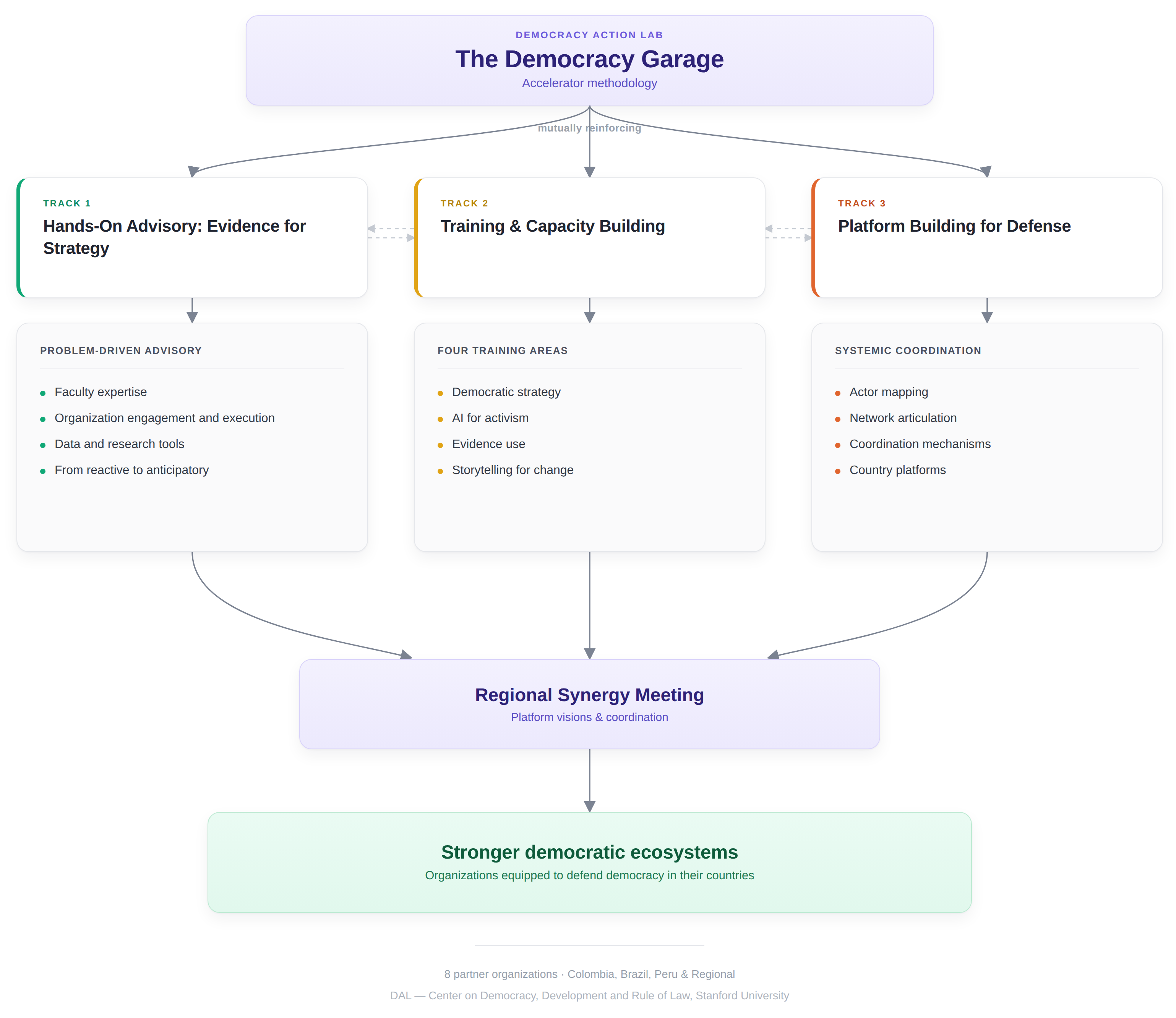
El modelo acelerador de The Democracy Garage se organiza en torno a tres ejes que se refuerzan mutuamente, diseñados para abordar una brecha clave en el ecosistema de apoyo democrático: muchos programas ofrecen formación de alto nivel desconectada de las necesidades inmediatas, o asistencia técnica a corto plazo que no genera capacidad duradera. The Garage tiende ese puente.

Eje 1  |  Análisis de Evidencia para la Estrategia Democrática  —  Asesoría Práctica

El primer eje proporciona apoyo de asesoría directa, orientada a los problemas. Cada organización  entra al Garage con un desafío concreto y actual. DAL moviliza su capacidad analítica — incluyendo la experiencia de su cuerpo docente, la participación de estudiantes y herramientas de datos — para abordarlo de forma colaborativa. No se trata de asistencia técnica unidireccional: es un proceso conjunto que desarrolla la propia capacidad de las organizaciones para usar la evidencia como herramienta estratégica, transitando de modos reactivos a anticipatorios.

Eje 2  |  Formación y Fortalecimiento de Capacidades  —  Cuatro Áreas Fundamentales

El segundo eje ofrece formación estructurada en cuatro áreas críticas para la acción democrática: (1) Estrategia para la defensa democrática — comprender el estado de la democracia en la región y sus principales desafíos; (2) IA para el activismo — aplicaciones prácticas de la inteligencia artificial para monitoreo, comunicación y toma de decisiones; (3) Evidencia para la defensa democrática — recolección, análisis e interpretación de datos vinculados directamente a las decisiones estratégicas; y (4) Narrativa para el cambio — traducir el análisis complejo en narrativas persuasivas que resuenen con tomadores de decisiones, medios de comunicación y ciudadanos.

Eje 3  |  Construcción de Plataformas para la Defensa Democrática  —  Escalar el Impacto Sistémico

El tercer eje apoya a las organizaciones  para que se conviertan en nodos fundacionales de plataformas nacionales de defensa democrática. El deterioro democrático rara vez se produce de forma aislada: requiere respuestas coordinadas entre la sociedad civil, los medios, la academia y las instituciones. A través del mapeo de actores, la articulación de redes y el desarrollo de mecanismos de coordinación, el Garage contribuye a construir ecosistemas estructurados capaces de acción colectiva. Este eje culmina en el Encuentro Regional de Sinergias en agosto de 2026, donde las organizaciones presentarán su visión de plataforma y sentarán las bases para la coordinación regional.

Image
Diagram of Democracy Action Lab's Democracy Garage accelerator methodology, showing three mutually reinforcing tracks — Advisory, Training, and Platform Building — leading to a Regional Synergy Meeting and stronger democratic ecosystems.


Metodología de aceleración de DAL (haga clic para ampliar)

Ocho Organizaciones. Tres Países. Una Región.


Tras un riguroso proceso de selección, The Democracy Garage se enorgullece en dar la bienvenida a las siguientes organizaciones participantes:

CESJUL — Centro de Estudios Socio Jurídicos Latinoamericanos (Colombia)  

Trabaja en la intersección del derecho penal, los derechos humanos y la gobernanza democrática, aportando análisis jurídico riguroso a los desafíos más urgentes de la democracia colombiana — incluyendo el uso del derecho tanto como herramienta de represión como vehículo de rendición de cuentas.

Dejusticia (Colombia)

Una de las organizaciones de derechos humanos más respetadas de América Latina — un auténtico think-and-do tank que combina investigación jurídica rigurosa con litigio estratégico, incidencia directa y formación de capacidades en antidiscriminación, justicia transicional y protección del espacio cívico.

Instituto Sou da Paz (Brazil)

Referente en política de seguridad pública en Brasil durante 25 años, influyendo en la legislación nacional sobre regulación de armas y reducción de homicidios mediante un enfoque basado en evidencia que centra a las comunidades más afectadas por la violencia, en particular la población negra brasileña.

Pacto pela Democracia (Brazil)

La principal coalición pro-democracia de Brasil, integrada por más de 200 organizaciones y reconocida internacionalmente como modelo de defensa democrática colectiva. Su protección coordinada de las elecciones de 2022 — más de 80 acciones entre 35 organizaciones — demostró el poder de construir coaliciones antes de que llegue la crisis.

Instituto de Estudios Peruanos (IEP) (Perú)

Una de las instituciones de ciencias sociales más antiguas y distinguidas de América Latina, el IEP ha construido durante seis décadas la base empírica del análisis democrático en el Perú — desde encuestas de opinión pública y estudios electorales hasta investigación interdisciplinaria sobre poder, desigualdad y el Estado.

Recambio (Perú)

En un país que ha tenido ocho presidentes en una década, Recambio reconstruye la cultura democrática desde dentro del sistema político — con una red de más de 500 egresados de 28 partidos políticos, diálogo interpartidario y la iniciativa 'Voces Contra la Polarización'.

Espacio Crítico (Regional, LAC)

Una organización regional que brinda apoyo estratégico personalizado, formación técnica y asesoría en seguridad a organizaciones de la sociedad civil, periodistas independientes y líderes políticos en la primera línea del retroceso democrático en América Latina y el Caribe.

D-Hub (Regional, Global)

Una comunidad global de defensores de la democracia que conecta a activistas de primera línea y organizaciones de la sociedad civil con expertos que han enfrentado desafíos similares — construyendo la infraestructura para la solidaridad democrática transfronteriza que ninguna organización puede sostener sola.

Un Hito Histórico


The Democracy Garage es el primer programa acelerador de este tipo diseñado específicamente para defensores de la democracia en América Latina y el Caribe. Al combinar el rigor de la investigación basada en evidencia, la agilidad de un modelo acelerador y la profundidad de una alianza a largo plazo, DAL está abriendo un camino inédito para fortalecer la resiliencia democrática — basado en la convicción de que las organizaciones más cercanas a la crisis están mejor posicionadas para afrontarla, cuando se les proporcionan las herramientas, el conocimiento y las conexiones adecuadas.

“Nos enorgullece inmensamente lanzar The Democracy Garage junto a estas ocho organizaciones extraordinarias," afirmó Beatriz Magaloni, codirectora del DAL y Graham H. Stuart Professor of International Relations en el Departamento de Ciencia Política. "Cada una de ellas representa lo que es la defensa de la democracia en la práctica, no en la teoría. Juntos, estamos comprometidos con algo sin precedentes: construir una comunidad de estrategia y solidaridad que fortalezca la democracia, país por país.”
 

Sobre el Democracy Action Lab

El Democracy Action Lab (DAL) es una iniciativa de investigación y estrategia con sede en el Center on Democracy, Development and Rule of Law de la Universidad de Stanford, dedicada a traducir las ciencias sociales en herramientas prácticas para quienes defienden la democracia. El DAL trabaja en la intersección entre la evidencia y la acción, colaborando con organizaciones de primera línea para fortalecer las instituciones democráticas, proteger el espacio cívico y contrarrestar las amenazas autoritarias en América Latina y más allá.

Read More

Wall plastered with posters and graffiti text reading "DEMOCRACY NOW"
News

Stanford Launches New Democracy Action Lab to Confront Global Democratic Backsliding

By combining rigorous research with practitioner collaborations, the Democracy Action Lab at the Center on Democracy, Development and the Rule of Law turns ideas into action.
Stanford Launches New Democracy Action Lab to Confront Global Democratic Backsliding
DAL launch panel
News

Political scientists emphasize need for pro-democracy coalitions at launch of Democracy Action Lab

Political science scholars discussed strengthening pro-democracy coalitions in a Wednesday event marking the launch of CDDRL’s new Democracy Action Lab.
Political scientists emphasize need for pro-democracy coalitions at launch of Democracy Action Lab
Prof. Adam Prezworski, Prof. Beatriz Magaloni, and Prof. Alberto Díaz Cayeros present during DAL’s Inaugural Conference at El Colegio de Mexico.
Blogs

Stanford’s Democracy Action Lab Launches in Mexico City

The new initiative from the Center on Democracy, Development and the Rule of Law connects research with frontline efforts to address democratic backsliding across Latin America.
Stanford’s Democracy Action Lab Launches in Mexico City
Hero Image
Illustration of diverse young activists emerging from a garage carrying books and a raised-fist flag, with a network of connected stars overhead, symbolizing the Democracy Garage.
Pariplab Chakraborty
All News button
1
Subtitle

El Primer Acelerador de Democracia de Este Tipo en América Latina y el Caribe.

Date Label
In Brief
  • El Laboratorio de Democracia en Acción (DAL, por sus siglas en inglés) del CDDRL lanzó el primer acelerador de democracia de América Latina, el Democracy Garage (Garaje de la Democracia).
  • El programa combina la capacidad de investigación y la experiencia docente del DAL con ocho organizaciones de Colombia, Brasil y Perú.
  • Beatriz Magaloni, codirectora del DAL, calificó la iniciativa como una comunidad de estrategia y solidaridad sin precedentes, impulsada por Stanford.
Display Hero Image Wide (1320px)
Yes
Authors
Héctor Fuentes
News Type
News
Date
Paragraphs

The Democracy Action Lab (DAL), a practitioner-centered initiative of the Center on Democracy, Development and the Rule of Law at Stanford University, is proud to officially announce the first cohort of its Democracy Garage, the first accelerator program of its kind dedicated to strengthening frontline democracy defenders across Latin America and the Caribbean.

The Democracy Garage was born from a simple but urgent conviction: democratic resilience is built not only through ideas, but through the capacity of organizations to act strategically, use evidence effectively, communicate persuasively, and adapt to rapidly evolving political environments. DAL built this program to close a persistent gap in democracy support, bridging high-level research with the real-time, operational needs of the organizations doing the hardest work on the ground.

Over the next few months, DAL will work side by side with eight extraordinary organizations across the region, applying a structured accelerator methodology to co-develop strategies tailored to the specific democratic challenges in each country. This is not a traditional growth program: it is a deep collaboration grounded in evidence, strategy, and solidarity.

A Three-Track Accelerator Model


The accelerator model of the Democracy Garage is organized around three mutually reinforcing tracks designed to address a key gap in the democracy support ecosystem: many programs either provide high-level training disconnected from immediate needs or short-term technical assistance that does not build lasting capacity. The Garage bridges this divide.

Track 1  |  Evidence Analysis for Democratic Strategizing  —  Hands-On Advisory

The first track provides direct, problem-driven advisory support. Each of the selected organizations enters the Garage with a defined, real-time challenge. DAL mobilizes its analytical capacity, including faculty expertise, student engagement, and data tools, to help address it collaboratively. This is not one-directional technical assistance: it is a joint process that builds organizations' own capacity to use evidence as a strategic tool, shifting from reactive to anticipatory modes of operation.

Track 2  |  Training and Capacity Building  —  Four Core Areas

The second track offers structured training in four areas critical to democratic action: (1) Strategizing for democratic defense — understanding the state of democracy in the region and its main challenges; (2) AI for activism — practical applications of artificial intelligence for monitoring, communication, and decision-making; (3) Evidence for democratic defense — data collection, analysis, and interpretation linked directly to strategic decisions; and (4) Storytelling for change — translating complex analysis into compelling narratives that resonate with policymakers, media, and citizens alike.

Track 3  |  Platform Building for Democratic Defense  —  Scaling for Systemic Impact

The third track supports participating organizations in becoming foundational nodes of country-level democratic defense platforms. Democratic erosion rarely unfolds in isolation: it requires coordinated responses across civil society, media, academia, and institutions. Through actor mapping, network articulation, and the development of coordination mechanisms, the Garage helps build structured ecosystems capable of collective action. This track culminates at the Regional Synergy Meeting in August 2026, where organizations will present their platform visions and lay the groundwork for regional coordination.

Image
Diagram of Democracy Action Lab's Democracy Garage accelerator methodology, showing three mutually reinforcing tracks — Advisory, Training, and Platform Building — leading to a Regional Synergy Meeting and stronger democratic ecosystems.


DAL's Accelerator Methodology (click to enlarge)

Eight Organizations. Three Countries. One Region.


After a rigorous selection process, The Democracy Garage is proud to welcome the following participating organizations:

CESJUL — Centro de Estudios Socio Jurídicos Latinoamericanos (Colombia)  

Works at the intersection of criminal law, human rights, and democratic governance, bringing rigorous legal analysis to the most pressing challenges in Colombian democracy — including the use of law as both a tool of repression and a vehicle for accountability.

Dejusticia (Colombia)

One of Latin America's most respected human rights organizations — a true think-and-do tank combining rigorous legal research with strategic litigation, direct advocacy, and capacity-building across anti-discrimination, transitional justice, and the protection of civic space.

Instituto Sou da Paz (Brazil)

A 25-year leader in public security policy in Brazil, shaping national legislation on firearms regulation and homicide reduction through an evidence-first approach that centers the communities most affected by violence — particularly Black Brazilians.

Pacto pela Democracia (Brazil)

Brazil's preeminent pro-democracy coalition of more than 200 organizations, and an internationally recognized model for coalition-based democratic defense. Its coordinated protection of the 2022 elections — over 80 actions across 35 organizations — demonstrated the power of building coalitions before the crisis arrives.

Instituto de Estudios Peruanos (IEP) (Perú)

One of Latin America's oldest and most distinguished social science institutions, IEP has spent six decades producing the empirical foundation for democratic analysis in Perú — from public opinion surveys and electoral studies to interdisciplinary research on power, inequality, and the state

Recambio (Perú)

In a country that has seen eight presidents in a decade, Recambio is rebuilding democratic culture from within the political system — with a network of over 500 alumni from 28 political parties, cross-partisan dialogue, and the 'Voices Against Polarization' initiative.

Espacio Crítico (Regional, LAC)

A regional organization providing tailored strategic support, technical training, and security advice to civil society organizations, independent journalists, and political leaders on the front lines of democratic backsliding across Latin America and the Caribbean.

D-Hub (Regional, Global)

A global community of democracy defenders connecting frontline activists and civil society organizations with experts who have faced similar challenges — building the infrastructure for cross-border democratic solidarity that no single organization can sustain alone.

A Historic First


The Democracy Garage is the first accelerator program of this type designed specifically for democracy defenders in Latin America and the Caribbean. By combining the rigor of evidence-based research, the agility of an accelerator model, and the depth of long-term collaboration, DAL is pioneering a new approach to democratic resilience — one grounded in the conviction that the organizations closest to the crisis are best positioned to address it, when equipped with the right tools, knowledge, and connections.

"We are immensely proud to launch the Democracy Garage alongside these eight remarkable organizations," said DAL co-director Beatriz Magaloni, the Graham H. Stuart Professor of International Relations. "Each of them represents what democratic defense looks like in practice, not in theory. Together, we are committed to something unprecedented: building a community of strategy and solidarity that makes democracy stronger, one country at a time."
 

About the Democracy Action Lab

The Democracy Action Lab (DAL) is a research and strategy initiative housed at Stanford University’s Center on Democracy, Development and Rule of Law, dedicated to translating social science into practical tools for democracy defenders. DAL works at the intersection of evidence and action, partnering with frontline organizations to strengthen democratic institutions, protect civic space, and counter authoritarian threats across Latin America and beyond.

Read More

Wall plastered with posters and graffiti text reading "DEMOCRACY NOW"
News

Stanford Launches New Democracy Action Lab to Confront Global Democratic Backsliding

By combining rigorous research with practitioner collaborations, the Democracy Action Lab at the Center on Democracy, Development and the Rule of Law turns ideas into action.
Stanford Launches New Democracy Action Lab to Confront Global Democratic Backsliding
DAL launch panel
News

Political scientists emphasize need for pro-democracy coalitions at launch of Democracy Action Lab

Political science scholars discussed strengthening pro-democracy coalitions in a Wednesday event marking the launch of CDDRL’s new Democracy Action Lab.
Political scientists emphasize need for pro-democracy coalitions at launch of Democracy Action Lab
Prof. Adam Prezworski, Prof. Beatriz Magaloni, and Prof. Alberto Díaz Cayeros present during DAL’s Inaugural Conference at El Colegio de Mexico.
Blogs

Stanford’s Democracy Action Lab Launches in Mexico City

The new initiative from the Center on Democracy, Development and the Rule of Law connects research with frontline efforts to address democratic backsliding across Latin America.
Stanford’s Democracy Action Lab Launches in Mexico City
Hero Image
Illustration of diverse young activists emerging from a garage carrying books and a raised-fist flag, with a network of connected stars overhead, symbolizing the Democracy Garage.
Pariplab Chakraborty
All News button
1
Subtitle

The first democracy accelerator of its kind in Latin America and the Caribbean.

Date Label
In Brief
  • CDDRL’s Democracy Action Lab (DAL) has launched Latin America's first democracy accelerator, the Democracy Garage.
  • The program pairs DAL’s research capacity and faculty expertise with eight organizations across Colombia, Brazil, and Perú.
  • DAL co-director Beatriz Magaloni called the initiative an unprecedented Stanford-led community of strategy and solidarity.
Display Hero Image Wide (1320px)
Yes
Paragraphs

Background

The pandemic of antimicrobial resistance (AMR) will only be mitigated by policy action and innovation and importantly, supported by local and community action. With the United Nations General Assembly high level meeting on AMR taking place in September 2024, we decided to ascertain citizens’ understanding of the issues and prioritisation for action.

Methods

From June to August 2024, while intergovernmental negotiations on the outcome document were taking place, we used Deliberative Polling®, a methodology founded on deliberative democratic theory, in six middle income countries across three continents to explore people’s understanding and support for 45 policies that were likely to feature in the political declaration.

Results

In total 2419 participants were randomised to deliberation intervention (written and video information, facilitated online small group discussions, and expert plenary sessions) or control groups who only completed the pre- and post-deliberation surveys. Support increased significantly through deliberation for 3/4 of the proposals (>90% for 2/3), as well as on knowledge about AMR and internal political efficacy. Proposals relating to infection prevention were most heavily supported across all six countries. We found regional variation in support for proposals relating to informal antibiotic access and the use of antibiotics in food production, with less support for selected proposals from South America.

Conclusions

Deliberative polling is a powerful method of large scale community engagement and this is new for AMR helping us to understand the views of the public relating to policies that will require their support to enact.

All Publications button
1
Publication Type
Journal Articles
Publication Date
Subtitle

[version 2; peer review: 2 approved, 3 approved with reservations]

Journal Publisher
Wellcome Open Res 2026
Authors
Alice Siu
James S. Fishkin
Number
10:690
News Type
News
Date
Paragraphs

For the second time in history, UN Member States adopted a Political Declaration on AMR in 2024. This declaration outlines ambitious commitments to tackle one of the most pressing health challenges of our time. These commitments will only be successful if the public understands, supports, and ultimately changes behavior to make them work.

Ahead of UNGA, we asked citizens in six countries what they thought about different policy proposals across six themes: Equity, Access and Stewardship; Infection Prevention; Food Security; Awareness and Education; Target setting; and Surveillance.

Working with the Trinity Challenge, we brought together 2,419 citizens from Brazil, Colombia, Nigeria, Tanzania, India, and Indonesia using Deliberative Polling®, a method that assesses what a representative and informed sample would think about policy proposals after extended, evidence-based discussions. Deliberations took place on the innovative Artificial Intelligence (AI)-assisted Stanford University Online Deliberation Platform across two days.

Citizens left the process not just more informed, but more engaged with the solutions required.

What is Deliberative Polling® ?


Deliberative Polling® is a research methodology developed by Professor James Fishkin at Stanford University's Deliberative Democracy Lab. Unlike standard opinion polling, it measures not just initial public opinion but informed public opinion - what people think after genuine engagement with the issues, trade-offs, and expert perspectives.

It has been applied in over 160 cases around the world, from national referendums to climate policy.

Learn more about the Deliberative Polling® methodology.

"Deliberative Polling® doesn't just ask what people think - it asks what they would think if they had the chance to really engage with the evidence."
Professor James Fishkin
Stanford Deliberative Democracy Lab

Key Findings


The results were striking - and they matter for policymakers, health leaders, and the public alike.

🌍 2,419 citizens across six middle-income countries participated
📈 43 out of 45 policy proposals saw increased support after deliberation
✅ The most popular proposals were those relating to infection prevention
🌐 Regional differences emerged — particularly around attitudes to restricting antibiotic use in food production.

Antimicrobial resistance is not only a scientific challenge but a societal one. This project shows that when citizens are given balanced information, diverse perspectives, and the opportunity to deliberate, they can engage meaningfully with the complexity of AMR and support the action it requires. Building public trust and community engagement is essential to reducing the global impact of AMR. We hope these findings and resources will help advance public engagement on AMR and strengthen deliberative approaches across global health.

Support increased for 43 out of 45 proposals following deliberation. Beyond the data, participants left better informed about AMR and more engaged with the solutions on the table. That is whole-of-society action in practice.
Dame Sally Davies
Master of Trinity College Cambridge and Executive Chair of the Trinity Challenge

From Understanding to Action


This study demonstrates something important: when citizens are given the chance to engage seriously with a complex global health challenge, they rise to it.

Across all six countries, deliberation moved public opinion towards greater support for ambitious AMR action — on prescription practices, agricultural use, access to medicines, and prevention. The 2024 UN Political Declaration set out what governments have committed to. This research shows that the public, when informed, is ready to support it.

The findings have direct relevance for:

  • Policymakers designing national AMR action plans, particularly in middle-income countries
  • Health communicators seeking evidence-based approaches to public engagement on AMR
  • Researchers building the evidence base for deliberative approaches in global health
  • Civil society organizations advocating for community-level AMR action
     

We are committed to sharing these findings as widely as possible — with governments, health bodies, and the communities that took part.

Thanks to our funders


With thanks to the Novo Nordisk Foundation and Wellcome.

Contact and Media


For media inquiries and further information about the research, please contact Louise Gough (Chief Operating Officer) at info@thetrinitychallenge.org.

Read our press release.

Hero Image
Person in blue shirt washing hands
Melissa Jeanty
All News button
1
Subtitle

The Deliberative Democracy Lab and the Trinity Challenge asked 2419 people in six countries through the first-ever deliberative poll on AMR.

Image
Person in blue shirt washing hands
Photo credit Melissa Jeanty
Aria Label
Read More What Do Citizens Around the World Really Think About Tackling Antimicrobial Resistance (AMR)?
Date Label
Display Hero Image Wide (1320px)
Yes
News Type
News
Date
Paragraphs

For over 25 years, Stanford’s Kimberly Babiarz has felt fiercely devoted to addressing the complex injustice of human trafficking, a crime she is quick to point out, “is everywhere.” 

Modern slavery, which includes sex and labor trafficking, forced labor, domestic servitude, debt bondage, and forced marriage, is “a big, systemic problem in need of big, systemic solutions,” she notes.

Those kinds of solutions typically require a diverse array of skillsets and experience – not to mention a great deal of dedication to the work, both of which Babiarz found when she and longtime collaborator Grant Miller, Henry J. Kaiser, Jr. Professor in the Department of Health Policy at Stanford School of Medicine, linked up with Jessie Brunner of Stanford’s Center for Human Rights and International Justice, Clinical Associate Professor of Pediatrics Vicki Ward, and Luis Assis, labor prosecutor and Chief Data Scientist at Brazil’s Federal Labor Prosecution Office.

The group coalesced around a shared sense of frustration at the lack of an evidence base undergirding decades of anti-trafficking interventions and the Stanford Human Trafficking Data Lab was born in 2019 with a mission to bring data and evidence to the fight against human trafficking.

“Few things give me more satisfaction than gathering folks with disparate backgrounds and skillsets towards achieving a common goal to advance human rights,” said Brunner. “Forming the Lab was a unique opportunity to leverage advances in data science and technological innovation to bear on one of the most grievous abuses of our time.”

Fairly quickly, the team identified a gap they could fill in and around the remote Amazon region in northeastern Brazil.

“The steady pace of deforestation and land conversion in the Amazon relies on the exploitation of people, including some children, who work strenuous 16-hour days, often without pay, burning trees at extremely high temperatures and converting them into charcoal,” explains Miller, the Lab’s Principal Investigator. “This all takes place at illegal work sites, where laborers live without adequate shelter or clean water, that are intentionally hidden from view in remote areas.”

Because these sites consist of an almost geometric line-up of dome-shaped kilns devoted to burning trees and an output of thick smoke, the researchers realized their footprints are uniquely visible from space. 

Using geospatial data and remote detection algorithms, the lab was able to pinpoint a clear way in which data science could be leveraged to help Brazilian prosecutors locate and investigate the stealth work sites where laborers are often exploited in conditions analogous to slavery. 

At a Stanford Impact Labs storytelling event in April, Babiarz vividly described the thrill of realizing that an algorithm could be put to work against this severe, yet frequently invisible, human rights issue plaguing Brazil. By building a data-driven tool to find and map illegal charcoal production sites, she described how her team helped law enforcement uncover nearly 200 previously unknown sites.

Most exciting of all, prosecutors were able to inspect 130 of those sites and carried out 10 times more task force raids than historically observed. Most importantly, the team observed a surge in the number of workers rescued from conditions of modern slavery, a more than 10-fold increase compared to typical years. The team is now rolling the tool out to every charcoal producing region in Brazil and exploring the tool’s applicability potential in other geographies and sectors. 

“We found a way to build a solution big enough to meet the scale of the problem in a corner of the world that really needs it,” Babiarz notes. "We also found a great deal of hope in being a part of this solution. By harnessing powerful technology in the context of a trusted partnership, we were able to deliver real impact to people in need of real help.”

The steady pace of deforestation and land conversion in the Amazon relies on the exploitation of people.
Grant Miller, PhD
Professor of Health Policy and Director of the Trafficking Lab

The team's work in Brazil is far from over. 

With funding from Stanford Impact Labs, the Lab is expanding the impact of their work in Brazil’s charcoal sector, working with Brazil’s Federal Labor Prosecution Office to create a new data-driven technical tool to map exploitative supply chains. The tool will identify labor trafficking and illegal deforestation in distant tiers of the supply chain by integrating data from siloed publicly available administrative and legal records, making it easier for private sector steel manufacturers to address both trafficking and deforestation in their supply chains.

“The supply chain tracing tool is yet another example of the way our Lab is leveraging advances in data and social sciences to reach more trafficking victims and hold their exploiters accountable,” said Assis. “This has the potential to really change the game.”

This story was originally published by Stanford Impact Labs Director of Strategic Communications & Outreach Kate Green Tripp.


Read More

Illustration of charcoal kilns in Brazil
News

Launching AI-Driven Initiatives to Combat Labor Trafficking in Brazil

The Stanford Human Trafficking Data Lab, in partnership with Brazil’s Federal Labor Prosecution Office (FLPO), is developing Chain-Link, a new data-driven technical tool to map exploitative supply chains.
Launching AI-Driven Initiatives to Combat Labor Trafficking in Brazil
Grant Miller charcoal baking site in Brazil
News

Stanford Researchers Investigate Human Trafficking Alongside Brazilian Partners

Grant Miller and members of his Stanford Human Trafficking Data Lab travel to Brazil to investigate possible trafficking sites while working with their Brazilian counterparts to expand an AI database.
Stanford Researchers Investigate Human Trafficking Alongside Brazilian Partners
Stanford Students-Brazil
News

Students Devote Their Summer to Combating Human Trafficking in Brazil

Three Stanford students spend their summer in Brazil with Stanford faculty and researchers, all of whom are members of the Stanford Human Trafficking Data Lab.
Students Devote Their Summer to Combating Human Trafficking in Brazil
Hero Image
Brazil Aerial
Getty Images
All News button
1
Subtitle

Meet the team behind an ambitious anti-trafficking research agenda, including SHP's Kim Babiarz and Grant Miller.

Terms
Image
Brazil Aerial
Photo credit Getty Images
Title
The Data-Driven Fight Against Modern Slavery in Brazil
Aria Label
Read More A Solution Big Enough
Date Label
Display Hero Image Wide (1320px)
Yes
Authors
Nensi Hayotsyan
News Type
News
Date
Paragraphs

In a CDDRL research seminar held on November 20, 2025, Gerhard Casper Postdoctoral Fellow Ana Paula Pellegrino presented her research on the emergence of police-led armed illicit groups (PLAIGs) in Brazil. Pellegrino defines them as illicit organizations with coercive capacity led by active-duty police officers. Her seminar explored what makes these groups distinctive, why they form, and the conditions that allow them to take shape.

As discussed by Pellegrino, unlike ordinary corruption, informal protection rackets, or gangs that employ off-duty police as security, PLAIGs are fully organized and independently governed armed groups that operate illicitly, possess their own coercive capacity, and are led by active-duty police officers who remain part of the state. Because of this unique position inside the public safety apparatus, these groups can draw on the authority and resources of the state, becoming spoilers of efforts to monopolize violence.

To better understand how these groups arise, Pellegrino examines both the motivations behind their formation and the conditions that enable them. She argues that officers create these groups primarily as a rent-extraction strategy when they perceive the costs of policing to be rising, typically in response to a growing armed threat. As violence escalates, both politicians and the police feel pressure: politicians face public demands for safety, while officers face greater personal danger on the ground. This imbalance produces frustration within the police ranks and motivates some officers to exploit their coercive capacity for profit. 

However, motivation alone is not enough, as the opportunity to form PLAIGs depends on two enabling conditions. First, police must have greater coercive capacity than the threat they face, allowing them to compete with or expel armed groups. Second, they must have sufficient discretion to use their capacity outside of official duties. Pellegrino emphasizes that this autonomy is shaped by the degree of political control over police. When oversight is strong, officers cannot use state resources to build private organizations. When oversight is weak, however, officers have both the means and the opportunity to organize. Pellegrino refers to this dynamic as the Warrior’s Paradox: the increased investment in police capacity meant to combat disorder also creates the conditions for police to generate disorder themselves.

To test her argument, Pellegrino draws on extensive process tracing and three years of fieldwork in Rio de Janeiro and São Paulo. Despite similar histories of police violence, only Rio developed PLAIGs. Pellegrino shows that Rio consistently expanded police coercive power while failing to impose meaningful oversight, creating the conditions for PLAIGs to flourish after the rise of the Red Command and the Third Command of the Capital, prison gangs turned drug trade organizations. São Paulo, by contrast, implemented institutional reforms in the 1990s and early 2000s that tightened accountability, standardized use-of-force rules, and constrained police discretion, even after the rise of the First Command of the Capital, an equally powerful drug trade organization. As a result, officers in São Paulo lacked the autonomy and impunity necessary to form armed organizations.

Pellegrino closed by emphasizing that PLAIGs emerge not from state weakness but from well-equipped police forces operating with insufficient oversight, enabling officers to convert state authority into private coercive power. This, she claims, illustrates how police can become actors who undermine, rather than protect, the state’s monopoly of violence.

Read More

Hanna Folsz presented her research in a CDDRL seminar on November 13, 2025.
News

Economic Retaliation and the Decline of Opposition Quality in Hungary

CDDRL Pre-doctoral Fellow Hanna Folsz presented her research, which builds on her focus on authoritarianism and democratic backsliding.
Economic Retaliation and the Decline of Opposition Quality in Hungary
Killian Clarke
News

The Fragility of Democratic Revolutions: Why Counterrevolutions Emerge and Succeed

Georgetown political scientist Killian Clarke argues that unarmed, democratic revolutions are uniquely vulnerable to reversal, not because they lack legitimacy or popular support, but because of the kinds of power resources they rely on and later abandon.
The Fragility of Democratic Revolutions: Why Counterrevolutions Emerge and Succeed
Oren Samet presented his research in a CDDRL seminar on October 30, 2025.
News

Challenging Autocrats Abroad: Opposition Parties on the International Stage

In a CDDRL research seminar, Einstein-Moos Postdoctoral Fellow Oren Samet explored the benefits, costs, and global reach of opposition diplomacy.
Challenging Autocrats Abroad: Opposition Parties on the International Stage
Hero Image
Anna Paula Pellegrino presented her research in a CDDRL seminar on November 20, 2025.
Anna Paula Pellegrino presented her research in a CDDRL seminar on November 20, 2025. | Nora Sulots
All News button
1
Subtitle

Gerhard Casper Postdoctoral Fellow Ana Paula Pellegrino presented her research on police-led armed illicit groups in Brazil, exploring what distinguishes them and the conditions that enable their formation.

Date Label
Authors
News Type
News
Date
Paragraphs

Motivation and Summary


Modern states depend upon bureaucracies effectively delivering services and enforcing regulations, from public health to environmental protection and postal services. When bureaucracies are plagued by inefficiency and incapacity and are unable to “deliver the goods,” elected representatives suffer. This can open the door for citizens to throw their support behind authoritarian leaders who promise to deliver more effectively.

A central question of bureaucratic design concerns the degree of autonomy that ‘principals’ — political actors like legislators — should delegate to bureaucratic ‘agents.’ Calibrating autonomy is crucial because principals cannot perfectly monitor or control agents, whose preferences often diverge from their own. On the one hand, highly autonomous bureaucrats may become unaccountable to their principals. Think of national security agencies that create secretive dissident watchlists or even authorize assassinations. On the other hand, bureaucracies with little autonomy will find their decision-making hamstrung by “red tape.” If public health agencies required extensive legislative approval for every aspect of vaccine delivery, infection rates would skyrocket. How, then, can bureaucracies be designed to achieve their goals, creatively respond to new problems, and minimize corruption, all while being perceived as legitimate?

In “Calibrating autonomy,” Katherine Bersch and Francis Fukuyama disaggregate the concept of autonomy into two facets (independence and discretion), present hypotheses concerning how each facet relates to capacity and quality, and then test these hypotheses, primarily using survey data from Brazilian bureaucrats. Their findings caution against overly blunt efforts to calibrate autonomy across multiple bureaucracies, suggesting instead that policymakers should understand a given agency’s capacity to perform.

Argument and Hypotheses


The article builds on earlier research by co-author Francis Fukuyama, who in 2013 hypothesized a key moderating role for bureaucratic capacity in the relationship between autonomy and quality. Briefly, low-capacity agencies — lacking expertise and resources — will likely struggle to utilize their autonomy and deliver, whereas high-capacity bureaucracies will deliver effectively for opposite reasons. However, autonomy is itself a complex concept that ought to be disentangled before one can begin to spell out how it is linked to delivery.

Independence, the first “face” of autonomy, concerns the degree to which bureaucrats are constrained by actors who are close to politics, such as elected leaders or politically-appointed agency heads. More independent bureaucrats might allocate waste management contracts on the basis of cost-effectiveness or service quality records. Less independent bureaucrats might allocate according to the whims of politicians who wish to reward their allies. The degree of independence is oftentimes a function of the number and extent of political appointees in a given agency. 

The second face of autonomy is discretion, or rather, the extent to which agencies are constrained by laws, rules, or protocols. Waste management agencies with limited discretion may struggle to respond to sporadic garbage pile-ups, whereas those with high discretion may set unpredictable collection schedules. 

These two faces of autonomy lead to different expectations about how they are connected to quality. The authors hypothesize that independence and quality stand in a linear and positive relationship: agencies that are more unconstrained by political actors will deliver more effectively. By contrast, discretion and quality stand in a non-linear or “Goldilocks” relationship: too few and too many constraining rules will reduce quality. Following Fukuyama’s earlier research, capacity moderates these relationships; for example, less independence in specifically low-capacity agencies may strengthen quality, perhaps in cases where legislative actors are able to appoint highly qualified experts.

Methods and Findings


The authors select Brazil as their case, in part because it exhibits considerable internal variation in bureaucratic quality: some agencies are professional while others are incompetent. By focusing on one country, they avoid comparing fundamentally different national bureaucratic contexts. Further, selecting Brazil — with both strong and weak bureaucracies — reduces ‘selection biases,’ i.e., mistaking characteristics of only high- or low-quality agencies as causes of overall performance. From a global standpoint, Brazilian bureaucracies are solidly middle-ranged, neither outstanding nor abysmal. 

The main empirical part of the paper involves a 2018 survey of over 3200 Brazilian federal bureaucrats. About 60% of the respondents are political appointees and 40% are civil servants, which enables looking at bureaucrats who stand in different relationships to political actors. The authors exclude military personnel, teachers, nurses, and local police officers.

As hypothesized, respondents’ perceptions of agency independence increase their perceptions of quality in a linear way. This finding likely reflects Brazil’s coalitional style of government: politicians benefit electorally from strong government performance; without bureaucratic independence, political pressure and influence from the many coalition partners would likely hinder bureaucrats and weaken performance. Meanwhile, perceptions of discretion align with the authors’ non-linear expectations.


Image
Figure 3: (a) Impact of independence on quality at varying levels of capacity. (b) Impact of discretion on quality at varying levels of capacity.


Figure 3: (a) Impact of independence on quality at varying levels of capacity. (b) Impact of discretion on quality at varying levels of capacity.


These findings are mediated by capacity, which the authors measure in terms of resources, career length, salaries, and the proportion of agents in core or expert careers. The findings hold even when controlling for political factors like party membership or appointment type (political vs. civil servant), individual characteristics such as gender or years of service, and agency differences, including budget or size. These controls are based on administrative data from over 326,000 bureaucrats across Brazil’s 95 most important federal agencies.


Image
FIgure 4: Quality at varying levels of capacity.


Figure 4: Quality at varying levels of capacity.


Contributions and Implications

“Calibrating autonomy” makes important conceptual and empirical contributions to our understanding of bureaucratic performance. By disaggregating the concept of autonomy into independence and discretion, it helps make sense of seemingly contradictory empirical findings, namely that both minimally and highly autonomous bureaucracies perform well. And by evaluating their hypotheses about the two faces of autonomy using Brazilian data, the authors guard against selection biases or problems from comparing countries with quite different bureaucratic landscapes.

The paper serves as a caution against overly simplistic or blunt “solutions” to poor bureaucratic performance. Merely limiting discretion or increasing legislative oversight can make matters worse if the relevant bureaucratic culture is not properly understood, especially when it comes to capacity.

*Research-in-Brief prepared by Adam Fefer.

Hero Image
National Congress of Brazil (Congresso Nacional) in Brasília
National Congress of Brazil (Congresso Nacional). | Gabriel Tiveron
All News button
1
Subtitle

CDDRL Research-in-Brief [4-minute read]

Date Label
Subscribe to Brazil