Diplomacy
Authors
Noa Ronkin
News Type
Q&As
Date
Paragraphs

U.S.-China relations have been deteriorating at an alarming speed, and as distrust grows on both sides, it is unclear how to stop the downward spiral. What does China want and how can we best assess Chinese intentions?

This is a key question on the research agenda of East Asian security expert Oriana Skylar Mastro, FSI’s newest Center Fellow. Mastro, an assistant professor of security studies at Georgetown University’s Edmund A. Walsh School of Foreign Service, will begin her appointment at FSI on August 1 and be based at the Shorenstein Asia-Pacific Research Center (APARC), where she will continue her research on Chinese military and security policy, Asia-Pacific security issues, war termination, and coercive diplomacy. She will also work with the Center for International Security and Cooperation (CISAC), and teach students in both the CISAC Honors program and the Ford Dorsey Master’s in International Policy program.

Here, Mastro discusses Chinese ambitions and the rapidly increasing tensions in U.S.-China relations; talks about her military career and new research projects; shares how she first became interested in East Asian security issues as a Stanford undergraduate student; and even reveals some things we don’t know about her.

[To receive stories like this directly in your inbox sign up for APARC’s newsletters]


You have argued in your writings that although China does not want to usurp the United States’ position as the leader of the global order, its strategic goal in the Indo-Pacific region is nearly as consequential. Why is it so? What do you foresee for Chinese aims and the U.S.-China rivalry as we near the U.S. presidential election?

Mastro: My claim is that China doesn't want to replace the United States but rather displace the United States. It’s an important distinction because it’s become popular to assume that China wants to have everything that we, the United States, have and that its view of power is the same as ours. But if you look throughout history, every time a country rises, it exercises its power differently. The United States, for example, didn't build colonies because Great Britain had had colonies. It is equally unlikely to assume that China is going to build a global military and engage in foreign military interventions.

We make assumptions about what China wants and how it will get there based on our own experiences, and those tend to be incorrect.
Oriana Skylar Mastro

Therefore, I argue that China doesn't want to dominate the world. This doesn’t mean that its ambitions are limited, but rather that it thinks that the U.S. in-depth global involvement is an ineffective and costly way of doing business. Outside of Asia, China relies mainly on political and economic influence to ensure that no one goes against its interests. It is only in Asia where China’s military goals are problematic for the United States and where it wants to dominate and see the U.S. military less active. Again, this isn't due to lack of ambition: from China’s viewpoint, whoever dominates Asia, the world’s most dynamic and economically important region, is a superpower, just like whoever dominated Europe during the Cold War would have been a superpower. In short, I think we make assumptions about what China wants and how it will get there based on our own experiences, and those tend to be incorrect.

As for what’s ahead for the U.S.-China relationship and the coming presidential election, I think it’s a misconception to interpret the frictions between the two countries as stemming from the Trump administration. There are aspects of Chinese behavior that both the Republican and Democratic parties find problematic and I believe we will see a tougher policy towards China, regardless of who wins the election. A Democratic president might be less willing to risk confrontation with the Chinese the way the Trump administration is, but either way, I see increased tensions between the two sides as the norm for the next several years.

In your recent testimony on China’s maritime ambitions before the House Committee on Foreign Affairs, you distinguish between China's aims in its near seas and far seas. How do these intentions differ and why is it important to make the distinction between them?

Mastro: In the near seas — the South China Sea (SCS) and the East China Sea (ECS) — China is concerned with sovereignty, which is absolute control of these waters, and with regional hegemony. In the far seas — the Indian Ocean and beyond — China aims to operate, but it doesn’t aspire to exclude others from doing so. In these waters, China's ambitions are driven primarily by the desire to protect its strategic lines of communication and its economic and political interests.

While China's objectives in the South China Sea and East China Sea are detrimental to U.S. interests, some aspects of its objectives in the Indian Ocean and beyond are legitimate and do not necessarily threaten U.S. interests, although they are not without risks.
Oriana Skylar Mastro

It’s important to make this distinction for strategy reasons, which goes right to my previous point. There’s a growing sense now that “whatever China does is bad and the United States needs to counter everything China does,” but that's not quite true. While China's objectives in the SCS and ECS are detrimental to U.S. interests, some aspects of its objectives in the Indian Ocean and beyond are legitimate and do not necessarily threaten U.S. interests, although they are not without risks.

U.S. policy needs to consider these differences in the degree of threat because prioritization is crucial for strategy. If we are to prioritize our strategies, then we should prioritize countering China’s ambitions in its near seas and try to shape its objectives in the far seas, perhaps through more cooperative policies. Perceiving everything that China does as bad isn’t the right approach to competing with it.

In addition to your academic career, you have an extensive military portfolio: for over ten years, you have served in the United States Air Force Reserve. You have just been awarded the Meritorious Service Medal. Tell us more about this award, how your academic and military careers influence each other, and what it’s like to balance the two.

Mastro: I'm a special type of reservist called Individual Mobilization Augmentee (IMA), which means that I have a custom duty schedule and work with my active-duty supervisors to help meet mission requirements of whatever the priority is at the time. The award I just received, the Meritorious Service Medal, which is a recognition of commendable noncombatant service, is for my last role as a senior China analyst at the Pentagon. My main duties in that role were to prepare intel products and brief the senior leadership of Headquarters Air Force at the Pentagon.

I think that the mix of my two careers makes me a better military officer and a better scholar. My experiences in the military inspire a lot of my research projects, oftentimes regarding questions that I don't have good answers for. As an officer, I need the power of argumentation on my side if I am to make a difference. After I engage in the good academic practice of spending a year or more researching something in-depth, I can then go back and provide inputs into the Department of Defense. There is a synergy between the two careers in terms of topics.

Moreover, my experiences in the military have taught me leadership and teamwork skills that we don’t necessarily learn from being professors. There’s a vast difference in leadership and teamwork dynamics between the military and academia. When I’m on active duty, I'm there as Major Mastro to provide my expertise but also be a strong part of a team with a chain of command.

Of course, managing both civilian and military careers demands considerable planning and balancing. I schedule my deployments around my teaching schedule, but sometimes there are urgent assignments given current world events. For example, last semester, I was on duty one day a week while teaching full time. So that requires planning and flexibility on the part of my family, as well as support from the people who employ me.

How did you first become interested in China and East Asian security issues, and what made you pursue a military career?

Mastro: This is a fun topic to talk about at Stanford because it's all thanks to my experiences as an undergraduate student on The Farm. As a freshman, I began learning Chinese, and in the following years, being humanities- and arts-focused, I mainly studied ancient China and Chinese literature. When I returned to campus after a year of intensive study in China, I was looking for a research opportunity and heard about the CISAC Honors Program in International Security Studies. So it was only in my senior year that I took my first course in political science and was exposed to international security studies. I discovered a passion for this topic like nothing else I had studied before. I wanted to learn more and got my first job, at the Carnegie Endowment, researching security issues, and then decided to continue with graduate studies.

During my Ph.D. at Princeton, I met a General in the Air Force who told me I should join the military. At that point, I'd never met anyone in the military. I thought, “I’m not very tough; what could I possibly contribute?” But I took up on his suggestion to do an internship with the U.S. Indo-Pacific Command and realized that my Chinese language skills and knowledge about China could be useful. I wanted to serve and planned to do my duty for four years and be done, yet here we are, nearly 11 years later. It’s been a blessing to make a whole career out of this and it’s truly all thanks to many memorable experiences at Stanford and the CISAC Honors Program. I’m thrilled to be back and looking forward to teaching and mentoring students in the Honors program and the Ford Dorsey Master’s in International Policy program.

What are some of your current research projects and what do you plan to work on at APARC and Stanford at large?

Mastro: My main project is researching a book about what China wants – a framework for understanding how to assess Chinese intentions. This is a policy-relevant book that engages with international relations theory and literature, where understanding state intentions plays a key role. The framework I’m developing assesses information to answer what China’s intentions are in several areas and regarding several cases. There will be chapters on China’s regional ambitions, global ambitions, approach to international institutions, and intentions towards the economic and technological order. As part of this project, you may see me currently publishing works on the South China Sea or the Indian Ocean.

China doesn't have any alliances, but that doesn't mean it isn’t aligned or working with other countries.
Oriana Skylar Mastro

Another project, in its beginning stages, focuses on the China-Russia relationship. Here the overarching framework is an attempt to understand state cooperation. This relates to alliances, though the notion of alliances is rather outdated. China doesn't have any alliances, but that doesn't mean it isn’t aligned or working with other countries. The question is what types of cooperation between China and Russia are problematic for the United States and what types are not. Again, we need to prioritize: is it so bad if China and Russia back each other in the UN, or is it worse that they exercise together? I don't know yet, but I think that international relations theory can shed some light on these questions.

Tell us something we don’t know about you.

Mastro: It may seem that I constantly work because I have a military career in addition to being very involved in the policy and academic worlds, but many people don't realize that I'm a big fan of leisure. I spend plenty of time with my children and have multiple hobbies that I engage in daily: I read novels, do yoga and CrossFit, play the piano, and manage to sleep! I was a very serious pianist and still take Skype lessons with my old teacher back in Chicago. Now with the move to California, I’ll finally be able to enjoy the grand piano my parents bought me for my 16th birthday, which I never had room for. I'm a firm believer in work-life balance. It's just that my work, too, is a passion and a hobby of mine.

Read More

A Chinese day trader reacts as he watches a stock ticker at a local brokerage house on August 27, 2015 in Beijing, China
News

China Faces Tough Decisions and Stronger Headwinds

China has had great success, but the era of miracle growth is over. Citizen needs and expectations are rising, and deferred reforms are riskier and more necessary, explain Jean Oi and Thomas Fingar on the World Class Podcast.
China Faces Tough Decisions and Stronger Headwinds
(From left to right) Siegfried Hecker, Victor Cha, Oriana Mastro, Gi-Wook Shin, Robert Carlin
News

Experts Discuss Future U.S. Relations with North Korea Amid Escalations

Led by APARC, a panel of scholars hosted by the Freeman Spogli Institute weighs in on the implications of recent events on the Korean peninsula and the ongoing uncertainties in charting a future course with the DPRK.
Experts Discuss Future U.S. Relations with North Korea Amid Escalations
Hero Image
Portrait of Oriana Mastro with text: "Q&A with Oriana Skylar Mastro"
All News button
1
Subtitle

Mastro, whose appointment as a Center Fellow at Shorenstein APARC begins on August 1, considers the worsening relations between the world’s two largest economies, analyzes Chinese maritime ambitions, and talks about her military career and new research projects.

Authors
Kiyoteru Tsutsui
News Type
Commentary
Date
Paragraphs

This op-ed by Kiyoteru Tsutsui was originally published in The Hill.


With the specter of a cold war with China arising, allies in Asia-Pacific are increasingly important for the United States, whether in fighting pandemics, negotiating trade deals, or containing territorial disputes. Japan historically has been one of the most important partners for American interests in the region and a steadfast ally in the post-World War II era. 

For Japan, too, the U.S.-Japan security alliance has been the cornerstone of its foreign policy for decades, and the Japanese public clearly understands that. Reflecting this understanding, every new security decision in Japan, from the relocation of a U.S.-base in Okinawa to the recent cancellation of Aegis Ashore deployment, spurs intense public debates about the future of the U.S.-Japan alliance. (Continue reading the full article at The Hill.)


[Subscribe to our newsletters to get the latest commentary from APARC scholars.]

Read More

South Koreans participate in a rally to denounce Japan's new trade restrictions and Japanese Prime Minister Shinzo Abe on August 24, 2019 in Seoul, South Korea.
News

Japan and South Korea on the Brink: International Affairs and Trade Relations Experts Elucidate the Conflict between the Two U.S. Allies

Japan and South Korea on the Brink: International Affairs and Trade Relations Experts Elucidate the Conflict between the Two U.S. Allies
U.S. Navy Patrols Philippines Sea
News

Experts Discuss Future of the International Order in East Asia

Experts Discuss Future of the International Order in East Asia
Hero Image
Prime Minister Shinzō Abe of Japan and President Donald Trump of the United States walk alongside the White House in Washington D.C.
Prime Minister Shinzō Abe of Japan and President Donald Trump walk alongside the White House in Washington D.C. | Getty Images
All News button
1
Subtitle

As political tensions in the Asia-Pacific increase, Kiyoteru Tsutsui, senior fellow and Japan Program director, cautions the United States from taking long-standing economic and military allies like Japan for granted.

Shorenstein APARC
Encina Hall
616 Jane Stanford way
Stanford, CA 94305-6055

(650) 723-2408
0
Senior Fellow at the Freeman Spogli Institute for International Studies
Professor of Sociology
Henri H. and Tomoye Takahashi Professor and Senior Fellow in Japanese Studies at the Walter H. Shorenstein Asia-Pacific Research Center (Shorenstein APARC)
kiyoteru_tsutsui.jpg PhD

Kiyoteru Tsutsui is the Henri H. and Tomoye Takahashi Professor and Senior Fellow in Japanese Studies at the Walter H. Shorenstein Asia-Pacific Research Center (APARC), the director of APARC and of the Japan Program at APARC, co-director of the Southeast Asia Program at APARC, executive director of the Inter-University Center for Japanese Language Studies, co-director of the Center for Human Rights and International Justice, senior fellow at the Freeman Spogli Institute for International Studies, and professor of sociology, all at Stanford University.

Prior to his appointment at Stanford in July 2020, Tsutsui was professor of sociology, director of the Center for Japanese Studies, and director of the Donia Human Rights Center at the University of Michigan, Ann Arbor.

Tsutsui’s research interests lie in political/comparative sociology, social movements, globalization, human rights, and Japanese society. More specifically, he has conducted (1) cross-national quantitative analyses on how human rights ideas and instruments have expanded globally and impacted local politics and (2) qualitative case studies of the impact of global human rights on Japanese politics. His current projects examine (a) changing conceptions of nationhood and minority rights in national constitutions and in practice, (b) populism and the future of democracy, (c) experimental surveys on public understanding about human rights, (d) campus policies and practices around human rights, (e) global expansion of corporate social responsibility and its impact on corporate behavior, and (f) Japan’s public diplomacy and perceptions about Japan in the world.

His research on the globalization of human rights and its impact on local politics has appeared in American Sociological Review, American Journal of Sociology, Social Forces, Social Problems, Journal of Peace Research, Journal of Conflict Resolution, and other social science journals. His book publications include Rights Make Might: Global Human Rights and Minority Social Movements in Japan (Oxford University Press 2018), and two co-edited volumes Corporate Social Responsibility in a Globalizing World (with Alwyn Lim, Cambridge University Press 2015) and The Courteous Power: Japan and Southeast Asia in the Indo-Pacific Era (with John Ciorciari, University of Michigan Press forthcoming). He has been a recipient of National Endowment for the Humanities Fellowship, National Science Foundation grants, the SSRC/CGP Abe Fellowship, Stanford Japan Studies Postdoctoral Fellowship, and other grants as well as awards from American Sociological Association sections on Global and Transnational Sociology (2010, 2013, 2019), Human Rights (2017, 2019), Asia and Asian America (2018, 2019), Collective Behavior and Social Movements (2018), and Political Sociology (2019). 

Tsutsui received his bachelor’s and master’s degrees from Kyoto University and earned an additional master’s degree and Ph.D. from Stanford’s sociology department in 2002.

Director, Shorenstein APARC
Director, Japan Program at Shorenstein APARC
Co-Director, Southeast Asia Program at Shorenstein APARC
Executive Director, Inter-University Center for Japanese Language Studies
Co-Director, Center for Human Rights and International Justice
CV
Date Label
-

This event is available through livestream only. Please register in advance for the webinar by using the link below.

REGISTRATION LINK: https://bit.ly/2WSJxRx


As the complex and multi-layered US-China relationship has become increasingly strained with the global pandemic led by the US political leadership, Japan-China relations appears to have taken a different path. Despite continued security tensions in the East China Sea, Japan and China seem to have moved closer in crucial ways, according to some important popular opinion surveys and diplomatic cooperation. At the same time, the relationship is complex with Japanese manufacturers rushing to diversify production networks and supply chains to other parts of Asia and with security issues in the oceans surrounding China continuing. 

This panel brings together deep, balanced expertise on Japan-China relations and will examine an array of areas with a focus on moving forward constructively. Panelists will cover diplomatic, security, and public opinion dimensions as well as introducing China's advanced digital technology used for medical care, education, e-commence and the rapid recovery of Japanese companies supported by China's central and local governments.

PANELISTS

Image
tiberghien headshot

Yves Tiberghien, Professor, Political Science and Co-Director, Center for Japanese Research, University of British Columbia

Yves Tiberghien (Ph.D. Stanford University, 2002 and Harvard Academy Scholar 2006) is a Professor of Political Science, Faculty Associate in the School of Public Policy and Global Affairs, Director Emeritus of the Institute of Asian Research, Co-Director of the Center for Japanese Research, and Executive Director of the China Council at the University of British Columbia (UBC). Yves is currently a visiting professor at Tokyo University and at Sciences Po Paris.

Yves is also a Distinguished Fellow at the Asia-Pacific Foundation of Canada. He serves as the International Steering Committee Member representing Canada at Pacific Trade and Development Conference (PAFTAD). In November 2017, he was made a Chevalier de l’ordre national du mérite by the French President.

Yves' research specializes in East Asian comparative political economy, international political economy, and global economic and environmental governance, with an empirical focus on Japan, as well as China and Korea. His published books include Entrepreneurial States: Reforming Corporate Governance in France, Japan, and Korea. 2007. Cornell University Press in the Political Economy Series directed by Peter Katzenstein and Leadership in Global Institution-Building: Minerva’s Rule, edited volume, Palgrave McMillan, 2013. He is currently working on articles related to Japan’s role in the Liberal and International Order and a book, titled Up for Grabs: Disruption, Competition and the Remaking of the Global Economic Order."

Image
seguchi headshot updated

Kiyoyuki Seguchi, Research Director, Canon Institute for Global Studies
 
Kiyoyuki Seguchi is the Research Director at the Canon Institute for Global Studies. His research focuses on the Chinese economy and the U.S.-China-Japan trilateral relationship. Mr. Seguchi worked for the Bank of Japan from 1982 to 2009. During this time, he was Chief Representative of the Representative Office at BOJ in Beijing from 2006 to 2008. Mr. Seguchi was also the international visiting Fellow at RAND Corporation (Los Angeles, CA) from 2004 to 2005. Mr. Seguchi received his bachelor’s degree in economics from the University of Tokyo.

Image
Portrait of Kenji Kushida

Kenji Kushida, Research Scholar, Shorenstein APARC Japan Program (Moderator)

Kenji E. Kushida is a Japan Program Research Scholar at the Walter H. Shorenstein Asia-Pacific Research Center and an affiliated researcher at the Berkeley Roundtable on the International Economy. Kushida’s research interests are in the fields of comparative politics, political economy, and information technology. He has four streams of academic research and publication: political economy issues surrounding information technology such as Cloud Computing; institutional and governance structures of Japan’s Fukushima nuclear disaster; political strategies of foreign multinational corporations in Japan; and Japan’s political economic transformation since the 1990s. Kushida has written two general audience books in Japanese, entitled Biculturalism and the Japanese: Beyond English Linguistic Capabilities (Chuko Shinsho, 2006) and International Schools, an Introduction (Fusosha, 2008). Kushida holds a PhD in political science from the University of California, Berkeley. He received his MA in East Asian studies and BAs in economics and East Asian studies, all from Stanford University.

Virtually via Zoom.

Registration Link: https://bit.ly/2WSJxRx

Yves Tiberghien, University of British Columbia
Kiyoyuki Seguchi, Canon Institute for Global Studies
Kenji Kushida, Stanford University
Seminars
Paragraphs

The easy phases of China’s quest for wealth and power are over. After forty years, every one of a set of favorable conditions has diminished or vanished, and China’s future, neither inevitable nor immutable, will be shaped by the policy choices of party leaders facing at least eleven difficult challenges, including the novel coronavirus. 

See also https://aparc.fsi.stanford.edu/news/tom-fingar-and-jean-oi-preview-forthcoming-volume-fateful-decisions

All Publications button
1
Publication Type
Journal Articles
Publication Date
Journal Publisher
The Washington Quarterly
Authors
Thomas Fingar
Jean C. Oi
Authors
Noa Ronkin
News Type
Q&As
Date
Paragraphs

North Korea continues to declare that it has not had a single case of COVID-19, but health experts find it inconceivable that the infectious disease would not be in the country given its proximity to China and South Korea, two early victims of the pandemic. A coronavirus outbreak in the North could be devastating, says Asian affairs and security expert Victor Cha, as it would act on an extremely vulnerable population with already-compromised immune systems and outdated health care infrastructure.

Cha, professor of government and holder of the D.S. Song-KF Chair in Government and International Affairs at Georgetown University, has joined Shorenstein APARC as the Koret Fellow in Korean Studies for the winter quarter of 2020. He spoke with APARC via videoconferencing about the threat of COVID-19 to North Korea, the deadlock in the diplomacy of denuclearization, and the North Korean human rights problem.

COVID-19 or not, the Kim regime has recently stepped up again its weapons testing. The North typically resorts to missile tests, notes Cha, in periods of non-dialogue with the United States, and the data also shows that North Korea will bolster weapons testing before and after U.S. presidential elections.

[To get more stories like this delivered to your inbox, sign up for our newsletters]

What is to be done about engagement with the North? Cha believes that any new U.S. administration should prioritize three areas: first, focus not only on North Korea’s nuclear program but also on its ballistic missile delivery capability; second, enable the flow of humanitarian assistance into the country; and third, genuinely work with our allies and partners in the region, “who have tended to be neglected lately and seen in largely transactional terms.”

While at Stanford, Cha has been researching a project that he calls “Binary Choices” and that examines how U.S. allies and partners in Asia react when they are forced to choose between the United States and China over various issues. Regardless of how one feels about the U.S.-China trade war, Cha concludes, the question is if we are “calculating the other externalities, in terms of how our allies make choices, into our net assessment of whether a policy towards China is working or not.”

Watch the Q&A with Cha above or on our YouTube channel:

Hero Image
A woman holding a balloon with Korean writing on it
A North Korean defector, now living in South Korea, prepares to release balloons carrying propaganda leaflets denouncing North Korea's nuclear test, near the Demilitarized Zone (DMZ) on September 15, 2016 in Paju, South Korea. The leaflets also denounce the North Korean government for their human rights abuses. | Chung Sung-Jun/Getty Images
All News button
1
Authors
Noa Ronkin
News Type
News
Date
Paragraphs

APARC’s Southeast Asia Program recently hosted the U.S. Ambassador to Vietnam Dan Kritenbrink, who joined faculty members from the Freeman Spogli Institute for International Studies and other Stanford experts for a roundtable discussion about U.S.-Vietnam relations and U.S. strategy in Southeast Asia.

Ambassador Kritenbrink outlined the priorities of the U.S. Mission Vietnam and commended the Vietnamese leadership on its cooperation on a range of issues that span economic development, nuclear nonproliferation, regional security, and people-to-people ties.

The year 2020 marks a quarter of a century since the United States and Vietnam established diplomatic relations. Vietnam is now the fastest-growing economy in Southeast Asia and has emerged as a U.S. partner in pushing back against Beijing's claims in the South China Sea. Yet there are limits to the partnership, as Vietnam is not a democracy and its communist government, having adopted a hedging strategy, is pursuing a multi-country foreign policy, including advancing defense ties with Russia. 

Five men seated at a table in a conference room Roundtable discussion participants listening to Ambassador Kritenbrink..

Roundtable participants listening to Ambassador Kritenbrink. Photo credit: Noa Ronkin.

The issues considered during the roundtable discussion with the Ambassador included some of the challenges and opportunities for Vietnam, which has more leverage to engage the region this year as it serves as chair of the Association of Southeast Asian Nations (ASEAN). It certainly has a full agenda for its chairmanship amid geopolitical tensions in the region, the need to balance the U.S.-China friction, the spread of COVID-19, a slowdown in global trade, and the looming environmental and social impacts posed by the threats to the Mekong river.

Ambassador Kritenbrink began his posting in Vietnam in November 2017 and has served as an American diplomat since 1994. He has completed multiple assignments related to Asia, including the roles of senior advisor for North Korea policy at the Department of State; senior director for Asian affairs at the National Security Council, where he worked on Vietnam and oversaw the negotiation of two Joint Statements regarding the U.S. Comprehensive Partnership with Vietnam; seven years in senior roles in the U.S. Embassy Beijing; and three prior diplomatic postings in Japan.

Hero Image
Ambassador Dan Kritenbrink and Donald Emmerson seated at a conference room during a group discussion
Ambassador Dan Kritenbrink (right) and Southeast Asia Program Director Donald K. Emmerson. | Noa Ronkin
All News button
1
-

President Xi Jinping is scheduled to pay a state visit to Japan this spring. How have the relations between Japan and China been evolving during the last several years? How has the U.S.-China “trade war” been affecting the Japan-China relations? What is the best way for us to address China’s trade issues? The U.S. and Japan have been promoting cooperation under the Free and Open Indo Pacific (FOIP). Will Japan cooperate with China’s Belt and Road Initiative? How can the U.S. and Japan expand the cooperation under the FOIP?

Image
shitaka headshot

Speaker:

Noriyuki Shikata, Former Envoy Extraordinary and Minister Plenipotentiary, Deputy Chief of Mission, Embassy of Japan in Beijing

Bio:

Noriyuki Shikata holds a B.A. in Law from Kyoto University and Master of Public Policy (MPP) from Harvard Kennedy School of Government. Most recently, he was the Envoy Extraordinary and Minister Plenipotentiary, Deputy Chief of Mission, Embassy of Japan in China. His other prior positions include: Deputy Director General, Asian and Oceanian Affairs Bureau; Director, Economic Treaties Division, International Legal Affairs Bureau; and Director, Second North America Division, North America Bureau. Mr. Shikata has also been a Visiting Professor at Kyoto University’s Graduate School of Law/Public Policy. He is currently at Harvard conducting research on an emerging U.S. policy toward China and the Indo-Pacific region. His Twitter handle is: @norishikata.

Noriyuki Shikata, Former Envoy Extraordinary and Minister Plenipotentiary, Deputy Chief of Mission, Embassy of Japan in Beijing
Seminars
News Type
Commentary
Date
Paragraphs

In a recent interview with People's Daily Online, APARC Fellow Thomas Fingar reflects on some of the milestones in the developing and diversifying relationship between the United States and China over the past forty years. The interview is part of a series of short documentaries produced by People's Daily Online West USA to commemorate the 40th anniversary of the establishment of formal diplomatic relations between the United States and China in 1979. The series was premiered at the San Francisco Public Library on January 18, 2020.

"So much of my career has been devoted to this relationship, [to] making this relationship work," says Fingar. He recounts how his own interest in China was sparked as a student in an anthropology class, where he began trying to understand why China and the United States "did things differently."

That initial question led him to a lifetime of building connections between the two countries, both in academia and government. Fingar was instrumental in launching Stanford's U.S.-China Relations Program in 1975, which promoted the exchange of learning, technology, and training between U.S. academics and students and their Chinese counterparts.

The focus on promoting U.S.-China engagement continues to inform Fingar’s perspectives today. "I'm concerned about the relationship [between the U.S. and China], but I'm not worried about it. I'm confident that both sides understand the stakes, [and] both sides understand the pressures to make this work".

Watch the interview below:


Hero Image
Thomas Fingar in a People's Daily documentary
All News button
1
Authors
Noa Ronkin
News Type
News
Date
Paragraphs

Southeast Asia, home to over 640 million people across 10 countries, is one of the world’s most dynamic and fastest growing regions. APARC just concluded the year 2019 with a Center delegation visit to two Southeast Asian capital cities, Hanoi and Bangkok, where we spent an engaging week with stakeholders in the academic, policy, business, and Stanford alumni communities.

Led by APARC Director Gi-Wook Shin, the delegation included APARC Deputy Director and Asia Health Policy Program Director Karen Eggleston, Southeast Asia Program Director Donald Emmerson, and APARC Associate Director for Communications and External Relations Noa Ronkin. Visiting Scholar Andrew Kim joined the delegation in Bangkok.

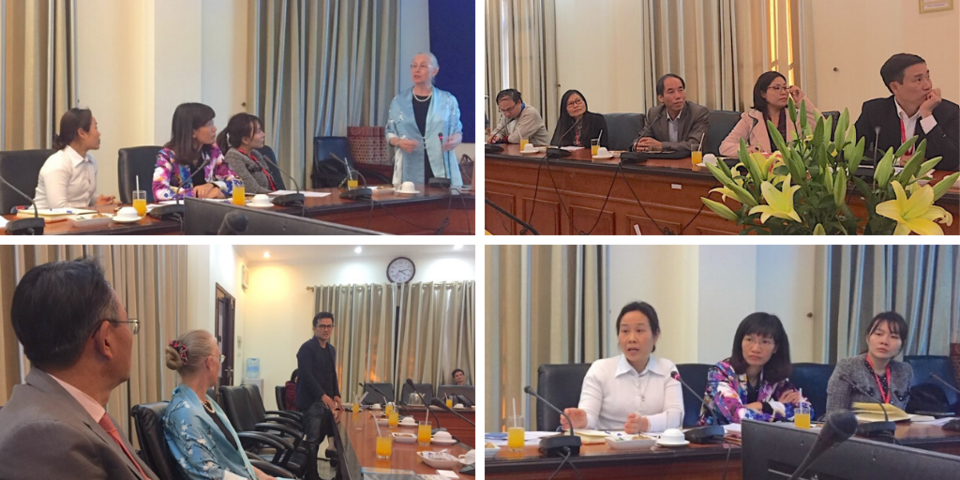
With a focus on health policy, our first day in Hanoi included a visit to Thai Nguyen University, a meeting with government representatives at the Vietnam Ministry of Health, and a seminar on healthy aging and innovation jointly with Hanoi Medical University.

Image
Collage of four images showing participants at a roundtable held at Hanoi Medical University with APARC delegation members

Karen Eggleston and participants at the roundtable held at Hanoi Medical University, December 9, 2019.

Throughout the day, Eggleston presented some of her collaborative research that is part of two projects involving international research teams: one that assesses public-private roles and institutional innovation for healthy aging and another that examines the economics of caring for patients with chronic diseases across diverse health systems in Asia and other parts of the world. We appreciated learning from our counterparts about the health care system and health care delivery in Vietnam.

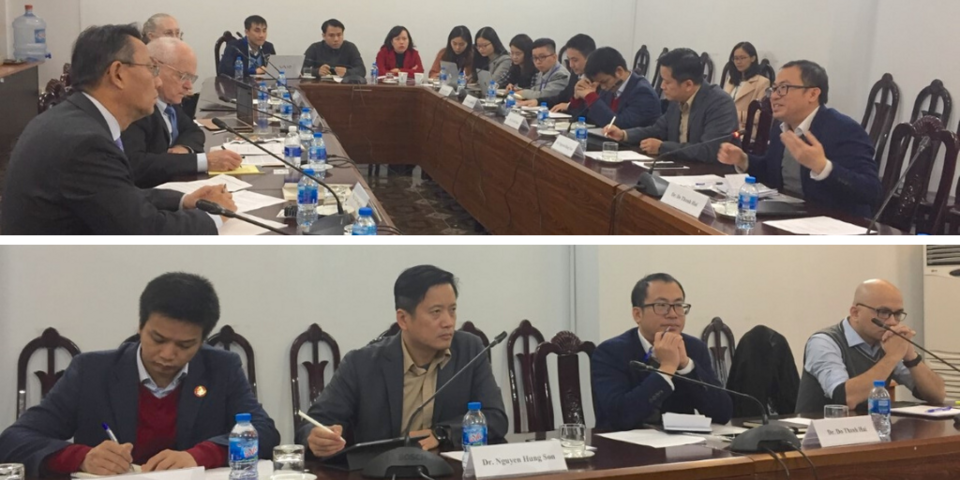
Shifting focus to international relations and regional security, day 2 in Hanoi opened with a roundtable, “The Rise of the Indo-Pacific and Vietnam-U.S. Relations,” held jointly with the East Sea Institute (ESI) of the Diplomatic Academy of Vietnam (DAV). Following a welcome by ESI Director General Nguyen Hung Son, the program continued with remarks by Shin, Emmerson, ESI Deputy Director General To Anh Tuan, and Assistant Director General Do Thanh Hai.

Image
Participants at a roundtable held at the Diplomatic Academy of Vietnam with APARC delegation members

Roundtable at the Diplomatic Academy of Vietnam, December 10, 2019.

The long-ranging conversation with DAV members included issues such as the future of the international order in Asia; the U.S. withdrawal from multilateralism; the concern about a lack of U.S. engagement in Southeast Asia, sparked by President Trump’s absence from the November 2019 summit of the Association of Southeast Asian Nations (ASEAN) at a time when China is bolstering its influence in the region and when ASEAN hopes to set a code of conduct with China regarding disputed waters in the South China Sea; the priorities for Vietnam as it assumes the role of ASEAN chair in 2020; and the challenges for the Vietnam-U.S. bilateral relationship amid the changing strategic environment in Southeast Asia.

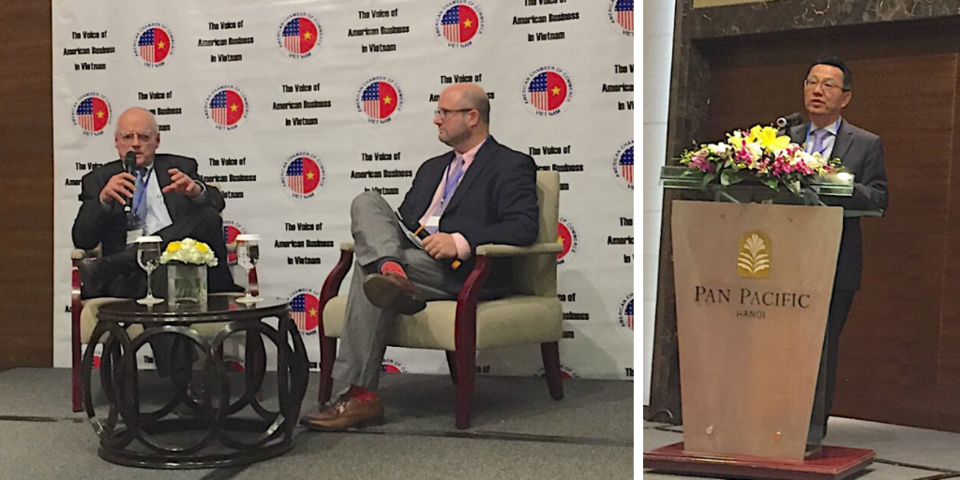
In the afternoon we were joined by members of the American Chamber of Commerce in Hanoi at an AmCham-hosted Lunch ‘n’ Learn session on Vietnam's challenges and opportunities amid the U.S.-China rivalry. The event featured Emmerson in conversation with AmCham Hanoi Executive Director Adam Sitkoff.

Image
Two men in conversation seated on stage and a man speaking at a podium

(Left) Donald Emmerson in conversation with Adam Sitkoff; (right) Gi-Wook Shin welcomes AmCham Hanoi members; December 10, 2019. 

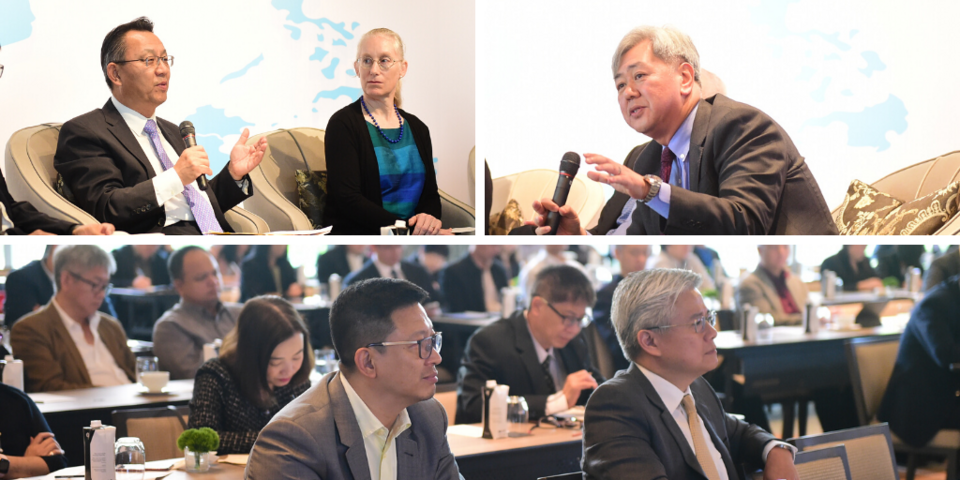
Moving to Bangkok, delegation members Shin, Eggleston, Emmerson, and Kim spoke on a panel for executives of the Charoen Pokphand Group (C.P. Group), one of Thailand’s largest private conglomerates, addressing some of the core issues that lie ahead for Southeast Asia in 2020 and beyond in the areas of geopolitics, innovation, and health.

Image
Participants at a panel discussion with APARC delegation hosted by the C.P. Group, Thailand

Top, from left to right: Gi-Wook Shin, Karen Eggleston, Andrew Kim; bottom: C.P. Group executive listening to the panel, December 12, 2019.

We also enjoyed a tour at True Digital Park, Thailand’s first startup and tech entrepreneur’s campus. Developed by the C.P. Group, True Digital Park aspires to be an open startup ecosystem that powers Thailand to become a global hub for digital innovation.

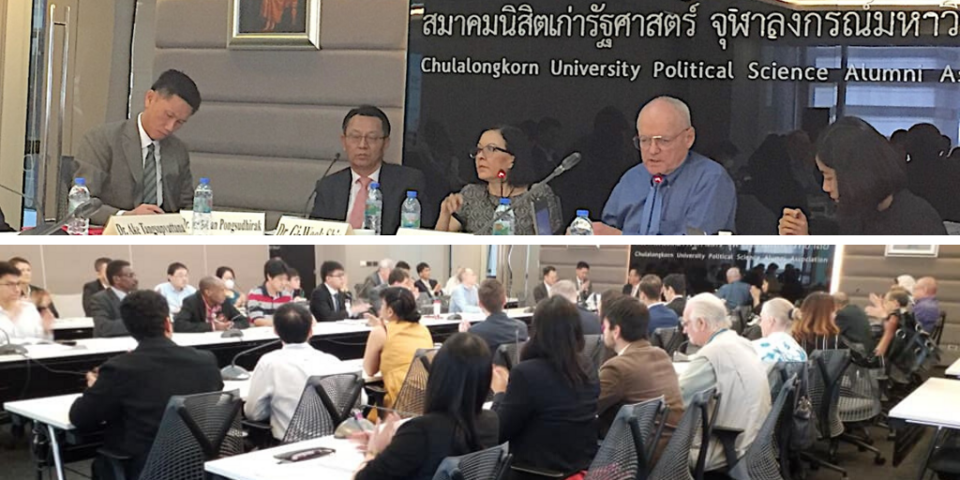
The following day, Shin and Emmerson participated in a public forum hosted by Chulalongkorn University’s Institute of Security and International Studies (ISIS Thailand), "Where Northeast Asia Meets Southeast Asia: The Great Powers, Global Disorder and Asia’s Future.” They were joined by ISIS Thailand Director Thitinan Pongsudhirak and Chulalongkorn University Faculty of Political Science Associate Dean for International Affairs and Graduate Studies Kasira Cheeppensook. The panel was moderated by Ms. Gwen Robinson, ISIS Thailand senior fellow and editor-at-large of the Nikkei Asian Review.

Image
Panelists and participants at a public forum held at Chulalongkorn University

ISIS Thailand forum participants and panelists, from left: Pngsukdhirak, Shin, Robinson, Emmerson, Cheeppensook; December 13, 2019.

As part of that discussion, Emmerson speculated that – driven by deepening Chinese economic and migrational involvement in Southeast Asia’s northern tier – Cambodia and Laos, less conceivably Myanmar, and still less conceivably Thailand could become incorporated de facto into an economically integrated “greater China” that could eventually reduce ASEAN to a more-or-less maritime membership in the region’s southern tier. Emmerson’s speculation was made in the context of his critique of ASEAN’s emphasis on its own “centrality” to the neglect of its lack of the proactivity that would serve as evidence of centrality and of a desire not to be rendered peripheral by the growing centrality-cum-proactivity of China. The event was covered by the Bangkok Post (although that report’s headline and quote of Emmerson are inaccurate, as neither the panel nor Emmerson predicted the “break-up of ASEAN.”)

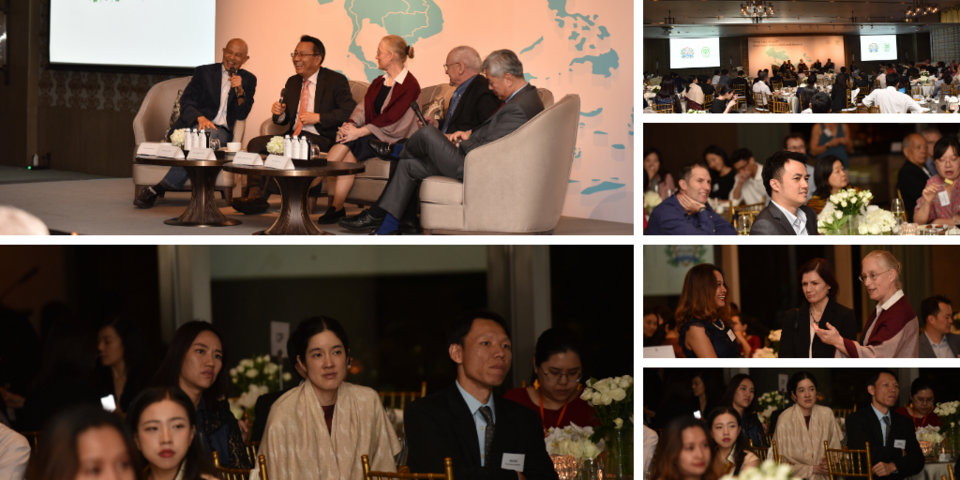
Our delegation visit in Bangkok concluded with a buffet dinner reception and panel discussion jointly with the Stanford Club of Thailand.

Image
alumni event

Stanford and IvyPlus alumni listening to the panel, December 13, 2019.

Moderated by Mr. Suthichai Yoon, a veteran journalist and founder of digital media outlet Kafedam Group, the conversation focused on the changing geopolitics of Southeast Asia, innovation and health in the region, and the opportunities and challenges facing Thailand-U.S. relations. It was a pleasure to meet many new and old friends from the Stanford and IvyPlus alumni communities.

APARC would like to thank our partners and hosts in Hanoi and Bangkok for their hospitality, collaboration, and the stimulating discussions throughout our visit. We look forward to keeping in touch!

Hero Image
APARC delegation speaking to Stanford and IvyPlus alumni, Bangkok
All News button
1
Subscribe to Diplomacy