Environment

FSI scholars approach their research on the environment from regulatory, economic and societal angles. The Center on Food Security and the Environment weighs the connection between climate change and agriculture; the impact of biofuel expansion on land and food supply; how to increase crop yields without expanding agricultural lands; and the trends in aquaculture. FSE’s research spans the globe – from the potential of smallholder irrigation to reduce hunger and improve development in sub-Saharan Africa to the devastation of drought on Iowa farms. David Lobell, a senior fellow at FSI and a recipient of a MacArthur “genius” grant, has looked at the impacts of increasing wheat and corn crops in Africa, South Asia, Mexico and the United States; and has studied the effects of extreme heat on the world’s staple crops.

Paragraphs

This research brief is based on a paper from the journal Nature, published on-line on October 21, 2015, entitled “Global non-linear effect of temperature on economic production.” The paper, led by Stanford University’s Marshall Burke, provides the first evidence that economic activity in all regions is coupled to the global climate and establishes a new empirical foundation for modelling economic loss in response to climate change.

All Publications button
1
Publication Type
Policy Briefs
Publication Date
Paragraphs

David Lobell’s recent research indicates that negative impacts to the global agriculture system are much more likely, more severe and wider-ranging in the face of human-caused climate change. Temperature increases are the main drier behind these far-reaching impacts.. There are several pathways toward adaptation, though none of them appears to completely offset the losses. Research highlighted in this brief offers insights for institutions and decisionmakers concerned with protecting food security and international stability throughout the coming decades.

All Publications button
1
Publication Type
Policy Briefs
Publication Date
-

Image
thedivinegod

The New York Times has described The Divine Grace of Islam Nusantara as “a 90-minute film that amounts to a relentless, religious repudiation of the [self-styled] Islamic State and the opening salvo in a global campaign by the world’s largest Muslim group [Nahdlatul Ulama] to challenge [IS’s] ideology head-on.” The film documents the enthusiasm with which Indonesian Muslims have commemorated the historic role of the 15th-16th century Walisongo (“Nine Saints”) movement—a movement that precipitated the development in the East Indies (now Indonesia) of a great Islamic civilization rooted in the principle of universal love and compassion (rahmah).

The film and a panel discussion the following day will unpack a perspective that has been historically central to Muslim cultures stretching from North Africa to Southeast Asia. The essence and mission of Islam Nusantara is to build civilization, not to destroy it. Yahya Staquf has described the film as an invitation to Muslims everywhere to reject radicalism and theological straight-jackets and stand up for their own cultural adaptation of Islam.

Kyai Haji Yahya Cholil Staquf is a leader of what is widely regarded as the largest Muslim organization in the world. Located in Indonesia, Nahdlatul Ulama adheres to the traditions of Sunni Islam. Yahya has primary responsibility for the expansion of NU’s activities to include North America, Europe, and the Middle East. Earlier positions included service as spokesperson for Indonesia’s 1999-2001 president Abdurrahman Wahid, the country’s first democratically elected head of state.

C. Holland Taylor’s leadership of the LibForAll Foundation dates from its co-founding in 2003 by Taylor and former Indonesian president Wahid. The Wall Street Journal has called LibForAll “a model of what a competent public diplomacy effort in the Muslim world should look like.” An expert on Islam and Islamization in Southeast Asia, Taylor has lived, studied, and worked in Muslim societies from Iran to Indonesia. He was educated at the University of North Carolina at Chapel Hill and Princeton University.

Note:  Although the panel will reference the film, the panelists will range beyond the film to present and discuss the role and relevance of the concept of Islam Nusantara in Indonesia and the larger Muslim world. Viewing the film is thus not a prerequisite to understanding the panel.

Film screening and brief discussion:  Wednesday, April 6, 2016 (screening: 4:00 – 5:30 pm; discussion: 5:30 – 6:00 pm)

RSVP: http://aparc.fsi.stanford.edu/southeastasia/events/registration/220800

Philippines Conference Room

Encina Hall, Third Floor, Central

616 Serra Street, Stanford University


Panel:  Thursday, April 7, 2016, noon – 1:30 pm

RSVP: http://aparc.fsi.stanford.edu/southeastasia/events/registration/220799

Philippines Conference Room

Encina Hall, Third Floor, Central

616 Serra Street, Stanford University

Free and open to the public

This event is co-sponsored by the Southeast Asia Program, the Abbasi Program in Islamic Studies and the Department of Religious Studies.

Yahya Cholil Staquf Secretary General, Supreme Council, Nahdlatul Ulama, Indonesia
C. Holland Taylor Chairman and CEO, LibForAll Foundation
Moderated by Donald K. Emmerson Southeast Asia Program, Shorenstein APARC Stanford University
Panel Discussions
-

- This event is jointly sponsored by the Center for International Security and Cooperation (CISAC) and the Walter H. Shorenstein Asia-Pacific Research Center (APARC) - 

Five years to the day after a massive earthquake and ensuing tsunami caused an accident at three of the reactors of the Fukushima Daiichi nuclear power plant in Fukushima, Japan, a panel of Stanford experts will convene in Encina Hall to reflect on the lessons learned from the disaster that unfolded starting on March 11, 2011. Panelists will include:

  • Steven Chu, 12th U.S. Secretary of Energy (2009-2013), Laureate of the 1997 Nobel Prize in Physics,  William R. Kenan, Jr., Professor of Physics and Professor of Molecular & Cellular Physiology in the Medical School at Stanford University - Focus: Perspective from the Department of Energy on the role of the department in helping mitigate the consequences and the lessons learned
  • Phillip Lipscy, Thomas Rohlen Center Fellow at the Freeman Spogli Institute for International Studies and Assistant Professor of Political Science at Stanford University - Focus: Fukushima in comparative perspective and how the Japanese nuclear power industry has reacted since the accident.
  • Scott Sagan, Caroline S.G. Munro Professor of Political Science, Mimi and Peter Haas University Fellow in Undergraduate Education, and Senior Fellow at the Center for International Security and Cooperation and the Freeman Spogli Institute at Stanford University. Focus: the effects of the accident on efforts to improve nuclear safety and security, based on the upcoming book Learning from a Disaster.
  • Takeo Hoshi, Senior Fellow at the Freeman Spogli Institute for International Studies (FSI) and director of APARC's Japan Program, will chair the session and act as moderator.

This event will also serve as a book launch for the book Learning from A Disaster: Improving Nuclear Safety and Security After Fukushima, co-edited by Edward Blandford, a former Stanton Nuclear Security Fellow at CISAC and Scott Sagan. the book is being published by Stanford University Press and will be available for purchase at the event. Pre-orders can be taken here.

Panel Discussions
-

Background: Substance abuse has been an important social and public health problem in Thailand for decades. The National Household Survey on Substance and Alcohol Use in Thailand, which has been conducted 5 times, shows that substance abuse has steadily increased. Extrapolated country-wide in recent data, the estimated number of people who had ever used at least one addictive substance at some time in their life was 3,531,436 or 7.30% of the total population aged 12-65 years. Krathom, Methamphetamine, Ice, and cannabis were the most prevalent substances of abuse.

Methods: Historical documentation, policy reports, and group discussion with key professionals who work in the substance abuse community were used in this study. The objectives of this study were to complete a document review, determine the effectiveness of previous  Thai illegal substance measures, and consider options for the future.

Findings: Although the Thai government has dedicated human resources and an enormous budget to controlling drug use, substance abuse has become a more severe problem when compared with previous years. There are many organizations trying to create and develop programs, measures, and policies for dealing with substance abuse. These policies usually have had loopholes which resulted in corruption of officers, undercutting the public health value, creating dilemmas for impoverished families experiencing drug abuse, ignoring human rights, and creating a negative attitude among society toward drug users. Barriers to establishing successful drug abuse policies in Thailand include limited access to data and data management, a lack of efficiency and cost-benefit measures and policies, and limited use of evidence-based research.

Conclusion: To address illegal substance abuse in the future, the stakeholders should work to reduce the incidence of new sellers and the prevalence of new users. This would result in diminishing the health impact and criminal aspect of illegal substance use, increase social awareness, and motivate communities to participate in managing this issue. To reach these goals, the policy should concurrently aim at curtailing the supply of illicit drugs and reducing their demand. The strategies relevant to drug policy consist of primary prevention, services for chronic drug users, supply control and regulations, prescription regimes, and the use of criminal sanctions, especially consideration of decriminalization of krathom use.

Image
darika 4x6
Darika Saingam is a researcher from Thailand. Her research works have focused on patterns and consequences of alcohol, tobacco, and illegal substance use. Currently she joins the Walter H. Shorenstein Asia-Pacific Research Center as the Developing Asia Health Policy Postdoctoral Fellow for the 2015-16 year. She completed her doctorate in epidemiology at the Prince of Songkla University in 2012, and has worked as a researcher at the University’s epidemiology unit since, as well as a researcher at the Thailand Substance Abuse Academic Network since 2014.

Darika Saingam 2015-16 Developing Asia Health Policy Postdoctoral Fellow
Seminars
Paragraphs

Climate change can reduce crop yields and thereby threaten food security. The current measures used to adapt to climate change involve avoiding crops yield decrease, however, the limitations of such measures due to water and other resources scarcity have not been well understood. Here, we quantify how the sensitivity of maize to water availability has increased because of the shift toward longer-maturing varieties during last three decades in the Chinese Maize Belt (CMB). We report that modern, longer-maturing varieties have extended the growing period by an average of 8 days and have significantly offset the negative impacts of climate change on yield. However, the sensitivity of maize production to water has increased: maize yield across the CMB was 5% lower with rainfed than with irrigated maize in the 1980s and was 10% lower (and even >20% lower in some areas) in the 2000s because of both warming and the increased requirement for water by the longer-maturing varieties. Of the maize area in China, 40% now fails to receive the precipitation required to attain the full yield potential. Opportunities for water saving in maize systems exist, but water scarcity in China remains a serious problem.

All Publications button
1
Publication Type
Journal Articles
Publication Date
Journal Publisher
Scientific Reports
Authors
David Lobell
Paragraphs

In this paper we discuss the scope of the adaptation challenge facing world agriculture in the coming decades. Due to rising temperatures throughout the tropics, pressures for adaptation will be greatest in some of the poorest parts of the world where the adaptive capacity is least abundant. We discuss both autonomous (market driven) and planned adaptations, distinguishing: (a) those that can be undertaken with existing technology, (b) those that involve development of new technologies, and (c) those that involve institutional/market and policy reforms. The paper then proceeds to identify which of these adaptations are currently modeled in integrated assessment studies and related analyses at global scale. This, in turn, gives rise to recommendations about how these models should be modified in order to more effectively capture climate change adaptation in the farm and food sector. In general, we find that existing integrated assessment models are better suited to analyzing adaptation by relatively well-endowed producers operating in market-integrated, developed countries. They likely understate climate impacts on agriculture in developing countries, while overstating the potential adaptations. This is troubling, since the need for adaptation will be greatest amongst the lower income producers in the poorest tropical countries. This is also where policies and public investments are likely to have the highest payoff. We conclude with a discussion of opportunities for improving the empirical foundations of integrated assessment modeling with an emphasis on the poorest countries.

All Publications button
1
Publication Type
Journal Articles
Publication Date
Journal Publisher
Energy Economics
Authors
Thomas Hertel
David Lobell
-

Image
april 19 flyer
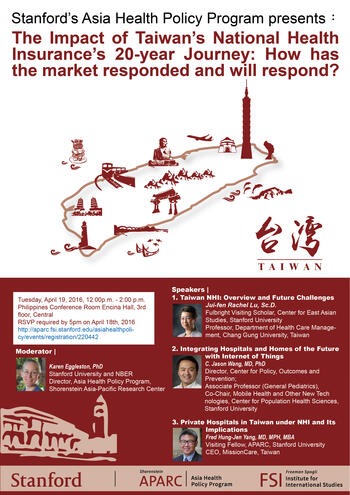
In 2015, Taiwan National Health Insurance (NHI) is celebrating its 20th anniversary since its historical inauguration in 1995. The NHI program, which provides universal health coverage (UHC) to Taiwan’s population of 23 million, has had a profound impact on Taiwan's health care market.   This seminar will showcase Taiwan's NHI scheme, the challenges encountered, and the market responses.

The single-payer NHI program, operated by National Health Insurance Administration (NHIA), was established through integrating three existing social insurance schemes and extended the coverage to the then uninsured 43% of the population. Taiwan NHI offers comprehensive benefit coverage that includes ambulatory care as well as inpatient services. On the service side, Taiwan has a market-oriented health care delivery system, reflecting its free-enterprise economy, as evidenced by the pluralistic organization of health services. Hospital ownership is mixed where public hospitals only account for 35% of all beds. Sixty-three percent of allopathic physicians are salaried employees of hospitals; the remainder, fee-for-service private practitioners. Over the years, hospitals have developed large outpatient departments and affiliated clinics for primary care in order to maintain inpatient volume and compete with private practitioners who operate free-standing clinics with beds. There is no gate keeping mechanism and the insured essentially enjoy complete freedom of choice which is likely a source of overuse.

NHI revenue mainly relies on payroll-based premiums, supplemented by a levy on non-payroll income and government subsidies. In 2013, NHI spent roughly NTD 492 (USD 16.4) billion on medical claims, accounting for approximately 52% of national health expenditures, and in total, Taiwan devoted 6.6% of GDP to health.  As a single payer, NHIA has effectively exploited its market power to experiment with various payment reforms in its 20-year history.  NHIA gradually set up separate global budgets for dental services, Chinese medicines, primary care services, and hospital services since 1998.  The annual growth rate of the total NHI budget is negotiated among stakeholders. 

Our seminar will look to the future with presentations on innovative healthcare delivery models and coping strategies by private hospitals.

Shorenstein APARC
Stanford University
Encina Hall E301
Stanford, CA 94305-6055

(650) 723-9072 (650) 723-6530
0
Senior Fellow at the Freeman Spogli Institute for International Studies
Center Fellow at the Center for Health Policy and the Center for Primary Care and Outcomes Research
Faculty Research Fellow of the National Bureau of Economic Research
Faculty Affiliate at the Stanford Center on China's Economy and Institutions
karen-0320_cropprd.jpg PhD

Karen Eggleston is a Senior Fellow at the Freeman Spogli Institute for International Studies (FSI) at Stanford University and Director of the Stanford Asia Health Policy Program at the Shorenstein Asia-Pacific Research Center at FSI. She is also a Fellow with the Center for Innovation in Global Health at Stanford University School of Medicine, and a Faculty Research Fellow of the National Bureau of Economic Research (NBER). Her research focuses on government and market roles in the health sector and Asia health policy, especially in China, India, Japan, and Korea; healthcare productivity; and the economics of the demographic transition.

Eggleston earned her PhD in public policy from Harvard University and has MA degrees in economics and Asian studies from the University of Hawaii and a BA in Asian studies summa cum laude (valedictorian) from Dartmouth College. Eggleston studied in China for two years and was a Fulbright scholar in Korea. She served on the Strategic Technical Advisory Committee for the Asia Pacific Observatory on Health Systems and Policies and has been a consultant to the World Bank, the Asian Development Bank, and the WHO regarding health system reforms in the PRC.

Director of the Asia Health Policy Program, Shorenstein Asia-Pacific Research Center
Stanford Health Policy Associate
Faculty Fellow at the Stanford Center at Peking University, June and August of 2016
CV
Date Label
Moderator Director, Asia Health Policy Program, Shorenstein Asia Pacific Research Center, Stanford University
Jui-fen Rachel Lu Professor, Department of Health Care Management Speaker Chang Gung University, Taiwan
C. Jason Wang Associate Professor (General Pediatric), Co-Chair, Mobile Health and Other New Technologies, Center for Population Health Sciences Speaker Stanford University
Fred Hung-Jen Yang Visiting Fellow, APARC, Stanford University Speaker CEO, MissionCare, Taiwan
Seminars
-

This event is open to Stanford undergraduate students only. 

The Center on Democracy, Development, and the Rule of Law (CDDRL) is currently accepting applications from eligible juniors due February 12, 2016 who are interested in writing their senior thesis on a subject touching upon democracy, economic development, and rule of law (DDRL) from any university department. CDDRL faculty and current honors students will be present to discuss the program and answer any questions.

For more information on the CDDRL Senior Honors Program, please click here.


Image
cddrl senior honors program 2016 flyer 2


CDDRL
Encina Hall, C152
616 Jane Stanford Way
Stanford, CA 94305-6055

(650) 725-2705 (650) 724-2996
0
Senior Fellow at the Freeman Spogli Institute for International Studies
Professor, by courtesy, of Political Science
Stedman_Steve.jpg PhD

Stephen Stedman is a Senior Fellow at the Freeman Spogli Institute for International Studies (FSI) and the Center on Democracy, Development and the Rule of Law (CDDRL), an affiliated faculty member at CISAC, and professor of political science (by courtesy) at Stanford University. He is director of CDDRL's Fisher Family Honors Program in Democracy, Development and Rule of Law, and will be faculty director of the Program on International Relations in the School of Humanities and Sciences effective Fall 2025.

In 2011-12 Professor Stedman served as the Director for the Global Commission on Elections, Democracy, and Security, a body of eminent persons tasked with developing recommendations on promoting and protecting the integrity of elections and international electoral assistance. The Commission is a joint project of the Kofi Annan Foundation and International IDEA, an intergovernmental organization that works on international democracy and electoral assistance.

In 2003-04 Professor Stedman was Research Director of the United Nations High-level Panel on Threats, Challenges and Change and was a principal drafter of the Panel’s report, A More Secure World: Our Shared Responsibility.

In 2005 he served as Assistant Secretary-General and Special Advisor to the Secretary- General of the United Nations, with responsibility for working with governments to adopt the Panel’s recommendations for strengthening collective security and for implementing changes within the United Nations Secretariat, including the creation of a Peacebuilding Support Office, a Counter Terrorism Task Force, and a Policy Committee to act as a cabinet to the Secretary-General.

His most recent book, with Bruce Jones and Carlos Pascual, is Power and Responsibility: Creating International Order in an Era of Transnational Threats (Washington DC: Brookings Institution, 2009).

Director, Fisher Family Honors Program in Democracy, Development and Rule of Law
Director, Program in International Relations
Affiliated faculty at the Center for International Security and Cooperation
Date Label

Encina Hall, C148
616 Jane Stanford Way
Stanford, CA 94305

0
Olivier Nomellini Senior Fellow at the Freeman Spogli Institute for International Studies
Director of the Ford Dorsey Master's in International Policy
Research Affiliate at The Europe Center
Professor by Courtesy, Department of Political Science
yff-2021-14290_6500x4500_square.jpg

Francis Fukuyama is the Olivier Nomellini Senior Fellow at Stanford University's Freeman Spogli Institute for International Studies (FSI), and a faculty member of FSI's Center on Democracy, Development and the Rule of Law (CDDRL). He is also Director of Stanford's Ford Dorsey Master's in International Policy, and a professor (by courtesy) of Political Science.

Dr. Fukuyama has written widely on issues in development and international politics. His 1992 book, The End of History and the Last Man, has appeared in over twenty foreign editions. His book In the Realm of the Last Man: A Memoir will be published in fall 2026.

Francis Fukuyama received his B.A. from Cornell University in classics, and his Ph.D. from Harvard in Political Science. He was a member of the Political Science Department of the RAND Corporation, and of the Policy Planning Staff of the US Department of State. From 1996-2000 he was Omer L. and Nancy Hirst Professor of Public Policy at the School of Public Policy at George Mason University, and from 2001-2010 he was Bernard L. Schwartz Professor of International Political Economy at the Paul H. Nitze School of Advanced International Studies, Johns Hopkins University. He served as a member of the President’s Council on Bioethics from 2001-2004. He is editor-in-chief of American Purpose, an online journal.

Dr. Fukuyama holds honorary doctorates from Connecticut College, Doane College, Doshisha University (Japan), Kansai University (Japan), Aarhus University (Denmark), the Pardee Rand Graduate School, and Adam Mickiewicz University (Poland). He is a non-resident fellow at the Carnegie Endowment for International Peace. He is a member of the Board of Trustees of the Rand Corporation, the Board of Trustees of Freedom House, and the Board of the Volcker Alliance. He is a fellow of the National Academy for Public Administration, a member of the American Political Science Association, and of the Council on Foreign Relations. He is married to Laura Holmgren and has three children.

(October 2025)

CV
Date Label
0
brett_carter_2025.jpg

Brett Carter is an Associate Professor in the Department of Political Science and International Relations at the University of Southern California, a Hoover Fellow at Stanford University's Hoover Institution, and a Faculty Affiliate at Stanford's Center on Democracy, Development and the Rule of Law. He received a Ph.D. from Harvard University, where he was a fellow at the Harvard Academy for International and Area Studies.

Carter studies politics in the world's autocracies. His first book, Propaganda in Autocracies: Institutions, Information, and the Politics of Belief (Cambridge University Press), draws on the largest archive of state propaganda ever assembled — encompassing over eight million newspaper articles in six languages from nearly 60 countries around the world — to show how political institutions shape the propaganda strategies of repressive governments. It received the William Riker Prize for the Best Book in Political Economy, the International Journal of Press/Politics Hazel Gaudet-Erskine Best Book Award, Honorable Mention for the Gregory Luebbert Award for the Best Book in Comparative Politics, and Honorable Mention for the APSA Democracy & Autocracy Section's Best Book Award.

His second book, in progress, shows how politics in Africa’s autocracies changed after the fall of the Berlin Wall and how a new era of geopolitical competition — marked by the rise of China and the resurgence of Russia — is changing them again.

Carter’s other work has appeared in the Journal of Politics, British Journal of Political Science, Perspectives on Politics, Journal of Conflict Resolution, Security Studies, China Quarterly, Journal of Democracy, and Foreign Affairs, among others. His work has been featured by The New York Times, The Economist, The National Interest, and NPR’s Radiolab.

Hoover Fellow
CDDRL Affiliated Scholar
CDDRL Visiting Scholar, 2020-2021
Date Label

Encina Hall, C150
616 Jane Stanford Way
Stanford, CA 94305

0
Center Fellow, Freeman Spogli Institute for International Studies
didi_kuo_2023.jpg

Didi Kuo is a Center Fellow at the Freeman Spogli Institute for International Studies (FSI) at Stanford University. She is a scholar of comparative politics with a focus on democratization, corruption and clientelism, political parties and institutions, and political reform. She is the author of The Great Retreat: How Political Parties Should Behave and Why They Don’t (Oxford University Press) and Clientelism, Capitalism, and Democracy: the rise of programmatic politics in the United States and Britain (Cambridge University Press, 2018).

She has been at Stanford since 2013 as the manager of the Program on American Democracy in Comparative Perspective and is co-director of the Fisher Family Honors Program at CDDRL. She was an Eric and Wendy Schmidt Fellow at New America and is a non-resident fellow with the Carnegie Endowment for International Peace. She received a PhD in political science from Harvard University, an MSc in Economic and Social History from Oxford University, where she studied as a Marshall Scholar, and a BA from Emory University.

Date Label
Subscribe to Environment