Environment

FSI scholars approach their research on the environment from regulatory, economic and societal angles. The Center on Food Security and the Environment weighs the connection between climate change and agriculture; the impact of biofuel expansion on land and food supply; how to increase crop yields without expanding agricultural lands; and the trends in aquaculture. FSE’s research spans the globe – from the potential of smallholder irrigation to reduce hunger and improve development in sub-Saharan Africa to the devastation of drought on Iowa farms. David Lobell, a senior fellow at FSI and a recipient of a MacArthur “genius” grant, has looked at the impacts of increasing wheat and corn crops in Africa, South Asia, Mexico and the United States; and has studied the effects of extreme heat on the world’s staple crops.

0
George G.C. Parker Professor of Finance and Economics, Stanford Graduate School of Business
Director of the Corporations and Society Initiative, Stanford Graduate School of Business
Director of the Program on Capitalism and Democracy, Center on Democracy, Development and the Rule of Law
Senior Fellow, Stanford Institute for Economic Policy Research
Senior Fellow (by courtesy), Freeman Spogli Institute for International Studies
anat_admati-stanford-2021.jpg

Anat R. Admati is the George G.C. Parker Professor of Finance and Economics at Stanford University Graduate School of Business (GSB), a Faculty Director of the GSB Corporations and Society Initiative, and a senior fellow at Stanford Institute for Economic Policy Research. She has written extensively on information dissemination in financial markets, portfolio management, financial contracting, corporate governance and banking. Admati’s current research, teaching and advocacy focus on the complex interactions between business, law, and policy with focus on governance and accountability.

Since 2010, Admati has been active in the policy debate on financial regulations. She is the co-author, with Martin Hellwig, of the award-winning and highly acclaimed book The Bankers’ New Clothes: What’s Wrong with Banking and What to Do about It (Princeton University Press, 2013; bankersnewclothes.com). In 2014, she was named by Time Magazine as one of the 100 most influential people in the world and by Foreign Policy Magazine as among 100 global thinkers.

Admati holds BSc from the Hebrew University, MA, MPhil and PhD from Yale University, and an honorary doctorate from University of Zurich. She is a fellow of the Econometric Society, the recipient of multiple fellowships, research grants, and paper recognition, and is a past board member of the American Finance Association. She has served on a number of editorial boards and is a member of the FDIC’s Systemic Resolution Advisory Committee, a former member of the CFTC’s Market Risk Advisory Committee, and a former visiting scholar at the International Monetary Fund.

Date Label
-

Image
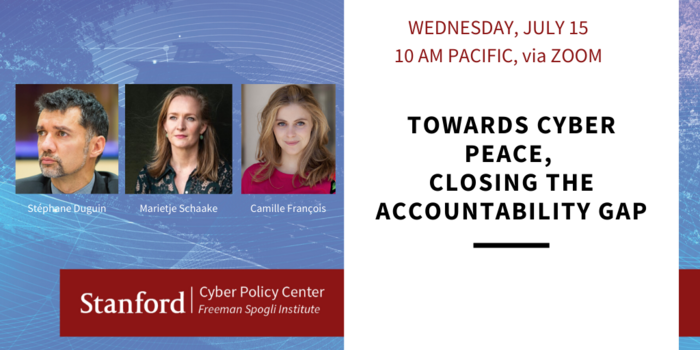
towards cyber peace

Please join the Cyber Policy Center for Towards Cyber Peace, Closing the Accountability Gap, hosted by Cyber Policy Center's Marietje Schaake, along with guests Stéphane Duguin, CEO of the Cyber Peace Institute and Camille François, CIO of Graphika and Mozilla Fellow. The discussion will focus on the challenges to cyber peace, and the work being done to chart a path forward. The session is open to the public, but registration is required. 

Marietje Schaake is the international policy director at Stanford University’s Cyber Policy Center and international policy fellow at Stanford’s Institute for Human-Centered Artificial Intelligence. She was named President of the Cyber Peace Institute. Between 2009 and 2019, Marietje served as a Member of European Parliament for the Dutch liberal democratic party where she focused on trade, foreign affairs and technology policies. Marietje is affiliated with a number of non-profits including the European Council on Foreign Relations and the Observer Research Foundation in India and writes a monthly column for the Financial Times and a bi-monthly column for the Dutch NRC newspaper. 

Camille François works on cyber conflict and digital rights online. She is the Chief Innovation Officer at Graphika, where she leads the company’s work to detect and mitigate disinformation, media manipulation and harassment. Camille was previously the Principal Researcher at Jigsaw, an innovation unit at Google that builds technology to address global security challenges and protect vulnerable users. Camille has advised governments and parliamentary committees on both sides of the Atlantic on policy issues related to cybersecurity and digital rights. She served as a special advisor to the Chief Technology Officer of France in the Prime Minister’s office, working on France’s first Open Government roadmap. Camille is a Mozilla Fellow, a Berkman-Klein Center affiliate, and a Fulbright scholar. She holds a masters degree in human rights from the French Institute of Political Sciences (Sciences-Po) and a masters degree in international security from the School of International and Public Affairs (SIPA) at Columbia University. François’ work has been featured in various publications, including the New York Times, WIRED, Washington Post, Bloomberg Businessweek, Globo and Le Monde.

Stéphane Duguin is the Chief Executive Officer of the CyberPeace Institute. His mission is to coordinate a collective response to decrease the frequency, impact, and scale of cyberattacks by sophisticated actors. Building on his hands-on experience in countering and analyzing cyber operations and information operations which impact civilians and civilian infrastructure, he leads the Institute with the aim of holding malicious actors to account for the harms they cause. Prior to this position, Stéphane Duguin was a senior manager and innovation coordinator at Europol. He led key operational projects to counter both cybercrime and online terrorism, such as the setup of the European Cybercrime Centre (EC3), the Europol Innovation Lab, and the European Internet Referral Unit (EU IRU). A leader in digital transformation, his work focused on the implementation of innovative responses to a large-scale abuse of the cyberspace, notably on the convergence of disruptive technologies and public-private partnerships.


News Type
News
Date
Paragraphs

APARC is pleased to share that Stanford alumnae Shiran Victoria Shen and Lizhi Liu have won prestigious awards for best dissertation in their fields. Both Shen and Liu earned their doctoral degrees in Political Science in 2018 and worked with Jean Oi, director of the China Program at APARC, during their tenure as doctoral students.

Shen, who is currently an assistant professor at the University of Virginia, has won the 2020 Harold D. Lasswell Award for her dissertation The Political Pollution Cycle: An Inconvenient Truth and How To Break It. The award is given annually by the American Political Science Association for “the best doctoral dissertation in the field of public policy.” Using a wide array of data, techniques, and research designs, Shen’s work explains how environmental change influences and is shaped by politics and policy. It centers on the critical case of air pollution control policies and uses China as a natural experiment.

Liu, whose doctoral research focuses on the political economy of e-commerce in China, has won the 2020 Ronald H. Coase Best Dissertation Award from the Society for Institutional and Organizational Economics. Her study proposes that China has devised a novel solution, that is, institutional outsourcing, to the central question of how developing states build market-supporting institutions. She is currently an assistant professor in the McDonough School of Business and a faculty affiliate of the Department of Government at Georgetown University.

Congratulations, Shiran and Lizhi, on your excellent work and prestigious awards!

Read More

encina 2x1
News

Ninth Annual Korean Studies Writing Prize Awarded

Won-Gi Jung (BA '20) is awarded the ninth annual Writing Prize in Korean Studies for his paper, "The Making of Chinatown: Chinese migrants and the production of criminal space in 1920s Colonial Seoul."
Ninth Annual Korean Studies Writing Prize Awarded
Portrait of Young Kyung Do, Winner of the 2020 Rothman Epidemiology Prize
News

Asia Health Policy Program Alum Wins Rothman Epidemiology Prize

Dr. Young Kyung Do, an expert in health policy and management at the Seoul National University College of Healthy Policy and the inaugural postdoctoral fellow in Asia health policy at APARC, has been awarded the 2020 prize for his outstanding publication in the journal Epidemiology last year.
Asia Health Policy Program Alum Wins Rothman Epidemiology Prize
Hero Image
Shiran Shen (left) and Lizhi Liu (right)
Shiran Shen (left) and Lizhi Liu (right).
All News button
1
Subtitle

Interdisciplinary environmental scholar Shiran Victoria Shen is the recipient of the Harold D. Lasswell Award and political economist Lizhi Liu is the recipient of the Ronald H. Coase Award in recognition of their outstanding doctoral dissertations.

Authors
News Type
News
Date
Paragraphs

Dust sweeping across the Southeast U.S. in recent days warns of a growing risk to infants and children in many parts of the world. A Stanford-led study focuses on this dust, which travels thousands of miles from the Sahara Desert, to paint a clearer picture than ever before of air pollution’s impact on infant mortality in sub-Saharan Africa. The paper, published on June 29 in Nature Sustainability, reveals how a changing climate might intensify or mitigate the problem, and points to seemingly exotic solutions to reducing dust pollution that could be more effective and affordable than current health interventions in improving child health.

“Africa and other developing regions have made remarkable strides overall in improving child health in recent decades, but key negative outcomes such as infant mortality remain stubbornly high in some places,” said study senior author Marshall Burke, an associate professor of Earth system science in Stanford’s School of Earth, Energy & Environmental Sciences. “We wanted to understand why that was, and whether there was a connection to air pollution, a known cause of poor health.”

Understanding airborne danger

Children under 5 are particularly vulnerable to the tiny particles, or particulate, in air pollution that can have a range of negative health impacts, including lower birth weight and impaired growth in the first year of life. In developing regions, exposure to high levels of air pollution during childhood is estimated to reduce overall life expectancy by 4-5 years on average.

Quantifying the health impacts of air pollution – a crucial step for understanding global health burdens and evaluating policy choices – has been a challenge in the past. Researchers have struggled to adequately separate out the health effects of air pollution from the health effects of activities that generate the pollution. For example, a booming economy can produce air pollution but also spur developments, such as lower unemployment, that lead to better healthcare access and improved health outcomes.

To isolate the effects of air pollution exposure, the Stanford-led study focuses on dust carried thousands of miles from the Bodélé Depression in Chad – the largest source of dust emissions in the world. This dust is a frequent presence in West Africa and, to a lesser extent, across other African regions. The researchers analyzed 15 years of household surveys from 30 countries across Sub-Saharan Africa covering nearly 1 million births. Combining birth data with satellite-detected changes in particulate levels driven by the Bodélé dust provided an increasingly clear picture of poor air quality’s health impacts on children.

Sobering findings and surprising solutions

The researchers found that a roughly 25 percent increase in local annual mean particulate concentrations in West Africa causes an 18 percent increase in infant mortality. The results expand on a 2018 paper by the same researchers that found exposure to high particulate matter concentrations in sub-Saharan Africa accounted for about 400,000 infant deaths in 2015 alone.

The new study, combined with previous findings from other regions, makes clear that air pollution, even from natural sources, is a “critical determining factor for child health around the world,” the researchers write. Emissions from natural sources could change dramatically in a changing climate, but it’s unclear how. For example, the concentration of dust particulate matter across Sub-Saharan Africa is highly dependent on the amount of rainfall in the Bodélé Depression. Because future changes in rainfall over the Bodélé region due to climate change are highly uncertain, the researchers calculated a range of possibilities for sub-Saharan Africa that could result in anywhere from a 13-percent decline in infant mortality to a 12-percent increase just due to changes in rainfall over the desert. These impacts would be larger than any other published projections for climate change impact on health across Africa.

Safeguarding children against air pollution is nearly impossible in many developing regions because many homes have open windows or permeable roofs and walls, and infants and young children are unlikely to wear masks. Instead, the researchers suggest exploring the possibility of dampening sand with groundwater in the Bodélé region to stop it from going airborne – an approach that has been successful at a small scale in California.

The researchers estimate that deploying solar-powered irrigation systems in the desert area could avert 37,000 infant deaths per year in West Africa at a cost of $24 per life, making it competitive with many leading health interventions currently in use, including a range of vaccines and water and sanitation projects.

“Standard policy instruments can’t be counted on to reduce all forms of air pollution,” said study lead author Sam Heft-Neal, a research scholar at Stanford’s Center on Food Security and the Environment. “While our calculation doesn’t consider logistical constraints to project deployment, it highlights the possibility of a solution that targets natural pollution sources and yields enormous benefits at a modest cost.”

Additional co-authors include Eran Bendavid, an associate professor of medicine at Stanford, member of the Maternal andChild Health Research Institute and an affiliate of the Stanford Woods Institute for the Environment; Jennifer Burney and Kara Voss of the University of California San Diego. Burke is also deputy director of the Center on Food Security and the Environment; and a fellow at the Stanford Woods Institute for the Environment, the Freeman Spogli Institute for International Studies and the Stanford Institute for Economic Policy Research.

The research was supported by the National Science Foundation and the Robert Wood Johnson Foundation.

Hero Image
 A man walks through a sandstorm in Chad

A man walks through a sandstorm in Chad, home of the Bodélé Depression – the largest source of dust emissions in the world.
George Steinmetz
All News button
1
Subtitle

The study of sub-Saharan Africa finds that a relatively small increase in airborne particles significantly increases infant mortality rates. A cost-effective solution may lie in an exotic-sounding proposal.

Authors
Noa Ronkin
News Type
News
Date
Paragraphs

The Walter H. Shorenstein Asia-Pacific Research Center (APARC) condemns the systemic nature and brutal expression of racism in the United States, and we stand in full support of protestors and civil rights organizations in their calls for social justice, equal access to basic rights, and accountability. Beyond reaffirming our commitment to these values, we recognize the imperative to do better as an institution and the urgent need to take concrete action to build a more inclusive community here at our Stanford home. We have joined our colleagues at the Freeman Spogli Institute for International Studies in developing specific steps towards that goal. But we also want to take initial, immediate action in moving from protest to progress.

That’s why we are announcing today a new diversity grant to support Stanford students from underrepresented minorities with an interest in studying issues related to contemporary Asia. The field of Asian studies suffers from an extreme paucity of students, scholars, and experts who self-identify as Black/African American or as affiliated with other underrepresented minority groups. “The path towards a more diverse and inclusive field isn’t easy or straightforward, but we must get on it,” says APARC Director and FSI Senior Fellow Gi-Wook Shin. “We believe that we can tackle the existing disparity if relevant stakeholders across institutes of higher learning all work together. APARC is looking to start this change at Stanford.”

Lowering Barriers to Diversity in Asian Studies

The purpose of the APARC Diversity Grant is to encourage Stanford students from underrepresented minorities (URM) to engage in study and research of topics related to contemporary Asia and U.S.-Asia relations, including economic, health, foreign policy, social, political, and security issues. We follow the University’s definition of the URM category as encompassing “all U.S. citizens and permanent residents who have self-identified as American Indian/Alaska Native, Black/African American, Hispanic/Latino, Native Hawaiian/Other Pacific Islander.” This grant opportunity is open to current Stanford undergraduate and graduate students in the URM category from any major or discipline. “This is just a small step to start lowering disciplinary, cultural, and funding barriers that hinder broader student participation in Asian studies,” notes Shin.

APARC will award a maximum of $10,000 per grant to support a wide range of research expenses such as travel to/from research sites, academic conferences, and workshops (dependent on COVID-19 restrictions); conference registration fees; professional development training programs; purchase of physical and digital books or other required materials; and access to relevant online resources. APARC will review grant applications for projects taking place in winter/spring 2021 on a rolling basis starting on September 1, 2020. Reviews of the second round of applications, for projects taking place in summer/fall 2021, will begin on April 1, 2021.

Examples of research topics, in addition to those that Asia scholars typically study, could include China’s growing activities in Africa; understanding the evolving relations between Asian Americans and African Americans in the United States; and comparative examinations of issues such as the treatment of minorities in Asia and the United States or policies that promote anti-discriminatory practices in schools, the workplace, and other settings in Asian countries and the United States.

Application Guidelines

  • Complete the application form and submit it along with these three (3) attachments:
    • A statement (no more than three pages) describing the proposed research activity or project;
    • A current CV;
    • An itemized budget request explaining research expense needs.
  • Arrange for a letter of recommendation from a faculty to be sent directly to APARC. Please note: the faculty members should email their letters directly to Kristen Lee at kllee@stanford.edu.

We will consider only applications that include all supporting documents.

Read More

Portrait of Young Kyung Do, Winner of the 2020 Rothman Epidemiology Prize
News

Asia Health Policy Program Alum Wins Rothman Epidemiology Prize

Dr. Young Kyung Do, an expert in health policy and management at the Seoul National University College of Healthy Policy and the inaugural postdoctoral fellow in Asia health policy at APARC, has been awarded the 2020 prize for his outstanding publication in the journal Epidemiology last year.
Asia Health Policy Program Alum Wins Rothman Epidemiology Prize
Cover image of the book "Healthy Aging in Asia", showing a smiling elderly Chinese woman with a cane standing in a small village.
News

New Book Highlights Policy Initiatives and Economic Research on Healthy Longevity Across Asia

Asia health policy expert Karen Eggleston’s new volume, ‘Healthy Aging in Asia,’ examines how diverse Asian economies – from Singapore and Hong Kong to Japan, India, and China – are preparing for older population age structures and transforming health systems to support patients who will live with chronic disease for decades.
New Book Highlights Policy Initiatives and Economic Research on Healthy Longevity Across Asia
Hero Image
A look at the front of Encina Hall, Stanford
All News button
1
Subtitle

To encourage Stanford students from underrepresented minorities to engage in study and research of topics related to contemporary Asia, the Shorenstein Asia-Pacific Research Center is offering a new Diversity Grant opportunity. Application reviews begin on September 1, 2020.

Authors
News Type
News
Date
Paragraphs

The ocean could produce up to 75 percent more seafood than it does today and drive sustainable economic growth, holding a key role in solving global hunger. Center on Ocean Solutions Co-Director Jim Leape joined Stanford Earth Professor Roz Naylor for a conversation about food security, the current COVID-19 pandemic and how global food policies can better integrate “blue foods” from marine and freshwater systems. 

"COVID-19 is disrupting processed and widely traded seafood products, such as salmon, shrimp and tuna," states Naylor. "However, locally produced and consumed food systems are actually faring much better. This is especially true for some small-scale fisheries, where local fishing groups have taken the initiative to sell seafood locally and new markets are emerging during the COVID-19 period. Production and consumption have become more tightly connected as a result."

Both Leape and Naylor are part of the global Blue Food Assessment, the first comprehensive review of aquatic foods and their roles in the global food system. Naylor will discuss the assessment with collaborators during the Virtual Ocean Dialogues on June 3rd. 

The pair also highlighted promising innovations for sustainable future food systems. "Illegal fishing defeats efforts to manage the resource sustainability and cheats the fishers who are playing by the rules," Leape explains. "And we can end it. Emerging technologies are bringing much greater transparency into the fishing industry."

"If we want healthy oceans in the future, we have to be thinking about a wide range of innovations, and the institutions, financial incentives, and public trust needed to turn these innovations into real market solutions," says Naylor. 


Read the full Stanford ReportQ&A >

Explore the new Blue Food Assessment website >

Learn more about our work curbing illegal fishing >

Hero Image
adobestock 116717930 fish in sea and sipadan island  half and half over under split image 960x640
All News button
1
-

* Please note all CISAC events are scheduled using the Pacific Time Zone


Seminar Recording: https://youtu.be/M7DEG62NsVQ


About the Event: In recent years, small modular reactors (SMRs, i.e. nuclear reactors with electric capacities less than 300 MWelec) have received bipartisan, Congressional support on the pretense that their development will reduce the mass and radiotoxicity of commercially generated nuclear waste. However, these metrics are of limited value in planning for the safe management and disposal of this radioactive material. By analyzing the published design specifications for water-, sodium-, and molten salt-cooled SMRs, I here characterize their notional, high-level waste streams in terms of decay heat, radiochemistry, and fissile isotope concentration, each of which have implications for geologic repository design and long-term safety. Volumes of low- and intermediate-level decommissioning waste, in the form of reactor components, coolants, and moderators, have also been estimated.

The results show that SMRs will not reduce the size of a geologic repository for spent nuclear fuel, nor the associated future dose rates. Rather, SMRs are poised to discharge spent fuel with relatively high concentrations of fissile material, which may pose re-criticality risks in a geologic repository. Furthermore, SMRs—in particular, designs that call for molten salt or sodium coolants—entail increased volumes of decommissioning waste, as compared to a standard 1100 MWelec, water-cooled reactor. Many of the anticipated SMR waste challenges are a consequence of neutron leakage, a basic physical process that reduces the fuel burnup efficiency in small reactor cores. Common approaches to attenuating neutron leakage from SMRs, such as the introduction of radial neutron reflectors, will increase the generation of decommissioning waste. The feasibility of managing SMR waste streams should be performed before these reactors are licensed, and future clean energy policies should acknowledge the adverse impact that SMRs will have on radioactive waste management and disposal.


About the Speaker: Dr. Lindsay Krall is a MacArthur post-doctoral fellow and a geochemist at SKB. Her post-doctoral research assesses the technical credibility of recent DOE programs related to SNF management, in particular those centered around deep borehole disposal and advanced nuclear reactors.

Virtual Seminar

0
rsd19_072_0267a.jpg

Lindsay Krall was a MacArthur Postdoctoral Fellow at CISAC, 2019-2020. She couples Earth science with energy policy to study the back-end of the nuclear fuel cycle, focusing on geologic repository development. She began this research in 2009, coincident with the termination of the United States’ project to develop a repository for high-level nuclear waste. After completing her bachelor's degree in Industrial and Operations Engineering at the University of Michigan in 2011, she moved to Stockholm to work at the Swedish Nuclear Fuel and Waste Management Company. In 2017, Lindsay was awarded a Ph.D. in geochemistry by Stockholm University, and between 2017 and 2020, she was a MacArthur post-doctoral fellow, first at George Washington University and then, at CISAC. During this time, she assessed the technical viability of concepts to dispose of spent nuclear fuel in deep boreholes and she characterized the radioactive waste streams that might be generated in advanced fuel cycles and discussed their implications for geologic disposal.

Affiliate
Paragraphs

In this report we identify the key drivers of observed market outcomes in the Colombian electricity supply industry during the fourth quarter of 2015 and first quarter of 2016, the time period covered by the most recent El Niño Event. We analyze how effective the market rules and market structure of Colombian electricity supply industry are in managing El Niño Events. The performance of the Reliability Payment Mechanism (RPM) is a major focus of this report because of its designation as the primary mechanism for ensuring an adequate supply of energy at a reasonable price during El Niño Events. We find that the RPM creates a number of perverse economic incentives for supplier behavior, particularly if suppliers have a significant ability to exercise unilateral market power, that works against the RPM mechanism ensuring an adequate supply of electricity at a reasonable price during El Niño Events. We identify several features of the RPM that make it extremely challenging even for a modified version of this mechanism to achieve its goal. We propose an alternative mechanism for ensuring an adequate supply of energy at a reasonable price during El Niño Events that should be straightforward to implement under the current market design in Colombia.

All Publications button
1
Publication Type
White Papers
Publication Date
Journal Publisher
Program on Energy and Sustainable Development
Authors
Frank Wolak
-

* Please note all CISAC events are scheduled using the Pacific Time Zone


Livestream: Please click here to join the livestream webinar via Zoom or log-in with webinar ID 913 4480 9317.


About the Event: How do states build lasting international order? Existing explanations of order formation argue that leading states are incentivized to create binding institutions with robust rules and strong enforcement mechanisms. The stability resulting from such institutionalized orders, scholars argue, allows leading states to geopolitically punch above their weight after they have declined in power. I argue, however, that such explanations overlook the trade-off between stability and flexibility, that leading states are faced with. Flexibility calls for short-term agreements that can be renegotiated when the strategic situation changes. And it allows the leading state to take advantage of relative power increases.Whereas states face significant incentives to err on the side of stability if they predict irreversible decline in power, states face incentives to err on the side of flexibility if they predict relative rise in power.  


About the Speaker: Mariya Grinberg is a postdoctoral fellow at the Center for International Security and Cooperation. She received her Ph.D. in political science from the University of Chicago in 2019. Her primary research examines why states trade with their enemies, investigating the product level and temporal variation in wartime commercial policies of states vis-a-vis enemy belligerents. Her broader research interests include international relations theory focusing on order formation and questions of state sovereignty. Prior to coming to CISAC, she was a predoctoral fellow at the Belfer Center’s International Security Program. She holds an M.A. from the University of Chicago's Committee on International Relations and a B.A. from the University of Southern California.

Virtual Seminar

Postdoctoral Fellow Stanford University
Seminars
-

This event is via Zoom Webinar. Please register in advance for the webinar by using the link below.

REGISTRATION LINKhttps://bit.ly/2xZHser

Part of APARC series COVID-19 IN ASIA: RESPONSES AND IMPLICATIONS FOR THE REGION

Co-sponsored by the Asia Health Policy Program and the Southeast Asia Program

Speakers (live and pre-recorded):

Dr. Dorairaj Prabhakaran, Professor of chronic disease epidemiology, Public Health Foundation of India, and Executive Director, Center for Chronic Disease Control.

Dr. Pham Quang Thai, Member of the Vietnam Steering Committee for COVID-19 Prevention and Control

Dr. HAC Van Vinh, Associate Professor & former Dean of Research & International Relations, Thai Nguyen University of Medicine and Pharmacy

Dr. Richard Cash, Senior Lecturer on Global Health, T.H. Chan School of Public Health, Harvard University

Dr. Radhika Jain, Asia Health Policy Postdoctoral Fellow, APARC, FSI, Stanford University

Dr. Arzan Tarapore, Research Scholar, APARC, FSI, Stanford University

How is the pandemic impacting health systems and society in south and southeast Asia? Numerous experts share their perspectives on topics ranging from COVID-19 challenges in Bangladesh, India and Vietnam, to geopolitical considerations for U.S. policy in the wider Indo-Pacific.

Via Zoom Webinar.

Register at https://bit.ly/2xZHser

Dorairaj Prabhakaran Professor of chronic disease epidemiology, Public Health Foundation of India, and Executive Director, Center for Chronic Disease Control.
Pham Quang Thai Member of the Vietnam Steering Committee for COVID-19 Prevention and Control
HAC Van Vinh Associate Professor & former Dean of Research & International Relations, Thai Nguyen University of Medicine and Pharmacy
Richard Cash Senior Lecturer on Global Health, T.H. Chan School of Public Health, Harvard University
Asia Health Policy Postdoctoral Fellow, APARC, FSI, Stanford University
Arzan Tarapore Research Scholar, APARC, FSI, Stanford University
Panel Discussions
Subscribe to Environment