Environment

FSI scholars approach their research on the environment from regulatory, economic and societal angles. The Center on Food Security and the Environment weighs the connection between climate change and agriculture; the impact of biofuel expansion on land and food supply; how to increase crop yields without expanding agricultural lands; and the trends in aquaculture. FSE’s research spans the globe – from the potential of smallholder irrigation to reduce hunger and improve development in sub-Saharan Africa to the devastation of drought on Iowa farms. David Lobell, a senior fellow at FSI and a recipient of a MacArthur “genius” grant, has looked at the impacts of increasing wheat and corn crops in Africa, South Asia, Mexico and the United States; and has studied the effects of extreme heat on the world’s staple crops.

Authors
Melissa Morgan
Nora Sulots
News Type
Q&As
Date
Paragraphs

A quick look on the internet and social media seems to confirm that America’s political divide is alive and well when it comes to talking about climate change and policies to address the urgent climate crisis.

Researchers Larry Diamond, James Fishkin and Alice Siu recently put that assumption to the test. Using the framework of the America in One Room initiative, 962 participants were brought together to deliberate amongst themselves in a thoughtful, civil, and substantive fashion on 72 questions about climate change and climate policy. The participants were selected to accurately represent the American electorate, reflecting regional, cultural and political diversity. The exercise was overseen by the Center for Deliberative Democracy at Stanford University, while NORC at the University of Chicago selected the samples and conducted the surveys.

The results are stunning. On 66 of the 72 issue propositions in the survey, the participants shifted significantly over the course of the deliberation toward wanting to do more to combat climate change. These shifts were generally in the same direction across party and demographic divides.

As policymakers meet at the 2021 United Nations Climate Change Conference, Fishkin, the director of the Center for Deliberative Democracy (CDD); Diamond, FSI senior fellow at the Center on Democracy, Development and the Rule of Law (CDDRL); and Siu, the associate director at CDD, reflected on their findings and what the results indicate about the path forward in addressing the global climate crisis.


What prompted you to apply the deliberative polling method of the America in One Room initiative to the issue of climate change and energy?

James Fishkin: Climate change and energy pose issues that are of great importance for our future, but are very complex. In many cases the public is not well-informed about the details, and are often subjected to partisan polarization. All of these factors make these issues suitable for Deliberative Polling.

Larry Diamond: Put simply, climate change is the most existentially important issue confronting the human species. But it is hard to see how the world will summon the political will and coordination to make the transition to Net Zero greenhouse gas emissions with the speed needed unless the U.S. takes a leading role, and in the U.S., our policymaking on climate and energy is stuck in the same polarizing deadlock that almost everything else is mired in. So, my passion is to see whether and how we can identify policies that will enable the United States to help lead the world expeditiously in a transition away from fossil fuels.

Alice Siu: The CDD has been conducting deliberations on climate and environment issues for many years, but this is the first national U.S. project. And, especially during COP26, the voices from the Deliberative Polling event need to be further amplified.

When people engage in deliberations with diverse others, they understand in a firsthand way that being in a democracy means listening to each other.
Alice Siu
Associate Director at CDD

Were you surprised by the results you saw?

Fishkin: I was gratified to see so many significant changes of opinion, mostly in the direction of people arriving at shared solutions once they discussed the issues and became more informed.

Diamond: I was surprised at the extent of movement among Republicans in two directions: toward greater recognition that climate change is an urgent and transcendent problem, and toward support for policies to accelerate the transition to renewable energy sources. I was also intrigued to find so much support, and then increased support, for a new generation of nuclear power plants. I don’t think we can get off our addiction to fossil fuels rapidly enough without nuclear power in the mix, and I was surprised that so many Democrats and in the end Republicans, too, understood that.

Siu: Indeed, there were some quite dramatic shifts in opinions. On top of the changes in survey results, the small group discussions themselves were extremely rich, with many people learning from those very different from themselves. Many participants came out of the event understanding that listening to each other is necessary to make any changes happen.

What is the path forward? How can this information be used at a policymaking level to create actionable change?

Fishkin: As in other Deliberative Polls around the world, these results need to be shared in detail with policy makers and with the media. They provide a route to responsible advocacy. They represent the considered judgments of the public once they really discuss and get their questions answered. In a democracy that helps contribute to the “will of the people.”

Diamond: Yes, I agree with Jim. It is vital that the results get publicized and considered in the policy debate. This is the only indication we have of what the American public as a whole would favor doing to combat climate change and transform our energy mix if everyone had access to objective and balanced information and the chance to weigh it together with one another.

Siu: In a webinar last week, Senators Lindsey Graham and Jeanne Shaheen spoke about the importance of this Deliberative Polling event and shared some ideas for paths forward to have actionable change. With everyone’s help, we can further amplify the results from this event and make it known that Americans believe that change can happen.

Climate change is the most existentially important issue confronting the human species. But it is hard to see how the world will summon the political will and coordination to make these transitions unless the U.S. takes a leading role.
Larry Diamond
FSI Senior Fellow at CDDRL

The COP26 climate change summit is currently underway in Glasgow, Scotland. Are policymakers and the public reaching a tipping point where we might see more substantive support for actions on climate change at the international level?

Diamond: Unfortunately, I don’t see signs of the necessary resolve to act with the urgency that is imperative.  We are moving in the right direction, toward publics around the world understanding that climate change is a threat to the well-being of all societies, and to the survival of some countries, and toward understanding that we must transition away from fossil fuels to renewable sources of energy, while also ending other practices that contribute to the problem, such as deforestation.  But we aren’t moving nearly fast enough. I am not a climate scientist, but I feel like we are at least ten years behind where we need to be, and a decade of difference in meeting goals could well be the difference between effective adaptation and calamity.  The one truly hopeful sign is that a growing number of conservatives in the U.S. are beginning to publicly acknowledge the magnitude of the danger and the urgent need for an energy transition. I hope they can mobilize their Congressional colleagues around an ambitious policy agenda, because we are running out of time to avert a global catastrophe, and the U.S. won’t get to where we need to be without a bipartisan approach.

Can the model of deliberative polling exercises be scaled to enable similar conversations with broader audiences?

Fishkin: These deliberations were conducted with the Stanford Online Deliberation Platform—a joint effort of the Crowdsourced Democracy Team here at Stanford (led by Professor Ashish Goel in Management Science and Engineering) and the Center for Deliberative Democracy (CDD). In theory, any number of these small groups can be convened, and we hope to use it for deliberative scaling to much larger numbers just as we have used it for Deliberative Polling with scientific samples. So, the answer is yes, and that is a direction we want to move in.

Diamond: I agree with Jim.  There are very exciting frontiers ahead for this. I also think there is room to implement deliberation in person in the schools and between schools in different neighborhoods. The lesson we are finding over and over is that there is great value for democracy, societal health, and policy effectiveness when people of diverse backgrounds engage one another in thoughtful, moderated, mutually respectful conversations. And we have growing evidence that the automated moderator—developed through this amazing partnership of engineers and social scientists at Stanford—can effectively moderate a small group discussion, even on very polarized issues.

Siu: Yes, absolutely. Our platform is designed with this in mind. We want to scale deliberation to the masses, so that anyone who wants to can experience deliberation for themselves. When people engage in deliberations with diverse others, they understand in a firsthand way that being in a democracy means listening to each other.

Read More

A woman farming seaweed in Indonesia.
News

Stanford researchers help lead international initiative to highlight aquatic foods’ untapped potential

Stanford researchers help lead international initiative to highlight aquatic foods’ untapped potential
Forest fires burn
News

Ban Ki-moon Urges Global Cooperation to Address Twin Crises of Climate Change, COVID-19

“We need an all hands on deck approach underpinned by partnership and cooperation to succeed...we must unite all global citizens and nations...indeed we are truly all in this together.”
Ban Ki-moon Urges Global Cooperation to Address Twin Crises of Climate Change, COVID-19
woods
News

Stanford researchers come together to discuss the environment and security

Stanford researchers come together to discuss the environment and security
Hero Image
Climate change activists march down a street carrying banners and signs.
Unsplash
All News button
1
Subtitle

New data from the Center for Deliberative Democracy suggests that when given the opportunity to discuss climate change in a substantive way, the majority of Americans are open to taking proactive measures to address the global climate crisis.

-

This is a virtual event. Please click here to register and generate a link to the talk. 
The link will be unique to you; please save it and do not share with others.

The greater Himalaya mountain range, known as the “roof of the world,” plays a central role in the environmental wellbeing of Asia and the world. It is the source of a system of rivers that sustain fertile food-producing land – and therefore populations – across the continent. But the recent race to develop infrastructure in the region, including hydropower dams, endangers the ecosystems that flourish around these rivers, and the populations that depend on them. This panel discussion will explore the causes and effects of those environmental changes. What is driving the competitive infrastructure development in India and China? How does this affect the hydrology and ecology of Asia’s major river systems? And how will these changes affect populations, and in turn state policy, in the many downstream countries?

Image
rush_gamble_98kb
Ruth Gamble is an environmental, cultural and climate historian of Tibet, the Himalaya, and Asia. She is writing her third book, a history of the Yarlung Tsangpo (Brahmaputra) River. Her previous books were on the relationship between sacred geography and the reincarnation tradition (Reincarnation in Tibetan Buddhism) and a biography of the Third Karmapa (Master of Mahamudra). She has also published numerous articles and book chapters on the region’s ecological politics, literatures, and histories. She completed her PhD in Asian Studies, and taught Tibetan language studies and Asian Religions, at the Australian National University.

Image
santosh-nepal_82kb
Santosh Nepal is a water and climate specialist, and leads the Climate and Hydrology Group, at the International Centre for Integrated Mountain Development (ICIMOD) in Kathmandu. He designs and implements climate change and hydrological assessments, including for climate change projections, flood modelling and predictions, upstream-downstream linkages, and integrated water resources management. He previously worked on integrated water resource management, disaster risk reduction, and wetland related issues. He holds a PhD from the Friedrich Schiller University of Jena, Germany, on mountain hydrology.

Image
arzan_tarapore_86kb
Arzan Tarapore (Moderator) is the South Asia research scholar at the Shorenstein Asia-Pacific Research Center at Stanford University, where he leads the newly-restarted South Asia research initiative. He is also a senior nonresident fellow at the National Bureau of Asian Research. His research focuses on Indian military strategy and contemporary Indo-Pacific security issues. Prior to his scholarly career, he served as an analyst in the Australian Defense Department. Arzan holds a PhD in war studies from King’s College London.


Image
5 png APARC Fall Series

This event is co-sponsored by Center for South Asia and is part of Shorenstein APARC's fall 2021 webinar series, Perfect Storm: Climate Change in Asia.

via Zoom webinar. Register at: https://bit.ly/3ntz4cU

Ruth Gamble <br>environmental, cultural and climate historian of Tibet, Himalaya and Asia<br><br>
Santosh Nepal <br>water and climate specialist, and leads the Climate and Hydrology Group ICIMOD in Kathmandu<br><br>
Arzan Tarapore <br>Research Scholar, Stanford University
Seminars
-

Wednesday, November 17, 2021, 8:00am - 9:30am (Shanghai time)

Designing effective climate change mitigation and adaptation policies requires comprehensive assessment of the projected damages from climate change. However,  current climate policy is informed by outdated models lacking empirical grounding. In this talk, we use subnational mortality records across 40 countries to generate data-driven estimates of the global mortality consequences of climate change. We show that both extreme cold and extreme heat raise mortality rates, especially for the elderly, the poor, and populations that experience these extremes infrequently. These heterogeneous nonlinear responses to warming lead to highly differentiated projected impacts of climate change across the globe. In this talk we focus in particular on the Asia-Pacific region, where mortality risk generally rises with a warming climate, but projected damages differ substantially within and across countries. We conclude by demonstrating how these results can be used to inform local adaptation policy within an individual city, using Chengdu, China as a case study, and point to new developments in climate science that will enable future improvements in mortality risk assessment across Asia. 

Image
Tamma Carleton
Tamma Carleton is an Assistant Professor of Economics at the Bren School of Environmental Science and Management at the University of California, Santa Barbara. Her research combines economics with datasets and methodologies from remote sensing, data science, and climate science to quantify how environmental change and economic development shape one another. Tamma's current work focuses on climate change, water scarcity, and the use of remote sensing for global-scale environmental and socioeconomic monitoring. She is an active member of the Climate Impact Lab, an interdisciplinary team conducting an empirically-grounded global assessment of climate change impacts. Tamma joined the Bren School after a postdoc at the Energy Policy Institute at the University of Chicago. She holds a PhD in Agricultural and Resource Economics from the University of California, Berkeley, MSc.'s in Environmental Change and Management as well as Economics for Development from the University of Oxford, and a BA in Economics from Lewis & Clark College.

Image
Yuan, Jiacan
Jiacan Yuan is an Associate Professor of Climatology at the Department of Atmospheric and Oceanic Sciences at Fudan University, Shanghai, China. She is interested in understanding fundamental dynamical processes of the climate system and improving climate models, which could give us stronger predictive power and more accurate risk assessment of the changing climate. Jiacan’s current work focuses on understanding the physical processes and uncertainties in climate changes, with major emphases on compound heat-humidity extremes and sea level rise. She is also an active member of the Climate Impact Lab. Before joining Fudan University, Jiacan was an Assistant Research Professor at the Department of Earth and Planetary Sciences at Rutgers University. She holds a Ph.D. in Meteorology from Peking University.

Image
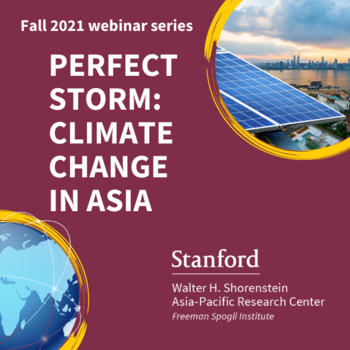
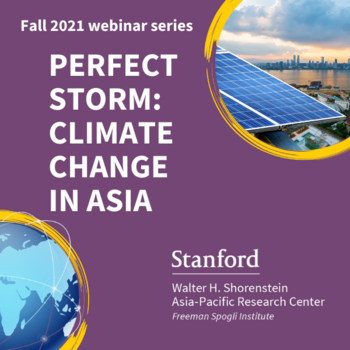
Solar panels and globe with text "Perfect Storm: Climate Change in Asia," APARC's fall 2021 webinar series
 This event is part of the 2021 Fall webinar series, Perfect Storm: Climate Change in Asia, sponsored by the Walter H. Shorenstein Asia-Pacific Research Center.

Via Zoom Webinar
Register: https://bit.ly/3DAaPA7

Tamma Carleton Assistant Professor, Environmental Economics, Climate Change, University of California, Santa Barbara
Jiacan Yuan Associate Professor of Atmospheric and Oceanic Sciences, Fudan University
Seminars
Authors
News Type
Q&As
Date
Paragraphs

A major bill with bipartisan support in Congress would reward farmers for an unusual harvest. The Growing Climate Solutions Act(link is external) promises billions of dollars for climate-smart agriculture practices, such as planting cover crops to reduce erosion and sequester carbon. The bill highlights farming’s potential as a climate change solution, as well as the challenge of controlling the sector’s growing greenhouse gas emissions. Below, Stanford Earth scientists Inês Azevedo, David Lobell and Rob Jackson discuss the surprising amount of greenhouse gases emitted by farming, how farmland conservation programs can help reverse the trend and what the federal government can do to promote more climate-friendly agriculture, among other issues.

Azevedo is an associate professor in the Department of Energy Resources Engineering at Stanford’s School of Earth, Energy & Environmental Sciences (Stanford Earth). Her research examines the role of food systems in reaching de-carbonized economies. Lobell is the Gloria and Richard Kushel Director of the Center on Food Security and the Environment. He uses unique datasets to study rural areas; his research has shown how reduced soil tillage can increase yields while nurturing healthier soils and lowering production costs. Jackson is the Michelle and Kevin Douglas Provostial Professor of Energy and Environment in Stanford Earth. His work has shown that global emissions of nitrous oxide increased by 30 percent over the past four decades due mostly to large-scale farming with synthetic fertilizers and cattle ranching, and that well-managed soil’s ability to trap carbon dioxide is potentially much greater than previously estimated.

What might the average person be surprised to learn about greenhouse gas emissions from America’s agricultural lands?

Lobell: First, I think people are surprised that the food system actually uses a very small share of fossil fuels, even when you include all the fertilizer production. Second, people are surprised by how many things they think are good, like eating organic or local foods, have very little effect on emissions and can even be worse than conventional alternatives.

Jackson: Many people are aware that fossil fuel use drives most carbon dioxide emissions, but they might not know that more than half of methane and nitrous oxide emissions attributable to human activities come from agriculture.

Azevedo: I think the average person would be surprised to learn agriculture – including livestock, agricultural soils and agricultural production – accounts for about 10 percent of total U.S. greenhouse gas emissions and, in contrast to some other sectors of the economy, they have increased over time.

Does the Growing Climate Solutions Act go far enough to mitigate and reduce emissions? How could it be stronger?

Lobell: I worry that there isn’t enough emphasis on the main greenhouse gases that agriculture contributes to – nitrous oxide and methane – where progress could probably be made a lot faster than for carbon dioxide. Soil carbon is like motherhood and apple pie – nobody is against it – but I wish that half the energy I see going into how to get more carbon into soil was going into how to reduce emissions of the other gases.

How can programs that reward farmers for certain conservation practices help? 

Jackson: The world’s soils contain far more carbon than the atmosphere, but agricultural activities such as plowing have released two hundred billion tons of carbon dioxide to the atmosphere from soils. Conservation programs can help us put some of that carbon back where it belongs, making our soils more fertile and better at retaining water.

Lobell: On one level, these programs can help start the process of making agriculture carbon neutral or even carbon negative. This is important if we want to meet aggressive climate goals. On another level, they can help build a broader political coalition devoted to solving climate change. This might be even more important for climate goals, especially given the disproportionate role of rural states in our federal government.

How should such programs be designed for maximum efficiency and cost-effectiveness?

Lobell: I’m concerned there is a lot of hype out there now on what specific practices can deliver, for example by companies trying to raise large funding rounds on the idea of selling carbon credits. I think it’s important that the programs have a strong system of verification and ability to adjust over time as we learn about what is truly effective.

Jackson: Rather than focusing primarily on carbon dioxide, agricultural incentives would be well served to reduce emissions of methane and nitrous oxide through practices such as better fertilizer and manure management. Methane’s warming potential is 30 times higher than carbon dioxide’s over a century, and nitrous oxide’s warming potential is nearly 300 times higher. Reducing them is a great bang for our climate buck.

From a global perspective, how important is agriculture’s role as a potential climate change solution, and how can policymakers better quantify and track it?

Azevedo: One of the recent things our recent research has shown is that although reducing emissions from fossil fuels is essential for meeting the Paris Agreement goals, other sources of emissions may also preclude its attainment. Specifically, even if all fossil fuel emissions were immediately halted, the achievement of the agreement’s 1.5 degree Celsius maximum temperature increase target would likely not be feasible if global food systems continue along their current trends.

Lobell: I think accelerating public research in this area will be critical, particularly for ways to accurately measure carbon accumulation or emissions reductions on individual farms. If this had been a well-funded area, we might be in a much better position in terms of leveraging all of the private sector enthusiasm for it. Since food is a traded commodity, it will also be important to monitor global land-use change and the extent to which our domestic policies might be having unintended consequences elsewhere.


Azevedo and Jackson are also senior fellows at the Stanford Woods Institute for the Environment and the Precourt Institute for Energy. Lobell is also a professor of Earth system science in Stanford’s School of Earth, Energy & Environmental Sciences, the William Wrigley Senior Fellow at the Stanford Woods Institute for the Environment and a senior fellow at the Freeman Spogli Institute for International Studies and the Stanford Institute for Economic Policy Research.

Hero Image
grain field
All News button
1
Subtitle

Stanford scientists discuss climate-smart agriculture

-

The Center on Democracy, Development, and the Rule of Law (CDDRL) will be accepting applications from eligible juniors on who are interested in writing their senior thesis on a subject touching upon democracy, economic development, and rule of law (DDRL) from any university department.  The application period opens on January 10, 2022 and runs through February 11, 2022.   For more information on the Fisher Family CDDRL Honors Program, please click here.

Join us online via Zoom on Friday, January 21st at 12:00pm (PST) to learn more! 

REGISTER NOW

CDDRL faculty and current honors students will be present to discuss the program and answer any questions.


Online via zoom. REGISTER HERE.

CDDRL
Encina Hall, C152
616 Jane Stanford Way
Stanford, CA 94305-6055

(650) 725-2705 (650) 724-2996
0
Senior Fellow at the Freeman Spogli Institute for International Studies
Professor, by courtesy, of Political Science
Stedman_Steve.jpg PhD

Stephen Stedman is a Senior Fellow at the Freeman Spogli Institute for International Studies (FSI) and the Center on Democracy, Development and the Rule of Law (CDDRL), an affiliated faculty member at CISAC, and professor of political science (by courtesy) at Stanford University. He is director of CDDRL's Fisher Family Honors Program in Democracy, Development and Rule of Law, and will be faculty director of the Program on International Relations in the School of Humanities and Sciences effective Fall 2025.

In 2011-12 Professor Stedman served as the Director for the Global Commission on Elections, Democracy, and Security, a body of eminent persons tasked with developing recommendations on promoting and protecting the integrity of elections and international electoral assistance. The Commission is a joint project of the Kofi Annan Foundation and International IDEA, an intergovernmental organization that works on international democracy and electoral assistance.

In 2003-04 Professor Stedman was Research Director of the United Nations High-level Panel on Threats, Challenges and Change and was a principal drafter of the Panel’s report, A More Secure World: Our Shared Responsibility.

In 2005 he served as Assistant Secretary-General and Special Advisor to the Secretary- General of the United Nations, with responsibility for working with governments to adopt the Panel’s recommendations for strengthening collective security and for implementing changes within the United Nations Secretariat, including the creation of a Peacebuilding Support Office, a Counter Terrorism Task Force, and a Policy Committee to act as a cabinet to the Secretary-General.

His most recent book, with Bruce Jones and Carlos Pascual, is Power and Responsibility: Creating International Order in an Era of Transnational Threats (Washington DC: Brookings Institution, 2009).

Director, Fisher Family Honors Program in Democracy, Development and Rule of Law
Director, Program in International Relations
Affiliated faculty at the Center for International Security and Cooperation
Date Label

Encina Hall, C150
616 Jane Stanford Way
Stanford, CA 94305

0
Center Fellow, Freeman Spogli Institute for International Studies
didi_kuo_2023.jpg

Didi Kuo is a Center Fellow at the Freeman Spogli Institute for International Studies (FSI) at Stanford University. She is a scholar of comparative politics with a focus on democratization, corruption and clientelism, political parties and institutions, and political reform. She is the author of The Great Retreat: How Political Parties Should Behave and Why They Don’t (Oxford University Press) and Clientelism, Capitalism, and Democracy: the rise of programmatic politics in the United States and Britain (Cambridge University Press, 2018).

She has been at Stanford since 2013 as the manager of the Program on American Democracy in Comparative Perspective and is co-director of the Fisher Family Honors Program at CDDRL. She was an Eric and Wendy Schmidt Fellow at New America and is a non-resident fellow with the Carnegie Endowment for International Peace. She received a PhD in political science from Harvard University, an MSc in Economic and Social History from Oxford University, where she studied as a Marshall Scholar, and a BA from Emory University.

Date Label
-

Asia Health Policy Program (AHPP) 2021-22 Colloquium series "Aligning Incentives for Better Health and More Resilient Health Systems in Asia”

Friday, November 12, 2021, 7:30am - 8:30am (Jakarta time)

Dr. Alatas will discuss her research on promoting vaccination in Indonesia and the impact of the pandemic on Indonesia’s society and economy more generally, including on poverty, human capital, and development.

Image
Vivi Alatas 4X4
Vivi Alatas is an  economist with passion for evidence-based solutions.  She is CEO of Asakreativita, a consulting and Edtech company that she established in 2020. Formerly she was a Lead Economist of the World Bank, where she led a team of seasoned local and international economists in producing several flagship reports for national and global audiences, including ‘Targeting Poor and Vulnerable Households in Indonesia’, ‘Making Poverty Work in Indonesia’ , ‘Indonesia’s Rising Divide’, ‘Indonesia Jobs Report’ and “Aspiring Indonesia – Expanding the Middle Class”. She has presented various of these research findings to the President, Vice President, Ministers and Deputy Ministers. She also has written several journal articles on poverty, inequality and labour issues. Some of the papers were written in collaboration with Nobel Laureates Abhijit Banerjee and Angus Deaton (who was also her advisor at Princeton).

Via Zoom Webinar
Register: https://bit.ly/3FmTUTp

Vivi Alatas CEO, Asakreativita
Seminars

APARC Fall 2021 Webinar Series

The Asia-Pacific region is the world’s most vulnerable region to climate change risks. With its densely populated low-lying territories and high dependence on natural resources and agriculture sectors, Asia is increasingly susceptible to the impacts of rising sea levels and weather extremes. The impacts of climate change encompass multiple socioeconomic systems across the region, from livability and workability to food systems, physical assets, infrastructure services, and natural capital.

-

North Carolina time: 19 October, 2021, 8:00-9:30 pm; Singapore time: 20 October, 2021, 8:00-9:30am

Viewed alongside other world regions, Southeast Asia is uniquely vulnerable to major damage by global warming. Its coastlines are lengthy and subject to searise. Its urban centers of economic and political gravity are mainly riverine or deltaic. Its agriculture requires optimal levels and rhythms of waterflow, as do its polluted main veins, the Mekong and the Irrawaddy.  In already tropical conditions, heatwaves are especially enervating.  Nor has the region escaped extreme weather events.  The ten most afflicted countries worldwide in that regard include Myanmar, the Philippines, Thailand, and Vietnam.  With this background in mind, Angel Hsu and Melissa Low, two scholars with deep regional and policy knowledge will consider questions such as:  What has been and is being done, by whom, and with what chances of success?  Can currently worsening trends be reversed?  Mitigated?  Or is adaptation the sole plausible recourse?  Who will represent the interests of the unborn generations who will suffer the long-term consequences of present-day indifference and delay?  Will effective policy require authoritarian politics?  Given that the largest current and historical emitters of greenhouse gases are, respectively, China and the US, what roles should and will they play?  And how, if at all, will global versions of these questions be addressed and answered in November in Glasgow at COP26?

Image
Hsu, Angel
Angel Hsu founded and heads the University of North Carolina-Chapel Hill’s Data-Driven EnviroLab, an interdisciplinary research group that innovates quantitative approaches to pressing environmental issues.  Her research into the causes and consequences of climate change explores the interfacing of science and policy.  Her many publications include coverage of Malaysia, Viet Nam, and especially China.  In February 2021 she spoke on global climate trends before the US Senate Committee on Energy and Natural Resources, having addressed US-China climate relations at the University of Pennsylvania in 2020.  Illustrating Prof. Hsu’s commitment to public outreach was her selection as a TED 2018 Age of Amazement Speaker and earlier as an inaugural member of the Grist 50, an annual list of “emerging leaders” working on “fresh, real-world solutions” to the world’s “biggest challenges,” global warming included.  She holds a PhD in Environmental Policy from Yale University.

Image
Low, Melissa
Melissa Low has published, presented, and advised on climate change in multiple forums.  She is currently researching the relative transparency of climate action and reporting in Southeast Asia.  She provides policy analyses and conducts workshops to improve understanding of the Paris Agreement and track whether countries are keeping their promises.  For that work, in 2021, she received Singapore’s EcoFriend Award and its Public Service Medal.  Having taken part in the UN Framework Convention on Climate Change (UNFCCC) Conference of Parties for many years, she is now on the steering committee that coordinates NGOs under the UNFCCC. She holds a University of Strathclyde LLM (with distinction) in Climate Change Law and Policy and an MSc in Environmental Management at the National University of Singapore, where is pursuing a PhD in geography.  Her master’s thesis on the run-up to the Paris Agreement won NUS’s Shell Best Dissertation Award.

Image
CC-SeAP
This event is part of the 2021 Fall webinar series, Perfect Storm: Climate Change in Asia, sponsored by the Walter H. Shorenstein Asia-Pacific Research Center.

Via Zoom Webinar
Register: https://bit.ly/3ulj9jV

Angel Hsu Assistant Professor of Public Policy and the Environment, University of North Carolina at Chapel Hill
Melissa Low Research Fellow, Energy Studies Institute, National University of Singapore
Seminars
-

Asia Health Policy Program (AHPP) 2021-22 Colloquium series "Aligning Incentives for Better Health and More Resilient Health Systems in Asia”

Professor Mobarak will discuss his research on COVID-19 response in Bangladesh and beyond, including masking, vaccine equity, and appropriate pandemic response policies in low and middle income countries.

He will provide an overview of the coauthored MaskNorm study, a randomized-trial of community-level mask promotion in rural Bangladesh during COVID-19 that demonstrates a scalable and effective method to promote mask adoption and reduce symptomatic SARS-CoV-2 infections. He will also discuss efficient last-mile vaccine delivery in low-income countries and related research on the lower epidemiological and welfare value of social distancing in lower-income countries.

Image
Mobarak, Mushfiq
Ahmed Mushfiq Mobarak is a Professor of Economics at Yale University with concurrent appointments in the School of Management and in the Department of Economics.

Mobarak is the founder and faculty director of the Yale Research Initiative on Innovation and Scale (Y-RISE). He holds other appointments at Innovations for Poverty Action, the Jameel Poverty Action Lab (J-PAL) at MIT, the International Growth Centre (IGC) at LSE.

Mobarak has several ongoing research projects in Bangladesh, Brazil, Chile, Kenya, Malawi and Sierra Leone. He conducts field experiments exploring ways to induce people in developing countries to adopt technologies or behaviors that are likely to be welfare improving. He also examines the complexities of scaling up development interventions that are proven effective in such trials. For example, he is scaling and testing strategies to address seasonal poverty using migration subsidies or consumption loans in Bangladesh, Nepal and Indonesia. His research has been published in journals across disciplines, including Econometrica, Science, The Review of Economic Studies, the American Political Science Review, Proceedings of the National Academy of Sciences, and Demography, and covered by the New York Times, The Economist, Science, NPR, BBC, Wall Street Journal, the Times of London, and other media outlets around the world. He received a Carnegie Fellowship in 2017.

Mobarak is collaborating with the government of Bangladesh, NGOs and think-tanks such as BRAC and BIGD, the major Bangladeshi telecom providers, Innovations for Poverty Action, UNDP, other economists, epidemiologists, computer scientists, and public health researchers to devise evidence-based COVID response strategies for Bangladesh and for other developing countries. The approach and results have been covered by BBC, Foreign Policy, New York Times, Washington Post, Vox, and media in India, Pakistan, Bangladesh, Nigeria, Austria, Sweden, Denmark, among others.  The work is supported by the Bill and Melinda Gates Foundation, Givewell.org, the Global Innovation Fund, and Yale Macmillan Center.

Co-sponsored by


Image
South Asia logo
Image
South Asia logo

Via Zoom Webinar
Register: https://bit.ly/3ulFdLi

Ahmed Mushfiq Mobarak Professor of Economics, Yale University
Seminars
Subscribe to Environment