Governance

FSI's research on the origins, character and consequences of government institutions spans continents and academic disciplines. The institute’s senior fellows and their colleagues across Stanford examine the principles of public administration and implementation. Their work focuses on how maternal health care is delivered in rural China, how public action can create wealth and eliminate poverty, and why U.S. immigration reform keeps stalling. 

FSI’s work includes comparative studies of how institutions help resolve policy and societal issues. Scholars aim to clearly define and make sense of the rule of law, examining how it is invoked and applied around the world. 

FSI researchers also investigate government services – trying to understand and measure how they work, whom they serve and how good they are. They assess energy services aimed at helping the poorest people around the world and explore public opinion on torture policies. The Children in Crisis project addresses how child health interventions interact with political reform. Specific research on governance, organizations and security capitalizes on FSI's longstanding interests and looks at how governance and organizational issues affect a nation’s ability to address security and international cooperation.

Paragraphs
Image
Book cover "The Hghest Exam"

Each year, more than ten million students across China pin their hopes on the gaokao, the nationwide college entrance exam. Unlike in the United States, where standardized tests are just one factor, in China college admission is determined entirely by gaokao performance. It is no wonder the test has become a national obsession.

Drawing on extensive surveys, historical research, and economic analysis, and informed by Ruixue Jia and Hongbin Li’s own experiences of the gaokao gauntlet, The Highest Exam reveals how China’s education system functions as a centralized tournament. It explains why preparation for the gaokao begins even before first grade—and why, given its importance for upward mobility, Chinese families are behaving rationally when they devote immense quantities of money and effort to acing the test. It shows how the exam system serves the needs of the Chinese Communist Party and drives much of the country’s economic growth. And it examines the gaokao’s far-reaching effects on China’s society, as the exam’s promise of meritocracy encourages citizens to focus on individual ability at the expense of considering socioeconomic inequalities.

What’s more, as the book makes clear, the gaokao is now also shaping debates around education in the United States. As Chinese-American families bring the expectations of the highest exam with them, their calls for objective, transparent metrics in the education system increasingly clash with the more holistic measures of achievement used by American schools and universities.

All Publications button
1
Publication Type
Books
Publication Date
Subtitle

Combining personal narratives with decades of research, a vivid account of how the gaokao—China’s high-stakes college admissions test—shapes that society and influences education debates in the United States.

Authors
Hongbin Li
Book Publisher
Harvard University Press
Paragraphs

Opposition coalitions under electoral authoritarianism have been associated with greater likelihood of opposition victory and democratization. I argue, however, that coalitions also entail significant downside risks with implications for longer term prospects for democracy. Where coalitions produce strong electoral outcomes but fail to force turnovers, regimes are left with both the incentive and capacity to repress and reconsolidate power. I show cross-nationally that opposition coalitions are associated with stronger opposition performance overall, but that when oppositions fail to take power, exceptionally strong performance is associated with greater autocratization in the subsequent years, including increased repression and poorer electoral quality in future contests. Probing the case of Cambodia, I demonstrate how the very features that make opposition coalitions a useful tool in strengthening performance also invite new threats from regimes. I argue that this makes coalition formation a particularly risky proposition.

All Publications button
1
Publication Type
Journal Articles
Publication Date
Journal Publisher
American Journal of Political Science
Authors
Oren Samet
Number
Issue 4, October 2025
Authors
Noa Ronkin
News Type
News
Date
Paragraphs

On October 21, 2025, Ms. Sanae Takaichi, a hardline conservative, became the first female Prime Minister of Japan, marking a historic moment for the country, which has one of the worst records among the world's developed democracies for gender equality. Yet, Takaichi's views on empowering women are complex, and she steps into office at a moment of internal party weakness and intense domestic and regional strategic pressures. On October 28, she will welcome President Trump to Tokyo, where the two leaders will hold a summit meeting.

In the following video explainer, Stanford sociologist Kiyoteru Tsutsui, the Henri H. and Tomoye Takahashi Professor and Senior Fellow in Japanese Studies at the Shorenstein Asia-Pacific Research Center (APARC) and the director of APARC and its Japan Program, discusses Takaichi’s background and rise to power, her cabinet choices, and what they signal for Japan's future. Watch:

Video: Michael Breger


Subscribe to APARC newsletters to receive our experts' analysis and commentary >


In the Media


On October 28, 2025, on the heels of the summit meeting of Prime Minister Takaichi and President Trump, Tsutsui joined Scott Tong, host of WBUR's Here & Now, to discuss Takaichi's rise to power and what's next for Japan. Listen:

Read More

Tasneem Khalil delivers remarks at a lectern.
News

Shorenstein Journalism Award Honors Netra News, Spotlights Public Interest Reporting Advancing Democracy and Accountability in Bangladesh

The 2025 Shorenstein Journalism Award recognized Netra News, Bangladesh’s premier independent media outlet, at a celebration featuring Tasneem Khalil, its founding editor-in-chief, who discussed its mission and joined a panel of experts in considering the prospects for democracy in Bangladesh.
Shorenstein Journalism Award Honors Netra News, Spotlights Public Interest Reporting Advancing Democracy and Accountability in Bangladesh
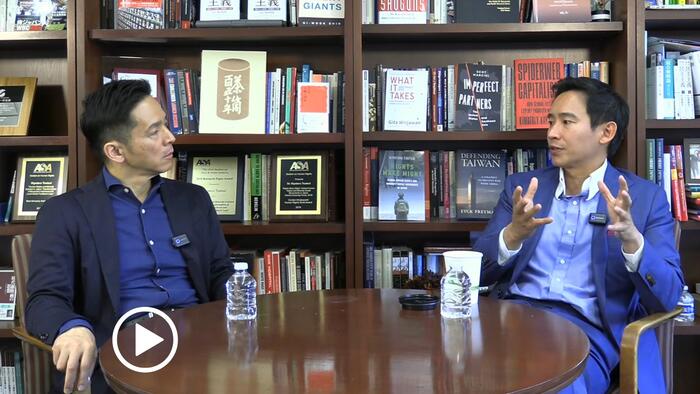
Gita Wirjawan presents his book What It Takes - Southeast Asia
News

How Southeast Asia Can Become a Leader on the World Stage

In his new book, What It Takes: Southeast Asia, Gita Wirjawan examines how Southeast Asia can unlock its untapped potential by leveraging its massive economic and human scale to claim its place on the global stage.
How Southeast Asia Can Become a Leader on the World Stage
Colonade at Stanford Main Quad with text: call for applications for APARC's 2026-28 fellowships.
News

Applications Open for 2026-2028 Fellowships at Stanford's Asia-Pacific Research Center

The center offers multiple fellowships in Asian studies to begin in fall quarter 2026. These include a postdoctoral fellowship on political, economic, or social change in the Asia-Pacific region, postdoctoral fellowships focused on Asia health policy and contemporary Japan, postdoctoral fellowships and visiting fellow positions with the Stanford Next Asia Policy Lab, and a visiting fellow position on contemporary Taiwan.
Applications Open for 2026-2028 Fellowships at Stanford's Asia-Pacific Research Center
Hero Image
Prime Minister Takaichi speaks in front of reporters during her first press conference as prime minister at the Prime Minister's Residence on 21 October 2025.
Takaichi speaks in front of reporters during her first press conference as prime minister at the Prime Minister's Residence on October 21, 2025.
Cabinet Secretariat, CC BY 4.0, via Wikimedia Commons
All News button
1
Subtitle

Stanford sociologist Kiyoteru Tsutsui, director of the Shorenstein Asia-Pacific Research Center and the Japan Program, explains the path to power of Japan’s first female prime minister and what her leadership means for the country's future.

Date Label
Authors
News Type
News
Date
Paragraphs

Motivation


Political parties have long reflected  dividing lines between groups in a society, often called political ‘cleavages’. Examples include workers vs. business owners, Protestants vs. Catholics, and urban vs. rural constituents. Civil society organizations (CSOs) — such as unions, churches, and chambers of commerce — have historically shaped the content and strength of these cleavages.

However, both CSOs and cleavages have changed in recent decades. For one, traditional cleavages have declined in importance, and new divides have emerged, such as between the so-called winners and losers of globalization or between those on one side or the other of the culture wars. In addition, formal CSOs have seen declining membership and reduced political influence, while informal groups and more episodic activism have grown. While CSOs and political parties used to have highly formalized relationships, they now tend to engage with each other more opportunistically and sometimes antagonistically. It seems clear that CSOs continue to influence political cleavages — both old and new — in the 21st century. But how exactly does this occur?

Contribution


In “Cleavage Theory Meets Civil Society,” Alex Mierke-Zatwarnicki, Endre Borbáth, and Swen Hutter examine the varied historical and contemporary relationships between CSOs, cleavages, and political parties in Western Europe. The authors develop a general framework for understanding the relationship between CSOs and cleavage development, providing insights into how contemporary politics reflects long-term changes in the structure of civil society. 

The paper is set against social science research on cleavages, which can be divided into two broad streams. First, classical scholarship emphasized the importance of early 20th-century mass associations, such as unions, in shaping cleavages and party politics. By contrast, newer work, written against the backdrop of a changing CSO landscape, has viewed CSOs as largely irrelevant, arguing that opposition parties shape cleavages via direct interactions with voters. Neither body of previous work provides a compelling framework for understanding how contemporary CSOs — given their fragmentation, informationalization, and politicization -- matter for cleavages.

The authors also shed light on the phenomenon of polarization, which is a key part of democratic backsliding. Indeed, electorates are polarized around several cleavages — economic, religious, and cultural — that populist leaders have used to justify excluding their opponents from politics, portraying them as existential threats to a specific way of life.

Processes and Mechanisms


The authors suggest that cleavage development can be seen as the culmination of three processes, which CSOs may influence in key ways. The first is “group formation,” which concerns how individuals come to identify as workers, congregants, or otherwise. The second process is “political institutionalization,” which entails cleavages being embodied in party competition. The third is “political stabilization,” whereby cleavages are reinforced over time by parties.


Stage of cleavage developmentImportance of political linkageImportance of social closure
I. Group formationLowHigh
II. Political institutionalisationHighMedium
III. Electoral stabilisationHighHigh


Table 1. Role of civil society across stages of cleavage development.


To understand how CSOs might shape these three processes, the authors outline two mechanisms. The first is “linkage,” whereby CSOs communicate group demands and pressure political parties to represent them. Linkage is hypothesized to be more important during the latter processes of institutionalization and stabilization; it was historically important in group formation but less so today because of the aforementioned decline of formal CSOs.

The second mechanism is “social closure,” which concerns how group boundaries are solidified. CSOs are hypothesized to contribute to social closure by bringing group members together and organizing them around shared demands, increasing their sense of ingroup identification. This mechanism is important for group formation as well as  political stabilization.

CSOs still appear to facilitate linkage and social closure, albeit in different ways than in the early 20th century. For example, CSOs are less likely to have formal links to parties but continue to exert pressure by organizing around individual issues, candidates, and elections. Voters’ relationships to CSOs are also more varied, creating divisions within the electorate between highly-active individuals who have a strong sense of group identity and people who are less ‘anchored’ to the cleavage. The authors also hypothesize that some of these dynamics may produce asymmetric changes across the left and right, as the strength and tactics of CSOs vary.


Trend in civil societyImplications for political linkageImplications for social closure
FragmentationCivil society groups have less capacity to present unified demands to parties and are more likely to compete for influence and adherents. Groups that persist are likely to be highly mobilised and ideologically distinct, exerting targeted pressure on priority issues and succeeding when they find points of cross-organisational consensus.Groups and identities likely to be more heterogeneous; individuals tend to form multiple, competing group attachments which vary over time in their personal salience. Likely to produce pockets of high social closure amongst ‘untethered’ masses.
InformalizationCivil society organisations less likely to have ongoing formal relationships with parties; influence comes through mobilisation in moments of political crisis or indecision.Interactions between group members become less frequent and more spontaneous, reducing social closure for most people while increasing it amongst committed adherents.
PoliticisationLandscape of civil society organisations is more differentiated and issue-specific, with groups pursuing alternate (and occasionally competing) linkage strategies; pressure on parties comes from different sources during different periods of mobilisation and is most effective in moments of coordination.Salience of voters’ group identities changes across different moments, depending on how parties and civil society groups invoke them. ‘Groupishness’ of the population as a whole may become very high in particular critical moments.
Overall effectMove towards more volatile forms of linkage, operating through punctuated equilibrium moments of mobilisation and contestation rather than stable formal ties.Proliferation of multiple identities leads social closure to bifurcate; ‘tight’, mobilised groups coexist alongside heterogeneous masses who become sporadically activated.
 Combination of the three trends widens the number and types of civil society actors that intervene in processes of political linkage, leading different groups to exert influence at different times and ‘successful’ pressure to hinge on effective cross-group coordination.Combination of the three trends simultaneously widens and blurs possibilities for participation, leading to a growing gap between people who are activated consistently and those whose group identification is more fluid and context-dependent.


Table 2. Implications of the changing structure of civil society.


Cross-National and Case Study Evidence


The authors then analyze cross-national data on political parties and voters in Austria, France, Germany, the Netherlands, and Switzerland. One data source concerns the extent to which political parties are tied to CSOs and whether they receive large-scale CSO donations. A second source looks at whether party supporters are active in CSOs. Preliminary findings point to important differences between old, class-based parties (especially Social Democrats) and newer parties, with the latter much less tied to CSOs. However, within the new party families, Green parties are more tightly linked to CSOs than far-right parties, but there also exists variation within far-right parties. These patterns demand a more fine-grained analysis of specific cases.


Image
Figure 2. Members of civil society organizations among the electorate of political parties in Austria, France, Germany, the Netherlands, and Switzerland.


Figure 2. Members of civil society organizations among the electorate of political parties in Austria, France, Germany, the Netherlands, and Switzerland.

Note: The figure is based on the Joint EVS/WVS 2017-2022 Dataset (2022). It uses the battery of membership in organizations and partisanship questions. In the WVS, partisanship is measured with ‘Which party would you vote for?’; in the EVS, with ‘Which political party appeals to you most?’ For this figure, the two items are treated as functional equivalents. The percentage of members is calculated from all respondents indicating sympathy towards the respective party.


Finally, the authors qualitatively analyze three distinct cases: one New Left party and both old and new far-right populist parties — the German Green Party, the Swiss People’s Party (SVP), and the Alternative for Germany (AfD). Their analysis reveals key differences as regards the importance of CSOs in fostering linkage and social closure. CSOs played a key role in consolidating the Greens and SVP, whereas in the case of AfD, antipathy from German CSOs helped generate a more outsider identity.

The Greens emerged via linkages with left-libertarian social movements in the 1970s and 80s. This included groups supportive of environmental protection and feminism and opposed to nuclear proliferation. CSOs provided ideas and personnel, which helped build a sense of social closure among party supporters. This identity still persists in spite of the subsequent fragmentation of civil society.

By contrast, SVP emerged through connections to Swiss farmers' associations, rural economic networks, and local interest groups. SVP has been radicalizing since the 1990s, becoming one of Europe’s most successful far-right parties and aligning itself with Euroscepticism. SVP’s long history of rural and community penetration has helped strengthen social closure among its electorate.

Finally, AfD emerged in a more fragmented context, via its ties to right-wing protest networks. The party was a top-down vehicle that organized in response to what it saw as Germany’s mismanagement of the Eurozone crisis. AfD lacks dense connections to CSOs and has instead built informal and often volatile alliances with protesters. Many German CSOs — as well as German society more generally — explicitly oppose AfD, which has ironically helped AfD build an outsider identity because its supporters feel isolated and stigmatized.

The case studies vividly illustrate how varied CSO relationships shape cleavages and partisanship in three of the most important Western European parties.

*Research-in-Brief prepared by Adam Fefer.

Hero Image
Brown and white concrete building under white clouds during daytime Sorin Gheorghita
All News button
1
Subtitle

CDDRL Research-in-Brief [4-minute read]

Date Label
Authors
Khushmita Dhabhai
News Type
News
Date
Paragraphs

On October 16, 2025, UC Davis political scientist Lauren Young delivered a talk on the politics of electoral repression in post–Cold War autocracies. Her talk examined why authoritarian incumbents use electoral repression in some elections and not others, why they often outsource it, and why it is often not targeted at the most strategically valuable districts. She argued that cohesion in the ruling coalition shapes its organization, targeting, and effectiveness. Electoral repression refers to the use of coercive violence by ruling elites to weaken opposition forces and tilt electoral competition in their favor while still holding elections. It is a common tool of authoritarian control, with opposition harassment present in roughly one in five elections since 1990. Yet incumbents do not always rely on repression, and when they do, they frequently delegate it to paramilitary groups rather than state security forces.

Young argued that repression is both valuable and politically risky, which explains why it is sometimes but not always used. Authoritarian elites face two key problems. First, there is a control problem: the effects of repression on political behavior are unpredictable. While violence may intimidate some citizens, it can also backfire, provoking outrage or mobilization. Second, there is a power-sharing problem: delegating repression to coercive actors — police, military, or militias — can empower these groups and threaten regime stability. These risks push rulers toward patronage, propaganda, and performance, turning to repression only when these strategies fail.

The problem of authoritarian control is shaped by the fact that citizen reactions to repression are driven by psychological factors that are hard for elites to observe. These include self-efficacy — the belief in one’s ability to overcome obstacles — and risk aversion, or preference for certainty. Individuals with high self-efficacy and lower risk aversion are less likely to be deterred, increasing the uncertainty of repression’s effects. 

The talk’s focus was on elite cohesion and how it structures electoral repression. When ruling coalitions are cohesive, regimes rely on state security forces, making violence more organized and strategically targeted at competitive “swing” districts. When coalitions are fragmented, elites are more threatened by the risk that politicized state security forces will turn on them and instead outsource violence to militias, including violent interest groups, criminal organizations, and loosely organized bands of party supporters. This produces poorly targeted repression, often concentrated in strongholds, less lethal, and more prone to backfire. Internal power dynamics thus shape how electoral repression unfolds.

To illustrate this, Young drew on more than 5,000 incidents of electoral violence in Zimbabwe between 2000 and 2023. Periods of high elite cohesion, such as the 2002 presidential election, saw repression directed by state security forces in competitive districts. Periods of low cohesion, such as the 2000 legislative election and the 2008 runoff, saw militia-led violence concentrated in party strongholds, where it was less strategic and more likely to generate backlash.

By linking elite politics with these dynamics, Young’s work shows why electoral repression remains widespread but unevenly effective, and why even carefully planned repression can backfire.

Read More

Saumitra Jha presented his research in a CDDRL seminar on October 9, 2025.
News

The Effects of Financial Exposures on Support for Climate Action

Can financial literacy shape climate beliefs? Saumitra Jha’s latest study suggests it can — and across party lines.
The Effects of Financial Exposures on Support for Climate Action
Maria Nagawa presented her research in a CDDRL seminar on October 2, 2025.
News

Foreign Aid and the Performance of Bureaucrats

CDDRL postdoctoral scholar Maria Nagawa examines how foreign aid projects influence bureaucrats’ incentives, effort, and the capacity of bureaucratic institutions.
Foreign Aid and the Performance of Bureaucrats
Claire Adida
News

Overcoming Barriers to Women’s Political Participation: Evidence from Nigeria

In Nigeria, women are far less likely than men to attend meetings or contact leaders. Claire Adida’s research reveals interventions that make a difference.
Overcoming Barriers to Women’s Political Participation: Evidence from Nigeria
Hero Image
Lauren Young presented her research at a CDDRL seminar on October 16, 2025.
Stacey Clifton
All News button
1
Subtitle

UC Davis Political Scientist Lauren Young examines why authoritarian incumbents use electoral repression selectively, why they often outsource it, and how elite cohesion shapes its organization, targeting, and effectiveness.

Date Label
Authors
News Type
News
Date
Paragraphs

Motivation and Summary


Modern states depend upon bureaucracies effectively delivering services and enforcing regulations, from public health to environmental protection and postal services. When bureaucracies are plagued by inefficiency and incapacity and are unable to “deliver the goods,” elected representatives suffer. This can open the door for citizens to throw their support behind authoritarian leaders who promise to deliver more effectively.

A central question of bureaucratic design concerns the degree of autonomy that ‘principals’ — political actors like legislators — should delegate to bureaucratic ‘agents.’ Calibrating autonomy is crucial because principals cannot perfectly monitor or control agents, whose preferences often diverge from their own. On the one hand, highly autonomous bureaucrats may become unaccountable to their principals. Think of national security agencies that create secretive dissident watchlists or even authorize assassinations. On the other hand, bureaucracies with little autonomy will find their decision-making hamstrung by “red tape.” If public health agencies required extensive legislative approval for every aspect of vaccine delivery, infection rates would skyrocket. How, then, can bureaucracies be designed to achieve their goals, creatively respond to new problems, and minimize corruption, all while being perceived as legitimate?

In “Calibrating autonomy,” Katherine Bersch and Francis Fukuyama disaggregate the concept of autonomy into two facets (independence and discretion), present hypotheses concerning how each facet relates to capacity and quality, and then test these hypotheses, primarily using survey data from Brazilian bureaucrats. Their findings caution against overly blunt efforts to calibrate autonomy across multiple bureaucracies, suggesting instead that policymakers should understand a given agency’s capacity to perform.

Argument and Hypotheses


The article builds on earlier research by co-author Francis Fukuyama, who in 2013 hypothesized a key moderating role for bureaucratic capacity in the relationship between autonomy and quality. Briefly, low-capacity agencies — lacking expertise and resources — will likely struggle to utilize their autonomy and deliver, whereas high-capacity bureaucracies will deliver effectively for opposite reasons. However, autonomy is itself a complex concept that ought to be disentangled before one can begin to spell out how it is linked to delivery.

Independence, the first “face” of autonomy, concerns the degree to which bureaucrats are constrained by actors who are close to politics, such as elected leaders or politically-appointed agency heads. More independent bureaucrats might allocate waste management contracts on the basis of cost-effectiveness or service quality records. Less independent bureaucrats might allocate according to the whims of politicians who wish to reward their allies. The degree of independence is oftentimes a function of the number and extent of political appointees in a given agency. 

The second face of autonomy is discretion, or rather, the extent to which agencies are constrained by laws, rules, or protocols. Waste management agencies with limited discretion may struggle to respond to sporadic garbage pile-ups, whereas those with high discretion may set unpredictable collection schedules. 

These two faces of autonomy lead to different expectations about how they are connected to quality. The authors hypothesize that independence and quality stand in a linear and positive relationship: agencies that are more unconstrained by political actors will deliver more effectively. By contrast, discretion and quality stand in a non-linear or “Goldilocks” relationship: too few and too many constraining rules will reduce quality. Following Fukuyama’s earlier research, capacity moderates these relationships; for example, less independence in specifically low-capacity agencies may strengthen quality, perhaps in cases where legislative actors are able to appoint highly qualified experts.

Methods and Findings


The authors select Brazil as their case, in part because it exhibits considerable internal variation in bureaucratic quality: some agencies are professional while others are incompetent. By focusing on one country, they avoid comparing fundamentally different national bureaucratic contexts. Further, selecting Brazil — with both strong and weak bureaucracies — reduces ‘selection biases,’ i.e., mistaking characteristics of only high- or low-quality agencies as causes of overall performance. From a global standpoint, Brazilian bureaucracies are solidly middle-ranged, neither outstanding nor abysmal. 

The main empirical part of the paper involves a 2018 survey of over 3200 Brazilian federal bureaucrats. About 60% of the respondents are political appointees and 40% are civil servants, which enables looking at bureaucrats who stand in different relationships to political actors. The authors exclude military personnel, teachers, nurses, and local police officers.

As hypothesized, respondents’ perceptions of agency independence increase their perceptions of quality in a linear way. This finding likely reflects Brazil’s coalitional style of government: politicians benefit electorally from strong government performance; without bureaucratic independence, political pressure and influence from the many coalition partners would likely hinder bureaucrats and weaken performance. Meanwhile, perceptions of discretion align with the authors’ non-linear expectations.


Image
Figure 3: (a) Impact of independence on quality at varying levels of capacity. (b) Impact of discretion on quality at varying levels of capacity.


Figure 3: (a) Impact of independence on quality at varying levels of capacity. (b) Impact of discretion on quality at varying levels of capacity.


These findings are mediated by capacity, which the authors measure in terms of resources, career length, salaries, and the proportion of agents in core or expert careers. The findings hold even when controlling for political factors like party membership or appointment type (political vs. civil servant), individual characteristics such as gender or years of service, and agency differences, including budget or size. These controls are based on administrative data from over 326,000 bureaucrats across Brazil’s 95 most important federal agencies.


Image
FIgure 4: Quality at varying levels of capacity.


Figure 4: Quality at varying levels of capacity.


Contributions and Implications

“Calibrating autonomy” makes important conceptual and empirical contributions to our understanding of bureaucratic performance. By disaggregating the concept of autonomy into independence and discretion, it helps make sense of seemingly contradictory empirical findings, namely that both minimally and highly autonomous bureaucracies perform well. And by evaluating their hypotheses about the two faces of autonomy using Brazilian data, the authors guard against selection biases or problems from comparing countries with quite different bureaucratic landscapes.

The paper serves as a caution against overly simplistic or blunt “solutions” to poor bureaucratic performance. Merely limiting discretion or increasing legislative oversight can make matters worse if the relevant bureaucratic culture is not properly understood, especially when it comes to capacity.

*Research-in-Brief prepared by Adam Fefer.

Hero Image
National Congress of Brazil (Congresso Nacional) in Brasília
National Congress of Brazil (Congresso Nacional).
Gabriel Tiveron
All News button
1
Subtitle

CDDRL Research-in-Brief [4-minute read]

Date Label
Authors
Nora Sulots
News Type
News
Date
Paragraphs

The Fisher Family Summer Fellows on Democracy and Development Program at Stanford University's Center on Democracy, Development and the Rule of Law is now accepting applications for our summer 2026 program. The deadline to apply is 11:59 pm PST on Thursday, January 15, 2026.

The program brings together an annual cohort of approximately 30 mid-career practitioners from countries in political transition who are working to advance democratic practices and enact economic and legal reform to promote human development. Launched by CDDRL in 2005, the program was previously known as the Draper Hills Summer Fellows Program. The new name reflects an endowment gift from the Fisher family — Sakurako (Sako), ‘82, and William (Bill), MBA ‘84 — that secures the future of this important and impactful program.

From Afghanistan to Zimbabwe, our program participants are selected from among hundreds of applicants every year for the significant contributions they have already made to their societies and their potential to make an even greater impact with some help from Stanford. We aim to give them the opportunity to join a global network of over 500 alumni from 97 countries who have all faced similar sets of challenges in bringing change to their countries.

The Fisher Family Summer Fellows Program provides an intensive 3-week on-campus forum for civil society leaders to exchange experiences and receive academic and policy training to enrich their knowledge and advance their work. Delivered by a leading Stanford faculty team composed of Michael McFaul, Kathryn Stoner, Francis Fukuyama, Larry Diamond, Erik Jensen, and more, the program allows emerging and established global leaders to explore new institutional models and frameworks to enhance their ability to promote good governance, accountable politics, and find new ways to achieve economic development in their home countries.

Prospective fellows from Ukraine are also invited to apply for our Strengthening Ukrainian Democracy and Development (SU-DD) Program, which runs concurrently with the Fisher Family Summer Fellows Program. The SU-DD program provides a unique opportunity for mid-career practitioners working on well-defined projects aimed at strengthening Ukrainian democracy, enhancing human development, and promoting good governance. Applicants to the SU-DD program will use the Fisher Family Summer Fellows Program application portal to apply and indicate their interest there. You will then be directed to a series of supplemental questions specific to the SU-DD program, including requiring a detailed description of your proposed project.

Read More

2025 Fisher Family Summer Fellows
News

Spotlight on the 2025 Summer Fellows

The Fellow Spotlight Series is an inspiring and moving series of "TED"-style talks given by each of our 2025 Fisher Family Summer Fellows to share their backstories and discuss their work.
Spotlight on the 2025 Summer Fellows
2025 Strengthening Ukrainian Democracy and Development fellows
News

Ukrainian Leaders Advance Postwar Recovery Through Stanford Fellowship

Meet the four fellows participating in CDDRL’s Strengthening Democracy and Development Program and learn how they are forging solutions to help Ukraine rise stronger from the challenges of war.
Ukrainian Leaders Advance Postwar Recovery Through Stanford Fellowship
FFSF Class of 2025 with 20th Anniversary logo
News

Announcing the 20th Anniversary Cohort of the Fisher Family Summer Fellows on Democracy and Development Program

In July 2025, the Center on Democracy, Development and the Rule of Law will welcome a diverse cohort of 27 experienced practitioners from 18 countries who are working to advance democratic practices and economic and legal reform in contexts where freedom, human development, and good governance are fragile or at risk.
Announcing the 20th Anniversary Cohort of the Fisher Family Summer Fellows on Democracy and Development Program
Hero Image
2025 Summer Fellows role play during a case study session Chloe Davis
All News button
1
Subtitle

The program will run from Sunday, July 19, to Friday, August 7, 2026. Applications are due by 11:59 pm PST on Thursday, January 15, 2026.

Date Label
Authors
Nora Sulots
News Type
News
Date
Paragraphs

The Center on Democracy, Development and the Rule of Law is thrilled to congratulate Hoover Fellows and CDDRL affiliated scholars Erin Baggott Carter and Brett L. Carter on receiving the William H. Riker Book Award presented by the American Political Science Association’s Political Economy section. The award honors the best book on political economy published in the past three years and recognizes the Carters’ recent work, Propaganda in Autocracies: Institutions, Information, and the Politics of Belief (Cambridge University Press, 2023).

Propaganda in Autocracies offers a groundbreaking account of how and why authoritarian regimes deploy propaganda. It draws on the first global dataset of authoritarian propaganda, analyzing nearly eight million newspaper articles across 59 countries. The book reveals how autocrats strategically craft narratives to secure their rule, and why propaganda varies so dramatically across contexts — from Russian invocations of Donald Trump to the sweeping state narratives of contemporary China.

Reflecting on the honor, Brett Carter emphasized the project’s roots at Stanford: “It goes without saying that we deeply value the wonderful CDDRL community where this project began so many years ago. This is very much a CDDRL book. We began it when I was a postdoctoral fellow and worked through the book’s key ideas over the course of several seminar presentations.”

This is very much a CDDRL book. We began it when I was a postdoctoral fellow and worked through the book’s key ideas over the course of several seminar presentations.
Brett L. Carter

CDDRL Mosbacher Director Kathryn Stoner noted that: “This award is a powerful testament to the incredible quality of Erin and Brett’s pathbreaking research. Their work significantly advances our understanding of how modern authoritarian regimes function in the 21st century, and I am so pleased that our CDDRL community helped to support some of their scholarship. But this honor is all theirs!”

The William H. Riker Book Award adds to the growing recognition of the Carters’ research: Propaganda in Autocracies has also received the Hazel Gaudet-Erskine Best Book Award from the International Journal of Press/Politics, along with honorable mentions for both the APSA Luebbert Award for Best Book in Comparative Politics and the APSA Democracy and Autocracy Best Book Award.

With this honor, Erin Baggott Carter and Brett Carter join the distinguished ranks of scholars whose work carries forward William Riker’s legacy of combining theory and empirics to deepen our understanding of political life.

Read More

Brett Carter and Erin Baggot Carter present their new book during CDDRL's Fall 2023 Research Seminar Series
News

CDDRL Affiliated Scholars Build the World’s Largest Autocratic Propaganda Dataset

Erin Baggot Carter and Brett Carter discuss their new book in the Center on Democracy, Development and the Rule of Law’s weekly research seminar.
CDDRL Affiliated Scholars Build the World’s Largest Autocratic Propaganda Dataset
Book award winners
News

CDDRL Scholars Celebrated for Exceptional Contributions to Political Science Literature

Anna Grzymala-Busse's book "Sacred Foundations" has been awarded the American Political Science Association's J. David Greenstone Award and the Hubert Morken Best Book in Religion and Politics Award. Erin Baggott Carter and Brett Carter's book "Propaganda in Autocracies" has won the Hazel Gaudet-Erskine Best Book Award from the International Journal of Press/Politics.
CDDRL Scholars Celebrated for Exceptional Contributions to Political Science Literature
Brett Carter and Erin Baggot Carter
News

Studying China—As China Stares Back

Erin Baggot Carter and Brett Carter describe how Beijing’s repression reaches all the way to American classrooms.
Studying China—As China Stares Back
Hero Image
Erin Baggot Carter, book cover of "Propaganda in Autocracies," and Brett Carter
Erin Baggot Carter and Brett Carter
Rod Searcey
All News button
1
Subtitle

The award recognizes their book, “Propaganda in Autocracies” (Cambridge University Press, 2023), as the best book in political economy published in the past three years.

Date Label
Authors
Khushmita Dhabhai
News Type
News
Date
Paragraphs

On September 25, 2025, FSI Senior Fellow Claire Adida presented her team’s research at a CDDRL Research Seminar Series talk under the title, “Overcoming Barriers to Women’s Political Participation: Evidence from Nigeria.” The seminar addressed a central paradox in global politics: although women’s legal formal right to vote is nearly universal, deep gender gaps remain in informal forms of political participation, such as contacting a local government official or attending a community meeting. This lack of engagement means women’s voices are underrepresented in governance and policies are less likely to reflect their priorities. This is particularly salient in hybrid democracies, where informal political participation may matter more than casting a vote.

Adida situated the study in the context of Nigeria, a large and diverse democracy that remains heavily patriarchal. Surveys highlight these disparities starkly: nearly half of Nigerian men believe men make better leaders than women; two in five women report never discussing politics with friends or family; and women are consistently less likely than men to attend meetings or contact community leaders. Against this backdrop, the project tested interventions designed to reduce barriers that discourage women’s participation.

The research team identified three categories of constraints: resource-based (a lack of time, skills, or information), norms-based (social expectations that women should remain outside the public sphere), and psychological (feelings of disempowerment and doubt about one’s capacity to create change). The study focused on the last two. To explore these, the team partnered with ActionAid Nigeria to conduct a randomized control trial (RCT) across 450 rural wards in three southwestern states. Local leaders identified groups of economically active women, aged 21 to 50, who were permitted by their spouses to join.

All communities began with an informational session on local governance. Beyond that, two types of training were introduced. The first, targeted at women, consisted of five sessions over five months designed to build leadership, organizing, and advocacy skills. These emphasized group-based learning and aimed to foster collective efficacy — the belief that a group can act together to achieve change. The second, targeted at men, encouraged husbands to act as allies in supporting women’s participation. After the initial informational session, communities were randomly assigned to no longer receive further training, to receive the 5 sessions of women’s training, or to receive the 5 sessions of women’s training and the 5 sessions of men’s training.

The findings were striking. Women’s trainings had clear positive effects: participants were more likely to engage in politics, attend meetings, and contact local leaders. The quality of their participation also improved, suggesting greater confidence and effectiveness. There was also evidence that these women’s trainings activated collective and self-efficacy, lending credence to the Social Identity Model of Collective Action (SIMCA), a framework explaining how a sense of shared identity, group-based injustice, and group efficacy build political engagement. By contrast, men’s trainings produced modest results. They did not increase women’s participation beyond the women’s trainings and, in some cases, had small negative effects, such as on grant applications. Still, men’s trainings reduced opposition to women’s involvement, improved beliefs about women in leadership, and increased perceptions of more permissive community norms, even if they did not translate into an increase in women’s political participation.

Adida noted that these limited effects may reflect “ceiling effects” — many men in the sample were already relatively supportive compared to national averages, or lower attendance rates. It is also possible that changes in men’s attitudes take longer to manifest in behavior. The seminar concluded that advocacy trainings for women show strong promise in boosting participation, while efforts to reshape patriarchal norms among men may require longer-term strategies.

Read More

Natalia Forrat presented her research in a CDDRL seminar on May 29, 2025.
News

Unity, Division, and the Grassroots Architecture of Authoritarian Rule

Dr. Natalia Forrat, a comparative political sociologist and lecturer at the University of Michigan’s Center for Russian, East European, and Eurasian Studies, explores how authoritarian regimes are maintained not only through top-down coercion but also through everyday social dynamics at the grassroots level.
Unity, Division, and the Grassroots Architecture of Authoritarian Rule
Paul Pierson presented his research in a CDDRL seminar on May 22, 2025.
News

The Risks of U.S. Democratic Backsliding

University of California, Berkeley Distinguished Professor Paul Pierson explores the risks of democratic backsliding in the United States in the face of rising polarization and inequality.
The Risks of U.S. Democratic Backsliding
Clémence Tricaud presented her research in a CDDRL seminar on May 15, 2025.
News

Margins That Matter: Understanding the Changing Nature of U.S. Elections

In a CDDRL research seminar, Clémence Tricaud, Assistant Professor of Economics at the UCLA Anderson School of Management, shared her research on the evolving nature of electoral competition in the United States. She explored a question of growing political and public interest: Are U.S. elections truly getting closer—and if so, why does that matter?
Margins That Matter: Understanding the Changing Nature of U.S. Elections
Hero Image
Claire Adida
All News button
1
Subtitle

In Nigeria, women are far less likely than men to attend meetings or contact leaders. Claire Adida’s research reveals interventions that make a difference.

Date Label
Subscribe to Governance