Southeast Asia in the Year of the Horse: Issues and Prospects for 2014-15
Daniel and Nancy Okimoto Conference Room
Abstract:
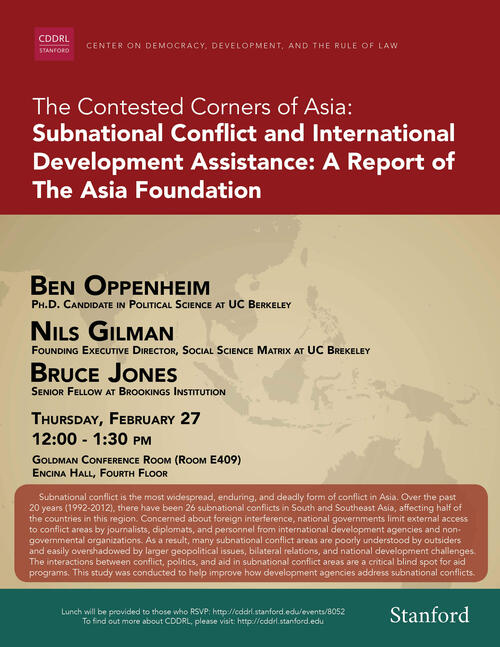
Subnational conflict is the most widespread, enduring, and deadly form of conflict in Asia. Over the past 20 years (1992-2012), there have been 26 subnational conflicts in South and Southeast Asia, affecting half of the countries in this region. Concerned about foreign interference, national governments limit external access to conflict areas by journalists, diplomats, and personnel from international development agencies and non-governmental organizations. As a result, many subnational conflict areas are poorly understood by outsiders and easily overshadowed by larger geopolitical issues, bilateral relations, and national development challenges. The interactions between conflict, politics, and aid in subnational conflict areas are a critical blind spot for aid programs. This study was conducted to help improve how development agencies address subnational conflicts.
Speaker Bios:
Ben Oppenheim is a Fellow (non-resident) at the Center on International Cooperation at New York University. His research spans a diverse set of topics, including fragile states, transnational threats (including pandemic disease risks and terrorism), and the strategic coherence and effectiveness of international assistance in fragile and conflict-affected areas.
Oppenheim has consulted for organizations including the World Bank, the United Nations, the Asia Foundation, the Institute for the Future, and the Fritz Institute, on issues including organizational learning, strategy, program design, foresight, and facilitation. In 2009, he served as Advisor to the first global congress on disarmament, demobilization, and reintegration, supported by the World Bank and the UN.
In 2013, Oppenheim was a visiting fellow at the Uppsala University Forum on Democracy, Peace, and Justice. His research has been supported by a Simpson Fellowship, and a fellowship with the Institute on Global Conflict and Cooperation. He was also a research fellow with UC Berkeley's Institute of International Studies, affiliated with the New Era Foreign Policy Project.
Nils Gilman is the Executive Director of Social Science Matrix. He holds a B.A., M.A. and Ph.D. in History from the University of California, Berkeley. Gilman’s first scholarly interest was in American and European intellectual history, with a particular focus on the institutional development of the social sciences, the lateral transfer and translation of ideas across disciplinary boundaries, and the impact of social scientific ideas on politics and policy.
Gilman is the author of Mandarins of the Future: Modernization Theory in Cold War America (Johns Hopkins University Press, 2004), the co-editor of Staging Growth: Modernization, Development, and the Global Cold War (University of Massachusetts Press, 2003) and Deviant Globalization: Black Market Economy in the 21st Century (Continuum Press, 2011), as well as the founding Co-editor of Humanity: An International Journal of Human Rights, Humanitarianism, and Development. He also blogs and tweets.
Prior to joining Social Science Matrix in September 2013, Gilman was research director at Monitor 360, a San Francisco consultancy that addresses complex, cross-disciplinary global strategic challenges for governments, multinational businesses, and NGOs. He has also worked at a variety of enterprise software companies, including Salesforce.com, BEA Systems, and Plumtree Software. Gilman has taught and lectured at a wide variety of venues, from the Harvard University, Columbia University, and National Defense University, to PopTech, the European Futurists Conference, and the Long Now Foundation.
Bruce Jones is a senior fellow and the director of the Project on International Order and Strategy in the Foreign Policy program at the Brookings Institution. He is also the director of the Center on International Cooperation at New York University.
Jones served as the senior external advisor for the World Bank’s 2011 World Development Report, Conflict, Security and Development, and in March 2010 was appointed by the United Nations secretary-general as a member of the senior advisory group to guide the Review of International Civilian Capacities. He is also consulting professor at the Center for International Security and Cooperation at Stanford University and professor (by courtesy) at New York University’s department of politics.
Jones holds a Ph.D. from the London School of Economics, and was Hamburg fellow in conflict prevention at Stanford University.
He is co-author with Carlos Pascual and Stephen Stedman of Power and Responsibility: Building International Order in an Era of Transnational Threats (Brookings Press, 2009); co-editor with Shepard Forman and Richard Gowan of Cooperating for Peace and Security (Cambridge University Press, 2009); and author of Peacemaking in Rwanda: The Dynamics of Failures(Lynne Reinner, 2001).
Jones served as senior advisor in the office of the secretary-general during the U.N. reform effort leading up to the World Summit 2005, and in the same period was acting secretary of the Secretary-General’s Policy Committee. In 2004-2005, he was deputy research director of the High-level Panel on Threats, Challenges and Change. From 2000-2002 he was special assistant to and acting chief of staff at the office of the U.N. special coordinator for the Middle East peace process.

Richard and Rhoda Goldman Conference Room
Zainab Hawa Bangura of Sierra Leone is Special Representative on Sexual Violence in Conflict at the level of Under-Secretary-General at the United Nations.
Prior to this appointment, Ms. Bangura was the Minister of Health and Sanitation for the Government of Sierra Leone, and brings to the position over 20 years of policy, diplomatic and practical experience in the field of governance, conflict resolution and reconciliation in Africa. She was previously the second female Minister of Foreign Affairs and International Cooperation, including Chief Adviser and Spokesperson of the President on bilateral and international issues. Ms. Bangura has been instrumental in developing national programmes on affordable health, advocating for the elimination of genital mutilation, managing the country’s Peace Building Commission and contributing to the multilateral and bilateral relations with the international community. She is experienced in meeting with interlocutors in diverse situations, including rebel groups, and familiar in dealing with State and non-State actors relevant to issues of sexual violence while fighting corruption and impunity.
Ms. Bangura has on-the-ground experience with peacekeeping operations from within the United Nations Mission in Liberia (UNMIL), where she was responsible for the management of the largest civilian component of the Mission, including promoting capacity-building of government institutions and community reconciliation. She is an experienced results-driven civil society, human and women’s rights campaigner and democracy activist, notably as Executive Director of the National Accountability Groups, Chair and Co-founder of the Movement for Progress Party of Sierra Leone, as well as Coordinator and Co-founder of the Campaign for Good Governance.
Ms. Bangura is a former fellow of the Chartered Insurance Institute of London, possessing Diplomas in Insurance Management from the City University Business School of London and Nottingham University. She received her Bachelor of Arts from the Fourah Bay College, University of Sierra Leone.
Building 200 (History Corner)
Room 205
Stanford University
Korea is one of the leading countries in technology-driven global markets for semiconductors, HDTVs, and mobile phones; and in shipbuilding industry, but Korea has already faced challenges in its global markets.
Dr. Dongwook Lee, 2013 Visiting Scholar in Korean Studies, will discuss Korea's industrial convergence policies that would help Park administration achieve its national agenda, a creative economy.
Dr. Lee is Director General at the Ministry of Trade, Industry and Energy in Korea, and has served as a government official for the past twenty-two years. He led and took part in developing industrial convergence policies and laws. Dr. Lee holds a BA in business administration from Yonsei University, an MA in public administration from Seoul National University, and a PhD in economics from Konkuk University, in Korea.
Philippines Conference Room
Historically, in Japan, out-of-court corporate restructurings have played a significant role in disciplining managers in the near-absence of hostile takeover activity and shareholder activism. This paper analyzes management turnover in a large sample of Japanese firms that underwent restructurings between 1981 and 2010. I find that restructurings that happen in later stages of financial distress, and those that are not initiated by the firm itself, are more likely to involve management turnover, as are restructurings in which the firm's main business operations are left intact. Furthermore, in restructurings after the reforms around the year 2000, management turnover is more likely to occur if the local potential managerial labor market is substantial. After controlling for firm characteristics and the firm's initial financial condition, it does not appear that management turnover is associated with an improvement in post-restructuring operating performance--in fact, the effect is significantly negative by estimates that address the non-random nature of management turnover. However, for restructurings led by equity funds, management turnover is associated with a more successful turnaround of the firm's performance. These results suggest that equity funds possess the ability to locate and recruit talented outside managers in a thin market for experienced managers.
Michael Furchtgott is an economist interested in corporate finance and governance. His current research investigates Japanese corporate restructurings and the behavior of firms and lenders when financial distress arises.
Furchtgott has completed his PhD in economics at the University of California, San Diego, where his research on corporate financial restatements has demonstrated that firms frequently circumvent laws designed to protect investors.
He holds a BA in economics and mathematics from Columbia University.
Daniel and Nancy Okimoto Conference Room
Shorenstein APARC
Encina Hall C331
616 Serra Street
Stanford, CA 94304-6055
Michael Furchtgott is an economist interested in corporate finance and governance. His current research investigates Japanese corporate restructurings and the behavior of firms and lenders when financial distress arises.
Furchtgott has completed his PhD in economics at the University of California, San Diego, where his research on corporate financial restatements has demonstrated that firms frequently circumvent laws designed to protect investors.
He holds a BA in economics and mathematics from Columbia University.
Abstract:
Professor Gold will make a presentation that is part of a larger book project that applies the theory of fields as elaborated by Pierre Bourdieu, Neil Fligstein and Doug McAdam to the remaking of Taiwan since the end of martial law in 1987. He argues that political democratization is only one part of the larger dispersal of all forms of power (what Bourdieu terms “capital”) away from the tight centralized control of the mainlander—dominated KMT to broader segments of Taiwan’s society. This talk will look at this process of the breakdown and reconstruction of the old order of various fields, in particular the political, economic and cultural fields, and the effect of this on the overarching field of power.
Speaker Bio:
Thomas B. Gold is Professor of Sociology at the University of California, Berkeley, and Executive Director of the Inter-University Program for Chinese Language Studies, whose executive office is at Berkeley and teaching program at Tsinghua University in Beijing. He received his B.A. in Chinese Studies from Oberlin College, and M.A. in Regional Studies – East Asia and PhD in Sociology from Harvard University. He taught English at Tunghai University in Taiwan. He was in the first group of U.S. government-sponsored students to study in China, spending a year at Shanghai’s Fudan University from 1979-1980. Prof Gold’s research has examined numerous topics on the societies on both sides of the Taiwan Strait. These include: youth; guanxi; urban private entrepreneurs (getihu); non-governmental organizations; popular culture; and social and political change. He is very active in civil society in the United States, currently serving on the boards of several organizations such as the Asia Society of Northern California, International Technological University, Teach for China, and the East Bay College Fund. His books include State and Society in the Taiwan Miracle, and the co-edited volumes Social Connections in China: Institutions, Culture, and the Changing Nature ofGuanxi, The New Entrepreneurs of Europe and Asia: Patterns of Business Development in Russia, Eastern Europe and China, and Laid-Off Workers in a Workers’ State: Unemployment With Chinese Characteristics.
Reuben W. Hills Conference Room
This talk is presented by the Greater China Business Club (GCBC) of Stanford Graduate School of Business and the Association of Chinese Students and Scholars at Stanford (ACSSS).
In July 2013, a Ted Talk “A tale of two political systems” was posted, and was instantly viewed millions of times around the world. In the talk, Mr. Eric X. Li, a venture capitalist and a political scientist argued that the universality claim of Western democratic systems was going to be "morally challenged" by China.
Do you agree? What do you think? Now you have the opportunity to discuss with Mr. Li face to face!
On Nov.6, Mr. Li will come to Stanford and talk with Professor Thomas Fingar on China’s Political System, its status, development, competitiveness and so on. Watch the Ted Talk and come to the event. We look forward to seeing you there!
---
Eric X. Li is a political scientist and an active participant in the intellectual discourses on the re-emergence of China as a great power and its impact on the world. His writings on comparative political governance and international relations have been widely published in leading publications such as the New York Times, Foreign Affairs, Financial Times, and Huffington Post. His most recent publications, The Life of the Party (Foreign Affairs, January/February, http://www.foreignaffairs.com/articles/138476/eric-x-li/the-life-of-the-party), Warring States (http://www.theasanforum.org/warring-states-the-coming-new-world-disorder/) and his talk at TED Global 2013 (http://www.ted.com/talks/eric_x_li_a_tale_of_two_political_systems.html), have generated active debates around the globe.
Mr. Li is a native of Shanghai. He received his B.A. in Economics from University of California, Berkeley, M.B.A. from Stanford Business School, and PhD from Fudan University’s School of International Relations and Public Affairs.
Thomas Fingar is the inaugural Oksenberg-Rohlen Distinguished Fellow in the Freeman Spogli Institute for International Studies at Stanford University. He was the Payne Distinguished Lecturer at Stanford during January to December 2009.
From May 2005 through December 2008, he served as the first deputy director of national intelligence for analysis and, concurrently, as chairman of the National Intelligence Council. He served previously as assistant secretary of the State Department’s Bureau of Intelligence and Research (2004–2005), principal deputy assistant secretary (2001–2003), deputy assistant secretary for analysis (1994–2000), director of the Office of Analysis for East Asia and the Pacific (1989–1994), and chief of the China Division (1986–1989). Between 1975 and 1986 he held a number of positions at Stanford University, including senior research associate in the Center for International Security and Arms Control.
Fingar is a graduate of Cornell University (AB in government and history, 1968), and Stanford University (MA, 1969 and PhD, 1977 both in political science). His most recent book is Reducing Uncertainty: Intelligence Analysis and National Security (Stanford University Press, 2011).
Room 380W, Building 380, Main Quad
Stanford University
Freeman Spogli Institute for International Studies
Stanford University
Encina Hall, C-327
Stanford, CA 94305-6055
Thomas Fingar is a Shorenstein APARC Fellow in the Freeman Spogli Institute for International Studies at Stanford University. He was the inaugural Oksenberg-Rohlen Distinguished Fellow from 2010 through 2015 and the Payne Distinguished Lecturer at Stanford in 2009.
From 2005 through 2008, he served as the first deputy director of national intelligence for analysis and, concurrently, as chairman of the National Intelligence Council. Fingar served previously as assistant secretary of the State Department’s Bureau of Intelligence and Research (2000-01 and 2004-05), principal deputy assistant secretary (2001-03), deputy assistant secretary for analysis (1994-2000), director of the Office of Analysis for East Asia and the Pacific (1989-94), and chief of the China Division (1986-89). Between 1975 and 1986 he held a number of positions at Stanford University, including senior research associate in the Center for International Security and Arms Control.
Fingar is a graduate of Cornell University (A.B. in Government and History, 1968), and Stanford University (M.A., 1969 and Ph.D., 1977 both in political science). His most recent books are From Mandate to Blueprint: Lessons from Intelligence Reform (Stanford University Press, 2021), Reducing Uncertainty: Intelligence Analysis and National Security (Stanford University Press, 2011), The New Great Game: China and South and Central Asia in the Era of Reform, editor (Stanford University Press, 2016), Uneasy Partnerships: China and Japan, the Koreas, and Russia in the Era of Reform (Stanford, 2017), and Fateful Decisions: Choices that will Shape China’s Future, co-edited with Jean Oi (Stanford, 2020). His most recent article is, "The Role of Intelligence in Countering Illicit Nuclear-Related Procurement,” in Matthew Bunn, Martin B. Malin, William C. Potter, and Leonard S Spector, eds., Preventing Black Market Trade in Nuclear Technology (Cambridge, 2018)."