Science and Technology
Authors
News Type
News
Date
Paragraphs

What makes an innovation cluster successful? Some regions rely on research universities and venture capital, while others draw power from established industries, manufacturing networks, and government coordination. Knowing these differences is essential for universities and companies seeking international research partnerships.

At a recent seminar hosted by the Stanford Next Asia Policy Lab (SNAPL) at Stanford Asia-Pacific Research Center, three experts from the Swedish Foundation for International Cooperation in Research and Higher Education (STINT) – Executive Director  Andreas Göthenberg, Science Fellow in Japan and South Korea Laura Barbieri, and Representative in China and APAC Erik Forsberg – discussed two leading innovation regions: Tokyo-Yokohama and China’s Greater Bay Area. Drawing on new reports and interviews with regional stakeholders, they shared findings on how each ecosystem developed, where its strengths lie, and how international partners can engage successfully.

Their core insight is that no universal formula exists for scaling innovation. Recognizing how each ecosystem works is the first step toward aligning engagement strategies for successful, high-impact collaboration.


Sign up for APARC newsletters to receive insights and analysis from our scholars and guest speakers > 


Look Beyond Rankings to Understand Regional Strengths


Tokyo-Yokohama has built its position through more than a century of industrial and scientific expertise. Its innovation ecosystem connects major corporate research laboratories, universities, and national research institutes, supported by substantial corporate and public investment.

For years, this region topped the World Intellectual Property Organization’s (WIPO) global innovation cluster rankings. Its move to second place in 2025, due to the introduction of venture capital activity as an indicator, reflected differences in funding methods rather than indicating a decline in research quality.

China’s Greater Bay Area presents a contrasting model. This megacity region systematically combines nine key cities in Guangdong Province along with the Special Administrative Regions of Hong Kong and Macao. Its innovation system developed alongside manufacturing, with companies and industrial supply chains driving technological development before large-scale university research emerged as a defining feature. Shenzhen illustrates this advantage: the city’s electronics markets and supplier networks enable entrepreneurs to easily source components and quickly develop prototypes.

Instead of relying on ranked lists, universities and companies should assess regions according to the specific capabilities they need. While Tokyo-Yokohama offers deep institutional research capacity, China’s Greater Bay Area combines industrial scale with rapid product development.

Connect Research to Industries That Can Scale It


In Tokyo-Yokohama, established institutions and corporate research and development play crucial roles in driving innovation. The environment sustains continuity and long-term growth, but complex governance and limited venture capital can slow commercialization, particularly in deep technology and life sciences.

On the other hand, the Greater Bay Area uses a combination of research and manufacturing. Shenzhen and Guangzhou have robust industrial capacity and an expanding research infrastructure, while Hong Kong brings internationally connected universities and research networks. This evolving network of university campuses and research centers is fostering additional links between these resources.

However, it is important to note that the Greater Bay Area is not a single, uniform ecosystem. Hong Kong, Macao, and mainland Guangdong operate under different legal, educational, funding, and administrative systems. These differences create practical barriers to moving people, money, data, and technology across borders.

The key is to design partnerships around a pathway from research to real-world application. In Japan, this could mean building stronger industry-university connections and developing industrial doctoral programs. In the Greater Bay Area, it means identifying the right jurisdiction and considering cross-border constraints from the start.

Build Relationships Before Expecting Results


Barbieri emphasized that international collaboration in Tokyo-Yokohama is concentrated among leading institutions. Approximately 55% of scientific publications from the cluster involve international co-authors, while around 7% of patent filings include foreign partners or inventors. This suggests that, while international research collaboration is more established, cross-border commercial partnerships are still developing.

Platforms such as Tokyo Innovation Base and SusHi Tech Tokyo can help international partners make those crucial initial connections. Still, sustained collaboration generally requires relationships with universities, research institutes, and individual research groups. Tying projects to Japan’s mission-oriented strategies, including Society 5.0 and Green Innovation, can also assist in finding common goals and potential financial support.

Institutional agreements matter, but they are not enough. Memoranda of understanding can provide legitimacy and facilitate cooperation; trusted relationships between researchers are what make joint projects work.

It is important to combine institutional assistance with researcher-level engagement. International partners should identify specific collaborators, set shared research objectives, and dedicate time to build trust rather than pursuing broad, surface-level engagement.

Treat Internationalization as a Long-Term Strategy


Both regions face challenges with talent mobility, governance, and geopolitics. Japan aims to balance openness with protecting key technologies, all while managing language barriers and a shortage of specialized researchers.

In China, growing research capabilities coexist with elevated security concerns and restrictions that limit some researchers’ international travel. Comprehending this policy landscape is key to successfully navigating collaborations.

Göthenberg’s broader argument was that international engagement must be guided by science intelligence. It requires a systematic, evidence-based analysis to help institutions grasp global research trends, pinpoint opportunities, and anticipate risks.

For universities and companies, this calls for moving beyond instinct or familiar networks when choosing international partners. It requires knowing where expertise lies, how funding and governance operate, and whether a partnership can deliver sustained mutual benefit.

Tokyo-Yokohama and China’s Greater Bay Area demonstrate two distinct routes to innovation at scale. The most effective international strategies recognize these differences, connect complementary strengths, and prioritize focused and durable partnerships instead of seeking broad connections alone.


View STINT's recent reports on global science and innovation clusters, part of its Outlook library: 

Read More

Two people walking in Memorial Court, Main Quad, Stanford Campus. Text: "Shorenstein APARC Call for Applications: 2027-2029 Fellowships."
News

Stanford’s Asia-Pacific Research Center Invites Applications for 2027-2029 Postdoctoral and Visiting Fellowships

The center and its research programs offer multiple postdoctoral and visiting fellowships in Asian studies starting in fall quarter 2027. Opportunities are open to scholars of contemporary Asia from a wide range of disciplines, encompassing both pan-regional research and specialized tracks focused on specific regions and themes.
Stanford’s Asia-Pacific Research Center Invites Applications for 2027-2029 Postdoctoral and Visiting Fellowships
Urban architecture of Suzhou Industrial Park. China.
News

How China’s Debt-Ridden Local Governments Are Rewriting Their Economic Development Playbook

Having lost their primary source of revenue from land finance, indebted Chinese counties and cities are pursuing new strategies to sustain development, pivoting toward industrial parks and venture capital, Stanford political scientist Jean Oi observes in her recent fieldwork.
How China’s Debt-Ridden Local Governments Are Rewriting Their Economic Development Playbook
Illustration of three speech bubbles representing (from left to right) the flags of the EU, Japan, and South Korea.
Commentary

EU-Japan-South Korea Cooperation Is Indispensable Now

The trilateral is more feasible – and more important – than ever before.
EU-Japan-South Korea Cooperation Is Indispensable Now
Hero Image
Shenzhen Talent Park cityscape, Guangdong, China.
Shenzhen Talent Park cityscape, Guangdong Province, China. The city's electronics markets and supplier networks drive technological development, a defining feature of China's Greater Bay Area innovation system. | Yinwei Liu via Getty Images
All News button
1
Subtitle

How do regions turn research and industrial capabilities into global innovation? A Stanford Next Asia Policy Lab seminar examined two distinct models in Tokyo-Yokohama and China’s Greater Bay Area.
Date Label
Display Hero Image Wide (1320px)
Yes
-

Please find the conference proceedings here.


About the event: AI-enabled decision systems are moving from labs to operations across military commands, intelligence analysis, crisis management, and clinical settings. The question is no longer if machines will inform high-stakes choices, but how to understand human judgment and accountability as they do, especially as many institutions fielding these systems lack empirical baselines and governance frameworks to manage them.

The Future of Decision-Making Project (FODM), based at Stanford's Center for International Security and Cooperation, is a multi-year international research initiative examining the human dimension of decision-making in these high-stakes domains.

FODM will host a public conference on October 28, 2026, bringing together scholars, practitioners, and operational experts to review the state of the field and future research directions. 


Please see the provisional agenda below:

  • 9:00am — Welcome and Framing

  • 9:15am — Keynote Address, Lt. Gen. Jack Shanahan
  • 10:00am — The Illusion of Control and AI-Enabled Decision Support, Paul Larcey
  • 10:35am — Break
  • 10:50am — Panel: AI and the Path to Cognitive Surrender, Brad Boyd, Lt. Gen. Jack Shanahan, Jackie Schneider
  • 11:40am — Military Decision-Making, LTC Indrek Sarap
  • 12:15pm — Lunch
  • 1:00pm — Command by Algorithm? AI-DSS and the Allocation of Battlefield Risk, Andrew Bell
  • 1:35pm — When Uncertainty Expands Authority: How AI Workflows Can Reduce Scrutiny, Eli Talbert
  • 1:50pm — Preventing Free Rein and Nominal Rein: A Disaggregated Civilian Harm Reporting Framework for AI-Assisted Targeting, Daniel Lucuix
  • 2:30pm — Beyond the Loop: AI-Supported Professional Judgement
    Across Sport and Military Settings, Tim Jones
  • 3:00pm — Break & Research Raffle
  • 3:20pm — The Aid Sector at Machine Speed: AI and the Future of Humanitarian Decision-Making, Rachel George
  • 3:50pm — Self-Determined Nudging and Boosting Cognitive Competences to Improve Decision-Making in the Security-Related Sector: 
    Exploratory Sketch Towards a CoBoNu Framework, Anja Dannewitz
  • 4:25pm — Closing Remarks
     

This event is free and open to the public. Prior registration is required.

 All CISAC events are scheduled using the Pacific Time Zone.

No filming or recording without express permission from speaker.

Brad Boyd
Conferences
Date Label
-
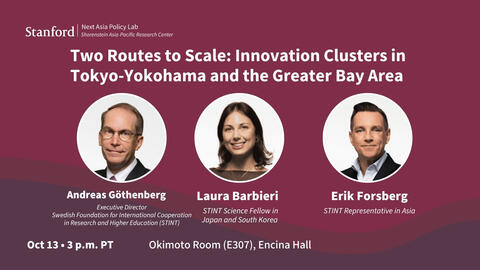
Two Routes to Scale: Innovation Clusters in Tokyo-Yokohama and the Greater Bay Area

What makes a science and innovation cluster thrive, and how can regions scale their global impact? This seminar explores two of the world’s leading innovation clusters, Tokyo-Yokohama and China’s Greater Bay Area, ranked among the top clusters in WIPO’s Global Innovation Cluster Index. Drawing on interviews and new reports from the Swedish Foundation for International Cooperation in Research and Higher Education (STINT), Executive Director Dr. Andreas Göthenberg will share perspectives from STINT’s Science Intelligence work on global science and innovation, followed by presentations from Dr. Laura Barbieri and Dr. Erik Forsberg on the ecosystems, strengths, and development trajectories of these two regions.

Speakers:

Dr. Andreas Göthenberg was appointed Executive Director of STINT as of September 1, 2009. And since 2024, he has been a Board Member at the Karolinska Institutet, Sweden. He received his M.Sc. and Ph.D. degrees from KTH Royal Institute of Technology, Stockholm, Sweden, in 1996 and 2003, respectively. 

From 2006 until 2009, he was a Science and Technology Attaché at the Embassy of Sweden in Tokyo, Japan. Before that, he worked as a Center Manager and Senior Researcher in China, setting up joint research and education centers for KTH Royal Institute of Technology at Zhejiang University and Fudan University.
 

Dr. Laura Barbieri is a STINT Science Fellow in Japan and South Korea. Based in Tokyo, she is currently a Visiting Scholar at the National Graduate Institute for Policy Studies (GRIPS). Previously, she was a JSPS Postdoctoral Fellow at Osaka Metropolitan University, where she conducted malaria immunology research within the SATREPS JICA Project in collaboration with Kenyan and Japanese partners.

Dr. Barbieri holds a PhD in Experimental Immunology from the University of Padova (Italy), carried out with Karolinska Institutet (Sweden), and a Master’s degree in Medical Biotechnologies from Padova in collaboration with King’s College London (UK). She also worked as a Postdoctoral Researcher at the University of Cambridge (UK) and was a Visiting Researcher at the University of Tokyo (Japan).
 

Dr. Erik Forsberg has been the STINT Representative in Asia since 2018. He has worked in China for more than 17 years, and was the Founding Vice Director of the Sino–Swedish Joint Research Center of Photonics as well as a Postdoctoral Fellow and an Associate Professor at Zhejiang University, China.

Dr. Forsberg was the Founding Graduate Dean at the Higher Colleges of Technology (United Arab Emirates) and a Visiting Scientist at Hokkaido University (Japan). Currently, he is an Adjunct Associate Professor at Zhejiang University and a Visiting Research Associate at the University of Malaya (Malaysia). In parallel with his academic work, he has been active in industry and entrepreneurship in China, co-founding several startups.


Directions and Parking > 

Okimoto Conference Room (E307)
Encina Hall, 3rd Floor
616 Jane Stanford Way, Stanford, CA 94305

Andreas Göthenberg, Executive Director, STINT
Laura Barbieri, Science Fellow in Japan and South Korea, STINT; Visiting Scholar, GRIPS
Erik Forsberg, Representative in China and ASEAN, STINT; Associate Professor, Zhejiang University
Seminars
Date Label
Paragraphs

This article identifies psychological, cultural, and organizational factors that drive optimism about emerging military technologies. Psychological influences include bounded rationality, cognitive biases (like the planning fallacy and confirmation bias), and motivated reasoning. Culturally, the US military's “can-do” ethos and historical narratives about technology's role in victory reinforce belief in technological solutions. Organizationally, interservice competition and strategic misrepresentation by program managers seeking resources amplify optimistic projections. All of these factors combine to contribute to technological optimism in US military acquisitions. Consistent with Amara's Law, short-term impacts are overestimated, while long-term effects are underestimated. Similar patterns often emerge as defense technology entrepreneurs consider and present “new” technologies such as AI despite mixed results. Two policy imperatives are discussed: realistic assessment through independent reviews and phased investment, and decentralized experimentation enabling rapid local adaptation alongside traditional top-down innovation.

Find the full article at tnsr.org.

All Publications button
1
Publication Type
Journal Articles
Publication Date
Authors
Herbert Lin
Paragraphs

The Stanford Deliberative Democracy Lab, based at the University’s Center on Democracy, Development and the Rule of Law, today released the findings from two national Community Forums on the evolving expectations around privacy and governance of AI-powered wearable devices. In collaboration with Meta, the forum engaged a representative sample of 550 participants — 300 from the United States and 250 from India — to solicit people's perspectives on user controls and societal expectations. The Community Forums were conducted as national Deliberative Polls.

All Publications button
1
Publication Type
Reports
Publication Date
News Type
News
Date
Paragraphs

The Stanford Deliberative Democracy Lab, based at the University’s Center on Democracy, Development and the Rule of Law, today released the findings from two national Community Forums on the evolving expectations around privacy and governance of AI-powered wearable devices. In collaboration with Meta, the forum engaged a representative sample of 550 participants — 300 from the United States and 250 from India — to solicit people's perspectives on user controls and societal expectations. The Community Forums were conducted as national Deliberative Polls.

As AI wearables see rapid adoption worldwide, understanding public attitudes can help to ensure these technologies are developed and deployed responsibly. Three key themes emerged from the forum. Participants in both the U.S. and India indicated the highest levels of support for users having controls over when their wearables passively process environments and actively capture data. U.S. participants consistently favored individual agency over how wearables are used, both in public and private settings, whereas in India, there was a slight preference for governments to decide wearable usage rules in public spaces. Additionally, U.S. participants supported workplaces and schools having the primary authority to decide how AI-powered wearables should be used in those environments, while Indian participants also saw a significant role for governments in these settings.

The forum also revealed important nuances in public perspectives. For example, participants expressed a preference for AI wearables that are tailored to cultural and regional contexts, rather than standardized global designs. There was also broad support for AI agents capable of responding to emotional cues, underscoring the public's desire for personalized, human-centric wearable experiences.

"This global forum provided invaluable insights into how the public's expectations around privacy and governance of wearable AI are evolving," said Alice Siu, Associate Director of the Stanford Deliberative Democracy Lab. "The findings will be essential for policymakers, technology companies, and other stakeholders as they work to ensure these powerful technologies empower users while respecting fundamental rights."

Read More

Human finger touching a screen with AI agent
News

People Shaping AI: Groundbreaking Industry-Wide Forum Invites Public Input for the Future of AI Agents Through Public Deliberation

In an unprecedented collaboration, Stanford's Deliberative Democracy Lab has spearheaded the first-ever Industry-Wide Forum, a cross-industry effort putting everyday people at the center of decisions about AI agents.
People Shaping AI: Groundbreaking Industry-Wide Forum Invites Public Input for the Future of AI Agents Through Public Deliberation
Back view of crop anonymous female talking to a chatbot of computer while sitting at home
News

Meta and Stanford’s Deliberative Democracy Lab Release Results from Second Community Forum on Generative AI

Participants deliberated on ‘how should AI agents provide proactive, personalized experiences for users?’ and ‘how should AI agents and users interact?’
Meta and Stanford’s Deliberative Democracy Lab Release Results from Second Community Forum on Generative AI
Chatbot powered by AI. Transforming Industries and customer service. Yellow chatbot icon over smart phone in action. Modern 3D render
News

Navigating the Future of AI: Insights from the Second Meta Community Forum

A multinational Deliberative Poll unveils the global public's nuanced views on AI chatbots and their integration into society.
Navigating the Future of AI: Insights from the Second Meta Community Forum
Hero Image
Close-up of smart glasses showing augmented reality interface while held by a woman in a modern urban environment.
Getty Images
All News button
1
Subtitle

National community forums in the U.S. and India highlight differences in preferences for privacy, user control, and governance of emerging technologies.

Date Label
In Brief
  • Stanford’s Deliberative Democracy Lab convened national forums in the U.S. and India to examine public attitudes toward AI-powered wearable devices.
  • Participants in both countries strongly supported user control over data collection, with differences in preferences for government and institutional oversight.
  • Findings highlight demand for culturally tailored designs and personalized, human-centered AI features as adoption of wearables grows.
Display Hero Image Wide (1320px)
Yes
Paragraphs


Banner showing a semiconductor with the Japanese flag superimposed on top.


Japan’s semiconductor industry, once globally dominant in DRAM during the 1980s, declined through the 1990s and 2000s due to trade friction with the United States, the rise of Korean competitors, and a failure to adapt to the fabless/foundry model. Today, Japan’s logic IC process technology lags at the 40nm node. 

The 2020 global semiconductor shortage prompted Japan to launch two major revitalization projects under the banner of economic security: TSMC Kumamoto, a joint venture producing 12–28nm logic ICs for Japan’s automotive, industrial, and consumer electronics sectors; and Rapidus, an ambitious startup targeting 2nm logic IC manufacturing by 2027. 

The paper argues that while TSMC Kumamoto meaningfully strengthens Japan’s domestic supply chain — connecting Japanese equipment and materials suppliers with downstream industries — Rapidus tells a different story. Because Japan has virtually no domestic industrial base currently using 2nm chips, Rapidus’s primary market will likely be the United States. Rather than enhancing Japan’s supply chain resilience, Rapidus effectively inserts Japan into a global advanced logic IC supply chain running from the Netherlands through Japan to the United States. Unless Japan develops industries using these chips, the Rapidus project will not directly address Japan’s economic security strategy.

All Publications button
1
Publication Type
Working Papers
Publication Date
Subtitle

The Validity of the Revitalization Strategy

Authors
Jun Akabane
Paragraphs

In recent years, analysts and scholars have noted that corruption or dysfunction in the global information ecosystem could have the effect of increasing nuclear risk.[1] In these works, corruption and dysfunction are interpreted broadly to include mis- and dis- information but also other information-related phenomena such as provocative or intemperate content, true-but-misleading information, or attentional diversions.

Now, the recent explosion in the capabilities of artificial intelligence—specifically, large language models (LLMs)—has led to the automated generation of novel text in enormous volumes and, increasingly, images and videos. For those interested in the creation of content to corrupt the information environment, there may be no better tool than a large language model. LLMs put former approaches to generating such content to shame. Also, LLM tools require far less expertise to produce and use, making the capabilities they afford much more broadly accessible and therefore expanding the number of possible threat actors as promoters of information dysfunction.

Continue reading at thebulletin.org.

All Publications button
1
Publication Type
Journal Articles
Publication Date
Authors
Herbert Lin
Subscribe to Science and Technology