International Law
Authors
George Krompacky
News Type
News
Date
Paragraphs
Image
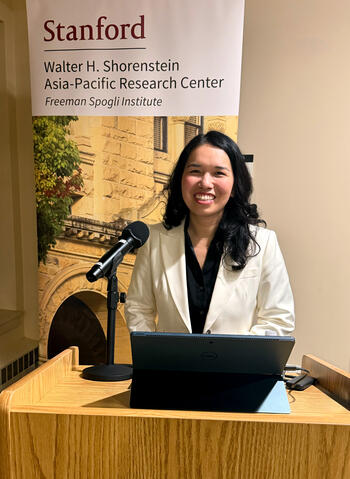
Image of Jessica Chen Weiss at the podium

At a recent seminar hosted by APARCʼs China Program, Professor Jessica Chen Weiss, the David M. Lampton Professor of China Studies at the Johns Hopkins University's School of Advanced International Studies, presented findings from her forthcoming book, Faultlines: The Tensions Beneath China's Global Ambitions (under contract with Oxford University Press), which examines how domestic politics and regime insecurity shape China’s foreign policy ambitions, prospects for peaceful coexistence, and the future of international order. Drawing on research and fieldwork in China, Weiss argued that understanding Beijingʼs behavior on the world stage requires looking beyond ideology to the contested priorities and political calculations that drive decision-making within the Chinese Communist Party (CCP).

Weiss proposed a framework centered on three pillars that have sustained CCP legitimacy since the late 1970s: sovereignty (nationalism), security (civility), and development. Her analysis reveals that China's objectives are not static but moving targets shaped by competing domestic interests, leadership priorities, and international pressures.


Sign up for APARC newsletters to receive our event invitations and programming highlights >


The Sovereignty-Security-Development Paradigm
 

At the heart of Weissʼs argument is the recognition that the CCPʼs foremost concern is domestic survival. In the face of the collapse of most communist regimes, the Party has remained vigilant against what it calls “peaceful evolution” and democratic contagion.

On issues touching core sovereignty concerns – Taiwan, Hong Kong, and maritime territorial claims – China has been “hyperactive” in making demands, even when doing so invites international censure. Weiss explained that the more central an issue is to CCP domestic legitimacy, the harder it becomes to make concessions, and the more likely international pressure is to backfire.

Yet tensions exist between competing priorities. China has compromised on certain border disputes to shore up domestic security, while its evolving stance on climate change reflects a shift from viewing carbon limits as threats to growth to recognizing the greater threat environmental catastrophes present to the nation’s stability.

Beyond the Monolith: China's Internal Contestation
 

Weissʼs research demonstrates that authoritarian China is far from monolithic. Different geographic, economic, institutional, and even ideological interests shape policy debates, even if most actors lack formal veto power. Local governments can resist central directives, as evidenced during the COVID-19 outbreak, when local officials initially withheld information about human-to-human transmission from the central government to prevent panic from disrupting important political meetings.

This pattern of center-local tension extends to China's international commitments. Local officials often game environmental regulations to juice growth and secure promotions, undermining Beijingʼs pledges on carbon emissions. On issues ranging from Belt and Road investments to export controls, implementation frequently diverges from stated policy as local actors pursue their own interests.

Weiss’s framework distinguishes among issues that are both central and uncontested (such as Taiwan), those that are central but contested (like climate change and trade policy), and peripheral issues where Beijing has shown greater flexibility (such as demonstrated by many UN peacekeeping initiatives). This helps explain why international pressure succeeds in some domains but fails spectacularly in others.

"The more central an issue is domestically, the more pressure the government faces to perform, and the harder it is to defy these domestic expectations," Weiss said. As a result, international pressure on these central issues is more likely to backfire, forcing the government to be seen as defending its core interests. She underscored that "even on these central issues, there's often tension with other central priorities, and managing these trade-offs comes with a number of different risks. It also means that sometimes an issue that touches on one pillar of regime support can yield to another."

Nationalism as Constraint and Tool
 

Weiss described nationalism as both a pillar of the CCPʼs legitimacy and a potential vulnerability when the government’s response appears weak. While large-scale anti-foreign protests have become rare, nationalist sentiment remains active online and shapes diplomatic calculations.

During Speaker Nancy Pelosiʼs 2022 visit to Taiwan, Chinese social media erupted with calls for the PLA to shoot down her plane. One interlocutor told Weiss his 14-year-old son and friends had stayed up past bedtime to watch Pelosiʼs plane land, illustrating nationalismʼs penetration into Chinese society.

Survey research reveals Chinese public opinion is quite hawkish, with majorities supporting military spending and viewing the U.S. presence in Asia as a threat. The government often refrains from suppressing nationalist sentiment to avoid backlash, even when doing so creates diplomatic complications. Weissʼs public opinion survey experiments, however, reveal that tough but vague threats can provide the government with wiggle room for de-escalation, although disapproval emerges when action is not sufficiently tough.

China's activities are making autocracy more viable and, to the extent that China is succeeding, making China's example more appealing as a consequence. But its strategy doesn't hinge on defeating democracy around the world.
Jessica Chen Weiss

Regime Security Without Ideological Crusade
 

Weiss pushed back against arguments that China is bent on global domination or that ideology drives conflict with the West. While the CCP seeks a less ideologically threatening environment, it must balance this against development and market access.

This pragmatic calculus explains China's constrained support for Russiaʼs war in Ukraine — Beijing fears secondary sanctions more than it values autocratic solidarity. Rather than exporting revolution, China has worked with incumbents of all political stripes in the service of its national interests.

Chinaʼs strategy focuses on making autocracy viable at home, not on defeating democracy globally. This suggests room for coexistence if both sides can reach a détente on interference in internal affairs.

“China's activities are making autocracy more viable and, to the extent that China is succeeding, making China's example more appealing as a consequence. But its strategy doesn't hinge on defeating democracy around the world,” argued Weiss. This implies, to her view, that “there is more room for coexistence between autocracies and democracies if these different systems can find or reach a potential détente in the realm of ideas about how countries govern themselves, and importantly, they need to pull back their efforts in other societies across boundaries.”

Interdependence and Future Trajectories
 

Weiss concluded by outlining how her framework suggests different engagement strategies depending on where issues fall within the centrality-contestation matrix. On central but uncontested issues like Taiwan, pressure proves counterproductive, and reciprocal restraint may be most promising. On central but contested issues like currency, multilateral pressure can influence certain Chinese constituencies against others. On peripheral issues, such pressure is most effective unless powerful domestic constituencies subvert implementation.

Addressing questions about U.S.-China decoupling, Weiss noted that both sides recognize there are interdependencies that don’t have quick solutions. Even in a critical area like minerals, diversification will take at least a decade, and Chinese processing will still dominate globally. The goal of diversification should be to preempt coercion, not to achieve true decoupling.

Read More

Oriana Skylar Mastro (left), Map of Venezuela (center), and Larry Diamond (right)
Commentary

U.S. Venezuela Operation Likely Emboldens China, Risks Strategic Neglect of Indo-Pacific, Stanford Scholars Caution

Speaking on the APARC Briefing video series, Larry Diamond and Oriana Skylar Mastro analyze the strategic implications of the U.S. operation in Venezuela for the balance of power in the Taiwan Strait, Indo-Pacific security, America’s alliances, and the liberal international order.
U.S. Venezuela Operation Likely Emboldens China, Risks Strategic Neglect of Indo-Pacific, Stanford Scholars Caution
CP_David_Meale
News

The Future of U.S.-China Relations: A Guardedly Optimistic View

Eurasia Group’s David Meale, a former Deputy Chief of Mission at the U.S. Embassy in Beijing, reflects on the last 30 years and describes how the two economic superpowers can maintain an uneasy coexistence.
The Future of U.S.-China Relations: A Guardedly Optimistic View
Stanford campus scene with a palm tree seen through an arch. Text about call for nominations for the 2026 Shorenstein Journalism Award.
News

2026 Shorenstein Journalism Award Open for Nominations

Sponsored by Stanford University’s Shorenstein Asia-Pacific Research Center, the annual award recognizes outstanding journalists and news media outlets for excellence in covering the Asia-Pacific region. News editors, publishers, scholars, and organizations focused on Asia research and analysis are invited to submit nominations for the 2026 award through February 15, 2026.
2026 Shorenstein Journalism Award Open for Nominations
Hero Image
Chinese President Xi Jinping is applauded by senior members of the government and delegates.
Chinese President Xi Jinping is applauded by senior members of the government and delegates as he walks to the podium before his speech during the Opening Ceremony of the 20th National Congress of the Communist Party of China at The Great Hall of People on October 16, 2022 in Beijing, China.
Kevin Frayer/ Getty Images
All News button
1
Subtitle

China studies expert Jessica Chen Weiss of the Johns Hopkins School of Advanced International Studies reveals how the Chinese Communist Partyʼs pursuit of domestic survival, which balances three core pillars, drives Beijingʼs assertive yet pragmatic foreign policy in an evolving international order.

Date Label
In Brief
  • Chinaʼs foreign policy is driven by three domestic pillars: The CCPʼs pursuit of sovereignty, security, and development creates competing priorities that shape Beijingʼs assertiveness on core issues like Taiwan, while allowing flexibility on peripheral concerns such as UN peacekeeping.
  • International pressure often backfires on central issues: The more important an issue is to CCP domestic legitimacy, the harder it becomes to make concessions, meaning external pressure regarding Taiwan or territorial disputes tends to strengthen rather than moderate Beijingʼs position.
  • China is not monolithic: Local governments, industries, and different Party factions contest policy implementation, creating gaps between Beijingʼs stated commitments and actual behavior on issues ranging from environmental regulations to trade.
     
Display Hero Image Wide (1320px)
Yes
Authors
News Type
Commentary
Date
Paragraphs

There are a lot of changes happening in the world, from the "rupture" in the global order to a new host of the World Class podcast.

For almost a decade, Michael McFaul, a senior fellow at the Freeman Spogli Institute for International Studies at Stanford University, has helped listeners understand what's happening in the world, and why, by bringing them in-depth conversations with scholars working across FSI's nine research centers. Now Colin Kahl, the new director of FSI, is taking on the role of podcast host to carry on the tradition.

In this episode, Kahl and McFaul discuss how institutions like FSI can better study and contribute understanding about the rapidly changing world and how alliances and partnerships — whether across academic departments or between nations — create better, stronger outcomes.

Listen to the episode below. World Class is also available on Apple Podcasts, Spotify, and other major podcast platforms.

TRANSCRIPT


McFaul: Hey everyone, you're listening to World Class from the Freeman Spogli Institute for International Studies at Stanfo rd University. I'm your host, or maybe I should say I'm your co-host, or maybe I should say this is the last time I'll be hosting World Class from Stanford University. Because as listeners and followers of FSI’s news may know, after eleven years, I just stepped down as the director a few weeks ago and I've handed the baton to my guest today, Colin Kahl, who's the brand new director of the Freeman Spogli Institute.

And it is fantastic, Colin, that you agreed to take on this assignment. This is another form, I consider, of public service just like what you've done for the U.S. government and the United States of America.

Colin, as you're going to hear in a few minutes, is the perfect mix of scholar and practitioner that we so value here at FSI. And we are really lucky that you are taking up this assignment.

So Colin, welcome to World Class where everybody will be listening to you forthcoming for, I hope, many, many years.

Kahl: Thanks Mike, it's a real pleasure to be with you and most especially thank you for your tremendous decade plus—eleven years—of service to FSI and the Stanford community. And I look forward to continuing to work with you as you transition to the next thing. And we should talk about that too. But it's great to be on the pod with you.

McFaul: Glad to be here. And just so everybody knows, I stepped down from FSI, but I'm not retiring from Stanford. I still have my various day jobs here. We can come back to that a little bit later.

But Colin, why don't you just tell our listeners and our viewers a little bit about your road to this present position.

Kahl: Yeah, sure. So I grew up in the Bay Area. I grew up in the East Bay in Richmond, California. I applied to Stanford as an undergrad, didn't get in. Applied again as a graduate student, didn't get in. So I got educated elsewhere. I went to the University of Michigan, which is a great school.

McFaul: Very fine institution.

Kahl: And then I went to Columbia University where I got my PhD in political science, focused on international relations and conflict studies. I did my PhD work in the 90s when the field of international relations was trying to figure out what the field even meant after the end of the Cold War.

So it was an exciting and very kind of plastic moment to be doing scholarly work.

I then started my first teaching job at the University of Minnesota in 2000. And of course, a year after that, 9/11 happened. And it was a terrible event for the United States and for the world. For those of us who lived in New York City—I did my graduate work there—it was especially painful.

And it really drove me to want to figure out a way to both do the academic side of understanding the world, but also see if there was a way to engage in public service. So my fifth year at the University of Minnesota, I actually got a fellowship through the Council on Foreign Relations . . .

McFaul: Right.

Kahl: . . . that put me at the Pentagon for a year and a half. This was during the George W. Bush administration. Don Rumsfeld was still the Secretary of Defense. I worked there for a year and a half. I kind of caught the bug, the Washington bug.

McFaul: What was your portfolio back then, Colin? Just remind everybody.

Kahl: So I worked in a small office called the Stability Operations Office. It was only 24 of us. worked within the office of the Undersecretary of Defense for Policy. It had historically been called the Peacekeeping and Humanitarian Affairs Office

McFaul: Right, right, I remember that. They changed it, right.

Kahl: But Rumsfeld was not a fan of peacekeeping, so they changed it to ‘stability operations.’

But at the time, most of what our office did was try to help the U.S. military reform itself in the face of the struggles that the U.S. military was facing in Iraq and Afghanistan with the stabilization missions there.

There's a lot of dark humor at the Pentagon, but we sometimes joked that the 24 of us were doing stability operations while the other 24,000 people in the building were doing instability operations.

McFaul: [laughing] Instability operations, yeah, that’s right.

Kahl: But anyway, it was totally exciting. You know, we were there when when U.S. counterinsurgency doctrine was being revised and a bunch of other things.

So that was 2005, 2006. I kind of caught the bug and decided to try to stay in Washington. So I actually took a job at the Georgetown School of Foreign Service where they were kind enough to give me tenure and I taught in the security studies program there for a decade.

McFaul: Let's just . . . hold on, hold on. Let's be clear. They were not ‘kind enough’ to give you tenure; you earned tenure. Nobody gives tenure anywhere. Congratulations that you landed that job.

Kahl: So, I was in the security studies program there for ten years, about a half that time I served in the Obama administration. We served together . . .

McFaul: Together, yes!

Kahl: . . . in the first few years. I was back at the Pentagon as the deputy assistant secretary of defense for the Middle East during the drawdown of our forces from Iraq during the Arab Spring.

McFaul: Right.

Kahl: During the first flare up of Israel-Iran tensions over Iran's nuclear program. By the way, none of that was my fault, but I was there when all that stuff happened.

And then I went back to Georgetown for a few years and then I got pulled back into the Obama administration at the end to work at the White House as a deputy assistant to the president and as then-vice president Biden's national security advisor. So I was there for Russia's first invasion of Ukraine . . .

McFaul: Right.

Kahl: . . . and the Central American migration crisis and tensions in the South China Sea and the campaign against the Islamic State and the Iran nuclear deal. A lot of interesting things.

And then, when Trump was elected the first time, Mike, you reached out to me with this amazing opportunity at Stanford, the Steven C. Házy Senior Fellow chair that I currently occupy. Applied for the job and got it. It was an opportunity to come back to Stanford. I’ve sat at CISAC, the Center for International Security and Cooperation here at FSI. And I was the co-director of CISAC for a couple of years.

And then last but not least, when Biden was elected president, he asked me to serve as the undersecretary of defense for policy back at DoD, which is essentially the number three civilian and senior policy advisor to the secretary. And I did that for the two first two and a half years of the Biden administration.

Also also very interesting times: fall of Afghanistan . . .

McFaul: Yes.

Kahl: . . . Russia's further invasion of Ukraine, rising tensions with China, dealing with the aftermath of COVID, lot of changes in the world.

So anyway, I'm glad to be back at Stanford. I've been back since the summer of 2023, and I'm excited to try to fill the very big shoes that you've left at FSI after eleven years.

McFaul: Well, let's talk about the future in a minute, but just two follow-up questions on your history. You've had lots of government jobs you just described. I can't think of anybody that's had a more diversified set of experiences in national security. We are lucky to have you here.

Tell us about the best day of any of those jobs and tell us about the worst day and maybe reverse that. Worst day first, best day second.

Kahl: So first of all, I'm fortunate to have had the opportunity to serve my country. I believe in it strongly. I've served in Republican administrations and Democratic administrations. I've worked for two Republican secretaries of defense and two Democratic secretaries of defense. So I think I've demonstrated my nonpartisan bona fides in how I've served my country.

And I just want to mention that because I think it's important.

McFaul: Yes, it is important.

Kahl: Because, of course, FSI is a nonpartisan place.

Worst day and best day: in a sense, it's almost the same. There was no more harrowing experience than the collapse of Kabul.

I was actually at the NIH getting a medical treatment when I got a text message from the secretary's chief of staff that I needed to hurry back to the Pentagon. So I literally pulled an IV out of my arm and raced back to the Pentagon because Kabul fell.

And obviously that was a tremendously terrible event for Afghanistan. It was a particularly harrowing way for the 20-year U.S. involvement in Afghanistan to end. But it also put us on the clock. You know, we had basically 17 days before the deadline for all American forces to be out of Afghanistan, and we suddenly had to do a lot of things.

We had to flood forces back into the country to occupy an airport that was now in hostile Taliban territory when the Taliban took over Kabul. We had to secure that airport. We sent five or six thousand soldiers and Marines to that airfield. We had postured them in the region previously to be able to do that, but we had to get them there.

McFaul: Right.

Kahl: And then we then had to oversee the evacuation of 125,000 human beings in two weeks, which had never happened in human history and no other country in the history of the world would have been capable of doing. And it was pretty horrible.

McFaul: Yeah.

Kahl: A lot of terrible human tragedies. Obviously, we got a lot of people out. A lot of people weren't able to get out. There was the terrible ISIS bombing that killed 13 of our brave service members. Toward the end of the evacuation, there was an errant U.S. strike on what we thought was an ISIS operator that turned out to be an aid worker and his kids. It was horrible.

But I'm also incredibly proud of what we were able to do. I mean, in the macro sense, because we were able to project our power back into Afghanistan, lock down that airfield and get all of those people to safety, including the family members of some Afghans who worked for me. We were able to get a lot of people out.

We were able to bring them to bases and facilities that didn't even exist when the crisis . . . I mean the bases existed, but the facilities to house these people in the Gulf and in Europe and back here in the continental United States . . . the amount of diplomacy that required, the amount of logistics by the U.S. military that it required. It was an unbelievable operation.

And so it was terrible. But it was also an extraordinary demonstration of what the United States was capable of doing even at these dark moments.

McFaul: That's a great way to put it together. I would guess we would not have been able to do that if we did not have NATO allies and bases in that part of the world, or is that incorrect? I don't know the logistics of that part of the world.

Kahl: If anything, it's an understatement. I think one of the things that distinguishes the United States from every other superpower or global power in history is the depth and breadth of our network of allies and partners. At the heart of that are our treaty allies in the NATO alliance, but also in the Indo-Pacific region, so think South Korea, Japan, Australia.

McFaul: All of them, right.

Kahl: But we also have very close security partnerships in the Middle East. And so literally it would not have been possible to fly aircraft into Afghanistan, fly people out from Afghanistan into places like Qatar, Bahrain, UAE, Saudi Arabia. But then we brought them to Germany and Spain and other U.S. bases in Europe. And then we brought them back to bases here in the United States.

And that network, literally that network made it possible. And had we not had those allies and partners when that happened, we couldn't have done what we did. We couldn't have done any of it. We couldn't have gotten any of our people out.

And so that really is like some of the secret sauce to America's power and influence in the world. And it remains the case that we have more allies and partners than any other country in history.

But it's also the case that those alliances and partnerships are probably more strained than they've been in my lifetime.

McFaul: So, one other historical question about you. Why did you come to Stanford? I mean, you've got this great job at Georgetown. You obviously are connected to the policy community. We're far away out here. Tell us about that decision.

Kahl: Part of it is I grew up in the Bay Area. Part of it is that, mean, Georgetown is a remarkable place, but Stanford's one of the two or three best universities in the world. We had a great community of scholars out here. And a lot of the issues that I'm particularly passionate about now—especially the intersection of technology and geopolitics— I mean, this is ground zero for a lot of that.

And so it was for a mix of kind of lifestyle reasons and professional reasons. And it's been awesome.

McFaul: Well, that's a great segue to what I wanted to ask you next, which is about the big agenda items. I mean, FSI has a lot going on: we have lots of centers here, as our listeners know, because we've had many guests from all, I think all of our centers over the time I've been here.

But you've got some particular things that you want to focus on. I know, because I talked to people that were part of the selection committee, that that was what was most impressive about you, is that you have a big agenda. Tell us about that agenda, Colin.

Kahl: As your longtime listeners undoubtedly know, FSI is an interesting place because FSI Central, where you were the director until three weeks ago, and now I sit, essentially sits over nine main research centers that cover everything from democracy to international security to regions like Asia and Europe to issues like technology and defense innovation, food security, global health.

And the breadth of this place is extraordinary. But it's also a highly decentralized place. Yes, we oversee the centers, but in many respects, the centers are kind of quasi-autonomous nation states.

McFaul: Exactly, exactly.

Kahl: So this isn't about trying to micro-manage our centers; that would be a fool's errand. It is actually, though, trying to look for ways to have the whole of FSI add up to more than the sum of its parts. And to look for synergies across our centers on really big questions.

You took the helm of FSI, I believe, back in 2015?

McFaul: Yes.

Kahl: To state the obvious, the world in 2026 is a lot different than it was in 2015. And so, FSI has to adapt to that world. And I think there are four really big questions of the moment that I think FSI really needs to be impactful on.

One is that we're in this new age of geopolitics. And it's become kind of trite to note that, you know, we have a resurgence of great power politics and competition between the United States and China and Russia and other major powers. But it actually runs deeper than that.

The distribution of power in general across the world is fundamentally different than it was 15, 20 years ago, let alone 50 years ago. The United States remains the world's most consequential actor, but China is nipping at our heels as a global superpower. And while Russia can't dominate the world, Russia can blow up the world. And we also know that countries like China, Russia, North Korea, Iran are working more closely together.

At the same time, the traditional role that the United States has played in the world since World War II or since the end of the Cold War is changing. And our relationship with our traditional allies is changing. And I think anybody who kind of paid attention to the World Economic Forum in Davos over the last few days heard speeches from the Prime Minister of Canada referring to the rupture in the international order.

And there's just the sense that things are fundamentally changing. And some of that may be a direct reaction to some of the policies of President Trump. But frankly, I think a lot of it is structural, that the policies of the current administration are as much an artifact as they are a cause even if they are accelerating some of the structural dynamics.

And then of course, there's big chunks of the world that doesn't want to be on anybody's team.

McFaul: Right.

Kahl: That wants to be non-aligned and multi-aligned. A lot of countries in the so-called ‘global south’ fall in that category. So we should be studying this new era of geopolitics

I would encourage you to say more about how you plan to study it, because I know you have a really fascinating project in this space that brings FSI and Hoover scholars together on some of these questions.

Kahl: So, one issue is the new geopolitics. The other though is what I call the new techno politics. It's actually a term I think Ian Bremmer coined.

But it's not just the notion that technologies like AI, biotech, quantum, space, clean energy are transforming our world, but also that the actors at the heart of these innovations are these multinational corporations that if their market cap was translated into GDP,

they would rank as G20 nations, right? When you're Nvidia and you have $5 trillion

McFaul: That's a great point.

Kahl: Like that would be the top half of the G20. But it's not just that. They have global presence. And for a lot of these companies, they have near sovereign control over the environments through which we live our lives.

McFaul: That's a great point.

Kahl: So, think cloud service providers, social media platforms, but also the infrastructure: undersea cables, low earth orbit constellations. And all of these things are under regulated spaces. So, it's not just that the technology is changing the world, but the companies are international actors. And again, where else should we be studying that but here at Stanford?

McFaul: Right.

Kahl: The third thing is there's a broader category of what people might refer to as existential risk. Nuclear weapons and the salience of nuclear weapons are back with a vengeance. For the first time, we're entering a world in which there are not two but three nuclear peers as China quadruples its nuclear arsenal. India and Pakistan are at loggerheads. They both have nuclear weapons. Israel and Iran are at loggerheads over Iran's quest for nuclear weapons. North Korea is expanding its arsenal. And arms control is breaking down.

So we know that the nuclear age is back with a vengeance. Simultaneously, we're facing the climate crisis. We all lived through COVID. It won't be the last pandemic, unfortunately, I think, in our lifetimes. There are other biosecurity risks emanating from emerging technologies. And then there's also the possibility that technologies like AI will produce their own existential externalities in the form of things like rogue super intelligence or other things.

So we should be studying those things. And then lastly, I think we have to be studying the future of global democracy because democracy is under siege around the world from revisionist authoritarian powers like Russia and China. But it's also eroding in many traditional democracies that are becoming increasingly illiberal.

And advanced democracies no longer agree on what democracy is. A big divide between the United States and Europe at the moment is both laying claim to being democratic, but in fundamentally different ways.

And so the point just is, we have 150 researchers at FSI, 50 of them are tenured faculty, many of them were working at the intersection of these issues. I want to support that and I also want them to do more together.

McFaul: That sounds fantastic. That is the agenda for our moment. And I think you're right that we have some people that work on some of those things, but we have holes to fill. And I wish you success in doing that to compliment what we have here, but also to try to get these different scholars that work on these different pieces to understand how they are intertwined, right?

The future of global democracy is also highly impactful on geopolitics and vice versa. I think that is a great agenda for FSI for the future.

I mean, on my own piece: I would just say in terms of what I want to work on, I have a lot of interests, but the main research one is I just did finish this book, as listeners will know, called Autocrats vs. Democrats, China, Russia . . .

Kahl: Available now!

McFaul: Available now! Available while you're listening on your phone. You can get it, and it's highly discounted now. And I'm going to tell you a little story about that actually, Colin. I don't think we've talked about it. The original title was ‘American Renewal.’ That was like two or three years ago. Then it switched the title to ‘Autocrats vs. Democrats.’ But the subtitle, until just a few months ago was ‘China, Russia and the New Global Order.’ The now title is ‘China, Russia, America and the New Global Disorder,’ reflecting a year ago what I thought was going to be a pretty tumultuous time. And I think I underestimated how tumultuous it is and your agenda is addressing that.

But I would say two things that I want to do here at FSI. One is, when I was working on this book, I knew a lot about the Cold War, so there's a debate, are we in the Cold War or not? And I addressed that. My answer is yes and no.

But I knew a lot about the Cold War. I know quite a bit about Russia. I know a fair bit about America and America's place in the world, both from teaching and being in the government. But I had to learn a lot about China. And I've been going to China for three decades, but I'm not an expert. It took me a long time. That's why it took me eight years to finish this book

But there were two big gaps that I saw at the end of it. One is we have a lot of great people working on capabilities of these various great powers. We have a really great literature on intentions of America, Russia, and China. And big debates, by the way, on the intentions, especially on the China side. I would say comparing the debate in the Russia field to China field, there's a lot more consensus in the Russia field about intentions of Putin's Russia than there is of Xi's China, and that's a good thing. I think that debate is unsettled and we should keep interrogating our hypotheses.

But what I was really struck by is very little examination. And with some exceptions, I'm looking at my shelf. There's some really great books. But there's not that many books that look at impact of this competition on other countries in the world. And when you do find great books—there's a great one on China and Zambia, for instance—it's just China and its impact on Zambia. There's no Europe in that story. There's no Russia in that story. There's no America in that story. So that's the academic kind of research project that I want to do here with Liz Economy from the Hoover Institution, Jim Goldgeier—he's going to cover the European part. And that'll take many, many years because we want to really get into the nitty gritty of these countries. And we want to find country experts to be the main people that write that.

The second part in my book—you know, my book looks at the debate, examines where we're at, and then has these three prescriptive chapters. And even had Vice President Harris won the election last year, the structural things that you identified would have been still a part of our trying to figure out where we're going and the debate about international order and how to manage the decline of democracy, technology and the global order, that would all been there. But to your other point you made earlier, it's been accelerated by President Trump.

And in my public policy life, I want to keep engaging that debate because yes, the old order is broken. We're not going to go back to it. But the idea that we have to just go back to some Hobbesian jungle that Trump seems to want to fight in, I don't accept that as an inevitable consequence. And even if it is analytically, and I'm wrong about that, I want to do everything I can to avoid it, even if it's going to be in failure. In a way, Trump has moved us in a different direction and I want to be part of that debate.

And one of the things I would add to that is part of the reason liberal internationalists like myself have lost that debate is because we lost the American people on it. And we didn't focus enough on trying to explain why being a NATO is in our interest or explain why it's better off to have a foot in even something like the United Nations than to pull out. Why we're better off to support ideas of democracy and freedom rather than just think that it's just all about power.

And so I'm going to be spending a lot of time speaking, not just in Silicon Valley—I'm still doing that—and not just Washington and New York or Brussels and Beijing, but my next stop for my book tour is Boise, Idaho. And I've done this for a while and not everybody agrees with me. I even had a few people walk out before I even said a word because they saw that I'd worked for Barack Obama.

But what I can tell you and report is people are curious. All my talks are sold out. And the agenda you just outlined, Colin, is an agenda I think that when we have things to say with our scholars, we should bring those ideas through things like World Class. I think there's a demand and a thirst for trying to figure out this new world order/disorder that we're in, and FSI has a great role to play in that.

Kahl: Hard agree. And also I'm thrilled that this is going to  be so much of your focus.

I would just say on the alliance piece: my view is that as the distribution of power changes, it's clearer than ever that foreign policy is a team sport.

McFaul: Yes.

Kahl: I used to make this reference: Michael Jordan, probably the best basketball player who ever lived. Although I'm sure there are people who claim it's LeBron or Kobe or somebody else. But if you believe that Michael Jordan was the best basketball player who ever lived, he still needed four other Bulls to win championships.

And as we go around, and address every problem that I've ever encountered as a policymaker, whether it's the rise of the Islamic state or the invasion of Ukraine, we need our team.

McFaul: Exactly.

Kahl: And our allies and partners are our team. So I think we have to tell that story. We also, as we enter this new world, have to figure out a way to re-anchor our alliances in a way that are politically sustainable on all sides, and that actually deliver benefits for the American people.

So it's not just telling a better story. There's an interesting example of this. Recently the Trump administration agreed to help South Korea with their submarine program. But South Korea in exchange is making tens of billions of dollars of investments in American shipyards . . .

McFaul: Right.

Kahl: . . . to build up our capacity. And I do think these ideas about joint industrial capacity across the free world might be a way to generate jobs, to generate political incentives on all sides to keep those alliances intact and give some people confidence on both sides of our alliances that we're not going to have these violent swings every four to eight years.

McFaul: I could not agree more. And that example you gave is a great example. And we have to be more creative about re-anchoring and win-win for everybody. I think that's a great idea.

Colin, I'm going to hand this over to you. We've already gone longer than we should have because you're so interesting. Tell us a few of the guests you have coming up on World Class.

Kahl: First of all, not only big shoes to fill on the FSI director position, but big shoes to fill as the host of World Class. We're going to try to start off with a bang in the near future. So stay tuned. We hope to have a great conversation involving H.R. McMaster, who is at Hoover, but as many of your listeners will know, was President Trump's national security adviser at the beginning of the first Trump administration.

And we're going to pair H.R. with Jake Sullivan, who was Joe Biden's national security advisor.

McFaul: Wow! Both on the same show?

Kahl: On the same show!

McFaul: Oh my God, that's fantastic!

Kahl: And the idea is to ask two of the smartest minds on different parts of the political spectrum to help get us smarter about the state of the world and where things are going for the rest of 2026. I have to say for the rest of 2026, because like we're not even a month in and we had Venezuela and Greenland and Iran, and Iran could come back and like, we're three weeks in.

But people should stay tuned because that's going to be an awesome conversation.

And then without naming names, I'm very hopeful to bring on leaders from the tech community here in Silicon Valley to interface with our scholars about some of these technology trends we talked about earlier.

McFaul: Great, excellent.

Kahl: So it's gonna be great. If you're a geopolitical nerd, you're going to love it. If you're into technology, you're going love it. And we're gonna find ways I think to both highlight the extraordinary work being done here at Stanford, but also Stanford's role in the broader ecosystem. It’s going to be fun.

McFaul: Sounds exciting, Colin. Well, first of all, thank you for taking on the role of leading FSI. We need you because of all the things you just described. Second, thanks for taking on World Class. And third, just with that teaser, I know that World Class is going to get a lot more interesting in the weeks and months to come. So congratulations.

Kahl: Thanks, Mike.

McFaul: You've been listening to World Class from the Freeman Spogli Institute for International Studies at Stanford University. If you like what you're hearing, please leave us review and be sure to subscribe on Apple, Spotify, or wherever you get your podcasts to stay tuned, to stay up to date on what's happening in the world and why.

And for the last time, this is Michael McFaul signing off as your host of World Class. Stay tuned for the next episode hosted by Colin Kahl.

Read More

Gabrielius Landsbergis on World Class Podcast
Commentary

Hope, Despair, and the Emotional Response to the War in Ukraine

On the World Class podcast, Gabrielius Landsbergis shares what the war in Ukraine has looked and felt like from a European perspective, and what he believes must be done to support Ukraine for the long-term.
Hope, Despair, and the Emotional Response to the War in Ukraine
Michael McFaul on World Class Podcast
Commentary

Understanding the Global Showdown Between Autocrats and Democrats

On the World Class podcast, Michael McFaul discusses his new book and makes the case for why the United States should remain an active, engaged member of the international community.
Understanding the Global Showdown Between Autocrats and Democrats
Larry Diamond on World Class Podcast
Commentary

How Democracy Is Doing Around the World

On the World Class podcast, Larry Diamond and Michael McFaul compare how civic discourse and political institutions are holding up in the United States, South Korea, Taiwan, and other democracies.
How Democracy Is Doing Around the World
Hero Image
All News button
1
Subtitle

On the World Class podcast, Michael McFaul officially hands the hosting baton over to FSI's new director, Colin Kahl, who makes the case for why alliances and partnerships — whether across academic departments or between nations — create better, stronger outcomes.

Date Label
Display Hero Image Wide (1320px)
No
Authors
Noa Ronkin
News Type
Commentary
Date
Paragraphs

The January 3, 2026, U.S. “Operation Absolute Resolve” in Venezuela to capture and remove President Nicolás Maduro has raised urgent questions about its repercussions for the U.S.-China competition, Taiwan Strait security, American strategic priorities in the Indo-Pacific region, and U.S. allies and partners.

In two new episodes of the APARC Briefing series, Stanford scholars Larry Diamond, the Mosbacher Senior Fellow in Democracy at the Freeman Spogli Institute for International Studies (FSI) and William L. Clayton Senior Fellow at the Hoover Institution, and APARC faculty affiliate Oriana Skylar Mastro, a center fellow at FSI, join host Kiyoteru Tsutsui, the director of APARC, to unravel what happened in Venezuela and the implications of the U.S. actions in Latin America for Taiwan, security and alliances in the Indo-Pacific, and U.S. relations with stakeholders in the region.

Both scholars agree that the U.S. mission in Venezuela is a precedent that likely emboldens rather than deters China in its Taiwan calculus, warning that the shift it represents in U.S. national security policy might detract from American capabilities in the Indo-Pacific region at a crucial moment. They also provide sobering advice for U.S. allies struggling to adjust to rapidly shifting geopolitical realities under the second Trump administration.

A Shocking Action in World Affairs


There is no dispute that the Maduro government has been deeply authoritarian, deeply corrupt, and deeply illegitimate, says Diamond, author of Ill Winds: Saving Democracy from Russian Rage, Chinese Ambition, and American Complacency. Yet the United States “has probably violated international law to intervene forcibly in the internal affairs of Venezuela and remove its political leader," creating enormous implications for the international community. If it does not pursue a strategy of systemic democratic change in Venezuela, “all of this will have been for naught, and it will have paid a tragic price in terms of international precedent and international legitimacy,” Diamond argues.

Beijing is already using the operation as a "discourse power win," depicting the United States as crushing sovereignty and international law, Mastro notes. Moreover, in addition to Venezuela, President Trump continues to make statements about Greenland, reiterating its importance for U.S. national security and his interest in acquiring the territory, which has alarmed European partners and exacerbated strains with NATO.

“For the first time since WWII, some European countries have declared the United States to be a security threat,” Mastro says. “So I am curious to see if the Chinese try to bring along the Venezuela case as well, to convince U.S. allies and partners to distance themselves from the United States, which would have significant repercussions for the global order and for the United States' role in it.”

There is no situation in which we 'neutralize' Chinese air defenses and then somehow do some sort of infiltration.
Oriana Skylar Mastro

A Risky Strategic Reorientation


By unilaterally bypassing international norms to wield power in its own "backyard," the United States may have set a precedent that China can now exploit to justify its own ambitions in Taiwan as a legitimate exercise of regional dominance.

Diamond remarks on this line of thought: “If the United States, as a hegemon, can just do what it wants to arrest and remove a leader, in its kind of declared sphere of influence, what's to stop Xi Jinping from doing the same in his sphere of influence, and with a democratic system in Taiwan, whose sovereignty he does not recognize?” 

On the other hand, many commentators have argued that Operation Absolute Resolve serves as a deterrent to Chinese aggression. Granted, there is no doubt that the operation was a remarkably successful military attack showcasing the capabilities of U.S. special forces, notes Mastro, who, alongside her academic career, also serves in the United States Air Force Reserve, for which she currently works at the Pentagon as deputy director of research for Global China Strategy. Nevertheless, she emphasizes that the United States cannot carry out a similar attack in Asia.

“There is no situation in which we ‘neutralize’ Chinese air defenses and then somehow do some sort of infiltration,” says Mastro, author of Upstart: How China Became a Great Power. The U.S. intervention in Venezuela, therefore, “does not tell us a lot, operationally, about what the United States is capable of in a contingency via China.”

More troubling, Mastro identifies the Venezuela operation as demonstrating a fundamental shift in U.S. strategic priorities, with the raid conducted just weeks after the Trump administration released its 2025 National Security Strategy, which prioritizes restoring “American preeminence in the Western Hemisphere.” Mastro characterizes it as “the one region where U.S. dominance faces no serious challenge.” Thus, Venezuela suggests “the Trump administration means business about the renewed focus on the Western Hemisphere, and, unfortunately, that makes me concerned that there might be strategic neglect of the Indo-Pacific moving forward,” she points out.

Diamond stresses that, virtually throughout the entire presidency of Xi Jinping, dating back to 2012, China has been rapidly building up its military capabilities, prioritizing those specifically suited for coercing, isolating, or potentially seizing Taiwan. Against this backdrop, “I am much more fearful about the future of Taiwan in the week following U.S. military action on January 3 in Venezuela than I was before that action.” 

Mastro agrees with this assessment about the ripple effects of the operation in Venezuela. “I would say that it probably emboldens China.”

[M]y advice to the leaderships [of our allies is]: Find a way to get to the fundamental interests you need to pursue, defend, and preserve. And in the case of East Asia, that has to be number one, above all else, the preservation of our alliances.
Larry Diamond

Frank Advice for U.S. Allies


For U.S. allies in the Indo-Pacific, including Japan, South Korea, the Philippines, and Australia, as well as allies and partners in Europe, both scholars offer pragmatic counsel for coping with the Trump administration.

Diamond urges U.S. allies to manage Trump diplomatically while staying focused on core interests, namely, prioritizing the preservation of the alliances and strengthening autonomous defense capabilities to demonstrate commitment and hedge against potential U.S. retrenchment.

“It takes constant, energetic, proactive, imaginative, relentless, and in some ways deferential working of the relationship, including the personal relationship between these leaders and Donald Trump [...] The future will be better if the leaders of these countries internalize that fundamental lesson about Trump.”

Mastro is equally direct about the limited alternatives ahead of U.S. allies: "You don't really have an option. That Chinese military – if it gives the United States problems, it definitely gives you problems. There's no hope for a country like Taiwan without the United States. There's no hope for Australia without the United States."

Counterintuitively, U.S. assertiveness may indicate its insecurity about the balance of power with China. “It seems to me that the United States also needs to be reassured that our allies and partners support us [...] And if we had that confidence, maybe the United States would be less aggressive in its use of military force.”

Watch the two APARC Briefing episodes:

🔸 What the U.S. Raid in Venezuela Means for Taiwan and Asia - with Larry Diamond >

🔸 Does Venezuela Provide China a Roadmap for Taiwan? – with Oriana Skylar Mastro >

Read More

On an auditorium stage, panelists discuss the documentary 'A Chip Odyssey.'
News

‘A Chip Odyssey’ Illuminates the Human Stories Behind Taiwan’s Semiconductor Dominance

A screening and discussion of the documentary 'A Chip Odyssey' underscored how Taiwan's semiconductor ascent was shaped by a collective mission, collaboration, and shared purpose, and why this matters for a world increasingly reliant on chips.
‘A Chip Odyssey’ Illuminates the Human Stories Behind Taiwan’s Semiconductor Dominance
Stanford campus scene with a palm tree seen through an arch. Text about call for nominations for the 2026 Shorenstein Journalism Award.
News

2026 Shorenstein Journalism Award Open for Nominations

Sponsored by Stanford University’s Shorenstein Asia-Pacific Research Center, the annual award recognizes outstanding journalists and news media outlets for excellence in covering the Asia-Pacific region. News editors, publishers, scholars, and organizations focused on Asia research and analysis are invited to submit nominations for the 2026 award through February 15, 2026.
2026 Shorenstein Journalism Award Open for Nominations
Hero Image
Oriana Skylar Mastro (left), Map of Venezuela (center), and Larry Diamond (right)
All News button
1
Subtitle

Speaking on the APARC Briefing video series, Larry Diamond and Oriana Skylar Mastro analyze the strategic implications of the U.S. operation in Venezuela for the balance of power in the Taiwan Strait, Indo-Pacific security, America’s alliances, and the liberal international order.

Date Label
Display Hero Image Wide (1320px)
No
Authors
News Type
News
Date
Paragraphs

On Jan. 7, the Democracy Action Lab convened a panel to assess Venezuela’s political landscape following the U.S. administration’s recent removal and arrest of leader Nicolás Maduro.

The event, “Venezuela After Maduro: Democracy, Authoritarian Rebalancing, or Chaos,” included speakers María Ignacia CurielHéctor FuentesDorothy KronickHarold Trinkunas, and Diego A. Zambrano. Moderated by Alberto Díaz-Cayeros, the discussion offered analyses of post-extraction scenarios that drew on comparative experiences, Venezuelan political dynamics, and theories of post-authoritarian and post-conflict transitions. 

Housed in the Center on Democracy, Development and the Rule of Law (CDDRL), the Democracy Action Lab (DAL) combines rigorous research with practitioner collaborations. It is co-directed by Beatriz Magaloni and Díaz-Cayeros, both senior fellows at the Freeman Spogli Institute for International Studies (FSI). During the panel discussion, Díaz-Cayeros said that DAL is collecting and sharing resources on the situation in Venezuela.

Authoritarian rebalance 


Maduro served as president of Venezuela for more than 10 years before he was ousted Jan. 3 in a U.S. military operation that brought him to America to face narco-terrorism charges.

Trinkunas, a senior research scholar at FSI’s Center for International Security and Cooperation (CISAC), discussed the possibility of Venezuela transitioning to democracy, especially given the opposition's overwhelming victory in the 2024 presidential elections. But an authoritarian rebalancing looms large, he noted.

“We have to remember that all the institutions of power and all the electoral offices in Venezuela below the president are held by supporters of the regime,” he said.

Trinkunas recalled political scientist Alexander B. Downs’ book, “Catastrophic Success,” which examined the negative consequences of foreign-imposed regime changes and highlighted that such interventions often lead to civil war and violent removals of leaders.

“About one-third to 40% of all regimes installed by a foreign intervention end up in civil conflict within 10 years,” Trinkunas said. And, almost half of leaders installed by foreign powers withdraw from or are pushed from office before their terms are up.

He foresees a divergence between the interests of the intervening power, the U.S., and Venezuela’s power elites and population under the proposed arrangement. “The people with the guns stay employed.” And they may not be eager to cooperate if it involves sharing Venezuela’s mineral wealth with the United States government.

Díaz-Cayeros said, “Nothing has changed in the basic underlying economic conditions of Venezuela that has forced an exodus of 8 million people.” Days after the arrest of Maduro, the government in office is still the same government that came into office through an electoral fraud, he added.

We have to remember that all the institutions of power and all the electoral offices in Venezuela below the president are held by supporters of the regime.
Harold Trinkunas
Senior Research Scholar, CISAC

Status quo interests


Curiel, a research scholar at CDDRL, research manager for the Democracy Action Lab, and a native of Venezuela, described the ecosystem of armed actors in Venezuela and outlined how both state and non-state security forces have the incentives and capabilities to preserve the status quo. 

“They’ve had arrangements that have been important for their survival, up until now. And so, there’s a question that these groups face with the loss of Maduro and [his wife Cilia] Flores,” she said.

To the extent they perceive their arrangements are under threat, they might respond with violence or engage in chaos, Curiel added. This is further complicated by the fact that different armed groups are loyal to different members of the governing coalition, creating competing power centers.

Fuentes, a CDDRL visiting scholar and Venezuelan native, noted that the situation in Venezuela remains extremely fluid and that it is still too early to determine whether Maduro’s removal will lead to authoritarian rebalancing or a genuine democratic transition. He argued that policymakers face a real tension between two objectives: stabilizing the country while accounting for the complexity and fragility of the Venezuelan state, and recognizing that stabilization without a clear commitment to democratic transition as the ultimate goal is not sustainable.

“The stability is not going to happen unless you promise and commit to the final goal of a democratic transition,” said Fuentes, a lawyer and policy expert from Venezuela.

He explained that the regime’s basic instinct is to resist and survive any U.S. involvement in the way its key ally, Cuba, has done through the decades.

Stability is not going to happen unless you promise and commit to the final goal of a democratic transition.
Héctor Fuentes
Visiting Scholar, CDDRL

Zambrano, a Stanford law professor and CDDRL affiliated faculty member who grew up in Venezuela, said he was guardedly optimistic about a democratic transition and supported the military operation that removed Maduro. As for the legal implications of the capture of Maduro, he cited prior examples of the U.S. taking military action in Kosovo, Libya, and Panama, among others, without Congressional approval and in apparent violation of international law.

The international law prohibition on the use of force “has been violated [maybe] 40 times” in the last few decades, he said. “This is one more violation. Is that good? No, that’s not good, but it’s not a drastic change the way the Russian invasion of Ukraine was,” because the latter implicated the international prohibition on the annexation of territory. Moreover, in Venezuela’s case, the Venezuelan people welcomed the U.S. intervention.

Kronick, an associate professor of public policy at UC Berkeley and Stanford alum, observed that U.S. officials at a January 3 press conference didn’t mention democracy and totally dismissed María Corina Machado, whom she described as “Venezuela's most popular politician and the driving force behind the opposition candidate in last year's presidential election.”

The 2024 Venezuelan presidential election was highly controversial, given that both the opposition showed incontrovertible evidence, widely verified by the international community, that the election was stolen by Maduro and that the opposition actually won by a landslide.

Kronick said the acting president of Venezuela, Delcy Rodríguez, is clearly not a democratic activist and has been a key member of the regime for years. “It’s a little bit hard to be optimistic about the prospects for democratization,” given her current role.

On the other hand, Venezuela has very capable election-vote-counting technology and decades of high-turnout elections, all of which could potentially facilitate re-democratization. 

This kind of U.S. unilateral action strikes a very deep chord in the Latin American psyche. And it doesn’t really matter if someone is on the left or on the right.
Alberto Díaz-Cayeros
Senior Fellow, FSI; Co-Director, Democracy Action Lab

‘Gangster diplomacy’


In the question-and-answer session, Michael McFaul, former FSI director, described the Trump Administration’s current attempt to take more than $2 billion in oil from Venezuela as “gangster diplomacy” and a “travesty.” 

Díaz-Cayeros said, “This kind of U.S. unilateral action strikes a very deep chord in the Latin American psyche. And it doesn’t really matter if someone is on the left or on the right” in Latin and South America.”

Kathryn Stoner, Mosbacher Director of CDDRL, noted that the U.S. arrest of Maduro raises troubling questions about whether Russia would attempt a similar action against Ukraine’s leaders in the future. “What then stops Putin, other than the incompetence of the Russian armed forces, from going in and trying to get (President Volodymyr) Zelensky or any other high leader in Ukraine?”

Kronick suggested audience members read a recent Foreign Affairs essay, “A Grand Bargain With Venezuela,” in which the author argues for a “pacted transition,” a negotiated, power-sharing arrangement, as the most viable path for Venezuela. This would involve an agreement between the current regime and opposition to coexist and gradually democratize, rather than one side seeking total victory.

“Whether you read this and think this is pie in the sky and this is never going to happen, or you think this is what we need to really push for, I think it’s really worth engaging with, so I’ll end with that recommendation,” she said.
 

In October 2025, CDDRL launched the Democracy Action Lab, a new initiative designed to apply the findings of leading-edge research to practice in the global effort to defend and revitalize democracy. DAL’s agenda is organized around four key issues — how democratic erosion unfolds; how practitioners navigate strategic dilemmas; how diasporas may influence political struggles at home; and how citizens’ beliefs and trade-offs shape their commitments to democracy.

Read More

Leopoldo López
News

“Venezuela can be the spark for a fourth wave of democratization,” says Leopoldo López

López, a political leader and prominent advocate for democracy in Venezuela, shared his vision for uniting global efforts to champion freedom and push back against authoritarianism with a Stanford audience on December 2, 2024.
“Venezuela can be the spark for a fourth wave of democratization,” says Leopoldo López
María Corina Machado spoke to a Stanford audience in a special video address on November 18, and engaged in a conversation with Larry Diamond.
News

Venezuela: Cultivating Democratic Resilience Against Authoritarianism

María Corina Machado, the leader of the Venezuelan pro-democracy movement, suggests that a strong international response to Venezuelan authoritarianism will help overcome electoral fraud against democracy in her country.
Venezuela: Cultivating Democratic Resilience Against Authoritarianism
A person cast a vote during the presidential elections at Escuela Ecológica Bolivariana Simón Rodríguez on July 28, 2024 in Fuerte Tiuna, Caracas, Venezuela.
Commentary

Exploring the Implications of Venezuela’s 2024 Presidential Election with Héctor Fuentes

Fuentes, a lawyer, human rights advocate, and agent of social change in Venezuela, is a member of the 2024 class of Fisher Family Summer Fellows at the Center on Democracy, Development and the Rule of Law.
Exploring the Implications of Venezuela’s 2024 Presidential Election with Héctor Fuentes
Hero Image
man holds a portrait of nicolas maduro during a march
A man holds a portrait of Nicolas Maduro during a march in Caracas, Venezuela, on January 6, 2026.
Jesus Vargas/Getty Images
All News button
1
Subtitle

A Democracy Action Lab panel weighed competing scenarios for Venezuela’s political future amid elite continuity, economic crisis, and international intervention.

Date Label
-
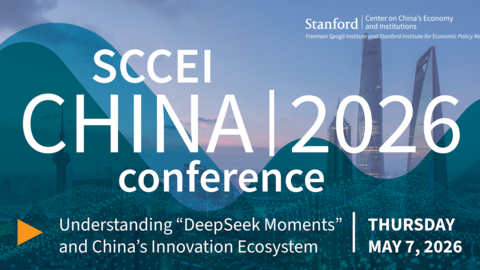
SCCEI China Conference 2026 banner image.


The Stanford Center on China's Economy and Institution's (SCCEI) annual China Conference brings together leading voices from policy, business, and academia to examine key economic trends in China and their implications for the world.

We are finalizing an outstanding lineup of speakers from academia, industry, and policy communities. This year's theme and selected speakers will be announced in the coming months. Updates will be posted here as confirmed. 

*Schedule is subject to change  

Location: 

Bechtel Conference Center
Encina Hall
616 Jane Stanford Way, Stanford University

*Topics, speakers, and timing will be confirmed in the coming months. 


10:00 AM - 10:30 AM  Registration & Light Breakfast

10:30 AM - 10:45 AM  Welcome & Opening Remarks


10:45 AM - 11:45 AM  Session 1


11:45 AM - 1:00 PM  Lunch
 
1:00 PM - 2:00 PM  Session 2 
 

2:00 PM - 2:30 PM  Break
 
2:30 PM - 3:30 PM  Session 3


3:30 PM - 4:00 PM  Break

4:00 PM - 5:30 PM  Keynote Address


Questions? Contact scceichinaconference@stanford.edu 


Bechtel Conference Center
Encina Hall
616 Jane Stanford Way, Stanford University

This event is by invitation only.

Conferences
News Feed Image
banner_2_to_1_dimensions_2026-no_topic.png
Date Label
0
6875216_hayotsyan_kaacx_2026letter.jpg

Nensi Hayotsyan is a Research Assistant at the Center on Democracy, Development and the Rule of Law. Currently pursuing studies in Political Science and International Relations, her academic interests lie in international law, transitional justice, and democratic resilience. She is also interested in questions of institutional stability, human rights protection, and accountability within global governance.

CDDRL Undergraduate Communications Assistant, 2025-26
Date Label
Authors
Aurelia Leowinata
News Type
News
Date
Paragraphs

In the wake of Venezuela’s 2024 presidential election — marred by widespread fraud to ensure Nicolás Maduro’s re-election over opposition candidates Edmundo González and María Corina Machado — the regime has escalated its repression of political dissent. In the aftermath of the election, the regime arrested over 2,400 people. More than 807 political prisoners remain unjustly detained, including 95 women, 4 minors, and over 83 foreign nationals. These individuals, many held as leverage in international negotiations, are subjected to degrading conditions and denied due process.

Amongst them is Jesús Armas, a 2022 Fisher Family Summer Fellow at the Center on Democracy, Development and the Rule of Law (CDDRL) and a recently admitted student to Stanford’s Ford Dorsey Master’s in International Policy program (MIP). As a key campaign organizer for González and Machado, Jesús promoted civic participation and democratic unity in Caracas. He has now been held incommunicado, in conditions of physical and legal abuse, for over eight months. His arrest is emblematic of the Maduro regime’s broader strategy to silence opposition and dismantle civil society.

On August 4, 2025 Fisher Family Summer Fellows Lilian Tintori and Waleed Shawky joined Gulika Reddy, Director of the International Human Rights and Conflict Resolution Clinic at Stanford Law School (SLS), for a panel on how local and global communities can support political prisoners and their families. As Beatriz Magaloni, Graham H. Stuart Professor of International Relations, stated in her opening remarks: “This event should act as a call to action for deeper reflection and justice.”

CDDRL faculty wear shirts that read "Liberen a Jesús Armas"
CDDRL faculty standing in solidarity with Jesús Armas and political prisoners around the world. | Nora Sulots

Strategies for Release


Lilian Tintori, an internationally recognized human rights advocate and the wife of former political prisoner Leopoldo López (the 2022 Robert G. Wesson Lecturer in International Relations Theory and Practice at the Freeman Spogli Institute for International Studies), spoke candidly about her seven-year struggle to secure her husband’s release. “It is not easy,” she stated, “You become the voice of the political prisoner. You can’t talk, you have to scream in every crevice, every place, every moment you get.” 

Tintori argues that the most important aspect for release is a community of resilience, which is to provide mental health and emotional support to political prisoners’ families, as they cannot act as the voice if they feel broken themselves. At the heart of this strength, she argued, is love. In her efforts, she now distributes the Pathway to Freedom handbook, produced through her organization, the World Liberty Congress, to help families navigate the grueling road to release.

“Torture only occurs because the Maduro regime knows we are the majority,” Tintori clarified. Since the beginning of 2025, five political prisoners in Venezuela have died in custody. Tintori emphasized the importance of protecting the life of the person being detained — the human being behind the titles of activist, mayor, or opposition leader, beyond a simple number. To raise awareness about political prisoners alike, Tintori often employs the strategy of always mentioning “other political prisoners” after their loved ones’ names. This keeps the broader community of victims in public consciousness.

With international and local channels to plead for help closing, such as the EU or historically, the U.S., all three panelists stressed that silence is not an option for all communities — including academic spheres — and the broader public. Tintori testified that after public pressure, the regimes do pay attention and often send proof of life to suppress further outrage, hence helping to protect prisoners until their release.

You become the voice of the political prisoner. You can’t talk, you have to scream in every crevice, every place, every moment you get.
Lilian Tintori

Ways to Support A Political Prisoner 


Having been a political prisoner himself after co-founding the April 6th Youth Movement in Egypt, Waleed Shawky recounted what he believed carried him through his time behind bars — the cause he fought for. Upholding the values and vision that led to their arrest, he argued, can provide hope and dignity in the most inhumane conditions. “Being a victim is a choice as a prisoner, because you can choose to be a survivor,” Shawky asserted, “It is important to remind them of the bigger picture.” 

Echoing Tintori’s previous statements, Shawky praised the courage of the families, particularly women, who visit and support prisoners, often at great personal risk. He also warned against idolizing or victimizing political prisoners. “They’re human,” he emphasized. “Don’t cry in front of them. Be strong; they need your strength.”

[Political prisoners are] human. Don’t cry in front of them. Be strong; they need your strength.
Waleed Shawky

Authoritarian Crackdowns and Resistance


Gulika Reddy highlighted the challenges advocates operating in authoritarian contexts face and how they navigate these challenges. She broke it down into three different categories: movements, organizations, and individuals.

  • Movements are often delegitimized and co-opted. Reddy stressed the importance of engaging in grounded movement building, offering counter-narratives to sustain public trust, and fostering solidarity and collective action.

  • At the organizational level, regimes may block formal registration, restrict funding, and launch physical or digital attacks — including office raids and data seizures. To survive these assaults, organizations can diversify financial models, invest in digital security, and cultivate collective care to mitigate burnout and trauma. Additionally, there is a need to adopt diverse theories of change in contexts where traditional human rights tactics prove ineffective.

  • For individuals, threats include intimidation and retaliation, which can also extend to their loved ones. Reddy recommended conducting risk assessments and creating mitigation and response plans, including access to free legal aid and safe housing.


What we learned from our speakers is clear: authoritarianism thrives on silence, but freedom depends on our voices. For political prisoners around the world, solidarity, resilience, and an unwavering defense of human dignity are not just ideals; they are lifelines that can bring them home.

Read More

Jesus Armas participates in the 2022 Fisher Family Summer Fellows Program at CDDRL
News

Statement Demanding the Immediate Release of Jesús Armas (FFSF 2022, Venezuela)

A joint statement from the Center on Democracy, Development and the Rule of Law (CDDRL) and the Ford Dorsey Master’s in International Policy program (MIP) at Stanford University.
Statement Demanding the Immediate Release of Jesús Armas (FFSF 2022, Venezuela)
Leopoldo López
News

“Venezuela can be the spark for a fourth wave of democratization,” says Leopoldo López

López, a political leader and prominent advocate for democracy in Venezuela, shared his vision for uniting global efforts to champion freedom and push back against authoritarianism with a Stanford audience on December 2, 2024.
“Venezuela can be the spark for a fourth wave of democratization,” says Leopoldo López
María Corina Machado spoke to a Stanford audience in a special video address on November 18, and engaged in a conversation with Larry Diamond.
News

Venezuela: Cultivating Democratic Resilience Against Authoritarianism

María Corina Machado, the leader of the Venezuelan pro-democracy movement, suggests that a strong international response to Venezuelan authoritarianism will help overcome electoral fraud against democracy in her country.
Venezuela: Cultivating Democratic Resilience Against Authoritarianism
Hero Image
Lilian Tintori, Waleed Shawky, and Gulika Reddy
Lilian Tintori, Waleed Shawky, and Gulika Reddy spoke to a Stanford audience about strategies to support political prisoners in a panel discussion on August 4, 2025.
Nora Sulots
All News button
1
Subtitle

A panel discussion featuring 2025 Fisher Family Summer Fellows Lilian Tintori and Waleed Shawky, along with Gulika Reddy, Director of the International Human Rights and Conflict Resolution Clinic at Stanford Law School, explored the human cost of political imprisonment, the barriers advocates face, and the strategies available to combat them.

Date Label
0
CDDRL Honors Student, 2025-26
sakshi_umrotkar.jpg

Major: Political Science
Minor: Economics
Hometown: Fremont, California
Thesis Advisor: Vasiliki Fouka

Tentative Thesis Title: Trade, Trust, and Populism: Weighing Norm Adherence against Economic Protectionism

Future aspirations post-Stanford: I'm hoping to explore work in international law and relations between the public and private sectors, since both seem relevant to international economics conversations! I also hope to combine my interest in national security with trade and economics.

A fun fact about yourself: The first guitar solo I learned to play was Hotel California by The Eagles.

Date Label
Authors
Heather Rahimi
News Type
News
Date
Paragraphs

SCCEI Senior Research Scholar Chenggang Xu’s latest book, Institutional Genes: Origins of China's Institutions and Totalitarianism, offers a reinterpretation of China’s political and institutional development. Drawing from decades of research, Xu introduces the concept of "institutional genes"—the enduring foundational structures that shape and constrain how institutions evolve. Through this lens, he examines the emergence and evolution of China’s current communist totalitarian institution, contending that substantial parts of its "institutional genes" were implanted by Soviet Russia, building upon a longstanding tradition of authoritarian rule dating back to imperial China.

Book cover: Institutional Genes: Origins of China's Institutions and Totalitarianism by Chenggang Xu

With insights spanning political economy, institutional economics, and history, Institutional Genes presents a compelling account of why China’s institutions have taken their particular form—why they have resisted democratization—and why its economic reforms have risen and fallen. Xu’s work will appeal to scholars, policymakers, and general readers seeking a deeper understanding of how China’s past continues to shape its political trajectory today. 

Institutional Genes: Origins of China's Institutions and Totalitarianism, previously published in Chinese, is currently available for pre-order and will be published and available to the public on August 21, 2025. For more from Xu, read his recent essay, The Origins of China’s Institutions and Totalitarianism, based on his forthcoming book.


Headshot of Dr. Chenggang Xu.

Chenggang Xu

Senior Research Scholar, Stanford Center on China's Economy and Institutions
About the Author

Read More

Landscape aerial view of Haikou City, China.
News

Shanjun Li to Lead New Research Program on Sustainability and Energy Transition in China

SCCEI's newest research program addresses the pressing sustainability challenges facing China and examines their broader global implications. Grounded in rigorous empirical analysis and economic modeling, researchers aim to inform the development of effective evidence-based policy solutions as well as uncover valuable lessons for other countries navigating similar economic and energy transitions.
Shanjun Li to Lead New Research Program on Sustainability and Energy Transition in China
Elizabeth Economy speaks during a Fireside Chat.
News

Strategic Shifts: Understanding China’s Global Ambitions and U.S.-China Dynamics with Elizabeth Economy

At the 2025 SCCEI China Conference, Elizabeth Economy, Hargrove Senior Fellow at the Hoover Institution, outlined China’s ambitious bid to reshape the global order—and urged the U.S. to respond with vision, not just rivalry, during a Fireside Chat with Professor Hongbin Li, Senior Fellow and SCCEI Faculty Co-Director.
Strategic Shifts: Understanding China’s Global Ambitions and U.S.-China Dynamics with Elizabeth Economy
Professor Matteo Maggiori speaks in front of a crowd.
News

Stanford Professor Matteo Maggiori Unpacks the New Geopolitics of Global Trade

Professor Maggiori joined SCCEI and Stanford Libraries to discuss how the U.S. and China apply economic pressure to achieve their political and economic goals, and the economic costs and benefits that this competition is imposing on the world.
Stanford Professor Matteo Maggiori Unpacks the New Geopolitics of Global Trade
All News button
1
Subtitle

SCCEI Senior Research Scholar Chenggang Xu’s latest book, "Institutional Genes: Origins of China's Institutions and Totalitarianism", explores the origins and evolution of China's institutions and communist totalitarianism.

Date Label
All Publications button
1
Publication Type
Working Papers
Publication Date
Subtitle

This paper examines how power lawyers shape judicial and economic outcomes by studying the “revolving door” between judges and lawyers in China’s judicial system—namely, former judges who quit the bench to practice law. In otherwise identical lawsuits, revolving-door lawyers deliver 8−23% higher win rate for their clients. Their performance in home versus away courts suggests these gains stem from both “know how” and “know who.” We extend the theoretical framework of Dewatripont and Tirole (1999) to show that revolving-door lawyers create countervailing forces in society: they enhance judicial decision-making through evidence and reasoning, but also exploit strategic arguments and connections to bias outcomes in favor of their clients. We estimate a structural model of the judicial process to quantify these trade-offs and find that increasing the supply of power lawyers can have a non-monotonic effect on equilibrium judicial quality.

Journal Publisher
NBER Working Paper
Authors
Subscribe to International Law