
 FSI researchers strive to understand how countries relate to one another, and what policies are needed to achieve global stability and prosperity. International relations experts focus on the challenging U.S.-Russian relationship, the alliance between the U.S. and Japan and the limitations of America’s counterinsurgency strategy in Afghanistan.
Foreign aid is also examined by scholars trying to understand whether money earmarked for health improvements reaches those who need it most. And FSI’s Walter H. Shorenstein Asia-Pacific Research Center has published on the need for strong South Korean leadership in dealing with its northern neighbor.
FSI researchers also look at the citizens who drive international relations, studying the effects of migration and how borders shape people’s lives. Meanwhile FSI students are very much involved in this area, working with the United Nations in Ethiopia to rethink refugee communities.
Trade is also a key component of international relations, with FSI approaching the topic from a slew of angles and states. The economy of trade is rife for study, with an APARC event on the implications of more open trade policies in Japan, and FSI researchers making sense of who would benefit from a free trade zone between the European Union and the United States.
 Colleagues, policymakers, and other friends of John W. Lewis


SPICE Director Gary Mukai recognized by the Japanese government
News Type
News
Date
Paragraphs
SPICE Director Gary Mukai has been named a recipient of the 2017 Autumn Conferment of Japanese Decorations. On November 3, the government of Japan announced that Dr. Mukai will be awarded the Order of the Rising Sun, Gold and Silver Rays for his contributions to the promotion of friendship and mutual understanding between Japan and the United States.
The Order of the Rising Sun is a decoration in the Japanese honors system that dates back to 1875. It was established as the first national decoration awarded by the Japanese government, and it recognizes individuals who have made significant contributions to Japan or its culture. It is one of the highest decorations conferred by the government.
“I am very humbled by this honor,” reflects Mukai. “I still find it hard to believe. But as someone who has always cared deeply about the U.S.–Japan relationship, this decoration truly means a lot to me. I’m just thankful I’ve had so many opportunities to be involved.”
[[{"fid":"228578","view_mode":"crop_870xauto","fields":{"format":"crop_870xauto","field_file_image_description[und][0][value]":"","field_file_image_alt_text[und][0][value]":false,"field_file_image_title_text[und][0][value]":false,"field_credit[und][0][value]":"Marc Franklin","field_caption[und][0][value]":"","thumbnails":"crop_870xauto","alt":"","title":""},"type":"media","field_deltas":{"2":{"format":"crop_870xauto","field_file_image_description[und][0][value]":"","field_file_image_alt_text[und][0][value]":false,"field_file_image_title_text[und][0][value]":false,"field_credit[und][0][value]":"Marc Franklin","field_caption[und][0][value]":"","thumbnails":"crop_870xauto","alt":"","title":""}},"link_text":null,"attributes":{"style":"width: 150px; height: 200px; float: right; margin: 5px 10px;","class":"media-element file-crop-870xauto","data-delta":"2"}}]]
After receiving his Bachelor of Arts degree and teaching credential from UC Berkeley, Dr. Mukai moved to Japan to teach in 1977 and has since worked to promote cross-cultural education between the United States and Japan. Besides working as a teacher in both countries, he has served as a longtime interviewer for the Japan Exchange and Teaching (JET) Program and has been a selection committee member of the United States-Japan Foundation’s Elgin Heinz Teacher Award since its inception. At SPICE, he has developed numerous curriculum guides on Japan for K–12 classrooms as well as overseen the creation of both the Reischauer Scholars Program and Stanford e-Japan—a pair of nation-wide online courses that teach American and Japanese high school students about each others’ countries.
A date for Mukai’s formal conferment ceremony has not been announced.
To read the Consulate’s announcement of the recipients of the Order of the Rising Sun, visit http://www.sf.us.emb-japan.go.jp/itpr_en/17_1103.html.
To stay informed of SPICE-related news, follow SPICE on Facebook and Twitter.
Hero Image

Gary in Hiroshima, his ancestral hometown.
All News button
1
2017 Holiday Party
-
Image

Jonathan Achter
(650) 725-9155
0
jjachter@stanford.edu
Jonathan Achter
Jonathan has been with the Ford Dorsey Master's in International Policy (MIP) since November 2005. His current responsibilities include academic administration, student services, finance, operations, and major events. Previously, he also managed admissions for 14 years. Prior to MIP, he worked in international education and study abroad at the University of California, Santa Barbara and Iowa State University. His international study, work, and program leadership destinations include Australia, Mexico, Spain, and England. He holds a master's degree in educational leadership and policy studies, specializing in student development, from Iowa State University. Additionally, he completed his doctoral coursework at the University of Minnesota, which focused on higher education leadership, policy, and development for international educators.
Assistant Director, Academic and Student Affairs
Hide publication sections
Off
Trump's Asia Trip
News Type
News
Date
Paragraphs
Commenting on President Trump's twelve-day trip to Asia, FSI senior fellow and director of the Southeast Asia Program at Shorenstein Asia-Pacific Research Center Donald K. Emmerson noted that Trump "failed . . . to significantly alter the calculus brings to bear on North Korea."
Trump's approach to foreign policy, one based on forming personal relationships, might have caused him to get the mistaken idea "that he had made a real impact and everybody was getting along," Emmerson suggested.
Emmerson likewise questioned any substantial trade-related results coming out of the trip, saying that many touted achievements were either "already on the table" or were non-binding memoranda of understanding.
That said, Emmerson stressed that if in time President Trump were to realize the dearth of interest in bilateral trade deals, and that the "U.S. is making China great again," he could shift U.S. policy.
The full article is available from the Sinclair Broadcast Group.
Hero Image

Presidents Trump and Xi take part in a business event in Beijing during Trump's twelve-day Asia tour.
WhiteHouse.gov
All News button
1
Why nuclear deterrence can work on North Korea
News Type
News
Date
Paragraphs
The same logic that kept a nuclear war from breaking out between the United States and former Soviet Union is the best strategy to now pursue with North Korea, several scholars said Tuesday at Stanford.
The panel, convened at Stanford’s Center for International Security and Cooperation (CISAC), included political scientist Scott D. Sagan of CISAC; political scientist Mira Rapp-Hooper of Yale University; and political scientist Vipin Narang of MIT. The moderator was James D. Fearon, a political scientist at the Freeman Spogli Institute for International Studies. The event was titled “Can the U.S. Deter a Nuclear North Korea” and held in the William J. Perry Conference Room in Encina Hall.
Nuclear decision-making
The discussion revolved around whether North Korea will have the ability to strike the U.S. with nuclear warheads, and can the U.S. depend on a deterrence strategy like it did during the Cold War?
Deterrence theory holds that nuclear weapons are intended to deter other states from attacking with their nuclear weapons, through the promise of retaliation and possibly mutually assured destruction
Sagan, who recently wrote an essay in Foreign Affairs magazine on the North Korea nuclear crisis, said he has come to decide deterrence is the best approach to the issue.
“I am not one who gladly listens to the siren song of nuclear deterrence,” he said, noting that while he is a self-described dove on disarmament issues, he is more hawkish on allowing countries to obtain nuclear weapons, which deterrence implies. “I accept deterrence reluctantly.”
In North Korea, he said, no military alternatives exist to solve the problem. For example, even if a decapitation strike were successful – and several U.S. attempts have failed in the past with regard to Saddam Hussein and Muammar Gaddafi – there’s no way to know if North Korean leader Kim Jong-un has already given his generals the green light to unleash nuclear or powerful conventional attacks in the case of his demise.
For Sagan, deterrence is a more complicated issue today than during the Cold War when the U.S. and U.S.S.R. were rational actors with thousands of nuclear weapons. He is especially concerned with the rhetoric and the preventive war suggestions emanating from the Trump Administration.
Senior U.S. military leaders, Sagan said, have a duty not to follow “impaired-decision making” that might come from the president. He invoked the prospect of using the Cabinet and the 25th Amendment to halt such an order and remove the president from office. Currently, he belives the nuclear decision process is problematic, as the president alone can directly order the Strategic Air Command to launch nuclear weapons.
Sagan advises that a revised nuclear chain of command should include both the U.S. Secretary of Defense and the U.S. Attorney General. A U.S. Senate hearing, led by Sen. Bob Corker, is actually studying the nuclear authorization process due to concerns with Trump's rhetoric and escalation of the North Korean issue.
“We need more checks on how we decide to use nuclear weapons,” said Sagan, who studies nuclear strategy, ethics and war, public opinion about the use of force, and nuclear non-proliferation and arms control.
He noted that U.S. National Security Advisor H.R McMaster recently criticized his predecessor, Susan Rice, for saying the U.S. could "tolerate" nuclear weapons in North Korea the same way we tolerated nuclear weapons in the Soviet Union.
He quoted McMaster: “'A regime that poses a continuous threat to the its neighbors in the region and now may pose a threat, direct threat, to the United States with weapons of mass destruction? A regime that imprisons and murders anyone who seems to oppose that regime, including members of his own family, using sarin nerve gas in a public airport?'”
But Sagan said we have long tolerated such authoritarian regimes that have nuclear weapons.
Stumbling accidentally into war with North Korea also seems like a rising risk. On Sept. 27, several U.S. service members and their families received a fraudulent “noncombatant evacuation operation” order via text and social media, he said. The fake notices were quickly reported up the chain of command and the U.S. issued a statement denouncing their validity – the perpetrators have not been found. But Sagan says it illustrates how easy it is to create a situation where North Korea felt a U.S. invasion and attack is imminent – and as a result, could choose to unleash a nuclear first strike.
‘Western fantasy’
Narang, who was once a CISAC visiting assistant professor, studies nuclear proliferation and strategy, South Asian security, and general security studies.
“Deterrence is your friend,” he said in explaining why it can work with North Korea. If the U.S. believes North Korea seeks to preserve its regime – a status quo intention – then deterrence theory works much like it did with the former Soviet Union.
On the other hand, if the U.S. believes North Korea has darker motives, such as reunifying the Korean peninsula through an invasion, then that perspective could lead to a U.S. first strike. Also, the existing U.S. demand of rolling back North Korea’s nuclear program – “denuclearization” – is a “Western fantasy.” They will not give up nuclear weapons, he said.
He said the U.S. does not like to be deterred from making a first strike – as in preventive war – but that is what it must accept if it decides to follow the deterrence course. North Korea, once it possesses an ICBM capable of hitting the U.S. mainland, would pose such a deterrence in the balance of power between the two countries.
“The good news is that deterrence can work, coupled with coercive diplomacy,” Narang said. “We know how to play this game.”
He believes Jong-un is a rational actor, though a cruel dictator. “There’s nothing to suggest he’s crazy.” Ultimately, he said, an effective deterrence policy depends on clarity, consistency, coherence and communications.
U.S. nuclear shield, alliances
An expert on security in the Asia-Pacific region and alliance politics, Rapp-Hooper talked about the U.S. relationships, especially with Japan and South Korea, and the “nuclear shield” over these countries that those agreements offer. As a result, neither country has developed nuclear weapons.
This dynamic, however, could change if a North Korean missile could reach the U.S., said Rapp-Hooper, who earned a bachelor’s degree in history at Stanford.
“North Korea is eroding U.S. security guarantees over time,” she said, adding that once those missiles are capable of hitting a U.S. city, would the U.S. government still protect Seoul from attack and let an American city be hit?
The Korean situation, Rapp-Hooper said, is much different than Europe in the Cold War, when such an American nuclear shield existed against a Soviet invasion. Many different U.S. agreements exist now than during that time; no U.S. nuclear weapons are forwardly deployed in northeast Asia, like in Europe then; and the unilateral threats coming from the Trump Administration are unprecedented in nuclear diplomacy.
On the latter point, she called it the “Trump multiplier” effect. “That’s the most exacerbating thing of all,” she said, noting that elements of the White staff are pushing a “better-use-it-now” or preventive attack approach, whereas Secretary of Defense James Mattis and Secretary of State Rex Tillerson see North Korea as more concerned with preserving its regime.
Sagan also pointed out how President Trump’s speech at the United Nations in September led to a realization among the North Koreans that they had no choice but to continue to develop nuclear weapons.
That’s when the president said, “’Rocket Man is on a suicide mission for himself and for his regime,’” Sagan noted.
He then recalled Kim Jong Un’s response to Trump’s speech, quoting the North Korean leader: “’His remarks which described the U.S. option through straightforward expression of his will have convinced me, rather than frightening or stopping me, that the path I chose is correct and that it is the one I have to follow to the last.’”
Hero Image

The same logic – deterrence – that kept the United States and the former Soviet Union from nuclear war is the best option to deal with North Korea, scholars said Tuesday at Stanford.
Getty Images/Chung Sung-Jun
All News button
1
Eastern European Security with Bronislaw Komorowski, former president of Poland
Image
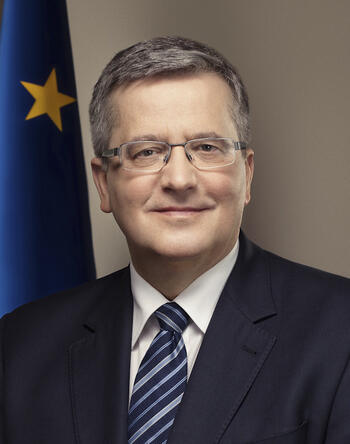
Bronisław Komorowski, a former anti-communist opposition activist, member of Parliament, Minister of National Defence, and Marshal of the Sejm of the Republic of Poland, was President of Poland from 2010-2015.
During the '60s and '70s, Komorowski was deeply involved in opposition activities. Komorowski worked as a printer, journalist, distributor and publisher of the underground press. In the years of opposition activities, he was frequently arrested and victimized. During martial law, he was interned.
He defended his MA thesis at the Faculty of History at the University of Warsaw. In 1977 he worked in Zespół Prasy Pax, and in 1980- 1981 at the Social Research Centre NSZZ Solidarność (Independent and Self-governing Trade Union Solidarność) of the Mazovian Region. From September 1982 he worked as an editor of the independent, underground magazine “ABC” (Adriatic – Baltic – Black Sea).
From 1991 to 2010 he was Member of Parliament for consecutive terms in the Sejm. He worked in the Commission for Poles Overseas and in the Commission for National Defense, and then in the Commission for Foreign Affairs. From 1997 to 2000 he presided over the Sejm Commission for National Defense. From 2001 he was deputy chairman of the Sejm commission for National Defense and a member for the Sejm Commission for Foreign Affairs.
As a result of the tragic death of President Lech Kaczyński in the Smoleńsk catastrophe on April 10th, 2010, Komorowski became Acting President of the Republic of Poland under the regulations of the Constitution. He later won the presidential election on July 4, 2010, and took office on August 6, 2010.
As a result of the tragic death of President Lech Kaczyński in the Smoleńsk catastrophe on April 10th, 2010, Komorowski became Acting President of the Republic of Poland under the regulations of the Constitution. He later won the presidential election on July 4, 2010, and took office on August 6, 2010.
Koret-Taube Conference Center
Gunn-SIEPR Building
366 Galvez Street
Bronisław Komorowski
former president of Poland
former president of Poland
Lectures
Russian-American Relations: Present and Future
-
This event has reached capacity. Please email sj1874@stanford.edu to be placed on the waitlist.
NOTE: Due to the overwhelming response for this event, we have moved it to the GSB Common, a larger venue, located at the Schwab Residential Center.
Relations between the two countries are at the lowest level since the Cold War. Their improvement will take time and great efforts. But, as major world powers, Russia and the United States are
"doomed" to dialogue in order to try to solve some of the biggest global challenges.
Image

Anatoly Antonov was appointed Ambassador of the Russian Federation to the United States and Permanent Observer of the Russian Federation at the Organization of American States in August 2017. Prior to that, he served as Deputy Foreign Minister of the Russian Federation, Deputy Minister of Defense, Director of the Department of Security, and Disarmament and Ambassador-at- Large of the Russian Foreign Ministry. Antonov holds a PhD in Political Science and is fluent in Russian, English and Burmese.
Anatoly Antonov
Russian Ambassador to the United States
speaker
Russian Ambassador to the U.S.
18th Korea-U.S. West Coast Strategic Forum
-
In this eighteenth session of the Strategic Forum, former senior American and South Korean government officials and other leading experts will discuss current developments in the Korean Peninsula and North Korea policy, the future of the U.S.-South Korean alliance, and a strategic vision for Northeast Asia. The session is hosted by the Korea Program in association with The Sejong Institute, a top South Korean think tank.
Conferences
17th Korea-U.S. West Coast Strategic Forum
-
In this seventeenth session of the Strategic Forum, former senior American and South Korean government officials and other leading experts will discuss current developments in the Korean Peninsula and North Korea policy, the future of the U.S.-South Korean alliance, and a strategic vision for Northeast Asia. The session is hosted by the Korea Program in association with The Sejong Institute, a top South Korean think tank.
The report from this session is avaiable here to download.
Seoul, Repulic of Korea
Conferences