Suhani Jalota was only 20 years old when she established a foundation to help impoverished women in the slums of her native city, Mumbai. She was 23 when Forbes named her one of Asia’s 30-Under-30 Social Entrepreneurs as her foundation was taking off.
Now, at the ripe old age of 24, she is embarking on her pursuit of a PhD in health policy on the econ track at Stanford Medicine’s Department of Health Research and Policy.
As a social entrepreneur, she is hoping to create self-sustaining health organizations managed entirely by the people in the low-income communities they serve.
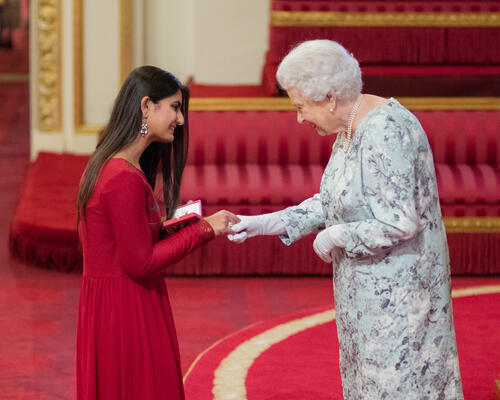
Last year, Jalota, who is also in the first cohort of Knight-Hennessy Scholars, received the Queen’s Young Leader award from Queen Elizabeth II and attended the royal wedding of Prince Harry and American actress Meghan Markle, who is now Duchess of Sussex.
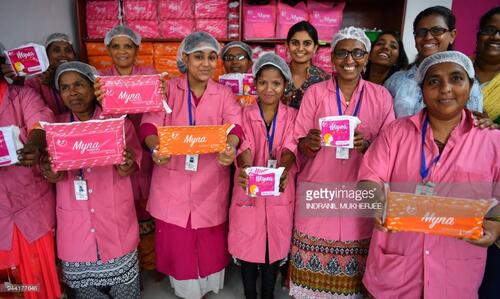
The Myna Mahila Foundation— which provides affordable sanitary products and promotes employment and empowerment among women in Mumbai’s slums — was the only non-UK charity chosen to receive donations in lieu of gifts for the royal couple.
Stanford Health Policy caught up with Jalota to ask her a few questions about what inspires her and how she became so passionate about sanitary health and empowering women in India.
Who inspired you to become social-entrepreneur at such a young age?
I come from a government family and, growing up, our conversations at home were always about the development of India and the status of women. My father is an Indian civil servant who has worked on water sanitation for the city; my mom works with underprivileged girl children, and my brother creates water filters for the same slum community. My grandparents were in the police. It’s just what we do. It’s our family calling.
As for entrepreneurship, it was Duke University, the Baldwin Scholars Program and the Melissa and Doug Entrepreneurship Fellowship that actually made me believe that all the dreams I had to change the pitiful state of things on the ground in Mumbai could actually be achievable. There I learned to translate the problems I saw to actionable items that the institution was willing to back and support endlessly.
Then in 2011, I met Dr. Jockin Arputham, who spent 40 years working in the slums of Mumbai as the founder of Slum Dwellers International. He became my inspiration, my idol and my mentor. He singlehandedly improved the lives of millions of women.
Dr. Arputham passed away in October. I am here to complete this mission.
What inspired you to establish the Myna Mahila Foundation?
When I started spending more time with women in the slum communities they told me horrific stories about living on the railway tracks, children dying in front of them, and not being able to walk the public toilets without being sexually harassed. Some were taking pills to constipate themselves just so they did not have to go to the public toilet. Others would tell me how they had been married off at 12 and were still living with drunk husbands who beat them every day.
Women were ignoring their own health and it really struck me as how this would lead to such wasted potential for the women, and for India.
The slum community leaders and I began brainstorming — we became very chatty. That’s where the name comes from. Myna from the chatty South Asian bird and Mahila, which means women in Hindi. And we found that their menstrual cycles were physically and mentally exhausting. We found that sanitation and hygiene were clear signals of dignity for women, so we jumped on that.
You see, 320 million women in India do not have access to sanitary pads. And menstruation in India is a taboo health topic; there is a stigma to shopping for sanitary pads. Most women use rags on their periods and these often become dirty, leading to urinary and vaginal infections.
When you are trapped under an aluminum roof where your horizon is the lining of the slum settlement, and you only see limitations ahead of you, it is difficult to see another way of life. After more than six years of working on sanitation and health research with these women, I realized the problems lay deeply entrenched in a woman’s lack of agency, or ability to make decisions. You are brought up to think that what the generations ahead of you have been doing is the only way of life. Hiding your periods, not cooking food or sleeping with the family during your periods, not going to the temple or playing sports — you believe this is the only way to live.
So we came up with a scheme to sell sanitary pads door-to-door to women who would normally not leave their homes or go to a pharmacy to buy them from male clerks. And we get to know these women; they are opening up and exploring things outside the confines of their husbands’ world. I learned that if women were confident to talk about their periods and menstrual hygiene, it could break the silence surrounding domestic violence or sanitation.
Tell us about the women who work for you and the women you serve.
We employ women from the slum communities we serve, including the accountants, production and sales managers, and the education trainers. We work mostly with Muslim women as that is a representation of the demographics of the communities we are in.
We currently meet about 10,000 women at their doorsteps every month in the 12 slums across Mumbai. It’s not about giving out free pads — a woman gets her period 450 times in her lifetime, so what we’re trying to do is make sure that she understands that it’s a normal health cycle that should not stop her from getting her education and jobs. We have more than 500 girls in our sponsor a girl program, with 100 more girls joining every month. We hold individual counseling and mentorship for these girls along with menstrual hygiene workshops at health camps. We employ 20 women and have partnerships with self-help groups across the city who work with us part-time.
You strongly believe that self-sustaining health organizations should be managed by women in those communities. Why is this so important?
In the words of my mentor Dr. Arputham, it’s not our purpose to tell the women in the slums what to do; you must think about it from their perspective of what they need and help them create their own change. This has been my mission ever since.
We have millions of NGOs in India so you realize that if things are not really improving at a national level, then there’s something that we’re not doing right. We need the civic mindset to marry the efficiency of the business world. This makes people less dependent and more autonomous to be in control of their own situations. And that comes with a sense of pride.
Why focus on health and sanitation?
We are still struggling with the basics in India: basic health, which includes food, housing, potable water and improved sanitation. Numerous research studies have demonstrated that improvements in sanitation have led to dramatic improvements in health, such as life expectancy outcome measures. Unless we have basic health standards achieved, we will remain behind. To add to the problem, health-care is often deprioritized in India. While it accounts for nearly 18 percent of the GDP here in the United States, for example, it only accounts for 1 percent in India. Can you imagine that? With more than 1 billion people. The role of the public sector in India is to get people on the same level playing field with the basics: education, health care so you’re well enough to go to school or work, find food, shelter and water.
India is a true democracy — so if people start to recognize the importance of health and demand better health care, they can get it.
What are your goals for the PhD?
To learn more research techniques to use for conducting experiments on the ground for a variety of topics, including women’s demand for health care, effects of positions of power in seeking health care, and the connection between environment and health. On the supply side, I am becoming increasingly interested in understanding pay-for-performance incentive structures in health institutions and for front-line health workers.
I will also be spending my December breaks and summers in India working at the foundation. After my second year, I hope to continue data collection for my dissertation topic: the effect of environmental changes on health outcomes, such as child stunting levels in the slums. As part of my undergrad thesis, I collected anthropometric data on 880 children to look at the effect of slum redevelopment (when the government forcibly relocates people from slums to government subsidized housing) on child stunting. I learned that when a child has one additional year in the buildings — instead of out in the slums with no toilets and clean water and proper ventilation — they were less likely to be stunted. The effect was even more pronounced (and significant) for children moving from slums without toilets than for children moving from slums with toilets.
Another area of research for me moving forward is how this plays out if a pregnant mother gives birth in the slums or the building. Is that affecting the child’s birth weight? Is water quality, sanitation, population density — have other health outcomes actually improved?
You could have gone anywhere for your PhD. Why Stanford?
The Knight Hennessy Scholars Program — that was a very compelling pull. Further, I think that being at Stanford gives you this additional advantage of having access to really positive technology like Virtual Reality — giving people exposure to a different world. We want people to demand better health care, so if they can experience what it feels like to walk into a hospital and a clean waiting room with a bench and a trash can, it can change their concept of what they deserve. I’m really excited to learn more about how new technologies can be applied in the slums to prompt people to stand up and demand better for themselves.
I took two women who work at Myna Mahila with me to the royal wedding. These are women who come from the slums — and what impressed them most was the cleanliness. They couldn’t believe how people could keep everything so clean. If more women see this through VR, they will start to think that this world should become theirs too. We have access to thousands of women and if we can teach menstrual hygiene education through this technology — well, as an entrepreneur, I get very excited about this. This is just one of the many technologies I want to learn more about and see if they can be applied in the slums.
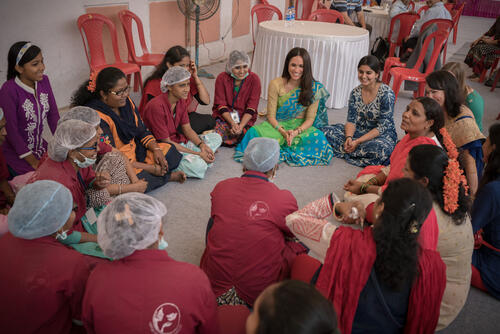
What did you make of Meghan Markle’s visit to the foundation in January 2017?
When she came to visit she told us she would support us in any way that she could. She kept her word. For us being chosen as one of seven charities for the royal wedding, I thought to myself, oh my God, she really thinks that we’re on to something that could actually change the world for many women. I feel like I have a huge responsibility to live up to their expectations. Now we have to keep our word to them and help women meet their true potential.