Carnes, N., Ferrer, J., Golden, M., Lillywhite, E., Lupu, N., & Nazrullaeva, E. (2025). The Global Legislators Database: Characteristics of national legislators in the world’s democracies. British Journal of Political Science, 55, e27, 1–12.
Social scientists and philosophers have shown increased interest in the concept of descriptive representation. Indeed, the identities and life experiences of those doing the representing may be critical for enacting the preferences of those being represented. This is especially the case for historically marginalized groups — upper-class, educated men may simply fail to adequately represent lower-class, uneducated, or women voters. In addition to considerations of fairness, there is growing recognition that descriptive representation can improve policy outcomes, such as service delivery or trust in government.
However, the study of descriptive representation has been hampered by data availability. Identifying simple correlations across the world’s democracies — for example, between proportions of working-class legislators and levels of social welfare provision — has hitherto been impossible.
In “The Global Legislators Database,” Nicholas Carnes, Joshua Ferrer, Miriam Golden, Esme Lillywhite, Noam Lupu, and Eugenia Nazrullaeva introduce the largest dataset of biographic and demographic information on national legislators ever assembled. GLD will enable scholars to assess just how much voters elect those with life experiences resembling their own. The authors compile information on five descriptive variables across 97 democracies: legislators’ party affiliation, gender, age, highest level of education, and previous occupation (to assess their social class). By contrast, prior datasets have focused only on heads of state or cabinet members, or on only a selection of more developed democracies.
Some questions around descriptive representation would seem to have intuitive answers: Wouldn’t developed countries have more women representatives, or wouldn’t women legislators feature less prominently in right-wing parties? Scholars can now hope to do more than merely gesture at answers.
The authors introduce the largest dataset of biographic and demographic information on national legislators ever assembled. GLD will enable scholars to assess just how much voters elect those with life experiences resembling their own.
Characteristics, Validity Checks, and Applications:
GLD comprises countries that (a) have a population of over 300,000 and (b) meet the standard for what Freedom House calls “Electoral Democracy” — having some minimum of political rights and civil liberties. Excluding six cases of data availability constraints, this yields 97 countries, including India, the United States, Brazil, Mexico, Nigeria, and the Philippines. Scholars of Pakistan, Bangladesh, or Turkey — who would likely characterize these countries as authoritarian during the 2015-17 time period — will be pleased that the authors chose a more forgiving measure of democracy.
Biographic data is drawn from the national legislature in unicameral countries and the lower chamber in bicameral countries. (By contrast, upper chambers are sometimes indirectly appointed or hereditary, which sheds less light on whether voters choose descriptively similar representatives.) This yields over 19,000 individuals who held office during at least one legislative session in 2015, 2016, and 2017. GLD has remarkably complete data for the five variables mentioned above: age and education data are presented for over 90% of legislators in the dataset, for over 93% as regards occupation, and nearly 100% for gender.
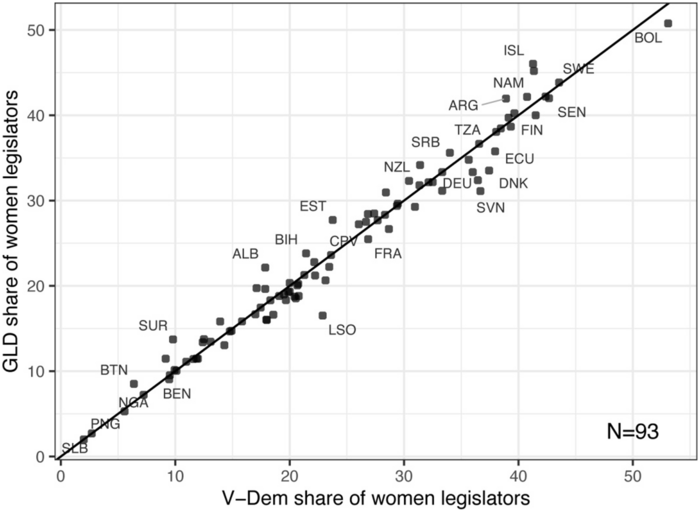
In order to assess GLD’s validity, the authors compare select variables to those in comparable datasets. For example, the gender variable is compared with gender data from the Varieties of Democracy (V-Dem) project, which shows that the two measures are nearly identical. So too is the age data nearly identical to an index from 15 affluent democracies.
Image
Figure 1. Shares of women legislators in the GLD and V-Dem. Note: Bahamas, Belize, Fiji, and Kosovo are omitted because of missing data in the V-Dem.
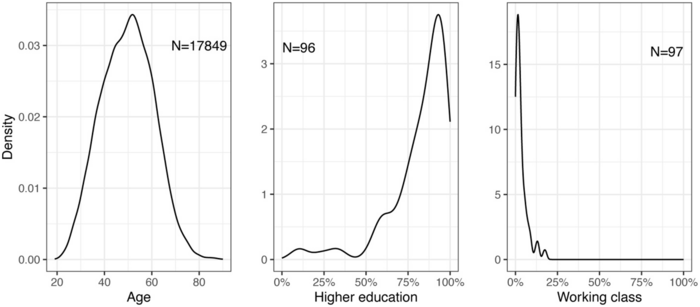
For categories like education and prior occupation — where comparable data are unavailable — the authors conduct “face validity” tests: these draw on our intuitions that legislators are, for example, mostly educated and not working class. And indeed, these intuitions are borne out in the distributions of GLD data. In terms of total coverage, GLD includes information on more legislators than the comparable Global Leadership Project database for all but two countries, and in many cases, the differences are large.
Image
Figure 3. Distributions of legislator traits in the GLD. Note: Age is calculated at the time of election. Higher education includes levels beyond primary and secondary education (Bachelors, Masters, PhD, LLB, LLM, JD, MD, and short-cycle tertiary). Data on educational attainments for legislators is unavailable for Côte d’Ivoire.
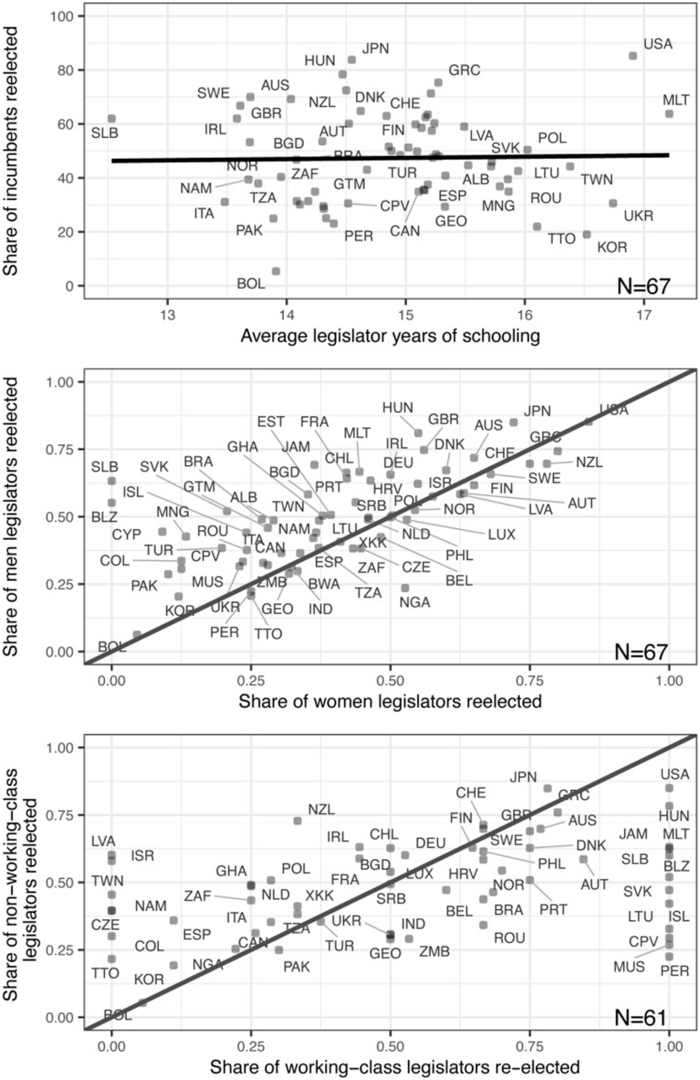
The authors then use GLD in application to a number of questions for which scholars have lacked global data. First, some have hypothesized that in legislatures with more (a) uneducated, (b) female, and (c) working-class representatives, incumbency rates will be lower. This is because individuals from these three groups might have a harder time overcoming challenges relating to expertise, sexism, and fundraising, respectively. Correlating GLD data with a global reelection database, the authors find only evidence for (b), suggesting that women may face higher barriers to remaining in office. These are only correlations, but they point to fruitful areas for exploration: why might women face unique barriers, and what distinguishes countries with lower versus higher barriers?
Image
Figure 5. Re-election rates by years of education, gender, and occupational background. Note: The share of working-class legislators is zero for six countries that are dropped from the figure: Albania, Botswana, Cyprus, Estonia, Guatemala, and Mongolia.
A second application involves public financing of elections, which is thought to favor more working-class legislators who would have a harder time fundraising. Correlating V-Dem data on public financing with the GLD variable on prior occupation, however, the authors find limited evidence for this conjecture. Finally, some have proposed that countries with a stronger rule of law would favor a higher proportion of lawyers in the national legislature. Looking again at GLD prior occupation data alongside V-Dem rule of law data, the authors find limited evidence for this hypothesis.
These varied applications point to how the Global Legislators Database can serve as a valuable resource for scholars interested in the causes and consequences of descriptive representation. Although the GLD covers only a single point in time, it can serve as a bedrock for additional data-collection efforts. In addition to expanding its temporal coverage, scholars may also wish to gather data on upper chambers. Especially in ethnically diverse countries like Bosnia and Herzegovina, upper chambers are intended to mirror the descriptive composition of specific regions. However, it may be the case that ethnic representatives are still vastly more wealthy or educated than their constituents, thus impeding their ability to represent.
The January 3, 2026, U.S. “Operation Absolute Resolve” in Venezuela to capture and remove President Nicolás Maduro has raised urgent questions about its repercussions for the U.S.-China competition, Taiwan Strait security, American strategic priorities in the Indo-Pacific region, and U.S. allies and partners.
In two new episodes of the APARC Briefing series, Stanford scholars Larry Diamond, the Mosbacher Senior Fellow in Democracy at the Freeman Spogli Institute for International Studies (FSI) and William L. Clayton Senior Fellow at the Hoover Institution, and APARC faculty affiliate Oriana Skylar Mastro, a center fellow at FSI, join host Kiyoteru Tsutsui, the director of APARC, to unravel what happened in Venezuela and the implications of the U.S. actions in Latin America for Taiwan, security and alliances in the Indo-Pacific, and U.S. relations with stakeholders in the region.
Both scholars agree that the U.S. mission in Venezuela is a precedent that likely emboldens rather than deters China in its Taiwan calculus, warning that the shift it represents in U.S. national security policy might detract from American capabilities in the Indo-Pacific region at a crucial moment. They also provide sobering advice for U.S. allies struggling to adjust to rapidly shifting geopolitical realities under the second Trump administration.
A Shocking Action in World Affairs
There is no dispute that the Maduro government has been deeply authoritarian, deeply corrupt, and deeply illegitimate, says Diamond, author of Ill Winds: Saving Democracy from Russian Rage, Chinese Ambition, and American Complacency. Yet the United States “has probably violated international law to intervene forcibly in the internal affairs of Venezuela and remove its political leader," creating enormous implications for the international community. If it does not pursue a strategy of systemic democratic change in Venezuela, “all of this will have been for naught, and it will have paid a tragic price in terms of international precedent and international legitimacy,” Diamond argues.
Beijing is already using the operation as a "discourse power win," depicting the United States as crushing sovereignty and international law, Mastro notes. Moreover, in addition to Venezuela, President Trump continues to make statements about Greenland, reiterating its importance for U.S. national security and his interest in acquiring the territory, which has alarmed European partners and exacerbated strains with NATO.
“For the first time since WWII, some European countries have declared the United States to be a security threat,” Mastro says. “So I am curious to see if the Chinese try to bring along the Venezuela case as well, to convince U.S. allies and partners to distance themselves from the United States, which would have significant repercussions for the global order and for the United States' role in it.”
There is no situation in which we 'neutralize' Chinese air defenses and then somehow do some sort of infiltration.
Oriana Skylar Mastro
A Risky Strategic Reorientation
By unilaterally bypassing international norms to wield power in its own "backyard," the United States may have set a precedent that China can now exploit to justify its own ambitions in Taiwan as a legitimate exercise of regional dominance.
Diamond remarks on this line of thought: “If the United States, as a hegemon, can just do what it wants to arrest and remove a leader, in its kind of declared sphere of influence, what's to stop Xi Jinping from doing the same in his sphere of influence, and with a democratic system in Taiwan, whose sovereignty he does not recognize?”
On the other hand, many commentators have argued that Operation Absolute Resolve serves as a deterrent to Chinese aggression. Granted, there is no doubt that the operation was a remarkably successful military attack showcasing the capabilities of U.S. special forces, notes Mastro, who, alongside her academic career, also serves in the United States Air Force Reserve, for which she currently works at the Pentagon as deputy director of research for Global China Strategy. Nevertheless, she emphasizes that the United States cannot carry out a similar attack in Asia.
“There is no situation in which we ‘neutralize’ Chinese air defenses and then somehow do some sort of infiltration,” says Mastro, author of Upstart: How China Became a Great Power. The U.S. intervention in Venezuela, therefore, “does not tell us a lot, operationally, about what the United States is capable of in a contingency via China.”
More troubling, Mastro identifies the Venezuela operation as demonstrating a fundamental shift in U.S. strategic priorities, with the raid conducted just weeks after the Trump administration released its 2025 National Security Strategy, which prioritizes restoring “American preeminence in the Western Hemisphere.” Mastro characterizes it as “the one region where U.S. dominance faces no serious challenge.” Thus, Venezuela suggests “the Trump administration means business about the renewed focus on the Western Hemisphere, and, unfortunately, that makes me concerned that there might be strategic neglect of the Indo-Pacific moving forward,” she points out.
Diamond stresses that, virtually throughout the entire presidency of Xi Jinping, dating back to 2012, China has been rapidly building up its military capabilities, prioritizing those specifically suited for coercing, isolating, or potentially seizing Taiwan. Against this backdrop, “I am much more fearful about the future of Taiwan in the week following U.S. military action on January 3 in Venezuela than I was before that action.”
Mastro agrees with this assessment about the ripple effects of the operation in Venezuela. “I would say that it probably emboldens China.”
[M]y advice to the leaderships [of our allies is]: Find a way to get to the fundamental interests you need to pursue, defend, and preserve. And in the case of East Asia, that has to be number one, above all else, the preservation of our alliances.
Larry Diamond
Frank Advice for U.S. Allies
For U.S. allies in the Indo-Pacific, including Japan, South Korea, the Philippines, and Australia, as well as allies and partners in Europe, both scholars offer pragmatic counsel for coping with the Trump administration.
Diamond urges U.S. allies to manage Trump diplomatically while staying focused on core interests, namely, prioritizing the preservation of the alliances and strengthening autonomous defense capabilities to demonstrate commitment and hedge against potential U.S. retrenchment.
“It takes constant, energetic, proactive, imaginative, relentless, and in some ways deferential working of the relationship, including the personal relationship between these leaders and Donald Trump [...] The future will be better if the leaders of these countries internalize that fundamental lesson about Trump.”
Mastro is equally direct about the limited alternatives ahead of U.S. allies: "You don't really have an option. That Chinese military – if it gives the United States problems, it definitely gives you problems. There's no hope for a country like Taiwan without the United States. There's no hope for Australia without the United States."
Counterintuitively, U.S. assertiveness may indicate its insecurity about the balance of power with China. “It seems to me that the United States also needs to be reassured that our allies and partners support us [...] And if we had that confidence, maybe the United States would be less aggressive in its use of military force.”
‘A Chip Odyssey’ Illuminates the Human Stories Behind Taiwan’s Semiconductor Dominance
A screening and discussion of the documentary 'A Chip Odyssey' underscored how Taiwan's semiconductor ascent was shaped by a collective mission, collaboration, and shared purpose, and why this matters for a world increasingly reliant on chips.
2026 Shorenstein Journalism Award Open for Nominations
Sponsored by Stanford University’s Shorenstein Asia-Pacific Research Center, the annual award recognizes outstanding journalists and news media outlets for excellence in covering the Asia-Pacific region. News editors, publishers, scholars, and organizations focused on Asia research and analysis are invited to submit nominations for the 2026 award through February 15, 2026.
Speaking on the APARC Briefing video series, Larry Diamond and Oriana Skylar Mastro analyze the strategic implications of the U.S. operation in Venezuela for the balance of power in the Taiwan Strait, Indo-Pacific security, America’s alliances, and the liberal international order.
The COVID-19 crisis was a profound stress test for health, economic, and governance systems worldwide, and its lessons remain urgent. The pandemic revealed that unpreparedness carries cascading consequences, including the collapse of health services, the reversal of development gains, and the destabilization of economies. The magnitude of global losses, measured in trillions of dollars and millions of lives, demonstrated that preparedness is not a discretionary expense but a foundation of macroeconomic stability. Countries that invested early in surveillance, resilient systems, and inclusive access managed to contain shocks and recover faster, proving that health security and economic security are inseparable.
For the Asia-Pacific, the path forward lies in transforming vulnerability into long-term resilience. Building pandemic readiness requires embedding preparedness within fiscal and development planning, not as an emergency measure but as a permanent policy function. The region’s diverse economies can draw on collective strengths in manufacturing capacity, technological innovation, and strong regional cooperation to institutionalize the four pillars— globally networked surveillance and research, a resilient national system, an equitable supply of medical countermeasures and tools, and global governance and financing—thereby maximizing pandemic prevention, preparedness, and response. Achieving this will depend on sustained political will and predictable financing, supported by the catalytic role of multilateral development banks and international financial institutions that can align public investment with global standards and private capital.
The coming decade presents a narrow but decisive window to consolidate these gains. Climate change, urbanization, and ecological disruption are intensifying the probability of new zoonotic spillovers. Meeting this challenge demands a shift from episodic response to continuous readiness, from isolated health interventions to integrated systems that link health, the environment, and the economy. Strengthening regional solidarity, transparency, and mutual accountability will be vital in ensuring that no country is left exposed when the next threat emerges.
A pandemic-ready Asia-Pacific is not an aspiration but an imperative. The lessons of COVID-19 call for institutionalized preparedness that transcends political cycles and emergency budgets. By treating health resilience as a global public good, the region can turn its experience of crisis into a model of sustained, inclusive security for the world.
Stanford University's Walter H. Shorenstein Asia-Pacific Research Center (APARC) is pleased to invite nominations for the 2026 Shorenstein Journalism Award. The award, which carries a cash prize of US$10,000, recognizes outstanding journalists and news media outlets for excellence in covering the complexities of the Asia-Pacific region. The 2026 award will honor a Western news media outlet or a journalist whose substantial body of work has primarily appeared in Western news media. APARC welcomes award nomination submissions from news editors, publishers, scholars, news outlets, journalism organizations, and entities focused on researching and analyzing the Asia-Pacific region. Entries are due by February 15, 2026.
The award defines the Asia-Pacific region broadly as including Northeast Asia, Southeast Asia, South Asia, Central Asia, and Australasia. Both individual journalists with a considerable body of work and news media outlets are eligible for the award. Nominees’ work may be in traditional forms of print or broadcast journalism and/or in new forms of multimedia journalism. The Award Selection Committee oversees the judging of nominees and is responsible for selecting honorees.
An annual tradition since 2002, the award honors the legacy of Mr. Walter H. Shorenstein, APARC's benefactor, and his twin passions for promoting excellence in journalism and understanding of Asia. Throughout its history, the award has recognized world-class journalists and news media who push the boundaries of coverage of the Asia-Pacific region and champion press freedom and human rights.
Recent honorees include Netra News, Bangladesh's premier public interest journalism outlet; Chris Buckley, the New York Times' chief China correspondent; The Caravan, India’s esteemed magazine of long-form journalism; Emily Feng, then NPR's Beijing correspondent; and Nobel Laureate Maria Ressa, CEO and president of the Philippines-based news organization Rappler. Visit the award page to learn more.
Award nominations are accepted electronically through Sunday, February 15, 2026, at 11:59 PM PST. Visit the award nomination entry page for information about the nomination procedures and to submit an entry.
Shorenstein Journalism Award Honors Netra News, Spotlights Public Interest Reporting Advancing Democracy and Accountability in Bangladesh
The 2025 Shorenstein Journalism Award recognized Netra News, Bangladesh’s premier independent media outlet, at a celebration featuring Tasneem Khalil, its founding editor-in-chief, who discussed its mission and joined a panel of experts in considering the prospects for democracy in Bangladesh.
Japan's Prime Minister Takaichi: A First-Month Report Card
Stanford sociologist Kiyoteru Tsutsui, director of the Shorenstein Asia-Pacific Research Center and the Japan Program, evaluates Japanese Prime Minister Sanae Takaichi's first month in office.
Reassessing the Rule of Law: How Legal Modernization Can Lead to Authoritarianism
Weitseng Chen of the National University of Singapore explores how legal modernization can entrench rather than erode authoritarian power, an unexpected result of a legal mechanism that underpins functioning democracies.
Sponsored by Stanford University’s Shorenstein Asia-Pacific Research Center, the annual award recognizes outstanding journalists and news media outlets for excellence in covering the Asia-Pacific region. News editors, publishers, scholars, and organizations focused on Asia research and analysis are invited to submit nominations for the 2026 award through February 15, 2026.
The Center on Democracy, Development and the Rule of Law (CDDRL) will be accepting applications from eligible juniors from any university department who are interested in writing their senior thesis on a subject touching upon democracy, economic development, and rule of law (DDRL).
Join CDDRL faculty and current honors students on Wednesday, January 21, at 12:00 pm, to discuss the program and answer questions.
The application period opens on January 5, 2026, and runs through February 13, 2026.
For more information on the Fisher Family CDDRL Honors Program, please click here.
CDDRL
Encina Hall, C152
616 Jane Stanford Way
Stanford, CA 94305-6055
(650) 725-2705
(650) 724-2996
0
sstedman@stanford.edu
Senior Fellow at the Freeman Spogli Institute for International Studies
Professor, by courtesy, of Political Science
Stedman_Steve.jpg
PhD
Stephen Stedman is a Senior Fellow at the Freeman Spogli Institute for International Studies (FSI) and the Center on Democracy, Development and the Rule of Law (CDDRL), an affiliated faculty member at CISAC, and professor of political science (by courtesy) at Stanford University. He is director of CDDRL's Fisher Family Honors Program in Democracy, Development and Rule of Law, and will be faculty director of the Program on International Relations in the School of Humanities and Sciences effective Fall 2025.
In 2011-12 Professor Stedman served as the Director for the Global Commission on Elections, Democracy, and Security, a body of eminent persons tasked with developing recommendations on promoting and protecting the integrity of elections and international electoral assistance. The Commission is a joint project of the Kofi Annan Foundation and International IDEA, an intergovernmental organization that works on international democracy and electoral assistance.
In 2003-04 Professor Stedman was Research Director of the United Nations High-level Panel on Threats, Challenges and Change and was a principal drafter of the Panel’s report, A More Secure World: Our Shared Responsibility.
In 2005 he served as Assistant Secretary-General and Special Advisor to the Secretary- General of the United Nations, with responsibility for working with governments to adopt the Panel’s recommendations for strengthening collective security and for implementing changes within the United Nations Secretariat, including the creation of a Peacebuilding Support Office, a Counter Terrorism Task Force, and a Policy Committee to act as a cabinet to the Secretary-General.
His most recent book, with Bruce Jones and Carlos Pascual, is Power and Responsibility: Creating International Order in an Era of Transnational Threats (Washington DC: Brookings Institution, 2009).
Director, Fisher Family Honors Program in Democracy, Development and Rule of Law
Director, Program in International Relations
Affiliated faculty at the Center for International Security and Cooperation
Encina Hall, Suite 052 616 Jane Stanford Way Stanford, CA 94305-6055
0
micuriel@stanford.edu
Research Scholar
Research Manager, Democracy Action Lab
Poverty, Violence, and Governance Lab Research Affiliate, 2024-25
CDDRL Postdoctoral Fellow, 2023-24
maria_curiel_2024.jpg
María Ignacia Curiel is a Research Scholar at the Center on Democracy, Development and the Rule of Law and Research Affiliate of the Poverty, Violence and Governance Lab at Stanford University. Curiel is an empirical political scientist using experimental, observational, and qualitative data to study questions of violence and democratic participation, peacebuilding, and representation.
Her research primarily explores political solutions to violent conflict and the electoral participation of parties with violent origins. This work includes an in-depth empirical study of Comunes, the Colombian political party formed by the former FARC guerrilla, as well as a broader analysis of rebel party behaviors across different contexts. More recently, her research has focused on democratic mobilization and the political representation of groups affected by violence in Colombia, Mexico, and Venezuela.
Curiel's work has been supported by the Folke Bernadotte Academy, the Institute for Humane Studies, and the APSA Centennial Center and is published in the Journal of Politics. She holds a Ph.D. in Political Science and dual B.A. degrees in Economics and Political Science from New York University.
This seminar will introduce the prototype of an innovative new AI-powered decision-making intelligence platform that forecasts country trajectories with scenario analysis, predictive analytics, hotspot detection, causal explanations through large language models, etc., for a range of outcomes central to CDDRL and FSI's missions — effective governance, human security, and sustainable development. The initial use case is for political resilience and its inverse, fragility, conflict, and violence.
ABOUT THE SPEAKER
Dr. Sanjeev Khagram is a world-renowned leader, entrepreneur, scholar, and professor across the academic, private, public, and civic sectors. His specialities include global leadership and management across sectors, entrepreneurship and innovation, the data revolution and 4th Industrial Revolution — including AI, sustainable development and human security, good governance and accountability, globalization and transnationalism, public-private partnerships and multi-stakeholder networks. Dr. Khagram holds all of his transdisciplinary bachelor's, master's, and doctoral degrees from Stanford University. He has lived and worked for extended periods in Australia, Brazil, China, Kenya, India, Indonesia, Mexico, Nigeria, the GCC, Germany, South Africa, Thailand, and the United Kingdom.
Dr. Sanjeev Khagram is currently a Visiting Scholar at Stanford University’s Center for Democracy, Development and the Rule of Law and Department of Management Science and Engineering. He is also a Distinguished Visiting Fellow with the Hoover Institution's Emerging Markets Working Group, where he leads the Global Reslience Intelligence Platform Partnership (GRIPP), and at the Center for Sustainable Development and Global Competitiveness, where he leads the AI and Sustainability Initiative at Stanford.
Khagram was most recently CEO, Director-General, and Dean of the Thunderbird School of Global Management, 2018-2024, which he took to #1 in International Trade with QS World University Rankings. He is on leave from his position as Foundation Professor of Global Leadership and Global Futures at the Thunderbird School of Global Management, Arizona State University. Previously, he was the inaugural Young Professor of Global Political Economy at Occidental College, Wyss Scholar at the Harvard Business School, Founding Director of the Lindenberg Center for International Development, Professor at the University of Washington, and Associate Professor at Harvard’s Kennedy School of Government.
Dr. Khagram is an award-winning scholar and teacher. Dr. Khagram has published widely including the award winning book Dams and Development with Cornell University Press; Restructuring World Politics with University of Minnesota Press; The Transnational Studies Reader with Routledge Press; Open Budgets: The Political Economy of Transparency, Participation and Accountability with Brookings Press; "Inequality and Corruption" in the American Journal of Sociology; "Future Architectures of Global Governance" in Global Governance, "Environment and Security" in the Annual Review of Environment and Resources, “Towards a Platinum Standard for Evidence-Based Assessment,” in Public Administration Review, “Social Balance Sheets” in Harvard Business Review, “Evidence for Development Effectiveness” in the Journal of Development Effectiveness, and “From Human Security and the Environment to Sustainable Security and Development,” in the Journal of Human Development.
Dr. Khagram has worked extensively in global leadership roles across international organizations, government, business, and civil society from the local to the international levels around the world. Dr. Khagram has established and led a range of global multi-stakeholder initiatives over the last three decades, including the Global Carbon Removal Partnership, Global Partnership for Sustainable Development Data, the Global Initiative for Fiscal Transparency, and the World Commission on Dams, authoring its widely acclaimed final report.
Dr. Khagram was selected as a Young Global Leader at the World Economic Forum, was a senior advisor to United Nations Secretary General Ban Ki-Moon, Dean of the Desmond Tutu Peace Centre, and Founder/CEO of Innovations for Scaling Impact – a global technology enterprise solutions network. He is currently Chair of the Board of United Platform Solutions (an African AI-IOT Pollution Monitoring Venture) and Vice Chair of Altos Bank (the first new bank in Silicon Valley since 2008).
Dr. Khagram was born in Uganda as a fourth-generation East African Indian. He and his family were expelled by Idi Amin and spent several years in refugee camps before being provided asylum in the United States in the 1970s. He has lived and worked across all regions of the world and travelled to over 140 countries.
Virtual to Public. If prompted for a password, use: 123456 Only those with an active Stanford ID with access to Philippines Conference Room in Encina Hall may attend in person.
Dr. Sanjeev Khagram is a world-renowned leader, entrepreneur, scholar, and professor across the academic, private, public, and civic sectors. His specialities include global leadership and management across sectors, entrepreneurship and innovation, the data revolution and 4th Industrial Revolution — including AI, sustainable development and human security, good governance and accountability, globalization and transnationalism, public-private partnerships and multi-stakeholder networks. Dr. Khagram holds all of his transdisciplinary bachelor's, master's, and doctoral degrees from Stanford University. He has lived and worked for extended periods in Australia, Brazil, China, Kenya, India, Indonesia, Mexico, Nigeria, the GCC, Germany, South Africa, Thailand, and the United Kingdom.
Dr. Sanjeev Khagram is currently a Visiting Scholar at Stanford University’s Center for Democracy, Development and the Rule of Law and Department of Management Science and Engineering. He is also a Distinguished Visiting Fellow with the Hoover Institution's Emerging Markets Working Group, where he leads the Global Reslience Intelligence Platform Partnership (GRIPP), and at the Center for Sustainable Development and Global Competitiveness, where he leads the AI and Sustainability Initiative at Stanford.
Khagram was most recently CEO, Director-General, and Dean of the Thunderbird School of Global Management, 2018-2024, which he took to #1 in International Trade with QS World University Rankings. He is on leave from his position as Foundation Professor of Global Leadership and Global Futures at the Thunderbird School of Global Management, Arizona State University. Previously, he was the inaugural Young Professor of Global Political Economy at Occidental College, Wyss Scholar at the Harvard Business School, Founding Director of the Lindenberg Center for International Development, Professor at the University of Washington, and Associate Professor at Harvard’s Kennedy School of Government.
Dr. Khagram is an award-winning scholar and teacher. Dr. Khagram has published widely including the award winning book Dams and Development with Cornell University Press; Restructuring World Politics with University of Minnesota Press; The Transnational Studies Reader with Routledge Press; Open Budgets: The Political Economy of Transparency, Participation and Accountability with Brookings Press; "Inequality and Corruption" in the American Journal of Sociology; "Future Architectures of Global Governance" in Global Governance, "Environment and Security" in the Annual Review of Environment and Resources, “Towards a Platinum Standard for Evidence-Based Assessment,” in Public Administration Review, “Social Balance Sheets” in Harvard Business Review, “Evidence for Development Effectiveness” in the Journal of Development Effectiveness, and “From Human Security and the Environment to Sustainable Security and Development,” in the Journal of Human Development.
Dr. Khagram has worked extensively in global leadership roles across international organizations, government, business, and civil society from the local to the international levels around the world. Dr. Khagram has established and led a range of global multi-stakeholder initiatives over the last three decades, including the Global Carbon Removal Partnership, Global Partnership for Sustainable Development Data, the Global Initiative for Fiscal Transparency, and the World Commission on Dams, authoring its widely acclaimed final report.
Dr. Khagram was selected as a Young Global Leader at the World Economic Forum, was a senior advisor to United Nations Secretary General Ban Ki-Moon, Dean of the Desmond Tutu Peace Centre, and Founder/CEO of Innovations for Scaling Impact – a global technology enterprise solutions network. He is currently Chair of the Board of United Platform Solutions (an African AI-IOT Pollution Monitoring Venture) and Vice Chair of Altos Bank (the first new bank in Silicon Valley since 2008).
Dr. Khagram was born in Uganda as a fourth-generation East African Indian. He and his family were expelled by Idi Amin and spent several years in refugee camps before being provided asylum in the United States in the 1970s. He has lived and worked across all regions of the world and travelled to over 140 countries.
The Trans-Pacific Sustainability Dialogue convenes social science researchers and scientists from Stanford University and across the Asia-Pacific region, alongside policymakers, private and public sector experts, and emerging leaders to accelerate progress on achieving the United Nations-adopted 2030 Agenda for Sustainable Development. The Dialogue aims to generate new research and policy partnerships to expedite the implementation of the Agenda's underlying framework of 17 Sustainable Development Goals (SDGs).
The 2025 Dialogue focuses on advancing SDG 11: Sustainable Cities and Communities. It will be held in Manila, Republic of the Philippines, on November 10 and 11, 2025 (PHT), and is free and open to the public.
Steering Committee: Ambassador Kim Bong-hyun, BKMF; Dr. Cheryll Alipio, Stanford APARC; Professor Kiyoteru Tsutsui, Stanford APARC; Dean Noel Moratilla, UP Asian Center; Professor Ariel Lopez, UP Asian Center; Professor Michelle Palumbarit, UP Asian Center and UP-CIFAL Philippines
🔍 View the program agenda using the menu tabs below.
Join the conversation! Tag @stanfordaparc on LinkedIn/ @StanfordSAPARC on Facebook / @stanford_aparc on Instagram and mention #TPSD2025.
Isabela Ballroom (Lower Lobby) Makati Shangri-La, Manila Makati City, Republic of the Philippines
Master of Ceremonies Cheryll Alipio Associate Director for Program and Policy Walter H. Shorenstein Asia-Pacific Research Center Stanford University
8:00–8:30 a.m. — Arrival and Check-In of Speakers 8:30–9:00 a.m.— Registration of General Attendees
9:00–9:50 a.m. — Opening Session
Welcome Remarks Ban Ki-moon The 8th Secretary-General of the United Nations Chairman, Ban Ki-moon Foundation for a Better Future
Kiyoteru Tsutsui Director of the Walter H. Shorenstein Asia-Pacific Research Center, Director of the Japan Program, Senior Fellow at the Freeman Spogli Institute for International Studies, Professor of Sociology, and the Henri H. and Tomoye Takahashi Professor and Senior Fellow in Japanese Studies, Stanford University
Keynote Speaker Arsenio M. Balisacan Secretary of the Department of Economy, Planning, and Development (DEPDev) of the Republic of the Philippines, Vice Chair of the Economy and Development Council and the National Innovation Council, and former Dean and Professor of the School of Economics at the University of the Philippines, Diliman
9:50–10:30 a.m. — Plenary 1 Envisioning the Future of Livable Cities: World Leaders on Accelerating Action on SDG 11 Target 11.3: By 2030, enhance inclusive and sustainable urbanization and capacity for participatory, integrated and sustainable human settlement planning and management in all countries.
Moderator Kiyoteru Tsutsui Director of the Walter H. Shorenstein Asia-Pacific Research Center, Director of the Japan Program, Senior Fellow at the Freeman Spogli Institute for International Studies, Professor of Sociology, and the Henri H. and Tomoye Takahashi Professor and Senior Fellow in Japanese Studies, Stanford University
Keynote Speakers Endo Kazuya Ambassador Extraordinary and Plenipotentiary of Japan to the Republic of the Philippines Angelo A. Jimenez President of the University of the Philippines
10:30–11:00 a.m. — Coffee and Tea Break
11:00–12:00 p.m. — Plenary 2 From Vision to Action: Advancing Climate-Resilient Cities Target 11.b: By 2020, substantially increase the number of cities and human settlements adopting and implementing integrated policies and plans towards inclusion, resource efficiency, mitigation and adaptation to climate change, resilience to disasters, and develop and implement, in line with the Sendai Framework for Disaster Risk Reduction 2015-2030, holistic disaster risk management at all levels
Moderator Gita Wirjawan Former Minister of Trade of the Republic of Indonesia, Visiting Scholar at the Precourt Institute for Energy of the Doerr School of Sustainability at Stanford University, Founder of Ancora Group and Ancora Foundation, and Founding Partner at Ikhlas Capital
Panelists Guillermo Luz Chairman of Liveable Cities Philippines, Chief Resilience Officer at the Philippine Disaster Resilience Foundation, Consultant at Ayala Corporation, Chairman of the Board of Advisors of the Rizalino S. Navarro Policy Center for Competitiveness at the Asian Institute of Management, and Trustee of the Ramon Magsaysay Award Foundation Gwendolyn T. Pang Secretary General of the Philippine Red Cross Nominchimeg Odsuren Member of the State Great Hural (Parliament) of Mongolia
12:00–1:30 p.m. — Public Luncheon for Attendees (Isabela Ballroom, Lower Lobby)
Private Luncheon for Speakers (Manila Room, Level 1) Hosted by The Honorable Loren Legarda, Senator of the Philippines
Keynote Speaker Loren Legarda She is the only woman in Philippine history to have topped two senatorial elections (1998 and 2007) and the only female to have served as Senate Majority Leader. In the 20th Congress, she serves as Chairperson of (1) the Committee on Culture and the Arts, (2) the Committee on Higher, Technical, and Vocational Education, and (3) the Committee on National Defense and Security, Peace, Unification, and Reconciliation, where she is the first woman to serve as Chairperson.
Commemorative Photo of Speakers
1:30–2:30 p.m. — Plenary 3 Driving Urban Innovation: Sustainable Solutions for Cleaner, Smarter Cities Target 11.6: By 2030, reduce the adverse per capita environmental impact of cities, including by paying special attention to air quality and municipal and other waste management
Moderator Ariel C. Lopez Associate Professor and Assistant to the Dean for Research, Publications, and Information at the Asian Center of the University of the Philippines, Diliman
Panelists Chang Sug Park Vice President for Management of the Korea Environment Institute Gita Wirjawan Former Minister of Trade of the Republic of Indonesia, Visiting Scholar at the Precourt Institute for Energy of the Doerr School of Sustainability at Stanford University, Founder of Ancora Group and Ancora Foundation, and Founding Partner at Ikhlas Capital Shari Yamaguchi Vice Director of the Global Management Division, El Camino Real Co. Ltd.
2:30–3:00 p.m. — Coffee and Tea Break
3:00–4:00 p.m. — Plenary 4 Designing Energy Efficient Infrastructure: Advancing Climate-Adapted Solutions Target 11.c: Support least developed countries, including through financial and technical assistance, in building sustainable and resilient buildings utilizing local materials
Moderator Rie Hiraoka Adjunct Professor at Kyoto University of Advanced Science, former Visiting Scholar at the Walter H. Shorenstein Asia-Pacific Research Center at Stanford University, and former Director of the Social Sector Division for Central and West Asia Department and former Country Director for the Kyrgyz Resident Mission at the Asian Development Bank
Panelists Sohail Hasnie Managing Director of Energypreneurs Advisory and former Principal Energy Specialist of the Southeast Asia Department and Central West Asia Department at the Asian Development Bank Dave H. Kim Senior Advisor to the President of the Assembly and Chair of the Council, Global Green Growth Institute Priyantha Wijatunga Senior Director of the Energy Sector Group, Asian Development Bank
4:00–4:30 p.m. — Coffee and Tea Break
4:30–5:30 p.m. — Policy Roundtable From Policy to Practice: Developing Accessible Urban Environments and Housing Target 11.1: By 2030, ensure access for all to adequate, safe and affordable housing and basic services and upgrade slums
Moderator David Cohen Co-Program Director of the Southeast Asia Program at the Walter H. Shorenstein Asia-Pacific Research Center, Professor of Environmental Social Sciences at the Doerr School of Sustainability, and WSD-HANDA Professor of Human Rights and International Justice, Stanford University
Panelists Henry L. Yap Senior Undersecretary of the Department of Human Settlements and Urban Development (DHSUD) of the Republic of the Philippines Cezar P. Consing President and CEO of Ayala Corporation Norio Yamato Vice Senior Chief Researcher at the Institute for Urban Strategies, The Mori Memorial Foundation
5:30–5:40 p.m. — Closing Session
Closing Remarks Kim Sook Executive Director of the Ban Ki-moon Foundation for a Better Future and former Ambassador and Permanent Representative of the Republic of Korea to the United Nations
5:40–5:50 p.m. — Commemorative Photo of Speakers
6:00–8:00 p.m. — Private Reception and Dinner
Manila Room (Level 1) Makati Shangri-La, Manila Makati City, Republic of the Philippines
Hosted by the Walter H. Shorenstein Asia-Pacific Research Center
Reception
Welcome Remarks Kiyoteru Tsutsui Director of the Walter H. Shorenstein Asia-Pacific Research Center, Director of the Japan Program, Senior Fellow at the Freeman Spogli Institute for International Studies, Professor of Sociology, and the Henri H. and Tomoye Takahashi Professor and Senior Fellow in Japanese Studies, Stanford University
Dinner and Cultural Performance
GT-Toyota Asian Center Auditorium University of the Philippines, Diliman Quezon City, Republic of the Philippines
Master of Ceremonies Danae M. Pantano University Researcher, Asian Center, University of the Philippines, Diliman
9:00-9:30 a.m. — Welcoming of Guests Registration, Check-In, and Breakfast for Speakers and Attendees
9:30–10:00 a.m. — Opening Session
Welcome Remarks Noel Christian Moratilla Dean and Professor, Asian Center, University of the Philippines, Diliman
Kiyoteru Tsutsui Director of the Walter H. Shorenstein Asia-Pacific Research Center, Director of the Japan Program, Senior Fellow at the Freeman Spogli Institute for International Studies, Professor of Sociology, and the Henri H. and Tomoye Takahashi Professor and Senior Fellow in Japanese Studies, Stanford University
Commemorative Photo of Speakers
10:00–11:00 a.m. — Expert Panel 1 Living Legacies: Bridging Tradition and Urban Growth in Cities Target 11.4: Strengthen efforts to protect and safeguard the world’s cultural and natural heritage
Moderator Ariel C. Lopez Associate Professor and Assistant to the Dean for Research, Publications, and Information at the Asian Center of the University of the Philippines, Diliman
Panelists Glecy Atienza Professor in the College of Arts and Letters at the University of the Philippines, Diliman and former Director for Research and Creative Work at the UP Resilience Institute Redento B. Recio Associate Professor in the College of Social Work and Community Development at the University of the Philippines, Diliman, and Research Fellow at InfUr- The Informatl Urbanism Research Hub at the Melbourne School of Design at The University of Melbourne Gita Wirjawan Former Minister of Trade of the Republic of Indonesia, Visiting Scholar at the Precourt Institute for Energy of the Doerr School of Sustainability at Stanford University, Founder of Ancora Group and Ancora Foundation, and Founding Partner at Ikhlas Capital
11:00 a.m.–12:00 p.m. — Expert Panel 2 Transforming Urban Transit: From Sustainable Mobility to Social Equity Target 11.2: By 2030, provide access to safe, affordable, accessible and sustainable transport systems for all, improving road safety, notably by expanding public transport, with special attention to the needs of those in vulnerable situations, women, children, persons with disabilities and older persons
Moderator David Cohen Co-Program Director of the Southeast Asia Program at the Walter H. Shorenstein Asia-Pacific Research Center, Professor of Environmental Social Sciences at the Doerr School of Sustainability, and WSD-HANDA Professor of Human Rights and International Justice, Stanford University
Panelists Maria Golda Hilario Director for Urban Development, Institute for Climate and Sustainable Cities (ICSC) Robert Siy Advisor and Co-Convenor of Move As One Coalition; Consultant for The Asia Foundation; Columnist for The Manila Times; former Senior Advisor at the Department of Transportation of the Republic of the Philippines; and former Director of the Human Resources Division, Director of Country Coordination and Regional Cooperation Division (Central/West Asia Department), and Director of Programs and Projects (Pacific Department) of the Asian Development Bank Lloyd Wright Senior Transport Specialist of the Transport and Energy Sectors Group, Asian Development Bank
12:00 - 1:30 p.m. — Public Luncheon for Attendees (GT-Toyota Asian Center Auditorium)
Private Luncheon for Speakers (Asian Center ASEAN-Japan Hall) Hosted by UP-CIFAL Philippines
Welcome Remarks Michelle Palumbarit Associate Professor and Assistant to the Dean for Curriculum and Quality Assurance at the Asian Center of the University of the Philippines, Diliman, and Director of UP-CIFAL Philippines
Keynote Speaker Arnaud Peral United Nations Resident Coordinator in the Philippines, United Nations Philippines
Commemorative Photo of Speakers
1:30–2:30 p.m. — Emerging Leaders Workshop 1 Reimagining Public Spaces: Critical Approaches for Accessible and Responsive Urban Environments Target 11.7: By 2030, provide universal access to safe, inclusive and accessible, green and public spaces, in particular for women and children, older persons and persons with disabilities
Moderator Cheryll Alipio Associate Director for Program and Policy, Walter H. Shorenstein Asia-Pacific Research Center, Stanford University
Panelists Kevin Bautista M.A. Student in Asian Studies, Asian Center, University of the Philippines, Diliman Kristine S. Calleja M.A. Student in Asian Studies, Asian Center, University of the Philippines, Diliman Lordivine Marie Pineda B.A. Student in Communication Research, College of Mass Communications, University of the Philippines, Diliman Daisy Mae R. Bongtiwon Master of Science Teaching Student, Department of Physics, De La Salle University
Discussant Carmeli Marie C. Chaves Assistant Professor at the School of Urban and Regional Planning and Vice Chancellor for Planning and Development, University of the Philippines, Diliman
2:30–3:30 p.m. — Emerging Leaders Workshop 2 From Risk to Readiness: Strengthening Urban Systems for Disaster Resilience Target 11.5: By 2030, significantly reduce the number of deaths and the number of people affected and substantially decrease the direct economic losses relative to global gross domestic product caused by disasters, including water-related disasters, with a focus on protecting the poor and people in vulnerable situations
Moderator Enkh-Undram Bayartogtokh Programs and Partnership Advisor to the Prime Minister of Mongolia
Panelists Gaea Morales Shorenstein Postdoctoral Fellow, Walter H. Shorenstein Asia-Pacific Research Center, Stanford University Junna Queen Prudenciado M.A. Student in Asian Studies, Asian Center, University of the Philippines, Diliman Rebecca Anne Verzola M.A. Student in Asian Studies, Asian Center, University of the Philippines, Diliman
Discussants Yasmin Wirjawan Visiting Scholar at the Walter H. Shorenstein Asia-Pacific Research Center of Stanford University, Independent Commissioner of TBS Energi Utama, Advisor to Ancora Group and Sweef Capital, and Head of the Ancora Foundation
3:30–3:45 p.m. — Special Keynote Address
Introduction Noel Christian Moratilla Dean and Professor, Asian Center, University of the Philippines, Diliman
Keynote Speech Ban Ki-moon The 8th Secretary-General of the United Nations and Chairman of the Ban Ki-moon Foundation for a Better Future
3:45–4:00 p.m. — Awarding of Emerging Leaders Certificates
Commemorative Photo of Students and Speakers
Coffee & Tea Break
4:00–5:00 p.m. — Policy Roundtable Connecting Urban and Rural Futures: Regional Planning for Sustainable Integration Target 11.a: Support positive economic, social and environmental links between urban, peri-urban and rural areas by strengthening national and regional development planning
Moderator Michelle Palumbarit Associate Professor and Assistant to the Dean for Curriculum and Quality Assurance at the Asian Center of the University of the Philippines, Diliman, and Director of UP-CIFAL Philippines
Panelists Alfredo Mahar Francisco Lagmay Executive Director, UP Resilience Institute, University of the Philippines, Diliman Francisco A. Magno Professor of Political Science and Development Studies at De La Salle University, Director of the Jesse M. Robredo Institute of Governance, and Coordinator of the UN Sustainable Development Goals Localization Project of DLSU with the City Government of Manila
5:00–5:15 p.m. — Closing Session
Moderator Noel Christian Moratilla Dean and Professor, Asian Center, University of the Philippines, Diliman
Closing Remarks Angelo A. Jimenez President of the University of the Philippines Kiyoteru Tsutsui Director of the Walter H. Shorenstein Asia-Pacific Research Center, Director of the Japan Program, Senior Fellow at the Freeman Spogli Institute for International Studies, Professor of Sociology, and the Henri H. and Tomoye Takahashi Professor and Senior Fellow in Japanese Studies, Stanford University Kim Bong-hyun Former Ambassador of the Republic of Korea to Australia, former President of Jeju Peace Institute, and Advisor to Mr. Ban Ki-moon
For inquiries about the Trans-Pacific Sustainability Dialogue, contact Cheryll Alipio, Shorenstein APARC’s Associate Director for Program and Policy: calipio@stanford.edu.
For press inquiries, contact Noa Ronkin, Shorenstein APARC’s Associate Director for Communications and External Relations: noa.ronkin@stanford.edu.
The Fisher Family Summer Fellows on Democracy and Development Program at Stanford University's Center on Democracy, Development and the Rule of Law is now accepting applications for our summer 2026 program. The deadline to apply is 11:59 pm PST on Thursday, January 15, 2026.
The program brings together an annual cohort of approximately 30 mid-career practitioners from countries in political transition who are working to advance democratic practices and enact economic and legal reform to promote human development. Launched by CDDRL in 2005, the program was previously known as the Draper Hills Summer Fellows Program. The new name reflects an endowment gift from the Fisher family — Sakurako (Sako), ‘82, and William (Bill), MBA ‘84 — that secures the future of this important and impactful program.
From Afghanistan to Zimbabwe, our program participants are selected from among hundreds of applicants every year for the significant contributions they have already made to their societies and their potential to make an even greater impact with some help from Stanford. We aim to give them the opportunity to join a global network of over 500 alumni from 97 countries who have all faced similar sets of challenges in bringing change to their countries.
The Fisher Family Summer Fellows Program provides an intensive 3-week on-campus forum for civil society leaders to exchange experiences and receive academic and policy training to enrich their knowledge and advance their work. Delivered by a leading Stanford faculty team composed of Michael McFaul, Kathryn Stoner, Francis Fukuyama, Larry Diamond, Erik Jensen, and more, the program allows emerging and established global leaders to explore new institutional models and frameworks to enhance their ability to promote good governance, accountable politics, and find new ways to achieve economic development in their home countries.
Prospective fellows from Ukraine are also invited to apply for our Strengthening Ukrainian Democracy and Development (SU-DD) Program, which runs concurrently with the Fisher Family Summer Fellows Program. The SU-DD program provides a unique opportunity for mid-career practitioners working on well-defined projects aimed at strengthening Ukrainian democracy, enhancing human development, and promoting good governance. Applicants to the SU-DD program will use the Fisher Family Summer Fellows Program application portal to apply and indicate their interest there. You will then be directed to a series of supplemental questions specific to the SU-DD program, including requiring a detailed description of your proposed project.
The Fellow Spotlight Series is an inspiring and moving series of "TED"-style talks given by each of our 2025 Fisher Family Summer Fellows to share their backstories and discuss their work.
Ukrainian Leaders Advance Postwar Recovery Through Stanford Fellowship
Meet the four fellows participating in CDDRL’s Strengthening Democracy and Development Program and learn how they are forging solutions to help Ukraine rise stronger from the challenges of war.
Announcing the 20th Anniversary Cohort of the Fisher Family Summer Fellows on Democracy and Development Program
In July 2025, the Center on Democracy, Development and the Rule of Law will welcome a diverse cohort of 27 experienced practitioners from 18 countries who are working to advance democratic practices and economic and legal reform in contexts where freedom, human development, and good governance are fragile or at risk.
The world’s health systems face a complex and interconnected set of challenges that threaten to outpace our capacity to respond. Geopolitical fragmentation, climatic breakdown, technological disruption, pandemic threats, and misinformation have converged to strain the foundations of global health. Building resilient global health systems requires five urgent reforms: sharpening the mandate of the World Health Organization (WHO), operationalizing the One Health concept, modernizing procurement, addressing the climate–health nexus, and mobilizing innovative financing. Together, these shifts can move the world from fragmented, reactive crisis management to proactive, equitable, and sustainable health security.
Emerging and Escalating Threats
While the global community demonstrated remarkable resilience in weathering the COVID-19 pandemic, the crisis also exposed profound structural weaknesses in global health governance and architecture. Chronic underinvestment in health systems led to coverage gaps, workforce shortages, and inadequate surveillance systems. The pandemic also revealed a fragmented global health architecture, plagued by institutional silos among key agencies (Elnaiem et al. 2023).
Years later, the aftershocks of the pandemic still resonate worldwide, with the ongoing triple burden of disease—the unfinished agenda of maternal and child health, the rising silent pandemic of noncommunicable diseases, and the reemergence of communicable diseases. These challenges, combined with the persistent challenge of malnutrition, unmet needs in early childhood development, growing concerns around mental health, and the threat of other emerging diseases, as well as the rising toll of trauma, injury, and aging populations, have placed countries across the world under immense strain. Health systems face acute infrastructure gaps, critical workforce shortages, and persistent inequities in service delivery, making it increasingly difficult to address the complex and evolving health needs of their populations. Post-pandemic fiscal tightening has constrained health budgets with debt-to-GDP ratios exceeding 70–80% in parts of the region (UN ESCAP 2023).
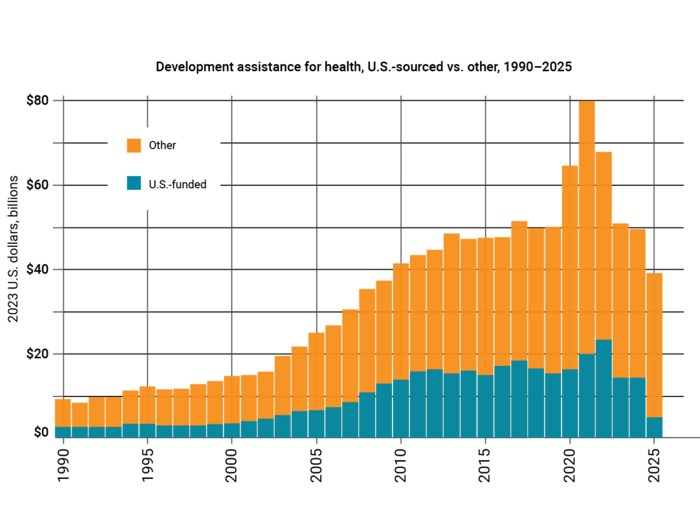
Global development assistance for health has significantly declined by more than $10 billion, with sharp cuts driven by the United States. This decline is likely to continue over the next five years.
Furthermore, climate change is fundamentally redefining the risk landscape. Rising temperatures, more frequent floods, intensifying storms, and shifting vector ranges for organisms like mosquitoes and ticks are disrupting food systems, displacing populations, and driving new patterns of disease transmission. Over the next 25 years in low- and middle-income countries, climate change could cause over 15 million excess deaths, and economic losses related to health risks from climate change could surpass $20.8 trillion (World Bank 2024). The cost of inaction has never been higher.
Meanwhile, deepening political polarization is amplifying conflict and weakening the global cooperation essential for scientific progress. The number of geopolitical disturbances worldwide is at an all-time high, displacing over 122 million people and eroding access to essential health services (UNHCR 2024). In 2023, false and conspiratorial health claims amassed over 4 billion views across digital platforms, compromising vaccine uptake and fueling health-related conspiracy theories. (Kisa and Kisa 2025). Furthermore, exponential technological advances in artificial intelligence are outpacing public health governance systems, creating new ethical and equity dilemmas. Global development assistance for health has significantly declined by more than $10 billion, with sharp cuts driven by the United States. This decline is likely to continue over the next five years (Institute for Health Metrics and Evaluation 2025).
Image
Note: Development assistance for health is measured in 2023 real US dollars; 2025 data are preliminary estimates.
Source: Institute for Health Metrics and Evaluation 2025.
Five Critical Reform Directions for Future-Proofing Global Health Systems
1. WHO matters more than ever — but only if it sharpens its focus.
The World Health Organization remains the technical backbone of global health, with a mandate to set norms and standards, shape research agendas, monitor health trends, coordinate emergency responses and regulation, and provide technical assistance. COVID-19 underscored both its indispensability and its limitations. During the pandemic, WHO convened states, disseminated guidance, and spearheaded initiatives like the Solidarity Trial and COVAX to promote vaccine equity, illustrating why it remains vital as the only neutral platform where 194 member states can cooperate on pandemics, antimicrobial resistance, or climate-related health risks. Its work on universal health coverage, the “triple burden” of disease, and global health data continues to anchor policy across countries.
At the same time, the crisis exposed structural weaknesses: WHO lacks enforcement authority, relies heavily on voluntary donor-driven funding, and sometimes stretches beyond its comparative strengths. When it shifts from convening and technical guidance into direct fund management, logistics, or large-scale program delivery, it risks diluting its mandate and eroding trust. Critics argue this reflects a broader challenge of an expansive mandate and donor-driven mission creep, pushing WHO beyond what 7,000 staff and a modest budget can realistically deliver. The way forward lies in sharpening focus: leveraging its convening power and legitimacy, providing technical expertise and evidence-based guidance, coordinating emergencies under the International Health Regulations, and advocating for equity in access to medicines and care. Anchored in these core strengths, a more agile WHO can better lead during crises, sustain credibility, and ensure that global health standards are consistently applied across diverse national contexts.
2. Animal Health as the Next Frontier
More than 70 percent of emerging infectious diseases are zoonotic in origin, with roughly three-quarters of newly detected pathogens in recent decades spilling over from animals into humans (WHO 2022; Jones, Patel, Levy, et al. 2008). The economic costs are staggering: the World Bank estimates that zoonotic outbreaks have cost the global economy over $120 billion between 1997 and 2009 through crises such as Nipah, SARS, H5N1, and H1N1 (World Bank 2012). The drivers of spillover are intensifying due to deforestation and land-use change, industrial livestock farming, wildlife trade, and climate change. These are further accelerating the emergence of novel pathogens.
However, the governance of animal health remains fragmented. While WHO, the Food and Agriculture Organization (FAO), and the World Organization for Animal Health (WOAH) each hold mandates, they often operate in silos. The Quadripartite, expanded in 2021 to include the United Nations Environment Programme, launched a One Health Joint Plan of Action (2022–26), but it remains underfunded and lacks strong political commitment.
There is an urgent need to move One Health from principle to practice. To fill this governance gap, the world should consider establishing an independent intergovernmental alliance for animal health with a clear mandate. This could strengthen global One Health response by augmenting joint surveillance, building veterinary workforce capacity, and integrating environmental data into early warning systems. Such an alliance should avoid creating new bureaucratic layers and instead leverage the Quadripartite as its operational backbone. Embedding One Health into national health strategies and cross-sectoral policies would enable animal, human, and environmental health systems to work in tandem and address risks at their source. Preventive investments are also very cost-effective; the World Bank estimates that annual One Health prevention investments of $10–11 billion could save multiple times that amount in avoided pandemic losses (World Bank 2012). Strengthening One Health is both a health and economic necessity.
COVID-19 revealed how vital procurement and financial management are to global health security [...] Reform must begin by making procurement agile, transparent, and equitable.
3. Agile Procurement: The Missing Link in Global Health Security
COVID-19 revealed how vital procurement and financial management are to global health security. A system built for routine procurement was suddenly called upon to handle crisis response on a worldwide scale, and it struggled to keep up. When vaccines became available, strict procedures, fragmented supply chains, and export restrictions meant access was uneven and often delayed. Developed countries’ advance purchase agreements stockpiled most of the supply, leaving many low- and middle-income countries waiting for doses. Within the UN system and its partners, overly complex procurement rules slowed the speed to market, and the lack of harmonized regulatory recognition caused further delays. As a result, those least able to handle shocks faced the longest waits and highest costs.
Reform must begin by making procurement agile, transparent, and equitable. Emergency playbooks should be pre-cleared to ensure that indemnity clauses and quality assurance requirements can be activated immediately when the next crisis arises. Regional pooled procurement mechanisms, like the Pan American Health Organization’s Revolving Fund or the African Union’s pooled initiatives, should be expanded to diversify supply sources and anchor distributed manufacturing. End-to-end e-procurement platforms would provide real-time shipment tracking, facility-level stock visibility, and open dashboards to strengthen accountability. Financial management must be integrated with procurement so that contingency funds, countercyclical reserves, and fast-disbursing credit lines can release resources in tandem with purchase orders. Together, these reforms would ensure that in future health emergencies, these procurement systems act as lifelines rather than bottlenecks.
4. Addressing the Health–Climate Nexus
Climate change poses severe health risks, disproportionately affecting women and vulnerable populations in developing countries through heatwaves, poor air quality, food and water insecurity, and the spread of infectious diseases. Climate-related disasters are increasing in frequency and severity worldwide, reshaping both economies and health systems. In 2022, there were 308 climate-related disasters worldwide, ranging from floods and storms to droughts and wildfires (ADRC 2022). These events generated an estimated $270 billion in overall economic losses, with only about $120 billion insured—underscoring the disproportionate burden on low- and middle-income countries where resilience and coverage remain limited (Munich Re 2023). Over the past two decades, Asia and the Pacific have consistently been the most disaster-prone regions, accounting for nearly 40% of all global events, but every continent is now affected, from prolonged droughts in Africa and mega storms in North America to record-breaking heatwaves in Europe (UNEP n.d.).
Meeting this challenge requires a dual agenda of adaptation and mitigation. Health systems must be made climate-resilient by hardening infrastructure against floods and storms, ensuring reliable, clean energy in clinics and hospitals, and building climate-informed surveillance and early-warning systems that can anticipate disease outbreaks linked to environmental change. Supply chains need redundancy and flexibility to withstand shocks, and frontline workers require training to manage climate-driven health crises. At the same time, health systems must rapidly decarbonize. This means greening procurement and supply chains, phasing out high-emission medical products like certain inhalers and anesthetic gases, upgrading buildings and transport fleets, and embedding sustainability into financing and governance. Momentum is growing. The 2023 G20 Summit in Delhi, supported by the Asian Development Bank (ADB), recognized the health–climate nexus as a global priority, and institutions such as WHO, the World Bank, and ADB have begun to advance this agenda. The next step is to translate commitments into operational change by embedding climate-health strategies into national health plans, financing frameworks, and cross-sectoral policies. Climate action, sustainability, and resilience need to be integrated into the foundation of health systems.
5. Mobilizing Innovative Financing
Strengthening health systems and preventing future pandemics will require massive financing, but global health funding is in decline. Innovative mechanisms to mobilize new resources are essential. This requires stronger engagement with finance ministries, development financing institutions, and the private sector to design models that attract and de-risk investment while enabling rapid disbursement during emergencies. International financing institutions (IFIs) need to unlock innovative financial pathways to amplify health investments. They need to deploy blended finance initiatives, public-private partnerships, guarantees, debt swaps, and outcome-based financing tools to mobilize private capital for health. Over the past few years, IFIs have committed billions in health-related financing worldwide. This has included landmark support for vaccine access facilities, delivery of hundreds of millions of COVID-19 vaccine doses, and mobilization of large-scale response packages that combine grants, loans, and technical assistance.
Embedding health into climate policies and climate resilience into health strategies will ensure that future systems are both sustainable and resilient to shocks.
There is a need to broaden the financing mandate beyond investing in universal health coverage and mobilize capital for emerging areas, including the climate-health nexus, mental health, nutrition, rapid urbanization, demographic shifts, digitization, and non-communicable diseases. By leveraging their balance sheets, IFIs can generate a multiplier effect in fund mobilization and attract new financing actors. Innovative instruments are already demonstrating potential. For example, the International Finance Facility for Immunisation (IFFIm), which issues “vaccine bonds” backed by donor pledges, has raised over $8 billion for Gavi immunization programs (IFFIm 2022; Moody’s 2024). Debt-for-health and debt-for-nature swaps have redirected debt service into social outcomes. For example, El Salvador’s 2019 Debt2Health agreement with Germany channeled approximately $11 million into strengthening its health system, while Seychelles’ debt-for-nature swap created SeyCCAT to finance marine conservation, yielding social and resilience co-benefits for coastal communities (Hu, Wang, Zhou, et al. 2024). Similarly, contingent financing facilities—such as the Innovative Finance Facility for Climate in Asia and the Pacific (IF-CAP) and the International Financing Facility for Education (IFFEd)—also hold significant potential for health (IFFEd n.d.; ADB n.d.). These examples demonstrate how contingent financing and swaps can expand fiscal space without exacerbating debt distress.
This can create a virtuous cycle of facilitating investments that create regional cooperation for sustainable and scalable impact. In this vein, the G20 Pandemic Fund is a beacon of catalytic multilateralism funding in a fragmented world. Launched in 2022 with over $2 billion pooled from governments, philanthropies, and multilaterals, it strengthens pandemic preparedness in low- and middle-income countries. Every $1 awarded from the Pandemic Fund has mobilized an estimated $7 in additional financing. The fund demonstrates that nations can still unite around shared threats, offering hope and a template for collective action on global challenges.
Equally important is the ability to deploy funds rapidly in emergencies. During the COVID-19 pandemic, reserve and countercyclical funds, used by countries such as Germany, the Netherlands, and Lithuania, along with the Multilateral Development Bank’s fast-track financing facilities with streamlined approval and disbursement processes, provided urgent and timely financing support (Sagan, Webb, Azzopardi-Muscat, et al. 2021; Lee and Aboneaaj 2021). These mechanisms should be institutionalized in national financial management systems as well as IFIs to ensure rapid funding disbursement in future health emergencies
Moving Forward
Delivering on this reform agenda requires more than technical fixes—it demands political will, sustained financing, and cross-sectoral collaboration. Member states must empower WHO to lead within its comparative strengths, while reinforcing One Health through stronger mandates and funding. Governments, IFIs, and the private sector should jointly design agile procurement and financing mechanisms that can be activated at speed during crises. Embedding health into climate policies and climate resilience into health strategies will ensure that future systems are both sustainable and resilient to shocks. Above all, reform efforts must be anchored in equity, so that the most vulnerable are protected first.
The opportunity before the global community is to reimagine health as the backbone of resilience and prosperity in the 21st century. A whole-of-systems approach is necessary to clarify mandates, integrate animal and environmental health, develop agile and fair procurement systems, embed climate action into health systems, and mobilize innovative financing. The steps taken in the next few years can lead to a more connected, cooperative, and future-ready global health architecture.
When the Storm Hit: How COVID Exposed China’s Flawed Fiscal System
A co-authored study by a team including Stanford political scientist Jean Oi traces how the Chinese central government’s shifting policies during the COVID pandemic exposed its fiscal fault lines and created a local government liquidity crisis.
Spending More, Gaining Less: Lowest-Income Koreans Derive the Least Value from Health Care Investment, New Research Reveals
Despite rising health care spending, adults in South Korea’s lowest-income quintile experience the smallest relative improvement in life expectancy and well-being, according to a new study. The co-authors, including Stanford health economist Karen Eggleston, call for the country’s health policy to prioritize both equity and value, and highlight lessons for other health systems.
Lab technician Martin Agunda tests a viral load sample from Ruth Gweyi, a mother living with HIV, in Kisumu, Kenya, where U.S. funding cuts to HIV programs strain local health services. | Michel Lunanga/Getty Images
This event is co-sponsored by the Korea Program and Taiwan Program at Shorenstein APARC.
For decades, Taiwan and South Korea have been celebrated as proof that strengthening the rule of law can move authoritarian regimes toward democracy. This talk challenges that view by revisiting the legal histories of Taiwan, South Korea, and China. It identifies two paradigms of rule-of-law promotion: the Cold War “state-first” approach and the post–Cold War “democracy-first” approach. Different in style but similar in outcome, both shared the same flaw: foreign legal aid often reinforced authoritarianism. Taiwan and South Korea’s democratization was not evidence of legal modernization theory, but an outlier. Law is a neutral infrastructural power, and future rule-of-law promotion must be recalibrated to prevent authoritarian capture.
Speaker:
Weitseng Chen teaches at the National University of Singapore, specializing in comparative studies of law, politics and economic development in Asia. His published books include Regime Type and Beyond: The Transformation of Police in Asia (CUP 2023), Authoritarian Legality in Asia (CUP 2019), The Beijing Consensus? How China Has Changed the Western Ideas of Law and Economic Development (CUP 2017), Property and Trust Law in Taiwan (Kluwer 2017), and Law and Economic Miracle: Interaction Between Taiwan’s Development and Economic Laws After WWII (in Chinese, 2000). Chen was a Hewlett Fellow at Stanford’s Center for Democracy, Development, and the Rule of Law, and practiced as a lawyer at Davis Polk & Wardwell. He was also a fellow of the Institute for Advanced Study in Berlin. Chen earned his JSD from Yale Law School.