-

Read a full event summary here

Agricultural crops are on the front lines of climate change. Can we expect increased food production in the context of global warming? Do our crops come pre-adapted to a climate not seen since the dawn of agriculture, or must we take bold measures to prepare agriculture for climate change? This talk will focus on the role that crop diversity must necessarily play in facilitating the adaptation of agricultural crops to new climates and environments. Genebanks, the “Doomsday Vault” near the North Pole, and possible new roles for plant breeders and farmers will be explored. 
 

Image
cary fowler 1

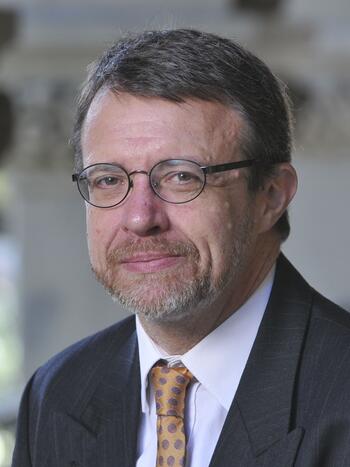
Dr. Cary Fowler is perhaps best known as the “father” of the Svalbard Global Seed Vault, which UN Secretary General Ban Ki-Moon has described as an “inspirational symbol of peace and food security for the entire humanity.” Dr. Fowler proposed creation of this Arctic facility to Norway and headed the international committee that developed the plan for its establishment by Norway. The Seed Vault provides ultimate security for more than 850,000 unique crop varieties, the raw material for all future plant breeding and crop improvement efforts. He currently chairs the International Council that oversees its operations.

In 2005 Dr. Fowler was chosen to lead the new Global Crop Diversity Trust, an international organization cosponsored by Food and Agriculture Organization of the UN (FAO) and the Consultative Group on International Agricultural Research (CGIAR). This position carried international diplomatic status. During his tenure, he built an endowment of $130 million and raised an additional $100 million (including the first major grant given for agriculture by the Gates Foundation) for programs to conserve crop diversity and make it available for plant breeding. The Trust organized a huge global project to rescue 90,000 threatened crop varieties in developing countries – the largest such effort in history - and is now engaged in an effort Dr. Fowler initiated with the Royal Botanic Gardens (Kew) to collect, conserve and pre-breed the wild relatives of 26 major crops. He oversaw development of a global information system to aid plant breeders and researchers find appropriate genetic materials from genebanks around the world. These initiatives at the Crop Trust, positioned the organization as a major path-breaking player in the global effort to adapt crops to climate change.

Prior to leading the Global Crop Diversity Trust, Dr. Fowler was Professor at the Norwegian University of Life Sciences in Ås Norway. He headed research and the Ph.D. program at the Department of International Environment and Development Studies and was a member of the university committee that allocated research funding to the different departments. 

The U.N.’s FAO recruited him in the 1990s to lead the team to produce the UN’s first global assessment of the State of the World’s Plant Genetic Resources. He was personally responsible for drafting and negotiating the first FAO Global Plan of Action on the Conservation and Sustainable Utilization of Plant Genetic Resources, formally adopted by 150 countries in 1996. Following this, Dr. Fowler served as Special Assistant to the Secretary General of the World Food Summit (twice) and represented the Consultative Group on International Agricultural Research (CGIAR/World Bank) in negotiations on the International Treaty on Plant Genetic Resources. He chaired a series of Nordic government sponsored informal meetings of 15 countries to facilitate negotiations for this treaty. And, he represented Norway on the Panel of Experts of the Convention on Biological Diversity.

Cary Fowler was born in 1949 and grew up in in Memphis, Tennessee, the son of a judge and a dietician. He studied at Simon Fraser University in Canada where he received a B.A. (honors – first class) degree. He earned his Ph.D. at Uppsala University in Sweden with a thesis on agricultural biodiversity and intellectual property rights. Dr. Fowler has lectured widely, been a visiting scholar at Stanford University and a visiting professor at the University of California – Davis. He is the author or co-author of more than 100 articles and several books including the classic Shattering: Food, Politics and the Loss of Genetic Diversity (University of Arizona Press), Unnatural Selection, Technology, Politics and Plant Evolution (Gordon & Breach Science Publishers) and The State of the World’s Plant Genetic Resources (UN-FAO).

Dr. Fowler currently serves on the boards of Rhodes College, the NY Botanical Garden Corporation, the Lillian Goldman Charitable Trust and Amy Goldman Charitable Trust. He remains associated with the Global Crop Diversity Trust as Special Advisor. He is a former member of the U.S. National Plant Genetic Resources Board (appointed by the Secretary of Agriculture) and former board and executive committee member of the International Maize and Wheat Improvement Center in Mexico. He has served as chair of the national Livestock Conservancy. He is the recipient of several awards: Right Livelihood Award, Vavilov Medal, the Heinz Award, Bette Midler’s Wind Beneath My Wings Award, the William Brown Award of the Missouri Botanical Garden and two honorary doctorates. He is one of two foreign elected members of the Russian Academy of Agricultural Sciences and is a member of the Russian Academy of Sciences. 


Dr. Cary Fowler Speaker Senior Advisor, Global Crop Diversity Trust
Symposiums
-

Anne Mills will speak about primary healthcare and the private sector in low- and middle-income Countries, drawing from her wide-ranging expertise and careful empirical evaluation of health policies in a range of countries in Asia, Africa, and other parts of the developing world. Linking themes of good health at low cost and equitable paths toward universal coverage, Professor Mills will argue how policymakers might best strengthen healthcare systems in the Asia-Pacific region, including the opportunities for health and efficiency improvements and the opportunity costs of continuing hospital-centric delivery systems. Professor Mill embodies a distinctive ability to combine broad thinking on the role of primary care with specific examples of how to harness the private sector toward public health objectives, an inter-linked theme the Asia Health Policy Program’s colloquium series and policy research. 

Image
mills anne office 094x4
Dame Anne Mills DCMGCBEFRS  Vice Director and Professor of Health Economics and Policy at the London School of Hygiene and Tropical Medicine. In 2014 she became a Fellow of the Royal Society and was made a Dame in the 2015 New Year's Honors. Her main research interests are: (1) issues concerned with the financing and organization of health care in low and middle income countries, including the impact on demand, utilization, equity and efficiency, and the private health sector; (2) the economics of tropical disease control; and (3) how to encourage the use of economic thinking and analysis in decision making. Professor Mills has been active in making economic evaluation techniques accessible to a non-specialist audience, as well as initiatives to build capacity in health economics. She chaired the Board of the Alliance for Health Policy and Systems Research, based in WHO; was a member of the Commission on Macroeconomics and Health; and co-chaired Working Group 1 of the High Level Taskforce on Innovative International Financing for Health Systems.  Dr. Mills was President of the International Health Economics Association for 2012-13, and is currently a Board member of Health Systems Global.

Philippines Conference Room

Encina Hall, 3rd Floor Central

616 Serra Street,

Stanford, CA 94305

Anne Mills Vice Director and Professor of Health Economics and Policy London School of Hygiene and Tropical Medicine
Seminars
News Type
News
Date
Paragraphs

Each year the Walter H. Shorenstein Asia-Pacific Research Center offers fellowship opportunities to recent graduates to further their research and engage with scholars at Stanford. Postdoctoral fellows have the opportunity to develop their dissertations for publication, present their research to the Stanford community, and participate in Center activities.

Fellows often go on to pursue teaching positions and advisory roles at top universities and research organizations around the world. Into the future, they remain engaged with the Center and continue to contribute to Shorenstein APARC publications, conferences and related activities.

Shorenstein APARC is pleased to welcome three postdoctoral fellows for the 2015-16 academic year:

Asia Health Policy Fellow

Image
darika profile
Darika Saingam

Saingam’s research interests are public health, substance abuse, drug policy and Southeast Asia. While at Shorenstein APARC, she will research the evolution of substance-abuse control measures and related policy in Thailand.

Saingam seeks to identify potentially effective policy directions suitable for Thailand, and other developing countries in Southeast and East Asia.

“There are a lot of lessons to be learned from substance abuse policy implementations in other countries…coping and dealing with substance abuse is a complex story and cannot respond successfully with only one strategy.”

Saingam completed her doctorate in epidemiology at the Prince of Songkla University in 2012, and has served as a researcher at the University’s epidemiology unit since, as well as a researcher at the Thailand Substance Abuse Academic Network since 2014.

Shorenstein APARC Postdoctoral Fellows

Image
chang profile
Booseung Chang

Chang’s research interests are comparative policy analysis and political institutions in East Asia, mainly South Korea and Japan. While at Shorenstein APARC, Chang will conduct research on how countries respond differently to the same external challenges, and how institutions are interpreted and applied in different ways.

His dissertation, which he seeks to build upon, is titled “The Sources of Japanese Conduct: Asymmetric Security Dependence, Role Conceptions, and the Reactive Behavior in response to U.S. Demands.” It is a qualitative comparative case study of how key U.S. allies in Asia – namely Japan and South Korea – and major powers in Europe - the United Kingdom and France responded to the U.S.-led Persian Gulf War and the Iraq War.

“East Asia is a treasure island of new theory building because some of the big challenges facing East Asia – finding a new role for Japan, denuclearization of North Korea, unification of the Korean peninsula, democratization of China and reconfiguration of its relations with the world, and development and integration of Southeast Asian countries – are truly new ones…”

Chang completed his doctorate in political science from the Paul H. Nitze School of Advanced International Studies at Johns Hopkins University in 2014.

Image
rnico profile
Nico Ravanilla

Ravanilla’s research interests are political economy and governance, comparative politics and Southeast Asia. While at Shorenstein APARC, Ravanilla will research how political selection impacts governance, and evaluate possible routes for incentivizing capable and virtuous citizens to run for public office.

His project titled “Nudging Good Politicians” looks at the case of the Sangguniang Kabataan, a governing body in the Philippines comprised of elected youth leaders. Ravanilla aims to apply his research to develop and scale up programs for politicians, especially those at the onset of their careers, which would include specialized leadership training and merit-based endorsement.

“If we could design a policy that screens-in and incentivizes competent and honest citizens to run for office, would it play a catalytic role in improving the quality of the political class, and ultimately, the quality of government?”

Ravanilla is also a Southeast Asia Research Group (SEAREG) Young Southeast Asia Fellow for 2015-16. He will complete his doctorate in political science and public policy from the University of Michigan in summer 2015.

Hero Image
hoover quad
View of Hoover Tower from Stanford's main quad.
Linda A. Cicero / Stanford News Service
All News button
1
-

Monday, May 4, 2015

4:30pm – 5:45pm Seminar
5:45pm - 6:15pm Reception


Image
mori ma
Masako Mori (Liberal Democratic Party) is in her second term as a member of House of Councillors of Japan’s Diet (roughly equivalent of U.S. Senate).  She represents Fukushima prefecture.  From December 2012 to September 2014, she served as Minister in charge of Support for Women's Empowerment and Child-Rearing, Minister of State for Consumer Affairs and Food Safety, Minister of State for Declining Birthrate and for Gender Equality in the Cabinet led by Prime Minister Shinzo Abe.  As a central policy maker in Abe Administration’s “womenomics,” she will discuss the progress on women’s empowerment in Japan and the road ahead.


Bechtel Conference Center
Encina Hall
616 Serra St., 1st floor
Stanford University
Stanford, CA 94305

Masako Mori Member of House of Councillors of Japan's Diet
Seminars
-

Abstract

In late January this year, the news that two Japanese hostages were killed by ISIL (Islamic State of Iraq and the Levant) sent a shock wave all over Japan.  This was not the first time that Japanese citizens were killed by international terrorists, but the length of time that Japanese general public were exposed to the unfolding event (12 days) sets this apart from the other incidences.  Some argue that this would mark a turning point for Japan's approach against political terrorism abroad. In the statement following confirmation of the killings, Prime Minister Shinzo Abe stated “We will never forgive the terrorists.  We will collaborate with the world community to make them pay the price.”  The Japanese public also started to pay more attention to the issue of international terrorism.  In the latest survey on defense issues and SDF (Self Defense Forces) conducted by the Japanese Cabinet, 42.6% of the respondents answered that they are concerned about activities by international terrorists, up from 30.3% three years ago.  We ask experts in the Freeman Spogli Institute for International Studies to discuss the future of international terrorism and Japan’s responses.


Speaker Bios

Martha Crenshaw - Senior Fellow at the Freeman Spogli Institue for International Studies; Professor, by courtesy, of Political Science at Stanford University

Takeo Hoshi - Henri H. and Tomoye Takahashi Senior Fellow in Japanese Studies at FSI; Professor, by courtesy, of Finance, Graduate School of Business and Director, Japan Program, Shorenstein APARC at Stanford University

Daniel Sneider - Associate Director for Research, Shorenstein APARC at Stanford University

Nobuhiro Watanabe - Deputy Consul General, Consulate General of Japan in San Francisco


Philippines Conference Room
Encina Hall
616 Serra St, 3rd floor
Stanford University
Stanford, CA 94305

0
Former Henri H. and Tomoye Takahashi Senior Fellow in Japanese Studies at the Freeman Spogli Institute for International Studies
Former Professor, by courtesy, of Finance at the Graduate School of Business
takeo_hoshi_2018.jpg PhD

Takeo Hoshi was Henri and Tomoye Takahashi Senior Fellow at the Freeman Spogli Institute for International Studies (FSI), Professor of Finance (by courtesy) at the Graduate School of Business, and Director of the Japan Program at the Shorenstein Asia-Pacific Research Center (APARC), all at Stanford University. He served in these roles until August 2019.

Before he joined Stanford in 2012, he was Pacific Economic Cooperation Professor in International Economic Relations at the Graduate School of International Relations and Pacific Studies (IR/PS) at University of California, San Diego (UCSD), where he conducted research and taught since 1988.

Hoshi is also Visiting Scholar at Federal Reserve Bank of San Francisco, Research Associate at the National Bureau of Economic Research (NBER) and at the Tokyo Center for Economic Research (TCER), and Senior Fellow at the Asian Bureau of Finance and Economic Research (ABFER). His main research interest includes corporate finance, banking, monetary policy and the Japanese economy.

He received 2015 Japanese Bankers Academic Research Promotion Foundation Award, 2011 Reischauer International Education Award of Japan Society of San Diego and Tijuana, 2006 Enjoji Jiro Memorial Prize of Nihon Keizai Shimbun-sha, and 2005 Japan Economic Association-Nakahara Prize.  His book titled Corporate Financing and Governance in Japan: The Road to the Future (MIT Press, 2001) co-authored with Anil Kashyap (Booth School of Business, University of Chicago) received the Nikkei Award for the Best Economics Books in 2002.  Other publications include “Will the U.S. and Europe Avoid a Lost Decade?  Lessons from Japan’s Post Crisis Experience” (Joint with Anil K Kashyap), IMF Economic Review, 2015, “Japan’s Financial Regulatory Responses to the Global Financial Crisis” (Joint with Kimie Harada, Masami Imai, Satoshi Koibuchi, and Ayako Yasuda), Journal of Financial Economic Policy, 2015, “Defying Gravity: Can Japanese sovereign debt continue to increase without a crisis?” (Joint with Takatoshi Ito) Economic Policy, 2014, “Will the U.S. Bank Recapitalization Succeed? Eight Lessons from Japan” (with Anil Kashyap), Journal of Financial Economics, 2010, and “Zombie Lending and Depressed Restructuring in Japan” (Joint with Ricardo Caballero and Anil Kashyap), American Economic Review, December 2008.

Hoshi received his B.A. in Social Sciences from the University of Tokyo in 1983, and a Ph.D. in Economics from the Massachusetts Institute of Technology in 1988.

Former Director of the Japan Program at the Shorenstein Asia-Pacific Research Center
CV

Stanford University
Encina Hall, Room E301
Stanford, CA 94305-6055

0
Lecturer in International Policy at the Ford Dorsey Master’s in International Policy
2011_Dan_Sneider_2_Web.jpg MA

Daniel C. Sneider is a lecturer in international policy at Stanford's Ford Dorsey Master’s in International Policy and a lecturer in East Asian Studies at Stanford. His own research is focused on current U.S. foreign and national security policy in Asia and on the foreign policy of Japan and Korea.  Since 2017, he has been based partly in Tokyo as a Visiting Researcher at the Canon Institute for Global Studies, where he is working on a diplomatic history of the creation and management of the U.S. security alliances with Japan and South Korea during the Cold War. Sneider contributes regularly to the leading Japanese publication Toyo Keizai as well as to the Nelson Report on Asia policy issues.

Sneider is the former Associate Director for Research at the Walter H. Shorenstein Asia-Pacific Research Center at Stanford. At Shorenstein APARC, Sneider directed the center’s Divided Memories and Reconciliation project, a comparative study of the formation of wartime historical memory in East Asia. He is the co-author of a book on wartime memory and elite opinion, Divergent Memories, from Stanford University Press. He is the co-editor, with Dr. Gi-Wook Shin, of Divided Memories: History Textbooks and the Wars in Asia, from Routledge and of Confronting Memories of World War II: European and Asian Legacies, from University of Washington Press.

Sneider was named a National Asia Research Fellow by the Woodrow Wilson International Center for Scholars and the National Bureau of Asian Research in 2010. He is the co-editor of Cross Currents: Regionalism and Nationalism in Northeast Asia, Shorenstein APARC, distributed by Brookings Institution Press, 2007; of First Drafts of Korea: The U.S. Media and Perceptions of the Last Cold War Frontier, 2009; as well as of Does South Asia Exist?: Prospects for Regional Integration, 2010. Sneider’s path-breaking study “The New Asianism: Japanese Foreign Policy under the Democratic Party of Japan” appeared in the July 2011 issue of Asia Policy. He has also contributed to other volumes, including “Strategic Abandonment: Alliance Relations in Northeast Asia in the Post-Iraq Era” in Towards Sustainable Economic and Security Relations in East Asia: U.S. and ROK Policy Options, Korea Economic Institute, 2008; “The History and Meaning of Denuclearization,” in William H. Overholt, editor, North Korea: Peace? Nuclear War?, Harvard Kennedy School of Government, 2019; and “Evolution or new Doctrine? Japanese security policy in the era of collective self-defense,” in James D.J. Brown and Jeff Kingston, eds, Japan’s Foreign Relations in Asia, Routledge, December 2017.

Sneider’s writings have appeared in many publications, including the Washington Post, the New York Times, Slate, Foreign Policy, the New Republic, National Review, the Far Eastern Economic Review, the Oriental Economist, Newsweek, Time, the International Herald Tribune, the Financial Times, and Yale Global. He is frequently cited in such publications.

Prior to coming to Stanford, Sneider was a long-time foreign correspondent. His twice-weekly column for the San Jose Mercury News looking at international issues and national security from a West Coast perspective was syndicated nationally on the Knight Ridder Tribune wire service. Previously, Sneider served as national/foreign editor of the Mercury News. From 1990 to 1994, he was the Moscow bureau chief of the Christian Science Monitor, covering the end of Soviet Communism and the collapse of the Soviet Union. From 1985 to 1990, he was Tokyo correspondent for the Monitor, covering Japan and Korea. Prior to that he was a correspondent in India, covering South and Southeast Asia. He also wrote widely on defense issues, including as a contributor and correspondent for Defense News, the national defense weekly.

Sneider has a BA in East Asian history from Columbia University and an MPA from the John F. Kennedy School of Government at Harvard University.

Nobuhiro Watanabe
Panel Discussions
-

Co sponsored by the Center on Democracy, Development, and the Rule of Law

In Hanoi on November 2, 2010, a member of the Vietnam Communist Party (VCP) stood before the National Assembly (VNA) and on live television called for a vote of confidence in the prime minister—a sitting member of the Politburo. The speech immediately gained national attention, and the delegate’s face graced the front page of at least one prominent state-run news media outlet. Considering the docility of other communist legislatures, such as China’s, is the VNA unique in its influence? If so, how did it acquire such prominence?

Prof. Schuler will challenge existing theories on legislative institutionalization under authoritarian rule that emphasize the co-optation of opposition groups and the stabilization of internal power-sharing arrangements. He will argue instead that legislative institutionalization in this case was designed to professionalize the legislature to generate a more coherent legal code. In doing so, rather than providing more routinized avenues for participation among existing political forces, as existing theories suggest, the institutionalization of the VNA empowered a new, and sometimes unpredictable, set of actors. In his talk he will also pursue this insight comparatively in relation to China among other authoritarian polities.

Paul Schuler will be an assistant professor in government and public policy at the University of Arizona starting this fall. His publications have appeared in the American Political Science Review, the Legislative Studies Quarterly, and the Journal of East Asian Studies among other places. His researches focuses on institutions, elite politics, and public opinion in authoritarian regimes, particularly Vietnam.  His 2014 PhD in political science is from the University of California, San Diego.


Philippines Conference Room

Encina Hall 3rd Floor Central

616 Serra Street,

Stanford, CA 94305

Paul Schuler 2014-2015 Shorenstein Postdoctoral Fellow in Contemporary Asia
Seminars
Authors
News Type
Commentary
Date
Paragraphs

The Walter H. Shorenstein Asia-Pacific Research Center honored Wall Street Journal reporter Jacob Schlesinger with the Shorenstein Journalism Award last Monday. Schlesinger received the award, which includes a $10,000 cash prize, for his work on Japan that spans nearly three decades.

Since 2002, the annual award has sought to recognize journalists who are outstanding in their field of reporting on the Asia-Pacific, and whose work has helped enhance Western understanding of the region. A jury selects the finalist, which alternates each year between an American and Asian journalist.

At an evening ceremony, Stanford professor Gi-Wook Shin presented Schlesinger with the award surrounded by supporters and friends including Michael Armacost and John Roos '77, (J.D. ‘80), two former U.S. ambassadors to Japan, who both came to know Schlesinger personally during their diplomatic posts.

Earlier in the day, Schlesinger delivered a keynote speech on Japan’s economy and the media. Stanford economist Takeo Hoshi and Shorenstein APARC associate director Daniel Sneider joined him on the panel, along with New York Times deputy executive editor Susan Chira.

Schlesinger was a visiting fellow at Shorenstein APARC at Stanford's Freeman Spogli Institute for International Studies. Under the advisory of then-Shorenstein APARC director Daniel Okimoto, he worked on a book manuscript at Stanford which became Shadow Shoguns: The Rise and Fall of Japan’s Postwar Political Machine.

“No foreign journalist has covered Japan longer, or understood its political economy more deeply, than Jacob M. Schlesinger…” Okimoto said in the award announcement.

Schlesinger is based at the Journal’s Tokyo bureau as Senior Asia Economics Correspondent and Central Banks Editors, Asia, and tweets with the handle @JMSchles.

He answered a few questions for Shorenstein APARC about Japan’s political and economic climate, as well as the changing face of media there.

Image

Schlesinger spoke on a panel with Stanford's Daniel Sneider and Takeo Hoshi, and The New York Times's Susan Chira, followed by a private evening reception.

You’ve covered Japan for the Wall Street Journal for nearly a decade on the ground, in the late 1980s and early 90s and again since 2009. What has changed, or remained the same?

When I first covered Japan in the late ‘80s and early ‘90s, there was huge interest in -- and also a fair amount of mistrust and hostility toward -- Japan. Americans feared that Japan’s economy was going to somehow “defeat” ours (though I don’t think that notion ever really made sense), and constantly accused Japan of unfairly taking advantage of the global free trade system, exporting heavily to us while keeping its market closed to our goods.

After the bubble burst, and, more recently, Japan’s trade surplus disappeared, the anger toward Japan dissipated. But so, in some ways, did the interest. There are far fewer foreign correspondents today in Japan than there were when I was first there 25 years ago.

I think that the rise of Prime Minister of Japan Shinzo Abe, and Abenomics, has revived interest in Japan a bit, but in different ways. People want to know if Japan will rebound, in part as a counterweight to China, which has really surged in economic and political influence in the time since I was last in Japan. That perhaps may be one of the biggest changes -- the fact that so much is now seen through the prism of China. For a time China simply overshadowed Japan but now it has actually, in some ways, revived interest in it. 

What are the greatest challenges you’ve found in explaining the state of the Japanese economy and U.S.-Japan relations?

As I say, one challenge has been in getting people interested, and in explaining to them why it matters. China in particular has become such a big story that Americans sometimes lose sight of Japan's significance as well.

Another challenge is that Japan is a country where change, even big change, often happens in slow, subtle, steady steps. Japanese rhetoric tends to downplay the dramatic and to cast things in indirect terms, which can make it harder to describe statements and developments in ways that are accurate, and will seem interesting to readers.

Can you describe Abenomics and its current status?

Abenomics is Prime Minister Abe's program to try and end Japan's long slump, sometimes branded the “lost decades.” The most concrete and effective action to date has been a much more aggressive policy of monetary stimulus, following Abe's shake-up at the Bank of Japan (the nation’s central bank), where he imposed new leadership. That might be able to lift short-term growth. But Abe’s ambition to raise Japanese growth over the long-run – to a pace near that enjoyed by the United States and other advanced economies – requires extensive structural reforms. Abe has talked a lot about implementing such reforms, but has so far been rather timid in what he has proposed and pursued.

Abenomics also hit a deep pothole in 2014, when Abe decided to proceed with a plan to raise the sales tax, a policy aimed at reducing Japan’s very large outstanding government debt. The depressing impact of the tax basically offset the gains from the Bank of Japan’s stimulus, and Japan last year fell into recession.

It now appears that Japan is slowly pulling out of the recession, and, to ensure that his stimulus polices now work at full force, Abe has delayed plans for a second tax hike that had been scheduled for this year. That may set back long-held goals to reduce government debt, but it should help the chief Abenomics goal of exiting the long deflationary slump.

I'd say overall that Abenomics has a decent chance of lifting Japanese growth a bit higher than it would otherwise have been, but that a dramatic change in Japan’s fortunes would probably require a more dramatic change in policies, something Abe has promised but hasn’t really shown signs of seriously pursuing.

Recently, the United States invited Prime Minister Abe for a state visit (in addition to leaders of other Asian nations). What issues would likely top the agenda?

Both countries are hoping, overall, that the visit will deepen ties between the two governments at a time of great change and challenge in Asia. Whatever one might think of Prime Minister Abe and his agenda, this visit does offer a special opportunity to expand relations, simply because he has now been in office long enough to make multiple trips to Washington as prime minister -- a rare feat over the past quarter century of Japan's notorious carousel politics. The Japanese government is eager for Abe to be able to address a session of the U.S. Congress, which could carry great symbolic significance. He would be the first Japanese leader to do so in more than half a century, since Prime Minister Hayato Ikeda in the early 1960s. That's a pretty long gap, when you consider that Japan has, over that period, long been hailed as one of America's most important allies.

In terms of specific issues, the chief economic agenda item is the Trans-Pacific Partnership free trade pact. It's an ambitious project attempting to set the economic rules for the Pacific economies for the 21st century. And while 12 countries are included, the United States and Japan are by far the biggest, and both sides are hoping that a bilateral agreement by the time Abe meets President Obama could give the broader deal sufficient momentum to be concluded this year.

On the military front, the United States and Japan are updating the terms of their mutual defense pact and hope to do so in ways that will give Japan's military more latitude to participate in joint operations.

While not part of the official agenda, Americans will be eager to hear what Abe has to say about history issues as the world marks the 70th anniversary of the end of World War II.

Abe and his aides have repeatedly challenged some of the established views of Japan and its behavior during the war, including recently directly asking the American publisher McGraw-Hill to change its account of so-called “comfort women,” women forced into prostitution under Japan's war-time military. Such statements and actions have irritated many Americans and stoked anger in China and South Korea. American officials in particular are concerned about deteriorating relations between Japan and South Korea -- the two principle U.S. military allies in Asia -- and are eager for Abe to try and do more to bridge the gap, particularly on history issues. 

Newspapers have played a large role in Japanese society; the nation boasts one of the highest readerships in the world. Where do you see the future of news media in Japan?

Japan, as you say, has one of the most -- perhaps the most -- literate and well-informed populations in the world. News readership and news viewership is extremely high. People are extremely knowledgeable about current events.

Oddly, for a country that is also very tech literate, digital media has been relatively slow to catch on in Japan. Most people still get their main news from print papers, or magazines, and there has not been -- at least not yet -- a real surge in new, credible online-only, or online-originated media sources to challenge the mainstream media, the way platforms like Politico, the Huffington Post, or BuzzFeed have popped up in the United States.

The Japanese media has also suffered from some serious setbacks to its credibility in recent years. There was tremendous soul-searching after the 2011 Fukushima nuclear disaster about whether the Japanese press had done enough, either before the accident, or in the immediate aftermath, to cover aggressively the flaws and mistakes in the country's nuclear energy policies.

More recently, over the past year there have been damaging battles, in varying degrees, over the accuracy, and independence, of three of the country's largest, and most-respected news organizations, the Asahi Shimbun newspaper, the Yomiuri Shimbun newspaper, and the NHK national broadcaster. I worry that the result, fair or not, could prompt further erosion in the credibility of the Japanese media. That's potentially a big problem at a time of great change, great political and policy debate -- and when the political opposition is so weak that the media arguably has a heightened role at this moment as a check on power.

You were a visiting scholar at Shorenstein APARC. How did your time at the Center impact your work?

The Center was a tremendous opportunity for me in so many ways. It is rare for a journalist to be able to break out of the steady deadline pressures of a newsroom, and soak up an academic atmosphere. Being at Shorenstein APARC was a fantastic way to do that. It offered the best elements of an ivory tower, without feeling isolated. It gave me chances to interact with policymakers there as visiting fellows, as well as some of the top experts in the field who were based there.

I have to give particular thanks to Dan Okimoto, who ran Shorenstein APARC at the time and Jim Raphael, who was director of research. When I was at Shorenstein APARC, I was researching and writing a book on Japanese politics. The feedback from Dan, Jim and others made it a much better work. But beyond the book, the depth and perspective that I gained from my immersion at Shorenstein APARC has helped shape my writing since then.

Hero Image
award shot
Stanford professor Gi-Wook Shin (Right) presented the 2014 Shorenstein Journalism Award to Wall Street Journal reporter Jacob Schlesinger (Left).
Rod Searcey
All News button
1
Date Label
Paragraphs

"North Korean Human Rights: A Long Journey with Little Progress" examines human rights in the Democratic People's Republic of Korea (DPRK, or North Korea) and the approaches that the European Union has taken to address the situation. In this paper, Mike Cowin provides perspective on EU-DPRK engagement; the two sides officially established diplomatic relations in May 2001. The EU and its members have continued to raise the human rights issue during bilateral meetings. But, North Korea says it will continue to refuse dialogue if the EU continues to sponsor resolutions against North Korea at the UN Human Rights Commission/Council. The EU has rejected this as a precondition. "The EU has had no incentive or justifiable reason to take the initiative to break out of this chicken-and-egg dilemma...The DPRK has also maintained its position. The gap between the two sides has therefore widened," he writes. Cowin suggests the EU could take additional steps to restart EU-DPRK engagement.

Mike Cowin is the 2014-15 Pantech Fellow in the Korea Program at the Walter H. Shorenstein Asia-Pacific Research Center. Before coming to Stanford, he served as the deputy head of mission at the British Embassy in Pyongyang, North Korea. He has also served in the British embassies in Seoul from 2003 to 2007, and in Tokyo from 1992 to 1997.

All Publications button
1
Publication Type
Policy Briefs
Publication Date
Journal Publisher
Shorenstein Asia-Pacific Research Center
Authors
Mike Cowin
Subscribe to Asia-Pacific