When Shibani Mahtani reopened the Washington Post’s Southeast Asia and Hong Kong bureau in 2018, the paper was in the middle of a major expansion of its foreign coverage, adding correspondents and reestablishing reporting hubs from Seoul to London. She later served as The Post’s international investigative correspondent with a broad mandate across the Asia-Pacific region, reflecting the paper’s commitment to deep, accountability-driven journalism outside of the United States. Since then, however, The Post has shuttered its foreign desk as part of sweeping newsroom layoffs in February 2026. “There is no China bureau, no India bureau, no Southeast Asia bureau,” says Mahtani, winner of the 2026 Shorenstein Journalism Award for excellence in Asia coverage.
Speaking at the October 20 award ceremony, Mahtani, whose role was cut in the layoffs, acknowledged the irony of being honored largely for work at an outlet that has since withdrawn from the region. But in her keynote, titled “What’s Your Agenda?”: Attacks Against the Free Press and Democratic Backsliding in Southeast Asia,” she drew attention to what she called “a more sobering story” of an embattled media environment across Asia, and of what the world loses as a result.
The waning commitment to foreign reporting by outlets like The Post occurs as governments across Asia are increasingly weaponizing their laws against the media – with local news media in places like Hong Kong, Cambodia, Myanmar, and Singapore battered by sustained attacks against the free press – and as funding for independent, nonprofit outlets in the region is drying up following the closure of the U.S. Agency for International Development.
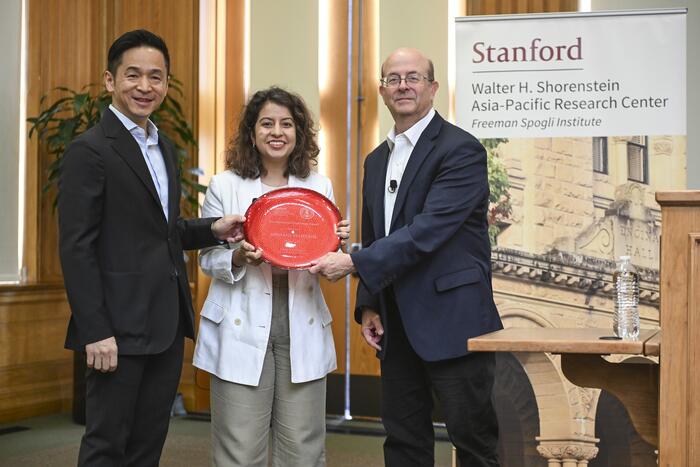
APARC Director Kiyoteru Tsutsui (left) and Stanford Vice Provost for Undergraduate Education James Hamilton, Hearst Professor of Communication and director of the Journalism Program, present Shibani Mahtani with the 2026 Shorenstein Journalism Award. | Photo credit: Rod Searcey.
Sign up for APARC newsletters to receive insights and analysis from our experts and guest speakers >
Accountability-Driven Investigations Across Asia
The Shorenstein Journalism Award, which carries a $10,000 prize, recognizes outstanding journalists and news outlets who have contributed to a greater understanding of Asia. Sponsored by APARC, it commemorates the legacy of the late Walter H. Shorenstein, the center's benefactor, by honoring two causes he cared about: promoting journalism at its best and an informed understanding of Asia.
In his welcome remarks, APARC Director Kiyoteru Tsutsui noted that this year’s ceremony marks the 25th anniversary of the Shorenstein Award. “With each new honoree, APARC is proud to carry Walter’s legacy forward and affirm our support for independent, nuanced, fact-based journalism. This commitment is critical as trust in the news media plummets and as the truth, and those who report it, are under attack.”
The 2026 Shorenstein Award honors Mahtani for her original, powerful accountability-driven reporting across the region, particularly Southeast Asia. As he introduced her, James Hamilton, Stanford vice provost for undergraduate education, the director of the Journalism Program, and a member of the Shorenstein Award judging committee, cited her chronicling of Beijing’s crackdown on Hong Kong; exposés on China’s quest to reshape Asia in its image; reporting on transnational repression; and investigations into the rise of organized crime syndicates connected to state actors. As the award judging committee put it, Mahtani “has broken stories that others would not or could not report.”
Following her keynote, Hamilton moderated a discussion with panelists Anna Fifield, a New Zealand journalist and foreign affairs analyst, former Asia-Pacific editor at the Washington Post, recipient of the 2018 Shorenstein Journalism Award, and a member of the award judging committee, and Oren Samet, an assistant professor of political science at Rice University and a former postdoctoral fellow at Stanford’s Center on Democracy, Development and the Rule of Law.
A Beleaguered Free Press and Untold Stories
Mahtani began her career in 2011 as a Southeast Asia correspondent for the Wall Street Jouranl at a time of optimism about the region and its free press. In Myanmar, amid democratic opening, exiled outlets returned home. In Hong Kong, platforms like Apple Daily and Stand News made it “one of the most fearless press environments anywhere in Asia.”
Today, none of those outlets exist in the same form. “They've either been forced into closure by authoritarian governments, or pushed back into exile after a string of defamation suits,” Mahtani said. The Online Citizen, an independent news platform focused on public interest reporting, has been forced out of Singapore and now operates from Taiwan. Most recently, two Singapore ministers won a defamation case against Bloomberg News, sending a chill across the media industry operating there.