Demographics
Authors
News Type
News
Date
Paragraphs

Motivation


Political parties have long reflected  dividing lines between groups in a society, often called political ‘cleavages’. Examples include workers vs. business owners, Protestants vs. Catholics, and urban vs. rural constituents. Civil society organizations (CSOs) — such as unions, churches, and chambers of commerce — have historically shaped the content and strength of these cleavages.

However, both CSOs and cleavages have changed in recent decades. For one, traditional cleavages have declined in importance, and new divides have emerged, such as between the so-called winners and losers of globalization or between those on one side or the other of the culture wars. In addition, formal CSOs have seen declining membership and reduced political influence, while informal groups and more episodic activism have grown. While CSOs and political parties used to have highly formalized relationships, they now tend to engage with each other more opportunistically and sometimes antagonistically. It seems clear that CSOs continue to influence political cleavages — both old and new — in the 21st century. But how exactly does this occur?

Contribution


In “Cleavage Theory Meets Civil Society,” Alex Mierke-Zatwarnicki, Endre Borbáth, and Swen Hutter examine the varied historical and contemporary relationships between CSOs, cleavages, and political parties in Western Europe. The authors develop a general framework for understanding the relationship between CSOs and cleavage development, providing insights into how contemporary politics reflects long-term changes in the structure of civil society. 

The paper is set against social science research on cleavages, which can be divided into two broad streams. First, classical scholarship emphasized the importance of early 20th-century mass associations, such as unions, in shaping cleavages and party politics. By contrast, newer work, written against the backdrop of a changing CSO landscape, has viewed CSOs as largely irrelevant, arguing that opposition parties shape cleavages via direct interactions with voters. Neither body of previous work provides a compelling framework for understanding how contemporary CSOs — given their fragmentation, informationalization, and politicization -- matter for cleavages.

The authors also shed light on the phenomenon of polarization, which is a key part of democratic backsliding. Indeed, electorates are polarized around several cleavages — economic, religious, and cultural — that populist leaders have used to justify excluding their opponents from politics, portraying them as existential threats to a specific way of life.

Processes and Mechanisms


The authors suggest that cleavage development can be seen as the culmination of three processes, which CSOs may influence in key ways. The first is “group formation,” which concerns how individuals come to identify as workers, congregants, or otherwise. The second process is “political institutionalization,” which entails cleavages being embodied in party competition. The third is “political stabilization,” whereby cleavages are reinforced over time by parties.


Stage of cleavage developmentImportance of political linkageImportance of social closure
I. Group formationLowHigh
II. Political institutionalisationHighMedium
III. Electoral stabilisationHighHigh


Table 1. Role of civil society across stages of cleavage development.


To understand how CSOs might shape these three processes, the authors outline two mechanisms. The first is “linkage,” whereby CSOs communicate group demands and pressure political parties to represent them. Linkage is hypothesized to be more important during the latter processes of institutionalization and stabilization; it was historically important in group formation but less so today because of the aforementioned decline of formal CSOs.

The second mechanism is “social closure,” which concerns how group boundaries are solidified. CSOs are hypothesized to contribute to social closure by bringing group members together and organizing them around shared demands, increasing their sense of ingroup identification. This mechanism is important for group formation as well as  political stabilization.

CSOs still appear to facilitate linkage and social closure, albeit in different ways than in the early 20th century. For example, CSOs are less likely to have formal links to parties but continue to exert pressure by organizing around individual issues, candidates, and elections. Voters’ relationships to CSOs are also more varied, creating divisions within the electorate between highly-active individuals who have a strong sense of group identity and people who are less ‘anchored’ to the cleavage. The authors also hypothesize that some of these dynamics may produce asymmetric changes across the left and right, as the strength and tactics of CSOs vary.


Trend in civil societyImplications for political linkageImplications for social closure
FragmentationCivil society groups have less capacity to present unified demands to parties and are more likely to compete for influence and adherents. Groups that persist are likely to be highly mobilised and ideologically distinct, exerting targeted pressure on priority issues and succeeding when they find points of cross-organisational consensus.Groups and identities likely to be more heterogeneous; individuals tend to form multiple, competing group attachments which vary over time in their personal salience. Likely to produce pockets of high social closure amongst ‘untethered’ masses.
InformalizationCivil society organisations less likely to have ongoing formal relationships with parties; influence comes through mobilisation in moments of political crisis or indecision.Interactions between group members become less frequent and more spontaneous, reducing social closure for most people while increasing it amongst committed adherents.
PoliticisationLandscape of civil society organisations is more differentiated and issue-specific, with groups pursuing alternate (and occasionally competing) linkage strategies; pressure on parties comes from different sources during different periods of mobilisation and is most effective in moments of coordination.Salience of voters’ group identities changes across different moments, depending on how parties and civil society groups invoke them. ‘Groupishness’ of the population as a whole may become very high in particular critical moments.
Overall effectMove towards more volatile forms of linkage, operating through punctuated equilibrium moments of mobilisation and contestation rather than stable formal ties.Proliferation of multiple identities leads social closure to bifurcate; ‘tight’, mobilised groups coexist alongside heterogeneous masses who become sporadically activated.
 Combination of the three trends widens the number and types of civil society actors that intervene in processes of political linkage, leading different groups to exert influence at different times and ‘successful’ pressure to hinge on effective cross-group coordination.Combination of the three trends simultaneously widens and blurs possibilities for participation, leading to a growing gap between people who are activated consistently and those whose group identification is more fluid and context-dependent.


Table 2. Implications of the changing structure of civil society.


Cross-National and Case Study Evidence


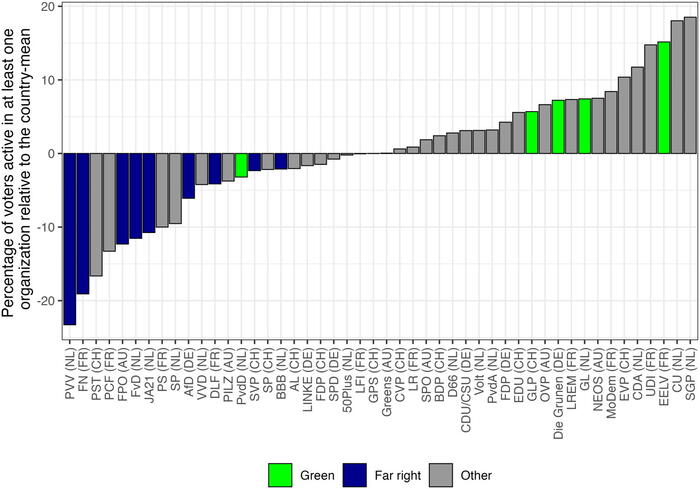
The authors then analyze cross-national data on political parties and voters in Austria, France, Germany, the Netherlands, and Switzerland. One data source concerns the extent to which political parties are tied to CSOs and whether they receive large-scale CSO donations. A second source looks at whether party supporters are active in CSOs. Preliminary findings point to important differences between old, class-based parties (especially Social Democrats) and newer parties, with the latter much less tied to CSOs. However, within the new party families, Green parties are more tightly linked to CSOs than far-right parties, but there also exists variation within far-right parties. These patterns demand a more fine-grained analysis of specific cases.


Image
Figure 2. Members of civil society organizations among the electorate of political parties in Austria, France, Germany, the Netherlands, and Switzerland.


Figure 2. Members of civil society organizations among the electorate of political parties in Austria, France, Germany, the Netherlands, and Switzerland.

Note: The figure is based on the Joint EVS/WVS 2017-2022 Dataset (2022). It uses the battery of membership in organizations and partisanship questions. In the WVS, partisanship is measured with ‘Which party would you vote for?’; in the EVS, with ‘Which political party appeals to you most?’ For this figure, the two items are treated as functional equivalents. The percentage of members is calculated from all respondents indicating sympathy towards the respective party.


Finally, the authors qualitatively analyze three distinct cases: one New Left party and both old and new far-right populist parties — the German Green Party, the Swiss People’s Party (SVP), and the Alternative for Germany (AfD). Their analysis reveals key differences as regards the importance of CSOs in fostering linkage and social closure. CSOs played a key role in consolidating the Greens and SVP, whereas in the case of AfD, antipathy from German CSOs helped generate a more outsider identity.

The Greens emerged via linkages with left-libertarian social movements in the 1970s and 80s. This included groups supportive of environmental protection and feminism and opposed to nuclear proliferation. CSOs provided ideas and personnel, which helped build a sense of social closure among party supporters. This identity still persists in spite of the subsequent fragmentation of civil society.

By contrast, SVP emerged through connections to Swiss farmers' associations, rural economic networks, and local interest groups. SVP has been radicalizing since the 1990s, becoming one of Europe’s most successful far-right parties and aligning itself with Euroscepticism. SVP’s long history of rural and community penetration has helped strengthen social closure among its electorate.

Finally, AfD emerged in a more fragmented context, via its ties to right-wing protest networks. The party was a top-down vehicle that organized in response to what it saw as Germany’s mismanagement of the Eurozone crisis. AfD lacks dense connections to CSOs and has instead built informal and often volatile alliances with protesters. Many German CSOs — as well as German society more generally — explicitly oppose AfD, which has ironically helped AfD build an outsider identity because its supporters feel isolated and stigmatized.

The case studies vividly illustrate how varied CSO relationships shape cleavages and partisanship in three of the most important Western European parties.

*Research-in-Brief prepared by Adam Fefer.

Hero Image
Brown and white concrete building under white clouds during daytime Sorin Gheorghita
All News button
1
Subtitle

CDDRL Research-in-Brief [4-minute read]

Date Label
0
Korea Program Postdoctoral Fellow, 2025-2027
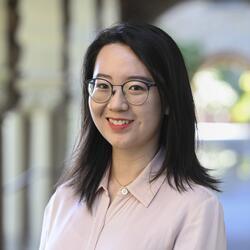
minyoung_an.jpg PhD

Minyoung An joins the Walter H. Shorenstein Asia-Pacific Research Center (APARC) as Korea Program Postdoctoral Fellow beginning July 2025 through 2027. She recently obtained her doctorate in Sociology from the University of Arizona. Her research lies at the intersection of gender, transnational migration, and knowledge production, combining statistical modeling, computational methods, and in-depth interviews.

Her dissertation analyzes gendered migration patterns in South Korea and among international PhD students in the U.S., revealing how gender inequality in countries of origin produces distinct selection effects and return migration dynamics. She also studies academic career trajectories and prestige hierarchies, exploring how gender and national origin affect integration into global academia.

At APARC, she will be involved with the Korea Program and the Stanford Next Asia Policy Lab (SNAPL) as she pursues two projects that extend this research agenda: one using computational analysis of social media data to examine gendered migration intent, and another investigating the academic trajectories and institutional reception of international scholars from East Asia. Through these projects, she aims to advance understanding of how transnational inequalities shape global mobility, opportunity, and inclusion.

Date Label
Paragraphs

Abstract


Cover of the Journal of the Economics of Aging

Korea’s labor force shift toward older, female, and more educated workers has been even more dramatic than that of the United States in recent decades. This paper documents how Korean job characteristics vary by age and characterizes the “age-friendliness” of Korean employment from 2000 to 2020 by applying the Age-Friendliness Index (AFI) developed by Acemoglu, Mühlbach, and Scott to Korean occupational data. The AFI measures job characteristics—such as physical demands and job autonomy—based on occupational descriptions and worker preferences. Our primary empirical findings are that the age-friendliness of Korean jobs grew more slowly than in the United States, and that older Koreans were not the main beneficiaries of these jobs. Both findings reflect the demographic, labor market, and institutional differences between Korea and the United States. The slow growth of AFI can be partially explained by labor market rigidities, the role of large firms in Korea, and the flattening of managerial structures.

All Publications button
1
Publication Type
Journal Articles
Publication Date
Journal Publisher
Journal of the Economics of Ageing
Authors
Karen Eggleston
Authors
Soraya Johnson
News Type
News
Date
Paragraphs

Democracies face the challenge of requiring competent yet representative leaders in order to effectively embody the will of the people. More than a hundred countries have electoral quotas for women and minorities to ensure representation; however, such efforts are being threatened globally under the guise of critiques alleging that quotas undermine meritocracy and candidate quality. 

To assess this assumption, Stanford Assistant Professor of Political Science Soledad Prillaman examined in a CDDRL research seminar the relationship between candidate quality and electoral affirmative action. Her co-authored study relies on data from India, where the largest of such policies is enacted, and local Gram Panchayat positions are proportionally reserved for women and lower caste individuals on a rotating basis. Using population, census, and survey data, Prillaman compared the quality of politicians by looking at their level of education and their relative education performance. 

Her findings reveal that politicians in general are positively selected, meaning that they are much better educated than the constituents they serve. While quota-elected politicians had lower average education levels than non-quota politicians, they were more positively selected — they were drawn from a higher tail of their group’s education distribution. This means that quota politicians are relatively better educated than non-quota politicians, suggesting that they are of no worse quality and maybe even higher quality.

To further bolster this claim — that quota politicians may be of higher quality than non-quota politicians — Prillaman shows that voters hold quota politicians to a higher education standard than non-quota politicians and that the lower levels of average education are largely due to inequality in access to education. 

The evidence provides little justification for the assumption that electoral quotas undermine meritocracy. Instead, inequality of opportunity underlies differences in levels of education, and overall quality can be higher because voters tend to hold minority candidates to higher standards. As affirmative action policies are under challenge across the globe, it is critical to remember that improving minority representation in our democratic systems does not require sacrificing candidate quality.

Read More

Francis Fukuyama presented his research in a CDDRL seminar on April 3, 2025.
News

Rethinking Bureaucracy: Delegation and State Capacity in the Modern Era

Francis Fukuyama traces how scholars and policymakers have grappled with the tension between empowering bureaucracies to act effectively and ensuring they remain accountable to political leaders.
Rethinking Bureaucracy: Delegation and State Capacity in the Modern Era
Michael Albertus presented his research in a CDDRL seminar on March 6, 2025.
News

How Land Shapes the Fate of Societies

Tracing land’s role as a source of power, University of Chicago Professor of Political Science Michael Albertus analyzed how its distribution affects governance, social stratification, and conflict.
How Land Shapes the Fate of Societies
Juliet Johnson presented her research in a REDS Seminar, co-hosted by CDDRL and TEC, on February 27, 2025.
News

Show Me the Money: Central Bank Museums and Public Trust in Monetary Governance

Juliet Johnson, Professor of Political Science at McGill University, explores how central banks build public trust through museums.
Show Me the Money: Central Bank Museums and Public Trust in Monetary Governance
Hero Image
Soledad Artiz Prillaman presented her research in a CDDRL seminar on April 10, 2025.
Soraya Johnson
All News button
1
Subtitle

In the wake of widespread challenges to affirmative action policy, Stanford Political Scientist Soledad Artiz Prillaman’s research challenges the notion that electoral quotas for minority representation weaken candidate quality.

Date Label
-
Event Flyer for Hyungjoon Park talk

The share of the South Korean population living alone has substantially increased over the last four decades, sparking public concerns about loneness and its broader effects on individuals and society. In this talk Dr. Hyunjoon Park analyzes trends in living alone in Korea from 1980 to 2020. Analyses show a divergence in solo living between those with more and less education in both younger and older age groups but in oppositive directions. Among young men and women aged 25-34, those with a bachelor’s degree or higher are increasingly more likely to live alone than their peers with a high school education or less. In contrast, among older adults aged 65-74, individuals with the lowest level of education are increasingly more likely to live alone. Dr. Park discusses the implications of solo living trends for family dynamics and inequality in Korea.

Hyunjoon Park's headshot

Hyunjoon Park is Korea Foundation Professor of Sociology and Director of the James Joo-Jin Kim Center for Korean Studies at the University of Pennsylvania. Park is interested in family and social stratification in cross-national comparative perspective, focusing on South Korea and other East Asian societies. He has studied changes in marriage, divorce, and living arrangements as well as consequences of demographic and economic trends for education, well-being, and socioeconomic outcomes of children, adolescents, and young adults in Korea. He was the director of the Korean Millennials Research Lab, a multiyear and multidisciplinary project team tasked with investigating the transition to adulthood among young adults in South Korea and Korean Americans in the US. His publications include the single-authored book Re-Evaluating Education in Japan and Korea: De-mystifying Stereotypes (Routledge, 2013); the coauthored book Diversity and the Transition to Adulthood in America (University of California Press, 2022), and the coedited volume Korean Families Yesterday and Today (University of Michigan Press, 2020). 

Directions and Parking > 

Philippines Conference Room (C330)
Encina Hall, 3rd Floor
616 Jane Stanford Way, Stanford, CA 94305

Hyunjoon Park, Korea Foundation Professor of Sociology, University of Pennsylvania
Seminars
Date Label
-
Flyer for the conference "Taiwan Forward." Image: aerial view of Taipei.

We have reached capacity for this event and registration has closed.


Organized by the Taiwan Program at Stanford University’s Walter H. Shorenstein Asia-Pacific Research Center (APARC)
Co-sponsored by National Taiwan University's Office of International Affairs

As Taiwan looks to develop comprehensive strategies to promote national interests, it faces challenges shared by other advanced economies. How can Taiwan leverage AI innovation and its semiconductor prowess to drive resilience and continued growth while promoting entrepreneurship and forging advantages in emerging industries? What regulatory and policy measures are needed to scale Taiwan’s role as a global leader in biomedical and healthcare advancements while ensuring patient trust and safety? How can it address the gaps posed by rapid family changes and population aging? And how do its historical and linguistic legacies shape present narratives and identities, within Taiwan and among the Taiwanese diaspora?

Join us for a conference that explores these questions and more, featuring panel discussions with scholars from Stanford University, National Taiwan University, and other universities in Taiwan, Japan, Korea, and Singapore, alongside Taiwanese industry leaders. We will examine Taiwan’s strategies for navigating modernization in a shifting global landscape — bridging technology, industry, culture, and society through interdisciplinary and comparative perspectives.


8:45 - 9:10 a.m.
Opening Session

Welcome Remarks

Shih-Torng Ding
Executive Vice President, National Taiwan University

Gi-Wook Shin
Director, Shorenstein APARC and the Taiwan Program, Stanford University

Congratulatory Remarks

Chia-Lung Lin
Minister of Foreign Affairs, Taiwan

Raymond Greene
Director, American Institute in Taiwan 


9:10-10:40 a.m.
Panel 1 — Advancing Health and Healthcare: Technology and Policy Perspectives     
    
Panelists 

Kuan-Ming Chen
Assistant Professor, Department of Economics, National Taiwan University

Lynia Huang
Founder and CEO, Bamboo Technology Ltd.

Ming-Jen Lin
Distinguished Professor, Department of Economics, National Taiwan University

Siyan Yi
Associate Professor, School of Public Health, National University of Singapore

Moderator
Karen Eggleston
Director, Asia Health Policy Program, Shorenstein APARC, Stanford University


10:40-10:50 a.m.
Coffee and Tea Break


10:50 a.m.-12:30 p.m.
Panel 2 — Innovation, Entrepreneurship, and Technology Leadership

Panelists 

Steve Chen
Co-founder, YouTube and Taiwan Gold Card Holder #1

Matthew Liu
Co-founder, Origin Protocol

Huey-Jen Jenny Su
Professor, Department of Environmental and Occupational Health and Former President, National Cheng Kung University

Yaoting Wang
Founding Partner, Darwin Ventures, Taiwan

Moderator
H.-S. Philip Wong
Willard R. and Inez Kerr Bell Professor in the School of Engineering, Stanford University


12:30-1 p.m.

Perspectives from Stanford and NTU Students

Tiffany Chang
BS Student in Engineering Management & Human-Centered Design, Stanford University

Liang-Yu Ko
MA Student in Sociology, National Taiwan University


1-2 p.m. 
Lunch Break


2-3:30 p.m.  
Panel 3 — Interwoven Identities: Exploring Chinese Languages, Taiwanese-american Narratives, and Japanese Colonial Legacies in Taiwan

Panelists 

Carissa Cheng
BA Student in International Relations, Stanford University

Yi-Ting Chung
PhD Candidate in History, Stanford University

Jeffrey Weng
Assistant Professor, Department of Sociology, National Taiwan University

Moderator
Ruo-Fan Liu
Taiwan Program Postdoctoral Fellow, Shorenstein APARC, Stanford University


3:30-3:45 p.m. 
Coffee and Tea Break


3:45-5:15 p.m.    
Panel 4 —  The Demographic Transformation: Lessons from Taiwan and Comparative Cases

Panelists

Yen-Hsin Alice Cheng
Professor, Institute of Sociology, Academia Sinica

Youngtae Cho
Professor of Demography and Director, Population Policy Research Center, Seoul National University

Setsuya Fukuda
Senior Researcher, National Institute of Population and Social Security Research, Japan

Moderator
Paul Y. Chang
Tong Yang, Korea Foundation, and Korea Stanford Alumni Association Senior Fellow, Shorenstein APARC, Stanford University


5:15-5:30 p.m.    
Closing Remarks

Gi-Wook Shin
Director, Shorenstein APARC and the Taiwan Program, Stanford University

THIS CONFERENCE IS HELD IN TAIPEI, TAIWAN, ON SUNDAY, MARCH 23, 2025, FROM 8:45 AM TO 5:30 PM, TAIPEI TIME

International Conference Hall, Tsai Lecture Hall
College of Law
National Taiwan University

No.1, Sec. 4, Roosevelt Road
Taipei City, 10617
Taiwan

Conferences
Date Label
Paragraphs
Cover of the book "The Four Talent Giants"

The Asia-Pacific region has seen extraordinary economic achievements. Japan's post-World War II transformation into an economic powerhouse challenging US dominance by the late 1980s was miraculous. China's rise as the world's second-largest economy is one of the 21st century's most stunning stories. India, now a top-five economy by GDP, is rapidly ascending. Despite its small population, Australia ranked among the top ten GDP nations in 1960 and has remained resilient. While cultivating, attracting, and leveraging talent has been crucial to growth in these countries, their approaches have varied widely, reflecting significant cultural, historical, and institutional differences.

In this sweeping analysis of talent development strategies, Gi-Wook Shin investigates how these four "talent giants'' achieved economic power and sustained momentum by responding to risks and challenges such as demographic crises, brain drain, and geopolitical tensions. This book offers invaluable insights for policymakers and is essential for scholars, students, and readers interested in understanding the dynamics of talent and economic growth in the Asia-Pacific region and beyond.

See also:

Sociologist Gi-Wook Shin Illuminates How Strategic Human Resource Development Helped Build Asia-Pacific Economic Giants
APARC website,  June 26, 2025

In the Media

Stanford Scholar Reveals How Talent Development Strategies Shape National Futures
The Korean Daily, July 13, 2025 (interview)
- English version
- Korean version


Reviews of The Four Talent Giants


Review by Barry Eichengreen, University of California, Berkeley 
Published in Foreign Affairs, December 16, 2025

"Scholars have offered multiple hypotheses, mostly emphasizing culture, history, and institutions, to explain the economic rise of countries in Asia. Shin focuses on human capital, analyzing the different ways Asian economies have developed their workforces. The four countries whose economies he focuses on—Australia, China, India, and Japan—have taken distinctive approaches to acquiring what he calls “talent portfolios.” Japan nurtured homegrown talent, while Australia attracted skilled immigrants. China sent students abroad, while India relied on its foreign diaspora and its advanced institutes of technology to train workers and impart needed skills. Although the approaches differ, each country successfully developed scientific, technical, and managerial talent in the quest for economic growth. Shin’s focus on talent competition is especially timely given the rapid increase in the number of students in China studying STEM subjects—science, technology, engineering, and math—and political attacks on higher education in the United States. Together, these trends raise questions about the ability of the United States to keep pace with China."

Review By Steven A. Mejia, Washington State University
Published in Social Forces, August 23, 2025

"The determinants of nation-state development is one of the most central questions in the comparative international social sciences. In The Four Talent Giants: National Strategies for Human Resource Development Across Japan, Australia, China, and India, Gi-Wook Shin joins these longstanding conversations in an ambitious work that may become a classic study. [...]

"There is much to praise about The Four Talent Giants. It makes sound theoretical inferences from analysis of expansive historical and quantitative data on major successes in the modern world economy, helping advance scientific understanding of the factors shaping development. These scholarly insights will also be crucial for policy makers at national, regional, and international levels. For example, countries seeking to foster their own development may invest in the forms of human and social capital emphasized in The Four Talent Giants. [...]

"Overall, The Four Talent Giants provides a groundbreaking theoretical innovation to help explain key empirical problems central to decades of comparative international social scientific work. This may in turn shape development policy that can then improve the quality of life for millions around the world. The Four Talent Giants will move comparative international social scientific conversations on development in important new directions."

Read the complete review via Social Forces.

Review by Anthony P. D'Costa, University of Melbourne
Published in The Developing Economies, November 2025

"Gi-Wook Shin has written an excellent book on talent development strategies [...] Shin's book is noteworthy for three key reasons: First, he has developed a novel framework to analyze the development and the international movement of talent and their mobilization by governments for national economic and technological development. Second, he covers an important region of the world that has significant players in talent portfolios and offers wide-ranging experiences for talent strategy. And third, it is a timely publication when anti-immigrant sentiments are running high. He has skillfully marshaled a wealth of data, including field interviews in these countries, to produce a coherent narrative of global talent [...]

"Gi-Wook Shin's skillfully argued book will inspire students and scholars to rethink talent migration, education inequality, and the future of Asian economic development."

Read the complete review via The Developing Economies.


Advance praise for The Four Talent Giants:

"The Four Talent Giants is a wonderful book, full of new ideas and, especially, comparative empirical research. Gi-Wook Shin's ambitious treatment of the topic of human capital, or 'talent,' in the context of a globalized economy is very important and reading it will be a rewarding exercise for scholars, politicians, corporate leaders, and many others."
—Nirvikar Singh, University of California, Santa Cruz

"The current scholarly literature offers multiple country-specific talent formation studies, including those on the transformative role of skilled migration. However, few authors have dared to attempt a thorough cross-national analysis, comparing the nature and impact of policies across highly variable geopolitical contexts. The Four Talent Giants achieves this goal triumphantly, and accessibly, assessing the global implications of national experimentation for effective talent portfolio management."
—Lesleyanne Hawthorne, University of Melbourne
 

All Publications button
1
Publication Type
Books
Publication Date
Subtitle

National Strategies for Human Resource Development Across Japan, Australia, China, and India

Authors
Gi-Wook Shin
Book Publisher
Stanford University Press
1
APARC Predoctoral Fellow, 2024-2025
Screenshot 2024-10-21 at 8.54.50 AM.png

Alisha Elizabeth Cherian joined the Walter H. Shorenstein Asia-Pacific Research Center (APARC) as APARC Predoctoral Fellow for the 2024-2025 academic year. She is a PhD candidate in Social and Cultural Anthropology at Stanford University. She received her BA from Vassar College in Anthropology and Drama with a correlate in Asian Studies, and her MA in the Social Sciences from the University of Chicago.

Her dissertation, entitled "Beyond Integration: Indian Singaporean Public Urban Life", investigates how enforced racial integration shapes racial formations and race relations in Singapore. Her project explores everyday encounters and interactions that are structured, but not overdetermined, by the state's multiracial policies as well as colonial histories and regional legacies of Indian indentured and convict labour. With her research, she seeks to contribute to a more ethnographic understanding of how plural societies are approached both scholarly and practically.

Date Label
-
Gender Inequity and Economic Impact

India is experiencing profound demographic changes and consequent shifts in the population age structure, though, unlike the experience of other countries, its demographic change is unique and unconventional. While declining fertility rates are often seen as a boost to women's empowerment, there are growing concerns about their impact on gender equity in India, including worsening sex ratios. One notable effect of this demographic shift is the rapid increase in the older population, particularly widows, who face heightened vulnerability shaped by cultural norms. This talk explores two key aspects of India's demographic changes: first, how fertility shifts have affected gender equity, and second, by estimating the economic value of widows, why we must move beyond cultural explanations to understand the vulnerability of widows in India.

KS James 100324

K S James possesses extensive research and teaching experience in the field of Demography. He was formerly the Director and Senior Professor of the International Institute for Population Sciences (IIPS), Mumbai, India. His work examines the interaction of socio-economic and policy forces on demographic factors, including fertility, marriage, gender and ageing in India.  He has several books and articles in his credit including papers in Science, Lancet Global Health, BMC Public Health, Social Science and Medicine, JAMA Network Open, Population Studies and Journal of Demographic Economics. He holds a postdoctoral training from Harvard Centre for Population and Development, Harvard University, USA and Ph.D from Jawaharlal Nehru University, New Delhi. He has been a visiting fellow in many prestigious institutes and universities including Harvard University, USA; London School of Economics, UK; International Institute for Applied System Analysis (IIASA), Austria; University of Southampton, UK and University of Groningen, The Netherlands.

Lunch will be served.

K S James, Senior Visiting Scholar Newcomb Institute, Tulane University
Seminars
Date Label
Authors
Rachel Owens
News Type
News
Date
Paragraphs

How have pre-communist social structures persisted in Russia, and why does this persistence matter for understanding post-communist political regime trajectories? In a CDDRL seminar series talk, Tomila Lankina, Professor of International Relations at the London School of Economics and Political Science, discussed her award-winning book, The Estate Origins of Democracy in Russia: From Imperial Bourgeoisie to Post-Communist Middle Class (Cambridge University Press, 2022)The book challenges the assumption that the 1917 revolution succeeded in leveling old estate hierarchies, arguing that these social structures persist today. 

While analyses of the bourgeoisie factor heavily into the understanding of many societies, the relevance of this group is frequently left out when discussing countries like Russia and China, on the assumption that they had been completely leveled by revolutionary ruptures. Lankina’s book critically assesses this assumption. It adopts a uniquely interdisciplinary approach, utilizing archives, subnational comparisons, statistical analysis, social network analysis, and interviews with descendants. 

In characterizing the social structure of pre-communist Russia, Lankina noted that peasants comprised 77 percent of the population on the eve of the revolution. Other social groups, which she refers to as “educated estates” because of their higher literacy rates compared to those of peasants, included the urban meshchane, the merchants, nobility, and clergy. Out of the educated estates, meshchane constituted the majority, or 10 percent of the population. While their homes appeared rather modest, members of the meshchane exhibited characteristics of the urban bourgeoisie, and even their dress differed from that of the rural estate. They enjoyed much higher literacy rates than peasants.

Lankina explained that the comparatively high status of these “educated estates” — the meshchane, merchants, nobility, and clergy — persisted even after the Bolshevik revolution. To illustrate this, she highlighted partially intact social circles of the highly networked merchants, nobles, and tsarist-inspired soviet schools. Letters from the Samara province indicate that while many high-status citizens emigrated, there were matriarchs who stayed, spreading the tsarist-era values to their children and grandchildren after the revolution. Regardless of whether this middle class was endowed with democratic values, Lankina maintained that they passed human and entrepreneurial capital onto their offspring.

How did these estates endure? While the literature clearly articulates what happened to the ruling classes following the revolution, less time has been spent understanding what happened to the educated, middle-class segments of society. How did they adapt? 

Lankina proposed three different routes. First is the “pop-up brigade,” wherein young, educated individuals traveled around promoting education to peasant workers, instantly employable and absorbable into a new society. Then there is the “museum society,” where prominent nobles and merchants joined insular cultural institutions like archives, provincial libraries, and museums. Finally, “the organization man” denotes professionally skilled individuals, such as medics, who retained their positions following the revolution as the social hierarchy got absorbed into newer organizations. 

To illustrate the significance of this persistence in social structures and values, Lankina, drawing on her co-authored paper with Alexander Libman (APSR 2021), indicated that meshchane concentration (as opposed to more recent educational indices) is a better predictor of a post-communist region’s openness, at least in the 1990s.

Read More

Maria Popova presents in a REDS Seminar co-hosted by CDDRL and The Europe Center
News

Corruption in Ukraine and EU Accession

While some observers have claimed that Ukraine’s corruption renders it unprepared for EU accession, Maria Popova’s research suggests otherwise.
Corruption in Ukraine and EU Accession
Will Dobson, book cover of "Defending Democracy in an Age of Sharp Power," and Chris Walker
News

How Can Democracies Defend Against the Sharp Power of Autocrats?

Christopher Walker, Vice President for Studies and Analysis at the National Endowment for Democracy, and Will Dobson, co-editor of the Journal of Democracy, discussed their new book, “Defending Democracy in an Age of Sharp Power” (Johns Hopkins University Press 2023).
How Can Democracies Defend Against the Sharp Power of Autocrats?
Eugene Finkel presents during a REDS Seminar co-hosted by The Europe Center and CDDRL on April 18, 2024.
News

The Historical Roots of Russia’s Quest to Dominate Ukraine

According to Eugene Finkel, the Kenneth H. Keller Associate Professor of International Affairs at Johns Hopkins University, Russia’s recurrent attacks against Ukraine can be traced to issues of identity and security.
The Historical Roots of Russia’s Quest to Dominate Ukraine
Hero Image
Tomila Lankina presented her research in a CDDRL seminar on May 9, 2024.
Rachel Cody Owens
All News button
1
Subtitle

Tomila Lankina’s award-winning book, “The Estate Origins of Democracy in Russia: From Imperial Bourgeoisie to Post-Communist Middle Class” (Cambridge University Press, 2022), challenges the assumption that the 1917 revolution succeeded in leveling old estate hierarchies, arguing that these social structures persist today.

Date Label
Subscribe to Demographics