Violence

Encina Hall, E109
616 Jane Stanford Way
Stanford, CA 94305-6055

0
Gerhard Casper Postdoctoral Fellow, 2025-26
xt4c0697.jpg

Ana Paula Pellegrino is the Gerhard Casper Fellow in Rule of Law at the Center on Democracy, Development and the Rule of Law (CDDRL) and a JSD Candidate at Stanford Law School. Pellegrino is an empirical political scientist using experimental, observational, and qualitative data to study questions of criminal and political violence, with a particular interest in Latin America. Her research agenda includes projects on state and non-state armed actors, including police and criminal groups, and how they form and engage with each other. Other projects explore public attitudes towards violence and war, as well as the micro-dynamics of violence and war outcomes.

Pellegrino's work has been supported by Georgetown University, Fundação Estudar’s Leaders program, and the Harry Frank Guggenheim Foundation’s Emerging Scholars program. She holds a Ph.D. in Government from Georgetown University and a BA and MA in International Relations from the Pontifical Catholic University of Rio de Janeiro. She is an incoming Assistant Professor at the School of Government at the Pontifical Catholic University of Chile, in Santiago, where she will begin in July 2026.

Date Label
-
Pathways to Freedom: Defending Political Prisoners and Democracy

The Stanford community is invited to join the Fisher Family Summer Fellows Program at the Center on Democracy, Development and the Rule of Law on Monday, August 4, for an important conversation about democracy, human rights, and political prisoners worldwide.

Authoritarian regimes across the globe are increasingly using political imprisonment as a strategic weapon. Far beyond isolated acts of repression, political prisoners serve autocrats in multiple ways: they silence vocal dissidents, fracture organized opposition, deter mass mobilization, and are often used as bargaining chips in international negotiations. These regimes understand that imprisoning individuals can sow fear and demoralize broader movements without drawing the same global backlash as overt violence.

The case of Jesús Armas — a Venezuelan activist, 2022 Fisher Family Summer Fellow, and recently admitted student to Stanford’s Master’s in International Policy program — illustrates this dynamic. His unjust detention for over seven months, under conditions of isolation and legal abuse, is not an aberration, but part of a systematic strategy to preserve power.

This event will explore not only the barriers advocates face in these environments and the human cost of political imprisonment, but also the strategies available to fight it. Families and advocates of detainees play a crucial frontline role, often navigating trauma, stigma, and bureaucratic barriers while working for their loved ones' release.

PANELISTS:

  • Lilian Tintori: Director of the World Liberty Congress' Pathway to Freedom project; human rights advocate, and leader with first-hand experience as the spouse of a former political prisoner; 2025 Fisher Family Summer Fellow
  • Waleed Shawky: Egyptian human rights researcher and civic activist, co-founder of the April 6th Youth Movement; former political prisoner; 2025 Fisher Family Summer Fellow.
  • Gulika Reddy: Human rights advocate and Director of the International Human Rights and Conflict Resolution Clinic at Stanford Law School


Beatriz Magaloni, the Graham H. Stuart Professor of International Relations and Senior Fellow at the Freeman Spogli Institute for International Studies, will share opening remarks.

Beatriz Magaloni
Beatriz Magaloni

William J. Perry Conference Room
Encina Hall, Second Floor, Central, C231

Open to Stanford affiliates only. Registration is not required.

Lilian Tintori
Waleed Shawky
Gulika Reddy
Panel Discussions
Date Label
Authors
Amichai Magen
News Type
Commentary
Date
Paragraphs

Lore has it that the late President Ronald Reagan loved telling “the one about the pony.” In his rendition of the story, the parents of twin brothers—one a diehard pessimist, the other an eternal optimist—consulted a psychologist who recommended a unique experiment. On the twins’ next birthday the pessimist was shown into a room packed with the most expensive gifts the parents could afford, while the optimist was invited into a room full of horse manure. An hour later, when the parents checked on the pessimist, he complained bitterly about some arcane detail in one of his expensive gifts. In contrast, when they cautiously opened the door to check in on the optimist, they found him digging joyfully through the manure. “Mom! Dad! This is incredible!” the optimist shouted with glee. “With all the shit piled up in this room, there’s got to be a pony!”

Read the full article in Persuasion.

Hero Image
Helicopter with three released hostages on January 19, 2025.
Nir Keidar/Anadolu via Getty Images
All News button
1
Subtitle

Amichai Magen hunts for the pony in the Israel-Hamas ceasefire.

Date Label
Authors
News Type
News
Date
Paragraphs

Sheryl Sandberg, former Chief Operating Officer of Meta and founder of LeanIn.org — an NGO dedicated to empowering women and girls — told a Stanford audience that the Oct. 7 Hamas terror attacks and sexual violence against women drew her back to the spotlight with a message for the world:

“What is at stake is actually important for all of humanity,” she said at a Nov. 19 film screening of her documentary, Screams Before Silence. The event was hosted by the Visiting Fellows in Israel Studies program, housed at the Center on Democracy, Development and the Rule of Law, and Hillel at Stanford.

The film included eyewitness accounts from released hostages, survivors, and first responders. During the Hamas attacks on Israeli towns and at the Nova Music Festival, women and girls were raped, assaulted, mutilated, and killed. Released hostages have revealed that Israeli captives in Gaza have also been sexually assaulted.

Yet, as Sandberg noted, the atrocities have received little scrutiny or attention from human rights and feminist groups, international organizations, and others. Some denialists have even said Hamas’ sexual violence never took place or that it was invented by Israel itself — an echo of 9/11 denialism and antisemitic conspiracy theories. So, Sandberg undertook the challenge of creating a 60-minute documentary, which has now registered almost three million YouTube views while also being screened around the world.

‘Make people see this’


Sandberg interviewed survivors and witnesses and survivors and traveled to the site of the Nova Music Festival, where 364, mostly young revelers, were murdered in the worst terrorist attack in the country’s history. She viewed hundreds of photos of dead bodies of women who displayed clear signs of sexual abuse and harm.

She noted that even war has rules of law and that what she discovered while making the film was often incomprehensible, tragic, and heartbreaking.

Rape should never be used as an act of war, she said, and silence is complicity. “We know we have to keep fighting and trying to make people see this.”


We know we have to keep fighting and trying to make people see this.
Sheryl Sandberg
Founder, LeanIn.org


‘A Moral Eclipse’


In his introduction of Sandberg, Amichai Magen, the inaugural Visiting Fellow in Israel Studies at the Freeman Spogli Institute for International Studies (FSI), explained the film’s title.

“There is the obvious meaning, capturing the silence of death after the acts of violence. But there is also the silence of the international community, the complete shock experienced by Jewish communities all around the world, that on Oct. 8, some people denied this ever happened … After the screams, we experienced a moral silence, a moral eclipse. And then there is the silence of the invisible wounds, the broken minds, the broken souls, the broken families,” Magen said.

Amichai Magen delivers opening remarks at a podium before a screening of "Screams Before Silence."
Amichai Magen delivers opening remarks before a screening of "Screams Before Silence." | Rod Searcey

After leaving Meta a few years ago, Sandberg said she was completely committed to being private and not public anymore. “I'd had it, and it was done.” And then, Oct. 7 took place, and subsequent reports about sexual violence seemed to be met with an eerie silence.

Why the silence? Sandberg offered that people are so politically polarized today that they want every fact to fit into their particular narrative. And for some, sexual violence may not fit into their narrative.

“What is happening is that politics — polarization and extreme politics — are blinding us to something that should be completely obvious. I shouldn't even have to say this. Rape is not resistance. Never. Under any circumstances. Rape is not resistance. It never has been, it never will be,” she said.


Rape is not resistance. Never. Under any circumstances. Rape is not resistance. It never has been, it never will be.
Sheryl Sandberg
Founder, LeanIn.org


Anyone who has a mother, a sister, a daughter, a wife, or a friend should join together to unite against rape in war or elsewhere, she added.

“It threatens all of our values,” Sandberg said about Hamas’ massacres of Israelis.

In one interview that Sandberg conducted, she spoke with Ayelet Levy Sachar, the mother of 19-year-old Naama Levy, whose kidnapping that morning was filmed by Hamas. The horrific sight of her pajama bottoms, drenched in blood at the back, was a clear indicator that sexual brutality was carried out by Hamas.

‘He’s just a hero’


After the film concluded, Sandberg joined Ayelet Gundar-Goshen, and Rabbi Idit Solomon for a conversation and question-and-answer session with the audience. Gundar-Goshen is a clinical psychologist who has personally treated Nova survivors. This quarter she is lecturer and artist-in-residence at Stanford’s Taube Center for Jewish Studies. Rabbi Idit Solomon is the interim associate director at Hillel at Stanford.

Ayelet Gundar-Goshen in conversation with Sheryl Sandberg.
Ayelet Gundar-Goshen in conversation with Sheryl Sandberg. | Rod Searcey

Sandberg expressed heartache over the current situation in Gaza and said she is a supporter of a two-state solution for Israel and the Palestinians.

“War is a terrible thing. Terror is a terrible thing. Oct. 7 is a terrible thing. What happened after that is a terrible thing. None of this should happen. We have to believe in peace. We have to get to peace. But in order to have peace, you need two people who are willing to let the other side live in peace,” she said.

In the film, she spoke with Rami Davidson, who heroically saved over 100 lives at the Nova Music Festival.

“He's just a hero,” Sandberg said about her interview with Davidson near the spot of the Nova festival. They stood close to the trees where he recalled seeing naked and mutilated bodies tied to them on Oct. 7.

“And he starts crying. He said, ‘I could have saved them. He rescued over 100 people, mostly from the Nova … For 10 hours, he went in and out in his little car, rescuing people, risking his own life. And he was just crying about the ones he didn't get to.”


We have to believe in peace. We have to get to peace. But in order to have peace, you need two people who are willing to let the other side live in peace.
Sheryl Sandberg
Founder, LeanIn.org


‘A threat to our values’


Sandberg urged the audience to embrace the point that such terror will never have a place in a civilized world.

“It may take time and it may take a lot of work by people like you and all the brave people who are here today. But we are going to persuade people that this is terror. We are going to get to a world where people don't tolerate this terror and recognize the threat to our values that this is,” she said.

The documentary was released for private and public use without any licensing fees. “We're trying to get everyone we can to see it,” she said. It can be viewed for free on YouTube.

Sandberg recalled a discussion with Denis Mukwege, a Congolese physician who won the Nobel Peace Prize for his efforts to end the use of sexual violence as a weapon of war and armed conflict. Mukwege said the most horrible aspect of sexual violence as a war tool is that it's incredibly effective and free.

“It doesn't just take real lives, but it destroys communities in many places around the world. When a woman is raped, in some cultures, she's then outcast from her society. It systematically destroys the fabric of communities. You have the single most effective tool of war, and it is available for free. You don't have to buy a bomb or a gun. That is so devastating because you realize what we're up against,” Sandberg said.

She concluded, “We will come through this. Not everyone will come through this. These people, some of these people will not. But we will come through this. And so, this event gives me hope.”

Ayelet Gundar Goshen, Sheryl Sandberg, and Rabbi Idit Solomon discuss Sandberg's documentary "Screams Before Silence" following a Stanford screening on November 19, 2024.
Ayelet Gundar Goshen, Sheryl Sandberg, and Rabbi Idit Solomon discuss Sandberg's documentary "Screams Before Silence" following a Stanford screening on November 19, 2024. | Rod Searcey

If you are someone you know has been affected by sexual violence, the following resources are available for support:
 

  1. CAPS: Stanford Counseling and Psychological Services
    CAPS provides an array of mental health services available to students: clinical services, groups and workshops, and options for care outside of CAPS. Additionally, satellite clinics in multiple community centers offer "Let’s Talk in community."
    Phone: 650.723.3785
     
  2. Confidential Support Team (CST)
    Supports connection, healing, and thriving among Stanford community members impacted by sexual, relationship, and gender-based violence through confidential, trauma-informed consultation, counseling, and outreach. Legally confidential (non-reporting) support for sexual assault or relationship abuse.
    Phone: 650.736.6933
    24/7 urgent support hotline: 650.725.9955
     
  3. Hillel@Stanford Brief Therapy Program
    Up to 5 sessions are free for students who identify as part of the Hillel community.
    Email: ekrohner@brieftherapycenter.org
     
  4. 211 Santa Clara County
    Free sexual assault hotline.
    Phone: Dial 211
     
  5. Shalom Bayit
    Support for Jewish battered women.
    Helpline: 866.742.5667 (SHALOM-7)

Read More

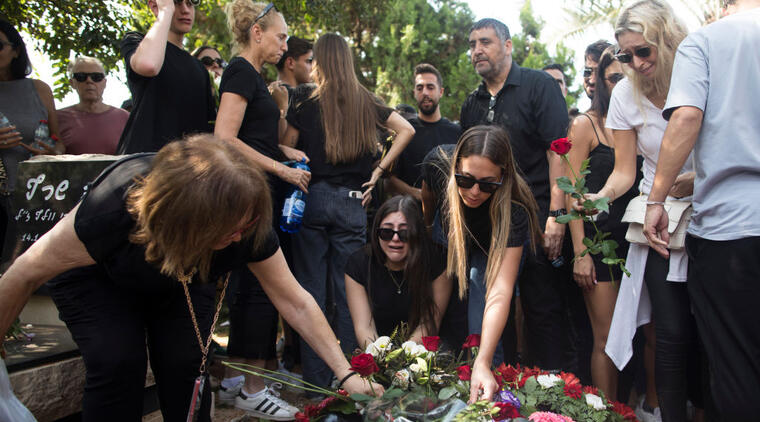
Family and friends of May Naim, 24, who was murdered by Palestinians militants at the "Supernova" festival, near the Israeli border with Gaza strip, react during her funeral on October 11, 2023 in Gan Haim, Israel. (Getty Images)
News

FSI Scholars Analyze Implications of Hamas’ Terror Attack on Israel

Larry Diamond moderated a discussion between Ori Rabinowitz, Amichai Magen and Abbas Milani on the effects of Hamas’ attacks on Israel and what the emerging conflict means for Israel and Middle Eastern geopolitics.
FSI Scholars Analyze Implications of Hamas’ Terror Attack on Israel
Panelists at the event "1973 Yom Kippur War: Lessons Learned"
News

The 1973 Yom Kippur War and Lessons for the Israel-Hamas Conflict

Scholars of Israel and the Middle East discussed the strategic takeaways of the 1973 Yom Kippur War and their relevance to the region’s current security crisis.
The 1973 Yom Kippur War and Lessons for the Israel-Hamas Conflict
Tzipi Livni speaks at a lunch time event with Stanford faculty and students.
News

FSI's Visiting Fellow in Israel Studies Reflects on What Lies Ahead for Israel and the Middle East

The October 7, 2023, attack by Hamas has already indelibly altered Israel and the Middle East, and will continue to reverberate for decades to come, says Amichai Magen, a fellow at the Freeman Spogli Institute for International Studies.
FSI's Visiting Fellow in Israel Studies Reflects on What Lies Ahead for Israel and the Middle East
Hero Image
Sheryl Sandberg answers audience questions with Rabbi Idit Solomon, Interim Associate Director of Hillel at Stanford, following a screening of her documentary film, "Screams Before Silence," on November 19.
Sheryl Sandberg answers audience questions with Rabbi Idit Solomon, Interim Associate Director of Hillel at Stanford, following a screening of her documentary film, "Screams Before Silence," on November 19, 2024.
Rod Searcey
All News button
1
Subtitle

Sheryl Sandberg said that filming a documentary about the sexual brutality of Hamas’ attacks on Israelis on Oct. 7 was the most important work of her life and that she wants to turn the world’s attention to the inhumanity that took place.

Date Label
0
CDDRL Postdoctoral Fellow, 2024-25
155a4102_-_jasmine.jpg

Jasmine is a Postdoctoral Fellow at Stanford’s Center on Democracy, Development and the Rule of Law (2024-25) and will be an Assistant Professor of Political Science at Reed College (2025).

Her research focuses on political behavior in American politics. Across her research, Jasmine uses ethnographic methods, in-depth interviews, original surveys, and experiments. Her work has been published in the American Political Science Review and Perspectives on Politics.

Jasmine received her PhD in Political Science from MIT in 2024 and graduated with degrees in Political Science and Economics from UCLA in 2018. She is originally from Belfast, Northern Ireland.

Date Label
-
Sergiy Leshchenko, 2024: A Decisive Year in Russia's War in Ukraine

In 2022, Russia initiated an unprovoked attack on Ukraine, marking the largest conflict in Europe since World War II. Despite initial gains, Putin was unable to change the political landscape in Kyiv, and approximately half of the territories initially seized by Russian forces were later reclaimed by Ukraine. However, the war is far from over. The war has also tested American leadership, particularly as China and France have expanded their international influence. The upcoming U.S. presidential election further escalates the uncertainty, as continued American support for Ukraine is critical. A Ukrainian victory is pivotal not only for regional stability but also for the security of American citizens.

ABOUT THE SPEAKER

Sergiy Leshchenko is formerly a journalist with Ukrainska Pravda and a member of the Ukrainian Parliament (2014-2019). He first rose to political prominence during Ukraine’s 2014 Maidan Revolution and has continued to serve in government and civil society since. He is an advisor to President Volodymyr Zelenskyy’s chief-of-staff and the initiator of the Working Group on Sanctions Against Russia, co-led by Michael McFaul. Mr. Leshchenko is an alumnus of the 2013 cohort of the Draper Hills Summer Fellows Program (now the Fisher Family Summer Fellows Program) at FSI’s Center on Democracy, Development and the Rule of Law at Stanford University.

Kathryn Stoner
Kathryn Stoner

In-person: Philippines Conference Room (Encina Hall, 3rd floor, 616 Jane Stanford Way, Stanford)
Online: Via Zoom

Sergiy Leshchenko Advisor to President Volodymyr Zelenskyy's Chief of Staff
Seminars
Date Label
Authors
News Type
News
Date
Paragraphs

Salam Fayyad, a former prime minister of the Palestinian Authority, told a Stanford audience that a peaceful outcome of the Gaza War depends on a principled two-state solution that recognizes Palestinian rights at the outset.

Fayyad engaged in a conversation on April 29 with Larry Diamond and Hesham Sallam at an event hosted by the Center on Democracy, Development and the Rule of Law’s (CDDRL) Program on Arab Reform and Democracy (ARD). Diamond is the Mosbacher Senior Fellow in Global Democracy at the Freeman Spogli Institute for International Studies and director of the Program on Arab Reform and Democracy, and Sallam is a CDDRL senior research scholar and associate director for the program. 

The problem, Fayyad said, is that a two-state solution has never been defined with adequate precision. “Part of this is to be expected if something is going to be the product of negotiations,” as was not the case in prior years with proposals such as the Oslo Accords.

On Oct. 7, 2023, Palestinian militants led by Hamas attacked Israel, killing almost 1,200 people, and Israel responded by launching an invasion of Gaza that has killed more than 34,000 Palestinians as of April 2024. With the war ongoing for seven months now, the Palestinian-Israeli conflict goes back many decades to 1948, when Israel was established. The question now is, what does the future hold for Gaza, the Palestinian people, Israel, and stability in the Middle East?

Fayyad raised the issue of what the key organizing principle to determine a future State of Palestine and a peaceful solution with Israel could be.

He said, “That process must be preceded by formal recognition of our rights as a people, our national rights. It's very important. Oslo was not about that. Oslo was very transactional.”

‘Voices in these discussions’


Sallam, a moderator, said in an email prior to the event that “the ongoing war has caused a grave humanitarian catastrophe in Gaza with tens of thousands of deaths, a serious risk of famine, and a pressing public health crisis. It is important for us to advance as many conversations as possible about how we got to this reality and how we can find a peaceful exit out of it. And it is imperative to elevate and center Palestinian voices in these discussions.”

He added, “Dr. Fayyad’s visit to CDDRL’s Program on Arab Reform and Democracy promises to shed light on a host of pressing questions that the Stanford community has been grappling with since last year. It is a timely opportunity to learn, engage, and deliberate.”

It is important for us to advance as many conversations as possible about how we got to this reality and how we can find a peaceful exit out of it. And it is imperative to elevate and center Palestinian voices in these discussions.
Hesham Sallam
Associate Director, Program on Arab Reform and Democracy

Fayyad is an economist who served as minister of finance for the Palestinian Authority from 2002 to 2005 and as prime minister from 2007 to 2013. During his tenure, he introduced a number of economic and governance reforms. Afterward, he founded "Future for Palestine," a nonprofit development foundation. He also worked for the International Monetary Fund, including as the resident representative in the West Bank and Gaza Strip. Currently, he is a Visiting Senior Scholar and Daniella Lipper Coules '95 Distinguished Visitor in Foreign Affairs at the Princeton School of Public Affairs. He is also a distinguished statesman at the Atlantic Council and a distinguished fellow at the Brookings Institution.

Recognition of Rights


Fayyad said that the recognition of Palestinian rights is critical to any future negotiations. “One of the key lessons learned is that it's a mistake to engage in a problematic process that is not defined well in terms of outcome – what it is supposed to lead to if it is not based particularly from our point of view, or on recognition of our national rights as a people? Because so far, we have gotten none of that.”

He added, “I, like many Palestinians, would find it reasonable to engage in a process that could take us there in agreement and through negotiation.”

Fayyad said that if Palestinians' interests and those of all countries in the region are ultimately to live in peace and sustainable harmony, then the process must be recalibrated. “It has to be more principled.”

Asymmetry and Conflict History


Fayyad said that asymmetry exists between Palestinians and Israelis. “You see this everywhere, in terms of power relations, you see it everywhere, all facets of life. You see it on college campuses; you see it everywhere.”

For example, he said that Israel, over 75 years, has built a strong, vibrant economy with a strong military. “So, to deny people (Palestinians) the right to self-determination, which is a right that is absolute for us under international law, just like any other people anywhere in the world,” is asymmetrical.

He noted, “It is equally important, if not more important, for us Palestinians to understand that just because we are the weaker party in this balance of power … that we must actively assume full agency in the act of our liberation. We must.”

It is equally important, if not more important, for us Palestinians to understand that just because we are the weaker party in this balance of power … that we must actively assume full agency in the act of our liberation. We must.
Salam Fayyad
Former Prime Minister, Palestinian Authority

During the conversation, Diamond told Fayyad, “Everything you've talked about was challenging enough on Oct. 6.” But, he asked, how have the last seven months after a devastating terrorist attack affected everything, including the war in Gaza that has leveled much of the physical infrastructure of the country? “Where do we go from here?”

Fayyad described Oct. 7 as a “major shock” that has made a solution more difficult and distant than it already was. He added that Israel’s response to eliminate Hamas is likely impossible to extremely unlikely.

A Sisyphean Task


Our freedom is an inalienable right, Fayyad said about the Palestinian people, and it's an inseparable component of them as human beings. 

“As human beings and members of the human race, like everyone, we have that to share with everyone else. You have to have that kind of recalibration.”

Future conversations between Palestinians and Israelis have to begin from the recognition that two equal parties exist to this disagreement, he said. “Not the oppressor, not the oppressed, not the master and the slave. Not the master and the surrogate.”

Fayyad compared the Palestinian-Israeli conflict to a Sisyphean task of sorts. 

“But I never really understood Sisyphus to be an exercise in futility myself,” he said. “You learn something every time that boulder rolls back on. It's really about empowerment. That’s why it is most inspiring to try it. Even if you fail, even if you know you’re going to fail, you learn from it, you learn from it, and you keep pushing that boulder up the hill. There will come a point in time when the stars align for that which is just.”

The Program on Arab Reform and Democracy at the Center on Democracy, Development and the Rule of Law at Stanford University examines the different social and political dynamics within Arab countries and the evolution of their political systems, focusing on the prospects, conditions, and possible pathways for democratic reform in the region.

Read More

Michael Robbins and Amaney A. Jamal
News

Survey sheds light on Palestinian views ahead of Hamas attack on Israel

Stanford’s Program on Arab Reform and Democracy – housed at the Center on Democracy, Development and the Rule of Law – hosted an event last Wednesday to discuss the Arab Barometer’s most recent survey, which concluded just as Hamas conducted its Oct. 7 attack on Israel.
Survey sheds light on Palestinian views ahead of Hamas attack on Israel
Panelists at the event "1973 Yom Kippur War: Lessons Learned"
News

The 1973 Yom Kippur War and Lessons for the Israel-Hamas Conflict

Scholars of Israel and the Middle East discussed the strategic takeaways of the 1973 Yom Kippur War and their relevance to the region’s current security crisis.
The 1973 Yom Kippur War and Lessons for the Israel-Hamas Conflict
Family and friends of May Naim, 24, who was murdered by Palestinians militants at the "Supernova" festival, near the Israeli border with Gaza strip, react during her funeral on October 11, 2023 in Gan Haim, Israel. (Getty Images)
News

FSI Scholars Analyze Implications of Hamas’ Terror Attack on Israel

Larry Diamond moderated a discussion between Ori Rabinowitz, Amichai Magen and Abbas Milani on the effects of Hamas’ attacks on Israel and what the emerging conflict means for Israel and Middle Eastern geopolitics.
FSI Scholars Analyze Implications of Hamas’ Terror Attack on Israel
Hero Image
Dr. Salam Fayyad, former prime minister of the Palestinian Authority, in conversation with Larry Diamond, FSI's Mosbacher Senior Fellow in Global Democracy, at an event hosted by CDDRL's Program on Arab Reform and Democracy.
Dr. Salam Fayyad, former prime minister of the Palestinian Authority, in conversation with Larry Diamond, FSI's Mosbacher Senior Fellow in Global Democracy, at an event hosted by CDDRL's Program on Arab Reform and Democracy. Photo: Damian Marhefka
Damian Marhefka
All News button
1
Subtitle

Salam Fayyad, former prime minister of the Palestinian Authority, spoke about the quest for peace and Palestinian statehood during a conversation on the Palestinian people, the Gaza War, and the conflict’s implications for stability in the Middle East, hosted by CDDRL’s Program on Arab Reform and Democracy.

Authors
Rachel Owens
News Type
News
Date
Paragraphs

Can indigenous communities ruling through politically autonomous institutions better protect against cartel takeover? In a CDDRL seminar series talk, Beatriz Magaloni, the Graham H. Stuart Professor of International Relations, a Senior Fellow at Stanford’s Freeman Spogli Institute for International Studies, and Director of CDDRL’s Poverty, Violence, and Governance Lab argued that in Mexico, indigenous communities ruled by traditional governance have proven more resilient against cartel takeovers than comparable municipalities relying on state-backed security provision. 

Existing literature typically frames violence in developing countries as a manifestation of state weakness. But, in many areas of the world, organized criminal groups infiltrate the state, buying off intelligence, protection, and impunity. 

In Mexico, cartels infiltrate local governments by funding political campaigns, killing those who refuse to be bought off. In this context, the selection of leaders through conventional Western multi-party elections is an effective vehicle through which cartels can extend their influence. 

The capture of municipal political bodies is advantageous to cartels as it allows them to diversify their revenue generation. Access to intelligence, resources, and territory makes demanding regular payments and extracting natural resources far easier. It also allows cartels to gain discretionary power in the decision of who the state grants protection to or not. This bleak reality in which the borders between the state, organized crime, rule of law, and impunity are blurred elevates the urgency of investigating to what extent “opting out” of the state represents a viable alternative in the provision of security. 

In Oaxaca and other regions across Mexico, indigenous communities have the right to govern autonomously. In their traditional form of governance, known as “usos y costumbres,” local elections and political parties are banned. Authorities are instead selected through community assemblies, in which decision-making is highly participatory. Based on this traditional governance, a growing number of indigenous communities have established community police groups, which are detached from the state and constituted by local community members with little or no professional police training. 

Importantly, autonomous indigenous municipalities still receive state transfers and cannot be punished for opting out of the party system. In conducting extensive qualitative fieldwork, Magaloni sought to understand whether this traditional governance structure prohibits cartel infiltration and keeps communities safer. 

The team hypothesized that higher levels of cartel presence would increase violence – which they proxied with homicide rates. They expected less cartel presence and less violence in Usos (autonomous indigenous communities) relative to party-controlled municipalities. Lower levels of police corruption and better deterrence against criminal cells were also expected for communities ruled by Usos

The initial exploratory analysis showed that following the autonomous governance reform, Usos communities experienced a sharp decrease in violence. When the drug war began in 2006, these communities continued to see low levels of violence, whereas comparable municipalities suffered a sharp increase. 

Magaloni employed a variety of difference in difference analyses to control for possible confounders. Usos communities were compared to similarly sized, similarly indigenous communities. Using a geographic discontinuity design, Usos were also compared to municipalities just 1 km from the border of Oaxaca – those ruled by multi-party elections. The analysis controlled for opium poppy suitability and history of ancestral governance practices. 

The analysis confirmed that the more cartel presence, the more violence a community experienced. Across all models, the team was able to conclude that Usos communities saw significantly less cartel presence, fewer homicides, and less violence. 

Magaloni’s work highlights the state's limitations in creating order in circumstances where criminal groups have compromised it. It also suggests that in the context of these predatory regimes, indigenous political autonomy can serve as a powerful rampart to the corrosive presence of organized crime.

Read More

Alisha Holland
News

Infrastructure, Campaign Finance, and the Rise of the Contracting State

Harvard University Professor of Government Alisha Holland explains how the advent of public-private partnerships has shifted politicians’ orientation toward infrastructure projects.
Infrastructure, Campaign Finance, and the Rise of the Contracting State
Sophie Richardson
News

The Global Dimensions of the Chinese Government Human Rights Abuses

Why have democracies failed in curtailing Xi Jinping’s human rights abuses? And how can they better insulate themselves from Beijing's transnational threats? CDDRL Visiting Scholar and former China Director at Human Rights Watch Sophie Richardson presented her research on the Chinese government’s deteriorating human rights record.
The Global Dimensions of the Chinese Government Human Rights Abuses
Hero Image
Beatriz Magaloni presents during a CDDRL research seminar on April 11, 2024.
Beatriz Magaloni presents during a CDDRL research seminar on April 11, 2024. Photo: Rachel Cody Owens
Rachel Cody Owens
All News button
1
Subtitle

Beatriz Magaloni, the Graham H. Stuart Professor of International Relations, presented her latest research during a CDDRL seminar talk.

Date Label
-
Liminal Minorities: Religious Difference and Mass Violence in Muslim Societies | Book Talk with Güneş Murat Tezcür

Why do some religious minorities, lacking any significant power and presenting no imminent threat, provoke the ire of popular groups and become targets of violent attacks? Tezcür's book offers the first comparative-historical study of mass atrocities targeting certain liminal minorities that are stigmatized across generations, as they lack theological recognition and social acceptance from a dominant religious group. The combination of hatred based on religious stigmas and political resentment becomes the spark leading to mass violence against these minorities. Case studies, utilizing a rich variety of original sources, focus on anti-Yezidi genocidal attacks in Iraq and anti-Alevi massacres in Turkey.

This event is co-sponsored by the Abbasi Program in Islamic Studies, the Middle Eastern Studies Forum, and CDDRL's Program on Turkey.

ABOUT THE AUTHOR

Güneş Murat Tezcür (Ph.D., University of Michigan, 2005) is the Director of the School of Politics and Global Studies at the Arizona State University. He is also a professor in the same school. He is primarily a scholar of darker shades of human experience and explores the trajectories and legacies of political violence and politics of identity with a focus on Iranian, Kurdish, and Turkish human geography as well as the United States. His scholarship has appeared in many leading scholarly journals. His newest book is Liminal Minorities: Religion and Mass Violence in Muslim Societies (Cornell University Press, 2024). He most recently edited The Oxford Handbook of Turkish Politics (Oxford University Press, 2022). His scholarship has been supported by a variety of entities including the National Science Foundation, Harry Frank Guggenheim Foundation, and United States Institute of Peace. 

Encina Commons Room 119
615 Crothers Way, Stanford

Güneş Murat Tezcür
Date Label
Subscribe to Violence