On the heels of the abrupt ending of the Hanoi summit between President Trump and North Korean leader Kim Jong Un, with the future of the diplomacy of denuclearization in question, the Korea Program at Shorenstein APARC convened the 11th Koret Workshop, appropriately titled this year “North Korea and the World in Flux.”
The workshop, an annual gathering made possible through generous funding from the Koret Foundation, brought together international experts in Korean affairs for a full day of panel discussions. Participants assessed the U.S.-DPRK summit diplomacy, examined the challenges and opportunities in media coverage related to the negotiations between the two countries, and considered the prospects and pitfalls for summitry with North Korea in the near term. A report on the workshop proceedings is forthcoming.
At a midday public keynote, General Vincent Brooks, U.S. Army (Ret.), spoke before a packed audience about the challenges and opportunities in Korea. Brooks, who recently retired from active duty as the four-star general in command of all U.S. Forces in Korea, provided his unique and very-timely assessment of the situation on the Korean peninsula, and offered his insights on where the diplomacy of denuclearization may go next.
STANFORD, CA, March 11, 2019 — The Walter H. Shorenstein Asia-Pacific Research Center (APARC), Stanford University’s hub for interdisciplinary research, education, and engagement on contemporary Asia and the sponsor of the Shorenstein Journalism Award for excellence in coverage of the Asia-Pacific, is pleased to introduce an all-new selection committee for the award, comprising diverse journalistic and Asia expertise. APARC now welcomes nominations for the 2019 award. The deadline for nomination submissions is 5pm Pacific time on Friday, March 29, 2019.
An annual tradition since 2002, the Shorenstein Journalism Award carries a cash prize of US $10,000 and recognizes outstanding veteran journalists who have spent their careers helping audiences around the world interpret the complexities of the Asia-Pacific region. It honors the legacy of APARC’s benefactor, Mr. Walter H. Shorenstein, and his twin passions for promoting excellence in journalism and understanding of Asia. “With this award we are committed to advancing journalism that persistently and courageously seeks accuracy, deep reporting, and nuanced U.S.-Asia dialogue,” said APARC Director Gi-Wook Shin.
Over the course of its history, the award has recognized world-class journalists who push the boundaries of coverage of the Asia-Pacific region and help advance mutual understanding between audiences in the United States and their Asian counterparts. Recent honorees include Anna Fifield, Caixin Media, Ian Johnson, Jacob Schlesinger, Siddharth Varadarajan, and Aung Zaw. The award alternates between recipients whose work has mostly been published through American news media and recipients whose work has mostly been conveyed through news media in one or more parts of the Asia-Pacific region. The 2019 award will recognize a recipient from the latter category, which oftentimes includes candidates who work at the forefront of the battle for press freedom.
APARC has recently assembled a new selection committee for the award that presides over the judging of nominees and is responsible for the selection of honorees. “I am delighted to welcome our new committee members who have all distinguished themselves in their careers and bring expertise across journalism, policy, and Asia research and reporting,” noted Director Shin.
The selection committee for the Shorenstein Journalism Award includes Wendy Cutler, Vice President and Managing Director, Washington, D.C. Office, Asia Society Policy Institute; James Hamilton, Hearst Professor of Communication, Chair of the Department of Communication, and Director of the Stanford Journalism Program, Stanford University; Raju Narisetti, Director of the Knight-Bagehot Fellowship in Economics and Business Journalism and Professor of Professional Practice at Columbia Journalism School; Philip Pan, Asia Editor, The New York Times; and Prashanth Parameswaran, Senior Editor, The Diplomat.
For the Shorenstein award, the Asia-Pacific region is defined broadly to include Northeast, Southeast, South, and Central Asia and Australasia. Both individual journalists with considerable body of work and journalism organizations are eligible for the award. Nominees’ work may be in traditional forms of print or broadcast journalism and/or in new forms of multimedia journalism. APARC is seeking 2019 award nomination submissions from editors, publishers, scholars, journalism-related associations, and entities focused on researching and interpreting the Asia-Pacific region. The award will be presented by APARC at Stanford in the Autumn quarter of 2019.
For complete details about the award, nominations and procedures, and past winners, please visit the Shorenstein Journalism Award page. Submissions are accepted electronically through 5pm Pacific time on Friday, March 29, 2019, via an online form.
About the Walter H. Shorenstein Asia-Pacific Research Center
The Walter H. Shorenstein Asia-Pacific Research Center (Shorenstein APARC) addresses critical issues affecting the countries of Asia, their regional and global affairs, and U.S.-Asia relations. As Stanford University’s hub for the interdisciplinary study of contemporary Asia, APARC produces policy-relevant research, provides education and training to students, scholars, and practitioners, and strengthens dialogue and cooperation between counterparts in the Asia-Pacific and the United States. Founded in 1983, APARC today is home to a scholar community of distinguished academics and practitioners in government, business, and civil society, who specialize in trends that cut across the entire Asia-Pacific region. For more information, visit https://aparc.fsi.stanford.edu.
The emergence of a global digital ecosystem has been a boon for global communication and the democratization of the means of distributing information. The internet, and the social media platforms and web applications running on it, have been used to mobilize pro-democracy protests and give members of marginalized communities a chance to share their voices with the world. However, more recently, we have also seen this technology used to spread propaganda and misinformation, interfere in election campaigns, expose individuals to harassment and abuse, and stir up confusion, animosity and sometimes violence in societies. Even seemingly innocuous digital technologies, such as ranking algorithms on entertainment websites, can have the effect of stifling diversity by failing to reliably promote content from underrepresented groups. At times, it can seem as if technologies that were intended to help people learn and communicate have been irreparably corrupted. It is easy to say that governments should step in to control this space and prevent further harms, but part of what helped the internet grow and thrive was its lack of heavy regulation, which encouraged openness and innovation. However, the absence of oversight has allowed dysfunction to spread, as malign actors manipulate digital technology for their own ends without fear of the consequences. It has also allowed unprecedented power to be concentrated in the hands of private technology companies, and these giants to act as de facto regulators with little meaningful accountability. So, who should be in charge of reversing the troubling developments in our global digital spaces? And what, if anything, can be done to let society keep reaping the benefits of these technologies, while protecting it against the risks?
Future Visions: Challenges and Possibilities of Korean Studies in North America — Social Science panel. From left to right: UC Berkeley's Laura Nelson, University of Michigan's Jordan Siegel, Stanford's Yong Suk Lee, USC's David Kang, Harvard's Paul Chang.
How can Korean studies faculty cultivate supportive and critical scholarly communities with graduate students? What can be done to overcome the severe constraints on Korean language training in North America? Why is there a dearth of Korea scholarship in academic literature? And how should Korean studies librarians prepare for the future in the light of new technologies and young researchers’ increasing interest in digital scholarship?
These were some of the questions examined at a two-day conference, “Future Visions: Challenges and Possibilities of Korean Studies in North America,” convened by the Korea Program of Stanford’s Shorenstein Asia-Pacific Research Center (APARC) on November 1-2. Co-sponsored by the Seoul-based Foundation Academia Platonica, the conference, the first of its kind, gathered distinguished Korean studies scholars from twelve North American institutions to consider the state of the field, assess its challenges, and carry forward a vision for its future direction and potential. Its six unique panels focused not only on the major disciplines of Korean studies—history, literature, and the social sciences—but also on language education, library collections and services, and Korean Wave.
“The presentations and discussions by our fellow experts reflected the breadth and depth of Korean studies in North America,” says APARC Director and the Korea Program Director Gi-Wook Shin. “Our program was established at Stanford in 2001 and has since become a leader in Korean studies in North America, so it is a special privilege for us to bring together colleagues from eminent institutions around the continent to further advance Korean studies education and research in the academic and policy worlds, and to build upon our track record of action and achievements.”
“The field of Korean studies, however,” notes Shin, “has significantly changed over the past seventeen years and it isn’t without its challenges. This is our opportunity to consider frankly where we go next and how we could explore the path ahead together.”
Conference participants indeed engaged in deep conversations and shared ideas and dilemmas regarding teaching in the different disciplines of Korean studies in North America. Harvard sociologist Paul Chang listed three types of challenges facing the field: publication, academic, and professional challenges. David C. Kang, professor of international relations and director of the Korean Studies Institute at the University of Southern California, emphasized the publication challenge: why is it, asked Kang, that top academic journals in the discipline of political science and international relations publish so much more scholarship about Europe than they do about Korea and Asia at large, even while the rise of Asian nations is surely one of the most consequential issues of the twenty-first century? The onus, Kang argued, comes back to East Asia scholars “to produce better and more compelling scholarship, and to better train graduate students.”
University of British Columbia's Ross King and conference participants.
Yet complex issues surround the question of how to broaden graduate coursework—and whether to do so. Korean language and linguistics expert Ross King, head of the department of Asian Studies at the University of British Columbia in Vancouver, Canada, was one of several panelists who considered the obstacles to graduate training, among different aspects of academic challenges facing the field of Korean studies. King probed into how Sinocentrism and what he called the “Mandarin conceit”—that is, the notion that training in Literary Sinitic should be predicated on a near-native proficiency in modern Mandarin Chinese—are emerging as a major stumbling block to the study of premodern Korean literary culture. He also pointed to the constraints on language training in both Korean and hanmun in North America, which, he claimed, is why we can probably anticipate continued decrease in the number of ethnically non-Korean (non-Korea-educated) graduate students undertaking graduate study in Korean literature.
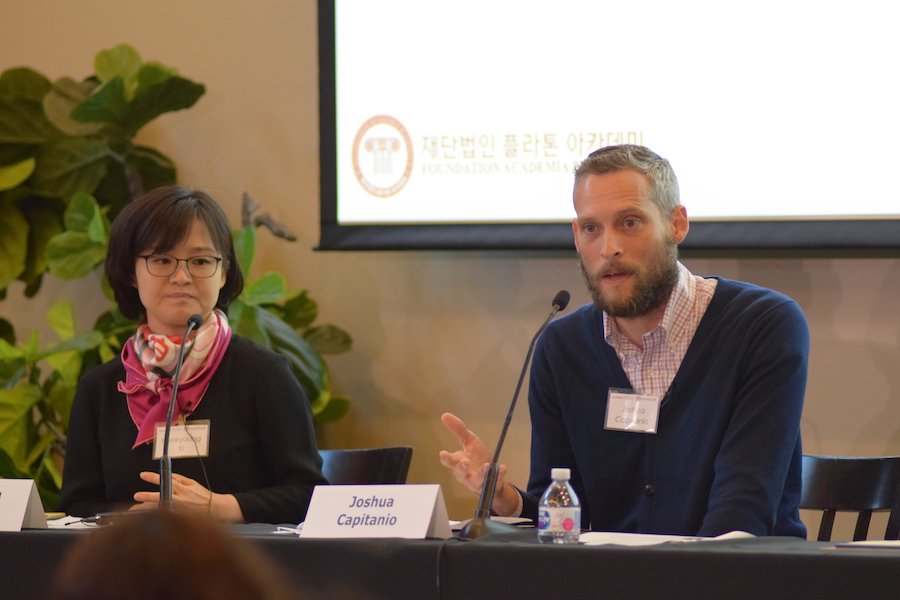
University of Washington's Hyokyoung Yi (left) and Stanford's Joshua Capitanio at a panel on library collections and service.
Sung-Ock Sohn, who coordinates the Korean language program in the department of Asian languages and cultures at the University of California – Los Angeles, further shed light on King’s prediction. She explained that while enrollments in Korean language classes have shown a sharp increase in American higher education institutions in the past decade, particularly at the introductory level and among ethnically non-Korean students, there is a high attrition rate of students from an introductory to advanced Korean classes nationwide.
How should the field move forward?
Participants proposed a host of ideas to that end. These included helping graduate students collaborate with colleagues in Korea; dedicating funding for junior faculty to spend periods of time before tenure conducting research and honing language skills in Korea at appropriate institutions, and for mid-career scholars to spend a year in Korea; emphasizing the application of social science theories and methods to premodern and modern East Asia; motivating scholars to apply a comparative lens to the study of the historical and contemporary experience of East Asia; and integrating linguistic and cultural diversity in Korean language classes by, for example, incorporating service learning in authentic contexts and extending the content spectrum to include topics such as Korean popular culture.
Image
K-pop star Siwon Choi (left) highlights closing panel on Korean Wave.
Korean Wave was the focus of the conference’s widely attended closing panel that featured K-pop star Siwon Choi, a member of Korean boy band Super Junior, and multi-platinum music producer Dominique Rodriguez, managing director of SM Entertainment USA. They spoke about the global reach of Korean pop music and some of the ways in which Korean popular culture could stimulate interest in Korean studies. Dafna Zur, assistant professor in Stanford’s department of East Asian languages and cultures, who chaired the panel, challenged her students to consider “what it means not just to monetize culture but to design culture with specific markets and audience in mind.” The Stanford Daily published a detailed article on the panel.
“We are grateful to Foundation Academia Platonica for its generous support of Stanford’s Korea Program at Shorenstein APARC and for making this conference possible through our shared vision for the future of Korean studies in North America,” said Gi-Wook Shin. “Our thanks also go to our many other friends and partners, including the Korea Foundation that has helped achieve great results through its commitment to promoting understanding of Korea in academia and beyond and its support of the overseas Korean Studies Program since its establishment in 1991.”
South Korean TV company SBS NBC filmed the conference that will be featured in an upcoming documentary about Korean studies in the United States.
Read the conference report or listen to the audio recordings of the sessions, below.
In 2012, as giants such as Facebook, Twitter, and Google began to position themselves as the go-to places to read news, a little-known news app called SmartNews emerged and started gaining popularity in Japan. The SmartNews app has since been dubbed “App of the Year” on Google Play and won the “Best of” award in Apple’s App store, launched US operations in 2014, and now has over 10 million monthly active users in US and Japan.
In the age of fake news and information polarization, SmartNews is working to deliver to users a balanced diet of quality information from trusted journalism sources. The SmartNews news app uses machine learning to deliver curated news from more than 3000 sources and identify fake news. The SmartNews Delivery Algorithm not only considers users’ likes and clicks and other behavior on the app to generate suggestions, but also applies political balancing algorithms to ensure multiple viewpoints are expressed on important topics, and diversification algorithms to help break the filter bubble.
In this public forum, SmartNews Director of Product Management Yuhei Nishioka will talk about SmartNews’ story and growth trajectory, competing in the current news app landscape, and finally, discuss the process and considerations in creating the SmartNews News Delivery Algorithm. Introduction by Rich Jaroslovsky Vice President for Content and Chief Journalist of SmartNews and former Wall Street Journal White House correspondent.
MAIN SPEAKER:
Yuhei Nishioka, Director of Product Management, SmartNews
INTRODUCTION BY:
Rich Jaroslovsky, Vice President for Content and Chief Journalist, SmartNews and former Wall Street Journal White House correspondent
AGENDA:
4:15pm: Doors open 4:30pm-5:30pm: Main Content, followed by discussion 5:30pm-6:00pm: Networking
Please note there is significant construction taking place on campus, which is greatly affecting parking availability and traffic patterns at the university. Please plan accordingly.
Yuhei Nishioka, Director of Product Management, SmartNews
User-Generated Ratings in Healthcare-Evidence from Yelp
Yiwei Chen
Advisor: Kate Bundorf
Abstract: It is controversial whether user-generated physician ratings from online sources improve healthcare efficiency. Using the universe of Yelp physician ratings matched with Medicare claims, I examine what information on physician quality Yelp ratings reveal, whether they affect patients' physician choices, and how they change physician behaviors. Through text and correlational analysis, I show that although Yelp reviews primarily describe physicians’ interpersonal skills, Yelp ratings are also positively correlated with various measures of clinical quality. Instrumenting physicians’ average ratings with reviewers' “harshness” in rating other businesses, I discover that physicians’ average ratings increase their revenue and patient volume by 1-2% per star. Using a difference-in-differences strategy, I find that after their physicians are rated on Yelp, patients do not receive different amounts of opioid prescriptions or show different health outcomes, although they have slightly more lab and imaging tests which are possibly wasteful. Overall, Yelp ratings seem to help patients—they convey both physicians' interpersonal skills and clinical abilities, bring patients into higher-rated physicians, and do not induce physicians to hurt patients’ health via ordering harmful substances.
William J. Perry Conference Room
Encina Hall
2nd Floor
616 Serra Mall (Address changed due to construction)
Jolted Images brings together a large cast of mainstream and avant-garde cineastes, artists, photographers, comics creators, poets, and more, to reflect on a wide range of phenomena from the realms of cinema and visual culture in the Yugoslav region, broader Europe, and North America. Far from a staid monograph, the book takes a cue from filmmaker Du¿an Makavejev, who once wrote that there are times when it is necessary "to jolt art, no matter what the outcome"; to that end, the book infuses its analysis with playful, creative transfiguration of the material at hand.
The consequences of contemporary technological innovations for the lives and values of future generations are enormous. The wide range of expected – and unexpected – applications require rethinking governance arrangements, legal regimes, economic structures, and social relations. Exploration of such topics is the subject of the 2017-18 CASBS symposium series.
The first symposium, held in November 2017, focused on “AI, Automation, and Society.” Read about and view a video of that event here.
The second symposium, held in March 2018, involved “The Effects of Technology on Human Interactions.” View the event video here.
In this final installment of the 2017-18 series, CASBS presents a conversation featuring two 2017-18 CASBS fellows – Stanford professor Nate Persily, an expert on law, democracy, and the internet; and Carrie Cihak, a senior policy expert and practitioner at one of the most innovative county governments in the U.S. They will outline the challenges that recent technology-based advances pose to democracy, public policy, and governance systems. Social media platforms increasingly are viewed as vehicles for exploiting political discourse, rather than as democratizing forces. How should our institutions respond? Though modern technological innovations more easily connect people, what are the implications for issues of “digital equity,” government capacity, and regulatory frameworks? Though the positive impacts are substantial, how do we address the numerous negative impacts of the technology sector’s concentration in certain regional economies – including the San Francisco Bay Area and the greater Seattle area? These are just a few questions that will stimulate a thought-provoking discussion between the panelists and with the audience.
As Chief of Policy for King County Executive Dow Constantine, the highest ranking elected official of King County, WA, the 13th largest county in the United States, Carrie S. Cihak is responsible for identifying the highest priority policy areas and community outcomes for leadership focus and for developing and launching innovative solutions to issues that are complex, controversial and cross-sectoral. She is an architect of some of the county’s key initiatives, such as Best Starts for Kids as well as nationally-recognized work on equity and social justice. Prior to her work in Constantine’s administration, Cihak served for eight years as a senior-level analyst for the King County Council and as lead staff for the King County Board of Health. She also served as a staff economist on international trade and finance for President Clinton's Council of Economic Advisers. As a policy fellow during the 2017-18 academic year, Cihak is leading projects at CASBS and in King County that advance meaningful collaboration between academic researchers and governments. She is spearheading efforts in King County on evidence-informed decision making and is co-director of CASBS’s Impact Evaluation Design Lab, launched in March 2018. She is also using time at CASBS to explore the science and evidence-base of belonging, while working back home to help launch a cross-sector partnership called “You Belong Here,” which seeks to build civic muscle and inclusive growth in the Seattle region.
Nate Persily is the James B. McClatchy Professor of Law at Stanford Law School, with appointments in the departments of political science, communication and the Freeman Spogli Institute for International Studies. Prior to joining Stanford, Persily taught at Columbia University and the University of Pennsylvania Law School, and as a visiting professor at Harvard, NYU, Princeton, the University of Amsterdam, and the University of Melbourne. His scholarship and legal practice focus on American election law or what is sometimes called the “law of democracy,” which addresses issues such as voting rights, political parties, campaign finance, redistricting, and election administration. He has served as a special master or court-appointed expert to craft congressional or legislative districting plans for Georgia, Maryland, Connecticut, New York and, most recently, North Carolina. He also served as the Senior Research Director for the Presidential Commission on Election Administration. In addition to numerous articles (many cited by the Supreme Court) on the legal regulation of political parties, issues surrounding the census and redistricting process, voting rights, and campaign finance reform, Persily is coauthor of an election law casebook, The Law of Democracy. As a fellow at CASBS supported by the Annenberg Foundation, he is examining the impact of changing technology on political communication, campaigns, and election administration. In 2016, he received an Andrew Carnegie Fellowship to pursue this work. Persily also co-directs the Stanford Project on Democracy and the Internet.
*There will be valet parking at the event.
Center for Advanced Study in the Behavioral Sciences at Stanford University 75 Alta Road Stanford, CA 94305
Nate Persily
The James B. McClatchy Professor of Law
Stanford Law School
Carrie Cihak
Chief of Policy for King County Executive Dow Constantine
King County, Washington