Landy said there are two directions to go: “One is to plunge yourself deeper into misery and make yourself even more afraid, and the other is, well, not escapism exactly, but the kind of writing that keeps your mind alive, alert and active.”
STANFORD, CA, April 8, 2020 — Stanford University’s Walter H. Shorenstein Asia-Pacific Research Center (APARC) is pleased to announce that journalist and author Tom Wright is the recipient of the 2020 Shorenstein Journalism Award for excellence in coverage of the Asia-Pacific region. Wright, who over the past twenty-five years has worked mainly in South and Southeast Asia, is the coauthor of the New York Times bestseller Billion Dollar Whale, which unravels the story of one of the world's greatest financial scandals involving the multibillion-dollar looting of the Malaysian sovereign wealth fund 1Malaysia Development Bhd (1MDB). The book builds on Wright’s multiyear investigative reporting for the Wall Street Journal, where he most recently served as Asia economics editor. In the coming fall quarter, Wright will receive the award at a ceremony and headline a panel discussion at Stanford.
Wright started his career with Reuters in Indonesia in the 1990s at a time when Gen. Suharto’s military dictatorship was crumbling. During the Asian financial crisis of 1997-98, he joined Dow Jones Newswires in Bangkok, later moving to the Wall Street Journal. He has investigated corruption in Indian companies, the failure of the U.S.’s civilian aid program for Pakistan, and was one of the first journalists to arrive at the scene of the raid in which Navy SEALs killed Osama bin Laden. His 2013 award-winning series on the Rana Plaza factory disaster in Bangladesh, which killed over 1,000 people, exposed how international garment manufacturers turned a blind eye to safety violations to reduce costs.
In 2015, he began investigations into the 1MDB scandal, one of the largest financial frauds of all time in which bankers at Goldman Sachs helped a young Malaysian financier steal at least $4 billion from Malaysian state fund 1MDB. The three-year investigation revealed the degree to which Western institutions, from Wall Street banks, law firms, auditors, and even Hollywood film companies, ignore malfeasance in the pursuit of profits. Wright’s work sparked investigations by law enforcement and regulators in multiple countries and outrage in Malaysia, where the ruling coalition, after 61 years in power, suffered a landslide defeat in a shocking 2018 election.
“Throughout his career, Tom Wright’s consummate reporting and persistent investigations have repeatedly shone a light on major Asian affairs and the complicity of Western institutions in the affliction of corruption in Asia,” said Gi-Wook Shin, Shorenstein APARC director. “His work embodies an unwavering commitment to the pursuit of truth and to advancing a critical consideration of both Asian and Western societies. We are delighted to recognize him with the Shorenstein Journalism Award.”
Presented annually by APARC, the Shorenstein award, which carries a $10,000 cash prize, honors the legacy of APARC’s benefactor, Mr. Walter H. Shorenstein, and his twin passions for promoting excellence in journalism and understanding of Asia. “We are grateful to the Shorenstein family for its support of our Center and its mission and to the members of the award selection committee for their expertise and service,” noted Shin.
The selection committee for the Shorenstein Journalism Award, which unanimously chose Wright as the 2020 honoree, includes Wendy Cutler, vice president and managing director, Washington, D.C. Office, Asia Society Policy Institute; James Hamilton, Hearst Professor of Communication, chair of the Department of Communication, and director of the Stanford Journalism Program, Stanford University; Raju Narisetti, global publishing director-elect, McKinsey & Company; Philip Pan, weekend editor, former Asia editor, the New York Times; and Prashanth Parameswaran, senior editor, the Diplomat.
Eighteen journalists have previously received the Shorenstein award, including most recently Maria Ressa, CEO and executive editor of Rappler; Anna Fifield, the Washington Post’s Beijing bureau chief and long-time North Korea watcher; Siddharth Varadarajan, founding editor of the Wire; Ian Johnson, a veteran journalist with a focus on Chinese society, religion, and history; and Yoichi Funabashi, former editor-in-chief of the Asahi Shimbun.
Information about the 2020 Shorenstein Journalism Award ceremony and panel discussion featuring Wright will be forthcoming in the fall quarter.
Shorenstein APARC
Stanford University
Encina Hall E301
Stanford, CA 94305-6055
0
junwa@stanford.edu
Visiting Student Researcher at APARC, 2019-20
jun_wang.jpg
Jun Wang joined the Walter H. Shorenstein Asia-Pacific Research Center as visiting student researcher for the spring and summer quarters of 2020 from Peking University, where she serves as a Ph. D. candidate at School of Government. At APARC, she worked with Professor Gi-Wook Shin and Professor Jean Oi conducting research on Chinese nationalism in the Internet era.
Around the world, democracy is in retreat. In its Freedom in the World 2019 report, the independent watchdog organization Freedom House records the 13th consecutive year of global declines in political rights and civil liberties. “More authoritarian powers are now banning opposition groups or jailing their leaders, dispensing with term limits, and tightening the screws on any independent media that remain,” and “even long-standing democracies have been shaken by populist political forces,” shows the annual study. Internet freedom, too, continues to decline globally amid the crisis of social media, unveils Freedom House’s newly released Freedom on the Net 2019 report. Social media platforms – once considered liberation technologies – have become a conduit for surveillance, disinformation, and electoral manipulation, and “are now tilting dangerously toward illiberalism, exposing citizens to an unprecedented crackdown on their fundamental freedoms.”
These troubling developments are also manifested throughout the Asia-Pacific, where continuous scaling back in U.S. engagement and leadership is raising doubts about American power and purpose in the region, thus empowering forces that undermine democratic norms and processes.
At Shorenstein APARC, we are committed to building a solid foundation of education, knowledge, and dialogue about the critical challenges facing Asian nations and U.S.-Asia relations. That’s why we are dedicating a major portion of our programming this fall quarter and throughout the entire year to elucidating the threats to rights and liberties in the Asia-Pacific region.
The Battle for Truth and Press Freedom in the Philippines
“This is an existential moment for global power structures, turned upside down by technology. When journalists globally are under attack, democracy is under attack.” With these words, the internationally-esteemed investigative journalist and press freedom champion Maria Ressa opened her keynote address upon receiving the 2019 Shorenstein Journalism Award.
As CEO and executive editor of Rappler, she has led the Philippine independent news platform in shining critical light on the Duterte administration's drug war and unprecedented number of killings in the country. President Duterte in turn has made no secret of his dislike for Ressa and Rappler, accusing the platform for carrying "fake news." Ressa has been arrested twice this year, accused of corporate tax evasion and of violating security laws, and slapped with charges of cyber libel for a report that was published before the libel law came into effect. Since Duterte’s election in summer 2016, the Philippine government has filed at least 11 cases and investigations against Ressa and Rappler. “And all because I’m a journalist,” she says.
Ressa detailed the devastating effects that disinformation has had on press freedom, democracy, and civic discourse in the Philippines. “Our dystopian present is your dystopian future if nothing significant is done,” she cautioned. She was joined on the 18th annual Journalism Award panel by Stanford’s Larry Diamond, senior fellow at FSI and the Hoover Institution, and Raju Narisetti, director of the Knight-Bagehot Fellowship in Economics and Business Journalism and professor of professional practice at Columbia Journalism School.
Watch Ressa’s keynote and the entire panel proceedings:
North Korea continues to be one of the world’s worst human rights violators, ranking at the bottom of Freedom House’s list of countries designated as Not Free with the worst aggregate scores for political rights and civil liberties. Although North Korea has experienced some degree of social and economic change in recent years, the Kim Jong Un regime continues to tightly control access to information, suppress all dissent, heavily surveil residents, and subject political prisoners to torture, forced labor, and other atrocities.
As momentum for U.S.-DPRK diplomatic negotiations has ebbed and flowed since summer 2018, all eyes have been on the questions surrounding the North Korean nuclear problem, while the human rights problem has received little attention. However, argues APARC’s Koret Fellow in Korean Studies Robert R. King, addressing the North Korean human rights problem is essential to moving the country on denuclearization and security issues.
Ambassador King, former special envoy for North Korean human rights issues at the Department of State, recently spoke at a seminar hosted by APARC’s Korea Program. Creating pressure on the North Korean government from within by its own people is the only way we’re going to make progress on the security front, he claimed. “If we can help generate greater interest on the part of the people in what is happening with their own government, we can create the kind of constraints that democracy imposes on its leadership […] and that is why we need to focus attention, as well as on negotiating with North Korea, on access to information and human rights.”
Listen to highlights from Ambassador King’s talk:
Hong Kong: City in Turmoil
In Hong Kong, millions of people have been protesting for months against rights violations and increasing interference by the Chinese government in local affairs. On October 1, while the People’s Republic of China celebrated its 70th anniversary with a massive National Day parade in Beijing, on the other side of the border, Hong Kong experienced one of its most violent and chaotic days.
With those contrasting images still fresh on everyone’s minds, APARC and the China Program, along with FSI And the Center for East Asian Studies, co-hosted an expert panel that explained the root causes of Hong Kong’s unremitting protests, examined the future of “one country, two systems,” and considered how the United States and the international community should best respond.
Former Chief Secretary for Administration of the Hong Kong Government (1993-2001), the Honorable Anson Chan, delivered a piercing keynote address, followed by a discussion featuring Harry Harding, Professor of Public Policy at the University of Virginia, David M. Lampton, APARC/FSI Oksenberg-Rohlen Fellow, and Professor Ming Sing of Hong Kong University of Science and Technology.
Since 1997, Chan asserted, Hong Kong SAR’s successive chief executives have progressively failed to reassure the Hong Kong people that they would do their utmost to uphold “one country, two systems” and to defend Hong Kong’s autonomy. Instead, she argued, they have increasingly come across as “mouthpieces of the central government, towing the Beijing line.” Chan also suggested that “some years back, Beijing began to both lose confidence in the judgment and competence of the Hong Kong administration and to fear that growing sense of people’s identity as ‘Hong Kongers’ rather than Chinese citizens could pose a threat to the long-term, successful integration of Hong Kong into the motherland.” She closed her speech urging the Beijing leadership “to act with greater confidence and to trust us more completely with stewardship of our own future by allowing us to elect our own leaders.”
China’s mass internment of Uighurs and other Muslims in “reeducation” camps and detention facilities and its deployment of high-tech surveillance and police tactics in Xinjiang Uyghur Autonomous Region have been interpreted as a superpower’s attempt to annihilate the distinct identities of minority groups. Approximately ten million Muslim minorities in the region are under tight control, and over one million Uyghurs and other Turkic Muslims have allegedly disappeared into internment camps. While Beijing characterizes the camps as vocational training centers and has claimed that most of the detainees have been released, evidence for these claims is difficult to verify, as information dissemination regarding the region to the outside world is closely guarded.
To shed light into the crisis in Xinjiang, APARC convened a multidisciplinary panel of experts who provided historical context and critical social scientific analysis of the events unfolding in the region.
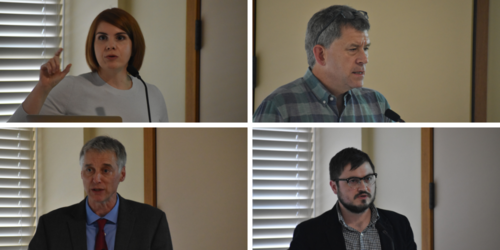
Image
From top left, clockwise: Lauren Hansen Restrepo, James Millward,, Darren Byler and Gardner Bovingdon.
James Millward, professor of Inter-societal history at Georgetown University’s Walsh School of Foreign Service, reviewed the historical background for the PRC assault on non-Han or non-Chinese culture in Xinjiang. Beginning in the early 2000s, the assault has included the razing of old Kashgar; the discouraging and then illegalizing of Muslim symbols such as head gear, prayer, and fasting in Ramadan; the disappearance of Uyghur script; and the securitization of the province by using police patrol, surveillance technologies, facial recognition, and biodata monitoring. The PRC hasn’t applied a single, top-down ethnic policy in Xinjiang, said Millward, but rather has rolled out different tactics it experimented with on local levels in different areas.
Lauren Hansen Restrepo, assistant professor in growth and structure of cities at Bryn Mawr College and an expert on Chinese development planning and urbanization in Xinjiang, explained how we got to the current crisis in the region by connecting seemingly disparate phenomena. She described the shifts in state power in Xinjiang and how, since 2014, “regional planning has broken every logic of urban planning in China,” resulting in the isolation and subordination of Uyghur-dominated urban centers and in the ossification of cities, as control has been seized from local governments and given to socialist land masters.
Anthropologist Darren Byler, whose research focuses on Uyghur dispossession and "terror capitalism" in the city of Ürümchi, the capital of Xinjiang, explained how, amid mass migration of Han people into the resource-rich region, Uyghurs had mostly been excluded from the new economy and how their identity as contemporary Muslims supported a vibrant public sphere not controlled by the state. The Chinese state, in turn, has merged Islamism with radicalism extremism. From the Chinese state and industry perspective, Byler said, the repression of Xinjiang’s Muslims promises stability and the detention camps are used as carriers of economy and new sources of cheap labor.
Indiana University’s Gardner Bovingdon, whose research focuses on politics in contemporary Xinjiang and the region’s modern history, reverted to the question of how we got to the current crisis, which he characterized as “one of the great state-engineered human rights disasters of our time.” He argued that, in the case of Xinjiang, the Chinese party transported and exacerbated a set of policies that had previously been applied to dealing with the Tibet problem. These policies, Bovingdon suggested, “are signs of a flailing, terrified party that doesn’t know what to do with Uighurs, but also feels no constraints from the international community on its behavior. And so the biggest problem now is to find a way to put constraints on a system that has operated untrammeled with devastating consequences.”
The panel "Xinjiang’s Muslims and the PRC" was cosponsored with the Center for Democracy, Development and the Rule of Law.
Hero Image
Clockwise from upper left: Relatives of alleged extrajudicial killings wear veils as they take part in a protest versus the drug war killings outside the military and police headquarters on July 17, 2019 in Manila, Philippines (Photo credit: Ezra Acayan/Getty Image); Workers pass propaganda posters as they cycle through Hungnam Fertilizer Complex on February 4, 2019 in Hamhung, North Korea (Photo credit: Carl Court/Getty Images); Pro-democracy protesters react as police fire tear gas during a demonstration on October 20, 2019 in Hong Kong (photo credit: Anthony Kwan/Getty Images); A mix of ethnic Uyghur and Han shopkeepers hold large wooden sticks as they are trained in security measures on June 27, 2017 next to the old town of Kashgar, in the far western Xinjiang province, China (photo credit: Kevin Frayer/Getty Images).
Shorenstein APARCStanford UniversityEncina Hall E301Stanford, CA 94305-6055
0
rgalt71@stanford.edu
Visiting Scholar at APARC
2019-2020 Lee Kong Chian NUS-Stanford Fellow on Contemporary Southeast Asia
rosalind_galt.jpg
Ph.D.
Rosalind Galt joined the Walter H. Shorenstein Asia-Pacific Research Center (Shorenstein APARC) in Fall 2019 from King’s College London, where she is a professor of Film Studies.
Her research broadly addresses the relationships between world cinema and geopolitics, including European cinema’s responses to the end of the Cold War and the global financial crisis; colonialism’s impact on film aesthetics; and cinema’s engagement with sexual and gender dissidence as a mode of globalization. During her time at Shorenstein-APARC, Galt conducted research for a book on the role of the popular Malay figure of the pontianak, or female vampire, in cultures of decolonization in Malaysia and Singapore.
Galt is the author of Queer Cinema in the World, coauthored with Karl Schoonover (2016), Pretty: Film and the Decorative Image (2011), and The New European Cinema: Redrawing the Map (2006), and the coeditor of Global Art Cinema: New Theories and Histories (2010).
She holds a PhD in Modern Culture and Media from Brown University and an MA (Hons) in Film and Television Studies and English Literature from the University of Glasgow.
Kenichiro Shino is a global affiliate visiting scholar at the Walter H. Shorenstein Asia-Pacific Research Center (Shorenstein APARC) for 2019-20. Shino has twelve years of experience as a news reporter at The Asahi Shimbun, the national leading newspaper company in Japan. Prior to joining Shorenstein APARC, he had mainly covered business news, with a focus on technology, and interviewed many people ranging from executives of large companies to entrepreneurs. He is also interested in the use of technology for journalism. After the Great East Japan Earthquake of 2011 and the Kumamoto Earthquake of 2016, Shino analyzed online data to learn what victims needed and created a visual summary of the results on a webpage with his co-workers. His research at Stanford is exploring the possibilities and application of reporting through data.
STANFORD, CA, May 21, 2019 — Stanford University’s Walter H. Shorenstein Asia-Pacific Research Center (APARC) announced today that the esteemed journalist Maria Ressa is the recipient of the 2019 Shorenstein Journalism Award. Ressa, the cofounder, CEO, and executive editor of the Philippine news platform Rappler, has been a highly-regarded journalist in Asia for more than thirty years and commended worldwide for her courageous work in fighting disinformation and attempts to silence the free press. Presented annually by APARC, the Shorenstein award is conferred upon a journalist who has contributed significantly to greater understanding of Asia through outstanding reporting on critical issues affecting the region. Ressa will receive the award at a ceremony at Stanford in fall quarter 2019.
Ressa spent nearly two decades at CNN, where she was lead investigative reporter focusing on terrorism in Southeast Asia and served as the network’s bureau chief in Manila, then Jakarta. She then became head of news and current affairs at ABS-CBN, the largest media network in the Philippines. Her work aimed to redefine journalism by combining traditional broadcast and new media for social change. In 2012, Ressa launched Rappler, turning it into one of the Philippines’ most influential news organizations and integrating data, content, and new technologies to promote public service journalism and civic engagement. With a commitment to editorial independence, Rappler has often produced critical coverage of Philippines President Rodrigo Duterte’s controversial policies and actions. In response to these reports, Duterte and his government have repeatedly targeted Rappler and Ressa with threats and lawsuits. Ressa has been arrested twice in recent months.
“Maria Ressa is a champion of digital journalism innovation, and a paragon of protecting democracy and speaking truth to power,” said Gi-Wook Shin, Shorenstein APARC director. “For decades, before she became internationally acclaimed for her brave fight to ‘hold the line,’ Maria’s work had provided deep insights into the complexities of Southeast Asia based on her nuanced knowledge, investigative skills, and the ability to draw upon them to connect with audiences around the world. We are honored to recognize her with the Shorenstein Journalism Award.”
Ressa has taught courses in politics and the press in Southeast Asia for her alma mater, Princeton University, and in broadcast journalism for the University of the Philippines. She is the author of two books: From Bin Laden to Facebook (2012), which traces the spread of terrorism from the training camps of Afghanistan to Southeast Asia and the Philippines, and Seeds of Terror: An Eyewitness Account of Al-Qaeda’s Newest Center of Operations in Southeast Asia (2003), which documented the changing tactics of Al-Qaeda and its next-generation roots in the Muslim strongholds in the Philippines and Indonesia.
The Shorenstein Journalism Award, which carries a $10,000 cash prize, honors the legacy of APARC’s benefactor, Mr. Walter H. Shorenstein, and his twin passions for promoting excellence in journalism and understanding of Asia. APARC recently introduced a new selection committee for the award that presides over the judging of nominees and honoree selection. “We are grateful to the Shorenstein family for its support of our Center and its mission, and to our selection committee members for their expertise and service,” noted Shin. “Our sincere thanks also to the members of the award’s previous jury for their contributions over the years.”
The independent selection committee for the Shorenstein Journalism Award, which unanimously chose Ressa as the 2019 honoree, includes Wendy Cutler, Vice President and Managing Director, Washington, D.C. Office, Asia Society Policy Institute; James Hamilton, Hearst Professor of Communication, Chair of the Department of Communication, and Director of the Stanford Journalism Program, Stanford University; Raju Narisetti, Director of the Knight-Bagehot Fellowship in Economics and Business Journalism and Professor of Professional Practice at Columbia Journalism School; Philip Pan, Asia Editor, The New York Times; and Prashanth Parameswaran, Senior Editor, The Diplomat.
“Maria Ressa is recognized around the world as a stellar leader in accountability journalism,” said committee member James Hamilton. “As an investigative reporter at CNN, she shed light on terrorism’s threats in Southeast Asia. In cofounding and leading the online news outlet Rappler, she’s brought attention to contentious politics and policies in the Philippines even as she endured politically motivated arrests for her coverage.”
Ressa has earned multiple honors and awards by professional peers and international press freedom organizations, including the Golden Pen of Freedom Award from the World Association of Newspapers and News Publishers, the Knight International Journalism Award of the International Center for Journalists, the Gwen Ifill Press Freedom Award of the Committee to Protect Journalists, the Free Media Pioneer Award from the International Press Institute, the National Democratic Institute’s Democracy Award, and the 2018 Time magazine Person of the Year.
Seventeen journalists have previously received the Shorenstein award, including most recently Anna Fifield, the Washington Post’s Beijing Bureau Chief and long-time North Korea watcher; Siddharth Varadarajan, founding editor of the Wire and former editor of the Hindu; Ian Johnson, a veteran journalist with a focus on Chinese society, religion, and history; and Yoichi Funabashi, former editor-in-chief of the Asahi Shimbun.
Information about the 2019 Shorenstein Journalism Award ceremonies featuring Ressa will be forthcoming in the fall quarter.
On the heels of the abrupt ending of the Hanoi summit between President Trump and North Korean leader Kim Jong Un, with the future of the diplomacy of denuclearization in question, the Korea Program at Shorenstein APARC convened the 11th Koret Workshop, appropriately titled this year “North Korea and the World in Flux.”
The workshop, an annual gathering made possible through generous funding from the Koret Foundation, brought together international experts in Korean affairs for a full day of panel discussions. Participants assessed the U.S.-DPRK summit diplomacy, examined the challenges and opportunities in media coverage related to the negotiations between the two countries, and considered the prospects and pitfalls for summitry with North Korea in the near term. A report on the workshop proceedings is forthcoming.
At a midday public keynote, General Vincent Brooks, U.S. Army (Ret.), spoke before a packed audience about the challenges and opportunities in Korea. Brooks, who recently retired from active duty as the four-star general in command of all U.S. Forces in Korea, provided his unique and very-timely assessment of the situation on the Korean peninsula, and offered his insights on where the diplomacy of denuclearization may go next.
STANFORD, CA, March 11, 2019 — The Walter H. Shorenstein Asia-Pacific Research Center (APARC), Stanford University’s hub for interdisciplinary research, education, and engagement on contemporary Asia and the sponsor of the Shorenstein Journalism Award for excellence in coverage of the Asia-Pacific, is pleased to introduce an all-new selection committee for the award, comprising diverse journalistic and Asia expertise. APARC now welcomes nominations for the 2019 award. The deadline for nomination submissions is 5pm Pacific time on Friday, March 29, 2019.
An annual tradition since 2002, the Shorenstein Journalism Award carries a cash prize of US $10,000 and recognizes outstanding veteran journalists who have spent their careers helping audiences around the world interpret the complexities of the Asia-Pacific region. It honors the legacy of APARC’s benefactor, Mr. Walter H. Shorenstein, and his twin passions for promoting excellence in journalism and understanding of Asia. “With this award we are committed to advancing journalism that persistently and courageously seeks accuracy, deep reporting, and nuanced U.S.-Asia dialogue,” said APARC Director Gi-Wook Shin.
Over the course of its history, the award has recognized world-class journalists who push the boundaries of coverage of the Asia-Pacific region and help advance mutual understanding between audiences in the United States and their Asian counterparts. Recent honorees include Anna Fifield, Caixin Media, Ian Johnson, Jacob Schlesinger, Siddharth Varadarajan, and Aung Zaw. The award alternates between recipients whose work has mostly been published through American news media and recipients whose work has mostly been conveyed through news media in one or more parts of the Asia-Pacific region. The 2019 award will recognize a recipient from the latter category, which oftentimes includes candidates who work at the forefront of the battle for press freedom.
APARC has recently assembled a new selection committee for the award that presides over the judging of nominees and is responsible for the selection of honorees. “I am delighted to welcome our new committee members who have all distinguished themselves in their careers and bring expertise across journalism, policy, and Asia research and reporting,” noted Director Shin.
The selection committee for the Shorenstein Journalism Award includes Wendy Cutler, Vice President and Managing Director, Washington, D.C. Office, Asia Society Policy Institute; James Hamilton, Hearst Professor of Communication, Chair of the Department of Communication, and Director of the Stanford Journalism Program, Stanford University; Raju Narisetti, Director of the Knight-Bagehot Fellowship in Economics and Business Journalism and Professor of Professional Practice at Columbia Journalism School; Philip Pan, Asia Editor, The New York Times; and Prashanth Parameswaran, Senior Editor, The Diplomat.
For the Shorenstein award, the Asia-Pacific region is defined broadly to include Northeast, Southeast, South, and Central Asia and Australasia. Both individual journalists with considerable body of work and journalism organizations are eligible for the award. Nominees’ work may be in traditional forms of print or broadcast journalism and/or in new forms of multimedia journalism. APARC is seeking 2019 award nomination submissions from editors, publishers, scholars, journalism-related associations, and entities focused on researching and interpreting the Asia-Pacific region. The award will be presented by APARC at Stanford in the Autumn quarter of 2019.
For complete details about the award, nominations and procedures, and past winners, please visit the Shorenstein Journalism Award page. Submissions are accepted electronically through 5pm Pacific time on Friday, March 29, 2019, via an online form.
About the Walter H. Shorenstein Asia-Pacific Research Center
The Walter H. Shorenstein Asia-Pacific Research Center (Shorenstein APARC) addresses critical issues affecting the countries of Asia, their regional and global affairs, and U.S.-Asia relations. As Stanford University’s hub for the interdisciplinary study of contemporary Asia, APARC produces policy-relevant research, provides education and training to students, scholars, and practitioners, and strengthens dialogue and cooperation between counterparts in the Asia-Pacific and the United States. Founded in 1983, APARC today is home to a scholar community of distinguished academics and practitioners in government, business, and civil society, who specialize in trends that cut across the entire Asia-Pacific region. For more information, visit https://aparc.fsi.stanford.edu.