Education
Authors
News Type
News
Date
Paragraphs

South Korea is facing a number of challenges. Not unlike other advanced economies in Asia, the country is confronted with a declining working-age population, reduction in birth rates, and risk of long-term stagnation.

A team of Stanford researchers at Stanford’s Shorenstein Asia-Pacific Research Center (APARC), in collaboration with other scholars from around the world, is increasingly thinking about those challenges and is working on a number of research initiatives that explore potential solutions in leveraging benefits from globalization.

The researchers propose that Korea can extract value from two major movements of people – outflows of its own population (diaspora) and inflows of foreigners (immigrants and visitors), all of whom hold the capacity to build social capital – a network of people who have established trust and in turn spread ideas and resources across borders.

Engaging diaspora

Emigration is traditionally viewed as a loss of human capital – ‘brain drain’ – movement of skills out of one country and into another, but Stanford professor Gi-Wook Shin and Koret Fellow Joon Nak Choi support an alternative view of outward flows of citizens.

Shin and Choi suggest that people who leave their countries of origin but never return can still provide value to their home country through ‘brain linkage,’ which advocates that there is economic opportunity in cross-national connections despite a lack of physical presence. This concept is a focus of their research which was recently published in the book Global Talent: Skilled Labor and Mobility in Korea.

“What we’re trying to do is to extend the thinking – to not just look at potential losses of having your people go abroad but also the potential gains,” Choi said. “Previous studies have found that if you have more of these relationships or ‘brain linkages,’ you have more trade and more flow of innovations between countries.”

People who stay in a host country become participants in the local economy and often conduct influential activities such as starting companies, providing advice and sitting on boards of directors, Choi said, and these transactions enact flows of resources from home country to host country and vice versa.

Choi, who outside of his fellowship is an assistant professor at Hong Kong University of Science and Technology, said that this way of thinking pulls away from a zero-sum view of the world and instead sees it as “more globalized, cosmopolitan and diffuse.”

He leads a research project with Shin focused on global talent and cultural movement in East Asia, and over the past quarter, taught a graduate seminar on the Korean development model.

“Cross-national ties are harder to establish than those that are geographically close, but they provide invaluable means of sharing information and brokering cooperation that may otherwise be impossible on other levels,” said Shin, who is also the director of Shorenstein APARC. “In many ways, social ties can be a good strategy to gain a competitive edge. This is an area we endeavor to better understand through our research efforts on Korea.”

Shin has described his own identity of being a part of the very system they are studying. He grew up in Korea, arrived in the United States as a graduate student and has since stayed for three decades and frequently engages the academic and policy communities in Korea.

One cross-national initiative that he recently started is a collaborative study between scholars at Shorenstein APARC and Kyung Hee University in Seoul. The two-year study evaluates the social capital impact of a master’s degree program at the Korean university that trains select government officials from developing countries.


Image
internationalization embed 1

An international cohort including many researchers from Stanford’s Shorenstein Asia-Pacific Research Center have been conducting group interviews with international students at Korean and Japanese universities to better understand their motivations to stay or go following their completion of a degree or non-degree program at Korean universities. Their initial results reveal that gaps in cross-cultural understanding and opportunities cause feelings of disassociation, but recent internationalization efforts are helping to address those gaps and support innovation, knowledge sharing and local economic growth. An op-ed on the topic authored by Stanford professor Gi-Wook Shin and Yonsei University associate professor Rennie Moon can be viewed here. Credit: Flickr/SUNY – Korea/crop and brightness applied


Harnessing foreign skilled labor

Globalization has also led to migration of people to regions that lack an adequate supply of skilled workers in their labor force. This new infusion of people is an opportunity to bridge the gap, according to the researchers.

“In order to be successful, countries need a large talented labor pool to invest in,” said Yong Suk Lee, the SK Center Fellow in the Freeman Spogli Institute for International Studies and affiliate of the Korea Program. “Innovation is not something like a technology ladder which has a more obvious and strategic trajectory, it’s more about investing in people and taking risks on their ideas.”

Korea currently has a shortage of ‘global talent’ – individuals who hold skills valuable in the international marketplace. Yet, Korea is well positioned to reduce the shortage.

The country produces a vast amount of skilled college graduates. Nearly 70 percent of Koreans between the age of 25 and 34 have the equivalent of a bachelor’s degree. Korea has the highest percentage of young adults with a tertiary education among Organisation for Economic Co-operation and Development (OECD) countries. Another study found that the foreign student population in Korea has risen by 13 percent in the past five years.

Universities are moving to “internationalize” in seeking to both recruit faculty and students from abroad and to retain them as skilled workers in the domestic labor force. A new book published by Shorenstein APARC Internationalizing Higher Education in Korea: Challenges and Opportunities in Comparative Perspective assesses efforts by institutions in Korea, China, Japan, Singapore and the United States through nine separately authored chapters.


[[{"fid":"223565","view_mode":"crop_870xauto","fields":{"format":"crop_870xauto","field_file_image_description[und][0][value]":"","field_file_image_alt_text[und][0][value]":false,"field_file_image_title_text[und][0][value]":false,"field_credit[und][0][value]":"","field_caption[und][0][value]":"","field_related_image_aspect[und][0][value]":"","thumbnails":"crop_870xauto"},"type":"media","field_deltas":{"2":{"format":"crop_870xauto","field_file_image_description[und][0][value]":"","field_file_image_alt_text[und][0][value]":false,"field_file_image_title_text[und][0][value]":false,"field_credit[und][0][value]":"","field_caption[und][0][value]":"","field_related_image_aspect[und][0][value]":"","thumbnails":"crop_870xauto"}},"link_text":null,"attributes":{"width":"870","class":"media-element file-crop-870xauto","data-delta":"2"}}]]


Shin and Yonsei University associate professor Rennie Moon, who served as book editors and chapter authors, found that Korea has on average more outbound students (students who leave Korea to study elsewhere) than inbound students (international students who come to Korea to study). The figure above compares five countries and finds that Korea and China are more outbound-driven while Singapore, Japan and the United States are more inbound-driven.

“For most national and private universities in Korea, internationalization is more inbound-oriented—attracting foreign students, especially from China and Southeast Asia,” said Yeon-Cheon Oh, president of Ulsan University and former Koret Fellow at Shorenstein APARC who co-edited Internationalizing Higher Education in Korea. “In many ways, it’s about filling up students numbers. There needs to be a balance in inbound and outbound student numbers in order for internationalization to have an optimal effect.”

International students that do come to Korea are on average not staying long after graduation, though. The researchers identify reasons being difficulty in adapting to the local culture, inability to attain dual citizenship, language barriers, and low wages in comparison to that of native Koreans; in short – it is not easy to assimilate fully.

These and other barriers facing foreigners in Korea are a focus of a broader research project led by Shin and Moon that aims to propose functional steps for policymakers striving to internationalize their countries and to shift the discourse on diversity.

Developing a narrative

The Korean government has expanded efforts to recruit foreign students to study at Korean universities – many of which now rank in the top 200 worldwide – but addressing education promotion is only one area.

“The challenge is to propose a pathway that rallies around a general narrative,” Lee said, citing a need for internationalization to be coordinated across immigration policy, labor standards, and social safety nets.

An international group of experts in Korean affairs gathered at Stanford earlier this year at the Koret Workshop to address the challenge of creating a cohesive narrative, focused on Korea as the case study. The Koret Foundation of San Francisco funds the workshop and fellowship in its mission to support scholarly solutions to community problems and to create societal and policy change in the Bay Area and beyond.


Image
internationalization embed 3

The Koret Workshop brings together an international panel of experts on Korean affairs at Stanford. From 2015-2016, the workshops focused on higher education, globalization and innovation in Korea. Above, Michelle Hsieh (far right) speaks during a question and answer session following her presentation on Korean and Taiwanese small and medium enterprises, next to her is former U.S. Ambassador to the Republic of Korea Kathleen Stephens, Stanford consulting professor Richard Dasher, former U.S. foreign affairs official David Straub, and Korea University professor Myeong Hyeon Cho.


The interdisciplinary nature of the workshop was an important aspect, according to Lee, and Michelle Hsieh, one of 27 participants of the conference that covered a range of areas from entrepreneurship to export promotion policies in Korea.

“The workshop demonstrated how internationalization of higher education – and academic research in general – can be achieved by constructing cross-cutting ties,” said Hsieh, who was a postdoctoral fellow at Shorenstein APARC from 2006-07 and is now an associate research fellow at Academia Sinica in Taiwan.

“Participating in the workshop made me realize I really miss the lively and rigorous discussions at Shorenstein APARC, where researchers are interdisciplinary with diverse backgrounds yet focused on a common research interest,” Hsieh said. “I think debate and discussion in that kind of setting can illuminate a completely different take.”

The workshop will result in a book that features multiple areas and policy directions for Korea’s development. The lessons included are also envisioned to apply to other emerging countries facing similar trends of demographic change and economic slowdown. Shorenstein APARC expects to publish the book next year.

Hero Image
internationalization headline
Getty Images
All News button
1
Paragraphs

This book discusses issues in large-scale systems in the United States and around the world. The authors examine the challenges of education, energy, healthcare, national security, and urban resilience. The book covers challenges in education including America's use of educational funds, standardized testing, and the use of classroom technology.  On the topic of energy, this book examines debates on climate, the current and future developments of the nuclear power industry, the benefits and cost decline of natural gases, and the promise of renewable energy. The authors also discuss national security, focusing on the issues of nuclear weapons, terrorism and cyber security.  Urban resilience is addressed in the context of natural threats such as hurricanes and floods.

All Publications button
1
Publication Type
Books
Publication Date
Journal Publisher
Wiley (1st edition)
Authors
Elisabeth Paté-Cornell
Authors
News Type
News
Date
Paragraphs

All things Korean – economics, culture, politics – are the subject of an educational conference on campus this week.

The fifth annual Hana-Stanford Conference on Korea for U.S. Secondary School Teachers takes place July 25 to 27 in Paul Brest Hall. The meeting brings together American teachers and educators from Korea for discussions on how Korean history, economics, North Korea, foreign policy and culture are covered in American schools.

From lectures to curriculum workshops and classroom resources, the attendees will deep-dive into conversations, information and resources made available by the Stanford Program on International and Cross-Cultural Education (SPICE) and the Korea Program, which hosts the event.

Gi-Wook Shin, director of Stanford’s Walter Shorenstein Asia-Pacific Research Center, said that Korea is a country often overlooked or understudied in U.S. secondary schools.

“The Hana-Stanford Conference provides an excellent opportunity for U.S. secondary school teachers to learn about Korea and return to their classrooms better equipped with teaching materials and knowledge about Korea, as well as with the confidence and motivation to incorporate what they have learned from the conference into their curricula,” he said.

Shin said that exposing more American students to Korea “nurtures in students more balanced and complete perspectives on the world.” Korea, after all, he noted, is an important U.S. ally.

Discussions will cover an array of topics, including Korea’s major historical themes; World War II memories in northeast Asia; English education in Korea; Korea’s relationship with the U.S.; Korean literature; and the lives of Korean teenagers and young people. Scheduled speakers include Yong Suk Lee, the SK Center Fellow at Stanford’s Freeman Spogli Institute for International Studies, and Kathleen Stephens, a former U.S. ambassador to South Korea.

Such conversations are important, as how one teaches history shapes contemporary society. Gary Mukai, director of SPICE, said that one of the curriculum units demonstrated at the conference each year is “Divided Memories: Examining History Textbooks.”

“The unit introduces the notion that school textbooks provide an opportunity for a society to record or endorse the ‘correct’ version of history and to build a shared memory of history among its populace,” Mukai said.

He noted that American and Korean teachers’ examination of textbook entries about the Korean War from U.S., Japanese, Korean, Taiwanese and Chinese textbooks challenged their assumptions and perspectives about the war.

Also, during the conference, the Sejong Korean Scholars Program, a distance-learning program on Korea sponsored by SPICE, will honor American high school students and give them the opportunity to present research essays.

Clifton Parker is a writer for the Stanford News Service. This article has been updated to reflect a different speaker and additional program sponsor.

Hero Image
hana stanford conference 2014 headline
Students in conversation at the Hana-Stanford Conference on Korea for U.S. Secondary School Teachers. The conference, now in its fifth year, brings together an international group of teachers and students in cross-cultural exchange. | Rod Searcey
All News button
1
News Type
News
Date
Paragraphs

The Walter H. Shorenstein Asia-Pacific Research Center (APARC), a Stanford hub focused on the interdisciplinary study of contemporary Asia, has been awarded a commendation from the Ministry of Foreign Affairs of Japan, the country’s official government arm that conducts its foreign policy.

The annual award recognizes individuals and organizations that have promoted mutual understanding between Japan and the United States, and among other countries and regions. Shorenstein APARC, part of the Freeman Spogli Institute for International Studies, is one of four award recipients in the Bay Area and of 173 total recipients around the world.

“It is a great honor to receive an award given on behalf of the Japanese foreign minister,” said Gi-Wook Shin, director of Shorenstein APARC and professor of sociology. “We strive to advance research and dialogue between Japan and the United States, and this commendation serves to further motivate us in our efforts.”

The research center has a program that facilitates social science-oriented research on contemporary Japan, and convenes outreach activities closely tied to its research agenda.

In the past year, the center hosted 10 visiting fellows from Japan through its corporate affiliates program; a workshop in Tokyo with scholars and former government officials focused on the U.S.-Japan security alliance; and a public panel discussion at Stanford on U.S.-Japan relations in conjunction with the conferral of the Shorenstein Journalism Award.

Faculty and students also participated in the visit of Japanese Prime Minister Shinzo Abe to Stanford in April 2015. Abe was the first prime minister of Japan to visit the university and spoke on innovation.

On Oct. 28, the award was presented to the center at a ceremony held by the Consulate General of Japan in San Francisco. Shorenstein APARC faculty and affiliates in attendance included Michael Armacost, Shorenstein APARC distinguished fellow and former U.S. ambassador to Japan; Donald Emmerson, FSI senior fellow emeritus; Thomas Fingar, Shorenstein APARC distinguished fellow; Takeo Hoshi, FSI senior fellow and director of Shorenstein APARC's Japan Program; Gi-Wook Shin; Daniel Sneider, associate director for research; Kathleen Stephens, the William J. Perry Distinguished Fellow; and Xueguang Zhou, professor of sociology.

Hero Image
us japan journalism
All News button
1
Authors
News Type
News
Date
Paragraphs

A new course jointly taught by Stanford and Peking University brought together students and scholars in China and the United States in dialogue using videoconferencing.

Each week during the past spring quarter, students at Stanford and Peking University (PKU) gathered in a classroom to learn, just as they would for any other course. The only difference was these students were neither in the same classroom nor on the same continent.

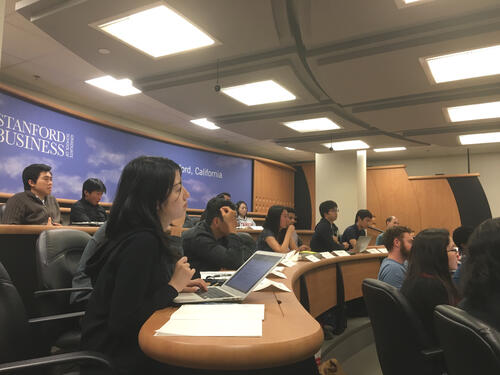
Despite being separated by nearly 6,000 miles, 18 students in Palo Alto and 28 students in Beijing held ‘face-to-face’ conversations via high definition videoconference in a course taught by American and Chinese scholars. On each side, they sat in a three-rowed amphitheater and looked directly ahead – not at a whiteboard – but at a screen that projects a video ‘wall’ of their colleagues at the other campus. The venue, known as a ‘Highly Immersive Classroom,’ enabled the distance learning experience between the two universities, using advanced software to create a cross-Pacific virtual classroom. The course titled The United States, China, & Global Security, led by former U.S. Ambassador to Afghanistan Karl Eikenberry and PKU professor Fan Shiming, was organized under the auspices of the U.S.-Asia Security Initiative whose research focuses on security challenges in Asia with teaching as one of its core activities.

“We set out to host a course that addressed topics critical to China and the United States in a new type of classroom format,” said Eikenberry, the Oksenberg-Rohlen Distinguished Fellow in the Shorenstein Asia-Pacific Research Center and director of the Initiative. “What resulted was a truly unique academic exchange that considered topics even beyond the bilateral relationship and carried a certain ‘Silicon Valley spirit’ being divided by an ocean yet connected through technology.”

“I loved the cybersecurity class because there was a lot of candor on both sides.”

-Shan Jee Chua, PKU graduate student

Over eight weeks, a select group of graduate students from the two universities explored a wide array of subjects related to international security, ranging from terrorism to trade and energy and the environment. The course aimed to provide students with a forum to discuss current issues in U.S.-China relations and to analyze areas that could be applied to other case studies. 

“Because each week was a different topic, it didn’t feel like I was just thinking about the United States and China again every Wednesday night,” said Sam Ide, a Stanford graduate student who studies China’s relations with Central Asia. “Each session was very interesting to me in a different way.”

Guest-taught by prominent scholars and former senior government officials from the United States and China, the course sessions allocated thirty minutes for each lecturer to present, followed by a thirty minute question-and-answer period in which students were given the opportunity to interact with the lecturers and their peers on the other campus. Lecturers from Stanford included nuclear scientist Siegfried Hecker, former U.S. Secretary of Energy Steven Chu, and Thomas Fingar, a former deputy director at the U.S. Office of the Director of National Intelligence; and from PKU, Dean of the School of International Studies Jia Qingguo, and arms control and disarmament expert Han Hua. All discussions were off-the-record to encourage candid exchange of ideas. 


Image
course 3

At Stanford's Highly Immersive Classroom in Palo Alto, students look ahead at their counterparts in Beijing.


One course session in particular resonated with students. The session, taught by Zha Daojiong, a professor of political economy at PKU and Herbert Lin, a senior research scholar at Stanford’s Freeman Spogli Institute for International Studies, focused on the changing nature and future of cybersecurity relations between China and the United States.

“I loved the cybersecurity class because there was a lot of candor on both sides,” PKU student Shan Jee Chua recalled.

Kimberly Chang, a second year Stanford graduate student in management science and engineering, noted that it was beneficial to hear the Chinese view on cyber “because most of the talk within the United States has been from an American perspective.”

“Hopefully, I'll be able to meet some of these people in real life who I've met on the 'wall.'”

-Sam Ide, Stanford graduate student

The course revealed a broader range of perspectives and provided a chance to interact first-hand with international colleagues while remaining at their home campus. Discussion amongst peers uncovered the “behind the scenes stories” and added context to media reports found online or in print, said Seung Kim, a student in Stanford’s East Asian studies program.

Besides the technology, a unique aspect of the course was its diversity. More than half of the course participants were international, representing 15 countries beyond China and the United States. That setting encouraged debate and reinforced the notion that “neither the United States nor China is the center of the universe,” said Zhu Jun Zhao, a PKU international relations student.

When students were asked what could bring about better understanding between China and the United States, continued dialogue was a common answer. The future of U.S.-China relations rests in the hands of people talking to one another: “I think we need more honest conversations,” Chang said.

And for some students, an opportunity to hold those conversations in-person may be close. Ide said he anticipates traveling to Beijing over the summer and plans to try and meet with a few of his counterparts whom he met through the course.

“Hopefully, I’ll be able to meet some of these people in real life who I’ve met on the ‘wall.’”

Related Links:

Video showcases SCPKU's Highly Immersive Classroom enabling co-teaching across the Pacific

Hero Image
course 2
At the Stanford Center at Peking University in Beijing, Peking University professor Fan Shiming presents his remarks during a session of "The United States, China, & Global Security," a joint course taught by Stanford and Peking University via videoconference; Palo Alto, May 2016.
All News button
1
Paragraphs

No nation is free from the charge that it has a less-than-complete view of the past. History is not simply about recording past events—it is often contested, negotiated, and reshaped over time. The debate over the history of World War II in Asia remains surprisingly intense, and Divergent Memories examines the opinions of powerful individuals to pinpoint the sources of conflict: from Japanese colonialism in Korea and atrocities in China to the American decision to use atomic weapons against Japan.

Rather than labeling others' views as "distorted" or ignoring dissenting voices to create a monolithic historical account, Gi-Wook Shin and Daniel Sneider pursue a more fruitful approach: analyzing how historical memory has developed, been formulated, and even been challenged in each country. By identifying key factors responsible for these differences, Divergent Memories provides the tools for readers to both approach their own national histories with reflection and to be more understanding of others.


"A well-written investigation on the legacy of World War II in Asia, greatly contributes to the field of cultural and military history.”Mel Vasquez, H-War

"This book is an important counterweight to prevailing tendencies that promote uncritical nationalism and is thus an invaluable resource for this generation’s Asian and American youth to gain a critical understanding of their national histories...[T]he authors’ non-judgmental approach, coupled with persistence in pursuing the multiple interpretations and experiences of these traumatic events, provoke a reconsideration of our notions of justice, equality, and humanity within our nationalist thinking."—Grace Huang, Journal of American-East Asian Relations, Vol. 26.2


This book is part of the Studies of the Walter H. Shorenstein Asia-Pacific Research Center series at Stanford University Press.

All Publications button
1
Publication Type
Books
Publication Date
Journal Publisher
Stanford University Press
Authors
Gi-Wook Shin
Daniel C. Sneider
Paragraphs
The cover image of "Internationalizing Higher Education," which shows abstract students carrying books, moving in different directions.

Student mobility in Asia has reached unprecedented levels. Inbound and outbound student mobility creates opportunities for Asian societies but also challenges, such as growing diversity and brain drain. This book examines these and other related, timely issues for the case of South Korea, a major player in the internationalization of higher education in Asia, and draws on the comparative experiences of other key players in the Asia-Pacific region—Japan, China, Singapore, and the United States. By doing so, it offers critical perspectives on the internationalization of Korean higher education as well as innovative, policy-relevant solutions for Asian countries undergoing similar challenges.  It will be a valuable addition to the growing literature on comparative and international education in Asia and can aid university administrators and policymakers striving to internationalize their higher education systems to meet new challenges.

Desk, examination, or review copies can be requested through Stanford University Press.

 
All Publications button
1
Publication Type
Books
Publication Date
Subtitle

Challenges and Opportunities in Comparative Perspective

Authors
Gi-Wook Shin
Book Publisher
Shorenstein APARC
Authors
Gary Mukai
News Type
News
Date
Paragraphs

For four decades since 1976, the SPICE staff has worked with many centers of Stanford Global Studies (SGS)—including the Center for Russian, East European, and Eurasian Studies, Center for East Asian Studies, Center for Latin American Studies, and Center for African Studies—on innovative educational outreach efforts. The 2015–16 academic year was no exception.

During 2015–16, SGS’s Education Partnership for Internationalizing Curriculum (EPIC) Fellowship Program supported nine community college faculty from Foothill College and the College of San Mateo. The inaugural cohort of EPIC Fellows collaborated with SGS, Lacuna, and SPICE on projects aimed at internationalizing course curricula and producing innovative curricular materials for use in community college classrooms.

SPICE's Jonas Edman worked with two EPIC Fellows, Michele Titus and Tania Beliz from the College of San Mateo. As EPIC Fellows, Titus and Beliz received stipends and access to Stanford Library resources. In addition to producing the projects, they participated in monthly meetings, served as liaisons to their college, presented their work at their college, and shared their projects at the EPIC Fellows Symposium, which was held on May 14, 2016. In addition, the EPIC Fellows were invited to attend half-day seminars that featured talks by Francis Fukuyama (governance), Walter Falcon (food security), and Gordon Chang (U.S.–China relations) and curriculum demonstrations on all three topics by Edman.

The EPIC Fellows Symposium, which featured presentations by the nine EPIC Fellows, was attended by over 50 California community college instructors from as far north as Shasta College in Redding to Santa Ana College and Santa Monica College in southern California. The presentations by Beliz and Titus during the Symposium stimulated a robust discussion.

Beliz focused her EPIC project on integrating the latest research on biodiversity and food production into her biology classes. Her work in utilizing technology to infuse international perspectives on this research into her classes inspired community college instructors to take a close look at the syllabus of one of her courses. In reviewing her syllabus, she explained that since the College of San Mateo enrolls significant numbers of students of Filipino descent, she was prompted to integrate a lecture on research on biodiversity from a scholar from the Philippines in her curriculum. Reflecting upon her experience as an EPIC Fellow, Beliz noted, “There are different and varied ways, and different depths of internationalizing curriculum. It depends on our course objectives, our vision of the message we want to impart to our students, and our own experiences in the international community… EPIC made the internationalizing of my biology classes possible in providing a platform for the project to take shape and be implemented.”

Titus’ participation in the EPIC Fellowship Program provided her with the opportunity to internationalize and revitalize the curriculum for her cultural and physical anthropology courses. Specifically, “ethnicity of diet” was investigated cross-culturally and internationally, with a special emphasis on the Tongan and Tongan-American student population at College of San Mateo. Her work with a very diverse student body prompted questions from community college instructors on topics such as culturally sensitive curriculum and culturally relevant pedagogy. Titus noted, “The EPIC Symposium was a showcase of faculty presentations that reflected the evolution of courses to broader, more global perspectives. It was a great opportunity to share my own project and to enjoy feedback from others.”

Titus, Beliz, and other EPIC Fellows appreciated the importance placed upon active and collective participation in the EPIC Fellowship Program. This may have contributed to the steady growth since fall 2015 of a community of learners comprised of the EPIC Fellows and SGS, Lacuna, and SPICE. Beliz commented, “I found our exchange of ideas thought-provoking, and after every conversation I was able to come up with more ideas about possible paths to follow. It helped that I was teaching a summer class, so after our conversations I could implement one or two of our ideas.” Titus noted, “I worked most closely with Tania Beliz… but also interacted regularly at seminars with the other faculty from the colleges and university. The Stanford group was supportive and inspiring, helping me shape my ideas into something meaningful for students.”

Most of SPICE’s work with SGS over the past 40 years has focused on elementary and secondary schools. The 2015–16 collaboration with SGS on the EPIC Fellows Program and the 2011–14 focus on the promotion of human rights education at community colleges (Stanford Human Rights Education Initiative or SHREI) have helped SPICE to expand its reach to community colleges throughout California. The EPIC Fellowship Program and SHREI could serve as models for other research universities in the United States that are recipients of U.S. Department of Education Title VI grants. To receive news about the EPIC Fellows Program, please visit SGS’s “Community Engagement” webpage. 


Hero Image
epic symposium 5 14 16
Gary Mukai, Tania Beliz, Michele Titus, and Jonas Edman at the EPIC Fellows Symposium. | Molly Aufdermauer
All News button
1
News Type
News
Date
Paragraphs

“The Friends of Beida,” a philanthropic group established in 1996 by Hong Kong entrepreneurs to support the development of Peking University, visited SCPKU on April 16 as part of their 20th anniversary celebration.  The group celebrated 20 years of partnership with Peking University which includes providing Mingde Scholarships to the top two test takers on the college entrance examinations from each province who are admitted to Peking University.  A number of past and current Mingde Scholars joined the celebration at SCPKU.  Lead donor, David Chan and his family, also have been generous supporters of Stanford.  The anniversary celebration truly used SCPKU as a bridge across the Pacific.  Leveraging the teleconferencing facilities at SCPKU and at Stanford, Jean Oi, Lee Shau Kee Director of SCPKU, speaking from Stanford welcomed David Chan and his group who were in the tiered classroom at SCPKU.  Mike McFaul, Director of Stanford's Freeman Spogli Institute for International Studies, and former US Ambassador to Russia, also speaking from Stanford presented “An Analysis of the Upcoming Presidential Election and the Political/Economical Implications to Asia Pacific” and then took questions from the group at SCPKU.  During the highly-interactive session, Michael Chan, an alumnus of Stanford, also announced his family’s generous donation to complete SCPKU's IT facilities, an upgrade that will allow teleconferencing from even more spaces within the center.


Hero Image
dsc 1547
Courtesy of Stanford University
All News button
1
Subscribe to Education