Stanford Report: The First Lady of the United States, Michelle Obama, spoke at SCPKU today and said study abroad allows students to realize that countries all have a stake in each other's success. Following her remarks, she held a conversation with students on the Stanford campu via SCPKU's Highly Immersive Classroom. Read more.
In 2016, SPICE launched its first regional online program in Japan. Today, SPICE works with local partners across Japan to offer programs that engage students in the study of U.S. society and culture, U.S.–Japan relations, and global issues. Students develop their perspectives through discussion and research and present their work at the end of their courses.
In August 2026, SPICE held four award ceremonies at Stanford University. Eighteen honorees from eight regional programs and one school-based program were recognized for their accomplishments during the 2025–26 year, including the quality of their final research projects. SPICE Director Dr. Gary Mukai welcomed guests and delivered closing remarks at each event.
The students’ visits extended beyond the ceremonies. Depending on their itineraries, groups explored San Francisco, toured Stanford’s campus, visited technology companies such as Google, Apple, and Sony, and spent time at the Computer History Museum. These experiences gave students opportunities to learn about the Bay Area and connect what they had studied online with places and people they encountered in person.
Image
The first ceremony was held on August 6, 2026, for students from Stanford e-Kobe and Stanford e-Minamata. Opening remarks were delivered by Consul Asami Chikae, Consul for Science, Technology and Education at the Consulate General of Japan in San Francisco. Stanford e-Kobe instructor Alison Harsch and Stanford e-Minamata instructor Natalie Montecino also offered opening comments before the honorees gave their presentations. The honorees are:
Stanford e-Kobe
Sakura Oe; Kobe Municipal Fukiai High School
Shotaro Take; Kobe Municipal Fukiai High School
Stanford e-Minamata
Rento Hiraishi; Minamata High School
Asuka Umekawa; Minamata High School
Image
In the second ceremony, on August 10, 2026, top students from Stanford e-Fukuoka and Stanford e-Oita were honored. Aya Nakajima, Advisor for Cultural and Educational Affairs at the Consulate General of Japan in San Francisco, delivered opening remarks. Kasumi Yamashita, instructor of both Stanford e-Fukuoka and Stanford e-Oita, also offered opening comments before the honorees presented their work. The honorees are:
Stanford e-Fukuoka
Konoha Inoyusu; Fukuoka Daichi High School
Haruki Kenyon; Kurume High School
Stanford e-Oita
Mao Hieida; Nakatsu Minami High School
Taichi Morikawa; Takada High School
Image
During the third ceremony, on August 18, 2026, students from Stanford e-Hiroshima and Stanford e-Yamaguchi were recognized. Consul Mayu Hagiwara, Director of the Japan Information and Culture Center at the Consulate General of Japan in San Francisco, offered opening remarks. Stanford e-Hiroshima instructor Rylan Sekiguchi and Stanford e-Yamaguchi instructor Jonas Edman also gave opening comments before the honorees presented their research. The honorees are:
Stanford e-Hiroshima
Konatsu Haga; Fukuyama Akenohoshi Girls’ High School
Momoka Nagayama; Hiroshima Inokuchi High School
Stanford e-Yamaguchi
Misaki Kobayashi; Keishin Senior High School
Hiroi Tomokawa; Iwakuni Senior High School
Image
The fourth ceremony was held on August 20, 2026, for honorees from Stanford e-Kagoshima City, Stanford e-Kawasaki, and Stanford e-Tottori. Daniel Busto, Coordinator of Educational Affairs at the Consulate General of Japan in San Francisco, delivered opening remarks. Stanford e-Kagoshima City instructor Amy Cheng, Stanford e-Kawasaki instructor Maiko Tamagawa Bacha, and Stanford e-Tottori instructor Jonas Edman also offered opening comments before the honorees gave their presentations. The honorees are:
Stanford e-Kagoshima City
Nayuta Nei; Kagoshima Gyokuryu High School
Shiori Nishizono; Kagoshima Girls’ High School
Stanford e-Kawasaki
Rio Hojo; Tachibana High School
Mio Suzuki; Kawasaki High School
Stanford e-Tottori
Una Ishikawa; National Institute of Technology, Yonago College
Asumi Nishimura; Tottori Nishi High School
SPICE congratulates all 18 honorees and thanks the instructors, local partners, and guests who supported and celebrated the students. The ceremonies gave the students an opportunity to share their research with an audience at Stanford and to mark the conclusion of their year of study.
Importantly, SPICE is grateful to the school, municipal, and prefectural representatives who accompanied the students to Stanford. They are Yuki Uchimura (Fukuoka); Noriyo Hayashi (Hiroshima); Takahiko Uchitani and Nanami Nomaguchi (Kagoshima); Fuka Okutani and Tracey Freyre (Kobe); Yasunori Takaki, Masha Boyko, and Kayo Fuchigami (Minamata); Keiichi Takakura and Yuki Matsumoto (Oita); Satoru Hamahashi (Tottori); and Akinobu Tomonari (Yamaguchi).
Congratulations are extended to the 2025–26 student honorees from Fukuoka Prefecture, Hiroshima Prefecture, Kagoshima City, Kawasaki City, Kobe City, Minamata High School, Oita Prefecture, Tottori Prefecture, and Yamaguchi Prefecture.
Maternal mental health issues are pervasive in rural China, yet community-based interventions are scarce. To address this gap, we developed the Thinking Healthy Extended Program, a nonspecialist-led intervention designed to promote mental health among female caregivers of children under the age of three, including mothers and grandmothers, in resource-constrained areas of China. Drawing on an adapted Stages of Implementation Science framework, this study describes the Exploration and Installation phases of a four-phase intervention development process. During the Exploration phase, we assessed caregivers’ mental health needs and preferences for intervention delivery through in-depth interviews. The Installation phase comprised three stages: developing the overall curriculum structure, identifying and validating curriculum topics, and integrating these topics into a comprehensive curriculum based on feedback from interviews, focus group discussions, and cognitive walkthroughs. The development process took place from 2022 to 2024 in a prefecture in southwestern China and involved 73 caregivers of children aged 6-36 months. The resulting 24-session curriculum integrates simplified cognitive reframing techniques, behavioral activation, caregiving skills, and peer support. This study demonstrates the feasibility of a systematic and participatory approach to developing a mental health intervention for low-resource populations.
Theories of democratic diffusion predict that exposure to liberal democracies fosters support for political liberalism, while recent studies on Chinese overseas students suggest studying abroad generates backlash against liberal values. Using a unique four-year longitudinal dataset of nearly 1,000 Chinese college students in China and the United States, we examine how studying abroad shapes students’ ideology, attitudes, and identity. Our findings challenge both perspectives. Students who study in the United States are already more politically liberal, market-oriented, and cosmopolitan, and less nationalistic than their peers upon departure, underscoring the importance of selection. Ideological preferences remain remarkably stable throughout college, regardless of location. However, support for China’s political system and affective identification with Chinese national identity declines among students in both countries from 2022 to 2023, with a greater decline among students in the United States. These results show that selection, home-country shocks, and host-country context jointly shape overseas students’ political attitudes.
The following is a guest article written by Dr. Jacob Vazquez, Interim Associate Dean of Instruction and Agribusiness Faculty member, and past Fellow of Stanford’s EPIC Community College Faculty Fellowship, one of several teacher professional development programs offered by SPICE.
My interest in agriculture started in high school, through my involvement in Future Farmers of America (FFA). That interest deepened later on, working in agriculture finance at Farm Credit, and eventually leading to my current role teaching Agribusiness at Butte College, where I get to share my passion for agriculture and agribusiness with our students.
My involvement with SPICE began through Stanford Global Studies’ EPIC Community College Leadership Program, where fellows were charged with developing global curricula for use in community college classrooms. Butte College is a rural community college in Northern California, where rice is one of the region’s most valuable commodities. I teach Agricultural Economics, a general education class taken by both agriculture majors and non-majors, and I wanted the curriculum modules to connect the agriculture we grow here in Northern California to something produced elsewhere in the world.
I built the modules around rice, comparing the industry in Butte and Glenn Counties to the industry in Japan. The two differ significantly in scale and farming method, but the crop carries economic and cultural weight in both places. With SPICE’s support and connections with the U.S. Consulate Fukuoka, part of the modules included Zoom interviews that connected students with Japanese rice farmers, including the owner of an organic farm in Saga Prefecture and a former musician who now farms rice and is developing a rice-based ice cream.
Those connections, particularly with the U.S. Consulate Fukuoka, led me to the Fulbright Specialist Program in collaboration with Kyushu Sangyo University (KSU), where SPICE has an existing program through their Stanford e-KyuSan-U Program. This past June, I traveled to Fukuoka as a Fulbright Specialist for a project titled “Seeds of Change: Empowering Community with Food Education.” Over two weeks, the itinerary included close collaboration with KSU students, faculty, and administration, a tour of a rice cracker manufacturing facility, and a public lecture on agribusiness and sustainability, among other events.
Image
One experience drew on a different part of my background: running a flag football clinic at KSU for local children, drawing on my own experience playing football at Fresno State and coaching at Butte College.
Image
One of the most meaningful moments of the visit was touring Meisho Farm in person, the same farm my students and I had previously engaged with only virtually. Seeing the operation firsthand with and reconnecting with its owner, Akira Shojima, gave me a much fuller picture of how Kyushu’s organic farming model works, something I never thought I would be able to experience when I started the fellowship.
I also had the chance to visit U.S. Consulate Fukuoka with Principal Officer Virsa Perkins and KSU Professor Kaori Miura; photo below. What began as a simple curriculum project grew into an incredible experience. I feel so grateful to SPICE, the Fulbright Program, and Kyushu Sangyo University for these opportunities, and I look forward to future collaborations connecting agriculture on both sides of the Pacific.
Jacob Vazquez delivering public lecture at Kyushu Sangyo University | Photo courtesy of Jacob Vasquez
All News button
1
Subtitle
Stanford Education Partnership for Internationalizing Curriculum (EPIC) Fellow Dr. Jacob Vazquez shares reflections on his EPIC Fellowship and Fulbright experience in Japan.
This article was written by Dr. Susan J. Duggan, initial Coordinator of the Western Europe Project at SPICE (1988–1990). In its early years, SPICE comprised several separate area-focused projects. This is the eighth of several articles—focusing on the 50-year history of SPICE—that will be posted this year.
Happy 50th Birthday to SPICE! I am honored to be part of this special group of multi-talented, internationally experienced educators and innovators.
I came to SPICE in a roundabout way. After studying in France and Italy during my undergraduate years at Stanford, I did my first master’s degree in Political Science (international relations) at Université Laval in Québec in 1980. My thesis was on the political role of educational exchange in Québec’s desire for sovereignty (from Canada). Upon returning to my home in California, I landed a job as the Project Associate at the “Bay Area and the World Project” hosted at the World Affairs Council in San Francisco and sponsored, among others, by Stanford University. In that small, windowless office Dr. Ron Herring discovered me researching the connections between the Bay Area and other countries; and promoting those connections through our publications and conferences with businesses, local governments and educators. He convinced me to come back to Stanford to get my Ph.D. That was the beginning of my SPICE connection, though it would be another six years before I officially worked for SPICE.
Initially, I pursued a second master’s degree in Education at Stanford. That is when I met Dr. David Grossman at the Center for Research in International Studies (CRIS), the predecessor to the Institute for International Studies (IIS), now FSI. I have fond memories of working on a research project looking at young U.S. students’ perceptions of Germany and Germans. David was there in Berlin when I began my field work for my dissertation in 1985. David and Ron encouraged me throughout my pre-SPICE time to explore the role of educational exchange, not only for students, but also for teachers.
Ron recruited me to be the initial coordinator of the newly founded Western Europe Project in 1988. I had just finished my dissertation at the Graduate School of Education at Stanford on the political role of educational exchange between Germany and the United States and was eager to work with the SPICE folks on curriculum development for K–12 students and teachers. Dr. Judy Wooster had just assumed the leadership of SPICE. I had a lot of fun working with this bright group of creative folks!
Image
In the summer of 1989, Ron asked me to help coordinate and run a study tour of American teachers to Western Europe. SPICE and the California International Studies Project (CISP) sponsored the tour. I had experience having co-founded the “Berlin-California Teachers Exchange” in 1985 with friend, colleague, and teacher Flex Ninow from the Internationale Lehrerkonferenz Berlin. In our 1989 tour (photo above courtesy of Sue Duggan), 12 brave teachers spent 24 intense days in Berlin; southern Germany (Weinstadt); Strasbourg; and on to Zeeland, Amsterdam and North Holland in the Netherlands.
The participants focused on two main themes for eventual curriculum development: “Communities, Regions, Nations” and “Conflict and Cooperation.” Mind you, this was the summer of 1989. The study tour focused on Western Europe and what would evolve, eventually, into the European Union. They heard, of course, analyses and speculation about Eastern Europe and Soviet aspirations. In retrospect, what an honor it was to hear from so many European teachers, politicians, political scientists, and regular folk about their perceptions of a 1989 version of Western Europe. No one among our many European interlocutors imagined that the Berlin Wall would fall just a few months after our departure creating a huge change in the political, economic and educational landscape of all of Europe.
In the early months of 1990, I felt compelled to return to Berlin to gather fresh insights about the Fall of the Berlin Wall (which had happened on November 9, 1989, just three and a half months after our return from the SPICE Study Tour). I imagined how hearing from real Germans about an actual historical event could inspire American high school students studying German. I pitched the idea to Judy Wooster along the lines of “Where were you when Kennedy was killed?” I wanted to hear from a variety of Berliners—from the East and West—about where they were when they heard the news of the Berlin Wall being taken down. Remember, there were two parallel walls that bisected the city of Berlin. For some, they only knew the existence of a divided city. For others, they had strong memories of the Wall being built, starting on August 13, 1961. I bought a Sony Walkman and a ticket to Berlin. I was able to line up interviews with various people, from politicians, to teachers, to a pub owner, and even a Berliner in her 60s who not only remembered when the Wall was built, but what happened during the Berlin Airlift (1948–1949) in her hometown. I came back to SPICE with precious recordings of remembrances and personal connections to one of the biggest changes in the latter part of 20th century Europe.
Possibly because of the Study Tour and the inspiration to record the voices of Berlin after the Wall fell, I felt drawn to return to Germany. The Alexander von Humboldt Stiftung (Foundation) created a new program in 1990 called the “Chancellor Scholars” bringing young, professional Americans to Germany to witness the unfolding of a new version of Europe. I was recruited to be in the initial group. I could not turn that down. With reluctance mixed with anticipation to experience a “whole” Germany, I left my position at SPICE in September 1990. I was pleased to leave the Berlin Perspectives curriculum unit in the capable hands of my successor, and even more pleased that that unit still exists today.
I have always considered myself lucky to have been part of the developing times of CRIS, IIS, and SPICE. I enjoyed smart, fun, creative colleagues who really cared about the world, education, and each other. Dr. Steve Thorpe, formerly the coordinator of the SPICE China Project, and I finished our PhDs around the same time and have stayed in touch all these years. Dr. Ron Herring is “Uncle Ron” to my daughter, Coral. Gosh, even the SPICE folks survived the Loma Prieta Quake together in the basement of Littlefield Center at 5:04 p.m. on October 17, 1989!
Photo above: Governor Neil Abercrombie of Hawai‘i, Dr. Susan Duggan, Executive Director of the Hawai‘i Language Roadmap Initiative, and Senator Daniel Akaka, 2013 | courtesy of Susan Duggan.
I have enjoyed a career mostly in international education. After SPICE and the Humboldt year, I started an international study abroad program in formerly Eastern European countries. I became the Senior Research and Policy Consultant to the National Security Education Program and ended up on the founding team that created the Boren Scholarship Program. Later, as Senior Strategist, I helped shaped The Language Flagship, now comprised of 14 U.S. universities with language and cultural studies in South Korea, Taiwan, Brazil, Morocco, and Kazakhstan. Toward the end of my career, I had the great pleasure of re-connecting with the K–12 sector as I created and ran many state Language Summits to create Language Roadmaps for those states. At times I have branched into the areas of high tech and agricultural tech innovations, but always with an international connection. I feel my early years at SPICE prepared me well for working with a variety of people in education, business, and government, all with creativity and integrity.
With gratitude, I wish SPICE—and all those involved with this wonderful program—a very happy 50th anniversary!
Looking back at the long list of pages on Canvas, I feel so accomplished about finishing the Design Thinking into Action: Teen Wellbeing course. From the first “Introduce Yourself” video we filmed, edited, and shared with our classmates, to the final prototype presentation, every module showed me a different way to think about teen wellbeing and how our skills could create real, meaningful change.
What made this course so special was that learning wasn’t restricted to the weekly virtual classes. The resource pages for each module on Canvas created a great balance between theory and practice, input and output. We learned about topics like the teenage brain, managing academic stress, creating a body map, and purpose learning. We didn’t just write essays as in a traditional class. We created prototypes with step-by-step exercises leading up to our final project. My favorite part was the design thinking process: empathizing with a real person, defining a need statement, brainstorming wildly, prototyping, and iterating based on feedback. The prototype I created, called the “Dream Door,” was designed for a friend who feels lonely and disconnected from peers and frustrated by surface-level conversations. The “Dream Door” is a small box with a bell and color-coded prompts to help her start deeper conversations with classmates. While creating the prop for my friend, I also learned to solve my own wellbeing challenges through the same process. When I gifted the finished product to my friend, her excited reaction felt better than any grade. That’s the magic of this design thinking course. When we truly empathize with someone, understand their needs, and listen to their feedback, we can see the physical results our ideas have on them.
I left this course with a toolbox I’ll use for life, for studying, for friendships, for future projects.
I participated in this course during a particularly challenging time. When the course began, I was overseas for an exchange program. Then I returned to China to prepare for AP exams, which felt like an ever-present gray cloud looming over me. Instead of adding to my stress, this course helped me navigate it more clearly. One of my favorite classes with a Stanford scholar, Dr. Cari Costanzo, combined anthropology with our connection to our bodies through an exercise called body mapping, a creative and reflective piece of art that pushed us to reflect on important aspects of our lives. When I added drawings of the AP exams in the thought bubble above my head on my body map, I realized they were my current, main priority. In this course I also learned that the concept of “failing forward” and pacing ourselves aren’t just nice ideas; they are ways to sustain our busy lives. After the Stanford e-China course ended, as I was taking an exam back in my regular school in China, I wrote about the concept of “failing forward” in my essay. I literally smiled in the middle of the exam because I was so excited to apply what I’d learned.
I also loved the small, surprising moments, like drawing my body map and realizing I could create a stickman with my arms and legs because I’ve been drawing them since primary school. I also loved writing a reflection of my views on life and education and noticing that my love for roller coasters and seeking thrilling experiences actually drives how I approach learning.
I left this course with a toolbox I’ll use for life, for studying, for friendships, for future projects. I’m leaving with gratitude. Thank you to Stefanie Orrick, Carey Moncaster, and the whole Stanford e-China team for creating a space where teenagers can be creative, vulnerable, and ambitious all at once.
The following reflection is a guest post written by Nathan Chan, an alumnus and honoree of the 2021 Stanford e-China Program, which is accepting student applications until September 1, 2022.
Cathy at the Summer Palace in Beijing | Photo courtesy of Cathy Fang
All News button
1
Subtitle
High school student Cathy Fang, an alumna of the Stanford e-China course, Design Thinking into Action: Teen Wellbeing, shares how the program enlightened the way she thinks about making meaningful change. Cathy is currently a student at Chongqing Yucai Secondary School.
Image
Caption
Cathy performing in a production of Billy the Kid, where she played the role of Mary Meacham
The National Consortium for Teaching about Asia (NCTA), funded by the Freeman Foundation, is a multi-year initiative to encourage and facilitate teaching and learning about East Asia in elementary and secondary schools nationwide. NCTA is a premier provider of professional development on East Asia.
From July 6 to 9, 2026, SPICE Teacher Professional Development Manager Naomi Funahashi and Event Coordinator Sabrina Ishimatsu hosted a summer institute for middle school teachers, most of whom are teaching in California. Fifteen teachers enrolled. SPICE was so grateful for their active participation and for sharing their reflections and insights on subject matter content and pedagogical content knowledge.
The first three days featured subject matter content lectures on topics commonly taught at the middle school level in California. These included lectures on “Chinese Dynasties” and “The Silk Road” by Dr. Clayton Dube, Senior Fellow at the USC U.S.-China Institute, and “Tokugawa Japan” by Professor Ethan Segal, Michigan State University, who received his PhD from Stanford. SPICE is a partner site of the USC U.S.-China Institute, one of seven National Coordinating Sites of the NCTA. Dr. Clayton Dube is Director Emeritus of the USC U.S.-China Institute, and SPICE now works with Glenn Osaki, Director, and Crystal Hsia, Program Specialist, of the USC U.S.-China Institute.
I have been very inspired by all the interactive meetings. Each truly serves as a model for creating engaging lessons for our students… There were so many interesting and relevant topics such as the different dynasties, the role and expectations of women, and cultural exchange!—Elena Giron, Elizabeth Learning Center, Cudahy, California
As a K–8 Mandarin teacher, I’m always looking for meaningful ways to help my students understand how Chinese language and culture have influenced other parts of East Asia. After today’s session, I began thinking about how I might incorporate elements of Japanese history, culture, or art into my Mandarin curriculum while still keeping Chinese language learning at the center.—Shu-Chen Lin, San Domenico School, San Anselmo, California
The first three days also featured demonstrations of SPICE curricula that focused on pedagogical content knowledge. These included demonstrations of Japanese Art in the Edo Period, by Karen Tiegel, Middle School Division Head at The Nueva School and a former SPICE Curriculum Writer; Along the Silk Road, by Rylan Sekiguchi, SPICE Manager of Curriculum and Instructional Design; and Angel Island, Chinese American Voices, the Chinese Railroad Workers in North America Project, and What Does It Mean to Be an American?, by Jonas Edman, SPICE Instructional Designer.
I will definitely incorporate the SPICE Silk Road curriculum into my teaching. I especially appreciate the interactive nature of its online resources, which make the content more engaging and accessible for students. The curriculum provides meaningful opportunities for students to actively explore the history, geography, and cultural exchanges of the Silk Road rather than simply learning through lectures or textbooks. I can see these resources helping my middle school students build a deeper understanding of the topic while keeping them motivated and engaged.—Jenn Wu, Martin Luther King Jr. Middle School, San Francisco, California
Image
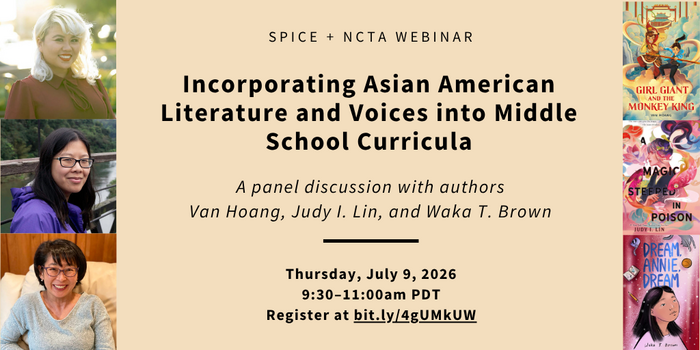
On day four, three authors of young adult novels (from top to bottom in image above)—Van Hoang, Judy I. Lin, Waka T. Brown—were featured on a panel titled, “Incorporating Asian American Literature and Voices into Middle School Curricula.” Including the Asian American experience in SPICE/NCTA seminars has been requested by many teachers and also supports the NCTA as it “strives to develop global citizenship based on the principles of cross-cultural understanding, equality, and justice.”
I loved being part of the summer cohort with SPICE… I was really inspired by the authors’ panel, as I had never heard from authors, especially ones who are so relatable. I love how they intertwine their identity and history and can create such cool stories.—Morgan Johnson, Kenmore School, Arlington, Virginia
Following the institute, each teacher will develop and share an original lesson plan inspired by the knowledge and resources gained throughout the seminar. Some of the themes and concepts that were shared by the lecturers, authors, teachers, and SPICE staff included diaspora, cultural relevance, the master narrative of history, diverse perspectives, and empathy; and SPICE hopes that one or more of these themes will be incorporated into their lessons.
SPICE is especially grateful to President Graeme Freeman and Vice President Shereen Goto of the Freeman Foundation for their support of the NCTA since 1998 and to Crystal Hsia of the USC U.S.-China Institute for her unwavering support and collaboration.


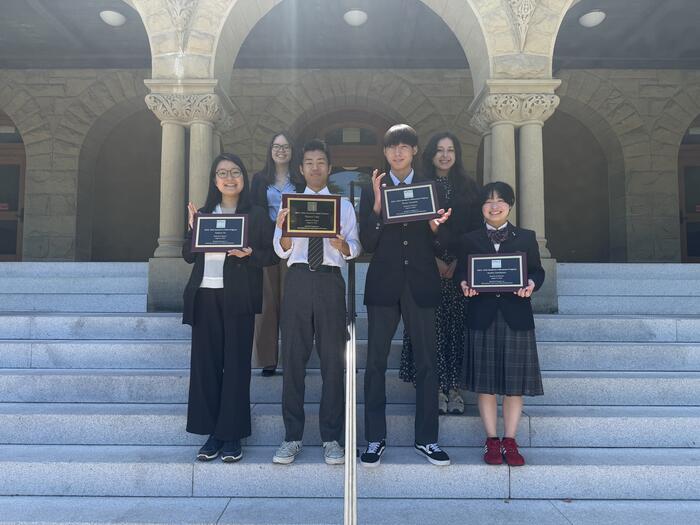
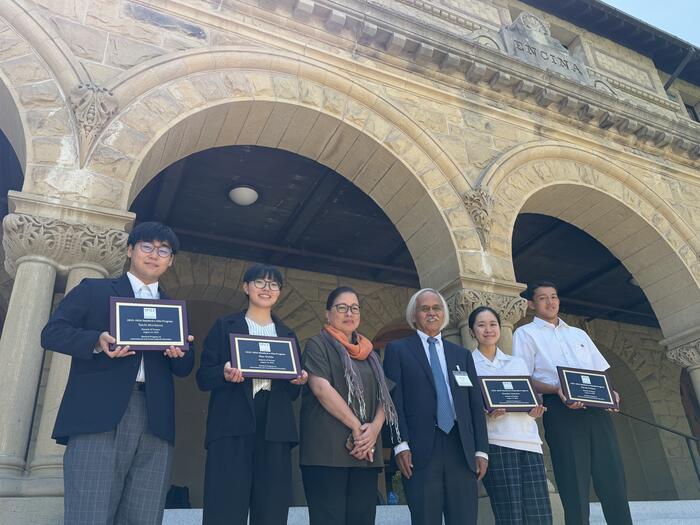
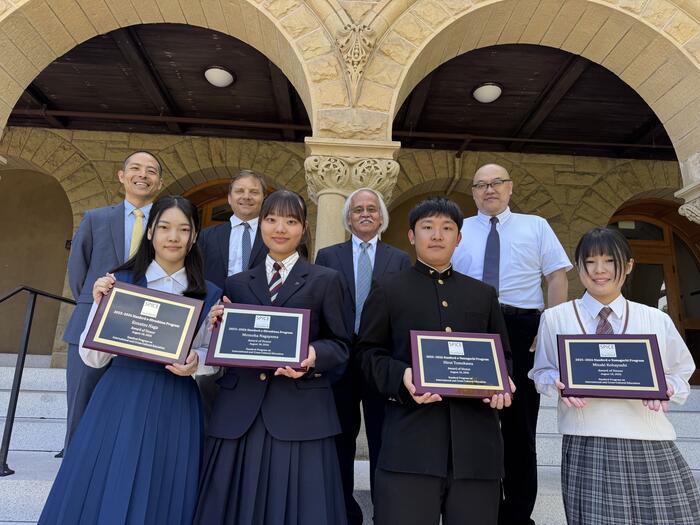
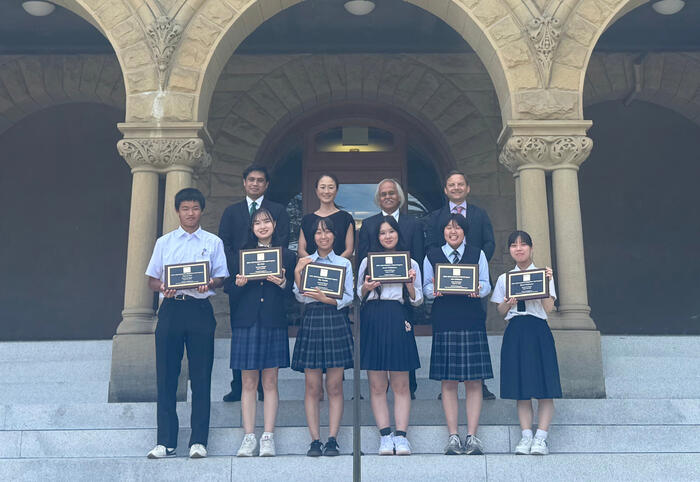


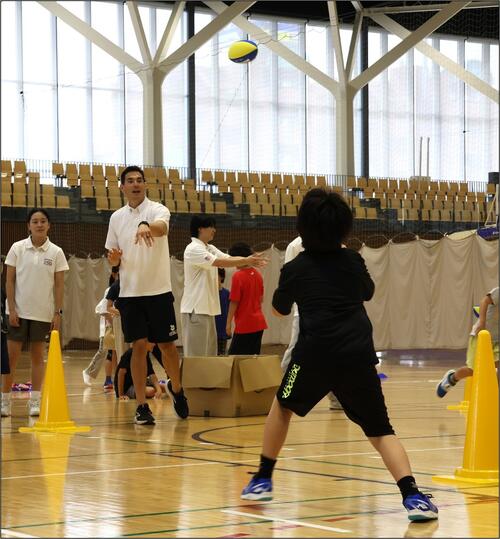
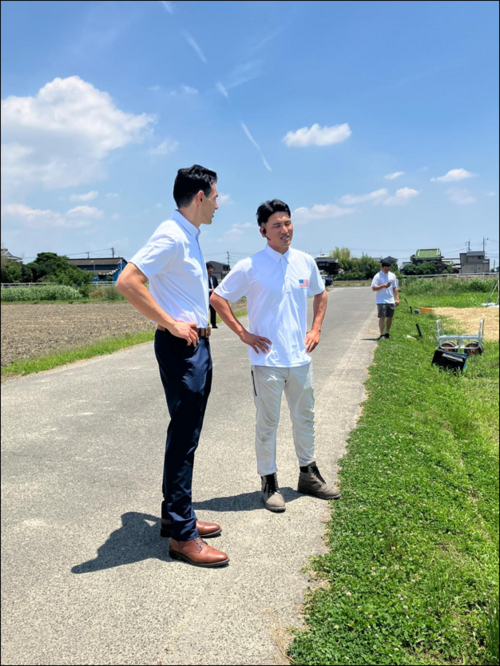
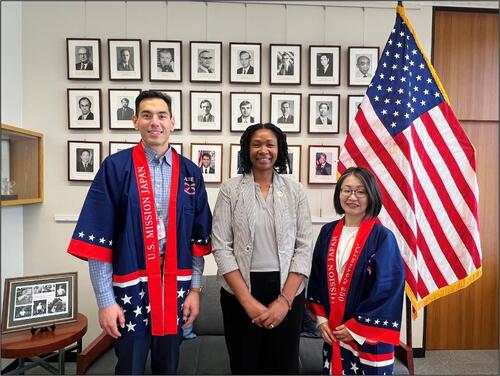


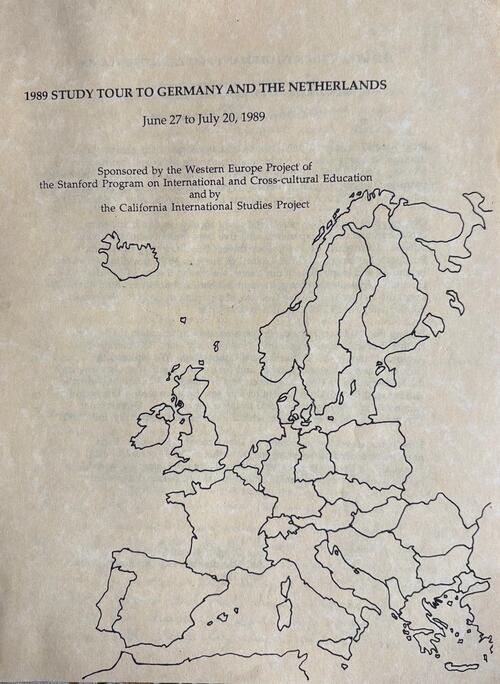
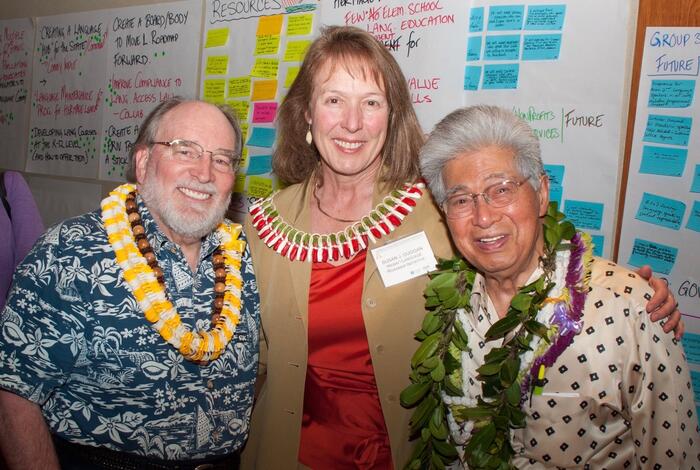 Photo above: Governor Neil Abercrombie of Hawai‘i, Dr. Susan Duggan, Executive Director of the Hawai‘i Language Roadmap Initiative, and Senator Daniel Akaka, 2013 | courtesy of Susan Duggan.