
Education
Authors
Noa Ronkin
News Type
News
Date
Paragraphs

hallenges and Possibilities of Korean Studies in North America — Social Science panel
Future Visions: Challenges and Possibilities of Korean Studies in North America — Social Science panel. From left to right: UC Berkeley's Laura Nelson, University of Michigan's Jordan Siegel, Stanford's Yong Suk Lee, USC's David Kang, Harvard's Paul Chang.


How can Korean studies faculty cultivate supportive and critical scholarly communities with graduate students? What can be done to overcome the severe constraints on Korean language training in North America? Why is there a dearth of Korea scholarship in academic literature? And how should Korean studies librarians prepare for the future in the light of new technologies and young researchers’ increasing interest in digital scholarship?

These were some of the questions examined at a two-day conference, “Future Visions: Challenges and Possibilities of Korean Studies in North America,” convened by the Korea Program of Stanford’s Shorenstein Asia-Pacific Research Center (APARC) on November 1-2. Co-sponsored by the Seoul-based Foundation Academia Platonica, the conference, the first of its kind, gathered distinguished Korean studies scholars from twelve North American institutions to consider the state of the field, assess its challenges, and carry forward a vision for its future direction and potential. Its six unique panels focused not only on the major disciplines of Korean studies—history, literature, and the social sciences—but also on language education, library collections and services, and Korean Wave.

“The presentations and discussions by our fellow experts reflected the breadth and depth of Korean studies in North America,” says APARC Director and the Korea Program Director Gi-Wook Shin. “Our program was established at Stanford in 2001 and has since become a leader in Korean studies in North America, so it is a special privilege for us to bring together colleagues from eminent institutions around the continent to further advance Korean studies education and research in the academic and policy worlds, and to build upon our track record of action and achievements.”

“The field of Korean studies, however,” notes Shin, “has significantly changed over the past seventeen years and it isn’t without its challenges. This is our opportunity to consider frankly where we go next and how we could explore the path ahead together.”

Conference participants indeed engaged in deep conversations and shared ideas and dilemmas regarding teaching in the different disciplines of Korean studies in North America. Harvard sociologist Paul Chang listed three types of challenges facing the field: publication, academic, and professional challenges. David C. Kang, professor of international relations and director of the Korean Studies Institute at the University of Southern California, emphasized the publication challenge: why is it, asked Kang, that top academic journals in the discipline of political science and international relations publish so much more scholarship about Europe than they do about Korea and Asia at large, even while the rise of Asian nations is surely one of the most consequential issues of the twenty-first century? The onus, Kang argued, comes back to East Asia scholars “to produce better and more compelling scholarship, and to better train graduate students.”

University of British Columbia's Ross King and conference participants.

Yet complex issues surround the question of how to broaden graduate coursework—and whether to do so. Korean language and linguistics expert Ross King, head of the department of Asian Studies at the University of British Columbia in Vancouver, Canada, was one of several panelists who considered the obstacles to graduate training, among different aspects of academic challenges facing the field of Korean studies. King probed into how Sinocentrism and what he called the “Mandarin conceit”—that is, the notion that training in Literary Sinitic should be predicated on a near-native proficiency in modern Mandarin Chinese—are emerging as a major stumbling block to the study of premodern Korean literary culture. He also pointed to the constraints on language training in both Korean and hanmun in North America, which, he claimed, is why we can probably anticipate continued decrease in the number of ethnically non-Korean (non-Korea-educated) graduate students undertaking graduate study in Korean literature.
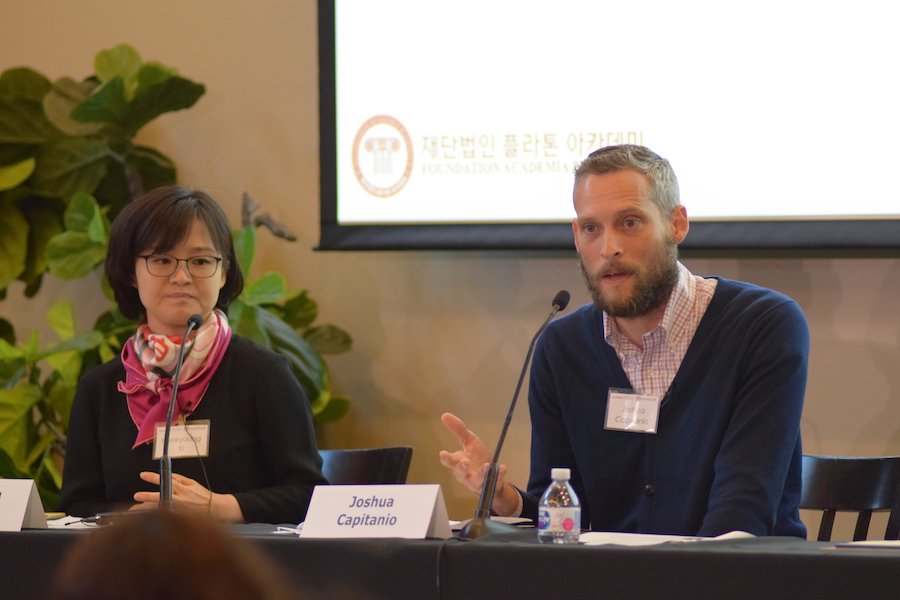
University of Washington's Hyokyoung Yi (left) and Stanford's Joshua Capitanio at a panel on library collections and service.

Sung-Ock Sohn, who coordinates the Korean language program in the department of Asian languages and cultures at the University of California – Los Angeles, further shed light on King’s prediction. She explained that while enrollments in Korean language classes have shown a sharp increase in American higher education institutions in the past decade, particularly at the introductory level and among ethnically non-Korean students, there is a high attrition rate of students from an introductory to advanced Korean classes nationwide.

How should the field move forward?

Participants proposed a host of ideas to that end. These included helping graduate students collaborate with colleagues in Korea; dedicating funding for junior faculty to spend periods of time before tenure conducting research and honing language skills in Korea at appropriate institutions, and for mid-career scholars to spend a year in Korea; emphasizing the application of social science theories and methods to premodern and modern East Asia; motivating scholars to apply a comparative lens to the study of the historical and contemporary experience of East Asia; and integrating linguistic and cultural diversity in Korean language classes by, for example, incorporating service learning in authentic contexts and extending the content spectrum to include topics such as Korean popular culture.


Image
K-pop star Siwon Choi (left) highlights closing panel on Korean Wave.

K-pop star Siwon Choi (left) highlights closing panel on Korean Wave.

Korean Wave was the focus of the conference’s widely attended closing panel that featured K-pop star Siwon Choi, a member of Korean boy band Super Junior, and multi-platinum music producer Dominique Rodriguez, managing director of SM Entertainment USA. They spoke about the global reach of Korean pop music and some of the ways in which Korean popular culture could stimulate interest in Korean studies. Dafna Zur, assistant professor in Stanford’s department of East Asian languages and cultures, who chaired the panel, challenged her students to consider “what it means not just to monetize culture but to design culture with specific markets and audience in mind.” The Stanford Daily published a detailed article on the panel.

“We are grateful to Foundation Academia Platonica for its generous support of Stanford’s Korea Program at Shorenstein APARC and for making this conference possible through our shared vision for the future of Korean studies in North America,” said Gi-Wook Shin. “Our thanks also go to our many other friends and partners, including the Korea Foundation that has helped achieve great results through its commitment to promoting understanding of Korea in academia and beyond and its support of the overseas Korean Studies Program since its establishment in 1991.”

South Korean TV company SBS NBC filmed the conference that will be featured in an upcoming documentary about Korean studies in the United States.

Read the conference report or listen to the audio recordings of the sessions, below.

Hero Image
Audience listens to panel during the conference "Future Visions: Challenges and Possibilities of Korean Studies in North America"
Thom Holme, APARC
All News button
1
Paragraphs

Solar lanterns are promoted across rural Sub-Saharan Africa to improve both lighting in homes and educational outcomes. We undertake a randomized controlled trial in Zimba District, Zambia, to evaluate whether solar lanterns help children study more effectively and improve academic performance. Our research design accounts for potential income effects arising from the giveaways of lanterns and also “blinds” participants to the study’s purpose. We find no evidence that receipt of a lantern improved performance on important national examinations (even though an ex poststatistical power analysis demonstrates that the research should detect economically significant impacts, if present). We also do not observe impacts on self-reported study habits. Several features of Zimba District that are likely to exist in other developing regions appear to drive our results. First, flashlights are the dominant lighting source in rural Zambia rather than traditional options like kerosene lamps or candles. In such environments, solar lights may hold only limited appeal for prospective users. Second, our survey data suggests that other major barriers to educational attainment likely render improved energy access (whether through solar lanterns or otherwise) a relatively unimportant educational input. 

All Publications button
1
Publication Type
Working Papers
Publication Date
Journal Publisher
Program on Energy and Sustainable Development
Authors
Ognen Stojanovski
Mark C. Thurber
Frank Wolak
0
rsd18_083_0009a.jpg

Alex Stamos is a cybersecurity expert, business leader and entrepreneur working to improve the security and safety of the Internet. Stamos was the founding director of the Stanford Internet Observatory at the Cyber Policy Center, a part of the Freeman Spogli Institute for International Studies. He is currently a lecturer, teaching in both the Masters in International Policy Program and in Computer Science.

Prior to joining Stanford, Alex served as the Chief Security Officer of Facebook. In this role, Stamos led a team of engineers, researchers, investigators and analysts charged with understanding and mitigating information security risks to the company and safety risks to the 2.5 billion people on Facebook, Instagram and WhatsApp. During his time at Facebook, he led the company’s investigation into manipulation of the 2016 US election and helped pioneer several successful protections against these new classes of abuse. As a senior executive, Alex represented Facebook and Silicon Valley to regulators, lawmakers and civil society on six continents, and has served as a bridge between the interests of the Internet policy community and the complicated reality of platforms operating at billion-user scale. In April 2017, he co-authored “Information Operations and Facebook”, a highly cited examination of the influence campaign against the US election, which still stands as the most thorough description of the issue by a major technology company.

Before joining Facebook, Alex was the Chief Information Security Officer at Yahoo, rebuilding a storied security team while dealing with multiple assaults by nation-state actors. While at Yahoo, he led the company’s response to the Snowden disclosures by implementing massive cryptographic improvements in his first months. He also represented the company in an open hearing of the US Senate’s Permanent Subcommittee on Investigations.

In 2004, Alex co-founded iSEC Partners, an elite security consultancy known for groundbreaking work in secure software development, embedded and mobile security. As a trusted partner to world’s largest technology firms, Alex coordinated the response to the “Aurora” attacks by the People’s Liberation Army at multiple Silicon Valley firms and led groundbreaking work securing the world’s largest desktop and mobile platforms. During this time, he also served as an expert witness in several notable civil and criminal cases, such as the Google Street View incident and pro bono work for the defendants in Sony vs George Hotz and US vs Aaron Swartz. After the 2010 acquisition of iSEC Partners by NCC Group, Alex formed an experimental R&D division at the combined company, producing five patents.

A noted speaker and writer, he has appeared at the Munich Security Conference, NATO CyCon, Web Summit, DEF CON, CanSecWest and numerous other events. His 2017 keynote at Black Hat was noted for its call for a security industry more representative of the diverse people it serves and the actual risks they face. Throughout his career, Alex has worked toward making security a more representative field and has highlighted the work of diverse technologists as an organizer of the Trustworthy Technology Conference and OURSA.

Alex has been involved with securing the US election system as a contributor to Harvard’s Defending Digital Democracy Project and involved in the academic community as an advisor to Stanford’s Cybersecurity Policy Program and UC Berkeley’s Center for Long-Term Cybersecurity. He is a member of the Aspen Institute’s Cyber Security Task Force, the Bay Area CSO Council and the Council on Foreign Relations. Alex also serves on the advisory board to NATO’s Collective Cybersecurity Center of Excellence in Tallinn, Estonia.

Former Director, Stanford Internet Observatory
Lecturer, Masters in International Policy
Lecturer, Computer Science
Date Label
Authors
Gary Mukai
News Type
Blogs
Date
Paragraphs

Comedian Conan O’Brien recently announced that he will visit Hokuei City (aka “Conan Town”) in Tottori Prefecture, Japan, which is well known for its sand dunes and the manga character, Detective Conan. Detective Conan was created by artist Gosho Aoyama, who was born in Hokuei. In fact, Tottori’s main airport is called the Tottori Sand Dunes Conan Airport. Tourists from the United States and other countries are drawn to the sand dunes and the “Manga Kingdom,” a nickname for Tottori because it is the home prefecture of many famous manga artists like Aoyama.

Governor Shinji Hirai of Tottori, who leads these efforts to make Tottori a more notable tourist destination, recently met with Governor Phil Scott of Vermont to formalize a sister state relationship. Both governors hope to give their students more opportunities for exchange. These are just two examples of the increasing synergy between the United States and Tottori, the least populous prefecture in Japan. Thanks to the vision of Governor Hirai, SPICE launched a distance-learning course, Stanford e-Tottori, for high school students in Tottori Prefecture in 2016. The course instructor, Jonas Edman, hopes that the course will help to build even more bridges at the grassroots level between Tottori and the United States.

Now in its third year, Stanford e-Tottori enrolls students from public and private schools in Tottori Prefecture and is a cornerstone of Tottori Prefecture’s Global Leaders’ Campus, an initiative by the Tottori Prefectural Board of Education to internationalize the curriculum in all schools in Tottori. Governor Hirai’s vision has provided many Tottori high school students with the opportunity to study with Edman, who engages students in English with Stanford scholars and experts on topics ranging from U.S. high schools to cultural diversity in the United States.

On August 1, 2018, Edman participated in the opening ceremony for the third year of Stanford e-Tottori. He met Superintendent Hitoshi Yamamoto, Office Director Takuya Fukushima (High School Division), several others of the Tottori Prefectural Board of Education, and the new cohort of students. Edman also visited Tottori Nishi High School and gave a special lecture to students. “Though the technology that I use to teach Stanford e-Tottori has improved over the years, I have to say that it was enormously rewarding to meet my students in person,” reflected Edman. “Seeing them in their picturesque home prefecture—and some of them in their school [Tottori Nishi High School]—provided a context that cannot be replicated virtually. My online interaction with the students from now will feel different.”

I also had the chance to visit Tottori Prefecture on August 26, 2018 to give the opening lecture for the third-year offering of Stanford e-Tottori. In attendance were not only the current cohort students but also three students from last year’s cohort. Before class began, I could feel the nervousness among the students as they anxiously waited outside the presentation room. Once class commenced, however, I could sense that their nerves started to settle down. The students gave their best during class, and I was so impressed with their efforts in particular because it was the first lecture of the course. I have no doubt that their English skills and understanding of U.S. society and culture will improve under the mentorship of Edman.

High school students from Tottori Prefecture with SPICE Director Gary Mukai and Stanford Visiting Scholar Junichiro Hirata High school students from Tottori Prefecture with SPICE Director Gary Mukai and Stanford Visiting Scholar Junichiro Hirata
Following the class, Fukushima took Stanford Visiting Scholar Junichiro Hirata and me to Mitaki-en, a village nestled in the mountain town of Chizu in Tottori Prefecture. While strolling around Mitaki-en, I was reminded of a different era and was pleasantly overwhelmed by my senses—most notably the sound of a babbling brook, the smell of an earthen floor of a home from the early 20th century, the taste of powdered green tea, the feel of a tatami mat, and the sight of a faint waterfall. The preservation of this village struck me as symbolic of the people of Tottori—people who seem to have a gift for successfully integrating innovation with tradition.

The Tottori Prefectural Board of Education encourages its students to appreciate Tottori’s historic ties to agriculture and fisheries and its natural beauty. Tottori is also said to be Japan’s best place for stargazing. Simultaneously, the Board of Education instills in its students a need to see the world in a grain of sand through courses like Stanford e-Tottori. To me, helping students appreciate the delicate balance of innovation and tradition lies at the heart of Tottori Prefecture’s Global Leaders’ Campus, and SPICE is honored to be a part of this initiative.


Hero Image
Jonas Edman with e-Tottori students
Jonas Edman with e-Tottori students | Takuya Fukushima
All News button
1
Authors
News Type
Blogs
Date
Paragraphs

As publics and policymakers are becoming more aware of the gravity of cyber related activities and potential disruption, Stanford Center for International Security and Cooperation honors undergraduate alumni have produced cutting-edge work to address major cyber issues in their final theses.

The theses topics span computer systems design, deterrence, international cooperation, defense acquisitions, hacking, zero days, the intelligence community, big data, and special forces operations. They make an excellent back-to-school reading list for anyone interested in cyber security, policy, and foreign affairs.

Check out their work on major cyber threats, events and consequences through the links below:


Sharpening the Tip of the Spear: Evaluating Technology Integration in Special Operations Forces, by Sam Lisbonne (June 2018)

Lisbonne articulates three early warning indicators suggesting that U.S. Special Operations Forces acquisitions processes have begun to look more like that of traditional branches of the armed services. He goes on to discuss the best paths forwards for mitigating root causes driving this pattern.  

Cybersecurity Magic: Parallel Structures of Design by Hackers and Magicians, by Samuel Kasem Sagan (May 2018)

Sagan explains how cyber criminals are successful despite technical and well-organized efforts to defend against cyber-crime. He investigates the “art of deception” as it relates to espionage, warfare, politics, theatre, and magic. In comparing exploits and tricks, he demonstrates “how the design processes used by hackers have inherent structural similarities to those used by magicians.”

Star Wars, Poison Gas, and Cybersecurity: Lessons from the Past for a Better Future, by Rachel Hirshman (May 2018)

Hirshman’s recent thesis outlines the conditions necessary for the creation of a formal international agreement to regulate cyberspace. She draws on the efforts of the Reykjavik Summit and the Chemical Weapons Convention to find that the most influential factor for an agreement “is the willingness of parties to make reciprocal concessions during negotiations.”

Towards DIUx 2.1 or 3.0? Examining Defense Innovation Unit Experimental’s Progress Towards Procurement Innovation, by Gabriele Fisher (June 2017)

Fisher’s thesis examines the military outfit known as DIUx intended to expedite military acquisitions from smaller tech firms outside of major defense procurement working on novel technologies for defense. She weighs how sustainable the program is given their reliance on Other Transaction Authorities over traditional U.S. Department of Defense procurement processes.

In Data We Trust?: The Big Data Capabilities of the National Counterterrorism Center, by Ben Mittelberger (May 2016)

Mittelberger combines lessons of capabilities yielded by big data analytics with the mission of counterterror intelligence for the National Counterterrorism Center. He provides recommendations on how to adopt large-scale analytics exercises to benefit the intelligence community’s organizational capacity and structure.

Evaluation of the Analogy Between Nuclear and Cyber Deterrence, by Patrick Cirenza (May 2015)

Cirenza details where the analogies of nuclear and cyber weapons and deterrence are flawed. Although cyber weapons have potentially strategic impacts, they have thus far not reached a level of importance to cause “revolution in military affairs that developed into a strategic deterrent because of its unique characteristics” alike nuclear weapons.

Scalable Security: Cyber Threat Information Sharing in the Internet Age, by Connor Gilbert (May 2014)

Gilbert unpacks information sharing issues faced by the federal government when analyzing cyber threats related to private companies tied to U.S. critical infrastructure. An engineer by training, he applies a Computational Policy approach to bring “the power of the abstractions used in computer systems design to bear on difficult policy problems.”

Anarchy or Regulation: Controlling the Global Trade in Zero-Day Vulnerabilities, by Mailyn Fidler (May 2014)

Fidler reveals the trade mechanisms of zero-day vulnerabilities as they are traded and utilized by governments, militaries, intelligence operations, law enforcement agencies, and criminal organizations. Her work “demonstrates how difficult regulation of the global zero-day trade will be, signaling the pervasiveness of realpolitik in cyberspace.”


All News button
1
News Type
News
Date
Paragraphs

Since 2010, Stanford Global Studies (SGS) has partnered with community colleges through innovative projects such as the Stanford Human Rights Education Initiative and the Education Partnership for Internationalizing Curriculum (EPIC) to bring together faculty and administrators committed to developing global and international studies. Jonas Edman works with SGS and FSI staff and faculty on this partnership, which has the goal of establishing a growing network of EPIC alumni who are developing innovative programs to internationalize curricula at the community college level.

From August 8 to 10, 2018, SGS convened a three-day summer intensive workshop for ten new EPIC fellows to launch this year’s EPIC Fellows Program. The 2018–19 EPIC Fellows are:

  • Marina Broeder, Mission College, California
  • Mary Conroy-Zouzoulas, San Jose City College, California
  • Dave Dillon, Grossmont College, California
  • Jennifer Fiebig, Pasadena City College, California
  • Andrew Hill, St. Philip’s College, Texas
  • Chigusa Katoku, Mission College, California
  • Philip Tran, San Jose City College, California
  • Don Uy-Barreta, De Anza College, California
  • Nancy Willet, College of Marin, California
  • Irene Young, St. Philip’s College, Texas

The institute featured talks by Stanford faculty, including talks on global competencies by Jeremy Weinstein, universities making knowledge in a global era by Mitchell Stevens, using films in classrooms by Pavle Levi, using maps in classrooms by Kären Wigen, and China under Mao Zedong by Andrew Walder. In addition to the talks, the EPIC fellows were introduced to library resources, including digital, map, and archival resources; as well as resources from SPICE and Lacuna Stories.

The EPIC Fellows will work collaboratively with Stanford staff for one academic year (August–May) on self-designed projects aimed at developing global competencies and awareness among community college students. From this month, the EPIC Fellows will participate in online seminars during which they will explore cutting-edge research in global studies with Stanford faculty and staff and develop innovative curricular materials and extra-academic programs to implement in their classrooms and at their home campuses. The fellowship will culminate at an end-of-year symposium on May 18, 2019 at Stanford University that will bring together faculty and administrators from community colleges and four-year universities committed to fostering global studies on their campuses.

To stay informed of SPICE-related news, follow SPICE on Facebook and Twitter.

Hero Image
2018–19 EPIC Fellows
2018–19 EPIC Fellows | Michael Breger
All News button
1
Authors
Gary Mukai
News Type
News
Date
Paragraphs
As Stacy Shimanuki delivered her presentation about the Pacific War (1941–45), I was reflective of the fact that the 73rd anniversary of the surrender of Japan, August 15, 1945, was five days away. Stacy was one of several American and Japanese high school students who were honored by SPICE during an annual event called “Japan Day” at Stanford University on August 10, 2018. The top three students of Stanford e-Japan (fall 2017 cohort) and three students of the Reischauer Scholars Program (2018 cohort) gave presentations on their course research papers. The Reischauer Scholars Program (RSP) is a distance-learning course on Japan and U.S.–Japan relations that is offered annually to high school students in the United States, and Stanford e-Japan is a distance-learning course on the United States and U.S.–Japan relations that is offered twice annually to high school students in Japan.
 
For me, Japan Day is not only a day of recognition of students but is also symbolic of the close friendship between the United States and Japan that has evolved from a once-bitter rivalry. Though the six students had met their instructors Naomi Funahashi (RSP instructor; Dr. Rie Kijima taught the latter part of the 2018 RSP course) and Waka Takahashi Brown (Stanford e-Japan instructor) in online “virtual classrooms,” it was their first time meeting face-to-face. Although they had never met before, it was remarkable to me how the students on both sides of the Pacific seemed almost like old friends by the end of the day.
 
Japan Day opened with comments by the Honorable Tomochika Uyama, Consul General of Japan in San Francisco. He stated,  
 
The Japan–U.S. alliance is the cornerstone of security, stability, and prosperity in the Asia-Pacific region. As we look at the global challenges we face today, I believe that we must strive to ensure that our special relationship remains strong and vital. One way to accomplish this is by preparing the best and brightest of our young people with the kind of learning opportunities that will deepen mutual understanding. It is my belief that the Reischauer Scholars Program and Stanford e-Japan are admirably working toward this goal by providing the knowledge and expertise our young people will need as future leaders in Japan–U.S. relations. 
Before the student presentations, Consul General Uyama took the time to speak with each of the honorees.
 
  RSP honorees Stanford e-Japan honorees
  • Grace Rembert, Bozeman High School, Bozeman, Montana
  • Stacy Shimanuki, Amador Valley High School, Pleasanton, California
  • Valerie Wu, Presentation High School, San Jose, California
  • Amane Kishimoto, Kyoto Prefectural Rakuhoku Senior High School, Kyoto
  • Yurika Matsushima, Keio Girls Senior High School, Tokyo
  • Jun Yamasaki, Shibuya Kyoiku Gakuen Senior High School, Tokyo
 
The students presented on topics ranging from open innovation, employment and people with disabilities, and the U.S. and Japanese educational systems to language and nationalism, literature on the atomic bombing of Japan, and urbanization in Japan. Brown and Funahashi had high praise for their students. “I’m always so proud of our e-Japan award winners,” stated Brown. “Their level of research is at such a high level, and to be able to conduct their presentations in English and with such poise is an amazing achievement for students at such a young age.” During the presentations by her students, Funahashi reminded the audience, “These are high school students!” Without fail on Japan Day, Funahashi hears audience members complimenting the intellect of her students and how articulate they are. 
 
Waka Brown and Naomi Funahashi at podium Waka Brown and Naomi Funahashi at podium
Attendees represented people from the Stanford community and the U.S.–Japan community in the Bay Area, including Dr. Takeo Hoshi, Director, Japan Program, and Junichiro Hirata, Visiting Scholar, Shorenstein Asia-Pacific Research Center, FSI; and Dr. Kazuhiko Hasegawa, Executive Director, San Francisco Office, Osaka University, Kathleen Kimura, Japan Society of Northern California, and Dr. Yoichi Aizawa, Executive Director, San Francisco Office, Waseda University. Amanda Minami Chao and David Chao were recognized for their many years of support to SPICE.   
 
Following the formal program, the students enjoyed a tour of Stanford University. The SPICE staff and I were left hoping that someday we would see them again as undergraduate or graduate students on campus and more importantly, hoping that they will remain friends to further strengthen the decades of friendship between Japan and the United States. 
 
To stay informed of SPICE-related news, follow SPICE on Facebook and Twitter.

Funding for SPICE’s distance-learning courses is generously provided by Amanda Minami Chao and David Chao, and Jean Mou and Yoshiaki Fujimori. Funding for the 2018 RSP was generously provided by Gen Isayama, the Center for Global Partnership/The Japan Foundation, and The Japan Fund, FSI. Funding for the Stanford e-Japan 2017 courses was generously provided by the United States-Japan Foundation, and for the Stanford e-Japan spring 2018 course by Noriko Honda Chen, Harry Gunji, Akira Horiguchi, Paul Li, Tomonori Tani, and the Capital Group Companies. 

 
Hero Image
The Honorable Tomochika Uyama with six student honorees
The Honorable Tomochika Uyama with six student honorees | Rylan Sekiguchi
All News button
1
Authors
Gary Mukai
News Type
News
Date
Paragraphs

I vividly remember the first time I met Houghton “Buck” Freeman (former Chairman of the Freeman Foundation) in New York City nearly 20 years ago. A short time after this meeting, he and his wife, Doreen (former Trustee of the Freeman Foundation), kindly took the time to visit me at Stanford University. I never imagined then that SPICE would have remained a grantee of the Freeman Foundation for so many years. I am now in touch with their son Graeme Freeman (President), grandson Alec Freeman (Senior Program Officer), and Shereen Goto (Director of Operations and Programs) of the Freeman Foundation. The Freeman Foundation has funded the National Consortium for Teaching about Asia (NCTA) since its inception in 1998, so this year marks its 20th anniversary. SPICE has been honored to contribute to the mission of the NCTA, which is “to encourage and facilitate teaching and learning about East Asia in elementary and secondary schools nationwide.” SPICE recently hosted NCTA summer institutes for middle school teachers (June 20–22, 2018) and high school teachers (July 23–25, 2018).

Rylan Sekiguchi, Gary Mukai, Shereen Goto, Jonas Edman Rylan Sekiguchi, Gary Mukai, Shereen Goto, Jonas Edman
The NCTA summer institute for middle school teachers—organized by Jonas Edman and Sabrina Ishimatsu—featured scholarly lectures, including one on ancient China by Professor Emeritus Albert Dien, who has been supporting SPICE teacher seminars since the 1970s. As has long been the tradition of SPICE, his lectures were followed by curricular demonstrations. Waka Brown engaged the teachers in “decoding” ancient Chinese characters that were found on oracle bones from the Shang Dynasty, 1600 BCE to 1046 BCE, which is one of the many lessons in SPICE’s two-part series on Chinese dynasties. Teachers found that Brown’s lessons made the subject matter content from Dien’s lecture accessible to their students. One of the participants, Eunjee Kang of San Lorenzo Unified School District, California, commented, “I am glad I participated in the program. I really enjoy any programs for Asian culture and history not only for my students but also for myself. The different pedagogical approaches to Asian culture and history that SPICE introduced to us were truly inspiring and very easy to bring to classrooms.” Representing the Freeman Foundation, Goto attended SPICE’s middle school seminar and had the chance to observe a lecture on feudal Japan and hear from teachers directly. To her surprise, she discovered that she had attended the same middle school in Honolulu as Rylan Sekiguchi.

The NCTA summer institute for high school teachers—organized by Naomi Funahashi and Sabrina Ishimatsu—also featured scholarly lectures, including one on U.S.–Korean relations by the Honorable Kathleen Stephens, former U.S. ambassador to the Republic of Korea from 2008 to 2011. Her lecture and the recent 2018 North Korea–United States Summit in Singapore stimulated enthusiastic questions from the teachers and fascinating discussions. Sekiguchi, who authored a three-part curricular series on U.S.–South Korean relations, North Korea, and inter-Korean relations, engaged the teachers in the lessons while referencing key points that were made by Ambassador Stephens. Commenting on the institute, Kimberly Gavin, University Preparatory Academy, San Jose, California, noted, “I realized that when it came to East Asian history, there were gaps in my knowledge, and I wanted to have a better understanding of it to be a more effective teacher. Between the readings and the conference itself, I filled up an entire notebook full of information!”

In a post-institute memo, Yoko Sase, The Nueva School, Hillsborough, California, stated, “I want to express my deepest gratitude to the Freeman Foundation for generously supporting us at the East Asia summer institute for middle and high school teachers at SPICE. I was immersed in such a depth of learning from the experts in their fields of East Asia throughout the program. I really appreciate that I not only deepened and expanded my knowledge on East Asia but also actually had the opportunities to practice thoughtfully designed SPICE curriculum lessons. Now I have a toolbox with amazing resources and materials that I have received from the institute, and I’m ready to use it in my classroom! This has been the best professional development I have ever attended!” The NCTA seminars are truly highlights of the year for the SPICE staff and Stanford scholars because it is a key channel through which SPICE curriculum on Asia and U.S.–Asian relations and Stanford scholarship are disseminated to students. Importantly, what an honor it has been to have worked with three generations of the Freeman family.

Hero Image
Houghton and Doreen Freeman. Courtesy: Graeme Freeman
All News button
1
0
Global Affiliate Visiting Scholar, 2018-19
Nippon Foundation
ed_matsuda_2.jpg MA, MBA

Yusuke Matsuda is a global affiliate visiting scholar at the Walter H. Shorenstein Asia-Pacific Research Center (Shorenstein APARC) for 2018-19.  As a graduate of Nihon University, Matsuda began his career as a physical education teacher at a private junior and senior high school in Tokyo.  There, he devised a special curriculum, "Sports English", teaching his Japanese students completely in English.  As an adviser to extracurricular club activities, he was able to bring the once minor track team to advance to national level track meets.  After moving on to the board of education in the adjacent prefecture of Chiba and serving as an analyst of educational policies, he completed his masters in educational leadership at Harvard University.  Upon his return to Japan, he worked as a consultant at PricewaterhouseCoopers before establishing several non-profit organizations including Learning for All and Teach for Japan.  In 2017, he resigned his CEO position at Teach for Japan and pursued his second masters program at Stanford Graduate School of Business.  In addition to joining Shorenstein APARC, he is also a Country Manager at Crimson Education Japan. 

Matsuda is a member of the World Economic Forum Global Shapers Community and is also a Research Associate Professor at Kyoto University.  He earned his BA degree from Nihon University in the Department of Humanities and holds a Masters degree from the Stanford Graduate School of Business and the Harvard Graduate School of Education.  He was selected as one of the 100 most influential people in Japan (Nikkei Business) and has published his book "Google, Disney yorimo hatarakitai kyositsu (a classroom you want to work more than Google and Disney)" in 2014 from Diamond.

Subscribe to Education