Discrimination
Authors
Michael Breger
News Type
News
Date
Paragraphs

Malaysia is a primary destination for displaced people in Southeast Asia, yet its absence from international refugee protection frameworks leaves refugees navigating profound insecurity and uncertainty in their daily lives. For nearly two decades, anthropologist Gerhard Hoffstaedter has studied how refugees in the country navigate lives shaped by legal exclusion, economic insecurity, and social discrimination. His new book, Lives in Limbo: Refugee Place-Making and Survival in Malaysia, explores how Chin and Rohingya refugees create meaningful lives despite these constraints. Published by APARC, the book is now out and distributed by Stanford University Press. 

Hoffstaedter, an associate professor of anthropology at the University of Queensland, was a Lee Kong Chian NUS-Stanford Fellow on Southeast Asia at APARC in 2024. We spoke with him about his book, the changing landscape of refugee studies, and the lessons long-term ethnographic research offers for understanding displacement. Watch the interview on our YouTube channel.


Sign up for APARC newsletters to receive our news and research updates >


Beyond Victimhood


Hoffstaedter began his research during his doctoral studies in Malaysia, where he encountered Chin and Rohingya refugees while studying Malay Muslim identity. He initially understood their experiences primarily through their lack of legal status. Over the course of his fieldwork, however, he came to recognize the many ways refugees build livelihoods, sustain cultural traditions, and establish communities despite structural barriers.

“I came to see how they themselves make place, make a home for themselves, even in very difficult situations and in, you know, sometimes horrendous situations,” he explains.

This is a key insight from Lives in Limbo. Rather than portraying refugees exclusively as victims or exceptional figures who overcome extraordinary adversity, Hoffstaedter focuses on the everyday practices through which people create meaning and pursue better lives. “I think the majority inhabit that middle part. And that's what I wanted to write about,” he says.
The things that anthropology can bring to the table are things that policy and politics often ignores. It's that depth of time, and it's that engagement with people on the ground over a long period of time to see the history and the importance of that history.
Gerhard Hoffstaedter
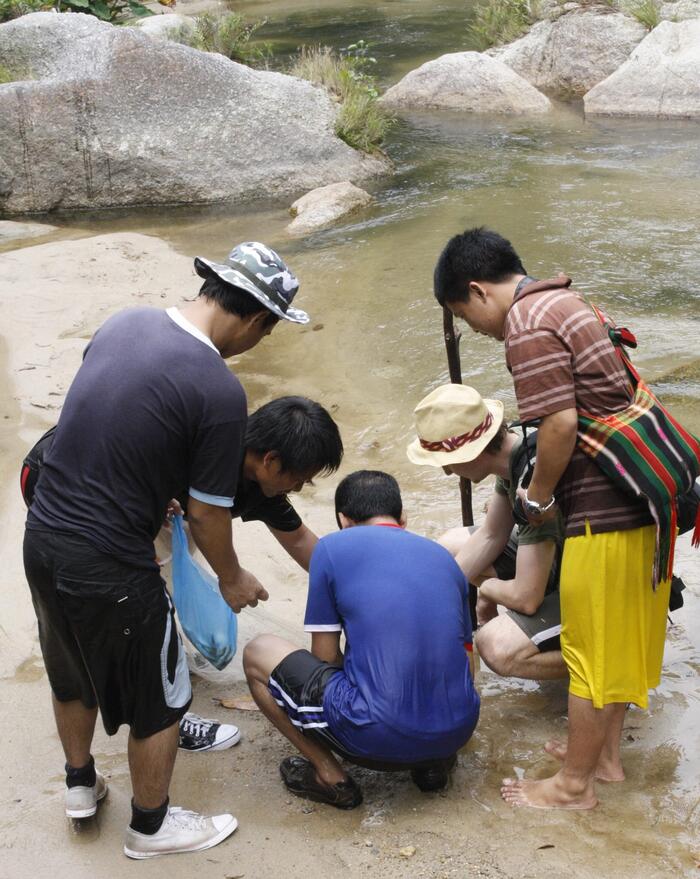
A researcher engaging with fishermen while conducting an ethnographic study. Hoffstaedter while building rapport through shared activities, such as a fishing trip with Chin refugee community members.

His research documents how work, religious gatherings, cultural celebrations, farming, and sports help refugees cultivate belonging in a country where they lack formal recognition. One example is a Rohingya Football Club Hoffstaedter was involved with. Competing against local teams gave Rohingya players opportunities to demonstrate their skills and gain recognition beyond their own communities.

As Hoffstaedter explains, “So they can't be citizens here. They don't have a legal standing, but they can for a moment be soccer stars and kind of, you know, win the game ten-nil, and celebrate and be really good at something, and be recognized by other people for that skill that they have.”

These experiences illustrate how seemingly ordinary activities can become meaningful ways to assert identity and belonging in precarious environments where legal avenues for recognition are unavailable.
 

Understanding the Polycrisis of Refugee Life


The book employs the notion of “polycrisis” to examine how legal exclusion, economic insecurity, health risks, and discrimination compound one another. The COVID-19 pandemic amplified these overlapping pressures in Malaysia, where Rohingya refugees were increasingly scapegoated and subjected to restrictions on movement.

For Hoffstaedter, such developments show how broader political and social crises can intensify the vulnerability of already marginalized communities.

“[W]e could see the coming together of multiple crises that were accelerating and making life much, much harder for certain populations because of that compounding of multiple crises acting on particular populations.”

Hoffstaedter also examines Malaysia’s inconsistent approach to refugee protection. Although the country has periodically provided sanctuary and work authorization to displaced populations, it lacks a comprehensive legal framework recognizing refugees. Comparing Chin and Rohingya experiences, he shows how religion, cultural affinity, international advocacy, and geopolitical interests can influence who receives protection. The differences in treatment reveal how refugee protection depends on arbitrary political priorities rather than consistent rights.
 

What Anthropology Can Contribute to Refugee Policy


In discussing the book, Hoffstaedter argues that understanding displacement requires looking beyond border crossings and dramatic humanitarian emergencies to examine how migration policies shape everyday life. Long-term ethnographic research can reveal the historical and political forces behind these policies, as well as the realities that broad categories such as “refugee” and “economic migrant” often obscure.

“The things that anthropology can bring to the table are things that policy and politics often ignore. And it's that depth of time, and it's that engagement with people on the ground over a long period of time to see the history and the importance of that history and how some of these things are arbitrary and very recent and are driven by their own logics that are not logical at all, but they have an internal logic.”

His research highlights an ongoing contradiction in Malaysia and elsewhere: the economy depends on migrant labor, yet undocumented workers remain excluded from the protections associated with legal status. Hoffstaedter calls for a broader reconsideration of how governments approach migration and the people whose labor sustains their economies.

The time he spent as a fellow at APARC provided him with opportunities to engage with policymakers and consider how ethnographic research can inform practical responses to displacement. As he explains, “It really brought home to so many ex-politicians or State Department officials how to translate all that knowledge that we amass over long periods of fieldwork. How do we make that digestible?”

By focusing on Chin and Rohingya refugees’ everyday experiences, Lives in Limbo reconsiders existing narratives of displacement and offers readers a more nuanced understanding of how people create community and pursue belonging amid precarity. Hoffstaedter invites readers and policymakers alike to look beyond legal categories and humanitarian crises to recognize the people building meaningful lives within them.

Learn more about the book and purchase it from Stanford University Press. 

Read More

Two people walking in Memorial Court, Main Quad, Stanford Campus. Text: "Shorenstein APARC Call for Applications: 2027-2029 Fellowships."
News

Stanford’s Asia-Pacific Research Center Invites Applications for 2027-2029 Postdoctoral and Visiting Fellowships

The center and its research programs offer multiple postdoctoral and visiting fellowships in Asian studies starting in fall quarter 2027. Opportunities are open to scholars of contemporary Asia from a wide range of disciplines, encompassing both pan-regional research and specialized tracks focused on specific regions and themes.
Stanford’s Asia-Pacific Research Center Invites Applications for 2027-2029 Postdoctoral and Visiting Fellowships
Phnom Penh City sunset
News

Six Strategies Could Scale Sustainable Growth in Southeast Asia

How can Southeast Asia achieve more economic growth for 700 million residents while balancing energy security and environmental sustainability? A new report offers actionable answers.
Six Strategies Could Scale Sustainable Growth in Southeast Asia
Pita Limjaroenrat and Kiyoteru Tsutsui in conversation.
News

Leadership Lessons from Thailand's "Almost Prime Minister" Pita Limjaroenrat

Speaking on the latest episode of the APARC Briefing series, the Thai democracy champion opens up about his upbringing, offers insights from his newfound role in social activism, and shares why he continues to hold hope for reform in Thailand.
Leadership Lessons from Thailand's "Almost Prime Minister" Pita Limjaroenrat
Hero Image
All News button
1
Subtitle

In his new book, 'Lives in Limbo: Refugee Place-Making and Survival in Malaysia,' Hoffstaedter draws on nearly two decades of research to examine how Chin and Rohingya refugees build communities, find belonging, and navigate legal exclusion.

Terms
Aria Label
Read More of Anthropologist Gerhard Hoffstaedter Explores How Refugees Build Lives Amid Exclusion in Malaysia
Date Label
Display Hero Image Wide (1320px)
Yes
Paragraphs

This study examines racism “denial” in Asia through a critical discourse analysis of state reports submitted to the United Nations’ Committee on the Elimination of Racial Discrimination (CERD) by 16 Asian countries from 1978 to 2023. Our findings reveal that denial is not just a rhetorical tool for deflecting accusations but functions as a deeply embedded mechanism to justify and reinforce existing discrimination. Importantly, these state discourses are shaped by social, political, and religious values, as well as struggles for national liberation, unity, and security. By unpacking these layers in historically and comparatively informed ways, we identify and classify patterns of discursive denial—literal, interpretive, and ideological—with subcategories for each. This study not only adds to empirical inquiry into racism in often-neglected Asian contexts but also presents a conceptual framework for examining the diverse manifestations and articulations of race and racism, extending beyond the explanatory capacity of existing dominant theories of race developed through Western lenses.

This paper is an outcome of the "Nationalism and Racism" research track at the Stanford Next Asia Policy Lab. 

All Publications button
1
Publication Type
Journal Articles
Publication Date
Journal Publisher
Critical Sociology
Authors
Junki Nakahara
Gi-Wook Shin
Paragraphs
Cover of the working paper "Korean Cuisine Gone Global," showing a bowl of noodles.

To understand the transformation of Korean food from an “ethnic curiosity” into one of the world’s hottest cuisines, the Korea Program at Shorenstein APARC brought together culinary experts and  academics at the conference “Korean Cuisine Gone Global.” Held on April 11, 2024, the scholars offered insights into the transformation of Korean cuisine, the role of race and place in its success story, and new directions in studying food and Korean culture. Their papers are collected in this volume.

The conference also featured celebrity chef Judy Joo, a renowned television star, an international restaurateur, and owner of the famed Seoul Bird, and Ryu Soo-young, an acclaimed actor turned culinary maestro. 

About the Contributors

Rebecca Jo Kinney is an interdisciplinary teacher and scholar of American Studies and Ethnic Studies, and an associate professor at the School of Cultural Studies at Bowling Green State University. Kinney’s award-winning first book, Beautiful Wasteland: The Rise of Detroit as America’s Postindustrial Frontier (University of Minnesota Press, 2016), argues that contemporary stories told about Detroit’s potential for rise enable the erasure of white supremacist systems. Her research has appeared in American Quarterly, Food, Culture & Society, Verge: Studies in Global Asia, Radical History Review, and Race&Class, among other journals. Her second book, Mapping AsiaTown Cleveland: Race and Redevelopment in the Rust Belt, is forthcoming from Temple University Press in 2025. She is working on a third book, Making Home in Korea: The Transnational Lives of Adult Korean Adoptees, based on research undertaken while a Fulbright Scholar in South Korea. 

Robert Ji-Song Ku is an associate professor of Asian and Asian American Studies at Binghamton University (SUNY) and the managing editor of Foundations and Futures: Asian American and Pacific Islander Multimedia Textbook of the Asian American Studies Center at UCLA. His teaching and research interests include Asian American studies, food studies, and transnational and diasporic Korean popular culture. Prior to Binghamton, he taught at Cal Poly, San Luis Obispo, and Hunter College (CUNY). He is the author of Dubious Gastronomy: Eating Asian in the USA (University of Hawai‘i Press, 2014) and co-editor of Eating More Asian America: A Food Studies Reader (NYU Press, forthcoming 2025), the sequel to Eating Asian America (NYU Press, 2013). He is also co-editor of Pop Empires: Transnational and Diasporic Flows of India and Korea (University of Hawai‘i Press, 2019) and Future Yet to Come: Sociotechnical Imaginaries in Modern Korea (University of Hawai‘i Press, 2021), as well as the Food in Asia and the Pacific series for the University of Hawai‘i Press. Born in Korea, he grew up in Hawai‘i and currently lives in Culver City, California. 

Jooyeon Rhee is an associate professor of Asian Studies and Comparative Literature and director of the Penn State Institute for Korean Studies. She specializes in modern Korean literature and culture. Her main research concerns Korean popular literature, with particular emphasis on transnational literary exchanges and interactions. Currently, she is writing her second book on cultural imaginations of crime and deviance manifested in late colonial Korean detective fiction. Her other research interests include diasporic art and literature and food studies. 

Dafna Zur (editor) is an associate professor of Korean literature and culture in the Department of East Asian Languages and Cultures and director of the Center for East Asian Studies at Stanford. Her first book, Figuring Korean Futures: Children’s Literature in Modern Korea (2017), interrogates the contradictory political visions made possible by children’s literature in colonial and postcolonial Korea. Her second project explores sound, science, and space in the children’s literature of North and South Korea. She has published articles on North Korean popular science and science fiction, translations in North Korean literature, the Korean War in children’s literature, childhood in cinema, children’s poetry and music, and popular culture. Zur’s translations of Korean fiction have appeared in wordwithoutborders.org, Modern Korean Fiction : An Anthology, and the Asia Literary Review. 

All Publications button
1
Publication Type
Working Papers
Publication Date
Subtitle

Papers from Shorenstein APARC’s Korea Program Conference

Authors
Dafna Zur
1
APARC Predoctoral Fellow, 2024-2025
Screenshot 2024-10-21 at 8.54.50 AM.png

Alisha Elizabeth Cherian joined the Walter H. Shorenstein Asia-Pacific Research Center (APARC) as APARC Predoctoral Fellow for the 2024-2025 academic year. She is a PhD candidate in Social and Cultural Anthropology at Stanford University. She received her BA from Vassar College in Anthropology and Drama with a correlate in Asian Studies, and her MA in the Social Sciences from the University of Chicago.

Her dissertation, entitled "Beyond Integration: Indian Singaporean Public Urban Life", investigates how enforced racial integration shapes racial formations and race relations in Singapore. Her project explores everyday encounters and interactions that are structured, but not overdetermined, by the state's multiracial policies as well as colonial histories and regional legacies of Indian indentured and convict labour. With her research, she seeks to contribute to a more ethnographic understanding of how plural societies are approached both scholarly and practically.

Date Label
0
CDDRL Postdoctoral Fellow, 2024-25
155a4102_-_jasmine.jpg

Jasmine is a Postdoctoral Fellow at Stanford’s Center on Democracy, Development and the Rule of Law (2024-25) and will be an Assistant Professor of Political Science at Reed College (2025).

Her research focuses on political behavior in American politics. Across her research, Jasmine uses ethnographic methods, in-depth interviews, original surveys, and experiments. Her work has been published in the American Political Science Review and Perspectives on Politics.

Jasmine received her PhD in Political Science from MIT in 2024 and graduated with degrees in Political Science and Economics from UCLA in 2018. She is originally from Belfast, Northern Ireland.

Date Label
-

Webinar recording: https://youtu.be/OuqgZCnXyo4 

When the U.S. government incarcerated over 120,000 people of Japanese descent during World War II (most of whom were U.S. citizens), Japanese Americans struggled to find a sense of normalcy behind the barbed wire. For some, this was achieved by playing baseball. 

Using baseball as a lens to explore the history of Japanese Americans and the U.S.–Japan relationship, this webinar offers K–12 educators a virtual tour of “Baseball’s Bridge to the Pacific,” a special exhibit currently on display at Dodger Stadium. The tour will be led by Kerry Yo Nakagawa, the founder and director of the Nisei Baseball Research Project (NBRP). The exhibit celebrates the 150th anniversary of U.S.–Japan diplomacy (1872–2022) and chronicles the introduction and development of baseball in Japan since the early 1870s. The exhibit’s photos, memorabilia, and artifacts offer a unique glimpse into key milestones of Japanese and Japanese Americans in baseball over the past 150 years. 

Join Nakagawa as he brings the legacy of Japanese Americans and baseball to life, live from Dodger Stadium! Attendees will receive a PDF of free curriculum materials on teaching about baseball and Japanese American incarceration, developed by SPICE and NBRP for high school and community college teachers.

This webinar is sponsored by the Stanford Program on International and Cross-Cultural Education (SPICE), the Nisei Baseball Research Project (NBRP), the National Consortium for Teaching about Asia (NCTA), and the USC U.S.-China Institute.

Kerry Yo Nakagawa is the author of "Through a Diamond: 100 Years of Japanese American Baseball." He is the founder and director of the non-profit Nisei Baseball Research Project (NBRP) and curator of “Diamonds in the Rough: Japanese Americans in Baseball,” an exhibition that was displayed at the Japanese American National Museum in 2000. He is also a consultant to the prestigious Baseball Hall of Fame tour entitled “Baseball in America” and an independent producer/filmmaker, actor, researcher, and writer.
portrait of a man
Naomi Funahashi

Online via Zoom.

Kerry Yo Nakagawa Founder and Director Nisei Baseball Research Project
Workshops
Authors
News Type
News
Date
Paragraphs

After the end of World War II, more than 45,000 young Japanese women married American GIs and came to the United States to embark upon new lives among strangers. The mother of Kathryn Tolbert, a former long-time journalist with The Washington Post, was one of them.

Kathryn noted, “I knew there was a story in my mother’s journey from war-time Japan to an upstate New York poultry farm. In order to tell it, I teamed up with journalists Lucy Craft and Karen Kasmauski, whose mothers were also Japanese war brides, to make a short documentary film through a mother-daughter lens. Fall Seven Times, Get Up Eight: The Japanese War Brides was released in August 2015 and premiered on BBC World Television. To show the experiences of many more women like our mothers, I spent a year traveling the country to record interviews, funded by a Time Out grant from Vassar College, my alma mater.”

I knew there was a story in my mother’s journey from war-time Japan to an upstate New York poultry farm.
—Kathryn Tolbert, Co-Director, Fall Seven Times, Get Up Eight

The Japanese War Brides Oral History Archive is the result of her interviews. The Oral History Archive documents an important chapter of U.S. immigration history that is largely unknown and usually left out of the broader Japanese American experience. In these oral histories, Japanese immigrant women reflect on their lives in postwar Japan, their journeys across the Pacific, and their experiences living in the United States.

SPICE developed five lessons for the Japanese War Brides Oral History Archive that suggest ways for teachers to engage their students with the broad themes that emerge from the individual experiences of Japanese war brides. The lessons are: (1) Setting the Context; (2) Japanese Immigration to the United States; (3) The Transmission of Culture; (4) Notions of Identity; and (5) Conflict and Its Analysis. SPICE also developed a teacher’s guide for the film, Fall Seven Times, Get Up Eight: The Japanese War Brides, that helps teachers set the context for the film and provides guided viewing activities and debriefing activities. The lessons and teacher’s guide can be found at the webpage below.

Read More

headshots of eight high school students
Blogs

What Does It Mean to Be an American?: Reflections from Students (Part 7)

Reflections of eight students on the website “What Does It Mean to Be an American?”
What Does It Mean to Be an American?: Reflections from Students (Part 7)
Hero Image
Hiroko Furukawa Tolbert and Kathryn Tolbert
Hiroko Furukawa Tolbert and Kathryn Tolbert; photo courtesy Kathryn Tolbert
All News button
1
Subtitle

SPICE has developed free lesson plans on an important chapter of U.S. immigration history that is largely unknown.

Authors
Jonas Edman
News Type
News
Date
Paragraphs

SPICE continues to expand its regional programs for high school students in Japan. This year marked the launch of the Stanford e-Kobe program, which joins the previously established programs, Stanford e-Hiroshima, Stanford e-Kawasaki, Stanford e-Oita, and Stanford e-Tottori.

These online courses are a collaboration between SPICE and local government and school officials in Japan and challenge students to think critically about global themes related to U.S. society and culture and U.S.–Japan relations.

All five courses have now finished their 2021–2022 term. This summer, two top students from each program will present their final research projects and be honored at a virtual event hosted by SPICE, Stanford University. Congratulations to the ten honorees below on their excellent academic achievement!

Stanford e-Hiroshima (Instructor Rylan Sekiguchi)

Student Honoree: Minori Imai
School: Hiroshima Prefectural Kuremitsuta High School
Project Title: All Lives Are Important

Student Honoree: Yui Miyake
School: Hiroshima Prefectural Hiroshima High School
Project Title: U.S. Prison System: How the Country’s History of Racial Inequality Drives the High Rate of Incarceration in America

Stanford e-Kawasaki (Instructor Maiko Tamagawa Bacha)

Student Honoree: Sayaka Kiyotomo
School: Kawasaki High School
Project Title: How Can We Improve Junior and Senior High School English Education in Japan?

Student Honoree: Anne Fukushima
School: Tachibana High School
Project Title: How Are Invisible Disorders Accepted in the United States and Japan?

Stanford e-Kobe (Instructor Alison Harsch)

Student Honoree: Nonoha Toji
School: Kobe University Secondary School
Project Title: How to Foster Entrepreneurship in School Days: Between U.S. and Japan

Student Honoree: Cullen Hiroki Morita
School: Kobe Municipal Fukiai High School
Project Title: The Different Work-Life Balance in Japan and America

Stanford e-Oita (Instructor Kasumi Yamashita)

Student Honoree: Rina Imai
School: Usa High School
Project Title: Learn About War and Peace Through the Naval Air Base Bunkers in Oita

Student Honoree: Yuki Nojiri
School: Hofu High School
Project Title: I Want to Live in the Second House of the Three Little Pigs

Stanford e-Tottori (Instructor Jonas Edman)

Student Honoree: Sakurako Kano
School: Tottori Keiai High School
Project Title: Being Proactive

Student Honoree: Yuki Yamane
School: Tottori Nishi High School
Project Title: The Effect of Collectivism and Individualism on Education

The SPICE staff is looking forward to honoring these ten students in a virtual ceremony on August 9, 2022 (August 10 in Japan). Each student will be given the opportunity to make a formal presentation to members of the Stanford community, the Consulate General of Japan in San Francisco, and the Japanese community in the San Francisco Bay Area.


SPICE also offers online courses to U.S. high school students on Japan (Reischauer Scholars Program), China (China Scholars Program), and Korea (Sejong Korea Scholars Program), and online courses to Chinese high school students on the United States (Stanford e-China) and to Japanese high school students on the United States and U.S.–Japan relations (Stanford e-Japan).

To stay informed of SPICE news, join our email list and follow us on Facebook, Twitter, and Instagram.

Read More

Principal Officer John C. Taylor and Governor Seitaro Hattori with students
Blogs

Opening Ceremony for Stanford e-Fukuoka

Governor Seitaro Hattori, Ambassador Rahm Emanuel, and Principal Officer John C. Taylor congratulate students in inaugural class.
Opening Ceremony for Stanford e-Fukuoka
Photo of student honorees holding plaques
News

SPICE Honors Top Students from 2020–2021 Regional Programs in Japan

Congratulations to the eight student honorees from Hiroshima Prefecture, Kawasaki City, Oita Prefecture, and Tottori Prefecture.
SPICE Honors Top Students from 2020–2021 Regional Programs in Japan
Honorees of SPICE’s regional programs in Japan
News

Ceremony Honors Top Students from SPICE’s Regional Programs in Japan

Congratulations to the eight honorees of SPICE’s 2019–2020 regional programs in Japan.
Ceremony Honors Top Students from SPICE’s Regional Programs in Japan
Hero Image
Encina Hall
Encina Hall, Stanford University, home of SPICE; photo courtesy Irene Bryant
All News button
1
Subtitle

Congratulations to the ten student honorees from Hiroshima Prefecture, Kawasaki City, Kobe City, Oita Prefecture, and Tottori Prefecture.

-

Image
Banner image of APARC May 24 Webinar, center text "How Can Women 'Shine' Brighter in Japan? Gains and Obstacles in Women's Advancement in Japanese Society", with photo of a Japanese woman thinking to the right

May 24, 5:00 p.m - 6:30 p.m. PT / May 25, 9:00 a.m. - 10:30 a.m. JT

The advancement of women in the workplace has been an elusive goal in Japan for decades. The shrinking and aging population call for a change in gender expectations that would enable Japan to tap women’s talents for economic growth, but many hurdles continue to block progress in gender equity in the workplace and at home. In this session, two experts who have led the efforts to increase women in leadership positions discuss the accomplishments and future challenges in enhancing gender diversity and inclusion in Japanese organizations. 


Panelists

Image
Square photo portrait of Mika Nabeshima
Mika Nabeshima has held several global assignments since joining Tokio Marine headquarters in 1991,
She established her career in claims, working with clients to resolve liability and property claims, provide risk management solutions, manage litigation, and fight fraudulent claims.
After seven years at Tokio Marine America, she became general manager of human resources at TMHD in 2019 and then added the role of Chief Diversity & Inclusion Officer, becoming the company’s first female C-suite officer, in April 2021.

Mika is responsible for Tokio Marine’s global HR strategy, from talent management and development to diversity & inclusion initiatives, governance of group companies, and ensuring the safety of expats around the world.
She graduated from Davidson College (North Carolina) with a B.A. in Political Science in 1991. 


Image
Square photo portrait of Naomi Koshi
Naomi Koshi is a lawyer, an entrepreneur, and former mayor of Otsu City. From 2002 to 2011, Naomi practiced corporate law at Nishimura & Asahi in Tokyo and Debevoise & Plimpton in New York. From 2010 to 2011, Naomi was a Visiting Fellow at Columbia Business School.  In 2012, Naomi was elected mayor of Otsu City and served a total of eight years. As the youngest female mayor, Naomi successfully expanded Otsu's childcare system, thus making it easier for many Japanese women to return to the workforce. Naomi is admitted to practice law in Japan, New York, and California and is now a partner at Miura & Partners. In 2021, Naomi Co-Founded OnBoard K.K., a company specializing in diversifying Japanese corporate boards. Naomi also serves as an outside director of V-Cube, Inc and SoftBank Corp. She holds multiple degrees from Hokkaido University and an LL.M. from Harvard Law School.


Moderator

Image
Square photo portrait of Kiyoteru Tsutsui
Kiyoteru Tsutsui is the Henri H. and Tomoye Takahashi Professor, Professor of Sociology, Senior Fellow at the Freeman Spogli Institute for International Studies, and Deputy Director of the Walter H. Shorenstein Asia-Pacific Research Center, where he is also Director of the Japan Program. He is the author of Rights Make Might: Global Human Rights and Minority Social Movements in Japan (Oxford University Press, 2018), co-editor of Corporate Responsibility in a Globalizing World (Oxford University Press, 2016) and co-editor of The Courteous Power: Japan and Southeast Asia in the Indo-Pacific Era (University of Michigan Press, 2021). 


Image
Square image with Webinar title "How Can Women “Shine” Brighter in Japan?: Gains and Obstacles in Women’s Advancement in Japanese Society", with a photo of a Japanese Woman thinking
This event is part of the 2022 Spring webinar series, Negotiating Women's Rights and Gender Equality in Asia, sponsored by the Walter H. Shorenstein Asia-Pacific Research Center.

Kiyoteru Tsutsui
Kiyoteru Tsutsui

via Zoom Webinar

Naomi Koshi Partner, Miura & Partners, CEO, OnBoard K.K., Former Mayor of Otsu City
Mika Nabeshima Executive Office and General Manager of Human Resources Dept., Tokio Marine Holdings
Authors
Gary Mukai
News Type
Blogs
Date
Paragraphs

Mayor Norihiko Fukuda of Kawasaki City—the sixth most populous city in Japan—spoke during the closing ceremony of Stanford e-Kawasaki on March 29, 2022. The ceremony marked the end of the third-year offering of Stanford e-Kawasaki, which is taught by Instructor Maiko Tamagawa Bacha. Nineteen students representing Kawasaki High School and Tachibana High School successfully completed the course and each received a certificate from Mayor Fukuda as Bacha announced each student’s name.

Stanford e-Kawasaki focuses on two themes, entrepreneurship and diversity. In Mayor Fukuda’s comments to students, he noted that with people coming from across and outside of Japan to Kawasaki, the city has developed to become a city of 1.54 million people and one of the most diverse cities in Japan. Given this, Fukuda underscored the importance of having students value diversity, and stated, “I want young people in Kawasaki to appreciate this core value.” He continued,

I also want students to foster entrepreneurial mindsets as they pursue their future careers… With the English and critical-thinking skills that they have gained in this program, they have taken off from a starting line to make their way into the world.

This year’s course featured a diverse group of speakers, including a panel of Japan Exchange and Teaching (JET) Program alumni who spoke about diversity in the United States. The panelists included Jeffrey Fleischman, Cerell Rivera, and Kai Wiesner-Hanks, who spoke on topics such as ethnic diversity, gender equality and identity, religious diversity, and cultural diversity. Bacha is a former Advisor for Educational Affairs at the Consulate General of Japan in San Francisco and one of her major responsibilities was overseeing the JET Program. She commented, “It was particularly gratifying for me to provide a platform for JET alumni to continue to offer their support to students in Japan.” Other sessions were led by Dr. Stephen Murphy-Shigematsu who addressed the central question, “What is diversity?,” and also discussed diversity issues in Japan, and Stanford graduate student Alinea Tucker, who spoke on “Black Lives Matter.”

In the area of entrepreneurship, Miwa Seki, General Partner, M Power Partners, provided perspectives as an investor, and Sukemasa Kabayama, Founder and CEO of Uplift Labs, shared his journey as an entrepreneur in Japan and in the United States.

A highlight of the closing ceremony was the announcement of the two honorees of Stanford e-Kawasaki. They are Sayaka Kiyotomo from Kawasaki High School and Anne Fukushima from Tachibana High School.

Reflecting on the three years of teaching the course, Bacha noted, “Since the inception of Stanford e-Kawasaki, Mayor Fukuda’s unwavering commitment has without a doubt contributed greatly to the success of the course. The students and I have always felt his support.” After the ceremony, Mayor Fukuda brought the students to one of his meeting rooms and engaged them in informal discussions. His formal and informal comments were very inspirational to the students.

I am most grateful to Mayor Norihiko Fukuda for his vision and for making this course possible. I would also like to express my appreciation to Mr. Nihei and Mr. Katsurayama from the Kawasaki Board of Education; and Mr. Abe, Mr. Tanaka, Mr. Kawato, and especially Mr. Inoue from Kawasaki City for their unwavering support. Importantly, I would like to express my appreciation to Principal Iwaki and his staff of Kawasaki High School and Principal Takai and his staff from Tachibana High School for their engagement with Stanford e-Kawasaki. An article in Japanese about the closing ceremony that was published by Kawasaki City can be found here.

headshot

Maiko Tamagawa Bacha

Instructor, Stanford e-Kawasaki
Full Bio

Read More

SPICE Director Dr. Gary Mukai with Mayor Norihiko Fukuda
Blogs

Stanford e-Kawasaki: The Vision of Mayor Norihiko Fukuda

Stanford e-Kawasaki: The Vision of Mayor Norihiko Fukuda
Stanford e-Kawasaki students and instructors
Blogs

Opening Ceremony Held for Stanford e-Kawasaki

Kawasaki Mayor Norihiko Fukuda makes welcoming comments.
Opening Ceremony Held for Stanford e-Kawasaki
Photo of student honorees holding plaques
News

SPICE Honors Top Students from 2020–2021 Regional Programs in Japan

Congratulations to the eight student honorees from Hiroshima Prefecture, Kawasaki City, Oita Prefecture, and Tottori Prefecture.
SPICE Honors Top Students from 2020–2021 Regional Programs in Japan
Hero Image
Students with Mayor Fukuda; photo courtesy Kawasaki City
All News button
1
Subtitle

Stanford e-Kawasaki closing ceremony held.

Subscribe to Discrimination