History
News Type
News
Date
Paragraphs


Event Recap: Networks of European Enlightenment

Networks of European EnlightenmentConventional wisdom suggests that there were multiple enlightenments, each of which was distinctive and national in nature. Yet did the "Scottish Enlightenment," for instance, truly develop apart from the "German Enlightenment"? At the end of April, Stanford University hosted the "Networks of European Enlightenment" conference, which brought together leading scholars studying the role of transnational networks and communication in spreading knowledge throughout the enlightenment. The works presented at this conference suggest an alternative to the conventional wisdom: there was significant communication between enlightenment thinkers, resulting in a diffusion of knowledge throughout Europe.

Over the course of the conference, participants presented work ranging from theoretical and empirical approaches to studying historical networks, to the role of particular individuals and locales in the diffusion of enlightenment thought, to the ways in which religious and epistemic communities facilitated this diffusion of knowledge. The participants in this conference included scholars from Stanford University, Carnegie Mellon University, Princeton University, Queen Mary University of London, the University of Cambridge, the University of Helsinki, University of Nice Sophia-Antipolis, the University of Oxford, the University of Vienna, and Yale University.

The Networks of European Enlightenment conference was convened by Dan Edelstein, who is the William H. Bonsall Professor of French and Chair of the Division of Literatures, Cultures, and Languages and a TEC faculty affiliate. Dan earned his Ph.D. in French from the University of Pennsylvania in 2004 and joined the faculty at Stanford in that same year. His research interests lie at the nexus of literature, history, political theory, and digital humanities and his work typically focuses on eighteenth-century France.

The Networks of European Enlightenment conference was co-sponsored by The Europe Center, Stanford Humanities Center, the French Culture Workshop, the France-Stanford Center, and the Division of Literatures, Cultures, and Languages.


Featured Faculty Research: Amir Eshel

We would like to introduce you to some of The Europe Center’s faculty affiliates and the projects on which they are working. Our featured faculty member this month is Amir Eshel, who is the Edward Clark Crossett Professor of Humanistic Studies, Professor of German Studies and Comparative Literature, and former Director of The Europe Center.

Amir EshelAmir earned his Ph.D. in German Literature from Hamburg University in 1998 and joined the faculty at Stanford that same year. In his research, Amir is interested in how literary and cultural portrayals of modernity are used as commentary on contemporary philosophical, political, and ethical questions. In his current project, The Contemporary, which is supported in part by The Europe Center, Amir and his colleagues examine the cultural and political portrayals and uses of defining moments of the twentieth century, such as 1945, 1973, 1989, and 2001. This project is both interdisciplinary and global in scope and seeks to not only understand how these pivotal moments are portrayed and used, but also why and how some moments become important cultural reference points, while others do not. Throughout this academic year, The Contemporary has hosted numerous events engaging scholars from across the United States and Europe, including speakers from Uppsala University in Sweden, Goethe University in Germany, and the University of Antwerp in Belgium, among others. For more information about The Contemporary, please visit the project's website.


Featured Graduate Student Research: Suddhaseel Sen

We would like to introduce you to some of the graduate students that we support and the projects on which they are working. Our featured graduate student this month is Suddhaseel Sen (Musicology). Suddhaseel is a Ph.D. candidate in the Department of Music at Stanford University. Prior to beginning his doctoral studies at Stanford, Suddhaseel arranged Indian music for Western ensembles in India and Canada, in addition to doing academic research in English literature.

Suddhaseel SenSuddhaseel is a musicologist who is interested in Indian music and the orchestral, chamber, and operatic repertoires of the nineteenth and early-twentieth centuries. Supported in part by The Europe Center, Suddhaseel spent summer 2015 conducting fieldwork for his dissertation, Intimate Strangers: Cross-Cultural Exchanges between Indian and Western Musicians 1880-1940. During his fieldwork, Suddhaseel spent time in the archives of the French National Library (Bibliothèque nationale de France), examining letters and writings by French composers known to have visited India and incorporated Indian themes and musical elements in their compositions. From this research, he discovered that French composers came into greater direct contact with the music of the Maghreb, on the one hand, and the music of Southeast Asia, on the other, as a result of which the musical traditions from these non-Western regions were more influential than Indian or South Asian music in France at the beginning of the twentieth century. Since completing his fieldwork in France, Suddhaseel has conducted further research in London and is currently located at Presidency University in Kolkata, India. Suddhaseel is continuing to work on his dissertation, which he hopes to defend in the 2016-2017 academic year.

For more information about The Europe Center's Graduate Student Grant program, please visit our website.


Spring 2016 Graduate Student Grant Competition Winners Announced

Please join us in congratulating the winners of The Europe Center Spring 2016 Graduate Student Grant Competition:

  • Lindsay DerAnthropology, "Animal Symbolism and Inequality at the Origins of Agriculture."
  • Jane EsbergPolitical Science, "Strategies of Repression: Killings, Courts, and Censorship in Military Dictatorships."
  • Andre FischerGerman Studies, "Myth in German Postwar Literature, Film, and Art."
  • Nicole GounalisItalian, "From Futurism to Neorealism: Art, Politics, and Civil Society in Italy, 1909-1959."
  • Benjamin HeinHistory, "Gateway to the Americas: ArcGIS and the Spatial History of Frankfurt's Financial Hinterland."
  • Torin JonesCultural Anthropology, "Reluctant Integration: African Migrants and the New Sicilian Imagination."
  • Nicholas LevyHistory, "Rust Proof: Industrial Development and Urban Life in the Socialist 1970s."
  • Lachlan McNameePolitical Science, "Sowing the Seeds of Conflict: The Long-Term Political Effects of the Irish Plantation Scheme."
  • Fayola NeelyGerman Studies, "Metalinguistic Awareness in the Acquisition of German as a Third Language: The role of L2 Proficiency."
  • Jessi PiggottTheater and Performance Studies, "Political Street Theater: A Comparative History of Agitprop and Contemporary Art Activism."
  • Jens PohlmannGerman Studies, "Capitalizing on the Avant-Garde? An Analysis of Adversarial Author's Marketing Strategies in the Second Half of the 20th Century."
  • Justin TackettEnglish, "Listening Between the Lines: Sound Technology and Poetry, 1850-1930."
  • Michael WebbEconomics, "Skill-Biased Technical Change in the UK Manufacturing Sector: Does It Explain Inequality?"

Please visit our website for more information about our Graduate Student Grant program.


The Europe Center-Alliance of Liberals and Democrats for Europe Exchange Program

Over the past month, The Europe Center has welcomed our first two visitors from the Alliance of Liberals and Democrats for Europe (ALDE) as part of an exchange program agreement set last year. Both visitors are senior policy advisors - one focused on trade and the other on the budget. While at Stanford, they interacted with faculty and students to discuss the critical issues facing Europe and examine solutions for them. The other part of the exchange agreement, the Summer Internship Program with the ALDE Group, was implemented last June. Selected Stanford undergraduate interns work on policy related research projects while also learning about the legislative work of the European Parliament.

For more information about The Europe Center's Undergraduate Internship Program in Europe, please visit our website.

Hero Image
stanford events logo
All News button
1
Authors
News Type
News
Date
Paragraphs

In a talk dated April 20, 2016, American University of Kuwait Scholar Farah Al-Nakib discussed her recently released book Kuwait Transformed: A History of Oil and Urban Life (Stanford University Press, 2016). The book traces the relationships between the urban landscape, patterns and practices of everyday life, and social behaviors and relations in Kuwait, from its settlement in 1716 through the bridge of oil discovery to the twenty-first century. The history that emerges reveals how decades of urban planning, suburbanization, and privatization have eroded an open, tolerant society and given rise to the insularity, xenophobia, and divisiveness that characterize Kuwaiti social relations today. However, over the past decade several social forces and youth-based movements—from political protesters to architects and small entrepreneurs—have been staking claims to the city and demanding a different kind of urban experience. Beyond simply reviving the declined urban center, Al-Nakib argues, their efforts have the potential to restore Kuwaiti society’s lost urbanity.


Hero Image
screen shot 2016 05 17 at 11 26 11 am
All News button
1
News Type
News
Date
Paragraphs

China and the United States have lately been characterized as geostrategic rivals and on a path toward inevitable conflict. But, according to Fu Ying, chairperson of China’s Foreign Affairs Committee of the National People’s Congress and former ambassador to the Philippines, Australia and the United Kingdom, this picture is incomplete and misrepresents a reality that is much more nuanced.

Fu discussed the current state of U.S.-China relations in a keynote speech at Stanford on Tuesday. Speaking to a full house in Encina Hall, she described different perspectives and shared challenges of China and the United States, and urged a new consensus between the world’s two largest economies.

“In the past thirty years, we’ve had friendly moments, but we were never very close. We had problems, but the relationship was strong enough to avoid derailing.

“Now we are at a higher level. If we work together now, we are capable of making big differences in the world. But if we fight, we will bring disasters – not only to the two countries, but to the world,” Fu said.

Fu’s visit was co-hosted by the China Program at the Shorenstein Asia-Pacific Research Center and the Center on Democracy, Development, and the Rule of Law, two centers in the Freeman Spogli Institute (FSI). Following her remarks, Thomas Fingar, a Shorenstein APARC Distinguished Fellow and former chairman of the National Intelligence Council, offered comments and took questions from the audience.

Fu opened her speech by saying she welcomed alternative views and “a debate.”

Misunderstandings, she said, afflict the U.S.-China relationship. Confusion shared between the two countries can largely be attributed to a “perception gap,” which, she said, is aggrandized through media reporting.

Concern on the American side over China, she said, is tied to its own doubts over its “constructive engagement” strategy. An approach held during the past eight U.S. administrations, the strategy was based on an assumption that supporting market-based reforms in China would lead to political change, she said. However, this has not occurred, and some in the U.S. are now urging the construction of another “grand strategy.”

The United States, she said, also has “rising anxiety about what kind of a global role China is going to play,” and about the future direction of the Chinese economy after its growth slid to hover around seven percent in the last two years compared to its once double digit growth in the past decade.

China interprets the United States’ apprehension as misguided, Fu said. “We see it as a reflection of the United States’ fear of losing its own primary position in the world.”

On the other hand, China, she said, is “relatively more positive” about its overall engagement with the United States. The purpose of Chinese foreign policy, Fu said, is to improve the international environment and to raise the standard of living of its people without exporting its values or seeking world power. “We believe China has achieved this purpose,” she added.

The United States and others must also remember that the past can loom large in the minds of the Chinese people, Fu said.

In attempting to understand China, “one should not lose sight of the historical dimension,” she said. China at various times in the nineteenth to early twentieth century was under occupation by foreign powers, she said, and this is a reason why sovereignty is a closely held value in the Chinese ethos.

The overall “perception gap” between China and the United States has moved from misunderstanding to fear, and that, she said, is causing negative spillover effects for both countries.

Two manifestations of this fear, she cited, are the United States’ “reluctance to acknowledge China’s efforts to help improve the existing order,” such as the development of the Asian Infrastructure Investment Bank and ‘One Belt, One Road’ initiative, and the U.S.’ “growing interference” in South China Sea issues.

“Will it lead to a reckless urge to ‘throw down the gauntlet’?” Fu asked.

She acknowledged that collision is a concern. China is focused on addressing its challenges with the United States, including avoiding potential incidents and finding ways “to adapt to and participate in adjustment in international order,” Fu said.

Yet, she cautioned that the two countries be realistic in their aims and know that China is not seeking to emulate the United States. China and the United States, unlike Japan and South Korea, do not have a formal strategic or security alliance, and they need not have one, Fu said.

“China is not an ally, and it should not be an enemy either,” she said.

“Can we accept and respect each other, and build new consensus?” she asked. She then stated, “I want to end my speech with a question mark as a salute to Stanford University which is renowned for its capability of addressing difficult questions.”

Fingar gave a brief response to Fu’s address.

Calling it largely “fictional,” he challenged the notion that there is high “American anxiety” about China. Instead, he noted, “Americans do not think very much about China,” as reflected in the multitude of polls taken recently during the primary campaigns. Thus, “there isn’t a lot of public drive to do things differently with China.”

Among U.S. academics, however, there is “puzzlement,” Fingar suggested. Puzzlement, he explained, borne less from any kind of loss of confidence in U.S. policy of constructive engagement but rather from China’s seeming departure from a trajectory that it had set for itself over the last 40 years. At the moment China’s reforms appear “bogged down;" its leaders, slow to take the critical steps necessary for economic growth; and its engagement with the outside world, increasingly unpredictable. “The puzzlement about China,” therefore, and “concern about policy has at least as much to do with concern that China may be stumbling as it does about a rising China,” he added. Debunking the zero-sum notion of international relations, Fingar emphasized instead that the United States has “done very well as a nation” in part because of its active engagement with and because of China’s success. “We welcome the rise of China, the rise of others,” he stated.

Fingar concluded with his opinion that the debacle in the South China Sea does not pose a serious threat to the relationship. Instead, “the world needs more examples of joint U.S.-Chinese cooperation and leadership” as was the case with recent breakthroughs in climate change between the United States and China. Otherwise, he added, other countries will not commit their resources for fear of a veto or objection from either the United States or China.

Later that day, Fu met with faculty members of FSI and Hoover.

Related links:

Photo gallery from the event

Hero Image
fu fingar headline
Fu Ying, chairperson of China's Foreign Affairs Committee at the National People's Congress, speaks with Thomas Fingar about U.S.-China relations at Stanford, May 10.
Adam Martyn
All News button
1
News Type
Commentary
Date
Paragraphs

In the wake of this month’s G7 Summit in Japan, U.S. President Barack Obama has an opportunity to make a presidential visit to Hiroshima. Such a visit would reinforce his vision of a nuclear-free world and solidify an important legacy of his foreign policy, Shorenstein APARC Director Gi-Wook Shin and Associate Director for Research Daniel Sneider write in an editorial for The Diplomat. The co-authors argue that the visit be framed in a way that would contribute to historical reconciliation in Northeast Asia and not undermine progress made between Japan and South Korea. 

Sneider wrote in an earlier Toyo Keizei editorial that while the White House has not yet announced a decision, the momentum for such a visit exists. And while issues of divided historical memory cannot be ignored, the occasion would not include an apology. The editorial can be viewed online in English and Japanese.

Sneider also contributed to Public Radio International's podcast series "Whose Century Is It?" and two articles on the Huffington Post Japan website. The first article, written in Japanese, examines how the history of atomic bombings are taught in the United States, and the second article, written in English, explores the question of acceptability of President Obama's visit to Hiroshima by the Japanese people.

During the visit, Obama delivered a speech that outlined the threat of nuclear weapons and the need for a world free from them. Writing for Nippon.com, Sneider said the speech and overall visit was well-received by many, but also had its critics. "The best judgment of the impact of Obama's Hiroshima visit may be what follows in Northeast Asia, where the task of postwar reconciliation remains unfinished," he wrote. The editorial can be viewed online in English and Japanese.

Shin and Sneider lead a decade-long research project that examines historical reconciliation in Asia, and are co-authors of the forthcoming book, Divergent Memories, about elite opinion and wartime memory in Asia.

Hero Image
hiroshima visit
During a break in the G7 Ministerial Meetings in Japan, a delegation visits the Hiroshima Peace Memorial on April 11, 2016 with U.S. Secretary of State John Kerry.
Flickr/U.S. Department of State
All News button
1
Authors
News Type
News
Date
Paragraphs

From atomic bombs to harsh military occupations in the World War II period, the past is very much the present in the Asia Pacific region.

Stanford scholars are striving to help heal these wounds from yesteryear. Helping old enemies better understand each other today is the aim of the Divided Memories and Reconciliation project, a multi-year comparative study of the formation of historical memory regarding the wartime period in countries such as China, Japan, South Korea, Taiwan and the United States.

Left unattended, misguided wartime narratives may exacerbate current disputes to the point of armed conflict, said Daniel Sneider, associate director of research at Stanford's Shorenstein Asia-Pacific Research Center. He leads the Divided Memories project along with Gi-Wook Shin, a Stanford sociology professor and the Shorenstein center director.

Sneider points out the critical importance of textbooks and what is taught in schools – especially given the rise of nationalism among youth in China, Japan, Taiwan and South Korea.

"Dialogue among youth of the different nations is needed, along with an appreciation for the diversity of views and the complexity of history," he said.

Shin said, "Each nation in northeast Asia and even the U.S. has selective or divided memories of the past, and does not really understand the views of the other side."

Education and history

Launched in 2006, the Divided Memories project has published research findings, issued recommendations and convened conferences. In the early days, the researchers examined high school history textbooks in China, Japan, Korea, Taiwan and America.

Image
divided memories 1
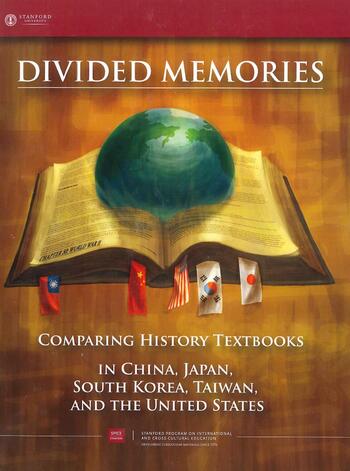
The outcome was the project's first book in 2011, History Textbooks and the Wars in Asia: Divided Memories, which suggests that an "introspective effort" to understand national narratives about WWII has the potential to bring about historical reconciliation in the region. Sneider describes it as the first comparative study of textbooks in the countries involved; it soon evolved into a classroom supplemental textbook published by the Stanford Program on International and Cross-Cultural Education.

"Formal education is a powerful force in shaping our historical understandings," Sneider noted. "We wanted to look at the textbooks that have the most impact and usage."

A 2014 book, Confronting Memories of World War II: European and Asian Legacies, which was co-edited by Shin, Sneider and Daniel Chirot, a sociologist with the University of Washington, compared successful European WWII reconciliations with lagging Asian efforts. Another book, Divided Lenses, published earlier this year, examined the impact of dramatic film and other forms of popular culture on wartime memory. A new book is due out this summer, Divergent Memories: Opinion Leaders and the Asia-Pacific War, which focuses on leaders in politics, the media and academia in Japan, China, South Korea and the U.S.

The Divided Memories project aims to generate discussions and collaborations among those who create "historical memories" – educators, policymakers and government leaders. One report that grew out of such dialogues included suggestions for reconciliation:

  • Create supplementary teaching materials on the issue. 
  • Launch dialogues among Asian, American and European historians. 
  • Offer educational forums for journalists, policymakers and students. 
  • Conduct museum exchanges and create new museums, such as one wholly dedicated to WWII reconciliation in Asia. 
  • Increase student exchanges among all the countries involved. 

History is reflected in today's geopolitics, as noted in the revived disputes by these nations over rival claims to islands in the South China Sea and elsewhere. Without resolution, these disagreements can flare up into military conflicts, Sneider wrote.

"The question of history taps into sensitive and deeply rooted issues of national identity," he noted.

Whether recounting Japanese atrocities in China, China's exaggerated account of its Communist fighters' role in World War II, or the U.S. decision to drop atomic bombs on Japan, no nation is immune to re-creating the past to further its own interests today, Sneider wrote.

For example, Divided Memories research on Chinese textbooks shows how the Chinese government in recent decades embarked on a "patriotic education" campaign to indoctrinate young people by exaggerating its role in Japan's WWII defeat. This narrative suits the nationalistic desires of a Chinese government no longer exclusively motivated by communist ideology, Sneider said.

One project of APARC and its Japan Program that was also an outgrowth of Divided Memories involved Stanford scholars urging Japanese Prime Minister Shinzo Abe to show "clear, heartfelt remorse" in a 2015 speech on the 70th anniversary of the end of WWII. A 15-page report featured hypothetical statements suggesting what Abe might say to make amends for Japanese actions in China and Korea.

"While we cannot claim to have directly influenced the prime minister, his statement did go further in the direction of an expression of remorse over the war and the need to continue to look clearly and honestly at the past than many expected," said Sneider.


Image
divided memories 2

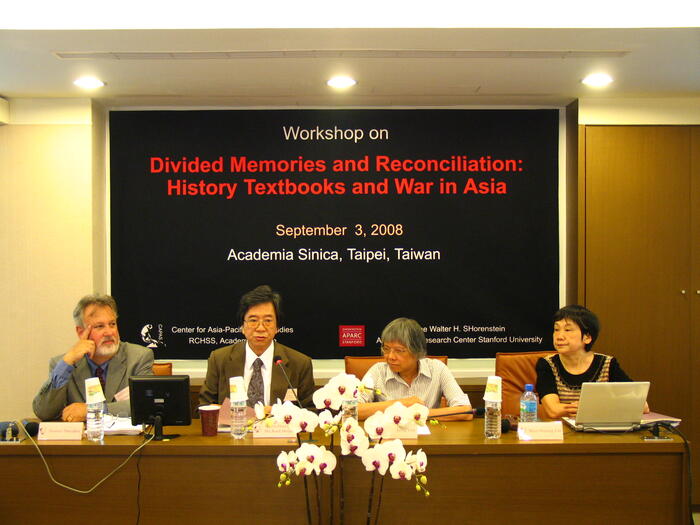
A workshop on history textbooks co-hosted by Shorenstein APARC and Academia Sinica's Center for Asia-Pacific Area Studies takes places in Taipei, Sept. 3, 2008.


Generations and grievances

Consciousness-raising on other fronts, however, is getting results, thanks to Stanford's Divided Memories project. A 2015 landmark agreement between Japan and South Korea over the WWII "comfort women" dispute was reached due to extensive U.S. involvement. Comfort women were women and girls who were forced into sexual slavery by the Imperial Japanese Army in occupied territories before and during World War II.

In an article, Sneider explained how the U.S. perceived that the dysfunctional relationship between South Korea and Japan over this issue, among others, threatened to undermine American strategic interests in Asia. 

Shin highlights the importance of U.S. involvement. "The U.S. is not just an outsider to historical and territorial disputes in the region," he said. "From a geopolitical perspective, the U.S. has done a wonderful job in reviving the devastated region into a prosperous one after 1945, but from a historical reconciliation perspective, the U.S. has done a poor job."

He suggests that America should "play a constructive role in promoting historical reconciliation" among the countries involved. And so, the Divided Memories project has included the United States in its efforts.

According to Sneider, Divided Memories is unique among all reconciliation projects for its emphasis on the inclusion of the U.S.; comparative analyses across countries; and real-world policy impacts. As part of the Shorenstein research center, it is housed within Stanford's Freeman Spogli Institute for International Studies.

"This project reflects what Stanford, our center and the Freeman Spogli Institute are all about – true interdisciplinary research and engagement," Sneider said.

Clifton Parker is a writer for the Stanford News Service.

Hero Image
divided memories reconciliation headline
Japanese soldiers in Shanghai, March 23, 1927 | A Stanford project encourages World War II reconciliation and historical accuracy about the conflict and its consequences in Japan, China, Korea, Taiwan and the United States. Progress has been made on classroom textbooks and scholarly discussions and exchanges.
Getty Images
All News button
1
Authors
Gary Mukai
News Type
News
Date
Paragraphs

On February 12, 2016, the Stanford Program on International and Cross-Cultural Education (SPICE) and Stanford Live (in collaboration with the National Consortium for Teaching about Asia) co-hosted a teacher professional development seminar that focused on the Silk Road. The seminar was held just prior to a Stanford Live performance by the Silk Road Ensemble at Stanford Bing Concert Hall on February 24, 2016 and a student matinee on February 25, 2016. Made up of performers and composers from more than 20 countries, the Silk Road Ensemble was formed under the artistic direction of Yo-Yo Ma in 2000.


Image
Jonas Edman introducing the Silk Road Ensemble. © Joel Simon

Jonas Edman (SPICE) and Ben Frandzel (Stanford Live) organized the day-long seminar. The morning featured a two-part lecture by Professor Emeritus Albert E. Dien, Stanford University. Part one focused on a general overview of the history and geography of the Silk Road and part two focused on a specific introduction to the religions along the Silk Road. Dr. Dien highlighted religion as an example of the many ways that the Silk Road helped to facilitate cultural exchange for millennia, resulting in the tremendous diversity one witnesses today in the region.


The afternoon featured a presentation and performance by composer and santur player Faraz Minooei, and a curriculum demonstration by SPICE staff. Minooei gave an overview of how the Silk Road played a role in the transmission of musical tradition, and also shared his personal story from his birth and childhood in Tehran, his immigrant experience in the United States, and his musical discoveries along the way. In particular, he shared his reflections on his deep spiritual desire to study music, seeing music as an “unexplainable souvenir from the eternal truth.”

Reflecting on Minooei’s presentation, Frandzel commented, “Faraz’s presentation really embodied the ways in which the Silk Road’s tradition of cultural exchange is a living story that continues to this day. His performances of Persian classical music and of his own compositions were entrancing, ear-opening experiences. As Faraz discussed his background and the musical forms that feed into his current work, his personal history and music seemed to encapsulate, in a fast-moving way, the kinds of cultural mixing that would have happened along the historic Silk Road. In our teacher workshops, we aim to provide teachers with arts-based teaching tools, and also to provide a larger social and cultural context for the art forms under discussion. The wonderful opportunity to partner with SPICE on the workshop, and the presence of this fascinating and brilliant musician, made this so much more possible.”

The curriculum demonstration was led by Rylan SekiguchiNaomi Funahashi, and Johanna Wee, who introduced both print- and web-based materials from the curriculum unit, Along the Silk Road, which were developed in collaboration with the Silk Road Ensemble and Dr. Dien. The 20 teachers in attendance interactively engaged with the materials and each received a complimentary copy of the curriculum unit as well as a large wall map of the Silk Road. The development of such materials has been a hallmark of SPICE for 40 years. The materials help to make content from teacher professional development seminars accessible to students.

Following the seminar, Edman reflected, “It is always such a pleasure to share with teachers the curriculum we produce here at SPICE. And to be able to collaborate with Stanford Live on a professional development workshop in conjunction with the Silk Road Ensemble’s visit to Stanford was a wonderful opportunity and experience. The Silk Road—with its themes of cross-cultural communication, exchange, and understanding—seems like an ideal topic for middle school students trying to understand today’s globalized world. We hope the speakers and pedagogical strategies and materials shared at the workshop will help teachers bring the topic to life in the classroom!”

 
Hero Image
Kinan Azmeh and Kojiro Umezaki, The Silk Road Ensemble. © Joel Simon Joel Simon
All News button
1
Authors
Gi-Wook Shin
News Type
News
Date
Paragraphs

A variety of media outlets have recently highlighted Stanford research efforts focused on the value of global talent and diversity policy in South Korea led by Professor Gi-Wook Shin, director of the Walter H. Shorenstein Asia-Pacific Research Center (APARC).

On Arirang, Shin discussed why South Korea should seek to recruit and retain foreign skilled workers in a moderated conversation with Rennie Moon, an assistant professor at Yonsei University. Together, the scholars work on a research project that examines diversity programs and policies of universities and companies in South Korea.

Shin and Moon wrote an editorial for Conversation UK that recognizes Korea’s failure to embrace diversity and says the country’s ethnic nationalism is largely to blame. They call upon Korean universities and the government to work closely together to tackle diversity issues. A similar message was relayed in a Q&A conducted by Shorenstein APARC and on a podcast episode recorded for "Korea and the World." Shin and Moon also wrote an editorial for the East Asia Forum that broadens the analysis to include the challenges of attracting foreign talent across Northeast Asia. 

Shin also told Maeil Shinmun that South Korea needs concrete and strategic policies to compete globally in its recruitment of foreign skilled workers. One of his policy suggestions is to offer a 2-year visa period for foreign college graduates to encourage them to work and stay in South Korea.

Dong-a Ilbo also covered an event where Shin presented findings from his co-authored publication, Global Talent: Skilled Labor as Social Capital. He said South Korea must embrace the value of social capital and diasporas as seen in the United States example, or else the country risks losing global competitiveness. Shin leads a research project on this topic with Joon Nak Choi, 2015-16 Koret Fellow at Shorenstein APARC and an assistant professor at Hong Kong University of Science and Technology. An earlier Nikkei Asian Review editorial highlights some of their studies.

Related links will be added to this news item as they arrive.

Hero Image
gettyimages 187172376
Students prepare to take an exam at a high school in Seoul.
AFP/Getty Images - Jung Yeon-Je
All News button
1
Date Label
Authors
Gary Mukai
News Type
News
Date
Paragraphs

My daughter, Emily, was teaching English at a middle school in Asahi City, Chiba Prefecture, on the Japan Exchange and Teaching (JET) Program when the 2011 Tohoku earthquake struck on March 11, 2011. Tohoku is a region in the northeast portion of the island of Honshu, the largest island in Japan. Though Asahi City, a coastal city, is not in the Tohoku region, it was still heavily damaged by the resulting tsunami. Several of Emily’s students lost their homes. She was emotionally shaken, of course, but was fortunate not to sustain any injuries.

With the fifth anniversary of the 2011 Tohoku earthquake and tsunami approaching, I have been reflecting upon the tremendous anxiety that I felt that day about Emily’s safety, my wife’s family in Tohoku, and the people of Japan in general. My reflections deepened last week while observing the interaction of SPICE’s Reischauer Scholars Program (RSP) students (American high school students studying about Japan) with SPICE’s Stanford e-Japan students (Japanese high school students studying about the United States) in an informal online “social hour.” The RSP and Stanford e-Japan are distance-learning courses that are offered by SPICE.

Stanford e-Japan instructor Waka Brown and RSP instructor Naomi Funahashi organized the social hour to help to build bridges between youth in Japan and the United States. During the latter part of the social hour, RSP student, David Jaffe (Mesa, Arizona), posed the question, “How is 3.11 remembered today?” Among the many Stanford e-Japan students who spoke was Minoru Takeuchi (Sakura City, Chiba Prefecture), who stated, “When the earthquake happened, I was an elementary school student (12 years old). I still remember very well… at that time, I was in school. Some students were very afraid and crying… Maybe after the earthquake, many Japanese noticed the importance of working together, the preciousness that they could meet their friends…” The Japanese students’ sharing of their experiences related to 3.11 extended the social hour far beyond the hour, and the gratitude expressed by the American students to their counterparts in Japan flowed for many minutes in a text-chat box.

Observing the students was one of the most rewarding experiences of my career at SPICE. The Japanese students’ remembrances of 3.11 brought back poignant and difficult memories for me but also provided me with hopeful thoughts on the future of the U.S.–Japan relationship as I witnessed students from across the Pacific forming budding friendships and discussing topics of mutual relevance.
 

Resources for the classroom
 

My hope is that teachers will carve out some time in their curriculum to engage their students in a study of 3.11 as well as its legacies. The study of natural hazards ought to be a core part of school curriculum. SPICE has undertaken many curricular projects related to 3.11. I would recommend that teachers show the film, After the Darkness, which was produced by Risa Morimoto and Funahashi. After the Darkness is a documentary film that touches upon the events of the disaster itself but also focuses on the experiences of two survivors in particular. It is accompanied with free curricular lessons that are accessible to students of various ages. I also recommend a lecture by Professor Emeritus Daniel Okimoto, Stanford University, on “Japan’s Geological Factors,” which is accompanied by a free lesson plan. Another recommended curricular unit is SPICE’s Examining Long-term Radiation Effects, which was produced prior to 3.11 but can help students understand the radiation-related concerns following the Fukushima Daiichi nuclear disaster. In addition, the film, Live Your Dream: The Taylor Anderson Story, is about one of two American JET Program teachers who lost their lives during 3.11. SPICE developed a teacher’s guide for the film that can be freely downloaded from the Live Your Dream: The Taylor Anderson Story website. Lastly, I recommend the use of the films from the 113 Project in classrooms. Earlier this week, I moderated a panel discussion that included Wesley Julian (director of the 113 Project), Andy Anderson (father of Taylor Anderson and board member of the Taylor Anderson Memorial Fund) as well as other Americans and Japanese who continue to contribute to relief efforts in the Tohoku region.

Hero Image
tohoku
A distraught woman carries an elderly woman on her back, away from the piles of debris that are the flattened remnants of what was once a city in the Tohoku region of Japan. This scene comes from a photo taken the day after a 9.0 magnitude earthquake struck Japan on March 11, 2011, triggering a destructive tsunami.
Kahoku Shimpo
All News button
1
News Type
Q&As
Date
Paragraphs

The Program on Arab Reform and Democracy (ARD) at Stanford’s Center on Democracy, Development, and the Rule of Law (CDDRL) is pleased to welcome Egyptian economist Samer Atallah as a visiting scholar for the 2015-16 academic year. Atallah has taught economics at the American University in Cairo (AUC) since 2011, and his work focuses on development economics and political economy of democratization. He is a leading contributor to debates on economic public policy in Egypt, and previously served as an advisor to the 2012 presidential campaign of Abdel-Moneim Abul-Fettouh. He holds a PhD in Economics from McGill University and a Masters Degree in Engineering from University of California, Berkeley. His research on the Arab world has received the support of the Arab Council for Social Sciences and the Economic Research Fund, and spans a wide range of areas, including; education, electoral behavior, public opinion, trade policies, and political institutions in resource dependent economies.

During his residency at CDDRL, Atallah will work on a series of publications examining salient questions in the political economy of the Arab World, including the impact of trade and capital flows on governance in Egypt and Tunisia, and the relationship between education and wealth inequality in Egypt. Atallah’s fellowship is generously funded by a grant from the Carnegie Corporation to support scholars from the Arab world. In the following interview, Atallah discusses his current research projects and their relevance to important public policy debates.


What are your research goals and priorities during your residency at CDDRL?

First of all, I would like to say that I am extremely delighted to be here and excited at this valuable opportunity to collaborate with distinguished scholars at CDDRL and Stanford University, which promises to be a nourishing environment for my research. 

My research agenda during my residency here at CDDRL includes working on two projects, both of which are related to broader questions of democratization and development. This first one is a comprehensive theoretical and empirical study investigating how political and economic institutions evolve as economies become integrated in the global economy. I am interested in understanding how trade and capital flows impact institutions - in the economic sense of the term - and the implications of that impact on political change. For instance, the experiences of economic liberalization in countries like Egypt and Tunisia had unquestionable consequences on the distribution of wealth within their respective societies. Economic liberalization policies had equally important effects on the performance and evolution of their legal, economic governance and political institutions. My own research seeks to investigate how these institutional changes have evolved and the impact of these processes on political change.  The second project is an empirical study examining the relationship between wealth inequality and educational inequality in Egypt.


In what ways do your projects speak to contemporary debates on the origins and trajectories of the Arab uprisings?

I would argue that the divergence in outcomes across the various uprisings in Arab region cannot be understood without seriously thinking about the different historical evolution of political and economic institutions in these countries. These institutions impact the functioning of the economy, its growth, and the social inclusiveness of that growth—factors that were very pertinent to the popular mobilization that advanced the post-2010 uprisings. Certainly these institutions are in part the product of how the economy is managed in a given country in the short-run. At the same time, they are the result of long-term external and internal factors that we need to investigate and understand.

A case in point is the bureaucratic apparatus in Egypt. That sizable bureaucracy is the outcome of a long-standing policy of guaranteed employment, which the government had adopted in the 1960s to secure political support. Whereas economic liberalization policies adopted by President Anwar al-Sadat in the 1970s shrunk the economic role of the state, the size of the bureaucracy, nevertheless, increased significantly. Thus, the question we confront as researchers is why have these institutions remained stagnant and shielded from change despite the fact the nature and priorities of the economy have shifted. This is a major concern in my own research.


What lessons, if any, does your work offer policy-makers involved in the areas of economic and human development?

My second project on inequality and education speaks to one of the central factors that have animated the post-2010 uprisings in the Arab world, namely economic inclusion. In the context of Egypt, educational inequality has contributed greatly to the huge disparities in income and wealth in the country. Exacerbating and reinforcing these disparities is an intergenerational dependency in educational attainment—that is, children of uneducated parents are highly likely to remain uneducated, and by implication, economically underprivileged. This is an area that leaves a lot of room for policy interventions.

But such interventions must be grounded in a better understanding of the causes of this dependency and why it persists. Toward that end, my research seeks to investigate how the type and range of assets in a given household affect schooling and education decisions. Other key determinants of these decisions include access to credit, spatial distribution of educational facilities, and volatility of household income. With a sufficiently nuanced understanding of the problem at hand, all of these factors present potential areas for policy interventions to alter the incentives for school enrolment and quality of education delivery. Such interventions could potentially lead to a better distribution of education and income in the long run.


What are the potentially important research questions that address Arab reform and democracy?

I believe the recent upheavals in the Arab world have pushed us to re-evaluate our understanding of the underlying reasons and implications of political and economic change. This has opened up a multitude of lines of inquiry related to the economic incentives and costs of political change. One such endeavor entails an ambitious effort to compare the evolution of social movements, economic policies, and political structures in the Arab world with other regions of the world. For instance, I think we could draw multiple parallels between the Arab experience and that of many Latin American countries, especially with respect to the role of military institutions, the impact of economic liberalization, social inequality, and civil society movements. Having said that, there is also a lot of work that needs be done in understanding and analyzing the divergent outcomes of the Arab uprisings.

Hero Image
fb img 1430070553548
All News button
1
-

Omer Moav is a Professor of Economics at the University of Warwick.

This workshop is part of the Economic History Workshop series in the Department of Economics and is co-sponsored by The Europe Center.


Cereals, Appropriability and Hierarchy
Download pdf

Conference Room B
351 Landau Economics Building
579 Serra Mall
Stanford, CA 94305-6072

Omer Moav Professor of Economics Speaker Warwick University
Workshops
Subscribe to History