Sustainable development
Authors
News Type
News
Date
Paragraphs

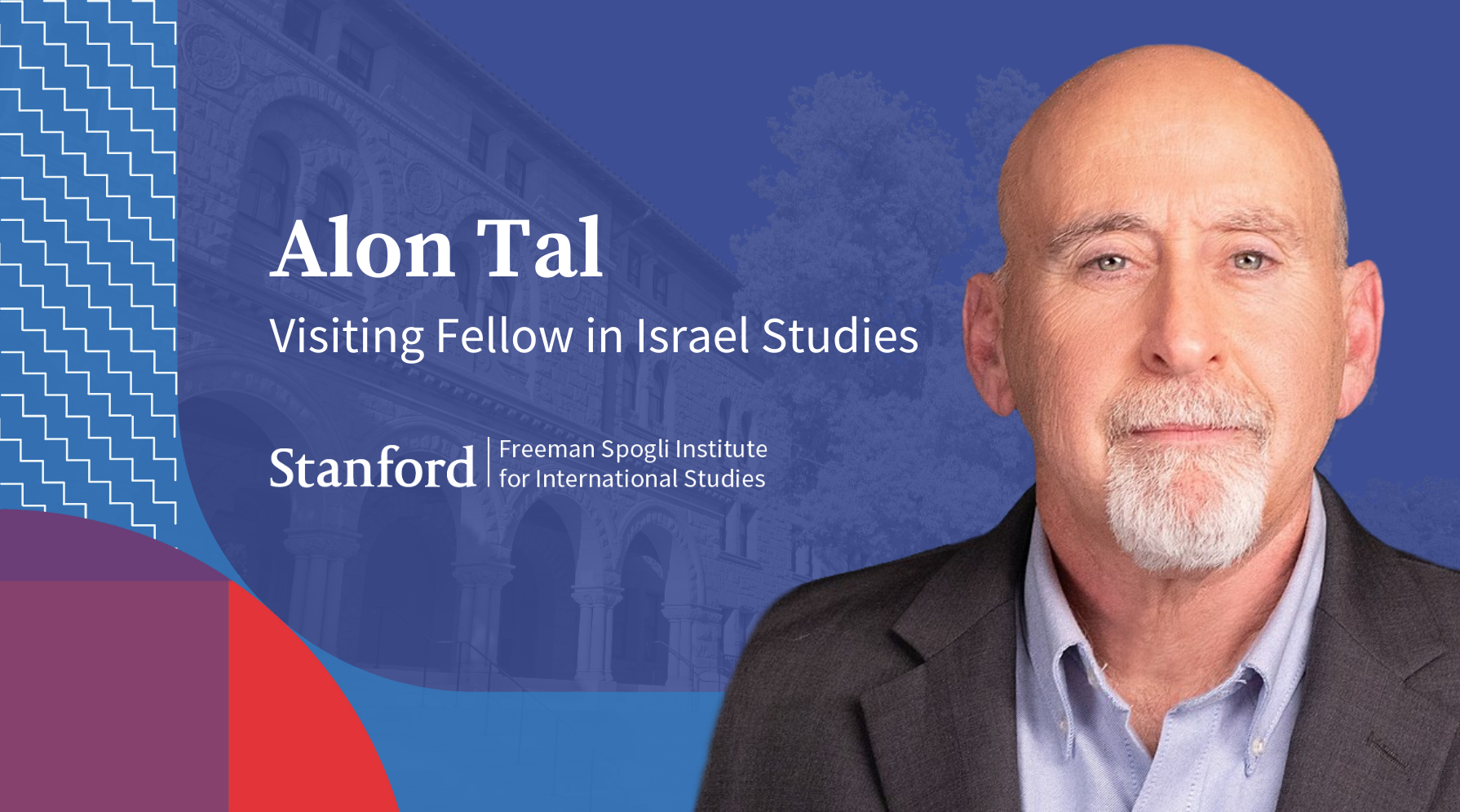
The Visiting Fellows in Israel Studies program at the Freeman Spogli Institute for International Studies (FSI) is pleased to welcome Professor Alon Tal as a visiting fellow. He will be based at FSI’s Center on Food Security and the Environment (FSE)

Professor Tal’s research looks at a broad range of issues involving public policy and sustainability, primarily considering the effect of rapidly growing populations on natural resources and the environment. Over the course of his career, Tal has balanced the demands of both academia and public interest advocacy. He has worked in government as a member of Israel’s parliament and as a professor with appointments at Tel Aviv University, Stanford, Ben Gurion, Hebrew, Michigan State, Otago, and Harvard Universities.

Prior to joining FSI, Tal was a visiting professor at the Stanford Graduate School of Business. He is also the founder of several environmental organizations in Israel, including Adam Teva V’Din, the Israel Union for Environmental Defense, and the Arava Institute.

To get a better understanding of how environmental issues are intersecting with other challenges unfolding in Israel and the region, we spoke to Dr. Tal about his research, his time in government, and his recommendations for what can be done to affect more action to address climate change.


Can you give us a general overview of how the Middle East as a region currently approaches climate-related and environmental policies?

Given the availability of inexpensive oil, it is not the surprising that many countries in the Middle East have a significant “carbon footprint.” Historically, there has been resistance to modify that energy profile. This is now starting to change. Just in December 2023, at the UN climate conference in Dubai, for the first time all Middle Eastern countries signed a pledge which ostensibly should lead to a decarbonized region. It’s fairly clear what needs to be done to achieve this, but there are enormous institutional and political obstacles to actually doing it. Each country in the Middle East functions as an “energy island” making renewable deployment much more difficult. Creating a regional electricity grid is a good place to start.

Israel has an extremely creative climate tech ecosystem that’s producing everything from green hydrogen and fuel cells to cultured meat and milk. I am encouraged that countries like the United Arab Emirates have already begun to invest in Israeli start-ups and more established companies to provide the muscle they need to become transformative. A year ago, Israel, Jordan, and the UAE signed an agreement which, for the first time, will provide clean solar energy from Jordan (which has ample open space in its deserts) to Israel. In exchange, Israel will deliver inexpensive desalinized water to Jordan, which is perhaps the world’s most water scarce country.

Beyond the sustainability dividends, given the prevailing tensions, I believe that such cooperative efforts in the environment will not only make the region healthier, but will serve as a basis to reduce the historic enmity. Indeed, I have been involved in a range of cooperative projects with Palestinian and Jordanian partners for almost thirty years.

Ready or not, the climate crisis is here, and making these issues part of the country’s political agenda and keeping them in the spotlight is important. The younger generations know this and are speaking out, and we have a responsibility to make sure they are heard.
Alon Tal
Visiting Fellow in Israel Studies


You have firsthand experience working on policy as a member of the Knesset, Israel’s parliament. What success did you see there, and what challenges remain in addressing environmental issues? 

Israeli politics is quite polarized, not unlike the U.S., but issues relating to the environment generally enjoy support from all political parties. I did a lot of work with partners on the Israeli right and amongst religious politicians to engage them and receive support for a green agenda. The press made a big deal about this “bi-partisan” orientation, but it feels very natural to me. Regardless of people’s political orientation, everyone wants their children to breath clean air, drink potable war, and live in a planet with a stable climate.

That being said, I worry that public awareness of these issues remains deficient in Israel even though we are considered a “climate hotspot.” Other issues, particularly those involving security, don’t leave our citizens very much bandwidth to think about other matters, even urgent ones like climate change.

That’s why having a committee that convenes regular meetings and pushes the executive branch to be more conscientious in its mitigation and adaptation efforts from inside government is so critical. While I was serving, we held hearings on increasing shading in urban areas, removing bureaucratic obstacles to installation of “agrovoltaic” systems (solar panels on farmlands), expediting sales of electric vehicles through tax incentives, and many other topics. 

Our paramount objective was to pass a “climate law,” which would provide a statutory basis for the energy transition that needs to be accelerated. This is a step many state and national governments have taken in recent years. Unfortunately, the “Government of Change” that my party was part of in Israel fell apart before this critical legislation could be passed. That’s truly unfortunate. But the cabinet did make a commitment to reach net-zero emissions of greenhouse gases by 2050.  

Ready or not, the climate crisis is here, and making these issues part of the country’s political agenda and keeping them in the spotlight is important. The younger generations know this and are speaking out, and we have a responsibility to make sure they are heard.


What environmental implications does the ongoing war between Hamas and Israel have for the region?

For me, the war is not just about personal security, but also environmental security. Extremist, Islamist forces, and proxies for the Iranian government all threaten the kind of cooperation which is critical for the region.

I am encouraged that not one of my environmental colleagues from Arab countries — including many Palestinian colleagues — has broken off interactions with me since the war began. We continue to do research with a West Bank Palestinian group from Al Quds University about exposures to pharmaceutical products from wastewater reuse. We urgently need more of this kind of cooperation if we are going to address the pressing needs being created by this crisis.

Consider, for example, the groundwater situation in Gaza. When Egypt held the Gaza Strip in the 1960s, the aquifers were contaminated by salt water intrusion from the Mediterranean Sea caused by over pumping. It is absolutely critical that the people of Gaza have desalinated water (like Israel does) both to meet their immediate needs now and as climate-driven droughts continue to change local hydrological conditions in the future. For this to happen, whoever rules Gaza will have to stop investing limited local resources in military weaponry and focus on environmental infrastructure.

The human toll of this war is heartbreaking on all sides. But I believe that when the dust settles, there will be a victory for those who want to work together on critical environmental issues.

If we are going to meet the unprecedented challenges posed by the climate crisis, the world as we know it will have to change. And that won’t happen without effective public policies.
Alon Tal
Visiting Fellow in Israel Studies


How can institutions like Stanford help in addressing these issues?

There’s no question that higher education is evolving. Universities generally divide up their departments according to disciplinary distinctions that were germane at the advent of the twentieth century but often make less sense today. In the fields I work in, it’s common lip service to talk about “interdisciplinary solutions.” But what that actually means in practice is that students need to be given literacy in topics ranging from chemistry and biology to economics, social science, and even aesthetics. I am very impressed with Stanford’s new Doerr School of Sustainability, which is aspiring to serve as an example of how this can be done. 

The course I am currently teaching, “Public Policy and Sustainability Challenges: Israel and the Middle East,” is designed to give the students a sense of what policies appear to work and which ones do not.  For instance, carbon taxes used to be a theoretical idea. But with 61 countries having introduced policies that monetize carbon, we can now dispassionately evaluate these interventions.

The students I see in my class are a healthy mix of MBA and sustainability scholars. They break up into groups of four and serve as consultants for a variety of climate tech companies, applying what they have learned to the real-life regulatory challenges which these promising ventures face. Stanford is preparing leaders, many of whom are committed to working in the climate space. I hope that the class provides them with valuable insights and tools to do this.


Looking to the future, what policies would you like to see put in place to precipitate meaningful action on climate-related issues in both the short and long term?

It is increasingly clear that despite increased global awareness, humanity is not meeting its goals for reducing greenhouse emissions. The population is growing, and billions of people are justifiably seeking a higher standard of living. If we are going to meet the unprecedented challenges posed by the climate crisis, the world as we know it will have to change; we are going to have undergo a complete technological makeover. This means an end to the fossil fuel era, beef as it is raised today, steel, cement, plastics – you name it. And this won’t happen without effective public policies.

One of the things that we started doing in Israel is requiring every school child from kindergarten to grade 12 to take 40 hours of classes about climate related topics during the course of the school year. That’s only a start, but it’s an important one. At Tel Aviv University, ten different departments have collaborated to produce a massive online open class, or “MOOC,” to get that expertise out of the university and into the hands of people. Education, coupled with urgency and action, is crucial. These are the kinds of initiatives that I believe are needed if we are going to see any real progress. 

Read More
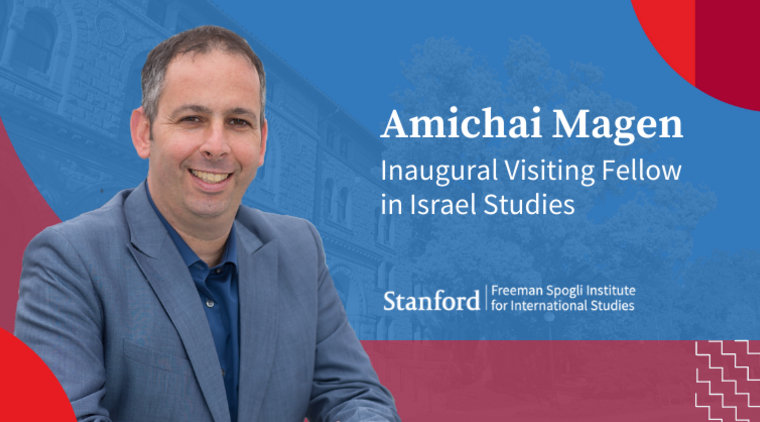
Amichai Magen joins the Freeman Spogli Institute as its inaugural Visiting Fellow in Israel Studies.
News

Meet Amichai Magen, Stanford’s Visiting Fellow in Israel Studies

In spring quarter, Magen, a scholar of law, government, and international relations, will teach “Israel: Society, Politics and Policy.”
Meet Amichai Magen, Stanford’s Visiting Fellow in Israel Studies
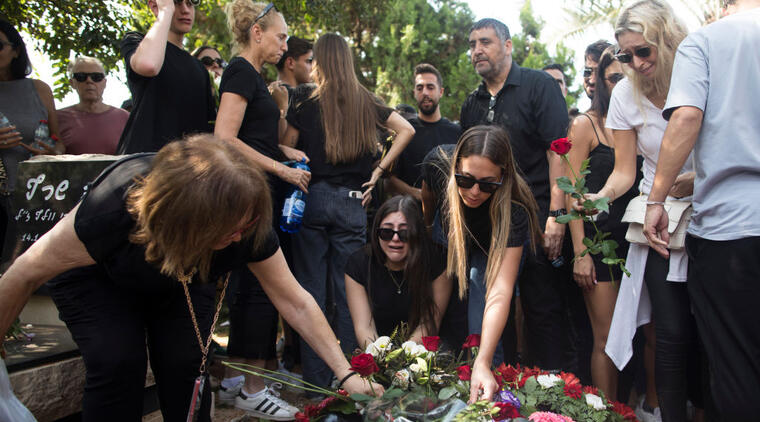
Family and friends of May Naim, 24, who was murdered by Palestinians militants at the "Supernova" festival, near the Israeli border with Gaza strip, react during her funeral on October 11, 2023 in Gan Haim, Israel. (Getty Images)
News

FSI Scholars Analyze Implications of Hamas’ Terror Attack on Israel

Larry Diamond moderated a discussion between Ori Rabinowitz, Amichai Magen and Abbas Milani on the effects of Hamas’ attacks on Israel and what the emerging conflict means for Israel and Middle Eastern geopolitics.
FSI Scholars Analyze Implications of Hamas’ Terror Attack on Israel
The flag of Israel flies against a sunlit sky
Commentary

Rise, Recover, Reimagine: A Jewish Response to the Terror of Oct. 7

For me, a Jewish response to Oct. 7 can be captured in three words: rise, recover, reimagine.
Rise, Recover, Reimagine: A Jewish Response to the Terror of Oct. 7
Hero Image
Alon Tal joins the Freeman Spogli Institute for International Studeis as a Visiting Fellow in Israel Studies
Dr. Alon Tal researches public policy and sustainability, primarily considering the effect of rapidly growing populations on natural resources and the environment.
All News button
1
Subtitle

Professor Tal’s expertise in sustainability and public policy will offer students valuable insight into the intersection of climate change issues and politics in the Middle East.

Date Label
Authors
News Type
Blogs
Date
Paragraphs

When I arrived at Stanford in September 2022, I’d just stepped out of a product manager role at a large government contractor. My career had focused on providing policymakers with the best open-source information possible around a myriad of foreign policy issues. Over the preceding years, that work had become increasingly intertwined with artificial intelligence (AI), not just as a subject of analysis but as a critical tool in the analytic process. In enrolling in the Ford Dorsey Master’s in International Policy (MIP) program, situated in the heart of Silicon Valley, I hoped I could better understand AI and how it would reshape geopolitics. 

My timing was serendipitous. Just as I settled in, OpenAI unveiled ChatGPT, and the world changed. It was a whirlwind period of wild speculation, anxiety, and excitement. To cut through the noise, I sat in on an advanced course on machine learning and enrolled in the Computer Science department’s core course, Programming Abstractions, to build my programming skills. Blending my policy framework development in MIP courses with technical study at Stanford’s renowned Computer Science department was exactly what I hoped Stanford would provide. 

What I didn’t expect, however, was how differently I was starting to think about my future after the program.

What I didn’t expect, however, was how differently I was starting to think about my future after the program.

The Entrepreneurial Leap

The original plan for MIP was to get smart and then apply what I learned within an established organization, like my former employer or the government. I began to wonder if, rather than providing information to decision-makers as I had previously in my career, I could combine my product management experience and burgeoning CS competency in a different way. Could I attack the same problems I’d been working on for years, but from the bottom up? Could I use technology to empower the broader public to become more resilient to misinformation and polarization?

The approaching summer seemed like the opportunity to test my product ideas and the possibility of starting a business around them. MIP’s summer funding made it feasible to take advantage of that opportunity while still paying my rent. It also added helpful structure to my plan, requiring me to record my hours and find a mentor to oversee my progress.

My former colleague, David, with whom I have a strong relationship built on trust and shared vision, agreed to be my mentor. He had recently launched his own company in a related space and was able to share a wealth of experience and insights.

The Summer of Coding and Discover

Summer came, and I dove headfirst into coding, dedicating countless hours at the corner desk of my Hoskins apartment to building something tangible that embodied my vision. I also began immersing myself in the Bay Area’s tech ecosystem - attending AI seminars, venture capital events, and networking with founders.

The results of those first weeks were encouraging. I prduced a working prototype that used AI to identify misleading information online and, by referencing trusted sources, provide missing context and corrective information to the reader. It was real progress toward a world where we no longer rely on ineffective fact-checking after readers are exposed to misleading information and form their opinions. Instead, AI could help every news reader spot deceptive content in real-time - during the opinion formation process.

Screenshot of the first time my prototype for The Critical Reader identified misleading info and injected corrective information on a live webpage

Despite my progress, I realized that if I were going to keep up with the pace of the hyper-competitive AI startup field, I would need a partner.

Finding a Co-founder 

With a working prototype of my Critical Reader Google Chrome extension, I felt ready to seek out an experienced partner who could help scale my vision. Y Combinator’s co-founder matching platform was my arena. It was a whirlwind of meetings and ideas, but eventually, I connected with the former CTO of a successful startup, who shared my commitment to revolutionizing digital information sharing.

Matching with a partner on Y Combinator’s matchmaking platform

We hit it off and decided to test our partnership with a 30-day trial. We examined my prototype critically and decided to pivot towards a simpler, more marketable product. In a few weeks, we had a minimum viable product ready and began user testing. As expected, the feedback was a mixture of praise and criticism, but it was energizing to have the critical data we needed to iterate and improve.

Beyond coding, we invested considerable effort into refining a mutual vision and business strategy. We began exploring non-profit frameworks and various hybrid business models that could achieve the scalability of a for-profit enterprise while preserving the principles that motivated us.

The experience developing financial forecasts and strategic plans significantly enhanced my professional toolkit and gave me first-hand experience with the reality of starting a business.

Renewed Vision 

In a few short months, my curiosity had evolved into a venture with real users and a business model. I had also changed. The experience developing financial forecasts and strategic plans significantly enhanced my professional toolkit and gave me first-hand experience with the reality of starting a business. 

Now, as I enter my penultimate quarter at Stanford, I am able to develop products and explore partnerships with a newfound clarity of purpose. My summer of entrepreneurship added a new dimension to my MIP experience and has set the stage for what comes after the program ends.

The Ford Dorsey Master's in International Policy Class of 2024 at the Freeman Spogli Institute for International Studies.

Meet the MIP Class of 2024

The 2024 Class has arrived at Stanford eager to tackle policy challenges ranging from food security to cryptocurrency privacy.
Read Full Story
Hero Image
Elliot Working on His Project
All News button
1
Date Label
Authors
News Type
Blogs
Date
Paragraphs
I had a great time learning, and seeing first hand, how countries act diplomatically to preserve their interests, but also collaborate with other countries to achieve common goals and purposes.
The Ford Dorsey Master's in International Policy Class of 2024 at the Freeman Spogli Institute for International Studies.

Meet the MIP Class of 2024

The 2024 Class has arrived at Stanford eager to tackle policy challenges ranging from food security to cryptocurrency privacy.
Read Full Story
All News button
1
Subtitle

This summer, Sebastian Ogando (Ford Dorsey Master's in International Policy Class of 2024) , passionate about art and culture, explored the diplomatic exchanges behind the nominations for heritage sites as an intern at the United Nations Educational, Scientific and Cultural Organization (UNESCO).

Authors
News Type
Blogs
Date
Paragraphs

My goal of spending the summer of 2023 working in the Global South came to fruition, courtesy of the Environment for Development - Makerere University Centre (EfD - MaK), the  Freeman Spogli Institute for International Studies (FSI), and the Stanford Sustainable Finance Initiative (SFI). Being on the ground in Uganda to work on green finance seemed the right call. I have spent four years in the Global North, primarily in the Netherlands and Luxembourg, working on European Union (EU) international economics issues, which included green finance. One of the biggest challenges I encountered was the conflict of interest between donors and the projects they prioritized and the beneficiaries and the projects they prioritized. In this aspect, disagreements about green financing were especially pronounced.

Pamella at a meeting

In my first year at Stanford, I participated in a series of learning, unlearning, and relearning experiences to understand better how to make economic decisions work well for both developed and developing countries. I was excited about a summer fellowship that would allow me to leverage my expertise from the Global North and newly acquired knowledge from Stanford to contribute toward addressing the economic development challenges of the Global South. Fortunately, the EfD - MaK Center in Uganda awarded me a fellowship opportunity, and with the funding of FSI and SFI, I was able to spend 12 weeks working in Uganda. Being in Uganda was not a novel experience for me. I was born and had previously worked there both as a development consultant and as a research assistant on different randomized controlled trial experiments.

Working in Uganda, however, and becoming immersed in the Global South perspective of green finance was new. My duties as a Visiting Fellow at EfD - MaK made the Fellowship an entirely unique and rewarding experience.

Working in Uganda, however, and becoming immersed in the Global South perspective of green finance was new. My duties as a Visiting Fellow at EfD - MaK made the Fellowship an entirely unique and rewarding experience. I conducted policy analysis on green finance, collaborated with stakeholders from the public sector, civil society, private sector, and academia, contributed to high-level policy dialogues, and took part in some of the ongoing projects on energy financing. This work gave me an understanding of the distinctive nature of the energy and climate environment in Uganda. Accomplishing development objectives, such as eliminating poverty and promoting prosperity for all, requires energy sources to be available. Ensuring essential levels of energy supply is also of mutual interest to donors and country beneficiaries.

In Uganda, green finance is particularly important in addressing the energy poverty problem and allowing the country to meet Uganda’s Nationally Determined Contributions (NDCs). UBOS- Uganda Bureau of Statistics’ 2018 National Electrification Survey shows that 66% of Ugandans are multidimensional energy poor, measured by access, cooking solutions, and end-use technology. In its NDCs, Uganda has pledged to reduce its greenhouse gas emissions, most of which are from agriculture, forestry, and other land use (AFOLU), by 24.7% before 2030. These commitments call for green financing approaches that promote access to clean and affordable energy for most Ugandans who are currently either underserved or unserved. Climate finance is essential to help vulnerable communities deal with the prevalent consequences of climate change. Uganda now faces a $28.1 billion climate financing gap and has been able to mobilize only $4 billion. Boosting green financing from all players, local or international, public, private, for-profit or not-for-profit, will help the country build climate resilience and adaptability and meet its broader green growth objectives, as specified under the NDCs.

Pamella with her colleagues

International donors have helped Uganda make some progress towards meeting the UN Sustainable Development Goal - SDG 7 - Ensure access to affordable, reliable, sustainable, and modern energy for all. The National Planning Authority reports that Uganda’s electricity access has increased from 24% in 2018/2019 to 57% in 2021/2022, and its grid reliability from 90% to 98%. However, a lot still needs to be done. Uganda’s biomass usage, primarily for household cooking, is still at 80% despite efforts to reduce it to 50%. Ugandan household emissions are estimated at 30 tons of carbon per year compared to five tons for the United Kingdom.

There are serious issues related to energy affordability. Uganda’s level of income inequality is high, with a Gini Index of 0.427.1 The Borgen Project reports that Uganda’s richest 10% receive 35.7% of the national wealth. In comparison, the poorest 20% receive only 5.8%. This indicates that a larger share of the population cannot afford clean energy. Even though policy dialogues sponsored by government officials have resulted in progress in reducing electricity costs, electricity remains unaffordable for many economically disadvantaged individuals.

This summer experience taught me that conditions within Uganda are similar to those of many countries of the Global South, particularly sub-Saharan Africa (SSA), that experience energy poverty. International Energy Centre (IEC) research has shown that the COVID-19 pandemic worsened energy poverty. IEC also projects that about 560 million people from SSA will still have no electricity access in 2030. My experience at EfD-Mak taught me that addressing country technical gaps and prioritizing green projects in planning, programming, and budgetary processes could enable countries to bridge the energy gaps.

It gave me a better understanding of the working environment in a developing country and elevated my grasp of several international development issues. I also acknowledge that countries are rarely the same, making it vital to gain direct exposure to the on the ground reality.

There is also a need to leverage the private sector, entrepreneurs, and financiers to invest in and contribute to Uganda’s green growth agenda. However, this necessitates that the government implement an enabling business climate to attract local and international players. Coordinated efforts are also essential to combat dependency on biomass, which increases greenhouse gas emissions and poses health risks to the populace. From the policy dialogues I participated in, ministries, departments, and agency officials emphasized the government’s commitment to reducing biomass usage. All players around the table, including the private sector, civil society, and communities themselves, must participate to accomplish biomass reduction.

Image
Pamella at a meeting

Spending the summer in Uganda met my expectations for an on the ground experience. It gave me a better understanding of the working environment in a developing country and elevated my grasp of several international development issues. I also acknowledge that countries are rarely the same, making it vital to gain direct exposure to the on the ground reality instead of relying on studies and external generalizations.

By and large, I am very thankful to the EfD Director, Professor Edward Bbaale, for allowing me to work on these issues and for his invaluable mentorship. I also enjoyed working with a team of experts, which included Dr. Peter Babyenda, Mr. Fred Kasalirwe, Mr. Gyavira Ssewankambo, and Ms. Jane Anyango, to mention just a few. Above all, I am thankful to FSI and SFI at Stanford University, whose collaboration with EfD-Mak Uganda made my summer fellowship both a priceless experience and a great opportunity to be home again.

The Ford Dorsey Master's in International Policy Class of 2024 at the Freeman Spogli Institute for International Studies.

Meet the MIP Class of 2024

The 2024 Class has arrived at Stanford eager to tackle policy challenges ranging from food security to cryptocurrency privacy.
Read Full Story
Hero Image
Pamella at a meeting
All News button
1
Subtitle

This summer, Pamella Eunice Ahairwe (Ford Dorsey Master's in International Policy Class of 2024) , a passionate advocate for sustainable development, merged her expertise in international economics from the Global North with the Global South perspective of green finance as a Visiting Fellow at the Environment for Development - Makerere University Centre in Uganda, delving into the intricate policy world of addressing energy poverty and achieving sustainable development goals.

0
img_8797_-_serena_rivera-korver.jpg

Serena joins the Ford Dorsey Master’s in International Policy from Ulu Ventures, a leading seed-stage venture firm in Silicon Valley with best-in-class decision analytics and a proactive approach to diversity. At Ulu, her investment focus included software, IT, and sustainability. Some of her favorite investments include Banyan Infrastructure, a software platform helping to deploy capital into sustainable infrastructure; SuperCircle, a company working with fashion brands to tackle textile waste; and Hey Jane, an online abortion clinic providing essential care to all. Prior to her time at Ulu, Serena was a growth-focused product manager at IBM on the Data and Artificial Intelligence portfolio and co-created the IBM Venture scout program as one of the first three Venture Associates. Serena received a B.A. in Environmental Science and Policy from Duke University.

At Stanford, Serena hopes to explore policy effects on entrepreneurship and sustainability innovation and adoption, particularly in emerging markets. Following her time at Stanford, she will be pursuing her MBA at Harvard Business School, as a member of the 2+2 program.

Master's in International Policy Class of 2025
Authors
News Type
Blogs
Date
Paragraphs

Climate Change is the defining issue of our generation, and we are at a defining moment. From shifting weather patterns that threaten food production, to rising sea levels that increase the risk of catastrophic flooding, the impacts of climate change are among the greatest threats to national and global security.

Energy accounts for two-thirds of total greenhouse gas, so the energy sector is the central player in efforts to reduce emissions and combat climate change. Thus, as national treasure Bill Nye put it, energy policy is climate policy. Mitigating the effects of climate change rests on the success of energy diplomacy and our ability to craft unprecedented global collaboration. Accordingly, the State Department's Bureau of Energy Resources work is vital not only to our energy security interests but also to realizing our ambitious goals toward a sustainable, low-emissions future.

The Bureau of Energy Resources (ENR) operates at the critical intersection between energy, climate, and U.S. national security and ensures U.S. leadership on global energy issues. ENR leads the Department of State's efforts to develop and execute international energy policy through diplomatic and programmatic engagement that promotes a low-emissions future, energy security for the United States and our allies and partners, and economic prosperity through sustainable, affordable, and reliable energy access.

Image
State Department Interiors


I worked in the Office of Energy Diplomacy for Europe, Western Hemisphere, and Africa (EWA), which specifically works to advance energy security and decarbonization and leads Department engagement on energy related sanction actions in these regions.

I worked in the Office of Energy Diplomacy for Europe, Western Hemisphere, and Africa (EWA), which specifically works to advance energy security and decarbonization and leads Department engagement on energy related sanction actions in these regions. EWA seeks to increase bilateral and regional energy diplomacy to support U.S. foreign energy policy, namely the green energy transition. In executing energy diplomacy priorities, EWA emphasizes improving energy market access, enhancing energy security, and promoting decarbonization through clean and renewable energy sources and technologies.

During my internship, I undertook a range of responsibilities that helped me develop a comprehensive understanding of energy diplomacy and its role in shaping global energy dynamics and the U.S.'s role in leading the energy transition. As Critical Minerals (CM) play a vital role in clean energy technologies, much of my work centered on securing and promoting resilient supply chains. Notably, there were key bilateral efforts with Argentinian and Brazilian energy stakeholders on critical mineral supply chains, which required coordination and information sharing on new projects to increase their CM output. As part of my responsibilities, I researched geopolitical and economic factors influencing the region's role in global supply chains and opportunities for growth and increased cooperation. As part of this work, I acquired new insights into mining techniques, production, and applications of critical minerals and broadened my grasp of the global supply chain and the pivotal role these resources play in various industries. Additionally, I gained a new understanding of the potential of new technologies like low nickel-cobalt ion batteries and green hydrogen, particularly their transformative role in advancing the energy transition and achieving sustainable development goals.

Image
Maya Rosales' placard as Energy Officer, Energy Resources Bureau, Department of State


I participated in a series of bilateral meetings with foreign counterparts, ranging from embassy officials to cabinet-level ministers. These interactions exposed me to the intricacies of international diplomacy, allowed me to witness the power of dialogue in forging alliances, and deepened my appreciation for the role of energy diplomacy in shaping a more secure and sustainable global energy landscape. Working at a functional bureau, I attended meetings with the Department of Energy, which exposed me to the inner workings of domestic energy policy formulation and implementation. I gained insights into how policy decisions translate into actions and how interagency collaboration contributes to effective energy governance.

My internship experience not only involved drafting important documents but also provided me with a variety of experiences and skills that have significantly contributed to my professional growth. The internship was a rewarding experience that allowed me to contribute to critical projects while deepening my understanding of energy diplomacy and its role on the global stage.

The papers I drafted, the exposure to high-level deliberations, engagement with key stakeholders, and the acquisition of diplomatic and technical skills expand my horizons and equip me to make meaningful contributions that will supplement my studies at Stanford. The knowledge gained during this internship will undoubtedly shape my future endeavors and commitment to advancing global energy security and sustainability.

Despite bureaucracy's (let's be real, sometimes fair) reputation, I was inspired by my department colleagues' bold leadership and tireless efforts. Amid an existential climate crisis and destructive war disrupting energy security, the hard and brilliant work of these public servants has left me optimistic about the future of our world. As global warming worsens, this office continues to shape and execute America's role in leading the global, renewable energy transition.

Image
Maya Rosales under the flags in a conference room


While it is easy to become jaded and nihilistic working on such harrowing issues, they boldly continue the work necessary to combat climate change by ensuring sustainable, equitable, and reliable energy access for individuals around the world. I am so excited to join their ranks next year when I officially enter the foreign service and continue to meet and work with some of America's best and brightest.

While it is easy to become jaded and nihilistic working on such harrowing issues, they boldly continue the work necessary to combat climate change by ensuring sustainable, equitable, and reliable energy access for individuals around the world.
The Ford Dorsey Master's in International Policy Class of 2024 at the Freeman Spogli Institute for International Studies.

Meet the MIP Class of 2024

The 2024 Class has arrived at Stanford eager to tackle policy challenges ranging from food security to cryptocurrency privacy.
Read Full Story
Hero Image
Maya Rosales at the State Department
All News button
1
Subtitle

This summer, Maya Rosales (Ford Dorsey Master's in International Policy Class of 2024) prepared for her pending career in the U.S. Foreign Service as a fellow in the U.S. Department of State's Office of Energy Diplomacy, working at the nexus of diplomacy and energy policy.

Authors
News Type
Blogs
Date
Paragraphs

This past summer, I had the opportunity to live and work in the center of Berlin with the International Security and Development Center (ISDC).  My research focus for the past several years has been at the intersection of food insecurity and civil conflict.  I want to understand which country characteristics leave states vulnerable to civil conflict when food insecurity exists.  In the months leading up to summer, I decided to locate a researcher I have cited repeatedly in my work, Tilman Brück.  I learned that he founded a research institute in Berlin whose vision is to improve lives and livelihoods shaped by conflict and humanitarian emergencies. That vision perfectly aligns with my own research goals and career interests.  I emailed the ISDC and asked to spend the summer with them, and just a few months later, there I was, in a European cultural epicenter, Berlin. 

Not only did I enjoy a beautiful summer steeped in history in Berlin, but I also honed my research skills.  I learned how to conduct collaborative research and present it effectively.  I got to work closely with and under the supervision of the Welfare Program Director, Ghassan Baliki, on a food security project.  The project focused on households in conflict settings.  Ghassan Baliki and I worked on strategies to evaluate the data empirically.  By the end of the internship, I produced substantive research that I presented at an ISDC seminar.

Not only did I enjoy a beautiful summer steeped in history in Berlin, but I also honed my research skills. I learned how to conduct collaborative research and present it effectively.
Image
Sarah in front of a mirror in a Berlin museum

A food-secure population is a necessary step in achieving sustainable peace.  My long-term goal is to shape food security literature and policy.  My next step towards this goal is to study for a Ph.D. and examine the effects of food insecurity on human populations, factoring in the consequences of climate change on food production.  The growing intensity of severe weather, floods, and droughts that destroy crop yields and cause the death of livestock undermine food security imperatives.  The research and presentation skills I learned at the ISDC will benefit me as I work toward my Ph.D.

ISDC Office Address

Beyond enhancing my research skills, I connected with leaders in the food insecurity field and observed how organizations function.  For example, our team had lunch with and engaged in a seminar discussion with Mike Robson, the Food and Agriculture Organization of the UN’s representative in Syria. I also built out my network of colleagues working towards a peaceful world.  I connected with people engaged in similar research across the globe - Tunisia, Lebanon, Germany, the United Kingdom, and Georgia.  Each colleague is dedicated to improving the lives of people who exist in the most difficult of circumstances throughout the world.  It was incredible to have the opportunity to work with people who are conscious and intensely committed to food security and peace.

I also learned about the difficulties of running an organization that focuses on making an impact.  While the research is essential, funding is crucial.  Stakeholders must make the necessary investments, which requires background research and discussions with partners and potential funders.  I gained insights into the complexities at the decision-making level in any organization.  It takes a team of specialists to run the various functions.  Research needs to be produced to address the needs in the world effectively; however, the research also has to be published and disseminated to policymakers and the public through appropriate channels and social media.  Given the variety of stakeholders that are essential for success when research outcomes are the final product, a network of relevant connections and strong partnerships are prerequisites.

I also learned about the difficulties of running an organization that focuses on making an impact. While the research is essential, funding is crucial.
City of Berlin

I am fortunate to have spent the summer learning and contributing at the ISDC and being integrated into such a beautiful city.  I am so grateful to have had the opportunity to do so.  It would not have been possible without the support of the MIP program at Stanford and the ISDC.  So, I want to thank both communities for being such fantastic partners in my development.  I also want to thank the entire ISDC community for making me feel like a part of the team.  From the picnic with the fun games and delicious foods to the all-hands-on-deck, paper-in-a-day project, you exemplify how great a work community can be and fill me with hope for a kinder and more just globe.

The Ford Dorsey Master's in International Policy Class of 2024 at the Freeman Spogli Institute for International Studies.

Meet the MIP Class of 2024

The 2024 Class has arrived at Stanford eager to tackle policy challenges ranging from food security to cryptocurrency privacy.
Read Full Story
Hero Image
In the ISDC office. From left to right: Neil Ferguson–Director of Peacebuilding; Tilman Brück–Founder and Director; Sophie Zschäbitz–Head of Administration; Sarah Brakebill-Hacke–Research Intern; Ghassan Baliki–Director of Welfare; Theodora Benesch–Peacebuilding Junior Researcher, Jonathan Garcia Fuentes–Doctoral Researcher ZeroHungerLab; Wolfgang Stojetz–Director of Behavior.
All News button
1
Subtitle

During the summer at the International Security and Development Center (ISDC), Sarah Brakebill-Hacke (Master's in International Policy '24) delved deeper into examining the relationship between food insecurity and civil conflicts and connected with renowned leaders in the food security domain from around the globe.

-
Encina Hall backdrop with text "A Summit Discussion with Prime Minister Kishida Fumio of Japan and President Yoon Suk Yeol of the Republic of Korea"

This event is at full capacity and has closed for registration. There is no waitlist.
No walk-ins will be accepted.

The Walter H. Shorenstein Asia-Pacific Research Center (APARC) is honored to host the Prime Minister of Japan, Kishida Fumio, and the President of the Republic of Korea, Yoon Suk Yeol, for a special summit discussion. The event co-hosts are the Freeman Spogli Institute for International Studies (FSI) and Hoover Institution.

Portraits of Prime Minister Kishida Fumio of Japan and President Yoon Suk Yeol of the Republic of Korea.


Following remarks by Prime Minister Kishida and President Yoon on the challenges and future of science and technology, they will engage in a moderated conversation with Secretary Condoleezza Rice, the Tad and Dianne Taube Director of the Hoover Institution. Discussion topics include decarbonization and clean energy, quantum technology, and startup innovation.

Speakers will also include Professors Gi-Wook Shin and Kiyoteru Tsutsui, Director and Deputy Director of APARC, respectively, and Professor Michael McFaul, Director of FSI.

This historic gathering on the Stanford campus of the leaders of the two key U.S. allies in the Indo-Pacific — a convening that would have been almost unthinkable just over a year ago — follows a period in which the two leaders have made extraordinary progress in strengthening Japan-ROK bilateral relations, and is particularly significant in the aftermath of the August 2023 Camp David U.S.-Japan-ROK trilateral summit, which has been touted as the beginning of a new era in trilateral cooperation among the three allies as they seek to advance peace and prosperity in the Indo-Pacific region.

This event is available to in-person attendees and will not be livestreamed.

When registering, please be sure to read carefully the terms and conditions for attendance.

Members of the press should follow the media advisory below. For press/media inquiries, please contact aparc-communications@stanford.edu.

We will keep registrants informed of any program revisions subject to Japanese, Korean, and U.S. government protocols.

1:00 p.m. 
Registration check-in opens

1:30 p.m.
Doors to the auditorium open

2:10 p.m.
Audience seated and doors to the auditorium close

2:30 p.m.
Event begins

Welcome
Michael McFaul
Director, Freeman Spogli Institute for International Studies
Ken Olivier and Angela Nomellini Professor of International Studies, Department of Political Science
Peter and Helen Bing Senior Fellow, Hoover Institution

Remarks
The Honorable Kishida Fumio
Prime Minister of Japan

The Honorable Yoon Suk Yeol
President of the Republic of Korea

Discussion
Moderated by 
Condoleezza Rice
Tad and Dianne Taube Director, Hoover Institution
Thomas and Barbara Stephenson Senior Fellow on Public Policy, Hoover Institution
Denning Professor in Global Business and the Economy, Stanford Graduate School of Business
Senior Fellow, by courtesy, Freeman Spogli Institute for International Studies

Q&A Session
Guided by 
Kiyoteru Tsutsui
Senior Fellow, Freeman Spogli Institute for International Studies
Professor of Sociology
Henri H. and Tomoye Takahashi Professor and Senior Fellow in Japanese Studies, Walter H. Shorenstein Asia-Pacific Research Center
Deputy Director, Walter H. Shorenstein Asia-Pacific Research Center
Director, Japan Program

Closing Remarks
Gi-Wook Shin
Senior Fellow, Freeman Spogli Institute for International Studies
Professor of Sociology
William J. Perry Professor of Contemporary Korea
Director, Walter H. Shorenstein Asia-Pacific Research Center
Director, Korea Program


Hauck Auditorium
David and Joan Traitel Building
Hoover Institution
435 Lasuen Mall
Stanford, CA 94305

Panel Discussions
Authors
News Type
Blogs
Date
Paragraphs

A day after the end of spring quarter, I hopped on a flight to leave behind beautiful Bay Area weather, destined for the hot, humid wetlands we call our nation’s capital. I was to spend 12 weeks working at the Technology Lab of the Federal Reserve Board of Governors (the Fed), the central bank of the United States. 

My first day was rather routine. I arrived a bit early and a bit overdressed. My supervisor, Bunmi, gave me my work laptop, a first-day tour, and my onboarding checklist. I was being paid to introduce myself repeatedly and fill out forms—quite an easy gig. But this is the nation’s central bank; they are going to get their money’s worth out of me. So, I was sitting in my office after lunch setting up my Federal Reserve gym membership when Bunmi walked in and asked me to come with her, Jill, the TechLab manager, and Jeff, a senior analyst, to a TechLab panel for the Federal Reserve System’s Innovation Office. Of course, let’s go. 

We got to the System Innovation Office’s onsite, and I was doing the introductions routine once again. I met Sunayna, a Stanford alum and, probably more importantly, the Chief System Innovation Officer, who introduced us to her team. After another round of introductions, I headed to the side to sit in the audience. Jill saw this and asked me to join the team on the panel. Why not? Well, I can think of a few reasons. Anyway, three hours into my first day, I was sitting on a panel in front of the entire Federal Reserve System Innovation Office explaining how I think machine learning can be applied to financial supervision and where I see the TechLab in five years. 

That first day set the pace for the next 11 weeks and four days.

I was to spend 12 weeks working at the Technology Lab of the Federal Reserve Board of Governors (the Fed), the central bank of the United States.

But first, a quick detour to some American history for context.

The Federal Reserve Board of Governors

The Federal Reserve System is the central bank of the United States. It was created by the Federal Reserve Act of 1913 after a series of financial crises led to the desire for stable monetary policy. The System is similar to our broader federalist system of governance, with power distributed among multiple layers. The Board of Governors of the Federal Reserve System—where I worked—is a federal government agency led by seven president-nominated and Senate-confirmed governors. Under the Board, 12 Federal Reserve Banks serve as the operational arms of the System. Each Reserve Bank is an independent private corporation, but all work closely with the Board to execute their policies. To promote the effective operation of the U.S. economy, the Federal Reserve is afforded autonomy and independence from the more political branches of government. While the Fed certainly coordinates and receives guidance from the executive, legislative, and judicial branches, it is generally empowered to make independent monetary and regulatory policies.

Fast forward 110 years. The Federal Reserve’s mission has expanded since its inception and now covers (1) setting monetary policy, (2) ensuring financial stability, (3) supervision and regulation of banks, (4) fostering a safe payments ecosystem, and (5) consumer protection. As part of this mission, the Federal Reserve has a large group of economists who produce research to inform policymakers as they steer the world’s largest economy. However, the economy and the financial system that supports it are being transformed by technological advancement. And while the Fed has a breadth and depth of economics expertise, it does not have the same technical expertise. So, to ensure that the governors receive informed, impartial technical research before making decisions, the Fed has set up multiple teams to focus on emerging technology. Three years ago, the Board created the Technology Lab to conduct research and experimentation with emerging technologies relevant to the financial system.

The Technology Lab changes its research agenda every year. It began by researching distributed ledger technology, central bank digital currencies, and has a new set of projects this year. The core team is five members strong, with over a dozen rotators from across the System who join the TechLab to lend their subject matter expertise on a specific project. 

I was assigned to work on two projects, and while I cannot discuss the specifics of my work, it comprised 60% writing and 40% software development and data analysis. Because the TechLab is relatively small and new, I effectively worked as a core team analyst leading sub-parts of the two projects. Hopefully, in the coming months, the Fed will publish the work, and I will be able to share more then. Beyond the core research and experimentation work, I also helped moderate the TechLab’s weekly series, where we invited subject matter experts from academia, the private sector, and the government.

Other highlights during my time at the Fed included representing the Board of Governors at a nationwide Federal Reserve System showcase in front of 250 people. I also got to sit next to Chairman Jerome Powell, ask him questions at an intern event, and meet now-Vice Chair Philip Jefferson at another event.

Working at the Fed this summer was an absolute pleasure and incredibly fulfilling—it made me genuinely excited about public service.
close up of a Bureau of Engraving and Printing, "escort required" badge

The summer also included several highlights outside the workplace. I celebrated the Fourth of July at the White House. I attended a piano and violin concert at the French Embassy. I went on an exclusive Fed-only tour of the dollar printing facility of the Bureau of Engraving and Printing. I got to see the dollar printing machines up close, smudge a few in-production hundred-dollar bills, and hold 40 pounds of cash in one hand.

Working at the Fed this summer was an absolute pleasure and incredibly fulfilling—it made me genuinely excited about public service. I want to thank Amber, Bunmi, Cy, Jeff, Jill, Jochen, Laila, Lucas, Megan, and Monique from the TechLab team. I also want to thank Karley and Laura from the Talent Acquisition team, who guided me through the recruitment process and supported me throughout the internship. And lastly, I want to thank Sonja, Sunayna, and Susan at the officer level, who met with me to chat about the Fed, financial innovation, and career options. There are many more people who I cannot list here because of a word count limit, but I appreciate all of you. It was a genuinely wonderful summer.

The Ford Dorsey Master's in International Policy Class of 2024 at the Freeman Spogli Institute for International Studies.

Meet the MIP Class of 2024

The 2024 Class has arrived at Stanford eager to tackle policy challenges ranging from food security to cryptocurrency privacy.
Read Full Story
Hero Image
Hamzah Daud sitting next to Chairman Jerome Powell of the Federal Reserve
All News button
1
Subtitle

During the summer at the Federal Reserve, Hamzah Daud (Master's in International Policy '24) furthered his understanding of the interplay between technology and central banking, contributing to cutting edge researches that evaluate the application of emerging technologies in the everyday financial system.

Authors
News Type
Blogs
Date
Paragraphs

A year ago, as I left the historic surroundings of Pennsylvania Avenue in Washington, D.C. to join the Ford Dorsey Master's in International Policy (MIP) at Stanford, one of my many objectives was to diversify my professional toolkit and improve my leadership skills. I have come to understand that the nature of many challenges today, particularly in the field of technology amid growing rates of global interconnection, innovation, and digitalization, requires much richer, diverse, and coordinated approaches. The leaders of today must strive to find fortitude in diversity and cooperation. 

In pursuing this objective, over the summer I interned for the Security and Intelligence Team at Duco Experts, a technology start-up headquartered in San Francisco. After five years of public service work, this represented a unique opportunity to learn the intricacies of entrepreneurship from the inside. 

Led by its inspiring CEO, Sidney Olinyk, and an elite team of young professionals, Duco works across the topics of artificial intelligence (AI), trust and safety, cybersecurity, elections, and geopolitical risk. Through its innovative advisory services, Duco supports a considerable pool of Fortune 100 companies, including some of the largest U.S. technology companies. 

The breadth of activities I carried out during my internship gave me exposure to the intersection of security and technology policy, as well as a deeper understanding of the complex decisions faced by corporate executives at major U.S. technology companies. 

I interned for the Security and Intelligence Team at Duco Experts, a technology start-up headquartered in San Francisco. After five years of public service work, this represented a unique opportunity to learn the intricacies of entrepreneurship from the inside.

In retrospect, there are three main lessons I learned during my time at Duco:

Finding Fortitude in Diversity and Cooperation

Image
Report cover page: Scaling Trust on the Web

One of the first experiences I had at Duco was supporting an event with different allies and stakeholders from the technology community in San Francisco and D.C. to showcase the launch of the report, Scaling Trust on the Web. Duco Experts contributed to the Atlantic Council's Digital Forensic Research Lab (DFRLab) Task Force for a Trustworthy Future Web and this event allowed me to interact with experts in the field of Trust and Safety, connect with former MIP students now working in industry, and experience first-hand how coordinated and collaborative approaches can result in innovative solutions to issues as complex as the ones faced in the cyber domain. 

The report summarizes the task force's recommendations for specific, actionable interventions that could catalyze safer, more trustworthy online spaces. And most importantly, the report reinvigorates the rationale of cooperation in cyberspace, as it highlights, for example, the role of academia, media, and civil society to help build better online spaces. I am convinced that these recommendations will have a long-lasting effect and will serve as a guide for many actors globally. 

Mapping Technological Risk Worldwide

In my role supporting the Manager for Security and Intelligence at Duco, I had the opportunity to conduct research and produce alerts relevant to major U.S. technology companies. I analyzed the implications for such companies of China's revised Counter Espionage Law, mapped the data and privacy risks posed by fake web browser extensions and the shortcomings of automatic vetting processes, detailed the risks of internet censorship and restrictions in Russia, and investigated how marketing scammers target children online. Furthermore, I gained valuable insights into timely debates in the field of generative AI technologies and challenges faced by content moderation teams when tackling CSAM online. 

During my time on the Security and Intelligence Team, I had the opportunity to work in their cybersecurity portfolio, understand the logic of business development and vertical markets, and support the delivery of high quality projects for clients, a novel experience for me. The last project I supported allowed me to widen my knowledge of cybersecurity research centers worldwide and interact with consultants, academics, and former industry experts to address clients' needs. 

Thinking Like a CEO

One of the biggest lessons I learned during my internship, a mantra I will carry with me wherever I go, came from Duco's CEO herself, Sidney Olinyk, who constantly reminded us during team meetings to: "be adaptable, be comfortable with rejection, and always think like a CEO."

My time at Duco Experts showed me the importance of flexibility and adaptability, particularly when attempting to tackle challenges related to emerging technologies. From generative AI to developments in quantum computing, the ever-evolving innovation landscape requires professionals who can lead with flexibility, humanity, and who are not afraid to redirect efforts when necessary. 

As I seek to make my way into the field of technology policy and I continue my efforts to bring unrepresented voices to the forefront of technology-related debates across the Americas, my summer experience at Duco Experts has equipped me with a valuable understanding of the start-up ecosystem in San Francisco, as well as some of the most pressing areas of opportunity in the field of cybersecurity and emerging technologies. 

From generative AI to developments in quantum computing, the ever-evolving innovation landscape requires professionals who can lead with flexibility, humanity, and who are not afraid to redirect efforts when necessary.

My sincere gratitude to Sidney Olinyk, Neema Basri, Lauren LaBrique, Sofia Arimany and all the members of the Duco Experts team for sharing their knowledge and for leading with such humane and passionate effectiveness. 

The Ford Dorsey Master's in International Policy Class of 2024 at the Freeman Spogli Institute for International Studies.

Meet the MIP Class of 2024

The 2024 Class has arrived at Stanford eager to tackle policy challenges ranging from food security to cryptocurrency privacy.
Read Full Story
Hero Image
Raul Ruiz at Duco Internship
All News button
1
Subtitle

Interning at Duco Experts, Raúl Ruiz-Solís (Master's in International Policy '24) gained an understanding of the start-up ecosystem in San Francisco, as well as some of the most pressing areas of opportunity in the field of cybersecurity and emerging technologies.

Subscribe to Sustainable development