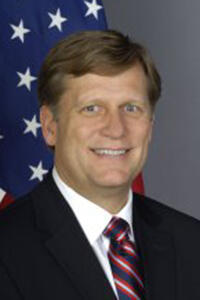
Abstract: Ambassador Koster will address the following political-military issues during his lecture. How has the security environment in Europe evolved since 2014, with growing instability and insecurity in the North Africa and the Middle East, and an assertive Russia in the East? How has Europe and NATO reacted to these challenges? Policies, structures and capabilities have been adapted, but will it be enough to restore peace and stability in Europe ? How will the demise of the arms control architecture affect all of this in the years to come?
Speaker's Biography: Ambassador Timo S. Koster is a career diplomat at the Dutch Ministry of Foreign Affairs. As of November 2018, Mr. Koster assumed his position as Ambassador-at-large for Security Policy & Cyber. Prior to this, since 2012, he was Director for Defence Policy and Capabilities at NATO HQ in Brussels.
After finishing his law degree at the University of Amsterdam, Ambassador Koster joined the diplomatic academy of the Ministry of Foreign Affairs of the Netherlands in 1991. His first appointment was at the Royal Netherlands Embassy in Nairobi, Kenya. Back in The Hague from 1994, he served in several positions within the Ministry, including a stint as Private Secretary to the Minister for European Affairs, before moving to the Royal Netherlands Embassy in London, as Head of Economic Department, between 1998 and 2001.
In 2001, Ambassador Koster became Acting Director for European Integration at the Ministry of Economic Affairs, after which he served as a Project Director at the Ministry for Foreign Affairs. In 2003 Mr. Koster was appointed Deputy Ambassador at the Royal Netherlands Embassy in Athens, Greece. In 2008 he moved to Brussels where he served as Defence Advisor at the Netherlands Permanent Representation to NATO until 2012 when he moved to the position of Director Defence Policy & Capabilities in the NATO International Staff.
Ambassador Koster is affiliated to the Atlantic Council Washington DC as a non-resident Ambassadorial Fellow at the Brent Scowcroft Centre for International Strategy and Security.
Timo S. Koster is married with two sons and two daughters.
Timo Koster
Career Diplomat
Dutch Ministry of Foreign Affairs
No recording will be allowed during the program. RSVP required for admission. No walk-ins.
Experts talk about a new Cold War between China and the United States. The world’s two largest economies are in open trade conflict, engaged in technological competition and stoking geopolitical uncertainty. The Oksenberg Conference will explore the causes that underlie today’s intensified conflict between the United States and China. We ask: What has precipitated the confrontational approach that currently unites U.S. policy towards China? What is the future of our strategic competition in the technological, economic and security realms? If U.S.-China rivalry is allowed to escalate, what might its implications be for our international liberal order? If a “new” Cold War is forming, how might it follow or diverge from the “old” Soviet-era Cold War?
Image
The Oksenberg Conference, held annually honors the legacy of the late Professor Michel Oksenberg (1938–2001) who was a senior fellow at Shorenstein APARC and the Freeman Spogli Institute for International Studies. Professor Oksenberg also served as a key member of the National Security Council when the United States normalized relations with China, and consistently urged that the United States engage with Asia in a more considered manner. In tribute, the Oksenberg Lecture recognizes distinguished individuals who have helped to advance understanding between the United States and the nations of the Asia-Pacific.
Agenda
2:35-3:05 PM Conversation with Dr. Condoleezza Rice, former U.S. Secretary of State and National Security Advisor
3:05-3:30 PM Audience Q & A
3:30-3:45 PM Break
3:45-4:25 PM Panel discussion with Prof. David M. Lampton and Amb. Michael A. McFaul
4:25-5:00 PM Audience Q & A
Speakers
Image
David M. Lampton is Oksenberg-Rohlen Fellow and Research Scholar at FSI and affiliated with Walter H. Shorenstein Asia-Pacific Research Center (Shorenstein APARC). He also is the Hyman Professor of China Studies and Director of the China Studies Program at the Johns Hopkins School of Advanced International Studies (SAIS) Emeritus. Dr. Lampton's current book project is focused on the development of high-speed railways from southern China to Singapore. He is the author of a dozen books and monographs, including Following the Leader: Ruling China, from Deng Xiaoping to Xi Jinping (University of California Press, 2014, and second edition 2019) and The Three Faces of Chinese Power: Might, Money, and Minds (University of California Press, 2008). He has testified at multiple congressional and commission sessions and published numerous articles, essays, book reviews, and opinion pieces in many venues popular and academic in both the western world and in Chinese-speaking societies, including Foreign Affairs, Foreign Policy, The American Political Science Review, The China Quarterly, The New York Times, The Washington Post,and many others.
Formerly President of the National Committee on United States-China Relations, Professor Lampton consults with government, business, and social sector organizations, and has served on the boards of several non-governmental and educational organizations, including the Asia Foundation for which he served as chairman. The recipient of many academic awards, he is an Honorary Senior Fellow of the American Studies Institute of the Chinese Academy of Social Sciences, former Gilman Scholar at Johns Hopkins, and the inaugural winner of the Scalapino Prize in 2010, awarded by the National Bureau of Asian Research and the Woodrow Wilson International Center for Scholars in recognition of his exceptional contributions to America’s understanding of the vast changes underway in Asia.
Image
Michael McFaul is the Ken Olivier and Angela Nomellini Professor of International Studies in Political Science; Director and Senior Fellow at the Freeman Spogli Institute for International Studies (FSI); and the Peter and Helen Bing Senior Fellow at the Hoover Institution, all at Stanford University. He was also the Distinguished Mingde Faculty Fellow at the Stanford Center at Peking University from June to August of 2015. He joined the Stanford faculty in 1995. Professor McFaul is also an analyst for NBC News and a contributing columnist to The Washington Post.
Dr. McFaul served for five years in the Obama administration, first as Special Assistant to the President and Senior Director for Russian and Eurasian Affairs at the National Security Council at the White House (2009-2012), and then as U.S. Ambassador to the Russian Federation (2012-2014). He has authored several books, most recently TheNew York Timesbestseller, From Cold War to Hot Peace: An American Ambassador in Putin’s Russia. Earlier books include Advancing Democracy Abroad: Why We Should, How We Can; Transitions to Democracy: A Comparative Perspective(eds. with Kathryn Stoner); Power and Purpose: American Policy toward Russia after the Cold War (with James Goldgeier); and Russia’s Unfinished Revolution: Political Change from Gorbachev to Putin.
Image
Jean C. Oi is the William Haas Professor of Chinese Politics in the Department of Political Science and a Senior Fellow of FSI at Stanford University. She is the founding director of the Stanford China Program at Shorenstein APARC and is the founding Lee Shau Kee Director of the Stanford Center at Peking University. Professor Oi has published extensively on political economy and the process of reform in China. Her books include Zouping Revisited: Adaptive Governance in a Chinese County, co-edited with Steven Goldstein (2018); and Challenges in the Process of China’s Urbanization, co-edited with Karen Eggleston and Wang Yiming (2017); Rural China Takes Off (1999); Property Rights and Economic Reform in China (1999), co-edited with Andrew Walder; and State and Peasant in Contemporary China (1989). Professor Oi also has an edited volume, China’s Path to the Future: Challenges, Constraints, and Choices, co-edited with Dr. Thomas Fingar (forthcoming, Stanford University Press). Her recent articles include “Unpacking the Patterns of Corporate Restructuring during China’s SOE Reform,” co-authored with Xiaojun Li in Economic and Political Studies (2018); and “Reflections on 40 Years of Rural Reform,” in Jacques deLisle and Avery Goldstein, eds., Reform and Opening: 40 Years and Counting, forthcoming. Her current research centers on fiscal reform and local government debt as well as continuing SOE reforms in China.
Image
Secretary Condoleezza Rice is currently the Denning Professor in Global Business and the Economy at the Stanford Graduate School of Business; the Thomas and Barbara Stephenson Senior Fellow on Public Policy at the Hoover Institution; and a professor of Political Science at Stanford University. She is also a founding partner of RiceHadleyGates, LLC.
From January 2005 to 2009, Rice served as the 66th Secretary of State of the United States, the second woman and first African American woman to hold the post. Rice also served as President George W. Bush’s Assistant to the President for National Security Affairs (National Security Advisor) from January 2001 to 2005, the first woman to hold the position.
Rice served as Stanford University’s Provost from 1993 to 1999, during which she was the institution's chief budget and academic officer. As Provost, she was responsible for a $1.5 billion annual budget and the academic program involving 1,400 faculty members and 14,000 students. In 1997, she also served on the Federal Advisory Committee on Gender -- Integrated Training in the Military.
From 1989 through March 1991, Rice served on President George H.W. Bush’s National Security Council staff. She served as Director; Senior Director of Soviet and East European Affairs; and, Special Assistant to the President for National Security Affairs. In 1986, while an international affairs fellow of the Council on Foreign Relations, Rice also served as Special Assistant to the Director of the Joint Chiefs of Staff.
As professor of Political Science, Rice has been on the Stanford faculty since 1981 and has won two of the highest teaching honors – the 1984 Walter J. Gores Award for Excellence in Teaching and the 1993 School of Humanities and Sciences Dean's Award for Distinguished Teaching.
She has authored and coauthored numerous books, including three bestsellers, Democracy: Stories from the Long Road to Freedom (2017); No Higher Honor: A Memoir of My Years in Washington (2011); and Extraordinary, Ordinary People: A Memoir of Family (2010). She also wrote Germany Unified and Europe Transformed: A Study in Statecraft (1995) with Philip Zelikow; The Gorbachev Era (1986) with Alexander Dallin; and Uncertain Allegiance: The Soviet Union and the Czechoslovak Army (1984).
In 1991, Rice cofounded the Center for a New Generation (CNG), an innovative, after-school academic enrichment program for students in East Palo Alto and East Menlo Park, California. In 1996, CNG merged with the Boys and Girls Club of the Peninsula (an affiliate club of the Boys and Girls Clubs of America). CNG has since expanded to local BGCA chapters in Birmingham, Atlanta, and Dallas. She remains an active proponent of an extended learning day through after school programs.
Since 2009, Rice has served as a founding partner at Rice Hadley Gates, LLC, an international strategic consulting firm based in Silicon Valley and Washington, D.C. The firm works with senior executives of major companies to implement strategic plans and expand in emerging markets. Other partners include former National Security Advisor Stephen J. Hadley and former Secretary of Defense Robert M. Gates.
Rice currently serves on the boards of Dropbox, an online-storage technology company; C3, an energy software company; and Makena Capital, a private endowment firm. In addition, she is vice chair of the board of governors of the Boys and Girls Clubs of America; a member of the board of the Foundation for Excellence in Education; and a trustee of the Aspen Institute. Previously, Rice served on various additional boards, including those of: the George W. Bush Institute; the Commonwealth Club; KiOR, Inc.; the Chevron Corporation; the Charles Schwab Corporation; the Transamerica Corporation; the Hewlett-Packard Company; the University of Notre Dame; the John F. Kennedy Center for the Performing Arts; and, the San Francisco Symphony Board of Governors.
In 2013, Rice was appointed to the College Football Playoff Committee, formerly the Bowl Championship Series.
Born in Birmingham, Alabama, Rice earned her bachelor's degree in political science, cum laude and Phi Beta Kappa, from the University of Denver; her master’s from the University of Notre Dame; and her Ph.D. from the Graduate School of International Studies at the University of Denver.
Rice is a Fellow of the American Academy of Arts and Sciences and has been awarded fifteen honorary doctorates. She currently resides in Stanford, California.
Bechtel Conference Center 616 Serra Mall Encina Hall, Central, 1st Floor Stanford, CA 94305
David M. Lampton
<br><i>Oksenberg-Rohlen Fellow, FSI, Stanford University</i><br><br>
Michael A. McFaul
<br><i>Director, Freeman Spogli Institute for International Studies (FSI); Professor, Political Science, Stanford University; Senior Fellow, Hoover Institution </i><br><br>
Jean C. Oi (Moderator)
<br><i>Director, Stanford China Program; William Haas Professor of Chinese Studies, Stanford University</i><br><br>
Secretary Condoleezza Rice
<br><i>The Denning Professor in Global Business and the Economy, Stanford Graduate School of Business; The Thomas and Barbara Stephenson Senior Fellow on Public Policy, Hoover Institution; Professor of Political Science, Stanford University</i><br><br>
Most studies that look at whether democracy improves global health rely on measurements of life expectancy at birth and infant mortality rates. Yet those measures disproportionately reflect progress on infectious diseases — such as malaria, diarrheal illnesses and pneumonia — which relies heavily on foreign aid.
A new study led by Stanford Health Policy's Tara Templin and the Council on Foreign Relations suggests that a better way to measure the role of democracy in public health is to examine the causes of adult mortality, such as noncommunicable diseases, HIV, cardiovascular disease and transportation injuries. Little international assistance targets these noncommunicable diseases.
When the researchers measured improvements in those particular areas of public health, the results proved dramatic.
“The results of this study suggest that elections and the health of the people are increasingly inseparable,” the authors wrote.
“Democratic institutions and processes, and particularly free and fair elections, can be an important catalyst for improving population health, with the largest health gains possible for cardiovascular and other noncommunicable diseases,” the authors wrote.
Templin said the study brings new data to the question of how governance and health inform global health policy debates, particularly as global health funding stagnates.
“As more cases of cardiovascular diseases, diabetes and cancers occur in low- and middle-income countries, there will be a need for greater health-care infrastructure and resources to provide chronic care that weren’t as critical in providing childhood vaccines or acute care,” Templin said.
Image
Free and fair elections for better health
In 2016, the four mortality causes most ameliorated by democracy — cardiovascular disease, tuberculosis, transportation injuries and other noncommunicable diseases — were responsible for 25 percent of total death and disability in people younger than 70 in low- and middle-income countries. That same year, cardiovascular diseases accounted for 14 million deaths in those countries, 42 percent of which occurred in individuals younger than 70.
Over the past 20 years, the increase in democratic experience reduced mortality in these countries from cardiovascular disease, other noncommunicable diseases and tuberculosis between 8-10 percent, the authors wrote.
“Free and fair elections appear important for improving adult health and noncommunicable disease outcomes, most likely by increasing government accountability and responsiveness,” the study said.
What Templin and her co-authors found was democracy was associated with better noncommunicable disease outcomes. They hypothesize that democracies may give higher priority to health-care investments.
HIV-free life expectancy at age 15, for example, improved significantly — on average by 3 percent every 10 years during the study period — after countries transitioned to democracy. Democratic experience also explains significant improvements in mortality from cardiovascular disease, tuberculosis, transportation injuries, cancers, cirrhosis and other noncommunicable diseases, the study said.
Watch: Some of the authors of the study discuss the significant their findings:
What Templin and her co-authors found was democracy was associated with better noncommunicable disease outcomes. They hypothesize that democracies may give higher priority to health-care investments.
HIV-free life expectancy at age 15, for example, improved significantly — on average by 3 percent every 10 years during the study period — after countries transitioned to democracy. Democratic experience also explains significant improvements in mortality from cardiovascular disease, tuberculosis, transportation injuries, cancers, cirrhosis and other noncommunicable diseases, the study said.
Foreign aid often misdirected
And yet, this connection between fair elections and global health is little understood.
“Democratic government has not been a driving force in global health,” the researchers wrote. “Many of the countries that have had the greatest improvements in life expectancy and child mortality over the past 15 years are electoral autocracies that achieved their health successes with the heavy contribution of foreign aid.”
They note that Ethiopia, Myanmar, Rwanda and Uganda all extended their life expectancy by 10 years or more between 1996 and 2016. The governments of these countries were elected, however, in multiparty elections designed so the opposition could only lose, making them among the least democratic nations in the world.
Yet these nations were among the top two-dozen recipients of foreign assistance for health.
Only 2 percent of the total development assistance for health in 2016 was devoted to noncommunicable diseases, which was the cause of 58 percent of the death and disability in low-income and middle-income countries that same year, the researchers found.
“Although many bilateral aid agencies emphasize the importance of democratic governance in their policy statements,” the authors wrote, “most studies of development assistance have found no correlation between foreign aid and democratic governance and, in some instance, a negative correlation.”
Autocracies such as Cuba and China, known for providing good health care at low cost, have not always been as successful when their populations’ health needs shifted to treating and preventing noncommunicable diseases. A 2017 assessment, for example, found that true life expectancy in China was lower than its expected life expectancy at birth from 1980 to 2000 and has only improved over the past decade with increased government health spending. In Cuba, the degree to which its observed life expectancy has exceeded expectations has decreased, from four-to-seven years higher than expected in 1970 to three-to-five years higher than expected in 2016.
“There is good reason to believe that the role that democracy plays in child health and infectious diseases may not be generalizable to the diseases that disproportionately affect adults,” Bollyky said. Cardiovascular diseases, cancers and other noncommunicable diseases, according to Bollyky, are largely chronic, costlier to treat than most infectious diseases, and require more health care infrastructure and skilled medical personnel.
The researchers hypothesize that democracy improves population health because:
When enforced through regular, free and fair elections, democracies should have a greater incentive than autocracies to provide health-promoting resources and services to a larger proportion of the population;
Democracies are more open to feedback from a broader range of interest groups, more protective of media freedom and might be more willing to use that feedback to improve their public health programs;
Autocracies reduce political competition and access to information, which might deter constituent feedback and responsive governance.
Various studies have concluded that democratic rule is better for population health, but almost all of them have focused on infant and child mortality or life expectancy at birth.
Over the past 20 years, the average country’s increase in democracy reduced mortality from cardiovascular disease by roughly 10 percent, the authors wrote. They estimate that more than 16 million cardiovascular deaths may have been averted due to an increase in democracy globally from 1995 to 2015. They also found improvements in other health burdens in the countries where democracy has taken hold: an 8.9 percent reduction in deaths from tuberculosis, a 9.5 percent drop in deaths from transportation injuries and a 9.1 percent mortality reduction in other noncommunicable disease, such as congenital heart disease and congenital birth defects.
“This study suggests that democratic governance and its promotion, along with other government accountability measures, might further enhance efforts to improve population health,” the study said. “Pretending otherwise is akin to believing that the solution to a nation’s crumbling roads and infrastructure is just a technical schematic and cheaper materials.”
The other researchers who contributed to the study are Matthew Cohen, Diana Schoder, Joseph Dieleman and Simon Wigley, from CFR, the University of Washington-Seattle and Bilkent University in Turkey, respectively.
Funding for the research came from Bloomberg Philanthropies and the Bill & Melinda Gates Foundation. Stanford’s Department of Health Research and Policy also supported the work.
Hero Image
Election officials count the votes at a polling station on February 24, 2019 in Dakar, Senegal. | Xaume Olleros/Getty Images
From the point of view of institutional economics, growth is related to the implementation and enforcement of property rights. The system that emits, and enforces those rights needs to have very low transactions costs leading to the least possible frictions. The lowest the transactions costs the highest the level of security of investment, as well as the benefits of direct and indirect socioeconomic impacts. However, traditional economic development models do not focus on transactions costs and property rights systems, both of which seem to be the suspects for low productivity, slow growth, and informality. Many developing countries suffer from systems of property rights that are unpredictable because they are inundated with overwhelming bureaucracy, difficult to follow, track, and measure. The speaker has developed a methodology to best diagnose the reasons why a country has such high transactions costs and how to reduce them systematically. This diagnostic method is called Reality Check Analysis (RCA) and its outcomes allow for the best design of policy reforms and strategic application. The presentation will focus on the theoretical definition of the problem, the analysis of Reality Check Analysis, its application and important results measured through a socioeconomic 3,000 household survey. This survey presented the direct benefits of applying a simple property rights system to investment, savings, property values, trust, child labor, to mention a few.
Speaker Bio
Image
Elena Panaritis until recently served as a senior economic advisor, handling the Euro and Greek Economic Crisis, to two Greek Governments (2009; 2015). In 2015 she also served as the Special Envoy for Negotiating the Greek Sovereign debt and lending program of Greece. Elena worked directly with 3 Greek Prime Ministers and the Minister of Finance, as well as EU and IMF high-level officials, lenders to Greece. In 2015 she was appointed the Alternate Director to the IMF of Italy, Greece, Portugal, Malta, Albania and San Marino, from which position she resigned the same year after strong political pressures. In 2009 she was appointed honorary Member of the Hellenic Parliament until 2012. She is the founder of Panel Group, a triple-bottom-line business that focuses in the informal sector, transforming the wealth base of poor property holders, to proud middle class owners. She has also founded Thought4Action, an Action Tank that works as an educational foundation to create awareness and calls for action, about transforming countries under solvency, economic crisis and informality. Elena Panaritis has taught economic development, housing finance and property markets reform courses at the Wharton Business School, University of Pennsylvania, INSEAD, and the Johns Hopkins University- School of Advanced International Studies (SAIS).
Elena Panaritis
Founder and CEO
Thought 4 Action - Panel Group
Shorenstein APARC
Stanford University
Encina Hall
Stanford, CA 94305-6055
650.724.6404
0
kate222@stanford.edu
Oksenberg-Rohlen Fellow
_ksa3419_lampton_2018_photo.jpg
David M. (“Mike”) Lampton is the Oksenberg-Rohlen Fellow at FSI and affiliated with Shorenstein APARC. Lampton (BA ’68, MA ’71, PhD ’74), an expert in Chinese politics and U.S.-China relations, is the Hyman Professor of China Studies and Director of the China Studies Program at the Johns Hopkins School of Advanced International Studies Emeritus.
Lampton's current book project is focused on the development of high-speed railways from southern China to Singapore. He is the author of a dozen books and monographs, including Following the Leader: Ruling China, from Deng Xiaoping to Xi Jinping (University of California Press, 2014, and second edition 2019) and The Three Faces of Chinese Power: Might, Money, and Minds (University of California Press, 2008). He has testified at multiple congressional and commission sessions and published numerous articles, essays, book reviews, and opinion pieces in many venues popular and academic in both the western world and in Chinese-speaking societies, including Foreign Affairs, Foreign Policy, The American Political Science Review, The China Quarterly, The New York Times, The Washington Post, and many others.
Over the course of his career, Lampton accompanied American public and private sector leaders to China, and Chinese leaders to the United States. Formerly President of the National Committee on United States-China Relations, Lampton consults with government, business, and social sector organizations, and has served on the boards of several non-governmental and educational organizations, including the Asia Foundation for which he served as chairman. The recipient of many academic awards, he is an Honorary Senior Fellow of the American Studies Institute of the Chinese Academy of Social Sciences, former Gilman Scholar at Johns Hopkins, and the inaugural winner of the Scalapino Prize in 2010, awarded by the National Bureau of Asian Research and the Woodrow Wilson International Center for Scholars in recognition of his exceptional contributions to America’s understanding of the vast changes underway in Asia.
After the Revolution of Dignity Ukraine has faced a challenging combination: Hybrid war from Russia side and economic and institutional collapse. Years under Yanukovych rule in conjunction with a lingering post-Soviet legacy created a perfect storm and required rapid, powerful and tailored response both from Ukrainian government and donor community. Inspired by the signing of the EU-Ukraine Association agreement, as well as understanding the weakness of Ukrainian institutions, the Ukrainian Reforms Architecture project was created. Co-invented by EU and the European Bank for Reconstruction and Development (EBRD), the project focuses on different reform areas such as Public Administration Reform, Business Climate, Public Finance management, Privatization and SOE corporate governance, and many others. This panel of experts will discuss the results of the project on the Ukrainian reform process: What is the future of the project? Can these reforms sustain major political changes with this year's elections? And, if successful, can it be replicated in other countries?
This event will be moderated by Francis Fukuyama, Mosbacher Director of the Center on Democracy, Development and the Rule of Law, and Steven Pifer, William J. Perry fellow at Stanford’s Freeman Spogli Institute for International Studies (FSI).
Speaker Bios
Image
Francis Malige is the Managing Director for Financial Institutions for the EBRD. He leads the Bank’s investments in the financial sector, including banks as well as insurance companies, non-bank financial institutions and capital market infrastructure companies, across three continents. He took up his role in August 2018. From 2014 to 2018, he served as Managing Director, Eastern Europe and the Caucasus, leading the Bank’s operations and policy initiatives in Ukraine, Belarus, Moldova, Armenia, Azerbaijan and Georgia. In Ukraine, he led the EBRD through the difficult post-revolution period, to develop a number of initiatives blending investment and policy impact, including the Ukraine Reforms Architecture
Image
Bojana J. Reiner is Senior Governance Counsellor at the European Bank for Reconstruction and Development (EBRD), based in London. She has more than 20 years experience in public policy, private sector development, intelligence and investigations across EMEA, gained in prominent organizations worldwide. In her current role, Bojana leads the Ukraine Reforms Architecture (URA) programme, which is the EBRD’s flagship state capacity building initiative. In her previous roles at EBRD, she oversaw the delivery of key reform policy engagements across EMEA, deployed with around €100 million of donor funds annually.
Image
Dmytro Romanovych is an alumnus of the Ukrainian Emerging Leaders Program and current Senior Consultant for the Ukrainian Reforms Architecture project at the EBRD. Prior to this role, Romanovych worked at the Reform Delivery Office for the Cabinet of Ministers of Ukraine. Romanovych was an advisor to the Minister of Economy, and is responsible for deregulation and improving the business climate in Ukraine. In addition, he was an economic expert in the largest NGO coalition in Ukraine, the Reanimation Package of Reforms, which is the most influential non-governmental reform advocate in the country.
Image
Nataliya Mykolska is the Trade Representative of Ukraine - Deputy Minister of Economic Development and Trade. In the government, Mykolska is responsible for developing and implementing consistent, predictable and efficient trade policy. She focuses on export strategy and promotion, building an effective system of state support for Ukrainian exports, free trade agreements, protecting Ukrainian trade interests in the World Trade Organization (WTO), dialogue with Ukrainian exporters, and removing trade barriers. Mykolska is the Vice-Chair of the International Trade Council and the Intergovernmental Committee on International Trade.
Francis Malige
Managing Director, Financial Institutions
European Bank for Reconstruction and Development (EBRD)
Bojana Reiner
Senior Governance Counsellor
EBRD
Dmytro Romanovych
Senior Consultant for Ukrainian Reforms Architecture Project
EBRD
Visiting Practitioner, Ukrainian Emerging Leaders Program 2018-19
natalia.jpg
Nataliya Mykolska is the Trade Representative of Ukraine - Deputy Minister of Economic Development and Trade. In the government, Mykolska is responsible for developing and implementing consistent, predictable and efficient trade policy. She focuses on export strategy and promotion, building an effective system of state support for Ukrainian exports, free trade agreements, protecting Ukrainian trade interests in the World Trade Organization (WTO), dialogue with Ukrainian exporters, and removing trade barriers. Mykolska is the Vice-Chair of the International Trade Council and the Intergovernmental Committee on International Trade.
In her position, Mykolska developed and adopted the first ever Export Strategy of Ukraine: Strategic Trade Development Roadmap of Ukraine for 2017-2021. She has concluded and launched free trade agreements with Canada and Israel, and initiated additional trade preferences by the EU. Due to her efforts, Ukraine has started actively using WTO mechanisms and procedures. Moreover, the Ministry initiated WTO proceedings against Russia in response to trade aggression. Mykolska established the Export Promotion Office at the Ministry to assist Ukrainian business, help them succeed on international markets and open new markets.
Mykolska has fifteen years of experience working as a legal counsel with a focus on international trade including WTO and free trade agreements, trade financing, cross-border trade transactions and contracts, franchising and other areas. Mykolska worked with governmental institutions to bring Ukraine in compliance with international obligations, including the EU-Ukraine Deep and Comprehensive Free Trade Area. She has been recognized as the No. 1 International Trade lawyer by Ukrainian Law Firms, and was recommended by the International Who’s Who of Business Lawyers and the International Who's Who of Trade & Customs Lawyers.
Mykolska graduated from the Ivan Franko National University of Lviv Faculty of Law in 2001, and completed her Master of European Studies Program at the Europa-Kolleg-Hamburg in 2002.
Visiting Practitioner
Ukrainian Emerging Leaders Program
Stanford’s Center on Democracy, Development and the Rule of Law is pleased to welcome R. Kent Weaver, Professor of Public Policy and Government at Georgetown University and senior fellow in the Governance Studies Program at the Brookings Institution, as a visiting scholar during the winter and spring quarter 2019. Kent Weaver is also one of three executive directors of CDDRL's Leadership Academy for Development.
Weaver’s research interests are comparative social policy (with a particular focus on public pension programs in advanced industrial societies) and policy implementation. His recent research focuses on understanding how political institutions, feedback from past policy choices and the strategic behavior of politicians interact to shape public policy choices. He is also interested in understanding the determinants of compliance and non-compliance with public policy across a variety of policy sectors.
“We look forward to having Kent in residence at CDDRL this winter and spring,” said Francis Fukuyama, CDDRL’s Mosbacher director. “Kent will work with Stephen J. Stedman and me on teaching the ‘Leadership and Implementation’ course for the Freeman Spogli Institute’s Masters of Arts in International Policy. He will help our students dig deeper into policy processes and behavioral change.”
At CDDRL, Weaver will also be completing a book on pension reform in seven wealthy democracies and working on a cross-national project on how politicians balance multiple objectives. More broadly, he will work with CDDRL on developing strategies for utilizing case-method teaching in the classroom and with CDDRL's LAD project on improving the capacity of training programs for public sector officials in developing countries.
"CDDRL is an intellectually vibrant environment. I'm excited to work with the CDDRL team on its programs and participate in the CDDRL community,” says Weaver. “I look forward to interacting with MIP students and learning about their perspectives on many of the issues and challenges the world is facing today."
616 Serra StreetEncina Hall E301Stanford, CA 94305-6055
0
kvzhang@stanford.edu
ketian_zhang.jpg
Ph.D.
Ketian Vivian Zhang joined the Walter H. Shorenstein Asia-Pacific Research Center (APARC) as the 2018-2019 Shorenstein Postdoctoral Fellow in Contemporary Asia. Ketian studies coercion, economic sanctions, and maritime territorial disputes in international relations and social movements in comparative politics, with a regional focus on China and East Asia. She bridges the study of international relations and comparative politics and has a broader theoretical interest in linking international security and international political economy. Her book project examines when, why, and how China uses coercion when faced with issues of national security, such as territorial disputes in the South and East China Seas, foreign arms sales to Taiwan, and foreign leaders’ reception of the Dalai Lama. Ketian's research has been supported by organizations such as the Belfer Center for Science and International Affairs at the Harvard Kennedy School, Institute for Security and Conflict Studies at George Washington University, the Smith Richardson Foundation, and the Chiang Ching-kuo Foundation.
At Shorenstein APARC, Ketian worked on turning parts of her book project into academic journal papers while conducting fieldwork for her next major project: examining how target states of Chinese coercion respond to China's assertiveness, including the business community and ordinary citizens.
Ketian received her Ph.D. in Political Science at the Massachusetts Institute of Technology in 2018, where she is also an affiliate of the Security Studies Program. Before coming to Stanford, Ketian was a Predoctoral Research Fellow in the International Security Program at the Belfer Center for Science and International Affairs at the Harvard Kennedy School. Ketian holds a B.A. in Political Science and Sociology from the University of Wisconsin-Madison and was previously a research intern at the Institute for Policy Studies in Washington, D.C., where she was a contributor to its website Foreign Policy in Focus.
2018-2019 Shorenstein Postdoctoral Fellow in Contemporary Asia
Eloise Duvillier is the Program Manager of the Program on Democracy and the Internet at the Cyber Policy Center. She previously was a HR Program Manager and acting HR Business Partner at Bytedance Inc, a rapidly-growing Chinese technology startup. At Bytedance, she supported the globalization of the company by driving US acquisition integrations in Los Angeles and building new R&D teams in Seattle and Silicon Valley. Prior to Bytedance, she led talent acquisition for Baidu USA LLC’s artificial intelligence division. She began her career in the nonprofit industry where she worked in foster care, HIV education and emergency response during humanitarian crises, as well as helping war-torn communities rebuild. She graduated from University of California, Berkeley with a bachelor’s degree in Development Studies, focusing on political economics in unindustrialized societies.
Program Manager, Program on Democracy and the Internet
On August 9, 2018 the Shorenstein Asia Pacific Research Center (APARC) Japan Program hosted a conference, "Break Through: Women in Silicon Valley, Womenomics in Japan." Women thought-leaders and entrepreneurs from Stanford, Silicon Valley, and Japan came together to discuss innovative ideas for narrowing the gender gap, and cultivating interpersonal support networks and collaboration across the pacific. The program combined panel presentations with participatory exercises and startup showcases which afford participants the opportunity to 1) discuss progress and challenges in women's advancement in Silicon Valley and Japan, 2) share practices and organizational features that better enable the hiring and retaining of women, 3) showcase Silicon Valley and Japanese women entrepreneurs and 4) provide tools for branding and building support networks.
The Break Through conference was supported by the Acceleration Program in Tokyo for Women (APT), a program that aims to shape a new narrative by providing opportunities for women entrepreneurs to build networks, receive mentoring, and become a focal point for dynamism. The program, spearheaded by Tokyo's first female governor, Yuriko Koike, is undertaken by the Tokyo Metropolitan government and supported by Tohmatsu Venture Support.
The full conference report, now available, outlines the issues and offers an analysis of the themes that were discussed in the presentations, panels and participatory exericses throughout the day.