


Communication Power and Taiwan's Democratization
-
Abstract
In 2010-2011, the "Arab Spring" brought unexpected revolutions to many Middle Eastern and North African countries. Why did these seemingly invincible regimes fall, while China remained durably authoritarian? Many observers credited global media for the political transformations. While the hopes of Arab Spring democracy have proven to be fragile or short-lived, we can effectively explore the relationship between political communication and regime stability by turning our attention to Taiwan’s remarkable democratization, which remains under-appreciated by the international community.
This talk considers political communication in Taiwan from the martial law era to the heady days of democratic activism beginning in the late 1970s and lasting till the 1990s. Professor Esarey argues that the Chiang Ching-kuo administration’s diminishing capacity to control a small but influential opposition (dangwai) media, and even mainstream newspapers, gradually permitted reformers to reframe debates, reset the political agenda, and challenge state narratives and legitimacy claims.
When viewed in comparative perspective, Taiwan’s successful democratization suggests that seeking regime change is impracticable, and even perilous, without considerable and sustainable media freedom as well as opportunities for the public to advocate, evaluate, and internalize alternative political views. A balance of “communication power” between state and societal actors facilitates a negotiated and peaceful transition from authoritarianism.
Bio
Professor Ashley Esarey received his PhD in Political Science from Columbia University and was awarded the An Wang Postdoctoral Fellowship by Harvard University. He has held academic appointments at Middlebury College, Whitman College, and the University of Alberta, where he is an instructor in the departments of East Asian Studies and Political Science and a research associate of the China Institute. Esarey has written on democratization and authoritarian resilience, digital media and politics, and information control and propaganda. His recent publications include My Fight for a New Taiwan: One Woman’s Journey from Prison to Power (with Lu Hsiu-lien) and The Internet in China: Cultural, Political, and Social Dimensions (with Randolph Kluver).
Communication Power and Taiwan's Democratization
Download pdf
Ashley Esarey
Research Associate, China Institute
University of Alberta
Seminars
FSI's McFaul & Eikenberry bring foreign policy to campus
News Type
News
Date
Paragraphs
Michael McFaul, the next director of the Freeman Spogli Institute for International Studies who recently returned from his position as U.S. Ambassador to Russia, joins Karl Eikenberry, the former U.S. Ambassador to Afghanistan and the William J. Perry Fellow in International Security at CISAC, to discuss the current state of foreign policy. The Nov. 11, 2014, talk was part of the fall course, "State of the Union," which examined major themes that contribute to the health, or disease, of the U.S. body politic.
Led by Rob Reich (Political Science), David Kennedy (History), and James Steyer (CEO, Common Sense Media), the course brought together distinguished analysts of American politics who noted that we live in an age of rising inequality, dazzling technological innovation, economic volatility, geopolitical uncertainty, and the accumulating impact of climate change. These conditions confront our political leaders and us as citizens of a democracy plagued by dysfunction.
Hero Image

All News button
1
The Digital Dictator’s Dilemma: Internet Regulation and Political Control in Non-Democratic States
-
Abstract: While non-democratic states often restrict traditional civil liberties such as speech, media, and association, the degree of Internet freedom permitted varies dramatically across states. This paper uses a mixed-method approach to analyze global patterns of Internet policy across hybrid and authoritarian regimes, and to offer a model of key causal factors and processes influencing policy choice – particularly the choice whether to adopt restrictive policies that limit Internet use and content or to permit the development of and access to a vibrant uncensored Internet. Large-N analysis identifies global patterns of Internet restrictions and examines how these patterns appear to be changing as Internet penetration increases. The paper also draws on research from the Russian Federation, tracing changes in domestic Internet policy choices and their relation to political instability and control, examining a critical period of policy change in a regime that had previously stood out for its relatively unrestricted Internet.
About the Speaker: Jaclyn Kerr is a doctoral candidate in government at Georgetown University. Her research examines the Internet policies adopted by authoritarian and hybrid regimes in their attempts to adapt to the potentially destabilizing influence of growing Internet penetration. She holds a BAS in Mathematics and Slavic Studies, and an MA in Russian, East European, and Eurasian Studies from Stanford University. In 2013-2014, Ms. Kerr was a research fellow at the Center for the Study of New Media and Society at the New Economic School in Moscow, while conducting field research for her dissertation. She has worked as a research assistant at the Berkman Center for Internet and Society at Harvard, has been an IREX EPS Fellow at the U.S. Embassy in Kazakhstan, a Research Fellow at Georgetown’s School of Foreign Service in Qatar, an IREX YLF Fellow in Saint Petersburg, Russia, and has previous professional experience as a software engineer. She joins CISAC as a Cybersecurity Predoctoral Fellow for 2014-2015.
The Digital Dictator's Dilemma
Download pdf
Encina Hall (2nd floor)
Jackie Kerr
Cybersecurity Predoctoral Fellow
Speaker
CISAC
Seminars
In Draghi We Trust: The Euro Crisis, Social Unrest and the European Central Bank
-
The 2008 global financial crisis came with fears - and, for some, hopes of a new wave of public mobilisation in industrialised countries. Large protests were particularly expected in the epicentre of the crisis, the European Union. Yet, the force with which social groups garnered their calls for strikes ebbed quickly away. Gerald Schneider provides new evidence for why this was the case. He claims that strikes, and particularly political strikes, are 'bad weather' phenomena and crises exacerbate them. In monetary unions, where currency adjustments are difficult, fiscal changes are not supported by easing monetary measures and should unchain social unrest unless supranational actors get involved. Schneider argues that the political actions of the European Central Bank (ECB) have countered the potential for strikes in the Eurozone. He provides evidence for his theory with yearly panel data and a new original data set of monthly strikes between 2001 and 2013. His analyses support the thesis that the EU institution was successful at attenuating social indignation over the Eurocrisis and its political fallout.
This paper is based on co-authored work with Dr. Federica Genovese (Essex) and Pia Wassmann (Hannover).
Image

Gerald Schneider is Professor of International Politics and Executive Editor of “European Union Politics”. His main areas of research are European Union decision making, the causes and consequences of armed violence, the international political economy of financial markets, bargaining and conflict management.
Schneider defended his doctoral thesis at the University of Zurich in 1991, worked as post-doc at the University of Michigan (Ann Arbor) for two years and was an assistant professor (1992 – 1995) at the Institut universitaire de hautes études internationales in Geneva. Before joining the faculty at Konstanz in 1997, he was a Professor of Political Science at the University of Stuttgart (1996-1997) and Program Director at the University of Berne (1994 – 1997). Gerald Schneider has also been visiting scholar at Università Bocconi (Visiting Research Professor), Charles University Prague, Harvard University, University of Kobe, Sciences Po Paris (Grosser Chair) and Università Siena. He has published around 150 articles in various journals and volumes. Schneider is President of the European Political Science Association (2013-2015) and was also in 2003-2004 Vice President of the International Studies Association, and served as Program Chair for the 50th annual convention in New York City in 2009. Schneider has acted as a consultant and referee for various organizations, including the World Bank and the U.S. National Science Foundation. He has served for various selection committees of the the Alexander von Humboldt Foundation since 2007 and was a member of the scientific board of the Swiss Network of International Studies (2008-2013). Besides his native German, Schneider speaks English, French and survives in Italian and Danish.
The Eurotower Strikes Back: Crises, Adjustments and Europe's Austerity Protests
Download pdf
CISAC Central Conference Room
Encina Hall, 2nd floor
Gerald Schneider
Professor of International Politics
Speaker
Universität Konstanz, Germany
Seminars
Erin Baggott Carter
0
ebaggott@stanford.edu
erin_baggot_carter_2025.jpg
Erin Baggott Carter (赵雅芬) is an Associate Professor at the Department of Political Science and International Relations at the University of Southern California and a Hoover Fellow at Stanford University's Hoover Institution. She is also a non-resident scholar at the UCSD 21st Century China Center. She has previously held fellowships at Stanford's Center on Democracy, Development and the Rule of Law and the Center for International Security and Cooperation. She received a Ph.D. in Political Science from Harvard University.
Dr. Carter's research focuses on Chinese politics and propaganda. Her first book, Propaganda in Autocracies (Cambridge University Press), explores how political institutions determine propaganda strategies with an original dataset of eight million articles in six languages drawn from state-run newspapers in nearly 70 countries. She is currently working on a book on how domestic politics influence US-China relations. Her other work has appeared in the British Journal of Political Science, Journal of Conflict Resolution, Security Studies, and International Interactions. Her work has been featured by a number of media platforms, including the New York Times and the Little Red Podcast.
Her research has been supported by the Chiang Ching-kuo Foundation, the Smith Richardson Foundation, the Center for International Studies at the University of Southern California, the Weatherhead Center for International Affairs at Harvard University, the Fairbank Center for Chinese Studies at Harvard University, and the Institute for Quantitative Social Science at Harvard University.
Dr. Carter regularly tweets about Chinese politics and propaganda at @baggottcarter. She can be reached via email at baggott [at] usc.edu or ebaggott [at] stanford.edu.
Hoover Fellow
CDDRL Affiliated Scholar
CDDRL Visiting Scholar, 2020-2021
CISAC Affiliate
Hide publication sections
Off
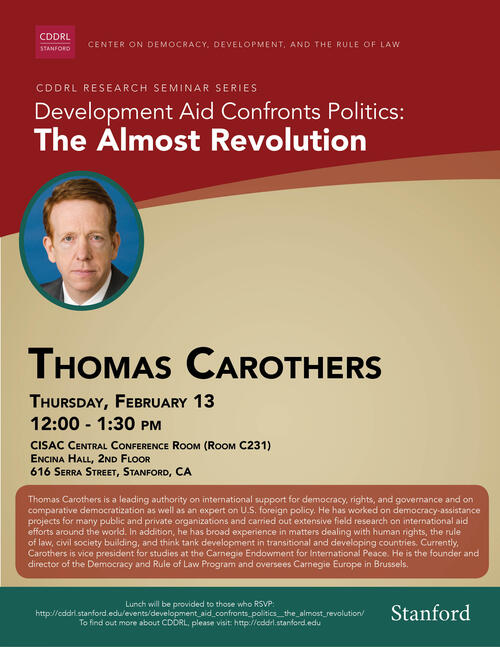
Development Aid Confronts Politics: The Almost Revolution
-
Speaker bio:
Thomas Carothers is vice president for studies at the Carnegie Endowment for International Peace. He is the founder and director of the Democracy and Rule of Law Program and oversees Carnegie Europe in Brussels.
Carothers is a leading authority on international support for democracy, rights, and governance and on comparative democratization as well as an expert on U.S. foreign policy. He has worked on democracy-assistance projects for many public and private organizations and carried out extensive field research on international aid efforts around the world. In addition, he has broad experience in matters dealing with human rights, the rule of law, civil society building, and think tank development in transitional and developing countries.
He is the author of six critically acclaimed books as well as many articles in prominent journals and newspapers. Carothers has also worked extensively with the Open Society Foundations (OSF), including currently as chair of the OSF Think Tank Fund and previously as chair of the OSF Global Advisory Board. He is an adjunct professor at the Central European University in Budapest and was previously a visiting faculty member at Nuffield College, Oxford University, and Johns Hopkins SAIS.
Prior to joining the Endowment, Carothers practiced international and financial law at Arnold & Porter and served as an attorney adviser in the Office of the Legal Adviser of the U.S. Department of State.
Carothers is the co-author (with Diane de Gramont) of Development Aid Confronts Politics: The Almost Revolution (Carnegie, 2013) and author of Confronting the Weakest Link: Aiding Political Parties in New Democracies (Carnegie, 2006); Promoting the Rule of Law Abroad: In Search of Knowledge (Carnegie, 2006); Uncharted Journey: Promoting Democracy in the Middle East, co-edited with Marina Ottaway (Carnegie, 2005); Critical Mission: Essays on Democracy Promotion (Carnegie, 2004); Funding Virtue: Civil Society Aid and Democracy Promotion, co-edited with Marina Ottaway (Carnegie, 2000); Aiding Democracy Abroad: The Learning Curve (Carnegie, 1999); and Assessing Democracy Assistance: The Case of Romania (Carnegie, 1996).
Image
CISAC Conference Room
Thomas Carothers
Vice President for Studies
Speaker
Carnegie Endownment for International Peace
Seminars
Should American Democracy Assistance become more European? Lessons from EU and US Democracy Assistance in Ethiopia
-
Abstract:
The U.S. and the E.U. are often seen as fundamentally different democracy promoters. It has been argued that the U.S. has a more political approach, which is confrontational vis-à-vis host governments and promotes democracy bottom-up via civil society. The E.U., on the other hand, is perceived as more developmental, focusing on non-confrontational projects that are mostly top-down or focused on civil society organizations not critical of the government. The U.S.’s political approach has been criticized for being too donor-led, unilateral, and hardly respecting country ownership. But should American democracy assistance become more European?
Based on research on E.U. and U.S. democracy assistance programs in Ethiopia, CDDRL Postdoctoral Fellow Karen Del Biondo explains the causes and consequences of a political and developmental approach to democracy assistance. She argues that the E.U. has indeed taken a more developmental approach, which can be explained by the European Commission’s commitment to the Paris Declaration principles on aid effectiveness, including ownership, alignment and, harmonization. This was possible because of the relatively autonomous position of the Commission vis-à-vis the Member States and the European Parliament. In contrast, USAID does not enjoy this bureaucratic autonomy, and has therefore paid lip service to aid effectiveness. Del Biondo discusses the advantages and disadvantages of a political and developmental approach in a semi-authoritarian regime such as Ethiopia. She finds that, although the impact of E.U. democracy assistance in Ethiopia can be questioned, the E.U.’s developmental approach has made the government of Ethiopia more open to E.U. democracy assistance, while the U.S.’s political approach led to a backlash.
Speaker Bio:
Karen Del Biondo is a 2012-2013 postdoctoral fellow at the CDDRL. Her research is funded with a Fulbright-Schuman award and a postdoctoral grant from the Belgian-American Educational Foundation (BAEF). She holds an MA in Political Science (International Relations) from Ghent University and an MA in European Studies from the Université Libre de Bruxelles. In 2007-2008 she obtained a Bernheim fellowship for an internship in European affairs at the Belgian Ministry of Foreign Affairs and Permanent Representation to the EU.
Karen Del Biondo obtained her PhD at the Centre for EU Studies, Ghent University in September 2012 with a dissertation entitled ‘Norms, self-interest and effectiveness: Explaining double standards in EU reactions to violations of democratic principles in sub-Saharan Africa’. Her PhD research was funded by the Flemish Fund for Scientific Research (FWO). Apart from her PhD research, she has been involved in the research project ‘The Substance of EU Democracy Promotion’ (Ghent University/University of Mannheim/Centre of European Policy Studies) and has published on the securitisation of EU development policies. In January 2011 she conducted field research in Addis Ababa, Ethiopia. Her postdoctoral research will focus on the comparison between EU and US democracy assistance in sub-Saharan Africa.
Philippines Conference Room
Karen Del Biondo
Encina Hall
616 Serra Street
Stanford, CA 94305-6055
0
kdelbion@stanford.edu
Fulbright and BAEF postdoctoral fellow 2012-2013
Karen Del Biondo is a 2012-2013 postdoctoral scholar at CDDRL. Her research is funded with a Fulbright-Schuman award and a postdoctoral grant from the Belgian-American Educational Foundation (BAEF). She holds an MA in Political Science (International Relations) from Ghent University and an MA in European Studies from the Université Libre de Bruxelles. In 2007-2008 she obtained a Bernheim fellowship for an internship in European affairs at the Belgian Ministry of Foreign Affairs and Permanent Representation to the EU.
Karen Del Biondo obtained her PhD at the Centre for EU Studies, Ghent University in September 2012 with a dissertation entitled ‘Norms, self-interest and effectiveness: Explaining double standards in EU reactions to violations of democratic principles in sub-Saharan Africa’. Her PhD research was funded by the Flemish Fund for Scientific Research (FWO). Apart from her PhD research, she has been involved in the research project ‘The Substance of EU Democracy Promotion’ (Ghent University/University of Mannheim/Centre of European Policy Studies) and has published on the securitisation of EU development policies. In January 2011 she conducted field research in Addis Ababa, Ethiopia. Her postdoctoral research will focus on the comparison between EU and US democracy assistance in sub-Saharan Africa.
Karen Del Biondo’s recent publications include: ‘Security and Development in EU External Relations: Converging, but in which direction?’ (with Stefan Oltsch and Jan Orbie), in S. Biscop & R. Whitman (eds.) Handbook of European Union Security, Routledge (2012); ‘Democracy Promotion Meets Development Cooperation: The EU as a Promoter of Democratic Governance in Sub-Saharan Africa’, European Foreign Affairs Review, Vol. 16, N°5, 2011, 659-672; and ‘EU Aid Conditionality in ACP Countries. Explaining Inconsistency in EU Sanctions Practice’, Journal of Contemporary European Research, Vol. 7, N°3, 2011, 380-395.
Seminars