Diplomacy
Authors
News Type
News
Date
Paragraphs

South Korea and the United States are “completely aligned” on North Korea strategy, the chief American diplomat in South Korea said to a Stanford audience on Monday.

Mark Lippert, who assumed the role of U.S. ambassador to the Republic of Korea in 2014, delivered remarks at a public seminar, “Perspectives on the U.S.-Korea Alliance,” organized by the Korea Program at the Walter H. Shorenstein Asia-Pacific Research Center.

Arriving from the Washington summit of President Obama and Korean President Park Geun-hye, Lippert spoke of the success of the state visit. The U.S.-Korea relationship is in “as good a shape as it’s ever been,” and that secure foundation is allowing the two countries to forge ahead on shared challenges, including North Korea, trade and global health.

img 6102 Mark Lippert expressed optimism about the U.S.-ROK alliance at a Stanford talk on Oct. 19, 2015.
“We want to get back to credible and authentic negotiations towards a denuclearized Korea,” Lippert said, explaining that U.S.-Korea strategy toward North Korea aligns in three main areas: diplomacy, economics and deterrence.

He said the United States and South Korea are invested in getting to a place where the North Koreans will “come back to the table” for discussions on ending their nuclear program, noting the continuing viability of the Six Party Talks mechanism which has been stalled for more than five years.

Lippert also cited U.S.-Korea strategic cooperation on sanctions against North Korea, and defense capabilities aimed to deter the threat of a North Korea with nuclear and long-range missile capacity.

Looking ahead, “The United States strongly supports calls for reunification of the Korean Peninsula,” he said. Human rights, a free economy and a democratically elected government in the North would be a priority in that pursuit.

Lippert said the United States is supportive of inter-Korean talks and reunions for families separated by the Korean War, both announced earlier this year. On Tuesday, hundreds of South Koreans crossed the border to meet with North Korean relatives, who have been separated for more than six decades.

Partnering on the economic level was another key aspect of the summit, Lippert said, and the Trans-Pacific Partnership (TPP) was among items discussed. The United States, as one of 12 TPP member nations, would welcome an application from South Korea should they choose to pursue it, he said.

Lippert acknowledged that South Korea already has bilateral trade agreements with 10 out of the 12 TPP member nations, including one with the United States. The U.S.-Korea Free Trade Agreement (KORUS) came into force in 2012 and is moving toward full implementation, he said. The United States’ sixth largest trading partner is South Korea.

Following his formal remarks, Lippert took questions from the audience.

Michael Armacost, a Shorenstein Distinguished Fellow, asked Lippert how Japan and China figured into the summit discussions following recent developments. In September, President Park attended a military parade in Beijing that marked the 70th anniversary of the end of World War II. She was the only leader from a democratic country at the event.

Responding on China, Lippert said the United States is supportive of South Korea engaging with China. “We don’t view this as a zero-sum game,” he said, likening South Korea’s regional relationships to a situation where “all boats rise” together.

Dafna Zur, a professor of Korean culture and literature, asked Lippert to talk about how his education informed his career in public service.

Lippert attended Stanford and studied political science and international policy studies.

His education, he said, was invaluable in preparing him for the diverse situations and people that a diplomatic career brings.

Lippert encouraged students to savor conversation and debate in the classroom. Participating in that kind of forum not only “makes you a more informed person” but also “sharpens your analytic skills,” he said.

Prior to becoming ambassador, Lippert held senior positions in the Department of Defense and the White House and served in the U.S. Navy.

Following the event, Lippert met with faculty members of Shorenstein APARC and the Freeman Spogli Institute for International Studies for a roundtable discussion, chaired by Kathleen Stephens, a distinguished fellow at Shorenstein APARC and former U.S. ambassador to the Republic of Korea (2008-11).

Embedded photo: Mark Lippert speaks at Stanford on Oct. 19, 2015. Photo credit: Heather Ahn.

Hero Image
8722114465 9d3d8afc0e o
Korean President Park Geun-hye (left) and U.S. President Barack Obama have an in-depth discussion at a White House summit. This picture is from their first summit in Washington in May 2013. Their second summit took place in October 2015.
Flickr/Korea.net - Cheong Wa Dae (crop applied)
All News button
1
-

Abstract:

The Syrian crisis continues to grind on without a viable settlement to the conflict in sight. The problems spurred by the crisis, from refugees to extremist groups, have become a tangible concern for the West, not just Middle Eastern countries. Meanwhile, from Russia to Iran to Saudi Arabia, Turkey, and Qatar, several countries have turned Syria into a political and military playground. The lack of strategy to end the conflict on part of the USA, Europe, and the United Nations has paved the way for those state and non-state actors to increase the scope of their actions in Syria. The continuation of this dynamic can only mean further instability across the Middle East and beyond.

This talk links the international relations, security, and social dimensions of the Syrian conflict to address how and why the crisis has reached the level it is at today, with a focus on the role of external stakeholders as well as of rising extremist groups. It will reflect on how a settlement to the conflict might be reached and what the implications of a settlement would be for the Middle East.


Bio:

Image
khatib color medium
Lina Khatib is a Senior Research Associate with the Arab Reform Initiative. She was formerly the director of the Carnegie Middle East Center in Beirut and before that a co-founder of the Program on Arab Reform and Democracy at Stanford University’s Center on Democracy, Development, and the Rule of Law. Her research focuses on the international relations of the Middle East, Islamist groups, and foreign policy. She has written extensively on Syria over the past two years, especially on armed groups like the Islamic State, and has also published seven books including Taking to the Streets: The Transformation of Arab Activism, an edited collection (with Ellen Lust; Johns Hopkins University Press, 2014) based on work produced by CDDRL’s Program on Arab Reform and Democracy. She is also a Research Associate at SOAS, University of London.


This event is sponsored by CDDRL's Program on Arab Reform and Democracy.


[[{"fid":"221011","view_mode":"crop_870xauto","fields":{"format":"crop_870xauto","field_file_image_description[und][0][value]":"","field_file_image_alt_text[und][0][value]":"","field_file_image_title_text[und][0][value]":"","field_credit[und][0][value]":"","field_caption[und][0][value]":"","field_related_image_aspect[und][0][value]":"","thumbnails":"crop_870xauto"},"type":"media","attributes":{"width":"870","class":"media-element file-crop-870xauto"}}]]

CISAC Central Conference Room
Encina Hall, 2nd Floor
616 Serra St
Stanford, CA 94305

Lina Khatib Arab Reform Initiative
Seminars
News Type
News
Date
Paragraphs

Stanford students worked together to pitch marketing ideas to a major Japanese airline at an event last Tuesday. The event, called an “ideathon,” is part of a series of events seeking to strengthen the U.S.-Japan relationship through exchange of ideas.

The ideathon was the first of its kind at the Shorenstein Asia-Pacific Research Center, led by the Japan Program under the rubric of the Stanford Silicon Valley-New Japan Project (SV-NJ). The project is supported in part by All Nippon Airways (ANA), the Japanese airline featured at the event.

Nineteen students participated, from both undergraduate and graduate levels and across disciplines – including students from the Graduate School of Business, and other majors including economics, mathematics, computer science, philosophy and East Asian studies.

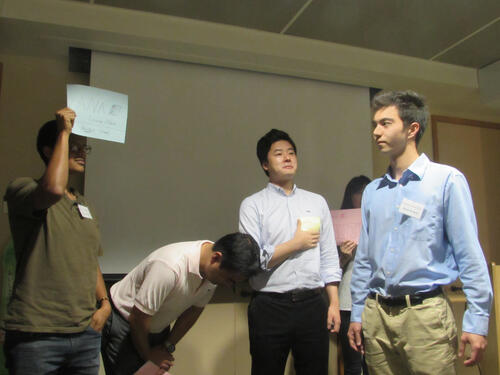
Placed on a team with others they had just met, students were encouraged to assemble quickly and generate solutions to the challenge: how can ANA strengthen its brand awareness in the United States?

ANA is seeking to double in size in the next three years, yet it faces a few obstacles in this endeavor, including a customer base that is mostly in Japan and low brand visibility internationally, according to a senior employee that presented at the event.

“Who had heard of ANA before this event?” asked Hiroyuki Miyagawa, a marketing executive at ANA. Few hands raised in the audience.

Organized into four teams, each student team was joined by an ANA employee who listened in and offered guidance and a chance to learn from a longtime practitioner.

One and a half hours later, with Post-it notes and scribbled diagrams sprinkled across tables, each team emerged ready to present their 3-minute pitch to a panel of judges. The panel included executives from ANA, the World Innovation Lab (WiL), a venture capital firm in Palo Alto, and bTrax, a San Francisco based design firm.

Below are a few pictures from the event.


Image
ideathon team three

Team Three acts out a skit.  |  They proposed that ANA establish lounges for the general public to gather in and purchase goods from Uniqlo and Muji, two Japanese lifestyle retailers. The lounges would offer a place to reinforce ANA's brand outside of the airport, they said.


Image
ideathon team four

Team Four puts their heads together to generate ideas.  |  In their pitch, the team noted that baseball is a popular sport among Americans and Japanese. They recommended baseball be a focus of the marketing campaign, and said television and social media would best reach the target audience.


Image
ideathon team five

Team Five explains their marketing approach.  |  Flying can lead to some unpleasant experiences, and a way ANA can set itself apart is to make those experiences manageable, and even enjoyable, they said. Their proposal was to bring new amenities to the in-flight experience such as a care package for people who sit in the middle seat.


Image
ideathon team one

Team One poses for a picture after their presentation.  |  In their pitch, they recommended using ANA’s association with Japan to differentiate from other global airlines. Their approach included creating a film that features an American celebrity traveling on ANA.


The winning team was Team One whose concept was to use a celebrity figure – Ellen DeGeneres – in their advertising. They said that the target audience could relate to DeGeneres, and her already-established following would be an advantage.

The judges commended Team One for the creativity of their idea and its level of feasibility. Team One consisted of students Yaqian Fan, Michael Hong, Sam Ide, Lu Li and Adelbert Tan.

Kenji Kushida, a Stanford alumnus and project leader of SV-NJ, said:

“When I was a student, I craved for an opportunity to brainstorm solutions to real-world challenges and to do it in an environment that provided instant feedback,” he said, “We were able to make that happen here with the support of ANA and WiL, and are thrilled with the outcome."

Hero Image
ideathon headline cropped
All News button
1
-

Image
amb lippert2014
In the wake of South Korean President Park Geun-hye's meeting with President Obama in Washington, D.C. on October 16, Mark Lippert, the American Ambassador to Korea, will offer his thoughts about U.S.-Korean relations and the challenges and opportunities the alliance may face in coming years.

Ambassador Lippert previously held senior positions in the Department of Defense from May 2012 until September 2014. This included Chief of Staff to the Secretary of Defense, Chuck Hagel, and Assistant Secretary of Defense for Asian and Pacific Security Affairs, where he was the principal advisor to the Secretary of Defense on all international security strategy and policy issues related to the nations and international organizations of Asia and the Pacific. Prior to being confirmed in April 2012, he completed a two-year mobilization on active duty in the United States Navy. During that time, which included a deployment to Afghanistan, he served as an Intelligence Officer for the Naval Special Warfare Development Group in Virginia Beach, Virginia from 2009 to 2011.

Ambassador Lippert served as Deputy Assistant to the President and Chief of Staff for the National Security Council in 2009.  In 2008, he served as Deputy Director for Foreign Policy on the Obama-Biden Transition Team, and Senior Foreign Policy Advisor on the Obama for America campaign. Previously, he worked as the Foreign Policy Advisor for then-Senator Obama from 2005 to 2008, where he managed the Senator's work on the Senate Foreign Relations Committee. From 2007 to 2008, he took a leave of absence from this position to deploy on active duty as an Intelligence Officer with Seal Team One in support of Operation Iraqi Freedom. From 2000 to 2005, he was a Professional Staff Member on the Senate Appropriations Committee, State-Foreign Operations Subcommittee, advising Senator Patrick Leahy on a range of foreign aid and security assistance issues. From 1999 to 2000, he served as the Foreign and Defense Policy Advisor to Senator Tom Daschle and the Senate Democratic Policy Committee.

Ambassador Lippert’s military awards and decorations include the Bronze Star Medal for his service in Iraq, the Defense Meritorious Service Medal, and the Basic Parachutist Badge. He is also the recipient of the Department of Defense’s Distinguished Public Service Award and the Department of the Navy’s Distinguished Public Service Award.

Ambassador Lippert graduated Phi Beta Kappa from Stanford University with a B.A. in Political Science and holds an M.A. in International Policy Studies from the same institution. He also studied Mandarin Chinese at Beijing University.


Mark W. Lippert <i>U.S. Ambassador to Republic of Korea</i>
Seminars
Authors
News Type
News
Date
Paragraphs

In a new book, David Straub explains why massive anti-American protests erupted across South Korea in 2002 and considers whether it could happen again.

South Korea is often seen as a pro-American ally, a model country that went from a poor, postwar nation into a maturing democracy in just four short decades.

But despite a historic alliance between South Korea and the United States, anti-Americanism flared throughout the Asian nation between 1999-2002 when a series of events and longstanding tensions aligned, according to Stanford researcher David Straub.

“It was a sort of venting of steam,” said Straub, an associate director at Stanford’s Walter H. Shorenstein Asia-Pacific Research Center.

“Many Koreans at the time were grossly overinterpreting issues and incidents involving the United States. And this was because they were viewing the U.S.-Korea relationship through a lens of historic victimization by other nations, including the United States,” he added.

Straub, who held a thirty-year diplomatic career in the State Department, headed the political section of the American embassy in Seoul during those years and was deeply involved in managing problems in the bilateral relationship.

Boiling point

Since the end of the Korean War, the United States Forces Korea (USFK) has been stationed in Seoul – now about 28,500 uniformed personnel.

In June 2002, a USFK vehicle struck two Korean students in a tragic accident. In December of that same year, after a U.S. court martial found the drivers of the vehicle not guilty of wrongdoing, hundreds of thousands of people protested in Seoul and other major Korean cities. Not only did activists partake but ordinary citizens too, he said.

Straub said the South Korean public had been “unintentionally primed” for such a reaction to the USFK traffic accident; it was the “spark that lit the firestorm” after years of escalation. A series of events led-up to the mass protests, they included:

  • A few months before the USFK traffic accident, a Korean athlete was disqualified at the Winter Olympics in Salt Lake City during a speed skating competition. American athlete Apolo Anton Ohno instead won gold after a disputed call.
  • A non-governmental organization in May 2000 revealed that USFK personnel dumped formaldehyde into a drain that ran into the Han River in Seoul.
  • In Sept. 1999, the Associated Press published its first investigative story examining the Nogun-ri incident of 1950, when hundreds of Korean refugees were killed in an alleged massacre by U.S. service members.

Asymmetry of attention

Straub said the shaping of Koreans’ views of Americans and fanning of tensions could be attributed in part to an “asymmetry of attention” on the part of the Korean and American publics to the U.S.-Korean relationship.

While the Korean public put tremendous focus on U.S.-Korean relations and the presence of U.S. military personnel in Korea, the American public was unaware of Korean attitudes and feelings, he said.

Similarly during the 1999-2002 period, Korean media reported hypercritical views of the United States and USFK, while the American media paid far less attention.

In negotiating with U.S. officials, South Korean officials would often allude to strong Korean public opinion and demand U.S. concessions. With no American public opinion on Korea issues to point to, U.S. officials were at a major disadvantage, Straub said.

U.S. officials would sometimes note opinions shared by members of Congress, he said, “however, for Korean officials, those claims weren’t as powerful as having a social movement literally on the front doorstep.”

In plain terms, the United States is much larger than South Korea. This very imbalance – which translates to military and economic power – added to Koreans’ assumption that they were “getting the worse end of the bargain,” he added.

“Most Koreans saw Korea as a victim of great powers,” Straub said. “It’s not just the media. It’s more than that, it was – and still is – a shared national narrative.”

Koreans’ sense of national vulnerability is magnified by their historic victimization to neighbors. South Koreans do not want to become a de facto tributary state of China or a colony of Japan again, he said.

Will anti-Americanism return?

USFK incidents were a main focus of Korean attention during the 1999-2002 period, and while there is always a possibility of problems arising, the intensity is gone now, Straub said.

“Some steam is under the lid again,” Straub said. “But I don’t think it’s nearly at the level like it was back then. I’m doubtful that we’d see an exact repeat.”

The media landscape in South Korea has improved and shifted away from its earlier position of “criticize the United States first and ask questions later,” Straub said.

Today, South Korea and the United States are in good standing at the government-level and among the people. President Obama and Korean President Park Geun-hye have an established rapport.   

What troubles Koreans now is North Korea, a Japan focused on collective defense, and the strategic rivalry between the United States and China and its possible implications for Korea, he said.

“South Korea being sandwiched between the United States and China – based on a perception that China is going to be the world’s dominant power – is a real worry for many Koreans,” Straub said, and a large number of Koreans – albeit still a minority – feel that their country must find a more equidistant ground between the two.

Most Koreans, however, still believe in the need for the continued presence of USFK personnel, at least for the time being, said Straub, and must be reassured of their strategic alliance with the United States.

Obama and Park are expected to meet in Washington in mid-October, and Straub said it will be used as an opportunity for both sides to reinforce the importance they attach to the alliance and to pressing North Korea to abandon its nuclear weapons and long-range missile programs.

Links to related articles

NK News: South Korean anti-Americanism dwindles, but roots remain: diplomat

NK News: South Korean anti-Americanism: a thing of the past?

Anti-Americanism in Democratizing South Korea, July 2015

Asia Times: American faces Seoul court over infamous unsolved murder

The Christian Science Monitor: South Korea: 20 years later, Californian son faces trial for Seoul murder

JoongAng Ilbo: Is anti-Americanism dead?

JoongAng Ilbo (Korean): 한미동맹은 빈틈없이 튼실한가 전 미국 국무부 한국과장의 진단

Hero Image
rtrpaj1
A South Korean protestor holds an American flag on which protesters left their footprints at a Seoul rally in June 2003.
Reuters/Lee Jae-Won
All News button
1
Authors
David Straub
News Type
Commentary
Date
Paragraphs

In an NK News' series of interviews with a panel of U.S. experts on North Korea policy, David Straub, associate director of the Korea Program and former State Department Korea director, analyzes the U.S. approach toward Pyongyang. With NK News' permission, downloadable PDF versions of the interviews are available below.


Hero Image
rtx1baqp
North Korean leader Kim Jong Un provides field guidance at the newly built National Space Development General Satellite Control and Command Centre in this undated photo released by North Korea's Korean Central News Agency (KCNA) in Pyongyang, May 3, 2015.
Reuters/KCNA
All News button
1
-

Sponsored by the Taiwan Democracy Project and the U.S. Asia Security Initiative at the Asia-Pacific Research Center (APARC)

Abstract

During the recent meeting between PRC President Xi Jinping and Taiwan President Ma Ying-jeou, the “1992 One China Consensus” served as a mutually acceptable paradigm for maintaining “peaceful and stable” conditions across the Taiwan Strait.  For Xi Jinping, the warmth of the visit thinly veiled a message to Taiwan’s leaders and electorate, as well as to onlookers in Washington.  Chinese officials and media clearly link the talks and confirmation of the 1992 Consensus to “the great rejuvenation of the Chinese nation”—a concept that is increasingly unpalatable to many in Taiwan.  Xi hopes to keep DPP presidential candidate Tsai Ing-wen (and perhaps even future KMT leaders) in the 1992 Consensus “box” and to co-opt the U.S. in this effort, but perhaps underestimates the political transformation underway on Taiwan. 

The Xi administration has also hardened its position regarding “core interests” such as Taiwan, embodied in a “bottom line principle” policy directive that eschews compromise.  Although many commentators and most officials across the region have shied away from stating that the PRC and Taiwan are at the crossroads of crisis, the collision of political transformation on Taiwan and the PRC’s “bottom line principle” will challenge the fragile foundations of peaceful cross-Strait co-existence.  Changes in the regional balance of military power brought about by a more muscular People’s Liberation Army compounds the potential for increased friction, providing Beijing with more credible options for coercion and deterrence.

This talk will consider the politics and principles involved in cross-Taiwan Strait relations in light of the upcoming 2016 Taiwan elections and the policies of the Xi Jinping administration; and will discuss some of the possible implications for China’s national security policy, regional stability, and the future of cross-Strait relations.

Bio

Image
Cortez Cooper
Mr. Cortez A. Cooper III joined RAND in April 2009, providing assessments of security challenges across political, military, economic, cultural, and informational arenas for a broad range of U.S. government clients.  Prior to joining RAND, Mr. Cooper was the Director of the East Asia Studies Center for Hicks and Associates, Inc.  He has also served in the U.S. Navy Executive Service as the Senior Analyst for the Joint Intelligence Center Pacific, U.S. Pacific Command.  As the senior intelligence analyst and Asia regional specialist in the Pacific Theater, he advised Pacific Command leadership on trends and developments in the Command’s area of responsibility.  Before his Hawaii assignment, Mr. Cooper was a Senior Analyst with CENTRA Technology, Inc., specializing in Asia-Pacific political-military affairs.  Mr. Cooper’s 20 years of military service included assignments as both an Army Signal Corps Officer and a China Foreign Area Officer.  In addition to numerous military decorations, the Secretary of Defense awarded Mr. Cooper with the Exceptional Civilian Service Award in 2001.

2016 Taiwan Elections and Implications for Cross-Strait and Regional Security
Download pdf
Cortez Cooper Senior International Policy Analyst RAND Corporation
Seminars
-

This event is now full, and we are unable to accept any further RSVPs.  Please email khaley@stanford.edu if you would like to be added to a wait list.


Russia's aggressive foreign policy is backed by Putin's domestic popularity ratings and his strong grip on Russia's political system. But in reality, how firmly does Putin control Russian politics? Can the ongoing economic crisis in Russia pose challenges to his system and the upcoming federal elections of 2016-2018? What impact will Russian domestic politics play in Russia's international behavior?


Vladimir Milov is a Russian opposition politician, publicist, economist & energy expert. He was the Deputy Minister of Energy of Russia (2002), adviser to the Minister of Energy (2001-2002), and head of strategy department at the Federal Energy Commission, the natural monopoly regulator (1999-2001). Milov is the author of major energy reform concepts, including the concept of market restructuring and unbundling of Gazprom, which was banned from implementation by President Vladimir Putin. He is the founder and president of the Institute of Energy Policy, a leading independent Russian energy policy think tank (since 2003). Milov is a columnist of major Russian political and business publications, including Forbes Russia, and a frequent commentator on Russian political and economic affairs in major Western media outlets (The New York Times, The Financial Times, The Washington Post, The Economist, etc.). Since leaving the Russian Government in 2002, Milov has became a vocal public critic of Vladimir Putin’s dirigiste and authoritarian course. Milov is also active in the Russian opposition politics, serving as Chairman of the “Democratic Choice” opposition party (www.en.demvybor.ru), and is also known as co-author of the critical public report on Vladimir Putin’s Presidential legacy called “Putin. The Results”, written together with Boris Nemtsov (several editions published since 2008).

Vladimir Milov former Russian Deputy Minister of Energy Speaker
Lectures
Subscribe to Diplomacy