Diplomacy
News Type
News
Date
Paragraphs

On January 21, 2016, an inquiry report ordered by the British government was released detailing the death of former Russian spy Alexander Litvinenko. Chairman of the inquiry, retired judge Sir Robert Owen, concluded that there is a strong probability that the Russian security service FSB directed the killing of Litvinenko and the operation was probably approved by President Vladimir Putin.

Michael McFaul, FSI director and former US Ambassador to Russia, discussed his initial reactions to the report findings on PBS NewsHour.

View full interview and transcript at PBS NewsHour.

Read Litvinenko report at the UK Home Office.

Hero Image
litvinenko report jan 21 2016
All News button
1
News Type
Commentary
Date
Paragraphs

Daniel Sneider, associate director for research at the Walter H. Shorenstein Asia-Pacific Research Center, provides an in-depth analysis of how the agreement on the “comfort women” issue between Japan and South Korea was reached late last year. In Japanese publication Toyo Keizai Online, Sneider writes that – after at least four years of negotiations between the two governments – political leadership in Seoul and Tokyo as well as pressure from the Obama administration can be credited for the breakthrough.

Read the article in English and Japanese.

Earlier in December, David Straub, associate director for the Korea Program, said the agreement is a sign of progress. He said it vindicates the victims and is a positive development for Korea-Japan relations. 

Read his comments in reporting done by Yonhap News and Voice of America.

Hero Image
rtx2080d
South Korean Foreign Minister Yun Byung-Se (Right) shakes hands with his Japanese counterpart Fumio Kishida (Left) during their meeting at the Foreign Ministry in Seoul Dec. 28, 2015.
Reuters/Jung Yeon-je/Pool
All News button
1
Paragraphs

The breakthrough agreement on the comfort women issue between Japan and South Korea on Dec. 28, 2015, was the culmination of at least four years of negotiations between the two governments. South Korean President Park Geun-hye and Japanese Prime Minister Shinzo Abe pushed for the agreement; the Obama administration provided persistent pressure while resisting a mediation role. The danger of the agreement falling apart is apparent to officials in Washington and Seoul, and hopefully Tokyo too, writes Sneider.

All Publications button
1
Publication Type
Commentary
Publication Date
Journal Publisher
Toyo Keizai Online
Authors
Daniel C. Sneider
-

This conference aims to further our understanding of the institutional cultures, funding schemes and power structures underlying transnational institutions, with a particular focus on heritage bureaucracies. We bring together scholars working at the intersection of archaeology, anthropology, sociology and law to offer a broader understanding of the intricacies of multilateral institutions and global civic society in shaping contemporary heritage governance. Speakers will provide ethnographic perspectives on the study of international organizations, such as the UN and EU, in an effort to show the entanglement of political and technical decision-making.

A 2-day international conference organized by Claudia Liuzza and Gertjan Plets.

Speakers:

Brigitta Hauser-Shäublin (Institute of Ethnology, Göttingen University)
Ellen Hertz (Institute of Ethnology, University of Neuchâtel)
Miyako Inoue (Department of Anthropology, Stanford University)
Claudia Liuzza (Department of Anthropology, Stanford University)
Brigit Müller (Ecole des Hautes Etudes en Sciences Sociales, Paris)
Elisabeth Niklason (Department of Archeaology, Stockholm University)
Gertjan Plets (Stanford Archaeology Center, Stanford University)
Cris Shore (Department of Anthropology, The University of Auckland)
Ana Vrdoljak (Department of Law, University of Technology, Sydney)

Co-sponsored by Stanford Archaeology Center, Cantor Arts Center, Department of Anthropology, Center for Russian, East European & Eurasian Studies, Stanford Humanities Center, The Europe Center, France-Stanford Center for Interdisciplinary Studies, The Mediterranean Studies Forum.

Contact: heritagebur@gmail.com

Heritage Bureaucracies Conference Flyer
Download pdf

Stanford Archaeology Center (BLDG 500)
488 Escondido Mall
Stanford Universit

Workshops
News Type
Commentary
Date
Paragraphs

North Korea claimed it successfully tested a hydrogen bomb on Jan. 6, according to a broadcast from the nation’s Korean Central Television. Experts at the Freeman Spogli Institute for International Studies offered their analyses to media.

Scholars from the Walter H. Shorenstein Asia-Pacific Center (APARC) and the Center for International Security and Cooperation (CISAC) contributed to a Stanford news release. Although the scholars said they are skeptical of North Korea’s claim, they also said the test would have a destabilizing effect on the region.

In a Q&A, Siegfried Hecker answered nine questions, offering perspective on the situation and how the United States should respond. Hecker, a CISAC senior fellow, is a former director of the Los Alamos National Laboratory and has visited North Korea seven times since 2004.

David Straub, associate director of the Korea Program, commented on the North Korean nuclear program in an NK News article. He said the timing of the nuclear test, now the nation’s fourth, was likely only marginally influenced by external factors such as Kim Jong-un’s birthday. The primary factor is technical, he said. Straub also spoke with Yonhap News on Feb. 12. In the interview, Straub said "although the United States and the People's Republic of China certainly have differences [in dealing with the North Korean nuclear issue], they pale in comparison to U.S.-Soviet differences." 

Straub also offered, in an extended interview with South Korea's Segye Ilbo newspaper, his thoughts on Pyongyang's motivations for pursuing nuclear weapons. He argued that the appropriate policy response is to continue to increase pressure on the regime. Pressure applied by Washington is meant to convince Pyongyang that nuclear weapons will bring more cost than benefit, while holding open the door to good-faith negotiations to resolve peninsular issues.

Shorenstein APARC Associate Director for Research Daniel Sneider talked with Al Jazeera America and Slate about the developments. He said the nuclear test signified North Korea’s uneasiness and was largely an accommodation of domestic politics.

In early February, South Korea announced temporary closure of Kaesong Industrial Complex (KIC), a jointly held project with North Korea. In Chosun Ilbo newspaper, Straub argued that South Korea's closure of KIC was a necessary response to North Korea's fourth nuclear test and latest satellite rocket launch. Two articles were published in Korean; the first is available here and the second here.

Hero Image
rtx1baqp
North Korean leader Kim Jong Un provides field guidance at the newly built National Space Development General Satellite Control and Command Centre in this undated photo released by North Korea's Korean Central News Agency (KCNA) in Pyongyang, May 3, 2015.
Reuters/KCNA
All News button
1
-

Abstract

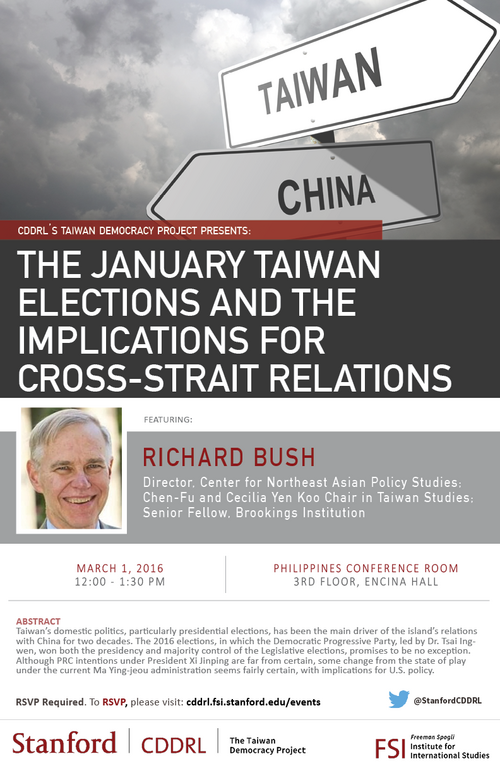
Taiwan’s domestic politics, particularly presidential elections, has been the main driver of the island’s relations with China for two decades. The 2016 elections, in which the Democratic Progressive Party, led by Dr. Tsai Ing-wen, won both the presidency and majority control of the Legislative elections, promises to be no exception. Although PRC intentions under President Xi Jinping are far from certain, some change from the state of play under the current Ma Ying-jeou administration seems fairly certain, with implications for U.S. policy.


Bio

Richard Bush is a Senior Fellow at the Brookings Institution and Director of its Center for Northeast Asian Policy Studies, and the Chen-Fu and Cecilia Yen Koo Chair in Taiwan Studies. He came to Brookings in July 2002 after nineteen years working in the US government, including five years as the Chairman and Managing Director of the American Institute in Taiwan. He is the author of a number of articles on U.S. relations with China and Taiwan, and of At Cross Purposes, a book of essays on the history of America’s relations with Taiwan, published in March 2004 by M. E. Sharpe. In the spring of 2005, Brookings published his study on cross-Strait relations, entitled Untying the Knot: Making Peace in the Taiwan Strait. In 2013, Brookings published his Uncharted Strait: The Future of China-Taiwan Relations.


This talk is co-sponsored by the Taiwan Democracy Project in the Center on Democracy, Development, and the Rule of Law and the U.S.-Asia Security Initiative in the Walter H. Shorenstein Asia-Pacific Research Center.

Image
richard bush taiwan talk flyer


Richard C. Bush Senior Fellow and Director, Center for East Asian Policy Studies Brookings Institution
Seminars
-

Abstract

After five years of political support for the regime of Bashar Al-Asad in its war against the opposition, Russia intervened militarily on his behalf in September 2015 and suddenly later this year Russian President Vladimir Putin announced the withdrawal of the Russian troops from Syria. While Moscow claims that its intervention was aimed at destroying ISIS and other terrorists groups, but the vast majority of its air strikes seem to target the moderate armed opposition, which has fought ISIS on the ground. This presentation assesses the outcome of Russia’s intervention, arguing that it neither achieved its goal of destroying ISIS nor did it tip the balance favor of Asad. Instead, the intervention had resulted in the killing of Syrian civilians, complicated the conflict in Syria, and constrained the prospects for a political solution by empowering Asad on the ground.

Speaker Bio

Image
radwan
Radwan Ziadeh is a senior analyst at the Arab Center in Washington D.C. He is the founder and director of the Damascus Center for Human Rights Studies in Syria and co-founder and executive director of the Syrian Center for Political and Strategic Studies in Washington, D.C. He is a Visiting Scholar at the Center for the Study of Human Rights at Columbia University, and Fellow at the Institute for Social Policy and Understanding (ISPU) in Washington D.C. Ziadeh was the managing editor of the Transitional Justice Project in the Arab World, and the Head of the Syrian Commission for Transitional Justice, which was established on November 14, 2013 by the Syrian Interim Government. He was also involved in the Syrian political opposition. He was elected in October 2011 as director of the Foreign Relations Office of the Syrian National Council until he resigned from the position in November 2012. He wrote more than twenty books in English and Arabic. His most recent book is Syria's Role in a Changing Middle East: The Syrian-Israeli Peace Talks (I.B.Tauris, 2016). Ziadeh holds a D.D.S in Dentistry from Damascus University, Diploma in international Human Rights Law from College of Law at the American University in Washington D.C, an MA in Democracy and Governance from Georgetown University in Washington D.C, and an MS in Finance from Kogod School of Business at the American University in Washington D.C.


[[{"fid":"222587","view_mode":"crop_870xauto","fields":{"format":"crop_870xauto","field_file_image_description[und][0][value]":"Radwan Ziadeh flyer","field_file_image_alt_text[und][0][value]":"","field_file_image_title_text[und][0][value]":"","field_credit[und][0][value]":"","field_caption[und][0][value]":"","field_related_image_aspect[und][0][value]":"","thumbnails":"crop_870xauto"},"type":"media","attributes":{"width":"870","style":"width: 870px;","class":"media-element file-crop-870xauto"}}]]


CISAC Central Conference Room
Encina Hall, 2nd Floor
616 Serra St
​Stanford, CA 94305

Radwan Ziadeh Arab Center, Washington, DC
Seminars
-

Abstract

After nearly five years since the start of the uprising, Syria finds itself divided and embattled, with no end in sight. More significantly, more than half of the Syrian population is displaced and the death toll surpassed 300,000 by all counts. The Syrian tragedy persists and, more than any other case of mass uprising in the region, continues to be shrouded in political power-plays and contradictions at the local, regional, and international levels. Defined increasingly by an absence of a clear favorable outcome, considering existing parties to the conflict, the logic of the lesser evil reigns supreme. This lecture is an attempt to understand the roots and dynamics of the tragic Syrian uprising, with particular attention to its background and to the recent Russian intervention.

Speaker Bio

Image
unnamed
Bassam Haddad is Director of the Middle East Studies Program and Associate Professor in the Department of Public and International Affairs at George Mason University, and is Visiting Professor at Georgetown University. He is the author of Business Networks in Syria: The Political Economy of Authoritarian Resilience (Stanford University Press, 2011). Haddad is currently editing a volume on Teaching the Middle East After the Arab Uprisings, a book manuscript on pedagogical and theoretical approaches. His most recent books include two co-edited volumes: Dawn of the Arab Uprisings: End of an Old Order? (Pluto Press, 2012) and Mediating the Arab Uprisings (Tadween Publishing, 2013). Haddad serves as Founding Editor of the Arab Studies Journal a peer-reviewed research publication and is co-producer/director of the award-winning documentary film, About Baghdad, and director of the critically acclaimed film series, Arabs and Terrorism, based on extensive field research/interviews. More recently, he directed a film on Arab/Muslim immigrants in Europe, titled The "Other" Threat. Haddad is Co-Founder/Editor of Jadaliyya Ezine and serves on the Editorial Committee of Middle East Report. He is the Executive Director of the Arab Studies Institute, an umbrella for five organizations dealing with knowledge production on the Middle East and Founding Editor of Tadween Publishing.


This event is co-sponsored by The Markaz: Resource Center at Stanford University.


[[{"fid":"221861","view_mode":"crop_870xauto","fields":{"format":"crop_870xauto","field_file_image_description[und][0][value]":"Bassam Haddad January 21","field_file_image_alt_text[und][0][value]":"","field_file_image_title_text[und][0][value]":"","field_credit[und][0][value]":"","field_caption[und][0][value]":"","field_related_image_aspect[und][0][value]":"","thumbnails":"crop_870xauto"},"type":"media","attributes":{"width":"870","class":"media-element file-crop-870xauto"}}]]

 

CISAC Central Conference Room
Encina Hall, 2nd Floor
616 Serra St
Stanford, CA 94305

Bassam Haddad Associate Professor George Mason University
Seminars
Paragraphs

The fifteenth session of the Korea-U.S. West Coast Strategic Forum, held in Korea on November 17, 2015, convened senior South Korean and American policymakers, scholars and regional experts to discuss North Korea policy and recent developments on the Korean Peninsula. Hosted by the Korea Program at the Walter H. Shorenstein Asia-Pacific Research Center at Stanford University, the Forum is also supported by the Sejong Institute.

All Publications button
1
Publication Type
Policy Briefs
Publication Date
Subscribe to Diplomacy