Environment

FSI scholars approach their research on the environment from regulatory, economic and societal angles. The Center on Food Security and the Environment weighs the connection between climate change and agriculture; the impact of biofuel expansion on land and food supply; how to increase crop yields without expanding agricultural lands; and the trends in aquaculture. FSE’s research spans the globe – from the potential of smallholder irrigation to reduce hunger and improve development in sub-Saharan Africa to the devastation of drought on Iowa farms. David Lobell, a senior fellow at FSI and a recipient of a MacArthur “genius” grant, has looked at the impacts of increasing wheat and corn crops in Africa, South Asia, Mexico and the United States; and has studied the effects of extreme heat on the world’s staple crops.

-

This event is open to Stanford undergraduate students only. 

The Center on Democracy, Development, and the Rule of Law (CDDRL) is currently accepting applications from eligible juniors due February 27, 2015 who are interested in writing their senior thesis on a subject touching upon democracy, economic development, and rule of law (DDRL) from any university department. CDDRL faculty and current honors students will be present to discuss the program and answer any questions.

For more information on the CDDRL Senior Honors Program, please click here.


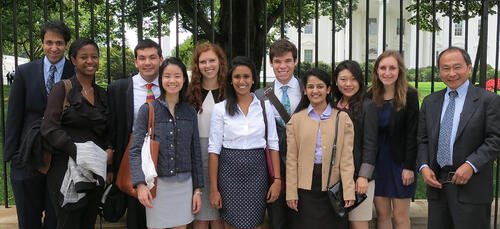
CDDRL Class of 2015 Class of 2015 in front of the White House with Francis Fukuyama.


[[{"fid":"217337","view_mode":"crop_870xauto","fields":{"format":"crop_870xauto","field_file_image_description[und][0][value]":"SHP15 Info Session Flyer","field_file_image_alt_text[und][0][value]":"","field_file_image_title_text[und][0][value]":"","field_credit[und][0][value]":"","field_caption[und][0][value]":"SHP15 Info Session Flyer","field_related_image_aspect[und][0][value]":"","thumbnails":"crop_870xauto","pp_lightbox":false,"pp_description":false},"type":"media","attributes":{"height":1056,"width":870,"class":"media-element file-crop-870xauto"}}]]

Encina Hall, C148
616 Jane Stanford Way
Stanford, CA 94305

0
Olivier Nomellini Senior Fellow at the Freeman Spogli Institute for International Studies
Director of the Ford Dorsey Master's in International Policy
Research Affiliate at The Europe Center
Professor by Courtesy, Department of Political Science
yff-2021-14290_6500x4500_square.jpg

Francis Fukuyama is the Olivier Nomellini Senior Fellow at Stanford University's Freeman Spogli Institute for International Studies (FSI), and a faculty member of FSI's Center on Democracy, Development and the Rule of Law (CDDRL). He is also Director of Stanford's Ford Dorsey Master's in International Policy, and a professor (by courtesy) of Political Science.

Dr. Fukuyama has written widely on issues in development and international politics. His 1992 book, The End of History and the Last Man, has appeared in over twenty foreign editions. His book In the Realm of the Last Man: A Memoir will be published in fall 2026.

Francis Fukuyama received his B.A. from Cornell University in classics, and his Ph.D. from Harvard in Political Science. He was a member of the Political Science Department of the RAND Corporation, and of the Policy Planning Staff of the US Department of State. From 1996-2000 he was Omer L. and Nancy Hirst Professor of Public Policy at the School of Public Policy at George Mason University, and from 2001-2010 he was Bernard L. Schwartz Professor of International Political Economy at the Paul H. Nitze School of Advanced International Studies, Johns Hopkins University. He served as a member of the President’s Council on Bioethics from 2001-2004. He is editor-in-chief of American Purpose, an online journal.

Dr. Fukuyama holds honorary doctorates from Connecticut College, Doane College, Doshisha University (Japan), Kansai University (Japan), Aarhus University (Denmark), the Pardee Rand Graduate School, and Adam Mickiewicz University (Poland). He is a non-resident fellow at the Carnegie Endowment for International Peace. He is a member of the Board of Trustees of the Rand Corporation, the Board of Trustees of Freedom House, and the Board of the Volcker Alliance. He is a fellow of the National Academy for Public Administration, a member of the American Political Science Association, and of the Council on Foreign Relations. He is married to Laura Holmgren and has three children.

(October 2025)

CV
Date Label
Honors Program Director

Encina Hall, C150
616 Jane Stanford Way
Stanford, CA 94305

0
Center Fellow, Freeman Spogli Institute for International Studies
didi_kuo_2023.jpg

Didi Kuo is a Center Fellow at the Freeman Spogli Institute for International Studies (FSI) at Stanford University. She is a scholar of comparative politics with a focus on democratization, corruption and clientelism, political parties and institutions, and political reform. She is the author of The Great Retreat: How Political Parties Should Behave and Why They Don’t (Oxford University Press) and Clientelism, Capitalism, and Democracy: the rise of programmatic politics in the United States and Britain (Cambridge University Press, 2018).

She has been at Stanford since 2013 as the manager of the Program on American Democracy in Comparative Perspective and is co-director of the Fisher Family Honors Program at CDDRL. She was an Eric and Wendy Schmidt Fellow at New America and is a non-resident fellow with the Carnegie Endowment for International Peace. She received a PhD in political science from Harvard University, an MSc in Economic and Social History from Oxford University, where she studied as a Marshall Scholar, and a BA from Emory University.

Date Label
Mentor
-

If we are to feed by 2050 a growing population that is increasingly adopting western style diets we will  have to intensify food production - producing more but on the same amount or less of land and with the same  amount or less of water. Moreover this has to be done in a sustainable manner, i.e. with much lower environmental impact and greater resilience. We can do this with ecological approaches, genetic approaches and socio-economic approaches. Each has its pros and cons.

Sir Gordon Conway is a Professor of International Development at Imperial College, London and Director of Agriculture for Impact, a grant funded by the Bill & Melinda Gates Foundation, which focuses on European support of agricultural development in Africa.

From 2005-2009 he was Chief Scientific Adviser to the Department for International Development. Previously he was President of The Rockefeller Foundation and Vice-Chancellor of the University of Sussex. 

He was educated at the Universities of Wales (Bangor), Cambridge, West Indies (Trinidad) and California (Davis).  His discipline is agricultural ecology.  In the early 1960's, working in Sabah, North Borneo, he became one of the pioneers of sustainable agriculture.

He was elected a Fellow of the Royal Society in 2004 and an Honorary Fellow of the Royal Academy of Engineering in 2007. He was made a Knight Commander of the Order of Saint Michael and Saint George in 2005.  He was recently President of the Royal Geographical Society.

He has authored The Doubly Green Revolution: Food for all in the 21st century (Penguin and University Press, Cornell) and co-authored Science and Innovation for Development (UK Collaborative on Development Sciences (UKCDS)).  His most recent book One Billion Hungry: Can we Feed the World? was published in October 2012. 

Can Sustainable Intensification Feed the World?
Download pdf

Oksenberg Conference Room
Encina Hall, 3rd floor
616 Serra St.
Stanford University
Stanford, CA 94305

Directions and parking information are available here

Professor Sir Gordon Conway Speaker

The Jerry Yang and Akiko Yamazaki
Environment and Energy Building
Stanford University
473 Via Ortega, Office 363
Stanford, CA 94305

(650) 723-5697 (650) 725-1992
0
Senior Fellow, Stanford Woods Institute and Freeman Spogli Institute for International Studies
William Wrigley Professor of Earth System Science
Senior Fellow and Founding Director, Center on Food Security and the Environment
Roz_low_res_9_11_cropped.jpg PhD

Rosamond Naylor is the William Wrigley Professor in Earth System Science, a Senior Fellow at Stanford Woods Institute and the Freeman Spogli Institute for International Studies, the founding Director at the Center on Food Security and the Environment, and Professor of Economics (by courtesy) at Stanford University. She received her B.A. in Economics and Environmental Studies from the University of Colorado, her M.Sc. in Economics from the London School of Economics, and her Ph.D. in applied economics from Stanford University. Her research focuses on policies and practices to improve global food security and protect the environment on land and at sea. She works with her students in many locations around the world. She has been involved in many field-level research projects around the world and has published widely on issues related to intensive crop production, aquaculture and livestock systems, biofuels, climate change, food price volatility, and food policy analysis. In addition to her many peer-reviewed papers, Naylor has published two books on her work: The Evolving Sphere of Food Security (Naylor, ed., 2014), and The Tropical Oil Crops Revolution: Food, Farmers, Fuels, and Forests (Byerlee, Falcon, and Naylor, 2017).

She is a Fellow of the Ecological Society of America, a Pew Marine Fellow, a Leopold Leadership Fellow, a Fellow of the Beijer Institute for Ecological Economics, a member of Sigma Xi, and the co-Chair of the Blue Food Assessment. Naylor serves as the President of the Board of Directors for Aspen Global Change Institute, is a member of the Scientific Advisory Committee for Oceana and is a member of the Forest Advisory Panel for Cargill. At Stanford, Naylor teaches courses on the World Food Economy, Human-Environment Interactions, and Food and Security. 

CV
Rosamond L. Naylor Chair

Energy and Environment Building
473 Via Ortega
Stanford CA 94305

(650) 721-6207
0
Professor, Earth System Science
Senior Fellow at the Freeman Spogli Institute for International Studies
Senior Fellow at the Stanford Woods Institute for the Environment
Senior Fellow at the Stanford Institute for Economic Policy Research (SIEPR)
Affiliate, Precourt Institute of Energy
shg_ff1a1284.jpg PhD

David Lobell is the Benjamin M. Page Professor at Stanford University in the Department of Earth System Science and the Gloria and Richard Kushel Director of the Center on Food Security and the Environment. He is also the William Wrigley Senior Fellow at the Stanford Woods Institute for the Environment, and a senior fellow at the Freeman Spogli Institute for International Studies (FSI) and the Stanford Institute for Economic Policy and Research (SIEPR).

Lobell's research focuses on agriculture and food security, specifically on generating and using unique datasets to study rural areas throughout the world. His early research focused on climate change risks and adaptations in cropping systems, and he served on the Intergovernmental Panel on Climate Change (IPCC) Fifth Assessment Report as lead author for the food chapter and core writing team member for the Summary for Policymakers. More recent work has developed new techniques to measure progress on sustainable development goals and study the impacts of climate-smart practices in agriculture. His work has been recognized with various awards, including the Macelwane Medal from the American Geophysical Union (2010), a Macarthur Fellowship (2013), the National Academy of Sciences Prize in Food and Agriculture Sciences (2022) and election to the National Academy of Sciences (2023).

Prior to his Stanford appointment, Lobell was a Lawrence Post-doctoral Fellow at Lawrence Livermore National Laboratory. He holds a PhD in Geological and Environmental Sciences from Stanford University and a Sc.B. in Applied Mathematics from Brown University.

CV
Date Label
David Lobell Moderator
Lectures
-

Abstract: Although anthropogenic impacts on biodiversity are recognized, human impacts on animal life are an under-appreciated form of global environmental change. For example, among terrestrial vertebrates, 322 species have
 become extinct since 1500, and populations of the remaining species show 25% average decline in abundance. Invertebrate patterns are equally dire: 
monitored populations show close to 50% mean abundance decline. Such animal declines
will cascade onto ecosystem functioning and human well-being, including risks to human health. I will discuss how defaunation is both a pervasive component of the current anthropogenic erosion of Earth’s biological diversity and also a major driver of global ecological change of significance for society.

About the Speaker: Rodolfo Dirzo earned his M.Sc. and his Ph.D. from the University of Wales, UK, and he is currently a professor of biology at Stanford, and Director of Stanford’s Center for Latin American Studies. His research on the ecology of plant and animals in tropical ecosystems examines the significance of biodiversity loss in terms of ecosystem functioning and ecosystem services to society. He is member of the US National Academy of Sciences. He is committed to education at all levels, including elementary and high schools from underserved communities in the Bay Area. 

Anthropogenic impact on animal life and its consequences for ecosystem functioning and ecosystem services
Download pdf

Encina Hall (2nd floor)

Rodolfo Dirzo Speaker Bing Professor in Environmental Science; Senior Fellow, Woods Institute for the Environment
Seminars
-

Abstract: The “unsinkable” RMS Titanic sank on April 14, 1912, in the North Atlantic Ocean on its maiden voyage from Southampton, UK, to New York City.  There was no single cause for the loss of the Titanic; rather the improbable combination of errors in human design and judgment, combined with unforeseeable circumstance, led to the loss of over 1,500 lives.  The failure appears to have occurred over a range of spatial and temporal scales – from the atomic-scale processes of the embrittlement of iron rivets to global-scale fluctuations in climate and ocean currents. Regardless of the specific combination of causes, this failure in design and practice led to impressive improvements in both.  Disaster and tragedy are harsh teachers, but critical to improvement and progress.

The important question for the nuclear waste management community is: How do we learn and improve our waste management strategies in the absence of the benefit of failure? A geologic repository “operates” over a very distant time fame, and today’s scientists and engineers will never have the benefit of studying the failed system. In place of failure followed by improvements, we only can offer a general consensus on disposal strategies and their effectiveness.  However, it may well be that consensus leads to complacency and compromise, both of which may be harbingers of a failed repository.  I will discuss these issues in the context of recent accidents and the release of radioactivity at the Waste Isolation Pilot Plant, a geologic repository in southeastern New Mexico.

About the Speaker: Rod Ewing is the Frank Stanton Professor in Nuclear Security in the Center for International Security and Cooperation in the Freeman Spogli Institute for International Studies and a Professor in the Department of Geological and Environmental Sciences in the School of Earth Sciences. Ewing’s research focuses on the back-end of the nuclear fuel cycle, mainly nuclear materials and the geochemistry of radionuclides with application to permanent geologic disposal. He is the past president of the International Union of Materials Research Societies. Ewing has written extensively on issues related to nuclear waste management and is a co-editor of Radioactive Waste Forms for the Future (1988) and Uncertainty Underground – Yucca Mountain and the Nation’s High-Level Nuclear Waste (2006). He received the Lomonosov Gold Medal of the Russian Academy of Sciences in 2006. In 2012, he was appointed by President Obama to chair the Nuclear Waste Technical Review Board, which provides scientific and technical reviews of the Department of the Energy’s programs for the management and disposal of spent nuclear fuel and high-level radioactive waste. In 2015, he will receive the Roebling Medal of the Mineralogical Society of America.

Encina Hall (2nd floor)

CISAC
Stanford University
Encina Hall, E203
Stanford, CA 94305-6165

(650) 725-8641
0
1946-2024
Senior Fellow at the Freeman Spogli Institute for International Studies
Frank Stanton Professor in Nuclear Security
Professor of Geological Sciences
rodewingheadshot2014.jpg MS, PhD

      Rod Ewing was the Frank Stanton Professor in Nuclear Security and Co-Director of the Center for International Security and Cooperation in the Freeman Spogli Institute for International Studies and a Professor in the Department of Geological Sciences in the School of Earth, Energy and Environmental Sciences at Stanford University. He was also the Edward H. Kraus Distinguished University Professor Emeritus at the University of Michigan, where he had faculty appointments in the Departments of Earth & Environmental Sciences, Nuclear Engineering & Radiological Sciences and Materials Science & Engineering.  He was a Regents' Professor Emeritus at the University of New Mexico, where he was a member of the faculty from 1974 to 1997. Ewing received a B.S. degree in geology from Texas Christian University (1968, summa cum laude) and M.S. (l972) and Ph.D. (l974, with distinction) degrees from Stanford University where he held an NSF Fellowship.    His graduate studies focused on an esoteric group of minerals, metamict Nb-Ta-Ti oxides, which are unusual because they have become amorphous due to radiation damage caused by the presence of radioactive elements. Over the past thirty years, the early study of these unusual minerals has blossomed into a broadly-based research program on radiation effects in complex ceramic materials.  In 2001, the work on radiation-resistant ceramics was recognized by the DOE, Office of Science – Decades of Discovery as one of the top 101 innovations during the previous 25 years. This has led to the development of techniques to predict the long-term behavior of materials, such as those used in radioactive waste disposal.

      He was the author or co-author of over 750 research publications and the editor or co-editor of 18 monographs, proceedings volumes or special issues of journals. He had published widely in mineralogy, geochemistry, materials science, nuclear materials, physics and chemistry in over 100 different ISI journals. He was granted a patent for the development of a highly durable material for the immobilization of excess weapons plutonium.  He was a Founding Editor of the magazine, Elements, which is now supported by 17 earth science societies. He was a Principal Editor for Nano LIFE, an interdisciplinary journal focused on collaboration between physical and medical scientists. In 2014, he was named a Founding Executive Editor of Geochemical Perspective Letters and appointed to the Editorial Advisory Board of Applied Physics Reviews.

      Ewing had received the Hawley Medal of the Mineralogical Association of Canada in 1997 and 2002, a Guggenheim Fellowship in 2002, the Dana Medal of the Mineralogical Society of America in 2006, the Lomonosov Gold Medal of the Russian Academy of Sciences in 2006, a Honorary Doctorate from the Université Pierre et Marie Curie in 2007, the Roebling Medal of the Mineralogical Society of America in 2015, Ian Campbell Medal of the American Geoscience Institute, 2015, the Medal of Excellence in Mineralogical Sciences from the International Mineralogical Association in 2015, the Distinguished Public Service Medal of the Mineralogical Society of America in 2019, and was a foreign Fellow of the Royal Society of Canada. He was also a fellow of the Geological Society of America, Mineralogical Society of America, Mineralogical Society of Great Britain and Ireland, American Geophysical Union, Geochemical Society, American Ceramic Society, the American Association for the Advancement of Science and the Materials Research Society. He was elected a Fellow of the National Academy of Engineering in 2017.

      He was president of the Mineralogical Society of America (2002) and the International Union of Materials Research Societies (1997-1998). He was the President of the American Geoscience Institute (2018). Ewing had served on the Board of Directors of the Geochemical Society, the Board of Governors of the Gemological Institute of America and the Science and Security Board of the Bulletin of the Atomic Scientists.

      He was co-editor of and a contributing author of Radioactive Waste Forms for the Future (North-Holland Physics, Amsterdam, 1988) and Uncertainty Underground – Yucca Mountain and the Nation’s High-Level Nuclear Waste (MIT Press, 2006).  Professor Ewing had served on thirteen National Research Council committees and board for the National Academy of Sciences, Engineering and Medicine that have reviewed issues related to nuclear waste and nuclear weapons. In 2012, he was appointed by President Obama to serve as the Chair of the Nuclear Waste Technical Review Board, which is responsible for ongoing and integrated technical review of DOE activities related to transporting, packaging, storing and disposing of spent nuclear fuel and high-level radioactive waste; he stepped down from the Board in 2017.

https://profiles.stanford.edu/rodney-ewing

Co-director of the Center for International Security and Cooperation
CV
Rodney C. Ewing Frank Stanton Professor in Nuclear Security Speaker CISAC, Stanford University
Seminars

The project is supported under the NSF Science, Engineering and Education for Sustainability Fellows (SEES Fellows) program, with the goal of helping to enable discoveries needed to inform actions that lead to environmental, energy and societal sustainability while creating the necessary workforce to address these challenges. Sustainability science is an emerging field that addresses the challenges of meeting human needs without harm to the environment, and without sacrificing the ability of future generations to meet their needs.

Authors
News Type
Commentary
Date
Paragraphs

Asia-Pacific leaders recently met in Beijing at the annual APEC summit, and after two days of discussion, concluded with some significant pledges and remarkable moments. President Xi Jinping of China and Prime Minister Shinzo Abe of Japan held a landmark meeting, and the United States and China discussed two agreements that are both symbolic, and lay groundwork for regional progress, say Stanford scholars.

High-level intergovernmental meetings are often more theatre than substance, but this year the 21-member Asia-Pacific Economic Cooperation, the oldest trans-Pacific regional organization, delivered important messages and may spur actions by member governments.

“Any summit is a ‘hurry up, get this done’ motivator,” says Thomas Fingar, the Oksenberg-Rohlen Distinguished Fellow at the Freeman Spogli Institute for International Studies. “The head of state goes to the meeting – and generally speaking – he doesn’t want to arrive and say ‘my guys were asleep for the last year.’”

Fingar says the APEC summit prodded countries to work on “deliverables,” particularly the goals and projects on the agenda from previous meetings. He recently returned from Beijing, and shared his perspectives with students in the Asia-Pacific Scholars Program.

Writing for the East Asia Forum, Donald Emmerson, director of the Southeast Asia Program at the Walter H. Shorenstein Asia-Pacific Research Center, said many of the commitments declared at the APEC summit, and at the subsequent meetings of the G20 in Australia and the Association of Southeast Asian Nations in Myanmar, will have implications for global governance, particularly as China holds a more influential role in the region.

APEC countries account for over 40 percent of the world’s population and nearly half of global trade – and true to form, the grand vision of the summit is to advance regional economic integration.

Yet, “the ancillary things – things that went on in the margins – are in many ways more important,” Fingar says, referring to areas outside of the summit’s obvious focus, and what’s discussed on the sidelines of the public talks.


Image
apec economic leaders meeting cropped


Key outcomes from the 2014 gathering include:

  • The leaders of Japan and China met for the first time since coming into office, afterward acknowledging that the two countries have “disagreements” in their official statements. Of the Xi-Abe meeting, Fingar says, “it helps clear the way for lower level bureaucrats to go to work on real issues."


  • The United States and China announced a proposal to extend visas for students and businesspeople on both sides. While the immediate effects would be helpful, the change is symbolically superior. “You don’t give 5-10 year visas to adversaries,” he says, it shows that “‘we’re in [the relationship] for the long-term.’”


  • China proposed the development of a new “Silk Road,” pledging $40 billion in resources toward infrastructure projects shared with South and Central Asian neighbors. “It’s tying the region together and creating economy-of-scale possibilities for other countries,” he says. “A real win-win situation.”


  • The United States and China, the world’s two largest energy consumers, announced bilateral plans to cut carbon emissions over the next two decades. “It’s significant because those two countries must be the ones to lead the world in this area. Unless we are seen to be in basic agreement, others will hold back.”


  • China codified the Asian Infrastructure Investment Bank (AIIB), a global financial institution intended as an alternative to institutions like the World Bank. “China has been frustrated with its role in existing international institutions,” Fingar says, explaining a likely motivation behind the AIIB’s creation.

Emmerson said the outcomes of the APEC summit from the U.S.-China standpoint were better than expected, speaking to McClatchy News. The visa and climate deals, as well as their commitment to lowering global tariffs on IT products, will lessen chances of conflict between the two countries. 

However, the summit did leave some areas unsolved. One of the most important is the Trans-Pacific Partnership (TPP), a trade pact proposed by the United States that includes 11 others countries in the region, but does not yet include China.

Leaders “made positive noises” coming out of the TPP discussions, Fingar says, but nothing was passed. The gravity and complexity of trade-related issues, especially agriculture and intellectual property, is likely to blame for slow action.

Hero Image
apec economic leaders meeting headline
Leaders pose for a group photo at the 22nd APEC Economic Leaders' Meeting in Beijing, China.
APEC/(Xinhua/Yao Dawei)
All News button
1
-

Join the Center for African Studies and the Center on Democracy, Development and the Rule of Law's (CDDRL) Program on Social Entrepreneurship (in partnership with the Haas Center for Public Service) for a special lunchtime seminar.

Three leaders from the Global Women’s Water Initiative (GWWI) will share their work in East Africa transforming women from being water bearers to water providers and social entrepreneurs. GWWI is training and building a cadre of women water, sanitation and hygiene (WASH) specialists steeped in a holistic set of technical and entrepreneurial skills to lift themselves from poverty and create self-reliance. Women have developed the capacity to construct technologies, provide health education and generate revenue by professionalizing their services. Come to Africa Table for an engaging hour listening to the stories of these three incredible leaders.

Gemma Bulos is a multi award-winning social entrepreneur, water champion and musician. As Director of the Global Women's Water Initiative, she trains women to be technicians and entrepreneurs who are able to build clean water and sanitation solutions in their communities. Her work has provided over 200,000 people with clean water in Asia and Africa.

Rose Wamalwa manages GWWI in-country logistics as Kenya/Tanzania Regional Coordinator. She was named one of the '8 African Water Women to Watch' by WASH Advocates alongside President Ellen Johnson Sirleaf of Liberia and President Joyce Banda of Malawi. She is currently an IREX Community Solutions Fellow sponsored by the US State Department.

Godliver Businge, Head Technology Trainer is a trained mason, welder, bricklayer, and a candidate for a Civil Engineering degree in Uganda. She is admired for her ability to train women with no background in construction. Godliver received a scholarship from the Uganda Rural Devlop-ment Trust, and was recently featured in Reuters trust.org as a Female Water Role Model. 

Lunch will be served.

[[{"fid":"216629","view_mode":"crop_870xauto","fields":{"format":"crop_870xauto","field_file_image_description[und][0][value]":"","field_file_image_alt_text[und][0][value]":"","field_file_image_title_text[und][0][value]":"","field_credit[und][0][value]":"","field_caption[und][0][value]":"","field_related_image_aspect[und][0][value]":"","thumbnails":"crop_870xauto","pp_lightbox":true,"pp_description":true},"type":"media","attributes":{"height":1145,"width":870,"class":"media-element file-crop-870xauto"}}]]

Room 202, Encina Hall West

616 Serra Street, Stanford, CA

Gemma Bulos Director Global Women's Water Initiative
Rose Wamalwa Kenya/Tanzania Regional Coordinator Global Women's Water Initiative
Godliver Businge Head Technology Trainer Global Women's Water Initiative
Seminars
-

Stanford’s Program on Human Rights in the Center on Democracy, Development and the Rule of Law is collaborating with U.S. Fund for UNICEF and the Stanford Center for Innovation in Global Health to present the Children’s Human Rights Seminar Series for 2014-2015. This monthly series will bring together UNICEF representatives, academic experts, and global civil society leaders to discuss some of the most pressing issues facing children today. Each event will highlight one of UNICEF's main programmatic areas, in the following order: emergency response, HIV/AIDS, disabilities, child protection, nutrition, water and sanitation, health and immunizations, and education.

SPEAKERS BIOS

Nick Hellmann, MD is the Strategy and Science Advisor at the Elizabeth Glaser Pediatric AIDS Foundation (EGPAF) and a consultant to the Bill and Melinda Gates Foundation on HIV-related issues. He previously worked from June 2008 to April 2014 as the EGPAF Executive Vice President of Medical & Scientific Affairs, responsible for strategic oversight and direction of the Foundation’s research initiatives and medical programs focused on ending HIV/AIDS in children and providing HIV prevention, care, and treatment services to children, women, and families at over 7000 foundation-supported sites in 14 countries across the globe.

Lisa Jacobs is a global health consultant with expertise in advocacy and communications, strategy, governance, and global health architecture. Lisa was a founding staff member at the GAVI Alliance, and served as head of governance for 10 years. In 2012 and 2013 she worked as a consultant to the UNICEF HIV/AIDS section in New York, supporting the development of UNICEF’s role in the global effort to eliminate mother-to-child transmission of HIV (eMTCT) and its strategy for adolescents and HIV/AIDS. Her other clients have included AVAC: Global Advocacy for HIV Prevention, WHO, UNAIDS, UCSF, and Clinton Health Access Initiative.

CISAC Central Conference Room

2nd FLoor Encina Hall

Nick Hellmann, MD Strategy and Science Advisor at the Elizabeth Glaser Pediatric AIDS Foundation
Lisa Jacobs Global Health Consultant
-
 
Market mechanisms have found increasing use in energy and environmental policy. This gives the financial sector an essential role in producing efficient short-term market outcomes and mobilizing capital for long-term investments.  But there remains serious popular distrust of financial players. Unnamed “speculators” are blamed for oil price gyrations. High electricity prices are laid at the feet of “market manipulation.” And the swoon in Europe’s carbon price sows doubt as to whether environmental markets are working.
 
Are financial sector participants having a net detrimental impact on the performance of energy and environmental commodity markets?
 
This conference will bring together experts and stakeholders from academia, industry, and regulatory agencies to examine the empirical validity of this concern. Specifically, how can financial sector participation benefit market efficiency, and what is the empirical evidence that it has? What regulatory and legal frameworks are needed to guard against the potential harms that are expressed in the popular press, and are the required safeguards currently in place? What changes are necessary to ensure consumers share in the economic benefits of financial sector participation in these markets? We promise a lively and enlightening exchange on this timely and important topic.
PESD 5th Annual Conference: Financialization of Energy and Environmental Markets
Download pdf
Koret-Taube Conference Center 366 Galvez Street, Stanford, CA 94305
Conferences
Subscribe to Environment