
 FSI scholars approach their research on the environment from regulatory, economic and societal angles. The Center on Food Security and the Environment weighs the connection between climate change and agriculture; the impact of biofuel expansion on land and food supply; how to increase crop yields without expanding agricultural lands; and the trends in aquaculture. FSE’s research spans the globe – from the potential of smallholder irrigation to reduce hunger and improve development in sub-Saharan Africa to the devastation of drought on Iowa farms.
Saving the world’s food and water supplies with Ertharin Cousin
The Freeman Spogli Institute for International Studies (FSI) at Stanford University is pleased to announce that former U.S. Ambassador and World Food Programme (WFP) Executive Director Ertharin Cousin will return for a second year at Stanford. Cousin will serve as the Frank E. and Arthur W. Payne Distinguished Lecturer at FSI and Distinguished Fellow at the Center on Food Security and the Environment and the Center on Democracy, Development and the Rule of Law.
Cousin brings over 30 years of experience addressing hunger and food security strategies on both a national and international scale. As U.S. Ambassador to the United Nations Agencies for Food and Agriculture, she focused on advocating for longer-term solutions to food insecurity and hunger, and at WFP she addressed the challenges of food insecurity in conflict situations.
We caught up with Cousin to ask about her plans for this upcoming school year.
If you had to pick out one thing that most concerns you in the realm of food security, what would it be?
Water access, particularly in terms of smallholder farmer centered irrigation and water management. The development community spent much of the past 10 years working to improve farmers’ access to the right seeds and tools – recognizing the need to increase the quality and quantity of their yields. A significant amount of work has also been performed related to improving private sector investment and to the development of markets including access for smallholder farmers.
Today there are approximately 500 million smallholder farmers in the world. The most vulnerable live and work in places where climate change creates ever more erratic rainy seasons. Particularly, in sub-Saharan Africa where 97 percent of all agriculture remains rain-fed. Too often the short rains don’t come, and the long rains produce insufficient precipitation. Inadequate policy management of diminishing water resources represents a significant problem which we must overcome to make agriculture productive and sustainable for the most vulnerable.
And what work have you been doing to address this issue?
I am working on a number of policy research and development projects. For example, I am co-chairing the Chicago Council on Global Affairs (CCGA) 2019 Global Food Security Symposium’s report exploring the linkages between water management and food security particularly as it relates to nutrition security. The report release will occur March 21, 2019 at the CCGA Food Security Symposium.
Over the past year, you also have been working on a project to encourage the private sector to create sustainable food systems. How is that going?
My work identifying and addressing policy-related challenges impacting private sector partnership and investment in global food system solutions continues. Globally, there is growing recognition that we cannot fix the broken global food system if we do not work to create collaborative efforts between public and private sector, academia, government, non-profits and larger society.
Governments, particularly those in developing countries, often lack both the financial resources and technical capacity required to perform the work and the investment necessary to fix our global food system. Governments and civil society must include private sector as an equal and desired partner. Government policies at the global, state and local level should support and encourage private sector participation.
Using my role here at Stanford as a platform to broker research and information both to private sector as well as to government, has proven quite successful over the past year. In very simple terms, helping global governments understand generating profit does not make the private sector a bad partner.
What successes have you had so far?
I was just in Amsterdam to meet with Royal DSM, a nutrition products manufacturer, with whom I developed a relationship during my tenure at the World Food Programme. In Kigali in Rwanda, DSM and several other partners - including the national government - have developed and are now operating the Africa Improved Foods company, the first European-type baby food manufacturing facility. European-type baby food differs from American products in terms of their lack of sweeteners and conservative use of food preservatives, lack of detectable pesticides (due to farming practices), and their stage-approach: they produce different products for the various stages of baby growth (from birth to 4 years) that cater to the specific nutritional needs of the child. Several farming cooperatives, representing approximately 10,000 Rwandan small farmers, form the sole supply chain for this baby food factory.
WFP serves as a catalyst market for the plant, purchasing the supplemental nutrition product distributed through the region’s targeted nutrition improvement program. The sustainability of the factory is directly related to the partners ability to grow (in addition to WFP) an institutional and a commercial consumer market for this easy-access, nutrient-rich food that is specifically made for children. I am assisting DSM and the government of Rwanda by helping to identify the policy changes required to ensure the sustainability of this public-private partnership. As a proof-of-concept, the success of AIF, will result in new public-private development opportunities. This initiative offers a case study demonstrating how collaboration between the private sector and government actually provides positive benefits for both farmers and nutritious food for consumers.
Why Stanford? How has being here helped your work?
Serving here at Stanford represents my first opportunity to work in academia on a full-time basis. I am a lawyer with over 30 years of experience of working on complicated domestic and global humanitarian and development issues; particularly, hunger related issues. I believe my experience adds value to any academic community. But in many institutions, the value of experience is not readily embraced, particularly because I don't have a PhD and haven’t spent 20 years in a classroom. At Stanford, I discovered collegial faculty, brilliant students and a recognition as well as a respect for my experience-based knowledge. I have received a welcoming response across the campus, collaborating with the law school, colleagues in the medical school, earth system sciences and the business school. The only limit to my participation and partnership with the amazing academic leaders here at Stanford has been time. I am quite looking forward to the opportunities for engagement provided by my additional time on campus.
___________________________________________________________
The Payne Distinguished Lectureship is awarded to scholars with international reputations as leaders, with an emphasis on visionary thinking, practical problem solving, and the capacity to clearly articulate an important perspective on the global political and social situation. Past Payne Lecturers include Bill Gates, Nobel Laureate Mohamed El Baradei, UNAIDS Executive Director Peter Piot, and novelist Ian McEwan.
The Center on Food Security and the Environment (FSE) addresses critical global issues of hunger, poverty and environmental degradation and is a joint effort of the Freeman Spogli Institute for International Studies and the Stanford Woods Institute for the Environment.
The Center on Democracy, Development and the Rule of Law is an interdisciplinary center for research on development in all of its dimensions: political, economic, social and legal, and the ways in which these different dimensions interact with one another.

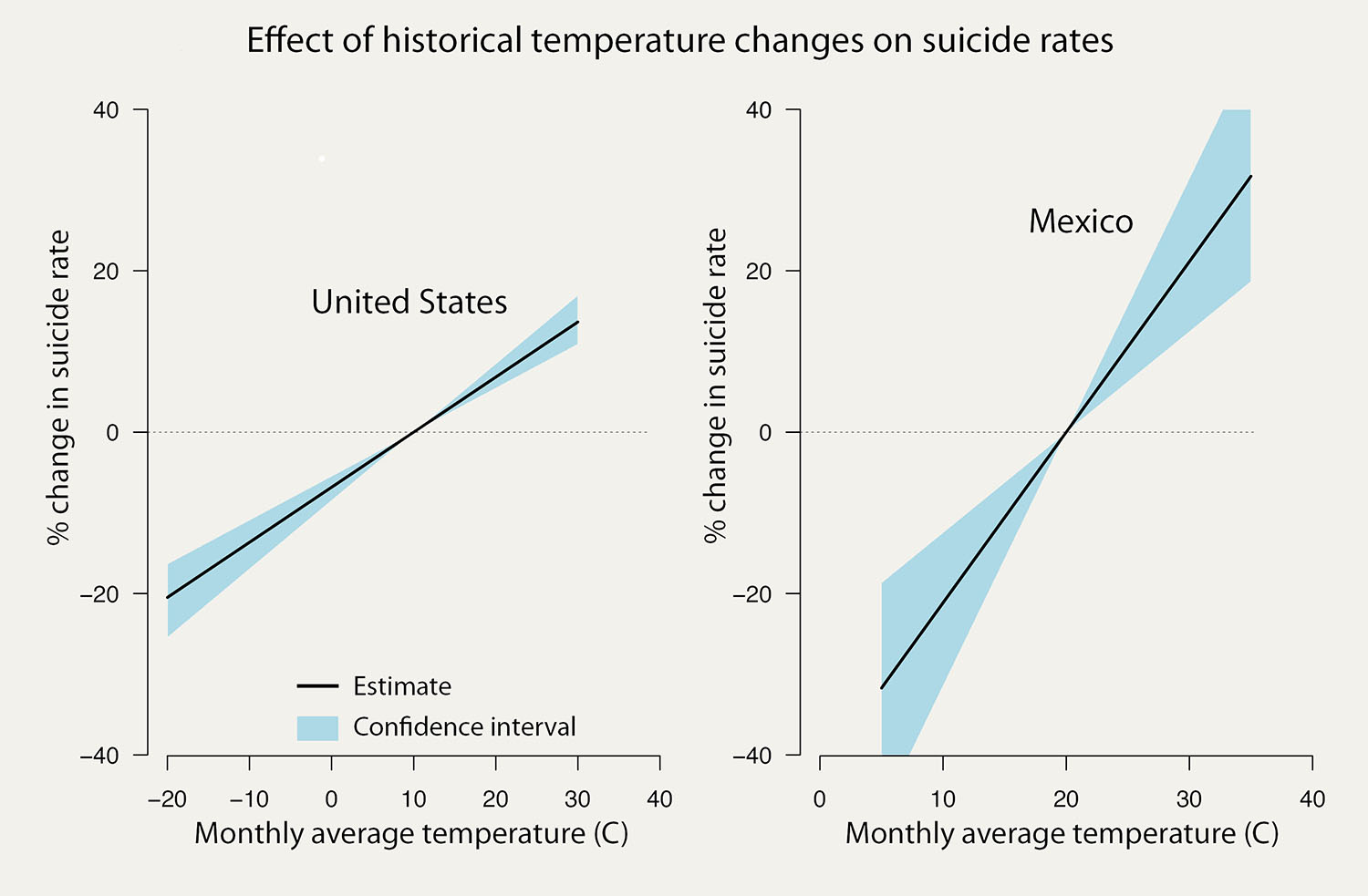 Effects of historical temperature changes on suicide rates are shown for the U.S. and Mexico. (Image credit: Marshall Burke)


