Environment

FSI scholars approach their research on the environment from regulatory, economic and societal angles. The Center on Food Security and the Environment weighs the connection between climate change and agriculture; the impact of biofuel expansion on land and food supply; how to increase crop yields without expanding agricultural lands; and the trends in aquaculture. FSE’s research spans the globe – from the potential of smallholder irrigation to reduce hunger and improve development in sub-Saharan Africa to the devastation of drought on Iowa farms. David Lobell, a senior fellow at FSI and a recipient of a MacArthur “genius” grant, has looked at the impacts of increasing wheat and corn crops in Africa, South Asia, Mexico and the United States; and has studied the effects of extreme heat on the world’s staple crops.

Authors
Noa Ronkin
News Type
News
Date
Paragraphs

Southeast Asia, home to over 640 million people across 10 countries, is one of the world’s most dynamic and fastest growing regions. APARC just concluded the year 2019 with a Center delegation visit to two Southeast Asian capital cities, Hanoi and Bangkok, where we spent an engaging week with stakeholders in the academic, policy, business, and Stanford alumni communities.

Led by APARC Director Gi-Wook Shin, the delegation included APARC Deputy Director and Asia Health Policy Program Director Karen Eggleston, Southeast Asia Program Director Donald Emmerson, and APARC Associate Director for Communications and External Relations Noa Ronkin. Visiting Scholar Andrew Kim joined the delegation in Bangkok.

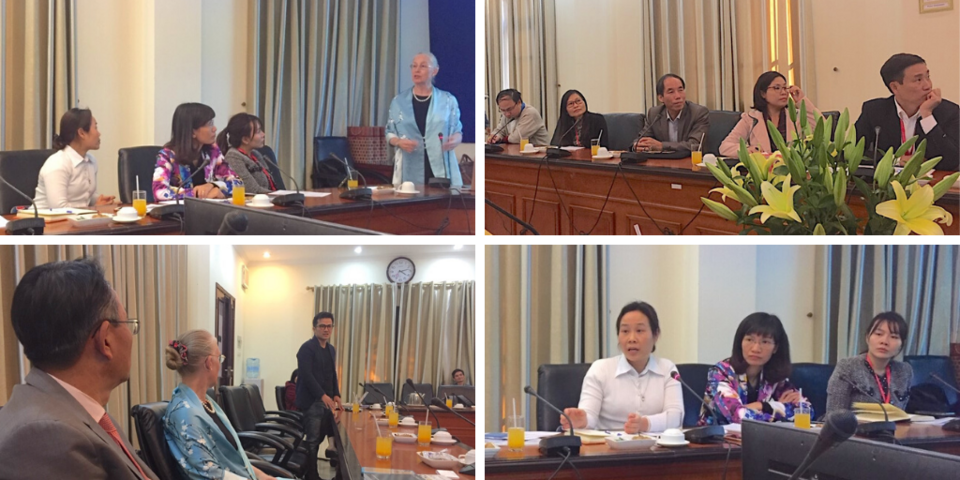
With a focus on health policy, our first day in Hanoi included a visit to Thai Nguyen University, a meeting with government representatives at the Vietnam Ministry of Health, and a seminar on healthy aging and innovation jointly with Hanoi Medical University.

Image
Collage of four images showing participants at a roundtable held at Hanoi Medical University with APARC delegation members

Karen Eggleston and participants at the roundtable held at Hanoi Medical University, December 9, 2019.

Throughout the day, Eggleston presented some of her collaborative research that is part of two projects involving international research teams: one that assesses public-private roles and institutional innovation for healthy aging and another that examines the economics of caring for patients with chronic diseases across diverse health systems in Asia and other parts of the world. We appreciated learning from our counterparts about the health care system and health care delivery in Vietnam.

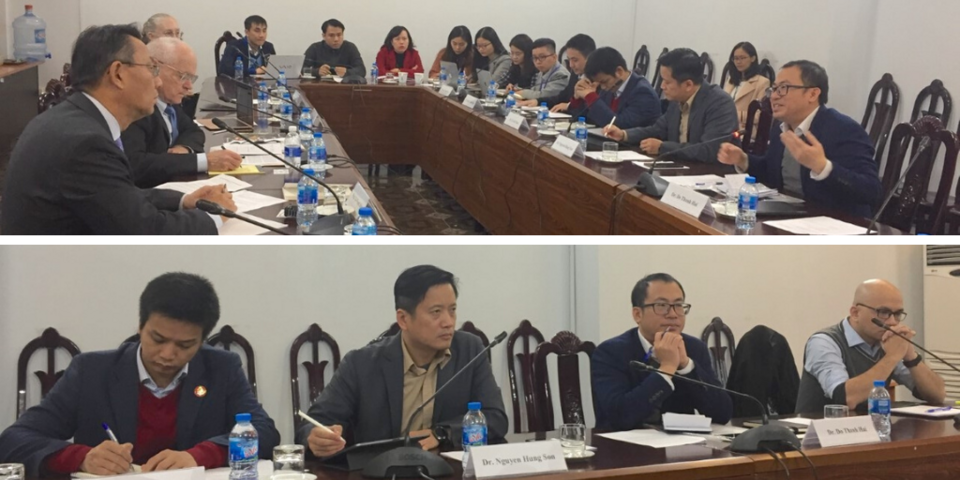
Shifting focus to international relations and regional security, day 2 in Hanoi opened with a roundtable, “The Rise of the Indo-Pacific and Vietnam-U.S. Relations,” held jointly with the East Sea Institute (ESI) of the Diplomatic Academy of Vietnam (DAV). Following a welcome by ESI Director General Nguyen Hung Son, the program continued with remarks by Shin, Emmerson, ESI Deputy Director General To Anh Tuan, and Assistant Director General Do Thanh Hai.

Image
Participants at a roundtable held at the Diplomatic Academy of Vietnam with APARC delegation members

Roundtable at the Diplomatic Academy of Vietnam, December 10, 2019.

The long-ranging conversation with DAV members included issues such as the future of the international order in Asia; the U.S. withdrawal from multilateralism; the concern about a lack of U.S. engagement in Southeast Asia, sparked by President Trump’s absence from the November 2019 summit of the Association of Southeast Asian Nations (ASEAN) at a time when China is bolstering its influence in the region and when ASEAN hopes to set a code of conduct with China regarding disputed waters in the South China Sea; the priorities for Vietnam as it assumes the role of ASEAN chair in 2020; and the challenges for the Vietnam-U.S. bilateral relationship amid the changing strategic environment in Southeast Asia.

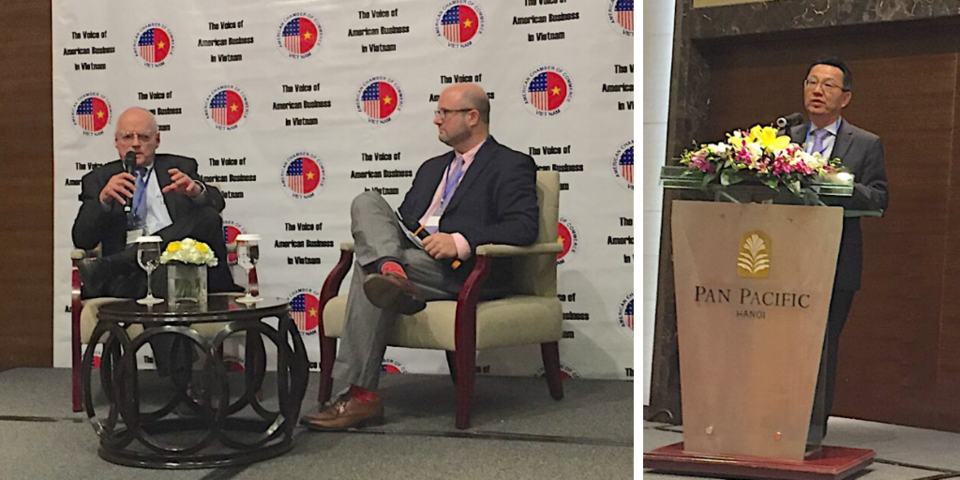
In the afternoon we were joined by members of the American Chamber of Commerce in Hanoi at an AmCham-hosted Lunch ‘n’ Learn session on Vietnam's challenges and opportunities amid the U.S.-China rivalry. The event featured Emmerson in conversation with AmCham Hanoi Executive Director Adam Sitkoff.

Image
Two men in conversation seated on stage and a man speaking at a podium

(Left) Donald Emmerson in conversation with Adam Sitkoff; (right) Gi-Wook Shin welcomes AmCham Hanoi members; December 10, 2019. 

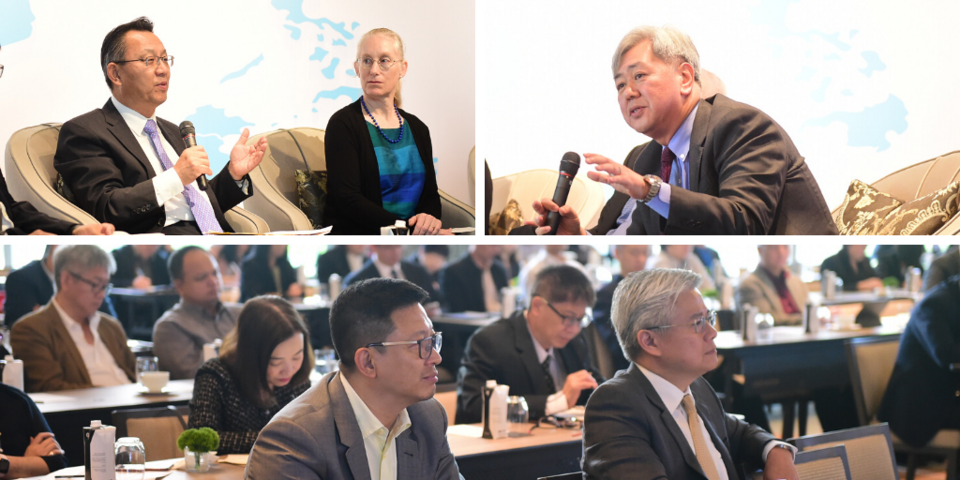
Moving to Bangkok, delegation members Shin, Eggleston, Emmerson, and Kim spoke on a panel for executives of the Charoen Pokphand Group (C.P. Group), one of Thailand’s largest private conglomerates, addressing some of the core issues that lie ahead for Southeast Asia in 2020 and beyond in the areas of geopolitics, innovation, and health.

Image
Participants at a panel discussion with APARC delegation hosted by the C.P. Group, Thailand

Top, from left to right: Gi-Wook Shin, Karen Eggleston, Andrew Kim; bottom: C.P. Group executive listening to the panel, December 12, 2019.

We also enjoyed a tour at True Digital Park, Thailand’s first startup and tech entrepreneur’s campus. Developed by the C.P. Group, True Digital Park aspires to be an open startup ecosystem that powers Thailand to become a global hub for digital innovation.

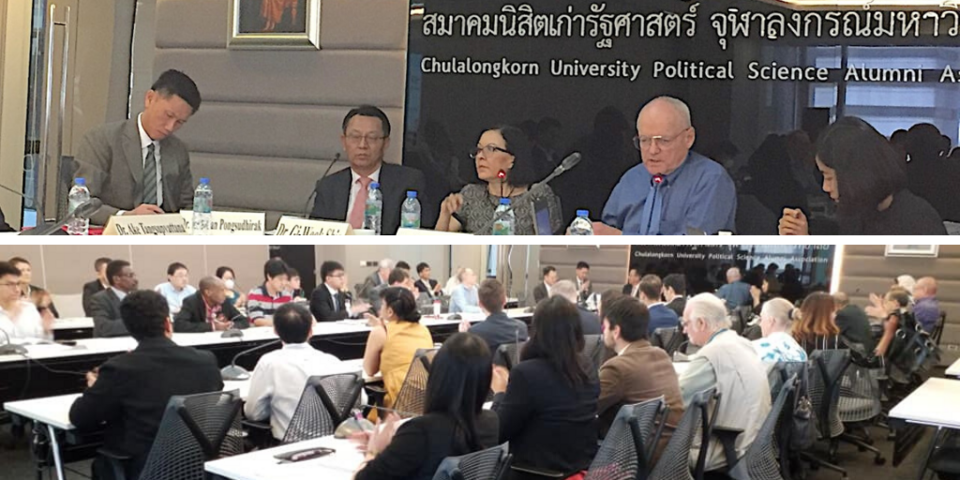
The following day, Shin and Emmerson participated in a public forum hosted by Chulalongkorn University’s Institute of Security and International Studies (ISIS Thailand), "Where Northeast Asia Meets Southeast Asia: The Great Powers, Global Disorder and Asia’s Future.” They were joined by ISIS Thailand Director Thitinan Pongsudhirak and Chulalongkorn University Faculty of Political Science Associate Dean for International Affairs and Graduate Studies Kasira Cheeppensook. The panel was moderated by Ms. Gwen Robinson, ISIS Thailand senior fellow and editor-at-large of the Nikkei Asian Review.

Image
Panelists and participants at a public forum held at Chulalongkorn University

ISIS Thailand forum participants and panelists, from left: Pngsukdhirak, Shin, Robinson, Emmerson, Cheeppensook; December 13, 2019.

As part of that discussion, Emmerson speculated that – driven by deepening Chinese economic and migrational involvement in Southeast Asia’s northern tier – Cambodia and Laos, less conceivably Myanmar, and still less conceivably Thailand could become incorporated de facto into an economically integrated “greater China” that could eventually reduce ASEAN to a more-or-less maritime membership in the region’s southern tier. Emmerson’s speculation was made in the context of his critique of ASEAN’s emphasis on its own “centrality” to the neglect of its lack of the proactivity that would serve as evidence of centrality and of a desire not to be rendered peripheral by the growing centrality-cum-proactivity of China. The event was covered by the Bangkok Post (although that report’s headline and quote of Emmerson are inaccurate, as neither the panel nor Emmerson predicted the “break-up of ASEAN.”)

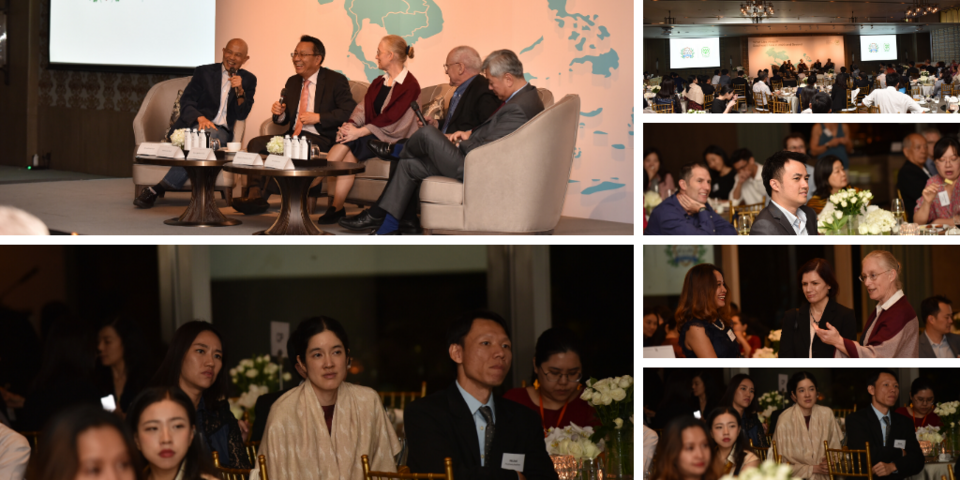
Our delegation visit in Bangkok concluded with a buffet dinner reception and panel discussion jointly with the Stanford Club of Thailand.

Image
alumni event

Stanford and IvyPlus alumni listening to the panel, December 13, 2019.

Moderated by Mr. Suthichai Yoon, a veteran journalist and founder of digital media outlet Kafedam Group, the conversation focused on the changing geopolitics of Southeast Asia, innovation and health in the region, and the opportunities and challenges facing Thailand-U.S. relations. It was a pleasure to meet many new and old friends from the Stanford and IvyPlus alumni communities.

APARC would like to thank our partners and hosts in Hanoi and Bangkok for their hospitality, collaboration, and the stimulating discussions throughout our visit. We look forward to keeping in touch!

Hero Image
APARC delegation speaking to Stanford and IvyPlus alumni, Bangkok
All News button
1
-


Abstract:
Kristen Looney will be discussing her forthcoming work, Mobilizing for Development: The Modernization of Rural East Asia (Cornell U. Press 2020). This book tackles the question of how countries achieve rural development and offers a new way of thinking about East Asia’s political economy that challenges the developmental state paradigm. Through a comparison of Taiwan (1950s–1970s), South Korea (1950s–1970s), and China (1980s–2000s), the research shows that different types of development outcomes—improvements in agricultural production, rural living standards, and the village environment—were realized to different degrees, at different times, and in different ways. Looney argues that rural modernization campaigns played a central role in the region and that divergent development outcomes can be attributed to the interplay between campaigns and institutions. Relevant to political science, economic history, rural sociology, and Asian studies, the book enriches our understanding of state-led development and agrarian change.


Speaker Bio:

Image
headshotlooney300dpi
Kristen Looney is an assistant professor of Asian Studies and Government at Georgetown University, where she teaches courses on Chinese and Comparative Politics. Her research is on rural development and governance and has previously appeared in The China Quarterly, The China Journal, and Current History. Her first book is forthcoming with Cornell University Press in spring 2020.

Kristen Looney Assistant Professor of Asian Studies and Government at Georgetown University
Seminars
-

Abstract:

In the face of mounting challenges from criminal activity and citizen demands for improved public safety, Mexico has undertaken significant efforts at police reform. Those efforts would presumably enhance the capacity of police forces to fight and deter crime. This paper explores the quantity and quality of police in Mexico, a federation where multi-tier government makes incentives for police professionalization more challenging than in unitary systems. The paper calculates, the true size of police forces, comparing them to all legal specialists in the use of violence, including private security guards at homes and businesses. It then estimates the implicit wage incentives given to experience and human capital formation in the different types of police corporations during the Calderón and Peña Nieto presidential administrations. Finally, we use a municipal cross section to gain further insight into the effects of police professionalization on interpersonal violence, as measured by homicide rates. The overall findings suggest that improving policing in Mexico is not merely a question of adding manpower or spending more budgetary resources, but of changing career incentives for greater professionalization.


Speaker Bio:

Image
alberto diaz
Alberto Diaz-Cayeros joined the FSI faculty in 2013 after serving for five years as the director of the Center for US-Mexico studies at the University of California, San Diego. He earned his Ph.D at Duke University in 1997. He was an assistant professor of political science at Stanford from 2001-2008, before which he served as an assistant professor of political science at the University of California, Los Angeles. Diaz-Cayeros has also served as a researcher at Centro de Investigacion Para el Desarrollo, A.C. in Mexico from 1997-1999. His work has focused on federalism, poverty and violence in Latin America, and Mexico in particular. He has published widely in Spanish and English. His book Federalism, Fiscal Authority and Centralization in Latin America was published by Cambridge University Press in 2007 (reprinted 2016). His latest book (with Federico Estevez and Beatriz Magaloni) is: The Political Logic of Poverty Relief Electoral Strategies and Social Policy in Mexico. His work has primarily focused on federalism, poverty and economic reform in Latin America, and Mexico in particular, with more recent work addressing crime and violence, youth-at-risk, and police professionalization. 


Encina Hall, C149
616 Jane Stanford Way
Stanford, CA 94305

(650) 725-0500
0
Senior Fellow, Freeman Spogli Institute for International Studies
Professor, by courtesy, of Political Science
alberto_diaz-cayeros_2024.jpg MA, PhD

Alberto Díaz-Cayeros is a Senior Fellow at Stanford University's Freeman Spogli Institute for International Studies (FSI), and co-director of the Democracy Action Lab (DAL), based at FSI's Center on Democracy, Development and Rule of Law (CDDRL). His research interests include federalism, poverty relief, indigenous governance, political economy of health, violence, and citizen security in Mexico and Latin America.

He is the author of Federalism, Fiscal Authority and Centralization in Latin America (Cambridge, reedited 2016), coauthored with Federico Estévez and Beatriz Magaloni, of The Political Logic of Poverty Relief (Cambridge, 2016), and of numerous journal articles and book chapters.

He is currently working on a project on cartography and the developmental legacies of colonial rule and governance in indigenous communities in Mexico.

From 2016 to 2023, he was the Director of the Center for Latin American Studies at Stanford University, and from 2009 to 2013, Director of the Center for US-Mexican Studies at UCSD, the University of California, San Diego.

Affiliated faculty at the Center on Democracy, Development and the Rule of Law
Co-director, Democracy Action Lab
Director of the Center for Latin American Studies (2016 - 2023)
CV
Date Label
Senior Fellow, Center on Democracy, Development and the Rule of Law
Seminars
-

CISAC will be canceling all public events and seminars until at least April 5th due to the ongoing developments associated with COVID-19.

------------------------------------------------------------------------------------------------------------------------------------------------------


Abstract: Since the opening of their first facilities, French nuclear companies chose to entrust some (or all, since the 1980s) of their maintenance procedures –the work presenting the greatest work-related hazards –to subcontractors. Starting to the 1970's, a controversy arose about working conditions and the using of employees of subcontracting companies for the operations that were most exposed to radioactive hazards. While subcontracting became endemic to the nuclear industry in France and around the world, there are still few social science studies based on direct research with nuclear maintenance employees, and fewer still addressing workplace health issues.This intervention will describe the processes of problematization of labour and recourse to subcontractors in nuclear industry. It will help understanding why the issue in occupational health do not gain more social visibility. Historical ethnography is the chosen approach. It combines observations, interviews and work in the archives.


Speaker's Biography: Marie Ghis Malfilatre has been a postdoctoral fellow at INSERM, in Paris since January 2019. She is also lecturer in sociology at Sciences Po Grenoble. Defendedat the Ecole des Hautes Etudes en Sciences Sociales in Paris, her thesis focuseson labor, health, and precarity in the French nuclear industry. Itoffersan interdisciplinary examination of occupational health controversies among both salariedand subcontracted workers at two of France’s principalnuclear facilities: the fuel reprocessing plant at La Hague, and the pressurizedwater reactors at Chinon. Hercurrent researchaims at understanding the interactions between law, medical expertise,and political power when it comes to recognizing radiation-induced occupational diseases. It unveilsdynamics amongknowledge, recognition,and ignorance of occupational health issues, and shows how the nuclear industry exemplifieslogics and issues at stake in many other professional domains.

Marie Ghis Malfilatre Lecturer Sciences Po Grenoble
Seminars
-

This event is co-sponsored by the Program in History and Philosophy of Science; Program in Science, Technology, and Society; and Stanford Center for Law and History.


Livestream: This event will not be live-streamed or recorded


Abstract: How have national practices of nuclear security produced local conditions of insecurity? After World War II, the United States’ nuclear testing program transformed the Marshall Islands into an experimental site for testing both new weapons and forms of territorial governance. During the same period, the Hunters Point Shipyard in southeast San Francisco became the launching point and return site for ships, scientists, and military personnel circulating between the mainland and the Pacific tests. These activities not only incorporated the Marshall Islands and Hunters Point into networks of militarization and scientific knowledge production, but also resulted in widespread radiological contamination. Professors Mary Mitchell and Helen Kang will discuss the entangled legal, environmental, and social legacies of radiological contamination at these two sites, shedding light on the consequential damages of the Cold War and ongoing efforts to demand accountability from the United States government.


Helen Kang Biography: Helen H. Kang is Professor of Law at Golden Gate University School of Law and Director of the school’s Environmental Law and Justice Clinic, which has received recognition for its work from the American Bar Association and the Clinical Legal Education Association, among others. She has devoted most of her legal career to environmental protection, first as Trial Attorney with the Environmental Enforcement Section of the U.S. Department of Justice. Since joining the clinic in 2000, she and her students have successfully represented community and environmental groups, prevailing against agencies such as U.S. EPA and large sources of pollution, including power plants. The clinic’s work has contributed to developments in environmental law, reducing pollution in communities most affected by pollution in California and beyond, and improving public participation and regulatory accountability. Helen’s achievements include successfully arguing in the California Supreme Court to defend the California Environmental Quality Act from federal preemption and compelling California, after decades of abdication, to meaningfully regulate agricultural pollution. She graduated from Berkeley Law, University of California at Berkeley, and Yale University.


Mary Mitchell Biography: Mary X. Mitchell is an Assistant Professor of History at Purdue University where she works on issues at the intersection of environmental inequality and law. During the spring of 2020, Mitchell will be a faculty fellow at Princeton University's Shelby Cullom Davis Center. She earned her PhD in History and Sociology of Science from the University of Pennsylvania in 2016 and was an Atkinson Fellow in Sustainability at Cornell University from 2016-2018. Previously, she practiced law in Pennsylvania and served as a law clerk to Judge Anthony J. Scirica of the United States Court of Appeals for the Third Circuit.


Helen Kang Professor of Law Golden Gate University School of Law
Mary Mitchell Assistant Professor of History Purdue University
Seminars
-

This event is cosponsored with the Stanford Woods Institute for the Environment


Seminar Recording: https://youtu.be/yMVJu1gmRFk


Abstract: Joshua Busby, University of Texas-Austin, will present the main argument and empirical work from his draft book manuscript. Over the past decade, a rich literature on the connections between climate change and security emerged, much of it quantitative on the links between climate change and violent internal conflict. In this book manuscript, Busby seeks to widen the aperture of security concerns to include major humanitarian emergencies. Through the study of paired cases, he explores why countries that face similar physical exposure to climate hazards experience different outcomes. His argument combines state capacity, the degree of political inclusion, and the role of international assistance to explain differences between countries as well as within countries over time. Countries with low state capacity, high political exclusion, and where assistance is denied or delivered in a one-sided manner are expected to have the worst security outcomes in the wake of exposure to climate hazards. While assistance can sometimes compensate for weak state capacity, improvements in capacity and inclusion can diminish the risks of climate-related emergencies and conflict. In this talk, Busby will compare the experience of Bangladesh, India, and Myanmar to cyclones.


Speaker's Biography:

Joshua Busby is an Associate Professor at the LBJ School of Public Affairs at the University of Texas-Austin. He is also a Senior Research Fellow at the Center for Climate and Security. He has been part of two U.S. Department of Defense-funded research projects on climate and security and his work on the topic has been published in Foreign Affairs, World Development, Climatic Change, Political Geography, International Security, Security Studies, among other publications.


Joshua Busby Associate Professor University of Texas-Austin
Seminars
-

...water, water everywhere, nor any drop to drink...

Join Stanford's Center on Food Security and the Environment for a lecture and reception with Dr. Junaid Ahmad, the World Bank Country Director for India.

Dr. Ahmad will look at the political economy of managing service delivery in India through the prism of water. The presentation will look at the water supply and sanitation sector and water resource management in the context of India’s federalism and urban and food policies. Ahmad argues that India’s transition to middle income will depend significantly on how water will be valued in India’s political economy.  

Junaid Ahmad, from Bangladesh, is currently the World Bank Country Director for India. Over the years, Mr. Ahmad has brought an exceptional track record of management and leadership in the areas of policy reform, service delivery and international partnerships, combining intellectual and analytical rigor with strategic operational focus. Mr. Ahmad’s work has covered urban finance and city management, infrastructure finance, water, service delivery in federal systems, and local government reform. Currently, he is responsible for managing the World Bank’s India portfolio.

Symposiums
-
This event is open to Stanford undergraduate students only. 
 
The Center on Democracy, Development, and the Rule of Law (CDDRL) will be accepting applications from eligible juniors on who are interested in writing their senior thesis on a subject touching upon democracy, economic development, and rule of law (DDRL) from any university department.  The application period opens on January 13, 2020 and runs through February 14, 2020.   CDDRL faculty and current honors students will be present to discuss the program and answer any questions.
 
For more information on the Fisher Family CDDRL Honors Program, please click here.
 
Image
honors info session 2019

CDDRL
Encina Hall, C152
616 Jane Stanford Way
Stanford, CA 94305-6055

(650) 725-2705 (650) 724-2996
0
Senior Fellow at the Freeman Spogli Institute for International Studies
Professor, by courtesy, of Political Science
Stedman_Steve.jpg PhD

Stephen Stedman is a Senior Fellow at the Freeman Spogli Institute for International Studies (FSI) and the Center on Democracy, Development and the Rule of Law (CDDRL), an affiliated faculty member at CISAC, and professor of political science (by courtesy) at Stanford University. He is director of CDDRL's Fisher Family Honors Program in Democracy, Development and Rule of Law, and will be faculty director of the Program on International Relations in the School of Humanities and Sciences effective Fall 2025.

In 2011-12 Professor Stedman served as the Director for the Global Commission on Elections, Democracy, and Security, a body of eminent persons tasked with developing recommendations on promoting and protecting the integrity of elections and international electoral assistance. The Commission is a joint project of the Kofi Annan Foundation and International IDEA, an intergovernmental organization that works on international democracy and electoral assistance.

In 2003-04 Professor Stedman was Research Director of the United Nations High-level Panel on Threats, Challenges and Change and was a principal drafter of the Panel’s report, A More Secure World: Our Shared Responsibility.

In 2005 he served as Assistant Secretary-General and Special Advisor to the Secretary- General of the United Nations, with responsibility for working with governments to adopt the Panel’s recommendations for strengthening collective security and for implementing changes within the United Nations Secretariat, including the creation of a Peacebuilding Support Office, a Counter Terrorism Task Force, and a Policy Committee to act as a cabinet to the Secretary-General.

His most recent book, with Bruce Jones and Carlos Pascual, is Power and Responsibility: Creating International Order in an Era of Transnational Threats (Washington DC: Brookings Institution, 2009).

Director, Fisher Family Honors Program in Democracy, Development and Rule of Law
Director, Program in International Relations
Affiliated faculty at the Center for International Security and Cooperation
Date Label

Encina Hall, C150
616 Jane Stanford Way
Stanford, CA 94305

0
Center Fellow, Freeman Spogli Institute for International Studies
didi_kuo_2023.jpg

Didi Kuo is a Center Fellow at the Freeman Spogli Institute for International Studies (FSI) at Stanford University. She is a scholar of comparative politics with a focus on democratization, corruption and clientelism, political parties and institutions, and political reform. She is the author of The Great Retreat: How Political Parties Should Behave and Why They Don’t (Oxford University Press) and Clientelism, Capitalism, and Democracy: the rise of programmatic politics in the United States and Britain (Cambridge University Press, 2018).

She has been at Stanford since 2013 as the manager of the Program on American Democracy in Comparative Perspective and is co-director of the Fisher Family Honors Program at CDDRL. She was an Eric and Wendy Schmidt Fellow at New America and is a non-resident fellow with the Carnegie Endowment for International Peace. She received a PhD in political science from Harvard University, an MSc in Economic and Social History from Oxford University, where she studied as a Marshall Scholar, and a BA from Emory University.

Date Label
-


This event is now full and we are unable to take any further reservations. However, if you would like to be added to the waitlist, please email us at sj1874@stanford.edu.


This panel will examine the role of Ukraine and Russia in the Trump impeachment inquiry. Why has Ukraine emerged as central focus of the charges? What are Russia’s goals here, and how has it tried to achieve them? How different is an impeachment process driven by foreign policy concerns, rather than by domestic charges? Bringing together three experts on Ukraine, Russia, and US presidential politics, we will examine this extraordinary moment in American and international politics.

PANELISTS:

Image
Headshot of Michael McFaul

Michael McFaul, '86, MA '86, is the Director and Senior Fellow at the Freeman Spogli Institute for International Studies; the Ken Olivier and Angela Nomellini Professor of International Studies in Political Science; and the Peter and Helen Bing Senior Fellow at the Hoover Institution, all at Stanford University. He was also the Distinguished Mingde Faculty Fellow at the Stanford Center at Peking University from June to August of 2015. He joined the Stanford faculty in 1995. Michael McFaul is also an analyst for NBC News and a contributing columnist to The Washington Post.

He received his B.A. in International Relations and Slavic Languages and his M.A. in Soviet and East European Studies from Stanford University in 1986. As a Rhodes Scholar, he completed his D. Phil. in International Relations at Oxford University in 1991.

He also served for five years in the Obama administration, first as Special Assistant to the President and Senior Director for Russian and Eurasian Affairs at the National Security Council at the White House (2009-2012), and then as U.S. Ambassador to the Russian Federation (2012-2014). He has authored several books, including most recently the New York Times bestseller, From Cold War to Hot Peace: An American Ambassador in Putin’s Russia. He is currently writing a book on great powers relations in the 21st century.

Image
Headshot of Terry M. Moe
Terry M. Moe
is the William Bennett Munro Professor of Political Science at Stanford University and a senior fellow at the Hoover Institution. He has written extensively on the presidency, public bureaucracy, and the theory of political institutions more generally. His most recent book on American national politics is Presidents, Populism, and the Crisis of Democracy (University of Chicago Press, forthcoming.  Coauthored with William G. Howell.)

Image
Headshot of Steve Pifer
Steven Pifer is a William Perry research fellow at Stanford University's Center for International Security and Cooperation and a nonresident senior fellow with the Brookings Institution.  He writes on nuclear arms control, Ukraine and Russia.  A retired Foreign Service officer, his assignments included U.S. ambassador to Ukraine and special assistant to the President and senior director for Russia, Ukraine and Eurasia on the National Security Council.

MODERATOR:
Image
Headshot of Anna Grzymala-Busse

Anna Grzymala-Busse is a professor in the Department of Political Science, the Michelle and Kevin Douglas Professor of International Studies, senior fellow at the Freeman Spogli Institute for International Studies and the director of The Europe Center. Her research interests include political parties, state development and transformation, informal political institutions, religion and politics, and post-communist politics.

Encina Hall
616 Jane Stanford Way
Stanford, CA 94305-6055

0
Senior Fellow, Freeman Spogli Institute for International Studies
Ken Olivier and Angela Nomellini Professor of International Studies, Department of Political Science
Peter and Helen Bing Senior Fellow, Hoover Institution
mcfaul_headshot_2025.jpg PhD

Michael McFaul is the Ken Olivier and Angela Nomellini Professor of International Studies in Political Science, Senior Fellow at the Freeman Spogli Institute for International Studies, and the Peter and Helen Bing Senior Fellow at the Hoover Institution, all at Stanford University. He joined the Stanford faculty in 1995 and served as FSI Director from 2015 to 2025. He is also an international affairs analyst for MSNOW.

McFaul served for five years in the Obama administration, first as Special Assistant to the President and Senior Director for Russian and Eurasian Affairs at the National Security Council at the White House (2009-2012), and then as U.S. Ambassador to the Russian Federation (2012-2014).

McFaul has authored ten books and edited several others, including, most recently, Autocrats vs. Democrats: China, Russia, America, and the New Global Disorder, as well as From Cold War to Hot Peace: An American Ambassador in Putin’s Russia, (a New York Times bestseller) Advancing Democracy Abroad: Why We Should, How We Can; and Russia’s Unfinished Revolution: Political Change from Gorbachev to Putin.

He is a recipient of numerous awards, including an honorary PhD from Montana State University; the Order for Merits to Lithuania from President Gitanas Nausea of Lithuania; Order of Merit of Third Degree from President Volodymyr Zelenskyy of Ukraine, and the Dean’s Award for Distinguished Teaching at Stanford University. In 2015, he was the Distinguished Mingde Faculty Fellow at the Stanford Center at Peking University.

McFaul was born and raised in Montana. He received his B.A. in International Relations and Slavic Languages and his M.A. in Soviet and East European Studies from Stanford University in 1986. As a Rhodes Scholar, he completed his D. Phil. in International Relations at Oxford University in 1991. 

CV
Date Label
Panelist Stanford University
Terry Moe Professor of Political Science and Senior Fellow at the Hoover Institution Panelist Stanford University
Panelist Stanford University

Encina Hall
616 Jane Stanford Way
Stanford, CA  94305


(650) 723-4270
0
Senior Fellow at the Freeman Spogli Institute for International Studies
Michelle and Kevin Douglas Professor of International Studies
Professor of Political Science
Senior Fellow, Hoover Institution
anna_gb_4_2022.jpg

Anna Grzymała-Busse is a professor in the Department of Political Science, the Michelle and Kevin Douglas Professor of International Studies, senior fellow at the Freeman Spogli Institute for International Studies and the director of The Europe Center. Her research interests include political parties, state development and transformation, informal political institutions, religion and politics, and post-communist politics.

In her first book, Redeeming the Communist Past, she examined the paradox of the communist successor parties in East Central Europe: incompetent as authoritarian rulers of the communist party-state, several then succeeded as democratic competitors after the collapse of these communist regimes in 1989.

Rebuilding Leviathan, her second book project, investigated the role of political parties and party competition in the reconstruction of the post-communist state. Unless checked by a robust competition, democratic governing parties simultaneously rebuilt the state and ensured their own survival by building in enormous discretion into new state institutions.

Anna's third book, Nations Under God, examines why some churches have been able to wield enormous policy influence. Others have failed to do so, even in very religious countries. Where religious and national identities have historically fused, churches gained great moral authority, and subsequently covert and direct access to state institutions. It was this institutional access, rather than either partisan coalitions or electoral mobilization, that allowed some churches to become so powerful.

Anna's most recent book, Sacred Foundations: The Religious and Medieval Roots of the European State argues that the medieval church was a fundamental force in European state formation.

Other areas of interest include informal institutions, the impact of European Union membership on politics in newer member countries, and the role of temporality and causal mechanisms in social science explanations.

Director of The Europe Center
Moderator Stanford University
Panel Discussions
Authors
News Type
News
Date
Paragraphs

More than 820 million people around the world don’t have enough to eat and their hunger affects us all. “Without food security, you will have no other security,” said David Beasley, the executive director of the World Food Programme, to an audience of Stanford members and local residents on Oct. 1. 

Beasley along with predecessor Ertharin Cousin, a visiting scholar with Stanford’s Center of Food Security and the Environment, helped shape the United Nations’ anti-hunger program into the world’s largest hunger relief organization, feeding over 90 million people every year.

Beasley and Cousin spoke on the multifaceted challenges of 21st century humanitarian response at the Robert G. Wesson Lecture, organized by Stanford's Center on Food Security and the Environment.


View photos from the event


In March 2017, the Trump administration considered pulling U.S. funding, which provides 40 percent of the program’s support. But by arguing that food insecurity drives terrorist groups, like ISIS using food to recruit members, Beasley was able to keep US funding and raise money internationally.

“If you’re not going to do this out of the goodness of your heart, then you better do this out of your interest for national security,” said Beasley.

Though Cousin lauded the efficacy of Beasley’s efforts, she questioned whether promoting food security as a solution for global security could incite safety issues for World Food Programme workers. “How does that affect the building of awareness and does that create more problems for the people working on the ground?” she asked.

There are countries the World Food Programme has struggled to assist due to safety concerns. In June 2019, Beasley suspended aid from Yemen due to diversion of food from vulnerable people by Houthis. Safety was also a huge factor. “You can get shot and killed or stabbed in a heartbeat,” Beasley said.

The World Food Programme has encountered another complex situation in Venezuela, which is in the midst of its direst food crisis in history. Almost 90 percent of the country is living below the poverty line with a substantial cut in government assistance food programs.

Though Beasley could not provide detail due to the sensitive nature of negotiations, he believes a resolution will come soon. “We’re on the ground…in the middle of negotiations as we speak, and we’re making tremendous headway,”

Future efforts will focus on self-sustainability, which is crucial for long-term food security. The program has rehabilitated about 400,000 acres of otherwise unusable land because of flash floods or drought, allowing hundreds of thousands of people food and job security that would no longer need direct aid.

Both Beasley and Cousin agree that with the technology and wealth available, no child should go hungry and there should never be another famine on earth. “There are [people] who don’t know where their next meal is, and they’re marching towards death. That is absolutely inexcusable,” said Beasley.

When asked by Cousin what his takeaway from his experience as director has been, Beasley said, “Go love your neighbor, first and foremost. Please understand the suffering world out there, and don’t underestimate the power you have as an individual…I have so much hope for the future but at the same time, a great fear form what I see because of a lot of destabilization. The world is very fragile…Loving your neighbor is the most powerful weapon.”

By Gina Yu, Stanford Global Health Media Fellow

This story originally appeard on the Stanford Center for Innovation in Global Health's website.

Hero Image
David Beasley at Stanford Oct. 1, 2019
UN World Food Programme Executive Director David Beasley speaks with his predecessor Ertharin Cousin at Stanford Oct. 1.
Don Feria for StanfordFSE
All News button
1
Subscribe to Environment