
Science and Technology
-

Abstract: In this age of increasing "Global Transparency," commercial satellite imagery has now made it possible for anyone to remotely peer "over the fence" and view what heretofore had been otherwise impossible...clandestine nuclear facilities (most significantly, those capable of producing fissile material suitable for use in nuclear weapons). The synergistic combination of readily available tools: personal computers, the internet, three-dimensional virtual globe visualization applications such as Google Earth, and high resolution commercial satellite imagery has gone beyond what anyone could have imaged just a few years ago. The downside of all this is that those who want to keep their clandestine nuclear facilities and associated activities from being either detected, identified, and/or monitored, are becoming more adept in their use of camouflage, concealment, and deception.

Iran is one such case where it has followed a steep learning curve of adapting to the threat that overhead observation can pose. After repeated dissident group revelations about Iran's clandestine nuclear facilities, together with confirming media broadcast of commercial satellite images of those facilities followed by verification inspections by the International Atomic Energy Agency (IAEA); the government of Iran has become increasingly aware of this threat and gone to greater and greater lengths to try and defeat it. Iran's cover-up tactics have improved with time...from concealed infrastructure and false cover stories (Natanz)...to refurbishment and sanitization of facilities following removal of incriminating equipment (Kalaye Electric and Lashkar Abad), to the wholesale razing of facilities together with the removal of dirt and vegetation to defeat IAEA forensic environmental sampling (Lavizan).

While the international community continues to debate the issue of whether or not Iran's nuclear program is purely peaceful in nature (helping it to stay an "open case"), Iran is defiantly pursuing its goal of fissile material production. Syria, on the other hand (evidently together with North Korea), was also quite aware of the overhead observation threat, taking great pains to conceal its plutonium production reactor at Al-Kibar. Syria disguised the true function of the facility by employing minimal site security (no fences or guard towers), having minimal support infrastructure (with non visible powerlines and only buried water lines), not installing a telltale reactor ventilation stack or cooling tower, hiding the reactor building in a ravine (terrain masking), and finally camouflaging the facility with a false façade to make it appear as a byzantine fortress. Nonetheless, despite all those steps, a leak of ground-level reactor construction and interior photographs, which formed the basis for the subsequent bombing of the facility by Israel, successfully thwarted that effort (the "closed case?"). Rather than confessing the truth about al-Kibar, the Syrian government rushed to remove all traces of the destroyed reactor and supplant it with a new larger footprint building for as yet unknown purposes while continuing to claim it was previously only a disused military warehouse. The IAEA asked d Syria for permission to inspect not only the Al-Kibar site, but reportedly up to three other sites thought to be associated with it. The Syrians refused access to all but the now heavily sanitized Al-Kibar location. We must now all await the IAEA report on the findings of that singular onsite inspection.

Frank Pabian is a Senior Nonproliferation Infrastructure Analyst at Los Alamos National Laboratory who has over 35 years experience in the nuclear nonproliferation field including six years with the Office of Imagery Analysis and 18 years with Lawrence Livermore National Laboratory's "Z" Division.  Frank also served as a Chief Inspector for the IAEA during UN inspections in Iraq from 1996-1998 focusing on "Capable Sites." In December 2002, Frank served as one of the first US nuclear inspectors back in Iraq with UN/IAEA. While at Los Alamos, Frank has developed and presented commercial satellite imagery based briefings on foreign clandestine nuclear facilities to the International Nuclear Suppliers Group, the IAEA, NATO, and the Foreign Ministries of China and India on behalf of the NNSA and STATE.

Reuben W. Hills Conference Room
Frank Pabian International Research, Analysis, and Development Work Force, LANL Speaker
Seminars
-

Encina Ground Floor Conference Room

Department of Political Science
Encina Hall
Stanford University
Stanford, CA 94305-6044

(650) 724-4166 (650) 724-2996
0
Professor of Political Science
Gildred Professor of Latin American Studies
William and Gretchen Kimball University Fellow
Senior Research Scholar (by courtesty) of FSI/CDDRL
terrykarl.png MA, PhD

Professor Karl has published widely on comparative politics and international relations, with special emphasis on the politics of oil-exporting countries, transitions to democracy, problems of inequality, the global politics of human rights, and the resolution of civil wars. Her works on oil, human rights and democracy include The Paradox of Plenty: Oil Booms and Petro-States (University of California Press, 1998), honored as one of the two best books on Latin America by the Latin American Studies Association, the Bottom of the Barrel: Africa's Oil Boom and the Poor (2004 with Ian Gary), the forthcoming New and Old Oil Wars (with Mary Kaldor and Yahia Said), and the forthcoming Overcoming the Resource Curse (with Joseph Stiglitz, Jeffrey Sachs et al). She has also co-authored Limits of Competition (MIT Press, 1996), winner of the Twelve Stars Environmental Prize from the European Community. Karl has published extensively on comparative democratization, ending civil wars in Central America, and political economy. She has conducted field research throughout Latin America, West Africa and Eastern Europe. Her work has been translated into 15 languages.

Karl has a strong interest in U.S. foreign policy and has prepared expert testimony for the U.S. Congress, the Supreme Court, and the United Nations. She served as an advisor to chief U.N. peace negotiators in El Salvador and Guatemala and monitored elections for the United Nations. She accompanied numerous congressional delegations to Central America, lectured frequently before officials of the Department of State, Defense, and the Agency for International Development, and served as an adviser to the Chairman of the House Sub-Committee on Western Hemisphere Affairs of the United States Congress. Karl appears frequently in national and local media. Her most recent opinion piece was published in 25 countries.

Karl has been an expert witness in major human rights and war crimes trials in the United States that have set important legal precedents, most notably the first jury verdict in U.S. history against military commanders for murder and torture under the doctrine of command responsibility and the first jury verdict in U.S. history finding commanders responsible for "crimes against humanity" under the doctrine of command responsibility. In January 2006, her testimony formed the basis for a landmark victory for human rights on the statute of limitations issue. Her testimonies regarding political asylum have been presented to the U.S. Supreme Court and U.S. Circuit courts. She has written over 250 affidavits for political asylum, and she has prepared testimony for the U.S. Attorney General on the extension of temporary protected status for Salvadorans in the United States and the conditions of unaccompanied minors in U.S. custody. As a result of her human rights work, she received the Doctor of Humane Letters, honoris causa from the University of San Francisco in 2005.

Professor Karl has been recognized for "exceptional teaching throughout her career," resulting in her appointment as the William R. and Gretchen Kimball University Fellowship. She has also won the Dean's Award for Excellence in Teaching (1989), the Allan V. Cox Medal for Faculty Excellence Fostering Undergraduate Research (1994), and the Walter J. Gores Award for Excellence in Graduate and Undergraduate Teaching (1997), the University's highest academic prize. Karl served as director of Stanford's Center for Latin American Studies from 1990-2001, was praised by the president of Stanford for elevating the Center for Latin American Studies to "unprecedented levels of intelligent, dynamic, cross-disciplinary activity and public service in literature, arts, social sciences, and professions." In 1997 she was awarded the Rio Branco Prize by the President of Brazil, Fernando Henrique Cardoso, in recognition for her service in fostering academic relations between the United States and Latin America.

CV
Terry Karl Professor, Political Science Speaker Stanford University
Workshops
-

In addition to Iraq, Afghanistan, Pakistan, the financial crisis, and the housing crisis (as if that were not enough!), the next American president will have his hands full with matters on the Korean peninsula.  What will be the future of Six Party talks?  What is the status of the leadership in Pyongyang?  How do changes in leadership in Washington (and potentially in Pyongyang) affect outcomes?  What are the prospects for US-ROK relations?  And what of the KORUS FTA?  Victor Cha, former director of Asian affairs at the White House, will lead a discussion on these issues.

Professor Cha is director of Asian Studies and holds the D.S. Song Chair in the Department of Government and School of Foreign Service at Georgetown University.  He left the White House in May 2007 after serving since 2004 as Director for Asian Affairs at the National Security Council.  At the White House, he was responsible primarily for Japan, the Korean peninsula, Australia/New Zealand and Pacific Island nation affairs.   Dr. Cha was also the Deputy Head of Delegation for the United States at the Six Party Talks in Beijing, and received two Outstanding Service commendations during his tenure at the NSC.  

He is the award-winning author of Alignment Despite Antagonism: The United States-Korea-Japan Security Triangle (Stanford University Press) (winner of the 2000 Ohira Book Prize) and co-author of Nuclear North Korea: A Debate on Engagement Strategies (Columbia University Press, 2004).  He has written articles on international relations and East Asia in journals including Foreign Affairs, International Security, Political Science Quarterly, Survival, International Studies Quarterly, and Asian Survey.   Professor Cha is a former John M. Olin National Security Fellow at Harvard University, two-time Fulbright Scholar, and Hoover National Fellow,  CISAC Fellow, and William J. Perry Fellow at Stanford University.

Image
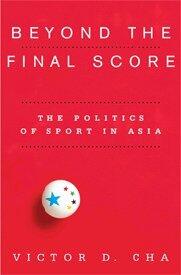
beyond the final score
He serves as an independent consultant, and has testified before Congress on Asian security issues.  He has been a guest analyst for various media including CNN, ABC Nightline, NBC Today Show, CBS Morning Show, Fox News, MSNBC, CNBC, BBC, ESPN, Sports Illustrated, and National Public Radio.

His new book Beyond the Final Score: The Politics of Sport in Asia (Columbia University Press, 2008) looks at the politics of sports and the Beijing Olympics. Cha holds a BA and Ph.D. from Columbia University, MA from University of Oxford.

This event is sponsored by the Pantech Group in Korea.

Philippines Conference Room

Victor D. Cha Director of Asian Studies Speaker Georgetown University
Seminars
-

The next U.S. president will face major science and technology challenges and opportunities. These, in turn, will have a significant influence on the nation's future standing. Unfortunately, he is likely to have limited financial resources with which to address them. This talk will discuss options for moving forward. The details will depend on who wins the election. This talk is presented by Media X and co-sponsored by SPRIE.

Arthur Bienenstock is Special Assistant to the President for Federal Research Policy and Director of the Wallenberg Research Link at Stanford University, where he also is a professor at the Stanford Synchrotron Radiation Laboratory and in the Departments of Applied Physics and Materials Science & Engineering. He is president of the American Physical Society. From November, 1997 through January, 2001, he was the Associate Director for Science of the White House Office and Science and Technology Policy (OSTP). He has also served Stanford as Vice Provost and Dean of Research and Graduate Policy (2003-6), Director of the Stanford Synchrotron Radiation Laboratory (1978-97) and Vice Provost for Faculty Affairs and Faculty Affirmative Action Officer (1972-77).

A video of Dr. Bienenstock's presentation is available courtesy of Media X.

Wallenberg Hall, Room 124

Arthur Bienenstock Special Assistant to the President for Federal Research Policy Speaker Stanford University
Seminars
-

CISAC co-founder Sidney Drell will be honored for his contributions to science at Stanford. The presentation is the first in the Stanford Pioneers in Science series.

CISAC consulting professor and former New York Times editor and reporter Philip Taubman will introduce Professor Drell, and present his professional accomplishments and their significance.  Professor Drell will be interviewed on stage about his life, values, and reflections, with a question-and-answer session to follow.

Cubberley Auditorium
School of Education

0
Affiliate
Taubman_Phil.jpg

Philip Taubman is affiliated with the Center for International Security and Cooperation at Stanford University. Before joining CISAC in 2008, Mr. Taubman worked at the New York Times as a reporter and editor for nearly 30 years, specializing in national security issues, including United States diplomacy, and intelligence and defense policy and operations. He served as Moscow bureau chief and Washington bureau chief, among other posts. He is author of Secret Empire: Eisenhower, the CIA, and the Hidden Story of America's Space Espionage (2003), The Partnership: Five Cold Warriors and Their Quest to Ban the Bomb (2012),  In the Nation's Service: The Life and Times of George P. Shultz (2023), as well as co-author (with his brother, William Taubman) of McNamara at War: A New History (2025).

Date Label
Philip Taubman Commentator
Sidney D. Drell senior fellow at the Hoover Institution and professor of theoretical physics (emeritus) Speaker the Stanford Linear Accelerator Center (SLAC), Stanford University
Seminars
-

The wars in Afghanistan and Iraq. Dependence on expensive foreign oil. Challenging diplomacy with nuclear-armed countries. America's next president needs a strong vision and stronger will to tackle these formidable tasks and those that lie ahead. Which candidate is best equipped to meet these challenges? Our panel of top advisors to the Republican and Democratic presidential nominees will address each candidate's plan to improve our international security. Join us to listen and ask questions of these experts.

Sponsored by The Commonwealth Club of California.

Mark Hopkins Intercontinental Peacock Court
999 California St.
San Francisco, CA

Hon. James Woolsey Annenberg Distinguished Visiting Fellow at the Hoover Institution, Stanford University; Former Director of Central Intelligence and the Central Intelligence Agency (1993-1995); Advisor to Senator McCain Speaker

Encina Hall
616 Jane Stanford Way
Stanford, CA 94305-6055

0
Senior Fellow, Freeman Spogli Institute for International Studies
Ken Olivier and Angela Nomellini Professor of International Studies, Department of Political Science
Peter and Helen Bing Senior Fellow, Hoover Institution
mcfaul_headshot_2025.jpg PhD

Michael McFaul is the Ken Olivier and Angela Nomellini Professor of International Studies in Political Science, Senior Fellow at the Freeman Spogli Institute for International Studies, and the Peter and Helen Bing Senior Fellow at the Hoover Institution, all at Stanford University. He joined the Stanford faculty in 1995 and served as FSI Director from 2015 to 2025. He is also an international affairs analyst for MSNOW.

McFaul served for five years in the Obama administration, first as Special Assistant to the President and Senior Director for Russian and Eurasian Affairs at the National Security Council at the White House (2009-2012), and then as U.S. Ambassador to the Russian Federation (2012-2014).

McFaul has authored ten books and edited several others, including, most recently, Autocrats vs. Democrats: China, Russia, America, and the New Global Disorder, as well as From Cold War to Hot Peace: An American Ambassador in Putin’s Russia, (a New York Times bestseller) Advancing Democracy Abroad: Why We Should, How We Can; and Russia’s Unfinished Revolution: Political Change from Gorbachev to Putin.

He is a recipient of numerous awards, including an honorary PhD from Montana State University; the Order for Merits to Lithuania from President Gitanas Nausea of Lithuania; Order of Merit of Third Degree from President Volodymyr Zelenskyy of Ukraine, and the Dean’s Award for Distinguished Teaching at Stanford University. In 2015, he was the Distinguished Mingde Faculty Fellow at the Stanford Center at Peking University.

McFaul was born and raised in Montana. He received his B.A. in International Relations and Slavic Languages and his M.A. in Soviet and East European Studies from Stanford University in 1986. As a Rhodes Scholar, he completed his D. Phil. in International Relations at Oxford University in 1991. 

CV
Date Label
Michael A. McFaul Deputy Director, Freeman Spogli Institute For International Studies and Professor of Political Science, Stanford University; Senior Fellow, Hoover Institution; Advisor to Senator Obama Speaker
Dr. Gloria C. Duffy President and CEO, The Commonwealth Club of California; Deputy Assistant Secretary of Defense under President Bill Clinton Moderator
Conferences
Paragraphs

Last May's passage of the 2008 Farm Bill raises the stakes for biofuel sustainability:
A substantial subsidy for the production of cellulosic ethanol starts the United States again down a path with uncertain environmental consequences. This time, however, the subsidy is for both the refiners ($1.01 per gallon) and the growers ($45 per ton of biomass), which will rapidly accelerate adoption and place hard-to-manage pressures on efforts to design and implement sustainable production practices-as will a 2007 legislative mandate for 16 billion gallons of cellulosic ethanol per year by 2022. Similar directives elsewhere, e.g., the European.

Union's mandate that 10% of all transport fuel in Europe be from renewable sources by
2020, make this a global issue. The European Union's current reconsideration of this target
places even more emphasis on cellulosic feedstocks. The need for knowledge- and science-based policy is urgent.

All Publications button
1
Publication Type
Journal Articles
Publication Date
Journal Publisher
Science
Authors
Holly Gibbs
Subscribe to Science and Technology