
International Development

FSI researchers consider international development from a variety of angles. They analyze ideas such as how public action and good governance are cornerstones of economic prosperity in Mexico and how investments in high school education will improve China’s economy.
They are looking at novel technological interventions to improve rural livelihoods, like the development implications of solar power-generated crop growing in Northern Benin.

FSI academics also assess which political processes yield better access to public services, particularly in developing countries. With a focus on health care, researchers have studied the political incentives to embrace UNICEF’s child survival efforts and how a well-run anti-alcohol policy in Russia affected mortality rates.

FSI’s work on international development also includes training the next generation of leaders through pre- and post-doctoral fellowships as well as the Draper Hills Summer Fellows Program.

-

This event is co-sponsored with The Europe Center

Abstract:

Ruby Gropas is a lecturer in international relations at the law faculty of the Democritus University of Thrace (Komotini) and research fellow at the Hellenic Foundation for European and Foreign Policy (ELIAMEP). Gropas was in residence at CDDRL in 2011 as a visiting scholar. In this seminar she will discuss the ongoing Greek economic and political crisis, and what it means for the future of the European Union and monetary system. Is the crisis in Greece ‘internal’ or is it symptomatic of a wider European failure? Is the Greek crisis the result of failed modernity, or rather a precursor of things to come? Why has Greece become so important and why has it dominated global politics and world news for the past two years?  Are its malignancies purely domestic or are they representative of a wider malaise within Europe and possibly beyond? The collapse and orderly default of a eurozone country at the heart of the Western financial system arguably marks the end of an era. It has brought with it the deepest social and political crisis that modern Greecehas faced since the restoration of democracy and it has also led to Europe's deepest existential crisis. With the EU struggling to effectively managing the eurozone crisis and the burst of recent movements opposing neo-liberal orthodoxy and the “Occupy” movements – what does this mean for Europe? And what is next?

Speaker Bio: 

Ruby Gropas has worked on asylum and migration issues for UNHCR in Brussels and worked for McKinsey & Co. in Zurich and Athens (2000-2002). As part of the ELIAMEP team, her research concentrates on European integration and foreign policy, Transatlantic relations, human rights, migration and multiculturalism. She was Managing Editor of the Journal of Southeast European and Black Sea Studies (Taylor & Francis) between January 2006 and October 2009. Ruby has taught at the University of Athens and at College Year in Athens. She was Southeast Europe Policy Scholar at the Woodrow Wilson International Center for Scholars in Washington DC in 2007 and again in 2009. She is Vice-President of the Alexander S. Onassis Public Benefit Foundation Scholars' Association since June 2009, and was Member of the Academic Organisation Committee of the Global Forum for Migration and Development, Civil Society Days, Athens 2009.

Ruby studied Political Science at the Université Libre de Bruxelles (1994) and undertook graduate studies at the University of Leuven (MA in European Studies) and at Cambridge University (MPhil in International Relations). She holds a PhD in History from Cambridge University (New Hall, 2000).

Encina Ground Floor Conference Room

Encina Hall
Stanford, CA 94305-6055

0
R_Gropas.jpg PhD

Ruby Gropas is Lecturer in International Relations at the Law Faculty of the Democritus University of Thrace (Komotini) and Research Fellow at the Hellenic Foundation for European and Foreign Policy (ELIAMEP).

Ruby has worked on asylum and migration issues for UNHCR in Brussels and worked for McKinsey & Co. in Zurich and Athens (2000-2002). As part of the ELIAMEP team, her research concentrates on European integration and foreign policy, Transatlantic relations, human rights, migration and multiculturalism. She was Managing Editor of the Journal of Southeast European and Black Sea Studies (Taylor & Francis) between January 2006 and October 2009. Ruby has taught at the University of Athens and at College Year in Athens. She was Southeast Europe Policy Scholar at the Woodrow Wilson International Center for Scholars in Washington DC in 2007 and again in 2009. She is Vice-President of the Alexander S. Onassis Public Benefit Foundation Scholars' Association since June 2009, and was Member of the Academic Organisation Committee of the Global Forum for Migration and Development, Civil Society Days, Athens 2009.

Ruby studied Political Science at the Université Libre de Bruxelles (1994) and undertook graduate studies at the University of Leuven (MA in European Studies) and at Cambridge University (MPhil in International Relations). She holds a PhD in History from Cambridge University (New Hall, 2000).

CV
Ruby Gropas Lecturer in International Relations at the Law Faculty of the Speaker Democritus University of Thrance (Komotini)
Seminars

Center for Chinese Agricultural Policy,
Chinese Academy of Sciences
Room 3830, Anwai Datun Road, 11A
Beijing, 100101, P. R. China

0
REAP Project Manager for Keeping Kids in School
JC_REAP.jpg MA

James Chu manages the Keeping Kids in School projects at REAP. He has five years of experience researching educational issues in China. His research experience involves extensive quantitative and qualitative fieldwork in Shaanxi province and Beijing migrant schools. He has also designed and implemented several projects in Beijing benefiting migrant students. He is fluent in Mandarin and received his MA in Sociology at Stanford University.

Authors
Scott Rozelle
Karen Eggleston
Jean C. Oi
Xueguang Zhou
Ang Sun
News Type
News
Date
Paragraphs

Full text available at YaleGlobal.

Children of China's Future – Part II

 
Aging population and poverty require stronger investment in China’s rural youth
Karen Eggleston, Jean Oi, Scott Rozelle, Ang Sun, Xueguang Zhou
YaleGlobal, 14 March 2012
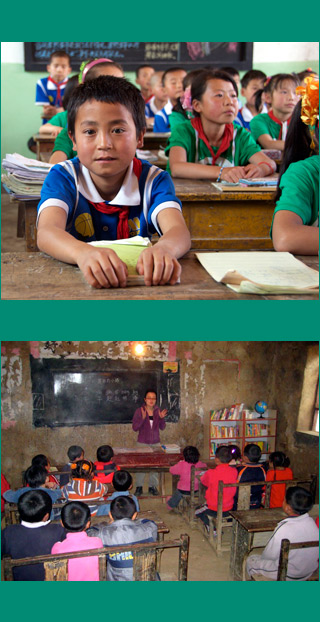
Poor education mortgaging the future? Students in a Gansu province school, where many are anemic (top); another class room in Loess Plateau. (Top Photo: Adam Gorlick)

DINGXI PREFECTURE: Wang Hongli, 8 years old, lives in a remote rural village on the Loess Plateau in one of China’s poorest and most agricultural provinces, Gansu. His prospects for living the good life are as bleak as the landscape. He is not on track to become part of China’s emerging middle class, the free-spending, computer-savvy, person-of-the-world often featured in the western media.

Hongli is a pseudonym. His parents work in a faraway industrial zone, coming home for only three weeks at Chinese New Year. His grandmother takes care of him and his siblings on the weekends, and during the week he lives in a dorm, three to a bed with 36 other students in an unheated room 4 by 4 meters.

Hongli suffers from iron-deficient anemia, but neither his family nor his teacher knows he is sick. Even if his anemia is discovered and treated by the researchers who have documented 30 percent anemia among children in poor rural areas, it likely will recur after he finishes the study, with furnished dietary supplements. Despite educational pamphlets, he’ll likely revert to a diet of staple grains and bits of pickled vegetables.

Unsurprisingly, Hongli’s grades are not good. In China’s competitive school system, he has only a slight chance of attending high school, much less college. In China’s future high-wage economy, all Hongli can hope for is a menial job in the provincial capital, Lanzhou, or as a temporary migrant elsewhere. Without urban permanent residency, hukou, he will have limited access to urban social services. He may suffer chronic unemployment, or resort to the gray economy or crime. He also may never marry – one of the millions of “forced bachelors” created by China’s large gender imbalance.

In China’s future high-wage economy, 
all the rural poor can hope for is menial jobs in a provincial capital.

Hongli is not alone. In fact, he’s one of 50 million school-age youth in China’s vast poor rural hinterlands. Recent studies by Stanford and Chinese collaborators show that 39 percent of fourth-grade students in Shaanxi Province are anemic, with similarly high rates elsewhere in the northwest; up to 40 percent of rural children in the poor southwest regions, e.g., Guizhou, are infected with intestinal worms. Millions of poor rural students throughout China are nearsighted, but do not wear glasses.

Because China’s urbanites have fewer children, poor rural kids like Hongli represent almost a third of China’s school-aged children, a large share of the future labor force. These young people must be healthy, educated and productive if China is to have any chance of increasing labor productivity to offset the shrinking size of its aging workforce.

Many observers presume that China’s growth will continue unabated, drawing upon a vast reservoir of rural labor to staff manufacturing plants for the world. In fact, to a considerable extent, China’s rural areas have already been emptied out, leaving many villages with only the old and the very young. The growth of wages for unskilled workers exceeds GDP growth.

Better pay should be good news for poverty alleviation. However, rising wages push up the opportunity cost of staying in school – especially since high school fees, even at rural public schools, are among the highest in the world.

It’s myopic to allow rural students to drop out of junior high and high school – mitigating the current labor shortage, but mortgaging their futures. Recent studies demonstrate that eliminating high school tuition – or reducing the financial burden on poor households – improves junior high achievement and significantly increases continuation on to high school. Yet unlike many other developing countries, China does not use incentives to keep children in school, such as conditional cash transfers. The public health and educational bureaucracies also do not proactively cooperate to remedy nutritional and medical problems – including mental health – that school-based interventions could address cost effectively.

Less than half of youth in China’s poor rural areas go to academic high school; less than 10 percent head to college.

The educational system, based on rote memory and drill, doesn’t teach children how to learn. The vocational education system is ineffective. Instead, China’s schools tend to focus resources on elite students. Tracking starts early, and test scores are often the sole criterion for success. A recent comparative study documents that China’s digital divide, with lower access to computers in poor rural areas, is among the widest in the world.

China’s government is increasing expenditures for school facilities and raising teacher salaries. However, these steps are far from adequate. During South Korea’s high growth, almost all Korean students finished high school. Today, less than half of youth in China’s poor rural areas go to academic high school, and the percent going to college remains in the single digits.

Greater investment in public health and education for the young people in China’s poor rural areas is urgent. If the government waits 10 years, it may be too late to avert risks for China’s stability and sustained economic growth.

Surely China could easily address this problem? A third of Chinese were illiterate in the early 1960s; now, fewer than 5 percent are. By 2010, about 120 million Chinese had completed a college degree. Chinese also enjoy a relatively long life expectancy compared to India and many other developing countries, and basic health insurance coverage is almost universal.

But the pace of change and citizens’ expectations are higher as well. Most Chinese assume that basic nutritional problems and intestinal worms were eradicated in the Mao era. China’s mortality halved in the 1950s; fertility halved in the 1970s. As a result, China will get old before it gets rich. Population aging, rapid urbanization and a large gender imbalance represent intertwined demographic challenges to social and economic governance. The policy options are complicated, the constraints significant, the risks of missteps real and ever-present.

China’s prosperity depends on youth mastering skills to thrive in a technology-driven world.

Timely policy response is complicated by competition for resources – pensions, long-term care, medical care for the elderly and more – as well as significant governance challenges arising from a countryside drained of young people. The well-intentioned programs for what government regards a “harmonious society” create large unfunded mandates for local authorities. Attempts to relocate rural residents to new, denser communities provoke anger at being uprooted and skepticism that local authorities simply want to expropriate land for development.

Millions of migrant workers – like Wang Hongli’s parents – return to their rural homes during economic downturns. Urbanization weakens this capacity to absorb future economic fluctuations. Government efforts at “social management” – strengthening regulatory control of informal social groups and strategies for diffusing social tensions – expand the bureaucratic state, a central target of popular discontent.

Premier Wen Jiabao’s announcement of a 7.5 percent growth target – the lowest in two decades – has been expected. Future economic growth will moderate partly because of demographics, but mostly because productivity gains slow as an economy runs out of surplus rural labor and converges on the technological frontier. Costly upgrading of industrial structure will squeeze the government’s ability to deliver on its promise of a better future for all, stoking social tensions.

China’s stability and prosperity, and that of the region and the globe, depends on how well today’s youth master the knowledge and skills that enable them to thrive in the technology-driven globalized world of the mid-21st century. Resilient public and private sector leaders of the future must be able to think creatively. Therefore, China’s government should respond to population aging by acting now to invest more in the health and education of youth, especially the rural poor.


Hero Image
5734696609 a3b10b4c8f z
All News button
1
Authors
News Type
News
Date
Paragraphs

The Program on Arab Reform and Democracy at Stanford University's Center on Democracy, Development, and the Rule of Law is pleased to announce a joint venture with the Brookings Doha Center (BDC) to examine democratic transitions underway in the Arab world. The BDC-Stanford “Project on Arab Transitions” will engage both Arab and Western scholars and practitioners from diverse backgrounds to generate comprehensive analysis and offer recommendations to help inform policymaking and development assistance in both the Arab world and the broader international community. The collaboration was born out of the need to generate cross-regional scholarship and address the ongoing transitions in a more systematic manner.

“This partnership brings together the complementary strengths of two great institutions to generate original scholarship that unites the scholarly and policy worlds during a critical period of transition underway in the Arab world," said CDDRL Director Larry Diamond. "We are hopeful that it will provide guidance to the international community and Arab governments as they work to build democratic institutions in post-revolutionary societies."

The BDC-Stanford scholarly collaboration seeks to provide concrete and practical recommendations to Arab governments and the international policy community. The series of policy papers produced will analyze and illuminate the key issues facing the transition period, including electoral design, constitution-drafting, political party development, and national dialogue processes.

“We are excited to be working with a top university like Stanford University to produce cutting-edge research on the critical issues facing transitional countries like Egypt, Tunisia, and Libya,” said Salman Shaikh, the director of the Brookings Doha Center. “This will be a vital addition to the literature surrounding these transitions and policymakers’ understanding of them.”

The first paper in the BDC-Stanford Project on Arab Transitions series released today is authored Dr. Tamir Moustafa of Simon Fraser University in Canada and author of The Struggle for Constitutional Power: Law, Politics, and Economic Development in Egypt. Using Egypt as a case study, Moustafa highlights the deficiencies of the constitution-writing process to serve as an example to other Arab countries as they embark on their own national projects. In addition, Moustafa offers key recommendations to the international community, as well as to Egypt’s Constituent Assembly on the various statutes, provisions, and conditions that should be included in the document to ensure that human rights protections, judicial independence, and institutions of governance are enforced.

A forthcoming paper in the series will be authored by Ellen Lust from Yale University on the topic of electoral processes during democratic transition, drawing on recent experiences in Egypt and Tunisia.

For more information on The Project on Arab Transitions and the BDC-Stanford collaboration, please click here. 


Hero Image
ARDWRLD Logo
All News button
1
-

For decades the ability to ascertain whether states are hiding germ weapons programs has been nonexistent because the 1975 bioweapons ban has no inspection measures. Yet, in 1995 a small United Nations inspection corps pulled off a spectacular verification feat in the face of concerted resistance from Iraq's Saddam Hussein and popular skepticism that it was even possible to conduct effective biological inspections. Working from sketchy intelligence, the inspectors busted open Iraq's cover stories and wrested a confession of biowarfare agent production from Baghdad. This compelling story is told through the firsthand accounts of the inspectors who, with a combination of intrepidness, ingenuity, and a couple of lucky breaks, took the lid off Iraq's bioweapons program.


About the speaker: Dr. Amy Smithson is a Senior Fellow at the Washington, D.C. Office of CNS. She chairs the Global Affairs Council on Nuclear, Biological, and Chemical Weapons for the World Economic Forum. Before joining CNS, Ms. Smithson worked at the Center for Strategic and International Studies and the Henry L. Stimson Center, where in January 1993 she founded the latter's Chemical and Biological Weapons Nonproliferation Project to serve as an information clearinghouse, watchdog, and problem-solver regarding chemical and biological weapons issues. Previously, she worked for Pacific-Sierra Research Corporation and the Center for Naval Analyses. Dr. Smithson received her Ph.D. in political science from George Washington University, an M.A. in international relations from Georgetown University, and a B.A. in political science and Russian from the University of North Carolina, Chapel Hill.

Please note the different day and time for the seminar.

Reuben W. Hills Conference Room

Amy Smithson Senior Fellow Speaker Center for Nonproliferation Studies (CNS)
Seminars
-

About the topic: This talk will present four important but largely unexplored topics in regarding conflict in cyberspace – two in some detail and two in a passing mention. These include escalation dynamics, uncertainties in threat assessment, offensive cyber operations for the private sector, and attribution in practice.

About the Speaker: Herbert Lin is chief scientist at the Computer Science and Telecommunications Board, National Research Council of the National Academies, where he has been study director of major projects on public policy and information technology. Of particular note are two recent studies: a 2009 study on offensive information warfare (Technology, Policy, Law, and Ethics Regarding U.S. Acquisition and Use of Cyberattack Capabilities), and a 2010 study on cyber deterrence (Proceedings of a Workshop on Deterring Cyberattacks: Informing Strategies and Developing Options for U.S. Policy). Prior to his NRC service, he was a professional staff member and staff scientist for the House Armed Services Committee (1986-1990), where his portfolio included defense policy and arms control issues. He received his doctorate in physics from MIT. 

CISAC Conference Room

Herbert Lin Chief Scientist, Computer Science and Telecommunications Board, National Research Council of the National Academies Speaker
Seminars
-

Please join the Stanford Baha'i Club, in collaboration with the Center on Democracy, Development, and the Rule of Law; the Center on Philanthrophy and Civil Society, Stanford Amnesty International, Stanford Six Degrees in defending Article 26 of the UN's Universal Declaration of Human Rights on

Friday, April 6 from 7:00-9:00pm

We will be screening Education Under Fire, a moving documentary about this issue. Following the screening, we will be having a panel discussion.

Imagine you are sitting in class at Stanford University when armed guards come into the classroom and arrest everyone in your class. Your professor is sentenced to five years in prison; you are expelled not only from Stanford, but from any institution of higher education in the country. Your crime? Gaining a higher education. Your professor’s crime? Providing higher education. Fortunately, this is not happening today at Stanford, but it is happening right now to many young people in Iran.

Since its inception, the Baha’i community of Iran has been suffering different forms of human rights violations, from intense persecution to being denied employment, the ability to bury their dead, access to higher education. Their crime? Being a Baha’i. The Bahá'í Institute for Higher Education (BIHE) was founded in 1987 in response to the Iranian government's continuing campaign to deny Iranian Bahá'ís access to higher education. The need to create a new university for those who were denied access to higher education captivated the talents and minds of exceptional faculty and staff from within Iran and abroad. For twenty years they have dedicated their efforts to building an exemplary institution and cultivating a student body prepared for fulfilling careers, future study, and social responsibility. But this has come with constant struggles and limited resources. In May 2011, the government launched a coordinated attack against the BIHE–raiding dozens of homes, confiscating computers and materials and detaining eighteen professors and administrators. Seven of those arrested received four or five-year prison terms. Their only crime: educating the youth in their community.

We also have a facebook event here - http://www.facebook.com/events/291432670928509/


CEMEX AUDITORIUM, Stanford

Conferences
-

Abstract: 

This talk draws on case study evidence from Princeton University’s Innovations for Successful Societies to reflect on some current theories about building accountable government.  The focus is on settings where geography, insecurity, and limited resources render conventional management strategies unworkable.

Speaker Bio:

Jennifer Widner is professor of politics and international affairs and director of the Mamdouha S.Bobst Center for Peace & Justice at Princeton University. She runs a research program on institution building and institutional reform called Innovations for Successful Societies, a joint initiative of the Bobst Center and  the Woodrow Wilson School. Before joining the Princeton faculty in 2004-5, she taught at Harvard and the University of Michigan.  Her current research focuses on the political economy of institutional reform, government accountability, and service delivery.  She also remains interested in constitution writing, constitutional design, and fair dealing—topics of earlier research. She is author of Building the Rule of Law (W. W. Norton), a study of courts and law in Africa, and she has published articles on a variety of topics in Democratization, Comparative Politics, Comparative Political Studies, Journal of Development Studies, The William & Mary Law Review, Daedalus, the American Journal of International Law, and other publications.  She is completing work on a book about making government work in challenging settings, drawing on experiences in Africa, Asia, and parts of Latin America. 

Reuben W. Hills Conference Room

Jennifer Widner Professor of Politics and International Affairs, Woodrow Wilson School Speaker Princeton University
Seminars
-

Abstract:

Tamara Cofman Wittes, who helped manage the State Department's response to the Arab Awakening and now directs the Saban Center for Middle East Policy at the Brookings Institution, will reflect on the US government's reactions to the dramatic change underway in the Arab world -- how the Obama Administration viewed the uprisings, and how its policy evolved over time as different cases emerged from Tunisia to Libya and Syria. What were the key concerns shaping the US policy response to events? How much difference did American policy make to outcomes on the ground? And, given the complex variety of outcomes now visible in the region, where is American policy toward Arab political change headed over time? 

Speaker Bio:

Tamara Cofman Wittes directs the Middle East Democracy and Development (MEDD) Project at the Saban Center for Middle East Policy, a regional policy center at The Brookings Institution. The MEDD Project conducts research into political and economic reform in the region and US efforts to promote democracy there. It also hosts visiting fellows from the Middle East.


Before joining the Saban Center in December 2003, Dr. Wittes served as Middle East specialist at the US Institute of Peace and previously as director of programs at the Middle East Institute in Washington. She has also taught courses in International Relations and Security Studies at Georgetown University. Dr. Wittes was one of the first recipients of the Rabin-Peres Peace Award, established by President Bill Clinton in 1997.

 
Dr. Wittes’s latest book is Freedom’s Unsteady March: America’s Role in Building Arab Democracy (Brookings Press). She is also editor of How Israelis and Palestinians Negotiate: A Cross-Cultural Analysis of the Oslo Peace Process (USIP, 2005). Her recent work includes “What Price Freedom? Assessing the Bush Administration’s Freedom Agenda,” and “Back to Balancing in the Middle East,” co-authored with Martin Indyk.

 Her analyses of US democracy promotion, Arab politics, the Middle East peace process, and other policy topics have been published in the Washington Post, Policy Review, Political Science Quarterly, the American Interest, the Weekly Standard, and the Chronicle of Higher Education, among others. Dr. Wittes holds a B.A. in Judaic and Near Eastern Studies from Oberlin College; her M.A. and Ph.D. in Government are from Georgetown University. She is a member of the Council on Foreign Relations.

CISAC Conference Room

Tamara Wittes Director, Middle East Democracy and Development (MEDD) Project Speaker Saban Center for Middle East Policy at the Brookings Institution
Seminars
Subscribe to International Development