
International Development

FSI researchers consider international development from a variety of angles. They analyze ideas such as how public action and good governance are cornerstones of economic prosperity in Mexico and how investments in high school education will improve China’s economy.

They are looking at novel technological interventions to improve rural livelihoods, like the development implications of solar power-generated crop growing in Northern Benin.

FSI academics also assess which political processes yield better access to public services, particularly in developing countries. With a focus on health care, researchers have studied the political incentives to embrace UNICEF’s child survival efforts and how a well-run anti-alcohol policy in Russia affected mortality rates.

FSI’s work on international development also includes training the next generation of leaders through pre- and post-doctoral fellowships as well as the Draper Hills Summer Fellows Program.

-

Abstract:

This talk will present an account of long-run institutional development in Latin America that emphasizes the social and political foundations of state-building processes. The argument focuses on societal dynamics that have path-dependent consequences at two critical points: the initial consolidation of national institutions in the wake of independence, and at the time when the "social question" of mass political incorporation forced its way into the national political agenda across the region during the Great Depression. Dynamics set into motion at these points in time have produced widely varying, but highly stable distributions of state capacity in the region.

About the speaker:

Marcus Kurtz is an Associate Professor at Ohio State University. His research and teaching interests are in the areas of comparative politics, democratization, political economy and development, with a focus on Latin America. His publications have appeared in such journals as American Journal of Political Science, World Politics, Comparative Politics, Comparative Political Studies, International Organization, Journal of Politics, and Politics & Society. He has written two books, Free Market Democracy and the Chilean and Mexican Countryside (Cambridge, 2004) and Latin American State Building in Comparative Perspective (forthcoming, Cambridge 2013).

Encina Ground Floor Conference Room

Marcus Kurtz Associate Professor, Department of Political Science Speaker Ohio State University

Encina Hall, C148
616 Jane Stanford Way
Stanford, CA 94305

0
Olivier Nomellini Senior Fellow at the Freeman Spogli Institute for International Studies
Director of the Ford Dorsey Master's in International Policy
Research Affiliate at The Europe Center
Professor by Courtesy, Department of Political Science
yff-2021-14290_6500x4500_square.jpg

Francis Fukuyama is the Olivier Nomellini Senior Fellow at Stanford University's Freeman Spogli Institute for International Studies (FSI), and a faculty member of FSI's Center on Democracy, Development and the Rule of Law (CDDRL). He is also Director of Stanford's Ford Dorsey Master's in International Policy, and a professor (by courtesy) of Political Science.

Dr. Fukuyama has written widely on issues in development and international politics. His 1992 book, The End of History and the Last Man, has appeared in over twenty foreign editions. His book In the Realm of the Last Man: A Memoir will be published in fall 2026.

Francis Fukuyama received his B.A. from Cornell University in classics, and his Ph.D. from Harvard in Political Science. He was a member of the Political Science Department of the RAND Corporation, and of the Policy Planning Staff of the US Department of State. From 1996-2000 he was Omer L. and Nancy Hirst Professor of Public Policy at the School of Public Policy at George Mason University, and from 2001-2010 he was Bernard L. Schwartz Professor of International Political Economy at the Paul H. Nitze School of Advanced International Studies, Johns Hopkins University. He served as a member of the President’s Council on Bioethics from 2001-2004. He is editor-in-chief of American Purpose, an online journal.

Dr. Fukuyama holds honorary doctorates from Connecticut College, Doane College, Doshisha University (Japan), Kansai University (Japan), Aarhus University (Denmark), the Pardee Rand Graduate School, and Adam Mickiewicz University (Poland). He is a non-resident fellow at the Carnegie Endowment for International Peace. He is a member of the Board of Trustees of the Rand Corporation, the Board of Trustees of Freedom House, and the Board of the Volcker Alliance. He is a fellow of the National Academy for Public Administration, a member of the American Political Science Association, and of the Council on Foreign Relations. He is married to Laura Holmgren and has three children.

(October 2025)
CV
Date Label
Francis Fukuyama Olivier Nomellini Senior Fellow Moderator CDDRL, Stanford University
Seminars
-

Fifty years ago, the Soviet Union and the United States stood on the brink of nuclear war. For thirteen days in October 1962, people around the world held their breath and hoped for a peaceful resolution to the Cuban Missile Crisis. This distinguished panel will discuss and debate the crisis from the perspectives of Moscow and Washington, and consider what history has taught us since those thirteen days in 1962.


Drell Lecture Recording: NA


Drell Lecture Transcript: NA


Speaker's Biography: NA


Materials: 


Oak Lounge

CISAC
Stanford University
Encina Hall, E214
Stanford, CA 94305-6165

(650) 723-1737 (650) 723-0089
0
Senior Fellow Emeritus at the Freeman Spogli Institute of International Studies
Raymond A. Spruance Professor of International History
0820stanford-davidholloway-238-edit.jpg PhD

David Holloway is the Raymond A. Spruance Professor of International History, a professor of political science, and an FSI senior fellow. He was co-director of CISAC from 1991 to 1997, and director of FSI from 1998 to 2003. His research focuses on the international history of nuclear weapons, on science and technology in the Soviet Union, and on the relationship between international history and international relations theory. His book Stalin and the Bomb: The Soviet Union and Atomic Energy, 1939-1956 (Yale University Press, 1994) was chosen by the New York Times Book Review as one of the 11 best books of 1994, and it won the Vucinich and Shulman prizes of the American Association for the Advancement of Slavic Studies. It has been translated into seven languages, most recently into Chinese. The Chinese translation is due to be published later in 2018. Holloway also wrote The Soviet Union and the Arms Race (1983) and co-authored The Reagan Strategic Defense Initiative: Technical, Political and Arms Control Assessment (1984). He has contributed to the Bulletin of the Atomic Scientists, Foreign Affairs, and other scholarly journals.

Since joining the Stanford faculty in 1986 -- first as a professor of political science and later (in 1996) as a professor of history as well -- Holloway has served as chair and co-chair of the International Relations Program (1989-1991), and as associate dean in the School of Humanities and Sciences (1997-1998). Before coming to Stanford, he taught at the University of Lancaster (1967-1970) and the University of Edinburgh (1970-1986). Born in Dublin, Ireland, he received his undergraduate degree in modern languages and literature, and his PhD in social and political sciences, both from Cambridge University.

Faculty member at the Center for International Security and Cooperation
Affiliated faculty at the Center on Democracy, Development, and the Rule of Law
Affiliated faculty at The Europe Center
CV
Date Label
David Holloway CISAC, History, and Political Science, Stanford Speaker

CISAC
Stanford University
Encina Hall, E202
Stanford, CA 94305-6165

(650) 725-2715 (650) 723-0089
0
The Caroline S.G. Munro Professor of Political Science
The Bass University Fellow in Undergraduate Education  
Senior Fellow, Freeman Spogli Institute for International Studies
rsd25_073_1160a_1.jpg PhD

Scott D. Sagan is the Caroline S.G. Munro Professor of Political Science, the Bass University Fellow in Undergraduate Education, and a Senior Fellow at the Center for International Security and Cooperation, where he previously served as the social science co-director. He is the Inaugural Harry Frank Guggenheim Fellow for Nuclear Ethics and Security at the Carnegie Council for Ethics in International Affairs (2026-2027). Sagan also serves as co-chair of the American Academy of Arts and Sciences’ Committee on International Security Studies. Before joining the Stanford faculty, he was a lecturer in the Department of Government at Harvard University and served as special assistant to the director of the Organization of the Joint Chiefs of Staff in the Pentagon.

Sagan is the author of Moving Targets: Nuclear Strategy and National Security (Princeton University Press, 1989); The Limits of Safety: Organizations, Accidents, and Nuclear Weapons (Princeton University Press, 1993); and, with co-author Kenneth N. Waltz, The Spread of Nuclear Weapons: An Enduring Debate (W.W. Norton, 2012). He is the co-editor of Insider Threats (Cornell University Press, 2017) with Matthew Bunn; and co-editor of The Fragile Balance of Terror (Cornell University Press, 2022) with Vipin Narang. Sagan was also the guest editor of a two-volume special issue of Daedalus: Ethics, Technology, and War (Fall 2016) and The Changing Rules of War (Winter 2017).

Recent publications include “Creeds and Contestation: How US Nuclear and Legal Doctrine Influence Each Other,” with Janina Dill, in a special issue of Security Studies (December 2025); “Kettles of Hawks: Public Opinion on the Nuclear Taboo and Noncombatant Immunity in the United States, United Kingdom, France, and Israel”, with Janina Dill and Benjamin A. Valentino in Security Studies (February 2022); “The Rule of Law and the Role of Strategy in U.S. Nuclear Doctrine” with Allen S. Weiner in International Security (Spring 2021); “Does the Noncombatant Immunity Norm Have Stopping Power?” with Benjamin A. Valentino in International Security (Fall 2020); and “Just War and Unjust Soldiers: American Public Opinion on the Moral Equality of Combatants” and “On Reciprocity, Revenge, and Replication: A Rejoinder to Walzer, McMahan, and Keohane” with Benjamin A. Valentino in Ethics & International Affairs (Winter 2019).

In 2022, Sagan was awarded Thérèse Delpech Memorial Award from the Carnegie Endowment for International Peace at their International Nuclear Policy Conference. In 2017, he received the International Studies Association’s Susan Strange Award which recognizes the scholar whose “singular intellect, assertiveness, and insight most challenge conventional wisdom and intellectual and organizational complacency" in the international studies community. Sagan was also the recipient of the National Academy of Sciences William and Katherine Estes Award in 2015, for his work addressing the risks of nuclear weapons and the causes of nuclear proliferation. The award, which is granted triennially, recognizes “research in any field of cognitive or behavioral science that advances understanding of issues relating to the risk of nuclear war.” In 2013, Sagan received the International Studies Association's International Security Studies Section Distinguished Scholar Award. He has also won four teaching awards: Stanford’s 1998-99 Dean’s Award for Distinguished Teaching; Stanford's 1996 Hoagland Prize for Undergraduate Teaching; the International Studies Association’s 2008 Innovative Teaching Award; and the Monterey Institute for International Studies’ Nonproliferation Education Award in 2009.     

Former co-director, Center for International Security and Cooperation
CV
Date Label
Scott D. Sagan CISAC and Political Science, Stanford Speaker
Strobe Talbott President, Brookings Institution Speaker
Joe Cirincione President, Ploughshares Fund Moderator
Conferences
-

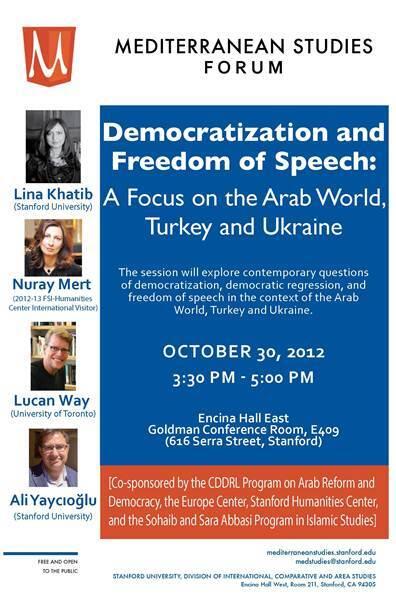
Co-sponsored by CDDRL Program on Arab Reform and Democracy, the Europe Center, Stanford Humanities Center, and the Abbasi Program in Islamic Studies

More info: http://www.stanford.edu/group/mediterranean/cgi-bin/web/2012/08/democratization-and-freedom-of-speech-a-focus-on-turkey-arab-world-and-ukraine/

Image

Richard and Rhoda Goldman Conference Room

Nuray Mert FSI-Humanities Center International Visitor Panelist
Lina Khatib Program Manager for the Program on Arab Reform and Democracy Panelist CDDRL
Lucan Way Associate Professor of Political Science Panelist University of Toronto
Ali Yaycioğlu Assistant Professor of Middle East History Moderator Stanford
Panel Discussions
-

Abstract:

Nearly two years after the Tunisian uprisings launched a massive wave of regional protest across the Arab world, many important and highly contested questions remain. How has the protest wave affected the dynamics of regional politics? Has the protest wave ended, or is it likely to recur? What explains the timing, the accomplishments and the limitations of that protest wave? What does the survival of many Arab regimes, the frustration of revolutionaries, the rise of Islamist movements in electoral politics, and the spiraling conflict in Syria mean for hopes of democratization and peaceful political change?

About the speaker:

Marc Lynch is associate professor of political science and international affairs at The George Washington University, where he directs the Institute for Middle East Studies. He also directs the Project on Middle East Political Science, edits the Middle East Channel for ForeignPolicy.com and the Columbia University Press book series Columbia Studies on Middle East Politics, and is a non-resident senior fellow at the Center for a New American Security. His most recent publications include The Arab Uprising (PublicAffairs 2012), Islamists in a Changing Middle East (ForeignPolicy 2012), and Blogs and Bullets II: New Media and the Arab Spring (US Institute for Peace).

CISAC Conference Room

Marc Lynch Director, Institute for Middle East Studies Speaker George Washington University
Seminars
-

Stephen Stedman is Freeman Spogli senior fellow at the Center on Democracy, Development, and the Rule of Law and FSI, an affiliated faculty member at CISAC, and professor of political science (by courtesy) at Stanford University. He currently serves as the Director for the Global Commission on Elections, Democracy, and Security, a body of eminent persons tasked with developing recommendations on promoting and protecting the integrity of elections and international electoral assistance. The Commission is a joint project of the Kofi Annan Foundation and International IDEA, an intergovernmental organization that works on international democracy and electoral assistance.

In 2003-04 Professor Stedman was Research Director of the United Nations High-level Panel on Threats, Challenges and Change and was a principal drafter of the Panel’s report, A More Secure World: Our Shared Responsibility. In 2005 he served as Assistant Secretary-General and Special Advisor to the Secretary- General of the United Nations, with responsibility for working with governments to adopt the Panel’s recommendations for strengthening collective security and for implementing changes within the United Nations Secretariat, including the creation of a Peacebuilding Support Office, a Counter Terrorism Task Force, and a Policy Committee to act as a cabinet to the Secretary-General. His most recent book, with Bruce Jones and Carlos Pascual, is Power and Responsibility: Creating International Order in an Era of Transnational Threats (Washington DC: Brookings Institution, 2009).

Encina Ground Floor Conference Room

CDDRL
Encina Hall, C152
616 Jane Stanford Way
Stanford, CA 94305-6055

(650) 725-2705 (650) 724-2996
0
Senior Fellow at the Freeman Spogli Institute for International Studies
Professor, by courtesy, of Political Science
Stedman_Steve.jpg PhD

Stephen Stedman is a Senior Fellow at the Freeman Spogli Institute for International Studies (FSI) and the Center on Democracy, Development and the Rule of Law (CDDRL), an affiliated faculty member at CISAC, and professor of political science (by courtesy) at Stanford University. He is director of CDDRL's Fisher Family Honors Program in Democracy, Development and Rule of Law, and will be faculty director of the Program on International Relations in the School of Humanities and Sciences effective Fall 2025.

In 2011-12 Professor Stedman served as the Director for the Global Commission on Elections, Democracy, and Security, a body of eminent persons tasked with developing recommendations on promoting and protecting the integrity of elections and international electoral assistance. The Commission is a joint project of the Kofi Annan Foundation and International IDEA, an intergovernmental organization that works on international democracy and electoral assistance.

In 2003-04 Professor Stedman was Research Director of the United Nations High-level Panel on Threats, Challenges and Change and was a principal drafter of the Panel’s report, A More Secure World: Our Shared Responsibility.

In 2005 he served as Assistant Secretary-General and Special Advisor to the Secretary- General of the United Nations, with responsibility for working with governments to adopt the Panel’s recommendations for strengthening collective security and for implementing changes within the United Nations Secretariat, including the creation of a Peacebuilding Support Office, a Counter Terrorism Task Force, and a Policy Committee to act as a cabinet to the Secretary-General.

His most recent book, with Bruce Jones and Carlos Pascual, is Power and Responsibility: Creating International Order in an Era of Transnational Threats (Washington DC: Brookings Institution, 2009).

Director, Fisher Family Honors Program in Democracy, Development and Rule of Law
Director, Program in International Relations
Affiliated faculty at the Center for International Security and Cooperation
Date Label
Stephen J. Stedman Freeman Spogli Senior Fellow at the Center on Democracy, Development, and the Rule of Law and FSI; CISAC Affiliated Faculty Member; Professor (by courtesy) of Political Science Speaker
Seminars
-

Abstract:

Marking the publication of Lina Khatib's latest book Image Politics in the Middle East: The Role of the Visual in Political Struggle, this seminar focuses on the evolution of political expression in the Middle East over the past decade, highlighting the visual dimension of power struggles between citizens and leaders in Lebanon, Iran, Egypt, Libya, and Syria.

About the speaker:

Lina Khatib is a co-founder and Program Manager of the Program on Arab Reform and Democracy at the Center on Democracy, Development, and the Rule of Law at Stanford University. She joined Stanford University in 2010 from the University of London where she was an Associate Professor. Her research is firmly interdisciplinary and focuses on the intersections of politics, media, and social factors in relation to the politics of the Middle East. She is also a consultant on Middle East politics and media and has published widely on topics such as new media and Islamism, US public diplomacy towards the Middle East, and political media and conflict in the Arab world, as well as on the political dynamics in Lebanon and Iran. She has an active interest in the link between track two dialogue and democratization policy. She is also a Research Associate at SOAS, University of London, and, from 2010-2012, a Research Fellow at the USC Center on Public Diplomacy at the Annenberg School.

Lina is a founding co-editor of the Middle East Journal of Culture and Communication, a multidisciplinary journal concerned with politics, culture and communication in the region, and in 2009 co-edited (with Klaus Dodds) a special issue of the journal on geopolitics, public diplomacy and soft power in the Middle East. She also edited the Journal of Media Practice from 2007-2010. She is one of the core authors of the forthcoming Arab Human Development Report (2012) published by the UNDP.

She has written two books, Filming the Modern Middle East: Politics in the Cinemas of Hollywood and the Arab World (IB Tauris 2006), which is a study of the link between international relations and film, focusing on 25 years of cinematic representation of politics in the region (1980-2005), from the Arab-Israeli conflict to the Gulf War to Islamic fundamentalism, and Lebanese Cinema: Imagining the Civil War and Beyond (IB Tauris 2008). The book takes a socio-political approach to the study of Lebanese cinema over the last thirty years, focusing on the issues of Lebanese national identity, history, sectarian conflict, and memory of the Civil War.

Lina has recently finished writing a book titled Image Politics in the Middle East: The Role of the Visual in Political Struggle for IB Tauris. The book examines the power struggles among states, other political actors, and citizens in the region that are expressed through visuals, and focuses on case studies from Lebanon, Egypt, Syria, Libya, and Iran, with a focus on the role of the image as a political tool in the Arab Spring. She has also recently led a multidisciplinary research project on US public diplomacy in the digital age, in collaboration with the University of Oxford and the University of Wolverhampton, the outcome of which will appear in the Middle East Journal in 2012.

Before joining the academic field, Lina worked in broadcast journalism in Lebanon. She is a frequent commentator on the Middle East in the media with appearances on Al-Jazeera (Arabic and English), CNN, BBC, Sky News and other media outlets across the globe

CISAC Conference Room

Lina Khatib Program Manager for the Program on Arab Reform and Democracy Speaker CDDRL
Seminars

Energy and Environment Building, room 369
473 Via Ortega
Stanford University
Stanford, CA 94305-4205

(650) 721-2220
0
Research Associate
xrueda.png PhD

Ximena Rueda is a research associate at the School of Earth Sciences at Stanford University. Her research focuses on the impacts of globalization on land use, with particular attention to tropical commodities.  She has extensive experience on rural development and environmental conservation in Latin America. Ximena received a BA and MA in Economics from Universidad de los Andes in Colombia, a Masters in City Planning from MIT, and a PhD in Geography from Clark University.

Y2E2 building
E-IPER, room 226
473 Via Ortega
Stanford, CA 94305-4020

0
PhD student, Emmett Interdisciplinary Program in Environment and Resources
Fran_Moore_Photo_hs.jpg MS

Frances C. Moore is a PhD student in the Emmett Interdisciplinary Program in Environment and Resources at Stanford University. She is working with David Lobell and Larry Goulder to study how farmers are likely to adapt to climate change so as to reduce its negative effects. Understanding the likely rate and effectiveness of this autonomous adaptation is important for accurately estimating the future impact of climate change on agricultural production and food security. Fran is combining experimental, statistical, and field-based methods from economics, anthropology and psychology with climate data and models in order to better model adaptation in agriculture.

Fran’s previous work focused on the negotiation of international climate agreements and she has published several articles on the mitigation potential of short-lived greenhouse gases in developing countries and on the negotiation of international adaptation policy. Fran is a Stanford Interdisciplinary Graduate Fellow, a former Switzer Foundation Fellow and a former NSF Graduate Research Fellow. She holds a Masters of Environmental Science from the Yale School of Forestry and Environmental Studies and a B.A., summa cum laude, in Earth and Planetary Science from Harvard University.

Lobell laboratory

0
kmoiyoi.png

Katrina grew up in Nairobi, Kenya, and spent much of her youth camping on the East African savannah and exploring coral reefs in the Indian Ocean. She moved to the US at the age of eighteen, and holds a B.A. from Brown University in International Relations, an M.A. from the University of Washington in Marine Affairs, and a PhD in Environment and Resources from the Stanford Emmett Interdisciplinary Graduate Program in Environment and Resources.

Her professional experience includes several years in international development consulting in Washington DC, where she provided programmatic and technical support to USAID-funded fisheries and water management programs in South Asia and Sub-Saharan Africa. Working with the UN Food & Agriculture Organization's Bay of Bengal Large Marine Ecosystem Program, she reviewed the status of marine protected areas in eight South Asian countries (Maldives, Sri Lanka, India, Bangladesh, Myanmar, Thailand, Malaysia and Indonesia) and presented recommendations to senior government officials from each country on ways to improve marine resource management across borders. In the field of agriculture, she worked with a private drip irrigation and greenhouse company in Israel, and also co-founded and ran a farm with 200+ customers on the outskirts of Tel Aviv. Most recently, she traveled to Thailand, Indonesia and the Philippines to provide technical advice on the design of a marine fisheries traceability program meant to improve food security and the health of marine ecosystems. She is currently the Director of Sustainability for Victory Farms.

The Yaqui Valley is the birthplace of the Green Revolution and one of the most intensive agricultural regions of the world, using irrigation, fertilizers, and other technologies to produce some of the highest yields of wheat anywhere. It also faces resource limitations, threats to human health, and rapidly changing economic conditions. In short, the Yaqui Valley represents the challenge of modern agriculture: how to maintain livelihoods and increase food production while protecting the environment.

Subscribe to International Development