Security

FSI scholars produce research aimed at creating a safer world and examing the consequences of security policies on institutions and society. They look at longstanding issues including nuclear nonproliferation and the conflicts between countries like North and South Korea. But their research also examines new and emerging areas that transcend traditional borders – the drug war in Mexico and expanding terrorism networks. FSI researchers look at the changing methods of warfare with a focus on biosecurity and nuclear risk. They tackle cybersecurity with an eye toward privacy concerns and explore the implications of new actors like hackers.

Along with the changing face of conflict, terrorism and crime, FSI researchers study food security. They tackle the global problems of hunger, poverty and environmental degradation by generating knowledge and policy-relevant solutions. 

-

Abstract: The problem of online disinformation is only getting worse. Social media may well play a role in the US 2020 presidential election and other major political events. But that doesn’t even begin to describe what future propaganda will look like. As Samuel Woolley shows, we will soon be navigating new technologies such as human-like automated voice systems, machine learning, ‘deep-fake’ AI-edited videos and images, interactive memes, virtual reality and augmented reality. In stories both deeply researched and compellingly written, Woolley describes this future, and explains how the technology can be manipulated, who might control it and its impact on political strategy. Finally, Woolley proposes strategic responses to this threat with the ultimate goal of empowering activists and pushing technology builders to design for democracy.

Image
Samuel Woolley
Samuel Woolley is a researcher with a focus on emerging media technologies, propaganda and politics. His work looks at how automation, algorithms and AI are leveraged for both democracy and control. His forthcoming book, The Reality Game: How the Next Wave of Technology Will Break the Truth, will be released in January of 2020 by PublicAffairs/Hachette. It explores the future of digital disinformation and provides a pragmatic roadmap for how society can respond.

Woolley is an assistant professor in the School of Journalism at the Moody College of Communication at the University of Texas-Austin. He is the Program Director of disinformation research at the Center for Media Engagement (CME) at UT. He holds a PhD from the University of Washington-Seattle. His academic work has appeared in the Journal of Information Technology and Politics, the International Journal of Communication, the Routledge Handbook of Media, Conflict and Security, A Networked Self: Platforms, Stories, Connections and The Political Economy of Robots.  He is one of the founders of the Computational Propaganda Research Project, now based at the Oxford Internet Institute, University of Oxford. Woolley is also the founder of the Digital Intelligence Lab at the Institute for the Future (IFTF)–a 50-year-old think-tank based in Palo Alto, CA.

Lectures
0
Kip Wainscott portrait

Kip Wainscott is a senior advisor at the Cyber Policy Center, where he directs programs and initiatives for the Global Digital Policy Incubator to promote policymaking that reinforces democratic values, universal human rights, and the rule of law in the digital realm.

Kip served in the White House under President Obama as Senior Director of Cabinet Affairs and Senior Advisor to the Domestic Policy Council, where his portfolio focused on issues related to justice, opportunity, and technology. He also was Senior Counsel in the Office of Legal Policy at the Department of Justice, where he worked on the development and coordination of technology policy and other initiatives of high priority to the Attorney General. After leaving the administration, Kip helped launch CrowdJustice, a digital platform for engaging online communities in support of public interest litigation. Since 2017, he has led democracy programming and policy engagement in Silicon Valley for the National Democratic Institute for International Affairs.

Before entering government, Kip was an attorney in a leading political and election law practice, where he advised on presidential nomination procedures, voting laws, and represented clients in litigation and ethics matters. For the 2012 election cycle, Kip was counsel and national delegate director for the Obama-Biden reelection campaign.

Kip was a 2019 Policy Fellow at Stanford’s Digital Civil Society Lab, where he supported research and co-authored a paper examining how civil society organizations can better protect their digital rights through policy advocacy. He has also authored chapters for two books on the subject of government and political ethics. He is a member of the Pacific Council on International Policy, and serves on the Advisory Council for the Institute for Data, Democracy, and Politics at the George Washington University.

Senior Advisor, GDPi
Authors
Noa Ronkin
News Type
News
Date
Paragraphs

Southeast Asia, home to over 640 million people across 10 countries, is one of the world’s most dynamic and fastest growing regions. APARC just concluded the year 2019 with a Center delegation visit to two Southeast Asian capital cities, Hanoi and Bangkok, where we spent an engaging week with stakeholders in the academic, policy, business, and Stanford alumni communities.

Led by APARC Director Gi-Wook Shin, the delegation included APARC Deputy Director and Asia Health Policy Program Director Karen Eggleston, Southeast Asia Program Director Donald Emmerson, and APARC Associate Director for Communications and External Relations Noa Ronkin. Visiting Scholar Andrew Kim joined the delegation in Bangkok.

With a focus on health policy, our first day in Hanoi included a visit to Thai Nguyen University, a meeting with government representatives at the Vietnam Ministry of Health, and a seminar on healthy aging and innovation jointly with Hanoi Medical University.

Image
Collage of four images showing participants at a roundtable held at Hanoi Medical University with APARC delegation members

Karen Eggleston and participants at the roundtable held at Hanoi Medical University, December 9, 2019.

Throughout the day, Eggleston presented some of her collaborative research that is part of two projects involving international research teams: one that assesses public-private roles and institutional innovation for healthy aging and another that examines the economics of caring for patients with chronic diseases across diverse health systems in Asia and other parts of the world. We appreciated learning from our counterparts about the health care system and health care delivery in Vietnam.

Shifting focus to international relations and regional security, day 2 in Hanoi opened with a roundtable, “The Rise of the Indo-Pacific and Vietnam-U.S. Relations,” held jointly with the East Sea Institute (ESI) of the Diplomatic Academy of Vietnam (DAV). Following a welcome by ESI Director General Nguyen Hung Son, the program continued with remarks by Shin, Emmerson, ESI Deputy Director General To Anh Tuan, and Assistant Director General Do Thanh Hai.

Image
Participants at a roundtable held at the Diplomatic Academy of Vietnam with APARC delegation members

Roundtable at the Diplomatic Academy of Vietnam, December 10, 2019.

The long-ranging conversation with DAV members included issues such as the future of the international order in Asia; the U.S. withdrawal from multilateralism; the concern about a lack of U.S. engagement in Southeast Asia, sparked by President Trump’s absence from the November 2019 summit of the Association of Southeast Asian Nations (ASEAN) at a time when China is bolstering its influence in the region and when ASEAN hopes to set a code of conduct with China regarding disputed waters in the South China Sea; the priorities for Vietnam as it assumes the role of ASEAN chair in 2020; and the challenges for the Vietnam-U.S. bilateral relationship amid the changing strategic environment in Southeast Asia.

In the afternoon we were joined by members of the American Chamber of Commerce in Hanoi at an AmCham-hosted Lunch ‘n’ Learn session on Vietnam's challenges and opportunities amid the U.S.-China rivalry. The event featured Emmerson in conversation with AmCham Hanoi Executive Director Adam Sitkoff.

Image
Two men in conversation seated on stage and a man speaking at a podium

(Left) Donald Emmerson in conversation with Adam Sitkoff; (right) Gi-Wook Shin welcomes AmCham Hanoi members; December 10, 2019. 

Moving to Bangkok, delegation members Shin, Eggleston, Emmerson, and Kim spoke on a panel for executives of the Charoen Pokphand Group (C.P. Group), one of Thailand’s largest private conglomerates, addressing some of the core issues that lie ahead for Southeast Asia in 2020 and beyond in the areas of geopolitics, innovation, and health.

Image
Participants at a panel discussion with APARC delegation hosted by the C.P. Group, Thailand

Top, from left to right: Gi-Wook Shin, Karen Eggleston, Andrew Kim; bottom: C.P. Group executive listening to the panel, December 12, 2019.

We also enjoyed a tour at True Digital Park, Thailand’s first startup and tech entrepreneur’s campus. Developed by the C.P. Group, True Digital Park aspires to be an open startup ecosystem that powers Thailand to become a global hub for digital innovation.

The following day, Shin and Emmerson participated in a public forum hosted by Chulalongkorn University’s Institute of Security and International Studies (ISIS Thailand), "Where Northeast Asia Meets Southeast Asia: The Great Powers, Global Disorder and Asia’s Future.” They were joined by ISIS Thailand Director Thitinan Pongsudhirak and Chulalongkorn University Faculty of Political Science Associate Dean for International Affairs and Graduate Studies Kasira Cheeppensook. The panel was moderated by Ms. Gwen Robinson, ISIS Thailand senior fellow and editor-at-large of the Nikkei Asian Review.

Image
Panelists and participants at a public forum held at Chulalongkorn University

ISIS Thailand forum participants and panelists, from left: Pngsukdhirak, Shin, Robinson, Emmerson, Cheeppensook; December 13, 2019.

As part of that discussion, Emmerson speculated that – driven by deepening Chinese economic and migrational involvement in Southeast Asia’s northern tier – Cambodia and Laos, less conceivably Myanmar, and still less conceivably Thailand could become incorporated de facto into an economically integrated “greater China” that could eventually reduce ASEAN to a more-or-less maritime membership in the region’s southern tier. Emmerson’s speculation was made in the context of his critique of ASEAN’s emphasis on its own “centrality” to the neglect of its lack of the proactivity that would serve as evidence of centrality and of a desire not to be rendered peripheral by the growing centrality-cum-proactivity of China. The event was covered by the Bangkok Post (although that report’s headline and quote of Emmerson are inaccurate, as neither the panel nor Emmerson predicted the “break-up of ASEAN.”)

Our delegation visit in Bangkok concluded with a buffet dinner reception and panel discussion jointly with the Stanford Club of Thailand.

Image
alumni event

Stanford and IvyPlus alumni listening to the panel, December 13, 2019.

Moderated by Mr. Suthichai Yoon, a veteran journalist and founder of digital media outlet Kafedam Group, the conversation focused on the changing geopolitics of Southeast Asia, innovation and health in the region, and the opportunities and challenges facing Thailand-U.S. relations. It was a pleasure to meet many new and old friends from the Stanford and IvyPlus alumni communities.

APARC would like to thank our partners and hosts in Hanoi and Bangkok for their hospitality, collaboration, and the stimulating discussions throughout our visit. We look forward to keeping in touch!

Hero Image
APARC delegation speaking to Stanford and IvyPlus alumni, Bangkok
All News button
1
Authors
News Type
Q&As
Date
Paragraphs

Brett McGurk served as Special Presidential Envoy for the Global Coalition to Counter ISIL from Oct. 23, 2015 to Dec. 31, 2018. He was appointed to the post by former President Barack Obama, but the Donald Trump administration kept McGurk in the position until his resignation in the wake of Trump’s decision to withdraw troops from Syria. McGurk has worked in diplomacy for the past 15 years, including a stint from October 2014 to January 2016 as deputy assistant secretary of state for Iraq and Iran. He is currently a lecturer at the Freeman Spogli Institute. 

The Daily sat down to talk to McGurk about his career and his thoughts on the Middle East in the wake of the withdrawal of U.S. troops from Syria and ISIL leader Abu Bakr al-Baghdadi’s death.

The Stanford Daily (TSD): Could you talk a little bit about your transition from working in the government to lecturing at Stanford?

Brett McGurk (BM): I had the unique experience of serving at fairly senior levels with President Bush, Obama and then two years of President Trump — three very different presidents. I resigned from the Trump administration at the end of last year following his decision to abruptly abandon Syria, which was very contrary to what our established policy was. 

Read the Rest at The Stanford Daily

Hero Image
1599px brett mcgurk 171024 d pb383 016 37912859172
All News button
1
-

Image
Portrait of M Taylor Fravel
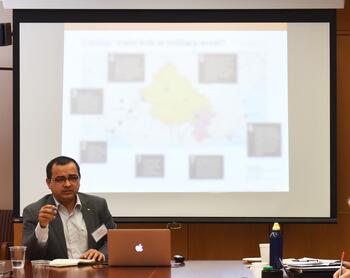
Since 1949, China has adopted nine national military strategies, known as “strategic guidelines.” The strategies adopted in 1956, 1980, and 1993 represent major changes in China's military strategy or efforts by the People's Liberation Army to wage war in a new way. This talk examines why major changes in strategy have been pursued at these periods and not at other times, highlighting the role of shifts in the conduct of warfare in the international system and unity among the top leaders of the Chinese Communist Party.

M. Taylor Fravel is the Arthur and Ruth Sloan Professor of Political Science and Director of the Security Studies Program at the Massachusetts Institute of Technology.  Taylor studies international relations, with a focus on international security, China, and East Asia.  His books include Strong Borders, Secure Nation: Cooperation and Conflict in China's Territorial Disputes (Princeton University Press, 2008) and Active Defense: China's Military Strategy Since 1949 (Princeton University Press, 2019).  His other publications have appeared in International SecurityForeign AffairsSecurity StudiesInternational Studies ReviewThe China QuarterlyThe Washington QuarterlyJournal of Strategic StudiesArmed Forces & SocietyCurrent HistoryAsian SurveyAsian SecurityChina Leadership Monitor, and Contemporary Southeast Asia. Taylor is a graduate of Middlebury College and Stanford University, where he received his PhD.  He also has graduate degrees from the London School of Economics and Oxford University, where he was a Rhodes Scholar.  In 2016, he was named an Andrew Carnegie Fellow by the Carnegie Corporation.  Taylor serves on the board of directors of the National Committee on U.S.-China Relations and as the Principal Investigator for the Maritime Awareness Project.


Image
Image of red flag over the Shanghai Bund

This event is part of the 2020 Winter/Spring Colloquia series, The PRC at 70: The Past, Present – and Future?, sponsored by APARC's China Program.
 

M. Taylor Fravel Arthur and Ruth Sloan Professor of Political Science, MIT
Seminars
-

renee diresta Renne DiResta
Abstract: Disinformation campaigns and black propaganda are not new, but they are evolving. Media coverage of disinformation and propaganda has focused primarily on the social-first memetic operations of the Internet Research Agency and its targeting of the United States 2016 presidential election. This talk examines a broader collection of influence operations, all affiliated with one state adversary – Russia – but leveraging distinctly different tactics. It investigates a 'playbook' that is far more expansive (and evolving) than previously understood, and assesses disinformation campaigns along several axes. We explore narrative vs memetic pathways, long-term vs discrete actions, and a collection of goals ranging from persuasion to distraction. This talk also discusses how online influence operations are deployed in conjunction hack-and-leak campaigns, and community infiltration. 

Renee DiResta Bio >


E207, Encina Hall 

0
renee-diresta.jpg

Renée DiResta is the former Research Manager at the Stanford Internet Observatory. She investigates the spread of malign narratives across social networks, and assists policymakers in understanding and responding to the problem. She has advised Congress, the State Department, and other academic, civic, and business organizations, and has studied disinformation and computational propaganda in the context of pseudoscience conspiracies, terrorism, and state-sponsored information warfare.

You can see a full list of Renée's writing and speeches on her website: www.reneediresta.com or follow her @noupside.


Former Research Manager, Stanford Internet Observatory
Renee DiResta Research Manager Stanford Internet Observatory
Seminars
Authors
News Type
News
Date
Paragraphs

The toll from gun violence at schools has only escalated in the 20 years since the jolting, horrific massacre at Columbine High.

By December 2019, at least 245 primary and secondary schools in the United States had experienced a shooting, killing 146 people and injuring 310, according to The Washington Post.

At least 245 primary and secondary schools in the United States have experienced a shooting — killing 146 people and injuring 310 — since the country's first mass school shooting at Columbine High School in April 1999.

Now, new Stanford-led research sounds an alarm to what was once a silent reckoning: the mental health impact to tens of thousands of surviving students who were attending schools where gunshots rang out.

A study has found that local exposure to fatal school shootings increased antidepressant use among youths.

Specifically, the average rate of antidepressant use among youths under age 20 rose by 21 percent in the local communities where fatal school shootings occurred, according to the study. And the rate increase – based on comparisons two years before the incident and two years after – persisted even in the third year out.

“There are articles that suggest school shootings are the new norm – they’re happening so frequently that we’re getting desensitized to them – and that maybe for the people who survive, they just go back to normal life because this is just life in America. But what our study shows is that does not appear to be the case,” said Maya Rossin-Slater, a core faculty member at Stanford Health Policy and faculty fellow at the Stanford Institute for Economic Policy Research (SIEPR). “There are real consequences on an important marker of mental health.”

The study is detailed in a working paper published Monday by the National Bureau of Economic Research. It was co-authored by Rossin-Slater, an assistant professor of health policy in the Stanford School of Medicine; Molly Schnell, a former postdoctoral fellow at SIEPR now an assistant professor at Northwestern University; Hannes Schwandt, an assistant professor at Northwestern and former visiting fellow at SIEPR; Sam Trejo, a Stanford doctoral candidate in economics and education; and Lindsey Uniat, a former predoctoral research fellow at SIEPR now a PhD student at Yale University.

Their collaborative research – accelerated by their simultaneous stints at SIEPR – is the largest study to date on the effects of school shootings on youth mental health.

The study comes as the issue of gun safety continues to stoke political wrangling and public debate. And the researchers say their findings suggest policymakers should take a wide lens to their decision-making process.

“When we think about the cost of school shootings, they’re often quantified in terms of the cost to the individuals who die or are injured, and their families,” Rossin-Slater noted. “Those costs are unfathomable and undeniable. But the reality is that there are many more students exposed to school shootings who survive. And the broad implication is to think about the cost not just to the direct victims but to those who are indirectly affected.”

A Driver for Antidepressant Use

More than 240,000 students have been exposed to school shootings in America since the mass shooting in Columbine in April 1999, according to The Washington Post  data used in the study. And the number of school shootings per year has been trending up since 2015.

Yet despite this “uniquely American phenomenon” – since 2009, over 50 times more school shootings have occurred in the U.S. than in Canada, Japan, Germany, Italy, France and the United Kingdom combined – little is known about the effects of such gun violence on the mental health of the nation’s youth, the study stated.

“We know that poor mental health in childhood can have negative consequences throughout life,” Schwandt said. “At the same time, children are known to show significant levels of resilience, so it really wasn’t clear what we would find as we started this project.”

The researchers examined 44 shootings at schools across the country between January 2008 and April 2013. They used a database that covered the near universe of prescriptions filled at U.S. retail pharmacies along with information on the address of the medical provider who prescribed each drug. They compared the antidepressant prescription rates of providers practicing in areas within a 5-mile radius of a school shooting to those practicing in areas 10-to-15 miles away, looking at two years prior and two to three years after the incident.

Of those 44 school shootings, 15 of them involved at least one death. The 44 shootings occurred in 10 states: Alabama, California, Connecticut, Florida, Nebraska, North Carolina, Ohio, South Carolina, Tennessee and Texas.

Researchers found a marked increase in the rate of antidepressant prescriptions for youths nearby, but only for the shootings that were fatal. They did not see a significant effect on prescriptions for youths exposed to non-fatal school shootings.

“The immediate impact on antidepressant use that we find, and its remarkable persistence over two, and even three years, certainly constitutes a stronger effect pattern than what we would have expected,” Schwandt said.

Meanwhile, adult antidepressant use did not appear to be significantly impacted by local exposure to school shootings.

Layers of Costs, More Unknowns

The researchers also analyzed whether the concentration of child mental health providers in areas affected by fatal school shootings made a difference in the antidepressant rates, and they drilled a further comparison between the prevalence of those who can prescribe drugs, such as psychiatrists and other medical doctors, and those who cannot prescribe drugs, such as psychologists and licensed social workers.

Increases in antidepressant rates were the same across areas with both high and low concentrations of prescribing doctors, the researchers found. But in areas with higher concentrations of non-prescribing mental health providers, the increases in antidepressant use were significantly smaller – indicating perhaps a greater reliance on non-pharmacological treatments or therapy for shooting-related trauma.

The researchers also found no evidence that the rise in antidepressant usage stemmed from mental health conditions that were previously undiagnosed prior to the shootings.

In totality, the researchers say the results in the study clearly pointed to an adverse impact from a fatal shooting on the mental health of youths in the local community. Furthermore, the results capture only a portion of the mental health consequences: Non-drug related treatments could have been undertaken as well.

“Increased incidence of poor mental health is at least part of the story,” Schnell said.

Though their analysis included only 44 schools and 15 fatal school shootings, Rossin-Slater noted how the trend of school shootings is growing. She believes the mental health impact found on the local communities they studied “can be generalizable to other communities’ experiences.”

That’s all the more reason why policymakers should consider the overall negative effects of school shootings, and how further research will be needed to gauge other societal consequences, the researchers said.

“Think of it as layers of costs,” Rossin-Slater said. And when it comes to evaluating gun violence at schools, “we think our numbers say, ‘Hey, these are costly things, and it’s costlier than we previously thought.’”

Hero Image
schoolshooting shutterstock Shutterstock
All News button
1
Authors
News Type
Q&As
Date
Paragraphs

The science of cyber risk looks at a broad spectrum of risks across a variety of digital platforms. Often though, the work done within the field is limited by a failure to explore the knowledge of other fields, such as behavioral science, economics, law, management science, and political science. In a new Science Magazine article, “Cyber Risk Research Impeded by Disciplinary Barriers,” cyber risk experts and researchers at Stanford University make a compelling case for the importance of a cross-disciplinary approach. Gregory Falco, security researcher at the Program on Geopolitics, Technology, and Governance, and lead author of the paper, talked recently with the Cyber Policy Center about the need for a holistic approach, both within the study of cyber risk, and at a company level when an attack occurs.

CPC: Your recent perspective paper in Science Magazine highlights the issue of terminology when it comes to how organizations and institutions define a cyber attack. Why is it so important to have consistent naming when we are talking about cyber risk?

Falco: With any scientific discipline or field, there is a language for engaging with other experts. If there’s no consistent language or at least dialect for communication around cyber risk, it’s difficult to engage with scholars from different disciplines. For example: The phrase “cyber event” is contested and the threshold for what an organization considers to be a cyber event varies substantially. Some organizations consider someone pinging their network as a cyber event, others only consider something a cyber event once an intrusion has been publicly disclosed. So there’s a disparity when comparing metrics of cyber events from organization to organization because of the different thresholds of what’s considered an event.

CPC: We’ve all been sent one of those emails letting us know our data may have been compromised and your paper points out it’s nearly impossible to put foolproof protections into place; attacks are inevitable. Given that, how should companies weigh the various ways they can protect themselves?

Falco: The first exercise each organization should go through when they decide to be serious about cyber risk is to prioritize their assets. What is business critical? What is safety critical? Then, like all other risks, a cost-benefit analysis must be done for each asset based on its priority. If the asset is safety-critical, then resources should be allocated to help protect that asset or at least ensure its resilience. Trade-offs are inevitable, no company has unlimited resources. But starting with an understanding of where the priorities are, is critical.

CPC: In companies, cyber security often falls entirely to the Chief Information Security Officer (CISO). Your paper argues that’s shortsighted. What is gained when a company takes a more holistic approach?

Falco: Distributing responsibility across the organization catalyzes a security culture. A security culture is one where there is a constant vigilance or at least broad awareness of cybersecurity concerns throughout the organization. Fostering a security culture is often suggested as a mechanism to help reduce cyber risk in organizations. The problem with not distributing responsibility is that when something happens, it’s too easy to resort to finger-pointing at the CISO, and that’s counterproductive. Efforts after an attack should be on responding and being resilient, not finding the scapegoat.

CPC: Cyber risk largely focuses on prevention, but your paper argues that it’s what happens after an attack in that needs greater attention. Why is that?

Falco: Every organization will be attacked. However organizations can differentiate themselves from a cyber risk standpoint by appropriately managing the situation after an attack. Some of the most significant damages to organizations can be reputational if communication after an attack is unclear or botched. Poor communication after an attack can result in major regulatory fines or valuation adjustments as seen in cases like Yahoo and that can have major business implications. Communications aren’t the only important element of post-attack response. A thorough post-mortem of the organization’s response to the attack can be an important learning experience and a way to plan for future attacks.

CPC: Protecting against cyber attacks and the losses that go with them can obviously be costly for companies. You make a case for collaboration among different fields, say among data scientists and economists. How can that be encouraged?

Falco: We argue that cross-disciplinary collaboration rarely happens organically. Therefore, we call on funding agencies like the NSF or DARPA to specify a preference for cross disciplinary research when funding cyber risk projects. Typically, this isn’t currently a feature of calls for proposals, but for cyber risk programs it should be. We encourage researchers to explore cyber risk questions at the margins of their discipline. Those questions may lend themselves to potential overlap with other disciplines and foster a starting point for cross-disciplinary collaboration.

For more on these topics, see a full list of recent publications from the Cyber Policy Center and the Program on Geopolitics, Technology, and Governance.

Hero Image
Gregory Falco Rod Searcey
All News button
1
Authors
News Type
News
Date
Paragraphs

CDDRL’s Program on Arab Reform and Democracy held its annual conference at Stanford University on October 11 and 12, titled “The Struggle for Political Change in the Arab World.” The conference is an outgrowth of ARD’s efforts to support new research on the dynamics of political change in the countries of the Arab world. Scholars from across different disciplines sought to understand how social, economic, and political dynamics at the national level, as well as international and regional conflict and power rivalries, impact struggles for political and social change in the region.

Overview of Panels and Speakers

Image
larry diamond banner
Following opening remarks by FSI Senior Fellow Larry Diamond, the first panel titled “The Boundaries of Authoritarianism post-Arab Uprisings” featured CDDRL Senior Research Scholar Amr Hamzawy. His paper examined how the regime of Abdel Fattah Al-Sisi has employed discursive strategies to discredit calls for democratic change in the country. Sean Yom, Associate Professor of Political Science at Temple University, outlined how the protest strategies of Jordanian youth have limited their effectiveness in advancing meaningful political change. University of California, Davis Scholar Samia Errazzouki discussed the failure of state-led political and economic reform in Morocco.

Chaired by Harvard University Fellow Hicham Alaoui, the second panel was titled “Popular Uprisings and Uncertain Transitions.” University of California, Santa Cruz Political Scientist Thomas Serres provided an overview of the economic disruptions that contributed to Algeria’s uprising. Lindsay Benstead, who is an Associate Professor of Political Science at Portland State University, analyzed the electoral successes of Tunisia’s Ennahda Party. Khalid Medani, Professor of Political Science at McGill University, explained how Sudanese protesters leveraged new strategies of contention to force Omar Al-Bashir out of power.

farrah al nakib and michael herb Farah Al-Nakib (right) and Michael Herb (left)
The third panel, titled “Politics, Succession and Sectarianism in the GCC States,” included Oxford University Fellow Toby Matthiesen, who discussed how Saudi Arabia and the GCC states have increasingly sought to protect their regimes by actively molding the politics of their autocratic patrons in the region, and by using new technologies to upgrade the effectiveness of their surveillance states. Georgia State University Political Scientist Michael Herb explained how the aging of the Saudi line of succession contributed to the political ascendancy of Crown Prince Mohammad Bin Salman and the decay of family rule in the country. Cal Poly Historian Farah Al-Nakib described how Kuwait’s royal family has used its sponsorship of large-scale development projects to sidestep the country’s political polarization, undermine the power of the parliament, and weaken public access to spaces of political contestation.

Image
hesham and toby matthiesen
The fourth panel focused on “Social Strife and Proxy Conflict in the Middle East.” Chatham House Scholar Lina Khatib described Syria’s transformation during the civil war from a highly centralized security state to a transactional state in which the regime depends heavily on local powerbrokers. Stacey Philbrick Yadav, Associate Professor and Chair of the Department of Political Science at Hobart and William Smith Colleges, discussed differences in how local communities in Yemen have been affected by the country’s conflict. David Patel, who serves as Associate Director for Research at the Crown Center for Middle East Studies at Brandeis University, argued that Iraq’s democratic institutions have been impressively robust to a series of existential challenges, but he also highlighted a widespread feeling among the Iraqi public that its parliamentary system is failing to deliver.

Image
lisa blaydes
Finally, the fifth panel examined the topic of “International Forces in the Arab Political Arena.” Stanford University Political Scientist Lisa Blaydes suggested that China’s efforts to involve itself in the regional economy may improve its reputation among economically-frustrated Arab citizens, but that such efforts also spell trouble for democracy and human rights in the Middle East. Hamid & Christina Moghadam Director of Iranian Studies at Stanford University Abbas Milani argued that Iran’s ideological commitment to exporting the Islamic Revolution has been remarkably consistent for several decades. Colin Kahl, Co-director of the Center for International Security and Cooperation at FSI, reviewed the strategies of US administrations toward the Middle East, and posited that President Trump’s approach of pursuing maximalist objectives with minimal commitments is particularly likely to heighten instability in the region. FSI Scholar Ayca Alemdaroglu emphasized that Turkey’s neo-Ottoman foreign policy has failed to achieve its objectives in the face of mounting regional upheaval.

Common Themes of Political Change and Continuity

Image
hamzawy khatib patel stacey
Several themes emerged from conference presentations. First, across the panels, scholars discussed the lessons learned by autocrats and activists alike in the aftermath of the Arab Spring, and the ways in which these lessons have transformed regional politics. Hamzawy emphasized that the Sisi regime in Egypt has increasingly relied on intensive repression over cooptation to maintain stability, while at the same time refusing to grant even limited political openings as existed under Hosni Mubarak’s presidency. In part, this change appears to be rooted in the regime’s belief that relaxing the state’s authoritarian posture had contributed to the revolutionary upheaval of 2011. Likewise, Matthiesen suggested that Saudi Arabia and the Gulf Cooperation Council States have learned to become more aggressive in strengthening their surveillance apparatus and policing popular discourse transnationally. By contrast, Serres discussed how the Algerian military and bureaucracy have responded to mass protests not by intensifying repression, but instead by attempting to coopt anti-corruption initiatives and democratic reforms to limit political and economic change. Similarly, regarding Kuwait, Al-Nakib illustrated how the restructuring of urban spaces has proved itself a subtle but successful strategy for the royal family to rehabilitate its reputation while limiting geographic focal points for popular politics.

Image
sean yom
Activists have also learned their own lessons from the aftermath of the Arab Spring. According to Yom, Jordanian activists continue to look to the leaderless revolutions of Tunisia and Egypt as a model to be emulated. As a result, they prioritize agility and horizontality in their protests, and they forgo the organization of formal political movements. This approach has succeeded in acquiring short-term concessions from the regime but has failed to generate broader structural changes. On the other hand, activists in Sudan appear to have been more successful at using lessons from the Arab Spring to push for systematic transformations of their political system. According to Medani, Sudanese protesters developed novel tactics to avoid the repression of the coercive apparatus, and they were effective at gradually forging a counterhegemonic discourse that clearly exposed the regime’s failures to the public. Following the overthrow of Omar Al-Bashir, activists in Sudan have also insisted on dismantling the political and economic might of the deep state to avoid following Egypt’s path.

Image
hicham alaoui at conference
Second, the conference discussion indicated widespread dissatisfaction with formal political institutions across the region. For instance, Hamzawy suggested that Sisi’s regime has been relatively successful at discrediting civilian political institutions, including the legislature and civilian-led ministries. Errazzouki highlighted widespread dissatisfaction in Morocco with existing political institutions. Likewise, Yom’s discussion of activists in Jordan emphasized their lack of interest in entering formal politics. In Kuwait, the royal court has found an opening to pursue urban development projects outside of normal institutions in part because of the public’s frustration with gridlock in the legislature. Patel speculated that frustration with the parliament and muhasasa system in Iraq may finally prompt major changes to the country’s political process.

Image
thomas serres and khalid medani
Third, despite this disillusionment with formal politics, these political institutions have proved remarkably durable in countries across the region. For example, though current frustrations may finally prompt change in Iraq, Patel also highlighted the resilience of the parliamentary system in the face of a sectarian civil war, US troop withdrawal, the rise of ISIS, and a number of other major challenges. For both Algeria and Sudan, Serres and Medani stressed that militaries continue to exercise significant influence despite the popular uprisings. Meanwhile, for Egypt, Hamzawy noted the firm grip of the current military regime on power, and for Morocco, Errazzouki described the lack of systematic changes to the country’s ruling monarchy, even after years of popular pressure.

Image
stacey yadav
Fourth, this durability has not precluded a number of important shifts within existing political institutions. Regarding Syria, for instance, Khatib explained how the survival of Bashar al-Asad’s presidency has depended on moving state institutions away from a centralized security state to a transactional state reliant on local actors with a degree of independence from the regime. Herb described how the consensus-based family rule of the Saudi monarchy fell victim to deaths among the aging senior princes, which opened up opportunities for the king to appoint more officials in a manner that heightened his direct influence. Herb suggested that Mohammad Bin Salman recognized this change and knew that he would likely lose relevance upon his father’s death; as a result, he was motivated to gamble on consolidating his control while his father still held the power to issue royal decrees. In Algeria, the influence of the military and bureaucracy may remain paramount for now, but Serres also pointed out that protesters have succeeded in stripping away the civilian intermediaries who used to protect these institutions. Regarding the durability of local institutions, Yadav noted how pre-conflict and even pre-unification institutions in Yemen have continued to operate effectively in a number of local communities around the country.

Image
colin kahl with abbas and ayca
Fifth, foreign interventions will continue to destabilize the region and impede prospects for democratization or post-conflict reconstructions in the coming years. Khatib noted that Russia has positioned itself as the agenda setter who can bring the Syrian state back to its feet, but also that Russia and Iran are competing to profit off the country’s reconstruction. For Yemen, Yadav argued that fragmentation at the local level has important implications for best practices in the international community’s reconstruction efforts, but that current actors are not well positioned to understand these trends. Kahl predicted that the Middle East strategy of the Trump administration would likely contribute to further destabilization of the region because of its emphasis on empowering allies to do what they want and go after Iran while the United States maintains its distance. Meanwhile, Blaydes’ presentation on China’s regional involvement, Milani’s discussion of Iran’s efforts to export the Islamic Revolution, and Matthiesen’s observations about the GCC States’ authoritarian coordination all illustrated how intervening states are reducing prospects for democratic political change.

Image
milani with audience
Sixth, even as interventionist countries have contributed to the destabilization of the region, they have also confronted major obstacles themselves – and in some cases have failed outright to achieve their primary objectives. Khatib noted that Iran has faced backlash in Syria, while Abbas Milani and David Patel pointed to backlash against Iran in Iraq. Kahl emphasized that the Trump administration’s Middle East policy was unlikely to achieve its goals. Blaydes observed that China has not acquired greater salience in the Middle East despite its more active economic involvement, and individuals in many of the region’s countries – particularly those that are more developed – do not see China’s growth as a positive force. She also stressed the reputational risks China is taking in pursuing potentially unpopular investments through the Belt and Road Initiative. The GCC States are attempting to prop up strongmen in both Libya and Sudan, but this strategy has struggled in the face of local political dynamics; furthermore, the intervention in Yemen has been a disaster for Saudi Arabia and the UAE. Finally, Alemdaroglu stressed that Turkey’s ambitious “neo-Ottoman” foreign policy, which reflects a desire to revive Turkish influence in areas ruled by the Ottoman Empire, has largely failed. In particular, the architect of the policy, former foreign minister Ahmet Davutoglu, lost his job; the country miscalculated badly in how it handled the aftermath of the Arab Spring; and Turkey’s relations with many of its neighbors have soured.

Hero Image
group photo from annual conference
ARD 2019 Annual Conference participants. Front row (from left): Sean Yom, Stacey Philbrick Yadav, Lindsay Benstead, David Patel, Michael Herb. Middle row (from left): Colin Kahl, Lina Khatib, Hicham Alaoui, Larry Diamond, Samia Errazzouki, Lisa Blaydes, Hesham Sallam. Back row (from left): Toby Matthiesen, Ayca Alemdaroglu, Abbas Milani, Amr Hamzawy, Michael McFaul, Scott Williamson
All News button
1
Authors
News Type
News
Date
Paragraphs

On October 20-22, the Stanford Center at Peking University hosted the 6th meeting in the series of Nuclear Risk Reduction Project workshops organized by Stanford University and China Arms Control and Disarmament Association and the Center for Strategic Studies of the China Academy of Engineering Physics (CAEP).  The Stanford team included CISAC’s Dr. Siegfried Hecker, Elliot Serbin, Dr. Larry Brandt and Nick Hansen as well as young nuclear scientists from the UC Berkeley and Sandia National Laboratories.


Image
scpku3

The workshop was focused on the North Korean nuclear situation and provided an excellent opportunity to compare both technical and political assessments of the current state of North Korea’s nuclear program and potential paths forward. The US participants presented their research with the latest analyses of open-source imagery of the North Korea’s nuclear and missile program. The Chinese specialists provided their own analysis of the current state of the North’s nuclear facilities and their operations.

Image
scpku4

Young technical professionals on both sides exchanged their views on the challenges and potential methods for verification, an area critical for moving ahead with denuclearization of the Korean peninsula. Both sides agreed that this was an excellent area of future cooperation. It is viewed as one of the most important priorities for future meetings, along with continuing cooperation in the broader field of nuclear security.

Image
scpku2

Hero Image
scpku2
All News button
1
Subscribe to Security