Recap: Pascal Lamy Lecture, “World Trade and Global Governance”
On February 10, 2014, Pascal Lamy, the former Director-General of the World Trade Organization, visited Stanford University as a special guest of The Europe Center and the Freeman Spogli Institute for International Studies. During his two-term tenure at the helm of the WTO (from 2005 to 2013), Mr. Lamy successfully guided the organization through complex changes in the regulation of international trade. Among his many achievements, he oversaw the systematic integration of developing countries into positions of political leadership in the world economic order. Prior to the WTO, Mr. Lamy served as the European Commissioner for Trade, the CEO of the French bank Crédit Lyonnais, and in the French civil service.
At Stanford, Mr. Lamy first participated in a lunchtime question and answer roundtable with students that was moderated by Stephen Stedman, Deputy Director of the Center for Democracy, Development, and the Rule of Law. Among other topics, he spoke about the necessary mix of economic, social, and political policies that determine the efficacy of free trade as an engine of global economic growth.
Mr. Lamy then delivered a public lecture on “World Trade and Global Governance” before an audience of over a hundred members of the Stanford community. In this talk, Mr. Lamy outlined a statement of his thinking about the future of global governance, focusing on three overarching points. First, despite some setbacks, governments and international organizations have achieved major successes in regulating the liberalization of global trade. Tariffs are on average lower than ever before, and governments did not raise tariffs during the recent financial crisis as they did during the Great Depression. Second, a new feature of the global economy is that protectionism based on economic objectives has been replaced by ‘precautionism’ based on normative prerogatives. For example, competing national perspectives on product standards such as those related to safety or labor norms thwart efforts to achieve consensus on trade regulation. Third, in order to achieve regulatory convergence, we need to bring together stakeholders from the public and private sector to build coalitions that jointly negotiate conflicts in matters of global governance. For example, the “C20-C30-C40 Coalition of the Working” that comprises countries, companies, and cities is currently striving to overcome regulatory gridlock on climate change.
We welcome you to visit our website for
additional details about this event.
Save the Date: The Europe Center Lectureship on Europe and the World
Please mark your calendars for the inaugural annual lectures in this series by Adam Tooze, Barton M. Briggs Professor of History, Yale University.
Dates: April 30, May 1, and May 2, 2014
Adam Tooze will deliver three lectures from his forthcoming book, A World Fit for Heroes. In particular, he will speak about the history of the transformation of the global power structure that followed from Imperial Germany’s decision to provoke America’s declaration of war in 1917. Tooze is the author of The Wages of Destruction: The Making and Breaking of the Nazi Economy (2006) and Statistics and the German State 1900-1945: The Making of Modern Economic Knowledge (2001), among numerous other scholarly articles on modern European history.
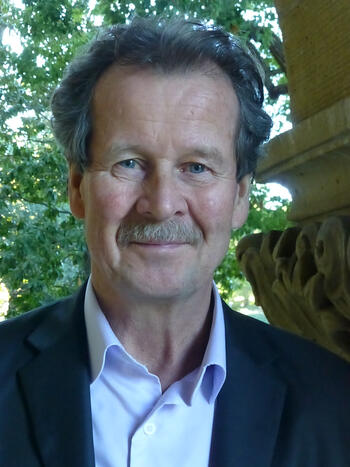
Meet our Visiting Scholars: Manfred Nowak
In each newsletter, The Europe Center would like to introduce you to a visiting scholar or collaborator at the Center. We welcome you to visit the Center and get to know our guests.
Manfred Nowak (LL.M., Columbia University, 1975) is Distinguished Visiting Austrian Chair Professor; Visiting Professor, Stanford Law School; and, Professor of Law, University of Vienna. One of the world’s most renowned human rights scholars and legal theorists, Nowak has published more than 400 books and articles on international, constitutional, administrative, and human rights law, including the standard commentary on the International Covenant on Civil and Political Rights. He was the Director of the Netherlands Institute of Human Rights at the University of Utrecht (1987-1989), and he founded the Austrian Ludwig Boltzmann Institute of Human Rights in 1989. From 1996-2003, Nowak was a judge at the Human Rights Chamber in Bosnia. He has also served as a U.N. legal expert on missing persons and enforced disappearances, and was appointed the U.N. Special Rapporteur on Torture and other Cruel, Inhuman or Degrading Treatment in 2004.
Manfred Nowak was awarded the UNESCO Prize for the Teaching of Human Rights in 1994 and the Bruno Kreisky Prize for Human Rights in 2007.
Workshop Schedules
The Europe Center invites you to attend the talks of speakers in the following workshop series:
Europe and the Global Economy
February 20, 2014
Alan Deardorff, John W. Sweetland Professor of International Economics & Prof. of Economics and Public Policy, University of Michigan
RSVP by Feb 19, 2014
Mar 6, 2014
Sophie Meunier, Research Scholar, Woodrow Wilson School and Co-Director, EU Program at Princeton, Princeton University
RSVP by Mar 3, 2014
Mar 13, 2014
Randy Stone, Professor of Political Science, University of Rochester
RSVP by Mar 10, 2014
Apr 3, 2014
Kåre Vernby, Associate Professor, Department of Government, Uppsala University
RSVP by Mar 31, 2014
Apr 17, 2014
Mark Hallerberg, Professor of Public Management and Political Economy, Hertie School of Governance
RSVP by Apr 4, 2014
May 15, 2014
Christina Davis, Prof. of Politics and International Affairs, Princeton University
RSVP by May 12, 2014
European Governance
May 22, 2014
Wolfgang Ischinger, Former German Ambassador to the U.S.; Chairman, Munich Security Conference
RSVP by May 19, 2014
May 29, 2014
Simon Hug, Professor of Political Science, University of Geneva
RSVP by May 26, 2014
The Europe Center Sponsored Events
We invite you to attend the following events sponsored or co-sponsored by The Europe Center:
March 6, 2014
“Promise and Critique of Capitalism: Changing Discourses Since the 18th Century”
Jürgen Kocka, Professor and Former President of the Social Science Research Center, Berlin
Location: Watt Room, Stanford Humanities Center
March 6 and 7, 2014
Indian Ocean Conference
“Connecting Continents: Setting an Agenda for a Historical Archaeology of the Indian Ocean World”
Location: Stanford Archaeology Center, Building 500, 488 Escondido Mall
March 31, 2014
Simon Hix, Professor of European and Comparative Politics, London School of Economics and Political Science
Political Science Comparative Politics Workshop
Location: Encina Hall West Room 400
April 15, 2014
Ulrich Wilhelm, Director General, Bavarian Broadcasting Corporation
“Assessing the Impact of the NSA Spy Scandal on American-European Relations”
The Europe Center and FSI Stanford Special Event
Location: Oksenberg Conference Room, Encina Hall
Other Events
The Europe Center also invites you to attend the following events of interest:
February 20, 2014
Gregory Shaffer, Melvin C. Steen Professor of Law, University of Minnesota Law School
“How the WTO Shapes Regulatory Governance”
Room 185, Stanford Law School
European Entrepreneurship & Innovation @Stanford Engineering
February 24, 2014
“Switzerland and Turkey - Venture Capital and Product Design Firms”
Giuseppe Zocco, Founding Partner, Index Ventures; Emrah Yalaz, CEO, Spring Ventures
March 3, 2014
“Flanders and Sweden - Enterprise Software and VC Funds”
Lieven Vermaele, CEO, SDNsquare; Martin Hauge, Founding Partner, Creandum
March 10, 2014
“Hungary and Italy - Digital Infrastructure Startups and ‘Maker’ Movements”
Gyula Feher, CTO & Co-Founder, Ustream
Location: Hewlett 201 Auditorium, Engineering School
We welcome you to visit our website for additional details.


 Since Kim Jong Un came to power, interest in North Korea (DPRK) has increased but it is difficult to judge whether the growing range of media reports and the commentaries based on them are accurate or not. Spending almost 30 months in the DPRK from March 2012, mainly in Pyongyang but also making visits outside, offered an opportunity to collect up-to-date materials, especially photographs, which may offer an insight into the changes taking place. These might offer a new angle to be considered and hopefully stimulate further discussion about what is really happening in the DPRK now.