FSI scholars produce research aimed at creating a safer world and examing the consequences of security policies on institutions and society. They look at longstanding issues including nuclear nonproliferation and the conflicts between countries like North and South Korea. But their research also examines new and emerging areas that transcend traditional borders – the drug war in Mexico and expanding terrorism networks. FSI researchers look at the changing methods of warfare with a focus on biosecurity and nuclear risk. They tackle cybersecurity with an eye toward privacy concerns and explore the implications of new actors like hackers.
Along with the changing face of conflict, terrorism and crime, FSI researchers study food security. They tackle the global problems of hunger, poverty and environmental degradation by generating knowledge and policy-relevant solutions.
Is Europe "elderly and haggard", and could France become "the crucible of Europe" (Jan. 10, 2015 NYTimes op-ed)?
On the one hand, Europe is warned by the US about an Asian "pivot", and is perceived here as less relevant and effective. Significantly, certainly as a wake up call, Pope Francis recently compared Europe to a "grandmother, no longer fertile and vibrant, increasingly a bystander in a world that has apparently become less and less Eurocentric”. France had been previously presented here as an eminent representative of an "Old Europe".
On the other hand, the US has been constantly, during the last decade, advocating for a stronger Europe and stressing a special French role in this endeavour. A few days ago, after the terrorist attacks in Paris, President Obama publicly stated that "France was the US oldest Ally".
At a time when we have to face common challenges in the Middle East and in Africa, to adapt to new emerged actors and a more assertive Russia, to deal with direct threats including in the field of proliferation and the cyber space, to define a multipolar world and organize our economic relation (TTIP), what can be the EU contribution? What can also be a special intellectual and diplomatic French input to this global realignment?
Co-sponsored by The Europe Center, the Center for International Security and Cooperation and the France-Stanford Center.
Image
Ambassador Eric Lebédel is a French diplomat, former ambassador to the OSCE and to Finland, with a deep experience in Transatlantic relationship (twice as Minister's advisor; in the French embassy in Washington DC) and in European affairs. He is also involved in crisis management (PMs office), international security (embassy in Moscow, consul general in Istanbul) and multilateral diplomacy ( NATO's Director for crisis management, OSCE). Presently working on Strategic Partnerships for the French MFA and interested in e.diplomacy, he also regularly lectures at Sciences-po and ENA (Ecole Nationale d'Administration) on crisis management and Europe.
CISAC Interschool Honors Program in International Security Studies
INFORMATION SESSION
for Stanford undergraduates interested in applying for the 2015-2016 academic year
Meet program faculty, current students, and alumni.
Learn about the program.
Eat pizza!
CISAC’s Interschool Honors Program in International Security Studies provides Stanford undergraduates with strong academic records and interest in international security topics from all undergraduate schools and majors the opportunity to earn Honors in International Security Studies by writing a rigorous, policy-relevant thesis.
Students are admitted to the program on a competitive basis.
Freeman Spogli Institute for International Studies
Stanford University
Encina Hall
616 Serra Street, C137
Stanford, CA 94305-6055
(650) 725-5368
(650) 723-3435
0
cblacker@stanford.edu
Senior Fellow Emeritus at the Freeman Spogli Institute for International Studies
Olivier Nomellini Professor Emeritus in International Studies at the School of Humanities and Sciences
coit_blacker_2022.jpg
PhD
Coit Blacker is a senior fellow emeritus at the Freeman Spogli Institute for International Studies, the Olivier Nomellini Professor Emeritus in International Studies at the School of Humanities and Sciences, and a Bass University Fellow in Undergraduate Education. He served as director of FSI from 2003 to 2012. From 2005 to 2011, he was co-chair of the International Initiative of the Stanford Challenge, and from 2004 to 2007, served as a member of the Development Committee of the university's Board of Trustees.
During the first Clinton administration, Blacker served as special assistant to the president for National Security Affairs and senior director for Russian, Ukrainian and Eurasian affairs at the National Security Council (NSC). At the NSC, he oversaw the implementation of U.S. policy toward Russia and the New Independent States, while also serving as principal staff assistant to the president and the National Security Advisor on matters relating to the former Soviet Union.
Following his government service, Blacker returned to Stanford to resume his research and teaching. From 1998 to 2003, he also co-directed the Aspen Institute's U.S.-Russia Dialogue, which brought together prominent U.S. and Russian specialists on foreign and defense policy for discussion and review of critical issues in the bilateral relationship. He was a study group member of the U.S. Commission on National Security in the 21st Century (the Hart-Rudman Commission) throughout the commission's tenure.
In 2001, Blacker was the recipient of the Laurence and Naomi Carpenter Hoagland Prize for Undergraduate Teaching at Stanford.
Blacker holds an honorary doctorate from the Russian Academy of Sciences' Institute of Far Eastern Studies for his work on U.S.-Russian relations. He is a graduate of Occidental College (A.B., Political Science) and the Fletcher School of Law and Diplomacy (M.A., M.A.L.D., and Ph.D).
Blacker's association with Stanford began in 1977, when he was awarded a post-doctoral fellowship by the Arms Control and Disarmament Program, the precursor to the Center for International Security and Cooperation at FSI.
Faculty member at the Center for International Security and Cooperation
Faculty member at the Center on Democracy, Development, and the Rule of Law
Hide publication sections
Off
Date Label
Coit Blacker
Senior Fellow at FSI, Olivier Nomellini Professor in International Studies at the School of Humanities and Sciences
Speaker
Stanford University
Martha Crenshaw
Senior Fellow at FSI and CISAC, Professor of political science by courtesy
Speaker
Stanford University
Sony Pictures Entertainment was set to release a satirical comedy, “The Interview,” in late 2014, but a cyberattack hit the organization that leaked corporate information, leading the company to initially pull the film and opening up a string of theories over who was behind the attack and how to respond.
Speculation began to mount as a clearer picture of the unprecedented hacking, both comprehensive and large in size, began to emerge. The breach is thought to be retribution for Sony’s production of the film, which carries a plot to assassinate North Korean leader Kim Jong-un.
Then, a threat was directed at movie theaters and moviegoers planning to screen and see “The Interview.” The message warned those against involvement ahead of the film’s Dec. 25 opening, indicating a “bitter fate” and alluding to the 9/11 attacks in the United States.
An unknown group, The Guardians of Peace “GOP,” claimed responsibility for the cyberattack. Media and those familiar with North Korea began to point blame on the country, which had already publicly condemned the film last June and has a history of cybercrime. Responding to accusations, top North Korean leadership rejected any involvement in the attack.
Image
The White House responded as Sony canceled the film’s New York premiere and said it would discontinue distribution. Following his year-end press conference, President Barack Obama condemned the hacking, citing the Federal Bureau of Investigation’s conclusion that North Korea was behind the attack. The President said the United States would respond “proportionally,” and on Jan. 2, signed an Executive Order that put into action a series of sanctions imposed by the Department of the Treasury.
David Straub, a Korea expert at Stanford University, answered questions about the Sony hacking and its policy implications for the United States and North-South Korean relations. Straub is the associate director of the Korea Program at the Walter H. Shorenstein Asia-Pacific Research Center. He formerly served as the State Department’s Korean affairs director.
What do we know about the Sony hacking? Who’s responsible?
Based on many types of evidence, including confidential information, U.S. government officials appear to be quite confident that North Korea did in fact conduct this operation. There’s still some disagreement in the media and among tech experts over who is responsible. They’ve cited a number of reasons but the main one is that the FBI’s official statement attributing the attack to North Korea provided evidence that they believe is far from conclusive. I myself am not a technical expert, but based upon my following North Korea for many years – the attack strikes me as being very likely to have been a North Korean operation. The FBI statement noted that the Sony attack is similar to an attack that the North Koreans conducted against South Korean banks and media outlets in March 2013. In that attack, many South Korean banks had their hard drives completely wiped clean. It was a hugely destructive attack and very similar to what happened to Sony.
Does North Korea’s response to the Sony hack coincide with past behavior?
In addition to the 2013 South Korean bank cyberattack, the North Koreans apparently sank a South Korean naval vessel in 2010, killing 46 sailors. In both instances, the North Koreans denied that they did it, expressed outrage over being accused, demanded that the South Koreans produce proof, said that they could prove that they didn’t do it, and then requested that the South Koreans conduct a joint investigation. These same demands are being made in response to the U.S. blaming Pyongyang for the Sony cyberattack. It couldn’t be more similar. More generally, the North Korean regime is very calculating. They know they can’t win an outright military confrontation with South Korea, much less the United States, so what they do is try to find a weak link and go after it in a way in which they have plausible deniability – a situation where it’s very difficult for the attacked party to prove who did it.
Describe North Korea’s hacking capabilities.
North Korea is a very secretive country, so it’s hard to be completely certain of their cyber capabilities. However, according to many accounts, the North Korean government has established professional hacking schools and units over the years, resulting in hundreds if not thousands of trained hackers. North Korea has engaged in a number of attacks in the past, the most prominent one was the attack on South Korean banks in March 2013. But also, a few years ago, North Korea conducted less sophisticated attacks on major U.S. government websites.
Why would they conduct an attack?
The North Koreans appear to have both the capability and the motivation to attack Sony. The nation’s entire political system rests on a cult of personality – now a cult of family, actually – that began with the founder of the regime, Kim Il-sung, and extends to his grandson today, leader Kim Jong-un, who has been in power since Dec. 2011. It’s the only thing holding the political system together at this point. The cult of personality is so strong that any direct criticism of the top leader is something that North Koreans will compete among each other to reject. From this standpoint, it seems very likely that they would feel they had to prevent the showing of a movie that features an assassination of Kim Jong-un. And, the hackers had plenty of time to prepare for and implement the attack because everyone knew well ahead of when the movie would be released.
The United States placed new financial sanctions on North Korea. What impact will the sanctions have?
President Obama made it clear that the U.S. government would respond at a time, in a place, and in a manner of its own choosing. Not all measures taken would be made public. So far, the first publically announced measure was the President’s Executive Order on Jan. 2 imposing additional sanctions on a number of North Korean agencies and officials. This in itself is unlikely to have major consequences because most of those entities were already sanctioned. But, the Executive Order states that the sanctions are being implemented not only because of the cyberattack against Sony, but more generally because of North Korea’s actions and policies, including its serious human rights abuses. So in a sense, the North Koreans got the United States to expand its reasons for sanctioning them.
President Obama addresses the Sony hacking, saying the United States will "respond proportionally," at his year-end press briefing on Dec. 19.
President Obama addresses the Sony hacking at his year-end press briefing on Dec. 19. Photo credit: WhiteHouse.gov
What other steps will the United States likely take?
President Obama left open the possibility that North Korea might be returned to the U.S. State Sponsors of Terrorism list, from which the nation was removed in 2008. I think it was a mistake to remove North Korea from that list in the first place. It was done to promote progress on the nuclear talks, which eventually failed, and ignored a number of terroristic actions that North Korea has committed in recent years. Another possibility, which is being pushed by Republicans in Congress, is to increase financial sanctions that mirror the type that were successfully implemented in Iran.
How will the U.S. response influence cybersecurity policy going forward?
The attack on Sony is a huge wakeup call to American businesses, and even to the U.S. government. It’s the first attack of this size on a company located in the United States. It got tremendous profile in the media and the President has been personally engaged in responding. Nearly everyone has heard about it, so U.S. companies are now going to be focused much more on cybersecurity because it has exposed some potential vulnerabilities – a “if North Korea can do it, presumably others can too” mentality. Moreover, if an attack can be executed on a film company, it could also be done to other businesses and even to elements of U.S. critical infrastructure.
How do you view North Korean leader Kim Jong-un’s possible offer to meet with South Korean leadership this year?
Kim Jong-un said that he was open to the possibility of a summit with South Korea in his annual New Year’s address, although he made no specific proposal. He made clear that the summit would be conditional on actions to be taken in advance by South Korea. Among these, Kim demanded ending U.S.-South Korean military exercises and halting the flow of propaganda-filled balloons sent over the border into the North by non-governmental activist groups in the South. Moreover, North Korea has a history of expanding its conditions later, without any warning. So, I think one has to be skeptical. The signal is unfortunately less likely to be a sincere effort toward real, sustained dialogue, and more likely to be a North Korean propaganda effort devised to confuse, divert and divide international public opinion. That said, South Korea has acted entirely appropriately in welcoming the signal and reiterating its own offer of high-level talks. Let’s hope for the best.
David Straub also participated in an interview with Public Radio International on Jan. 1 about the prospect for North-South talks, the audio can be accessed on the PRI website.
Hero Image
"The Interview," a Sony Pictures film starring actors Seth Rogen and James Franco about a fictional plot to assasinate North Korean leader Kim Jong-un, releases in theaters. | Reuters/Kevork Djansezian
This event is open to Stanford undergraduate students only.
The Center on Democracy, Development, and the Rule of Law (CDDRL) is currently accepting applications from eligible juniors due February 27, 2015 who are interested in writing their senior thesis on a subject touching upon democracy, economic development, and rule of law (DDRL) from any university department. CDDRL faculty and current honors students will be present to discuss the program and answer any questions.
For more information on the CDDRL Senior Honors Program, please click here.
Class of 2015 in front of the White House with Francis Fukuyama.
[[{"fid":"217337","view_mode":"crop_870xauto","fields":{"format":"crop_870xauto","field_file_image_description[und][0][value]":"SHP15 Info Session Flyer","field_file_image_alt_text[und][0][value]":"","field_file_image_title_text[und][0][value]":"","field_credit[und][0][value]":"","field_caption[und][0][value]":"SHP15 Info Session Flyer","field_related_image_aspect[und][0][value]":"","thumbnails":"crop_870xauto","pp_lightbox":false,"pp_description":false},"type":"media","attributes":{"height":1056,"width":870,"class":"media-element file-crop-870xauto"}}]]
Encina Hall, C148
616 Jane Stanford Way
Stanford, CA 94305
0
f.fukuyama@stanford.edu
Olivier Nomellini Senior Fellow at the Freeman Spogli Institute for International Studies
Director of the Ford Dorsey Master's in International Policy
Research Affiliate at The Europe Center
Professor by Courtesy, Department of Political Science
yff-2021-14290_6500x4500_square.jpg
Francis Fukuyama is the Olivier Nomellini Senior Fellow at Stanford University's Freeman Spogli Institute for International Studies (FSI), and a faculty member of FSI's Center on Democracy, Development and the Rule of Law (CDDRL). He is also Director of Stanford's Ford Dorsey Master's in International Policy, and a professor (by courtesy) of Political Science.
Dr. Fukuyama has written widely on issues in development and international politics. His 1992 book, The End of History and the Last Man, has appeared in over twenty foreign editions. His book In the Realm of the Last Man: A Memoir will be published in fall 2026.
Francis Fukuyama received his B.A. from Cornell University in classics, and his Ph.D. from Harvard in Political Science. He was a member of the Political Science Department of the RAND Corporation, and of the Policy Planning Staff of the US Department of State. From 1996-2000 he was Omer L. and Nancy Hirst Professor of Public Policy at the School of Public Policy at George Mason University, and from 2001-2010 he was Bernard L. Schwartz Professor of International Political Economy at the Paul H. Nitze School of Advanced International Studies, Johns Hopkins University. He served as a member of the President’s Council on Bioethics from 2001-2004. He is editor-in-chief of American Purpose, an online journal.
Dr. Fukuyama holds honorary doctorates from Connecticut College, Doane College, Doshisha University (Japan), Kansai University (Japan), Aarhus University (Denmark), the Pardee Rand Graduate School, and Adam Mickiewicz University (Poland). He is a non-resident fellow at the Carnegie Endowment for International Peace. He is a member of the Board of Trustees of the Rand Corporation, the Board of Trustees of Freedom House, and the Board of the Volcker Alliance. He is a fellow of the National Academy for Public Administration, a member of the American Political Science Association, and of the Council on Foreign Relations. He is married to Laura Holmgren and has three children.
(October 2025)
Global Populisms
A new project examining the global surge in populist movements and what it means for established democratic rules and institutions.
Encina Hall, C150
616 Jane Stanford Way
Stanford, CA 94305
0
jdkuo@stanford.edu
Center Fellow, Freeman Spogli Institute for International Studies
didi_kuo_2023.jpg
Didi Kuo is a Center Fellow at the Freeman Spogli Institute for International Studies (FSI) at Stanford University. She is a scholar of comparative politics with a focus on democratization, corruption and clientelism, political parties and institutions, and political reform. She is the author of The Great Retreat: How Political Parties Should Behave and Why They Don’t (Oxford University Press) and Clientelism, Capitalism, and Democracy: the rise of programmatic politics in the United States and Britain (Cambridge University Press, 2018).
She has been at Stanford since 2013 as the manager of the Program on American Democracy in Comparative Perspective and is co-director of the Fisher Family Honors Program at CDDRL. She was an Eric and Wendy Schmidt Fellow at New America and is a non-resident fellow with the Carnegie Endowment for International Peace. She received a PhD in political science from Harvard University, an MSc in Economic and Social History from Oxford University, where she studied as a Marshall Scholar, and a BA from Emory University.
This event is offered as a joint sponsorship with the Hoover Institution Library & Archives.
About the Topic: Sarah Chayes's book, "Thieves of State: Why Corruption Threatens Global Security," presents an explosive argument: many of today's major world crises -- the ISIS takeover of much of Iraq and Syria, the robust Afghan and Nigerian insurgencies, the Arab Spring and Ukrainian revolutions and their aftermaths -- have their roots in systemic corruption. If this is the case, then the policy priority of addressing corruption must be raised. Rather than a marginal concern to be passed off to development agencies or specialized bureaus, anti-corruption must pervade the conduct of foreign policy. Thieves of State is a riveting book; Chayes will provide a few short readings and reflections on its implications before engaging a conversation with the public.
About the Speaker: A senior associate at the Carnegie Endowment for International Peace, Sarah Chayes served as special assistant to the chairman of the Joint Chiefs of Staff in 2010 and 2011. She is an expert on kleptocracy and anti-corruption, civil-military relations, and South Asia policy. Chayes joined the Pentagon after 8 years living and working in Kandahar, Afghanistan, and advising the command of the international forces in Afghanistan. Since leaving government, she has been conducting in-depth research on the security implications of acute corruption in such contexts as the insurgencies in Iraq, Syria, South and Central Asia, and Nigeria, and the revolutions of the Arab Spring and Ukraine. Her work has been dubbed "revolutionary" and "a paradigm shift" by senior professionals in foreign and security policy.
A climate of uncertainty marks the Xi administration’s second year in power. The unfurling of a nationwide anti-corruption campaign, including high-profile domestic and international targets, may have unintended effects on economic growth. But will these effects be short- or long-lived? Can this campaign build confidence, domestically and internationally, in the party’s governing capacity? Questions also swirl around the motivations for reviving Mao-era language in the political realm while maintaining a relentless urbanization drive in the social and economic realms.
For 14 years, Mariano-Florentino Cuéllar has been a tireless Stanford professor who has strengthened the fabric of university’s interdisciplinary nature. Joining the faculty at Stanford Law School in 2001, Cuéllar soon found a second home for himself at the Freeman Spogli for International Studies. He held various leadership roles throughout the institute for several years – including serving as co-director of the Center for International Security and Cooperation. He took the helm of FSI as the institute’s director in 2013, and oversaw a tremendous expansion of faculty, research activity and student engagement.
An expert in administrative law, criminal law, international law, and executive power and legislation, Cuéllar is now taking on a new role. He leaves Stanford this month to serve as justice of the California Supreme Court and will be succeeded at FSI by Michael McFaul on Jan. 5.
As the academic quarter comes to a close, Cuéllar took some time to discuss his achievements at FSI and the institute’s role on campus. And his 2014 Annual Letter and Report can be read here.
You’ve had an active 20 months as FSI’s director. But what do you feel are your major accomplishments?
We started with a superb faculty and made it even stronger. We hired six new faculty members in areas ranging from health and drug policy to nuclear security to governance. We also strengthened our capacity to generate rigorous research on key global issues, including nuclear security, global poverty, cybersecurity, and health policy. Second, we developed our focus on teaching and education. Our new International Policy Implementation Lab brings faculty and students together to work on applied projects, like reducing air pollution in Bangladesh, and improving opportunities for rural schoolchildren in China. We renewed FSI's focus on the Ford Dorsey Program in International Policy Studies, adding faculty and fellowships, and launched a new Stanford Global Student Fellows program to give Stanford students global experiences through research opportunities. Third, we bolstered FSI's core infrastructure to support research and education, by improving the Institute's financial position and moving forward with plans to enhance the Encina complex that houses FSI.
Finally, we forged strong partnerships with critical allies across campus. The Graduate School of Business is our partner on a campus-wide Global Development and Poverty Initiative supporting new research to mitigate global poverty. We've also worked with the Law School and the School of Engineering to help launch the new Stanford Cyber Initiative with $15 million in funding from the Hewlett Foundation. We are engaging more faculty with new health policy working groups launched with the School of Medicine and an international and comparative education venture with the Graduate School of Education.
Those partnerships speak very strongly to the interdisciplinary nature of Stanford and FSI. How do these relationships reflect FSI's goals?
The genius of Stanford has been its investment in interdisciplinary institutions. FSI is one of the largest. We should be judged not only by what we do within our four walls, but by what activity we catalyze and support across campus. With the business school, we've launched the initiative to support research on global poverty across the university. This is a part of the SEED initiative of the business school and it is very complementary to our priorities on researching and understanding global poverty and how to alleviate. It's brought together researchers from the business school, from FSI, from the medical school, and from the economics department.
Another example would be our health policy working groups with the School of Medicine. Here, we're leveraging FSI’s Center for Health Policy, which is a great joint venture and allows us to convene people who are interested in the implementation of healthcare reforms and compare the perspective and on why lifesaving interventions are not implemented in developing countries and how we can better manage biosecurity risks. These working groups are a forum for people to understand each other's research agendas, to collaborate on seeking funding and to engage students.
I could tell a similar story about our Mexico Initiative. We organize these groups so that they cut across generations of scholars so that they engage people who are experienced researchers but also new fellows, who are developing their own agenda for their careers. Sometimes it takes resources, sometimes it takes the engagement of people, but often what we've found at FSI is that by working together with some of our partners across the university, we have a more lasting impact.
Looking at a growing spectrum of global challenges, where would you like to see FSI increase its attention?
FSI's faculty, students, staff, and space represent a unique resource to engage Stanford in taking on challenges like global hunger, infectious disease, forced migration, and weak institutions. The key breakthrough for FSI has been growing from its roots in international relations, geopolitics, and security to focusing on shared global challenges, of which four are at the core of our work: security, governance, international development, and health.
These issues cross borders. They are not the concern of any one country.
Geopolitics remain important to the institute, and some critical and important work is going on at the Center for International Security and Cooperation to help us manage the threat of nuclear proliferation, for example. But even nuclear proliferation is an example of how the transnational issues cut across the international divide. Norms about law, the capacity of transnational criminal networks, smuggling rings, the use of information technology, cybersecurity threats – all of these factors can affect even a traditional geopolitical issue like nuclear proliferation.
So I can see a research and education agenda focused on evolving transnational pressures that will affect humanity in years to come. How a child fares when she is growing up in Africa will depend at least as much on these shared global challenges involving hunger and poverty, health, security, the role of information technology and humanity as they will on traditional relations between governments, for instance.
What are some concrete achievements that demonstrate how FSI has helped create an environment for policy decisions to be better understood and implemented?
We forged a productive collaboration with the U.N. High Commissioner for Refugees through a project on refugee settlements that convened architects, Stanford researchers, students and experienced humanitarian responders to improve the design of settlements that house refugees and are supposed to meet their human needs. That is now an ongoing effort at the UN Refugee Agency, which has also benefited from collaboration with us on data visualization and internship for Stanford students.
Our faculty and fellows continue the Institute's longstanding research to improve security and educate policymakers. We sometimes play a role in Track II diplomacy on sensitive issues involving global security – including in South Asia and Northeast Asia. Together with Hoover, We convened a first-ever cyber bootcamp to help legislative staff understand the Internet and its vulnerabilities. We have researchers who are in regular contact with policymakers working on understanding how governance failures can affect the world's ability to meet pressing health challenges, including infectious diseases, such as Ebola.
On issues of economic policy and development, our faculty convened a summit of Japanese prefectural officials work with the private sector to understand strategies to develop the Japanese economy.
And we continued educating the next generation of leaders on global issues through the Draper Hills summer fellows program and our honors programs in security and in democracy and the rule of law.
How do you see FSI’s role as one of Stanford’s independent laboratories?
It's important to recognize that FSI's growth comes at particularly interesting time in the history of higher education – where universities are under pressure, where the question of how best to advance human knowledge is a very hotly debated question, where universities are diverging from each other in some ways and where we all have to ask ourselves how best to be faithful to our mission but to innovate. And in that respect, FSI is a laboratory. It is an experimental venture that can help us to understand how a university like Stanford can organize itself to advance the mission of many units, that's the partnership point, but to do so in a somewhat different way with a deep engagement to practicality and to the current challenges facing the world without abandoning a similarly deep commitment to theory, empirical investigation, and rigorous scholarship.
What have you learned from your time at Stanford and as director of FSI that will inform and influence how you approach your role on the state’s highest court?
Universities play an essential role in human wellbeing because they help us advance knowledge and prepare leaders for a difficult world. To do this, universities need to be islands of integrity, they need to be engaged enough with the outside world to understand it but removed enough from it to keep to the special rules that are necessary to advance the university's mission.
Some of these challenges are also reflected in the role of courts. They also need to be islands of integrity in a tumultuous world, and they require fidelity to high standards to protect the rights of the public and to implement laws fairly and equally.
This takes constant vigilance, commitment to principle, and a practical understanding of how the world works. It takes a combination of humility and determination. It requires listening carefully, it requires being decisive and it requires understanding that when it's part of a journey that allows for discovery but also requires deep understanding of the past.
Abstract: The “unsinkable” RMS Titanic sank on April 14, 1912, in the North Atlantic Ocean on its maiden voyage from Southampton, UK, to New York City. There was no single cause for the loss of the Titanic; rather the improbable combination of errors in human design and judgment, combined with unforeseeable circumstance, led to the loss of over 1,500 lives. The failure appears to have occurred over a range of spatial and temporal scales – from the atomic-scale processes of the embrittlement of iron rivets to global-scale fluctuations in climate and ocean currents. Regardless of the specific combination of causes, this failure in design and practice led to impressive improvements in both. Disaster and tragedy are harsh teachers, but critical to improvement and progress.
The important question for the nuclear waste management community is: How do we learn and improve our waste management strategies in the absence of the benefit of failure? A geologic repository “operates” over a very distant time fame, and today’s scientists and engineers will never have the benefit of studying the failed system. In place of failure followed by improvements, we only can offer a general consensus on disposal strategies and their effectiveness. However, it may well be that consensus leads to complacency and compromise, both of which may be harbingers of a failed repository. I will discuss these issues in the context of recent accidents and the release of radioactivity at the Waste Isolation Pilot Plant, a geologic repository in southeastern New Mexico.
About the Speaker: Rod Ewing is the Frank Stanton Professor in Nuclear Security in the Center for International Security and Cooperation in the Freeman Spogli Institute for International Studies and a Professor in the Department of Geological and Environmental Sciences in the School of Earth Sciences. Ewing’s research focuses on the back-end of the nuclear fuel cycle, mainly nuclear materials and the geochemistry of radionuclides with application to permanent geologic disposal. He is the past president of the International Union of Materials Research Societies. Ewing has written extensively on issues related to nuclear waste management and is a co-editor of Radioactive Waste Forms for the Future (1988) and Uncertainty Underground – Yucca Mountain and the Nation’s High-Level Nuclear Waste (2006). He received the Lomonosov Gold Medal of the Russian Academy of Sciences in 2006. In 2012, he was appointed by President Obama to chair the Nuclear Waste Technical Review Board, which provides scientific and technical reviews of the Department of the Energy’s programs for the management and disposal of spent nuclear fuel and high-level radioactive waste. In 2015, he will receive the Roebling Medal of the Mineralogical Society of America.
CISAC
Stanford University
Encina Hall, E203
Stanford, CA 94305-6165
(650) 725-8641
0
rewing1@stanford.edu
1946-2024
Senior Fellow at the Freeman Spogli Institute for International Studies
Frank Stanton Professor in Nuclear Security
Professor of Geological Sciences
rodewingheadshot2014.jpg
MS, PhD
Rod Ewing was the Frank Stanton Professor in Nuclear Security and Co-Director of the Center for International Security and Cooperation in the Freeman Spogli Institute for International Studies and a Professor in the Department of Geological Sciences in the School of Earth, Energy and Environmental Sciences at Stanford University. He was also the Edward H. Kraus Distinguished University Professor Emeritus at the University of Michigan, where he had faculty appointments in the Departments of Earth & Environmental Sciences, Nuclear Engineering & Radiological Sciences and Materials Science & Engineering. He was a Regents' Professor Emeritus at the University of New Mexico, where he was a member of the faculty from 1974 to 1997. Ewing received a B.S. degree in geology from Texas Christian University (1968, summa cum laude) and M.S. (l972) and Ph.D. (l974, with distinction) degrees from Stanford University where he held an NSF Fellowship. His graduate studies focused on an esoteric group of minerals, metamict Nb-Ta-Ti oxides, which are unusual because they have become amorphous due to radiation damage caused by the presence of radioactive elements. Over the past thirty years, the early study of these unusual minerals has blossomed into a broadly-based research program on radiation effects in complex ceramic materials. In 2001, the work on radiation-resistant ceramics was recognized by the DOE, Office of Science – Decades of Discovery as one of the top 101 innovations during the previous 25 years. This has led to the development of techniques to predict the long-term behavior of materials, such as those used in radioactive waste disposal.
He was the author or co-author of over 750 research publications and the editor or co-editor of 18 monographs, proceedings volumes or special issues of journals. He had published widely in mineralogy, geochemistry, materials science, nuclear materials, physics and chemistry in over 100 different ISI journals. He was granted a patent for the development of a highly durable material for the immobilization of excess weapons plutonium. He was a Founding Editor of the magazine, Elements, which is now supported by 17 earth science societies. He was a Principal Editor for Nano LIFE, an interdisciplinary journal focused on collaboration between physical and medical scientists. In 2014, he was named a Founding Executive Editor of Geochemical Perspective Letters and appointed to the Editorial Advisory Board of Applied Physics Reviews.
Ewing had received the Hawley Medal of the Mineralogical Association of Canada in 1997 and 2002, a Guggenheim Fellowship in 2002, the Dana Medal of the Mineralogical Society of America in 2006, the Lomonosov Gold Medal of the Russian Academy of Sciences in 2006, a Honorary Doctorate from the Université Pierre et Marie Curie in 2007, the Roebling Medal of the Mineralogical Society of America in 2015, Ian Campbell Medal of the American Geoscience Institute, 2015, the Medal of Excellence in Mineralogical Sciences from the International Mineralogical Association in 2015, the Distinguished Public Service Medal of the Mineralogical Society of America in 2019, and was a foreign Fellow of the Royal Society of Canada. He was also a fellow of the Geological Society of America, Mineralogical Society of America, Mineralogical Society of Great Britain and Ireland, American Geophysical Union, Geochemical Society, American Ceramic Society, the American Association for the Advancement of Science and the Materials Research Society. He was elected a Fellow of the National Academy of Engineering in 2017.
He was president of the Mineralogical Society of America (2002) and the International Union of Materials Research Societies (1997-1998). He was the President of the American Geoscience Institute (2018). Ewing had served on the Board of Directors of the Geochemical Society, the Board of Governors of the Gemological Institute of America and the Science and Security Board of the Bulletin of the Atomic Scientists.
He was co-editor of and a contributing author of Radioactive Waste Forms for the Future (North-Holland Physics, Amsterdam, 1988) and Uncertainty Underground – Yucca Mountain and the Nation’s High-Level Nuclear Waste (MIT Press, 2006). Professor Ewing had served on thirteen National Research Council committees and board for the National Academy of Sciences, Engineering and Medicine that have reviewed issues related to nuclear waste and nuclear weapons. In 2012, he was appointed by President Obama to serve as the Chair of the Nuclear Waste Technical Review Board, which is responsible for ongoing and integrated technical review of DOE activities related to transporting, packaging, storing and disposing of spent nuclear fuel and high-level radioactive waste; he stepped down from the Board in 2017.
A unified Korea is likely but it won’t come easily, said Stanford professor Gi-Wook Shin, in a recent interview with NK News. The most plausible scenario is reunification following a breakdown of the North Korean regime and eventual South Korean absorption of the North.
“Of course, I cannot predict the timing of such an occurrence, but it is likely that it will happen in the not-too-distant future,” said Shin, director of the Walter H. Shorenstein Asia-Pacific Research Center, in a Q&A among a panel of experts on inter-Korean relations.
In the event of unification, Shin says he is convinced it will be on South Korean terms. He said he doubts that the North Korean government, led by leader Kim Jong-Un and the ruling Worker’s Party of Korea, would find a role in South Korea’s democratic system.
Shin heads a multiyear research project focused on understanding the domestic and global implications of North Korea’s future. Earlier this year, he coauthored a policy brief assessing the situation and policy context on the Korean Peninsula. The report recommends steps that the South Korean government can take to engage North Korea toward the ultimate goal of Korean unification and a sustainable security environment in Northeast Asia.



 President Obama addresses the Sony hacking, saying the United States will "respond proportionally," at his year-end press briefing on Dec. 19.

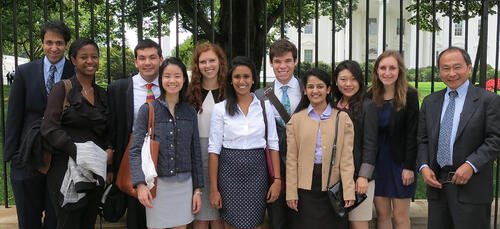 Class of 2015 in front of the White House with Francis Fukuyama.


![presidente fox[1]](https://fsi9-prod.s3.us-west-1.amazonaws.com/s3fs-public/styles/300x185_x2/public/evnts/5229/presidente_fox%5B1%5D.jpg?itok=UFWvykp-)
