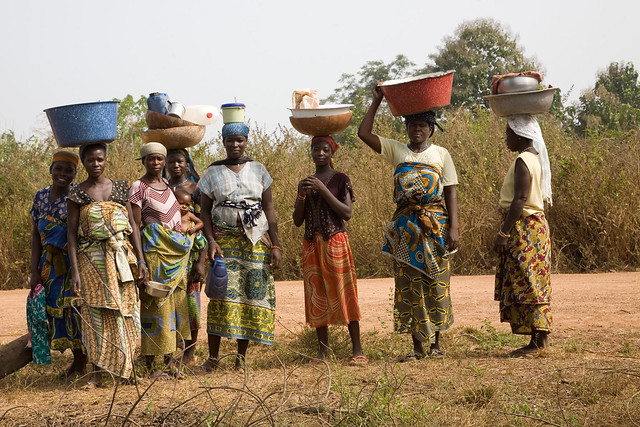
FSI researchers examine the role of energy sources from regulatory, economic and societal angles. The Program on Energy and Sustainable Development (PESD) investigates how the production and consumption of energy affect human welfare and environmental quality. Professors assess natural gas and coal markets, as well as the smart energy grid and how to create effective climate policy in an imperfect world. This includes how state-owned enterprises – like oil companies – affect energy markets around the world. Regulatory barriers are examined for understanding obstacles to lowering carbon in energy services. Realistic cap and trade policies in California are studied, as is the creation of a giant coal market in China.
New fellows to study China's automotive industry and religious tolerance in Indonesia
In September, Crystal Chang and Jeremy M. Menchik will join the Walter H. Shorenstein Asia-Pacific Research Center (Shorenstein APARC) as its Shorenstein Fellows for the 2011–2012 academic year.
Crystal Chang, a PhD candidate with the Department of Political Science at the University of California, Berkeley, is currently completing her dissertation on China's growing independent automotive industry. Her research examines Chinese automakers alongside historical case studies from Japan and Korea. During her time at Shorenstein APARC, she will expand her dissertation to include a comparative study of India's contemporary automotive industry, which, like China's, has experienced domestic and international success. She will also continue research that she is currently conducting about China's private energy sector, with a focus on the solar power industry. Chang holds an MPIA degree in international management from the University of California, San Diego, and a BA in international relations from Stanford University.
Jeremy Menchik, a PhD candidate with the Department of Political Science at the University of Wisconsin-Madison (UW-Madison), is finishing his dissertation, which poses the question: what is the basis for religious tolerance in Indonesia, and why does it sometimes break down? He addresses this question through a study of Indonesian civil society and of three of the country's largest and oldest Islamic organizations: Nahdlatul Ulama, Muhammadiyah, and Persatuan Islam. Menchik has conducted extensive field research in Indonesia during the course of his graduate studies. At Shorenstein APARC, he will prepare his dissertation for publication and develop related projects on Islamic law, political tolerance, and political symbolism in Indonesian elections. Menchik holds an MA in political science from UW-Madison and a BA, also in political science, from the University of Michigan.
Established in 2002 through the generosity of Walter H. Shorenstein, the Shorenstein Fellowship in Contemporary Asia is an exciting opportunity for junior scholars to spend a year at Shorenstein APARC, engaging with other scholars and experiencing the world-class resources—ranging from libraries to events—that Stanford University has to offer. Shorenstein APARC looks forward to welcoming Chang and Menchik to the center in the coming academic year.
Lessons from the Failure of Nuclear Negotiations with North Korea
Today nuclear negotiations with North Korea, begun twenty years ago, have returned to their starting point. The Geneva Agreement of 1994 collapsed as a result of North Korea’s clandestine uranium enrichment program, and the PRC-hosted Six Party talks have failed to halt nuclear tests by North Korea. Neither the engagement policy of the Clinton Administration nor the coercive policy of President Bush succeeded in resolving the North Korean nuclear conundrum. The North now claims it should be treated as a nuclear weapons state.
North Korea is currently waging a "peace offensive" to deflect criticism from the international community for its reckless military provocations against South Korea last year. The North may also need dialogue with the international community more than we do, to obtain economic assistance, since starving people would not support their regime and nuclear weapons cannot feed its people. The United States and South Korea agree, however, that under present circumstances, engagement with North Korea would be futile. They maintain that their refusal to resume talks with North Korea is a deliberate and strategic decision. Looking back on real-world experience, North Korea has consistently used provocations as "leverage" to arrive at negotiations on its terms. In most cases, it has gained considerable concessions, using its well-known brinkmanship tactics.
Now that North Korea has confirmed the existence of its uranium enrichment program and announced it will begin constructions of LWRs on its own, neighboring countries are deeply concerned about nuclear safety—not to mention nuclear security—in North Korea. This provides a reason for an unconditional dialogue with North Korea, apparently precisely the situation North sought. In this light, Mr. Yu will review the last twenty years of negotiations with North Korea to draw lessons for dealing with the regime in the future.
Mr. Yu is a former Minister of Foreign Affairs and Trade of Korea. He served as Korea's Ambassador to Israel, Japan and Philippines.
Philippines Conference Room
Myung Hwan Yu
Shorenstein APARC
Encina Hall E313
616 Serra Street
Stanford, CA 94305-6055
Mr. Yu is a former Minister of Foreign Affairs and Trade of Korea. He served as Korea's Ambassador to Israel, Japan and Philippines.
Hoffmann and Jeon on using ICT for clean water in Kibera
The February 10 Liberation Technology seminar titled, Can ICT Improve Clean Water Delivery Systems in Slums? Lessons from Kibera was led by two Stanford students, Katherine Hoffman, M.A. Candidate in International Policy Studies and Global Health together with Sunny Jeon, PhD candidate in Political Science. Hoffman and Jeon presented on the topic of the M-Maji system, a start-up non-profit project that uses mobile phones to empower communities with better information about water availability, price, and quality. M-Maji emerged from the Designing Liberation Technologies course taught at the Stanford d.school, which is dedicated to using mobile phone technology for health improvement in Kibera.
The M-Maji project was conceived to confront a specific need in one of Africa's largest informal settlements: Nairobi's Kibera slum. Kibera holds about one quarter of Nairobi's population, but lacks a formal water and sanitation system. In short, water in Kibera is scarce, costly, uncertain, and often contaminated. The cost of water can rise up to over $3 per square meter during a shortage, and often takes up 20% of residents' income. Water is uncertain because about 40% of vendors in Kibera do not have access to a constant supply of water, especially since many of the connections that they do use are illegal. Additionally, water is often contaminated because water pipes run through sewer areas and are often plastic, since metal pipes would be taken as scrap. The result of these conditions is that the average person spends about 55 minutes per day looking for water, and about 68% of residents use informal water kiosks to access water.
M-Maji is a mobile platform designed to address problems facing both the seller and buyer of water in Kibera. Sellers report information about water availability and price at their water kiosk, enabling them to attract customers. Meanwhile, buyers access the system to find information about where water is available, at what price and at what level of quality. A third feature of the platform enables complaints and feedback regarding water sources. By coordinating and centralizing water information from multiple sources, M-Maji is designed to empower residents with better information about water availability, price, and quality, which ultimately helps to improve access to clean water.
There are several key reasons why a mobile platform that tackles the information side of the problem may be effective in solving the water problem in Kibera:
- The water market is distorted, but not coordinated. Also, there is significant variation between neighborhoods.
- Information asymmetry exists that is not solved by other sources or tools.
- M-maji is needs-driven.
- Relative to other interventions, M-Maji is cost-sensitive and low tech.
Although fieldwork conducted by the M-Maji team has indicated great potential for the platform's success, the team has also faced many challenges in implementation. One example stems from the platform's use of USSD sessions. Like SMS, these sessions allow short messages (up to 182 characters) to be exchanged. Users must enter a short code to begin a session, which then lasts about 2 minutes. However, the team has faced significant difficulty in getting mobile operators to allow access to USSD (in Swahili), as well as to negotiate rate agreements with mobile operators. The involvement of gangs and government in the water market introduces another challenges. In some cases, gangs bribe utility people to restrict the supply to push up prices, which may hinder the eventual effectiveness of the M-Maji tool.
Following the formation of a partnership with an important local NGO in Kibera called Umande Trust, M-Maji is moving rapidly into the pilot stage. The team is currently working to carry out a randomized impact evaluation to obtain convincing estimates of M-Maji's cost-effectiveness and impact on water outcomes. With the help of the community partner, the team is running a six-month long pilot on the West side of Kibera. In addition to surveying 1000 households for the baseline survey, the team is also carrying out data collection on water prices and water quality. M-Maji will officially launch in May or June of 2011, and the team will continue to reassess the project to better meet user needs as the results of the pilot become available.
Thomas Isaacs: The future of nuclear
As Japan's troubles continue, CISAC's Thomas Isaacs discusses the future of the nuclear industry.
CISAC: My understanding is that Three Mile Island set back the industry because afterward there was no appetite for building new reactors.
Thomas Isaacs: It's not clear that it was Three Mile Island. It was certainly in that time frame. Others would say it was a combination of a reduction in the demand for electricity at that time and the emergence of alternative energy sources that were less expensive to get started. You saw less of an appetite not just because of the concern about Three Mile Island -- although that was probably a contributing factor -- but because it just no longer made sense to build new, huge, expensive power plants, particularly nuclear power plants.
CISAC: Experts now say that what's going on in Japan is worse than Three Mile Island. If so, how might that affect the building of nuclear reactors in the future?
Isaacs: The effects are probably unknown and unknowable now. We'll need to have a much better idea of what actually transpires, and how it is handled by the Japanese. We'll also have to see what the consequences are and what the perceived consequences are, and the ability of the Japanese government and utilities to generate a sense of confidence, which is lacking right now. All of that will have an effect and it will be different for a variety of countries, but it's hard to speculate. My own assumption is that in countries where there is more of a national, organized effort to build nuclear, principally in places like China and India, you might not see as much effect as you might see in countries where nuclear has been much more of a controversial issue, and where the public has much more engagement in the decision-making process. In emerging countries that now have no or very few plants, you might see much more controversy.
CISAC: What about regulation? Might there be more regulation, both here and in China, India, and elsewhere?
Isaacs: I think we don't know that yet either. You would hope that people would view this as a sobering event -- an opportunity to learn lessons for the future. As a result of Three Mile Island and then Chernobyl we have organizations like the World Association of Nuclear Operators, who come together from all over the world to share lessons learned. This will be an example of a place where you would hope they will take this very seriously -- I'm sure they will -- and they will ask very searching questions about whether our regulations or anybody's regulations are appropriate given what we've experienced. There's no question that the track record for U.S. reactors has been outstanding and getting better over the last 20 to 30 years. Should that lead to a sense of comfort? No. It should lead to a sense that we've always had an obligation to ask ourselves if we're doing everything that makes sense, and we can continue to learn from experience and improve.
CISAC: The issue of nuclear waste is important in this country and elsewhere. How might it fit into what we're seeing in Japan right now?
Isaacs: There is spent nuclear fuel, which is a waste form if it's not reprocessed. That's what would ultimately go into the repository, and that potentially is one of the problems that's causing the release of radioactivity at some of these plants. More broadly, you need to feel confident you know how to handle waste, both in the short term and in the very long term, because it is potentially hazardous for geologic time periods. Most people who work in that business believe that disposing of it in a geologic repository, in a stable geologic formation that has the right characteristics, is a very fine way to solve that problem, and pretty much every country that has decided to move toward nuclear waste disposal has chosen that approach. But from a societal point of view and a political point of view, it's a very tough problem. It's not just the science and technology problem.
Alan Hanson: Preventing the worst
As Japan's nuclear troubles continue, CISAC's Alan Hanson discusses the range of scenarios and how to prevent catastrophe.
CISAC: What is the range of events that could happen over the next several days and weeks?
Alan Hanson: The earthquake and resulting tsunami that hit northern Japan last Friday are unprecedented in modern times. These two nearly simultaneous natural disasters did significant damage to the Fukushima nuclear power stations operated by the Tokyo Electric Power Company (TEPCO). Despite this damage, including a total loss of off-site power and emergency backup power, TEPCO personnel have been making a heroic effort to bring the situation under control. To date off-site releases of radiation appear not to have had severe effects to the local population; because of prevailing westerly winds, the radiation releases have not been in the direction of major population centers.
It is impossible to predict the sequence of events that will unfold over the next few days and weeks. Under the best of circumstances, TEPCO will continue to take actions limiting further releases. To do so they must continue to cool the nuclear fuel in two separate regions of each reactor in the two stations; these regions are the reactor core itself and the used fuel storage pool. This means that enough water must be continually injected to keep the fuel covered. More dire circumstances could occur if the nuclear fuel is uncovered for a lengthy period of time. In the reactor core, this could lead to partial or total fuel melting, followed by failure of the primary steel containment due to excessive heat and pressure. Since some fuel has been uncovered for some time intervals, it is believed that partial melting may have already occurred and that the primary containment has been damaged in one or two of the reactors. If used fuel in the storage pools is uncovered, it could lead to fuel cladding failures from high temperatures releasing radioactive gases directly into the atmosphere. In a very unlikely scenario burning of the fuel cladding would release more gases and also particulate matter into the atmosphere. The reactor cores are of immediate concern because that is where the highest temperatures are located. The fuel pools become of greater concern over the intermediate term as water is boiled off or if some other event causes draining of a pool.
CISAC: What can be done to prevent the worst?
Hanson: Both worst-case scenarios described above can be prevented by keeping the nuclear fuel covered with water by any means available including the use of sea water, which has been initiated already. The weather will play an important role, too. As long as winds blow radioactive gases off shore and away from population centers, the public health effects should be minimal; if winds shift and blow toward Japanese cities, the situation would be significantly worse.
CISAC: How can we prevent this sort of thing from happening again?
Hanson: It is too early to speculate about the possibility of future accidents such as this one. Suffice it to say that the combination of a magnitude 9.0 earthquake and a 30-plus foot tsunami is a highly unlikely event. If early reports from the site turn out to be true, the reactors rode out the earthquake reasonably well and all of them shut down in the orderly fashion planned for an earthquake. Without the subsequent tsunami, it is very doubtful that the ongoing crisis at Fukushima would be anywhere near the magnitude we are witnessing. The nuclear industry has a good record of learning from accidents and making the appropriate changes to prevent reoccurrence or to at least mitigate the consequences should something similar happen in the future. Actions will certainly be taken by the industry and regulatory bodies in this vein once the immediate emergency is behind us.
Diamond on Obama's moment of truth
Each president of the United States enters office thinking he will be able to define the agenda and set the course of America's relations with the rest of the world. And, almost invariably, each confronts crises that are thrust upon him-wars, revolutions, genocides, and deadly confrontations. Neither Woodrow Wilson nor FDR imagined having to plunge America into world war. Truman had to act quickly, and with little preparation, to confront the menace of Soviet expansion at war's end. JFK, for all his readiness to "bear any burden" in the struggle for freedom, did not expect his struggle to contain Soviet imperial ambitions would come so close to the brink of nuclear annihilation. Nixon was tested by a surprise war in the Middle East. Carter's presidency was consumed by the Shah's unraveling and the Iranian revolution. George H.W. Bush rose to the challenge of communism's collapse and Saddam Hussein's invasion of Kuwait. Clinton squandered the opportunity to stop a genocide in Rwanda and waited tragically too long before stopping one in Bosnia. George W. Bush mobilized the country to strike back after September 11, but, in the view of many, he put most of his chips in the wrong war.
In the eye of the historical storm, and in the absence of a challenge as immediate and overpowering as September 11, Pearl Harbor, or the Nazis' march across Europe, it is risky to identify any set of world events as game-changing. Yet that is what many analysts, including myself, believe the Arab revolutions of 2011 are. And a surprising number of specialists-including hard-eyed realists like Fareed Zakaria-have seized upon the crisis in Libya as a defining moment not just for the United States in the region but for the foreign policy presidency of Barack Obama as well.
To date, one could say that Obama has had a surprisingly good run for a foreign policy neophyte. He has revived the momentum for arms control with a new START treaty with Russia, while pressing the issue of human rights within Russia. He has managed the meteoric rise of China decently, while improving relations with India. He has not cut and run from Iraq-as most Republicans were convinced he would. And he has ramped up but at least set limits to our involvement in Afghanistan. As the Arab revolutions have gathered momentum, he has increasingly positioned the United States on the side of democratic change. His statements and actions have not gone as far as democracy promotion advocates (like myself) would have preferred, but they have overridden cautionary warnings of the foreign policy establishment in the State Department, the Pentagon, think tanks, and so on. Without Obama's artful choreography of public statements and private messages and pressures, Hosni Mubarak might still be in power today.
All of this, however, may appear in time only a prelude to the fateful choice that Obama will soon have to make-and, one fears, is already making by default in a tragically wrong way-in Libya. Why is Libya-with its six million people and its significant but still modest share of global oil exports-so important? Why must the fight against Muammar Qaddafi-a crazy and vicious dictator, but by now, in his capacity for global mischief, a largely defanged one-be our fight?
When presidents are tested by crisis, the world draws their measure, and the impressions formed can have big consequences down the road. After watching Jimmy Carter's weak and vacillating posture on Iran, the Soviets figured he'd sit on the sidelines if they invaded and swallowed Afghanistan. They misjudged, but Afghanistan and the world are still paying the price for that misperception. In the face of mixed messages and a long, cynical game of balance-of-power, Saddam too, misjudged that he could get away with swallowing up Kuwait in 1991. When the United States did not prepare for war as naked aggression swept across Asia and Europe, the Japanese thought a quick strike could disable and knock out the slumbering American giant across the Pacific. When Slobodan Milosevic and his Bosnian Serb allies launched their war of "ethnic cleansing," while "the West"-which is always to say, first and foremost, the United States-wrung its hands, many tens of thousands of innocent people were murdered and raped before President Bill Clinton finally found the resolve to mix air power and diplomacy to bring the genocidal violence to a halt.
If Muammar Qaddafi succeeds in crushing the Libyan revolt, as he is well on his way to doing, the U.S. foreign policy establishment will heave a sad sigh of regret and say, in essence, "That's the nasty business of world politics." In other words: nasty, but not our business. And so: not their blood on our hands. But, when we have encouraged them to stand up for their freedom, and when they have asked for our very limited help, it becomes our business. On February 23, President Obama said: "The United States ... strongly supports the universal rights of the Libyan people. That includes the rights of peaceful assembly, free speech, and the ability of the Libyan people to determine their own destiny. These are human rights. They are not negotiable. ... And they cannot be denied through violence or suppression." Yet denying them through murderous violence and merciless suppression-with a massacre of semi-genocidal proportions likely waiting as the end game in Benghazi-is exactly what Qaddafi is in the process of doing.
Barack Obama has bluntly declared that Qaddafi must go. The Libyan resistance, based in Benghazi, has appealed urgently for the imposition of a no-fly zone. Incredibly, the Arab League has endorsed the call, as has the Gulf Cooperation Council. France has recognized the rebel provisional government based in Benghazi as Libya's legitimate government-while Obama studies this all. Can anyone remember a time when France and the Arab League were ahead of the United States on a question of defending freedom fighters?
There is much more that can be done beyond imposing a no-fly zone. No one in their right mind is calling for putting American boots on the ground in Libya. But we can jam Qaddafi's communications. We can, and urgently should, get humanitarian supplies and communications equipment, including satellite modems for connection to the Internet, to the rebels in Benghazi, where they can be supplied by sea. And we should find a way to get them arms as well. Benghazi is not a minor desert town. It is Libya's second largest city, a major industrial and commercial hub, and a significant port. Through it, a revolt can be supplied. If Benghazi falls to Qaddafi, it will fall hard and bloodily, and the thud will be heard throughout the world.
Time may be running out. As the Los Angeles Times reported yesterday, "All that stands between Kadafi and rebel headquarters in Benghazi are disorganized volunteers and army defectors spread thinly along the coastal highway." They have passion and courage, but they lack weaponry, strategy, and training. Like so many rebel movements, they need time to pull these all together. Time is what a no-fly zone and an emergency supply line can buy them.
Libya's rebels are pleading for our help. "Where is America?" asked one of them, quoted in the L.A. Times, who was manning a checkpoint in Port Brega. "All they do is talk, talk, talk. They need to get rid of these planes killing Libyan people." The "they" he was referring to was the Americans, beginning with their leader-one would hope, still the leader of the "free world"-President Obama.
Many prudent reasons have been offered for doing nothing. It is not our fight. They might lose anyway. We don't know who these rebels really are. We have too many other commitments. And so on. The cautions sound reasonable, except that we have heard them all before. Think Mostar and Srebrenica. And we had a lot of commitments in World War II as well, when we could have and should have bombed the industrial infrastructure of the Holocaust. As for the possibility that the rebels might lose-a prospect that is a possibility if we aid them and a near certainty if we do not-which would be the greater ignominy: To have given Libya's rebels the support they asked for while they failed, or to have stood by and done absolutely nothing except talk while they were mowed down in the face of meek American protests that the Qaddafi's violence is "unacceptable"?
Oh yes. There is also the danger that China will veto a U.N. Security Council Resolution calling for a no-fly zone. Part of us should hope they do. Let the rising superpower-more cynical than the reigning one ever was-feel the first hot flash of hatred by Arabs feeling betrayed. Go ahead, make our day.
Presidents do not get elected to make easy decisions, and they certainly never become great doing so. They do not get credit just because they go along with what the diplomatic and military establishments tell them are the "wise and prudent" thing to do. This is not Hungary in 1956. There is no one standing behind Qaddafi-not the Soviet Union then, not the Arab League now, not even the entirety of his own army. That is why he must recruit mercenaries to save him. Qaddafi is the kind of neighborhood bully that Slobodan Milosevic was. And he must be met by the same kind of principled power. For America to do less than that now-less than the minimum that the Libyan rebels and the Arab neighbors are requesting-would be to shrink into global vacillation and ultimately irrelevance. If Barack Obama cannot face down a modest thug who is hated by most of his own people and by every neighboring government, who can he confront anywhere?
For the United States-and for Barack Obama-there is much more at stake in Libya than the fate of one more Arab state, or even the entire region. And the clock is ticking.
Innovation Beyond Boundaries: Partnerships for Advancing Smart, Green Living
FORUM Speakers & DISCUSSANTS (listed in alphabetical order)
- Rohit T. Aggarwala, Special Advisor to the Chair, C40 Cities Climate Leadership Group
- Alan Beebe, Managing Director, China Greentech Initiative
- Sven Beiker, Executive Director, Center for Automotive Research at Stanford (CARS)
- Ann Bordetsky, North America Market Development, Better Place
- Dennis Bracy, cEO, US-China Clean Energy Forum
- Curtis R. Carlson, President and CEO, SRI International
- Jaching Chou, Senior Transportation Analyst, Institute of Transportation
- Stephen J. Eglash, Executive Director, Energy and Environment Affiliates Program, Stanford University
- Henry Etzkowitz, President of Triple Helix Association; Senior Researcher, Human Sciences and Technology Advanced Research Institute (H-STAR), Stanford University; Visiting Professor at University of Edinburgh Business School
- Gordon Feller, Director of Urban Innovation, Cisco Systems
- TJ Glauthier, President, TJG Energy Associates, LLC
- Russell Hancock, President & Chief Executive Officer, Joint Venture: Silicon Valley Network
- Ted Howes, Business for Social Responsibility
- Asim Hussain, Director of Product Marketing, Bloom Energy
- Paul Chao-Chia Huang, Deputy General Director, Service Systems Technology Center, Industrial Technology Research Institute, Taiwan
- Kristina M. Johnson, Former Under Secretary of Energy, U.S. Department of Energy
- Jeffrey Heller, President, Heller Manus Architects
- Allan King, Senior Manager, Institute for Information Industry, Taiwan
- Michael Marlaire, Director, NASA Research Park
- David Nieh, General Manager, Shui On Land Limited
- Jon Sandelin, Senior Associate Emeritus, Office of Technology and Licensing, Stanford University
- Gerald Sanders, CEO & Chairman, SkyTran
- Tim Schweikert, President & CEO, China Region for GE Technology Infrastructure, GE
- Jonathan Thorpe, Senior Vice President, Gale International
- Kung Wang, Professor, China University of Technology
- Sean Wang, President, ITRI International Inc.
- Jonathan Woetzel, Director, McKinsey & Co; Co-Chair, Urban China Initiative
Questions for presentations and discussion included:
- What roles are public-private partnerships and other forms of collaboration playing to advance innovations in smart green industries, such as in the built environment or intelligent transportation?
- What innovations - not only in technologies and products but also in processes, models and platforms - are leading the way?
- What results are emerging from living labs, leading cities, or other outstanding examples of public-private partnerships around the world?
- How do results stack up against economic, energy and social metrics, e.g. economic productivity, quality of life, energy impact, financial payback, user response, etc.?
- What are implications for business strategies?
- What government policies are effectively nurturing advancement in these areas?
Outcomes will include policy recommendations as well as highlights to be included in a book published by SPRIE at Stanford.
Fukuyama on China's potential for revolution
Over the course of three short months, popular uprisings have toppled regimes in Tunisia and Egypt, sparked a civil war in Libya and created unrest in other parts of the Middle East. They also have raised a question in many people's minds: Are all authoritarian regimes now threatened by this new democratic wave? In particular, is China, a rising superpower, vulnerable to these forces?
The Communist government in Beijing is clearly worried. It has limited news coverage of the recent uprisings and has clamped down on democratic activists and foreign reporters, acting pre-emptively against anonymous calls on the Internet for China to have its own "Jasmine Revolution." A recent front-page editorial in the Beijing Daily, an organ of the city's party committee, declared that most people in the Middle East were unhappy with the protests in their countries, which were a "self-delusional ruckus" orchestrated by a small minority. For his part, President Hu Jintao has urged the strengthening of what has been dubbed the "Great Firewall"-the sophisticated apparatus of censorship and surveillance that the regime uses to control access to the Internet.
No social scientist or intelligence analyst predicted the specific timing or spread of the Arab uprising-the fact that it would start in Tunisia, of all places, that it would be triggered by an event like the self-immolation of a vegetable seller, or that protests would force the mighty Egyptian army to abandon Hosni Mubarak. Over the past generation, Arab societies have appeared stolidly stable. Why they suddenly exploded in 2011 is something that can be understood only in retrospect, if at all.
But this doesn't mean that we can't think about social revolutions in a more structured way. Even unpredictable things take place in a certain context, and the present-day situations of China and the Middle East are radically different. Most of the evidence suggests that China is pretty safe from the democratic wave sweeping other parts of the world-at least for now.
Perhaps the most relevant thinker for understanding the Middle East today and China tomorrow is the late Samuel Huntington-not the Huntington of "The Clash of Civilizations," who argued that there were fundamental incompatibilities between Islam and democracy, but the Huntington whose classic book "Political Order in Changing Societies," first published in 1968, laid out his theory of the development "gap."
Observing the high levels of political instability plaguing countries in the developing world during the 1950s and '60s, Mr. Huntington noted that increasing levels of economic and social development often led to coups, revolutions and military takeovers. This could be explained, he argued, by a gap between the newly mobilized, educated and economically empowered people and their existing political system-that is, between their hopes for political participation and institutions that gave them little or no voice. Attacks against the existing political order, he noted, are seldom driven by the poorest of the poor in such a society; they tend to be led, instead, by rising middle classes who are frustrated by the lack of political and economic opportunity.
All of these observations would seem to apply to Tunisia and Egypt. Both countries have made substantial social progress in recent decades. The Human Development Indices compiled by the United Nations (a composite measure of health, education and income) increased by 28% for Egypt and 30% for Tunisia between 1990 and 2010. The number of people going to school has grown substantially; Tunisia especially has produced large numbers of college graduates. And indeed, the protests in Tunisia and Egypt were led in the first instance by educated, tech-savvy middle-class young people, who expressed to anyone who would listen their frustrations with societies in which they were not allowed to express their views, hold leaders accountable for corruption and incompetence, or get a job without political connections.
Mr. Huntington stressed the destabilizing power of new social groups seeking political participation. People used to be mobilized by newspapers and radio; today they are spurred to action by cell phones, Facebook and Twitter, which allow them to share their grievances about the existing system and to learn about the possibilities of the larger world. This change in the Middle East has been incredibly rapid, and it has trumped, for now, old verities about the supposed passivity of Arab culture and the resistance of Islam to modernization.
But do these remarkable developments tell us anything about the possibility for future instability in China?
It is certainly true that the dry tinder of social discontent is just as present in China as in the Middle East. The incident that triggered the Tunisian uprising was the self-immolation of Mohamed Bouazizi, who had his vegetable cart repeatedly confiscated by the authorities and who was slapped and insulted by the police when he went to complain. This issue dogs all regimes that have neither the rule of law nor public accountability: The authorities routinely fail to respect the dignity of ordinary citizens and run roughshod over their rights. There is no culture in which this sort of behavior is not strongly resented.
This is a huge problem throughout China. A recent report from Jiao Tong University found that there were 72 "major" incidents of social unrest in China in 2010, up 20% over the previous year. Most outside observers would argue that this understates the real number of cases by perhaps a couple of orders of magnitude. Such incidents are hard to count because they often occur in rural areas where reporting is strictly controlled by the Chinese authorities.
The most typical case of outraged dignity in contemporary China is a local government that works in collusion with a private developer to take away the land of peasants or poor workers to make way for a glittery new project, or a company that dumps pollutants into a town's water supply and gets away with it because the local party boss stands to profit personally. Though corruption in China does not reach the predatory levels of certain African or Middle Eastern countries, it is nonetheless pervasive. People see and resent the privileged lives of the nation's elite and their children. The movie "Avatar" was a big hit in China in part because so many ordinary Chinese identified with the indigenous people it portrayed whose land was being stolen by a giant, faceless corporation.
There is, moreover, a huge and growing problem of inequality in China. The gains from China's remarkable growth have gone disproportionately to the country's coastal regions, leaving many rural areas far behind. China's Gini index-a standard measure of income inequality across a society-has increased to almost Latin American levels over the past generation. By comparison, Egypt and Tunisia have a much more equal income distribution.
According to Mr. Huntington, however, revolutions are made not by the poor but by upwardly mobile middle-class people who find their aspirations stymied, and there are lots of them in China. Depending on how you define it, China's middle class may outnumber the whole population of the United States. Like the middle-class people of Tunisia and Egypt, those in China have no opportunities for political participation. But unlike their Middle Eastern counterparts, they have benefited from a dramatically improving economy and a government that has focused like a laser beam on creating employment for exactly this group.
To the extent that we can gauge Chinese public opinion through surveys like Asia Barometer, a very large majority of Chinese feel that their lives have gotten better economically in recent years. A majority of Chinese also believe that democracy is the best form of government, but in a curious twist, they think that China is already democratic and profess to be satisfied with this state of affairs. This translates into a relatively low degree of support for any short-term transition to genuine liberal democracy.
Indeed, there is some reason to believe that the middle class in China may fear multiparty democracy in the short run, because it would unleash huge demands for redistribution precisely from those who have been left behind. Prosperous Chinese see the recent populist polarization of politics in Thailand as a warning of what democracy may bring.
The fact is that authoritarianism in China is of a far higher quality than in the Middle East. Though not formally accountable to its people through elections, the Chinese government keeps careful track of popular discontents and often responds through appeasement rather than repression. Beijing is forthright, for example, in acknowledging the country's growing income disparities and for the past few years has sought to mitigate the problem by shifting new investments to the poor interior of the country. When flagrant cases of corruption or abuse appear, like melamine-tainted baby formula or the shoddy school construction revealed by the Sichuan earthquake, the government holds local officials brutally accountable-sometimes by executing them.
Another notable feature of Chinese government is self-enforced leadership turnover. Arab leaders like Tunisia's Zine al-Abidine Ben Ali, Egypt's Mr. Mubarak and Libya's Col. Moammar Gadhafi never knew when to quit, hanging on 23, 30 and 41 years, respectively. Since Mao, the Chinese leadership has rigidly adhered to terms of about a decade. Mr. Hu, the current president, is scheduled to step down in 2012, when he is likely to be replaced by Vice President Xi Jinping. Leadership turnover means that there is more policy innovation, in sharp contrast to countries like Tunisia and Egypt, which have been stuck for decades in the rut of crony capitalism.
The Chinese government is also more clever and ruthless in its approach to repression. Sensing a clear threat, the authorities never let Western social media spread in the first place. Facebook and Twitter are banned, and content on websites and on China-based social media is screened by an army of censors. It is possible, of course, for word of government misdeeds to get out in the time between its first posting by a micro-blogger and its removal by a censor, but this cat-and-mouse game makes it hard for a unified social space to emerge.
A final critical way in which China's situation differs from that of the Middle East lies in the nature of its military. The fate of authoritarian regimes facing popular protests ultimately depends on the cohesiveness and loyalty of its military, police and intelligence organizations. The Tunisian army failed to back Mr. Ben Ali early on; after some waffling, the Egyptian army decided it would not fire on protesters and pushed Mr. Mubarak out of power.
In China, the People's Liberation Army is a huge and increasingly autonomous organization with strong economic interests that give it a stake in the status quo. As in the Tiananmen uprising in 1989, it has plenty of loyal units around the country that it could bring into Beijing or Shanghai, and they would not hesitate to fire on demonstrators. The PLA also regards itself as the custodian of Chinese nationalism. It has developed an alternative narrative of 20th-century history that places itself at the center of events like the defeat of Japan in the Pacific war and the rise of a modern China. It is very unlikely that the PLA would switch sides and support a democratic uprising.
The bottom line is that China will not catch the Middle Eastern contagion anytime soon. But it could easily face problems down the road. China has not experienced a major recession or economic setback since it set out on its course of economic reform in 1978. If the country's current property bubble bursts and tens of millions of people are thrown out of work, the government's legitimacy, which rests on its management of the economy, would be seriously undermined.
Moreover, Mr. Huntington's scenario of rising but unfulfilled expectations among the middle class may still play out. Though there is a labor shortage among low-skill workers in China today, there is a glut of the college educated. Every year into the future, China will graduate more than seven million people from its universities, up from fewer than a million in 1998, and many of them are struggling to find work suitable to their self-perceived status. Several million unemployed college graduates are far more dangerous to a modernizing regime than hundreds of millions of poor peasants.
There is also what the Chinese themselves call the "bad emperor" problem. China's historical achievement over the centuries has been the creation of high-quality centralized bureaucratic government. When authoritarian rulers are competent and reasonably responsible, things can go very well. Indeed, such decision-making is often more efficient than in a democracy. But there is no guarantee that the system will always produce good rulers, and in the absence of the rule of law and electoral checks on executive power, there is no way to get rid of a bad emperor. The last bad emperor, commonly (if quietly) acknowledged as such, was Mao. We can't know what future tyrant, or corrupt kleptocrat, may be waiting in the wings in China's future.
The truth is that, much as we might theorize about the causes of social revolution, human societies are far too complex, and change too rapidly, for any simple theory to provide a reliable guide. Any number of observers dismissed the power of the "Arab street" to bring about political change, based on their deep knowledge of the Middle East, and they were right every year-up until 2011.
The hardest thing for any political observer to predict is the moral element. All social revolutions are driven by intense anger over injured dignity, an anger that is sometimes crystallized by a single incident or image that mobilizes previously disorganized individuals and binds them into a community. We can quote statistics on education or job growth, or dig into our knowledge of a society's history and culture, and yet completely miss the way that social consciousness is swiftly evolving through a myriad of text messages, shared videos or simple conversations.
The central moral imponderable with regard to China is the middle class, which up to now has seemed content to trade political freedom for rising incomes and stability. But at some point this trade-off is likely to fail; the regime will find itself unable to deliver the goods, or the insult to the dignity of the Chinese people will become too great to tolerate. We shouldn't pretend that we can predict when this tipping point will occur, but its eventual arrival, as Samuel Huntington might have suggested, is bound up with the very logic of modernization itself.