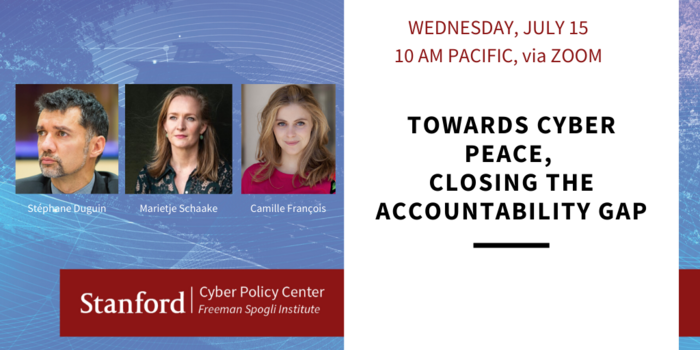
Please join the Cyber Policy Center for Towards Cyber Peace, Closing the Accountability Gap, hosted by Cyber Policy Center's Marietje Schaake, along with guests Stéphane Duguin, CEO of the Cyber Peace Institute and Camille François, CIO of Graphika and Mozilla Fellow. The discussion will focus on the challenges to cyber peace, and the work being done to chart a path forward. The session is open to the public, but registration is required.
Marietje Schaake is the international policy director at Stanford University’s Cyber Policy Center and international policy fellow at Stanford’s Institute for Human-Centered Artificial Intelligence. She was named President of the Cyber Peace Institute. Between 2009 and 2019, Marietje served as a Member of European Parliament for the Dutch liberal democratic party where she focused on trade, foreign affairs and technology policies. Marietje is affiliated with a number of non-profits including the European Council on Foreign Relations and the Observer Research Foundation in India and writes a monthly column for the Financial Times and a bi-monthly column for the Dutch NRC newspaper.
Camille François works on cyber conflict and digital rights online. She is the Chief Innovation Officer at Graphika, where she leads the company’s work to detect and mitigate disinformation, media manipulation and harassment. Camille was previously the Principal Researcher at Jigsaw, an innovation unit at Google that builds technology to address global security challenges and protect vulnerable users. Camille has advised governments and parliamentary committees on both sides of the Atlantic on policy issues related to cybersecurity and digital rights. She served as a special advisor to the Chief Technology Officer of France in the Prime Minister’s office, working on France’s first Open Government roadmap. Camille is a Mozilla Fellow, a Berkman-Klein Center affiliate, and a Fulbright scholar. She holds a masters degree in human rights from the French Institute of Political Sciences (Sciences-Po) and a masters degree in international security from the School of International and Public Affairs (SIPA) at Columbia University. François’ work has been featured in various publications, including the New York Times, WIRED, Washington Post, Bloomberg Businessweek, Globo and Le Monde.
Stéphane Duguin is the Chief Executive Officer of the CyberPeace Institute. His mission is to coordinate a collective response to decrease the frequency, impact, and scale of cyberattacks by sophisticated actors. Building on his hands-on experience in countering and analyzing cyber operations and information operations which impact civilians and civilian infrastructure, he leads the Institute with the aim of holding malicious actors to account for the harms they cause. Prior to this position, Stéphane Duguin was a senior manager and innovation coordinator at Europol. He led key operational projects to counter both cybercrime and online terrorism, such as the setup of the European Cybercrime Centre (EC3), the Europol Innovation Lab, and the European Internet Referral Unit (EU IRU). A leader in digital transformation, his work focused on the implementation of innovative responses to a large-scale abuse of the cyberspace, notably on the convergence of disruptive technologies and public-private partnerships.

 FSI researchers examine the role of energy sources from regulatory, economic and societal angles. The Program on Energy and Sustainable Development (PESD) investigates how the production and consumption of energy affect human welfare and environmental quality. Professors assess