International Relations

FSI researchers strive to understand how countries relate to one another, and what policies are needed to achieve global stability and prosperity. International relations experts focus on the challenging U.S.-Russian relationship, the alliance between the U.S. and Japan and the limitations of America’s counterinsurgency strategy in Afghanistan.

Foreign aid is also examined by scholars trying to understand whether money earmarked for health improvements reaches those who need it most. And FSI’s Walter H. Shorenstein Asia-Pacific Research Center has published on the need for strong South Korean leadership in dealing with its northern neighbor.

FSI researchers also look at the citizens who drive international relations, studying the effects of migration and how borders shape people’s lives. Meanwhile FSI students are very much involved in this area, working with the United Nations in Ethiopia to rethink refugee communities.

Trade is also a key component of international relations, with FSI approaching the topic from a slew of angles and states. The economy of trade is rife for study, with an APARC event on the implications of more open trade policies in Japan, and FSI researchers making sense of who would benefit from a free trade zone between the European Union and the United States.

Authors
Noa Ronkin
News Type
News
Date
Paragraphs

The Walter H. Shorenstein Asia-Pacific Research Center (APARC) is pleased to invite applications for four types of fellowship in contemporary Asia studies for the 2022-23 academic year.

The Center offers postdoctoral fellowships that promote multidisciplinary research on contemporary Japan, contemporary Asia broadly defined, health or healthcare policy in the Asia-Pacific region, and a fellowship for experts on Southeast Asia. Learn more about each fellowship and its eligibility and specific application requirements:

Postdoctoral Fellowship on Contemporary Japan

Hosted by the Japan Program at APARC, the fellowship supports research on contemporary Japan in a broad range of disciplines including political science, economics, sociology, law, policy studies, and international relations. Appointments are for one year beginning in fall quarter 2022. The application deadline is January 3, 2022.
 

Shorenstein Postdoctoral Fellowship on Contemporary Asia

APARC offers two postdoctoral fellowship positions to junior scholars for research and writing on contemporary Asia. The primary research areas focus on political, economic, or social change in the Asia-Pacific region (including Northeast, Southeast, and South Asia), or international relations and international political economy in the region. Appointments are for one year beginning in fall quarter 2022. The application deadline is January 3, 2022.
 

Read More

Photo of Charles Crabtree
News

Charles Crabtree Appointed as a Visiting Assistant Professor with the Japan Program at APARC

Crabtree, an assistant professor at Dartmouth College, researches discrimination in politics, particularly in Japan.
Charles Crabtree Appointed as a Visiting Assistant Professor with the Japan Program at APARC
[Left] Postdoc Spotlight, Jeffrey Weng, Shorenstein Postdoctoral Fellow in Contemporary Asia, [Right] Jeffrey Weng
Q&As

Postdoc Spotlight: Jeffrey Weng on Language and Society

Shorenstein Postdoctoral Fellow in Contemporary Asia Jeffrey Weng shares insights from his research into how language and society shape one another, particularly how the historical use of Mandarin affects contemporary Chinese society and linguistics.
Postdoc Spotlight: Jeffrey Weng on Language and Society
Hero Image
Autumn scene on the Stanford campus with a call to apply for APARC's 2022-23 fellowships for Asia schoalrs
All News button
1
Subtitle

The Center offers fellowships for postdoctoral scholars specializing in contemporary Asia, Japan, and Asia health policy and for experts on Southeast Asia.

Authors
Oriana Skylar Mastro
News Type
Commentary
Date
Paragraphs

There are many reasons to fear an impending Chinese attack on Taiwan: Intensified Chinese aerial activity. High-profile Pentagon warnings. Rapid Chinese military modernization. President Xi Jinping’s escalating rhetoric. But despite what recent feverish discussion in foreign policy and military circles is suggesting, the U.S. withdrawal from Afghanistan isn’t one of them.

Some critics of President Biden’s decision to withdraw from Afghanistan argue the move will embolden Beijing because it telegraphs weakness — an unwillingness to stick it out and win wars that China will factor in when deciding whether to attack Taiwan, which it considers to be part of its territory.

The reality is, though, that the U.S. departure from Afghanistan will more likely give pause to Chinese war planners — not push them to use force against Taiwan.

The Chinese Communist Party’s stated goal is “national rejuvenation”: Regaining China’s standing as a great power. Chinese leaders and thinkers have studied the rise and fall of great powers past. They have long understood that containment by the United States could keep China from becoming a great power itself.

Luckily for Beijing, the Afghan war — along with Iraq and other American misadventures in the Middle East — distracted Washington for two decades. While China was building roads and ports from Beijing to Trieste, Italy, fueling its economy and expanding its geopolitical influence, the United States was pouring money into its war on terrorism. While Beijing was building thousands of acres of military bases in the South China Sea and enhancing its precision-strike capabilities, the U.S. military was fighting an insurgency and dismantling improvised explosive devices.

While Beijing was building thousands of acres of military bases in the South China Sea and enhancing its precision-strike capabilities, the U.S. military was fighting an insurgency and dismantling improvised explosive devices.
Oriana Skylar Mastro

In many ways, it was just dumb luck that Mr. Xi and his predecessors, thanks in part to the war in Afghanistan, could build national power, undermine international normsco-opt international organizations and extend their territorial control all without the United States thwarting their plans in any meaningful way.

But the end of the war in Afghanistan could bring these good times — which the Communist Party calls the “period of important strategic opportunities” — to an abrupt end. Sure, over the past 10 years American presidents tried to get back into the Asia game even as the war continued. Barack Obama asserted we would pivot to Asia back in 2011. Donald Trump’s national security team made great power competition with China its top priority.

But neither went much beyond paying lip service. The withdrawal shows Mr. Biden is truly refocusing his national security priorities — he even listed the need to “focus on shoring up America’s core strengths to meet the strategic competition with China” as one of the reasons for the drawdown.

Such a refocusing comes not a moment too soon. Chinese expansion and militarization in the South China Sea, deadly skirmishes with India, its crackdown in Hong Kong and repression in Xinjiang all point to an increasingly confident and aggressive China. In particular, Chinese military activity around Taiwan has spiked — 2020 witnessed a record number of incursions into Taiwan’s airspace. The sophistication and scale of military exercises has increased as well. These escalations come alongside recent warnings from Mr. Xi that any foreign forces daring to bully China “will have their heads bashed bloody” and efforts toward “Taiwan independence” will be met with “resolute action.”

The U.S. policy toward Taiwan is “strategic ambiguity” — there is no explicit promise to defend it from Chinese attack. In this tense environment, U.S. policymakers and experts are feverishly considering ways to make U.S. commitment to Taiwan more credible and enhance overall military deterrence against China. A recent $750 million arms sale proposal to Taiwan is part of these efforts, as is talk of inviting Taiwan to a democracy summit, which undoubtedly would provoke Beijing’s ire.

Some have argued that America’s withdrawal from Afghanistan undermines efforts to signal U.S. support for Taiwan. On the surface, it may seem as if the U.S. withdrawal would be a good thing for China’s prospects at what it calls “armed reunification.” Indeed, this is the message the nationalist Chinese newspaper The Global Times is peddling: The United States will cast Taiwan aside just as it has done with Vietnam, and now Afghanistan.

However, the American departure from Afghanistan creates security concerns in China’s own backyard that could distract it from its competition with the United States. Beijing’s strategy to protect its global interests is a combination of relying on host nation security forces and private security contractors and free-riding off other countries’ military presence. Analysts have concluded that China is less likely than the United States to rely on its military to protect its interests abroad. Beijing appears committed to avoiding making the same mistakes as Washington — namely, an overreliance on military intervention overseas to advance foreign policy objectives.

Now there will be no reliable security presence in Afghanistan and undoubtedly broader instability in a region with significant economic and commercial interests for China. Chinese leaders are also worried that conflict in Afghanistan could spill across the border into neighboring Xinjiang, where Beijing’s repressive tactics have already been the cause of much international opprobrium.

The reality is, the United States stayed much longer in Afghanistan than most expected. This upsets China’s calculus about what the United States would do in a Taiwan crisis, since conventional wisdom in Beijing had been that the painful legacy of Somalia would deter Washington from ever coming to Taipei’s aid.

But U.S. interventions in Afghanistan and Iraq have called these assumptions into question. Taiwan, with its proportionately large economy and semiconductor industry, is strategically important to the United States. U.S. power and influence in East Asia are reliant on its allies and military bases in the region and America’s broader role as the security partner of choice. If Taiwan were to fall to Chinese aggression, many countries, U.S. allies included, would see it as a sign of the arrival of a Chinese world order. By comparison, Afghanistan is less strategically important, and yet the United States stayed there for 20 years.

If Taiwan were to fall to Chinese aggression, many countries, U.S. allies included, would see it as a sign of the arrival of a Chinese world order. By comparison, Afghanistan is less strategically important, and yet the United States stayed there for 20 years.
Oriana Skylar Mastro

This does not bode well for any designs Beijing might have for Taiwan.

It’s true that China would benefit from a home-field advantage given Taiwan’s proximity, and that Beijing’s arsenal is far greater than Taiwan’s. China, too, would likely enjoy more domestic public support for any conflict than the U.S. would for yet another intervention.

But if China has any hope of winning a war across the Strait, its military would have to move fast, before the United States has time to respondChinese planners know that the longer the war, the greater the U.S. advantage. Unlike Chinese production and manufacturing centers, which can all be targeted by the United States, the American homeland is relatively safe from Chinese conventional attack. China is far more reliant on outside sources for oil and natural gas, and thus vulnerable to U.S. attempts to cut off its supply.

And the Chinese economy would suffer more: Since the war would be happening in Asia, trade would be bound to be disrupted there. The United States would need to stick it out for only a short time — not 20 years — for these factors to come into play.

A call on Thursday between Mr. Biden and Mr. Xi hinted at the stakes — the two “discussed the responsibility of both countries to ensure competition does not veer into conflict,” according to the White House.

Chinese leaders already expected a tense relationship with the Biden administration. Now they are faced with the fact that the United States might have the will and resources to push back against Chinese aggression, even if it means war.

So, while there may be other reasons to oppose the end of the war in Afghanistan, the impact on China’s Taiwan calculus is not — and should not be — one of them.

Read More

Figures of Kuomintang soldiers are seen in the foreground, with the Chinese city of Xiamen in the background, on February 04, 2021 in Lieyu, an outlying island of Kinmen that is the closest point between Taiwan and China.
Commentary

Strait of Emergency?

Debating Beijing’s Threat to Taiwan
Strait of Emergency?
An Island that lies inside Taiwan's territory is seen with the Chinese city of Xiamen in the background.
Commentary

The Taiwan Temptation

Why Beijing Might Resort to Force
The Taiwan Temptation
A case holding lunar rock and debris collected from the Moon by China's space program that is part of a display at the National Museum of China is seen on March 2, 2021 in Beijing,
Commentary

Chinese Space Ambition

On the American Foreign Policy Council Space Strategy podcast, Center Fellow Oriana Skylar Mastro discusses how China views space and why the United States must not surrender global leadership in pursuing aspirational and inspirational space goals.
Chinese Space Ambition
Hero Image
Taiwan island seen from mid-air.
Yongyuan Dai/Getty Images
All News button
1
Subtitle

In a New York Times opinion piece, Center Fellow Oriana Skylar Mastro argues that the U.S. withdrawal from Afghanistan does not represent a potential catalyst for an impending Chinese attack on Taiwan.

-

Jakarta time: Friday, October 8, 2021 07:00 - 08:30 AM

Students often ask themselves: Do I want to be a specialist or a generalist? A hedgehog digging deeper or a fox ranging wider? The answer embedded in Gita Wirjawan’s life so far is unequivocal: Go broad. Think big. And be optimistic. For his weekly virtual podcast Endgame, Gita has interviewed many people, including Stanford’s Southeast Asia Program director Don Emmerson.  Don will turn the tables and interview Gita in this event. Gita will highlight life lessons from his international childhood and consider questions such as these: How well or poorly is Indonesia coping with corrupted governance, religious extremism, Covidian infection, and climate change? How should it respond to worsening US-China relations? To China’s efforts to control the South China Sea? To America’s exit from Afghanistan? To Myanmar’s brutal junta and ASEAN’s apparent impotence? Worldwide, looking forward, is eco-suicide avoidable? Will surveillance technology doom liberal democracy? If there is a global endgame to be played, how should concerned actors play it? Have present perils made Gita’s proactive optimism all the more necessary? Or all the more naïve? Attend the event and find out.

Image
photo_gita_wirjawan_4X4.jpg
Gita Wirjawan is the founding chairman of the Ancora Group of private-equity investors and wealth managers in Indonesia. He has held leadership positions in Citibank, JP Morgan, and other such firms. His philanthropy sustains the Ancora Foundation, which seeks to improve access to quality education in Indonesia across a range of endeavors—from funding the training of kindergarten teachers to endowing scholarships for students to attend universities around the world including Stanford. His passion for sports led Gita to chair Indonesia’s badminton association (2012-16). His public service career has included heading Indonesia’s trade ministry (2011-14) and investment coordinating board (2009-2011). A jazz pianist, he has performed in concerts and composed and played pieces in more than a dozen albums. His degrees include masters in business administration (Baylor) and public policy (Harvard). Indonesia’s School of Government and Public Policy sponsors his wide-ranging podcast “Endgame with Gita Wirjawan.”

Via Zoom Webinar
Register: https://bit.ly/3z7hM9b

Gita Wirjawan Indonesian businessman, philanthropist, educationist, musician, former minister of trade, badminton advocate, and popular talk-show host
Seminars
-

For Fall Quarter 2021, FSI will be hosting hybrid events. Many events will be open to the public online via Zoom, and limited-capacity in-person attendance for Stanford affiliates may be available in accordance with Stanford’s health and safety guidelines.

                                                Register for Zoom                                                         Register for In-Person
                                                           (Open to all)                                                                    (Stanford affiliates only)          


Retired U.S. Army Lieutenant Colonel Alexander Vindman, who found himself at the center of a firestorm for his decision to report the phone call between former U.S. President Donald Trump and Ukrainian President Volodymyr Zelensky that led to presidential impeachment, tells his own story for the first time.


Here, Right Matters is a stirring account of Vindman's childhood as an immigrant growing up in New York City, his career in service of his new home on the battlefield and at the White House, and the decisions leading up to the moment of truth he faced for his nation.

Alexander Vindman, a retired U.S. Army Lieutenant Colonel, was most recently the director for Eastern Europe, the Caucasus, and Russia on the White House’s National Security Council. Previously, he served as the Political-Military Affairs Officer for Russia for the Chairman of the Joint Chiefs of Staff and as an attaché at the U.S. Embassy in Moscow, Russia. While on the Joint Staff, he co-authored the National Military Strategy Russia Annex and was the principal author for the Global Campaign for Russia. He is currently a doctoral student and fellow of the Foreign Policy Institute at the Johns Hopkins School of Advanced International Studies (SAIS), Pritzker Military Fellow at the Lawfare Institute, and a visiting fellow at the University of Pennsylvania Perry World House. Follow him on Twitter @AVindman.

Alexander Vindman | Retired U.S. Army Lieutenant Colonel
Lectures
-

For Fall Quarter 2021, FSI will be hosting hybrid events. Many events will be open to the public online via Zoom, and limited-capacity in-person attendance for Stanford affiliates may be available in accordance with Stanford’s health and safety guidelines.

                                                Register for Zoom                                                         Register for In-Person
                                                           (Open to all)                                                                    (Stanford affiliates only)              


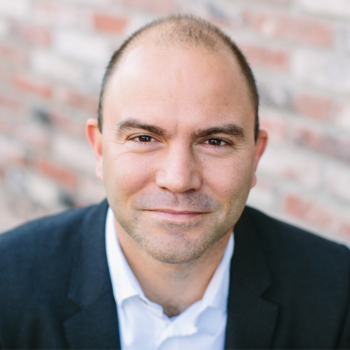
Why is democracy so threatened in America and around the world? And what can we do about it? Join Ben Rhodes to explore the answers to these questions and discuss his recent book, After the Fall.

Image
Ben Rhodes

In 2017, as Ben Rhodes was helping Barack Obama begin his next chapter, the legacy they had worked to build for eight years was being taken apart. To understand what was happening in America, Rhodes decided to look outward. Over the next three years, he traveled to dozens of countries, meeting with politicians, activists, and dissidents confronting the same nationalism and authoritarianism that was tearing America apart. Part memoir and part reportage, After the Fall investigates how much America’s fingerprints are on a world we helped to shape, through our post–Cold War embrace of unbridled capitalism and our post-9/11 nationalism and militarism; our mania for technology and social media; and the racism that fueled the backlash to America’s first Black president. At the same time, Rhodes learns from stories of a diverse set of characters—from Barack Obama himself to Cuban rebels to a rising generation of international leaders—that looking squarely at where America has gone wrong makes clear how essential it is to fight for what America is supposed to be, for our own country and the entire world.

Ben Rhodes is a writer, political commentator, and national security analyst. He is currently a contributor for NBC News and MSNBC; co-host of Pod Save the World; a senior advisor to former President Barack Obama; and chair of National Security Action, which he co-founded with Jake Sullivan in 2018. From 2009-2017, Ben served as a Deputy National Security Advisor to President Obama. In that capacity, he participated in all of President Obama’s key decisions, and oversaw the President’s national security communications, speechwriting, and public diplomacy.

Writer, political commentator, and national security analyst
Ben Rhodes | Writer, political commentator, and national security analyst
Seminars
1
kelsi_caywood.jpg

Kelsi Caywood graduated from Stanford with a Master's in International Policy, concentrating in governance and development. Her research areas include comparative policy analysis of the Asia-Pacific region, global women's issues, and migration and mobility. During her Master's program, she served as editor-in-chief of the Stanford International Policy Review, a course assistant, and a research assistant for Professor H. R. McMaster. Prior to Stanford, Kelsi received a Master of Law from Peking University as a Yenching Scholarship recipient and a BA in Political Science from Yale University. Her international work and study experiences include South Korea, China, the United Kingdom, and France.

In the Korea Program at APARC, Kelsi supported the research and practice partnerships stemming from the New Asia Research Project, a cluster of multi-year studies focusing on the new societal issues and challenges facing Korea and its neighbor countries. Currently, she focuses on the Global Talents book project and a series of research articles examining human resource development and associated global talent strategies in four Asia-Pacific countries: Australia, China, India, and Japan.

Research Associate, Korea Program (former)
Date Label

Shorenstein APARC
Stanford University
Encina Hall E301
Stanford, CA 94305-6055

650-498-9898
0
haley_gordon.jpg

Haley Gordon recently completed her Master of Arts at Stanford’s Center for East Asian Studies, where she wrote her Master’s thesis on human rights in North Korea. Her research interests include migration, nationalism, and multiculturalism in East Asia, as well as the transnational spread of social movements and culture in a globalized world. Haley received her bachelor’s degree in Ecology & Evolutionary Biology from Princeton University, with a minor in Humanistic Studies. In addition, she has studied the Korean language at Yonsei University and Ewha University in Seoul.

At APARC, Haley works at the Korea Program and the Stanford Next Asia Policy Lab, supporting the projects on Talent Flows and Development, Nationalism and Racism, and Re-Engaging North Korea.

Research Associate, Korea Program
Authors
Melissa Morgan
News Type
News
Date
Paragraphs

In 2015, Volodymyr Zelenskyy was at the height of a successful career as an entertainer. Though trained as a lawyer at the Kryvyi Rih Institute of Economics in Eastern Ukraine, the then 37 year old Zelenskyy was a successful comedian and public personality. As the star of the popular TV show, Servant of the People, he played a local history teacher who inadvertently becomes the president of Ukraine following a viral video rant about corruption.

No one watching comedic President Zelenskyy then could have possibly imagined the real-life plot twist that would follow. In an incredible act of life imitating art, in April 2019, Volodymyr Zelenskyy once again stood on stage in front of a cheering crowd, but this time as the actual president of Ukraine.

He won in a landslide election against incumbent president Petro Poroshenko on a platform of systemic change and progress using an almost exclusively virtual campaign. Speaking from his headquarters on election night, he affirmed the exuberance and hope of his supporters: “I can say as a citizen of Ukraine to all countries of the post-Soviet Union: Look at us — everything is possible.”

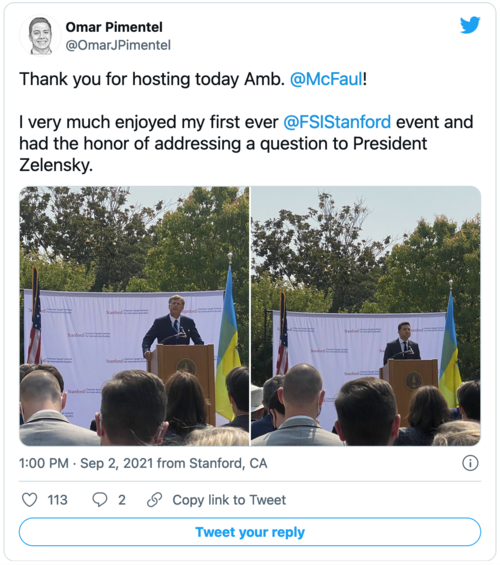
This same message shaped the theme of President Zelenskyy’s remarks at his historic address from the Freeman Spogli Institute for International Studies (FSI) at Stanford University on September 2. The first Ukrainian president to ever visit California, President Zelenskyy, First Lady Olena Zelenska and their delegation joined a group of FSI faculty members led by FSI Director Michael McFaul at an outdoor event held in the Encina Courtyard.

In his remarks, Zelenskyy drew inspiration from Steve Jobs’ famous "How to Live Before You Die" commencement address given at Stanford in 2005.

"This is one of the most famous speeches ever given at Stanford,” he said. “It's about believing in dreams and overcoming the impossible. This is the same as my story. I am just a common guy from a common family from a common industrial town in Eastern Ukraine. Yet here I am today at Stanford, because everything is possible."

He continued, “It is the same for Ukraine. Many people look at us and think that it will be impossible to achieve the goals we hope for. But we know that our critics are wrong. The people of our country love democracy and freedom and will not let threats take those things away. We know that anything is possible."

Looking to the future, Zelenskyy outlined the steps his administration is undertaking to bring increased digitization to Ukraine. These efforts include launching fully electronic passports, moving business and legal services online and expanding the scope of e-goverance. The hope is that this meld of new technology will help curb corruption while simultaneously creating more equitable opportunities and better access to public services for more Ukranians.

Speaking on the ambitious scope of these plans, the president acknowledged, “There will be resistance to the changes and innovations that we are going to make.” Nonetheless, he remains committed to the work ahead of strengthening democratic institutions in Ukraine and building on the progress that has already been made.  “We do not have a ‘Ukrainian Dream,’ yet,” he said. “But we have a ‘Ukrainian Goal’ and a ‘Ukrainian Mission’ to make the future we want for our country.” An edited recording of his remarks is below.

Keeping with Stanford tradition, Zelenskyy took questions from the audience after his prepared remarks. A variety of students and Stanford community members from Russia, Burma, Belarus and beyond had the opportunity to engage the president on a range of issues including U.S.-Ukraine relations, armament sales abroad and concerns over Russian aggression in Crimea and influence Eastern Ukraine. Of particular meaning was Zelensky’s affirmation and support for the democratic movement in Belarus led by Svaitlana Tsikhanouskaya, whom FSI hosted earlier this summer at a faculty roundtable.

Image
Tweet from Franak Viačorka

Students and faculty alike were appreciative of the president’s candor and good nature in addressing difficult topics.

Image
Tweet from Rose Gottemoeller
Image
Tweet from Graham Webster
Image
Tweet from Me Me Khant
Image
Tweet from Omar Pimentel

Following the formal remarks, President Zelenskyy and First Lady Zelenska had an opportunity to meet with Stanford President Marc Tessier-Lavigne in the Memorial Church Courtyard. Prior to leaving, the First Lady also sat down with leaders and students from Stanford's Office of Accessible Education (OAE), an area of interest she would like to support and better develop in Ukraine.

For FSI, the president’s visit was another affirmation of the special connection between Ukraine and the Stanford community. Since 2016, the Center on Democracy, Development and the Rule of Law has hosted the Ukrainian Emerging Leaders Program, which provides a 10-month academic training fellowship in support of mid-career practitioners working actively as policy-makers, legal professionals, entrepreneurs and leaders of civil society organizations in Ukraine.

Speaking to this shared history in his opening introductions, FSI Director Michael McFaul emphasized the crucial need for ongoing support and intellectual investment into Ukraine. “The fight for democracy and independence in Ukraine is one of the most important causes in the world today,” he affirmed. “Not just for Ukrainians, but for all who cherish the ideals of democracy, liberty and sovereignty.”

To President Zelenskyy, McFaul extended a future invitation: “You are always welcome back, either as president or in retirement as a professor.”

“With the classes you offer, I will think about it,” Zelenskyy replied with a smile.

Read More

President Zelenskky addresses Stanford students and community members via a live video address in the CEMEX auditorium.
News

President Volodymyr Zelenskyy Calls on Students to Lead as Future Ambassadors in a Special Video Address at Stanford

Ukraine’s President Volodymyr Zelenskyy spoke to the Stanford community in a special video address about his country’s war against Russia for independence, freedom, and global democracy, which he said requires the continued support of all the people of the free world.
President Volodymyr Zelenskyy Calls on Students to Lead as Future Ambassadors in a Special Video Address at Stanford
Larry Diamond speaking in the Bechtel Conference Center in Encina Hall
Commentary

"We Have Entered a New Historical Era": Larry Diamond on the Future of Democracy

Speaking at the April 2022 meeting of the FSI Council, Larry Diamond offered his assessment of the present dangers to global democracy and the need to take decisive action in support of liberal values.
"We Have Entered a New Historical Era": Larry Diamond on the Future of Democracy
Sviatlana Tsikhanouskaya discusses the future of democracy in Belarus with a roundtable of Stanford scholars.
News

Belarusian Leader Sviatlana Tsikhanouskaya Meets with Stanford Scholars for Roundtable on Democracy in Belarus

Democratic leader Sviatlana Tsikhanouskaya and her delegation joined an interdisciplinary panel of Stanford scholars and members of the Belarusian community to discuss the future of democracy in Belarus.
Belarusian Leader Sviatlana Tsikhanouskaya Meets with Stanford Scholars for Roundtable on Democracy in Belarus
Hero Image
President Volodymyr Zelenskyy of Ukraine speaks at the Freeman Spogli Institute for International Studies Rod Searcey
All News button
1
Subtitle

President Zelenskyy outlined the steps his administration is undertaking to bring increased digitization to Ukraine, curb corruption and create more equitable access to public services for more Ukrainians.

Authors
News Type
News
Date
Paragraphs

This story was originally reported by Melissa De Witte for Stanford News.

For those who remember Sept. 11, 2001, details of the day – the confusion, chaos and collective grief – are as clear now as they were 20 years ago when the deadliest terrorist attack in U.S. history occurred.

But many college students today have no memories of 19 al-Qaida operatives hijacking four commercial airplanes and killing nearly 3,000 people in a terrorist attack on the twin towers of the World Trade Center in New York City, the Pentagon outside Washington, D.C, and a field in Shanksville, Pennsylvania.

Teaching this next generation about the passion and the intensity that defined that pivotal moment is difficult, says Condoleezza Rice, who was the U.S. National Security Advisor at the time of the attacks.

For the new generation of students, 9/11 is now a part of history. “It would be like people trying to convey the intensity of World War II to me,” said Rice, who went on to serve as the 66th secretary of state of the United States under President George W. Bush before returning to her professorship at Stanford in 2009.

Rice, now the Tad and Dianne Taube Director of the Hoover Institution, was in the White House on that Tuesday morning of Sept 11. When she discusses the attacks with her students, her experiences on that day inevitably come up.

She is candid in her recounting. “That helps to vivify it because it’s a personal story,” Rice said.

Condoleezza Rice with President George W. Bush, Vice President Dick Cheney, Chief of Staff Andy Card and Special Agent Carl Truscott of the U.S. Secret Service in the Presidential Emergency Operations Center of the White House.
Condoleezza Rice with President George W. Bush, Vice President Dick Cheney, Chief of Staff Andy Card and Special Agent Carl Truscott of the U.S. Secret Service in the Presidential Emergency Operations Center of the White House. | Getty Images

Rice shares how, when the first plane hit the North Tower at the World Trade Center at 8:46 a.m., she and others were uncertain about the cause of the crash. She remembers wondering whether it could have been an accident. But when the second hijacked plane hit the remaining South Tower 17 minutes later, Rice knew it had to be a terrorist attack on the United States.

Then there was the short period when Defense Secretary Donald Rumsfeld could not be reached because the Pentagon was also hit that morning, Rice said. She, along with other senior government leaders, were ushered into the White House bunker. She tells students that around noon that day, oxygen levels started to drop because too many people were crammed into the fortified space. “So the Secret Service was going around saying, ‘You have to leave, you are not essential; you have to leave, you are not essential.’ You would never plan for such a thing as that,” she said.

I try to help them understand how we are still living the effects of 9/11. It isn’t an event that happened one day and then was over, but everything from the way that you go through an airport to something called ‘homeland security,’ which you didn’t have before 9/11.
Condoleezza Rice
Tad and Dianne Taube Director of the Hoover Institution

Inevitably, a student will ask her if she was afraid. Rice was so taken aback the first time she faced that question that she actually paused to think about it – and then concluded that she wasn’t. “I didn’t have time to be scared,” Rice recalled. “You can fear for your loved ones, but you are not allowed to feel personal fear. You don’t think about that in the moment.”

Rice also emphasized the importance of talking to students about how 9/11 transformed the world and that what seems routine today – such as additional airport screenings and the formation of new government institutions – didn’t even exist before the attacks.

“I try to help them understand how we are still living the effects of 9/11,” said Rice. “It isn’t an event that happened one day and then was over, but everything from the way that you go through an airport to something called ‘homeland security,’ which you didn’t have before 9/11.”

Teaching 9/11 Since 9/11


The attacks also introduced into the wider vernacular new places – like Afghanistan – and people – like Osama bin Laden – that students 20 years ago knew very little or nothing about.

Stanford scholars Amy Zegart and Martha Crenshaw experienced this firsthand on the day of the attacks when they found themselves in the surreal situation of teaching about 9/11 on 9/11. Both were so shocked by the unfolding events that they were unable to do anything except the one thing they were supposed to do that day, which was teach.

When they showed up to their respective classrooms – at the time, Crenshaw was at Wesleyan University teaching a course on decision making and foreign policy; Zegart at UCLA – they found them packed. There were more students in the lecture hall for Crenshaw’s course than were enrolled.

Martha Crenshaw, a senior fellow at the Freeman Spogli Institute for International Studies
Martha Crenshaw, a senior fellow at the Freeman Spogli Institute for International Studies, has written extensively on the issue of political terrorism; her first article, "The Concept of Revolutionary Terrorism," was published in 1972. | L.A. Cicero

Students – horrified and trying to make sense of what was happening – sought clarity and comfort from their teachers, who just happened to be experts on the issues that would come to define the next two decades of U.S. domestic and foreign policy.

“When something that shocking happens, our natural inclination is to make sense of what’s going on together, right now,” said Zegart, who is a leading scholar on national security and the Central Intelligence Agency and is now a senior scholar at the Freeman Spogli Institute for International Studies (FSI) and the Morris Arnold and Nona Jean Cox Senior Fellow at the Hoover Institution.

Students wanted to know more about the terms and names they were hearing for the first time that day, like jihadism and the Taliban. Over the months that followed came more complex challenges to explain: the global war on terror, torture, rendition, Guantanamo Bay, the wars in Afghanistan and Iraq.

This is the world that today’s students have inherited. Even the current generation’s media, as Zegart’s research has shown, has become increasingly saturated with a proliferation of “spytainment”: movies and TV shows depicting, often inaccurately, the clandestine world of intelligence and counterterrorism operations.

Like Rice, Crenshaw has also found herself having to explain that none of this was normal before 9/11.

“I have to go back and say, ‘All this wasn’t always here before 9/11.’ I have to trace the trajectory of policy changes,” said Crenshaw, a senior fellow at FSI and the Center for International Security and Cooperation.

Shifts in Emotion


In the first decade after the attacks, Zegart said her students were incredibly emotional about 9/11 and its aftermath, including the expansion of U.S. conflict abroad. A few years after the wars in Afghanistan and Iraq broke out, Zegart remembers one of her students, a recently returned veteran, telling her that he was taking her intelligence class because he wanted to learn more about why he had gone to Iraq, and what his friend who had deployed with him had died fighting for.

“It was a really raw, personal experience for students studying foreign policy in the first decade after 9/11 because they were living with war and uncertainty,” said Zegart. She had to push them be more analytical and objective in their class discussions of what a post 9/11 world entailed.

As the years progressed, though, 9/11 increasingly became less personal for the next generation of students. Perceptions began to shift. So much so that Zegart now finds herself in the opposite predicament: How to insert those feelings back in.

“Because they didn’t live through it, they look at it distantly and dispassionately,” Zegart said. “The challenge is, how do you help students better understand the context in which decisions were made and the raw emotion that unavoidably affects how we perceive threats and how we deal with policy responses.”

Teaching the Emotions of the Day


To evoke a visceral response to 9/11, Zegart shows a 4-minute montage of news clips. Students get a sense of how the day unfolded, from the breaking reports of the first tower being struck to a reporter’s on-air reaction as the second plane crashes live into the remaining tower. There are also scenes of people fleeing lower Manhattan amid dust, smoke and debris.

“You just cannot convey that day in a normal lecture or a book,” Zegart said. The video is effective; her students are often left with a sense of the sadness, horror and anguish that defined 9/11.

Amy Zegart and Condoleezza Rice co-teaching.
In 2018, Stanford scholars Amy Zegart and Condoleezza Rice co-taught the course POLECON 584: Managing Global Political Risk. | Rod Searcey

Zegart then asks her students to imagine they are policymakers at the White House and have to decide what to do next. “We often teach U.S. foreign policymaking as a sterile, Spock-like process where people weigh the pros and cons of options and make dispassionate decisions,” Zegart said. “But human emotion and searing national experiences are important and hard to convey. A key part of understanding history is empathy, and thinking about what it was like to live through something rather than only looking at an event through the distance of time. 9/11 looks inevitable in hindsight, but it was unimaginable on September 10.”

Through the exercise, students get a sense of the urgency that policymakers, like Rice, have to grapple with while making decisions amid a national emergency.

“In retrospect, everything looks quite orderly,” said Rice, who co-taught a class on global risk with Zegart at the Graduate School Business. “It looks like ‘of course that decision led to that decision.’ Political scientists are always talking about the options that were put before the president. That’s not how crisis decision making unfolds. You are dealing with really incomplete information, you are dealing with the need to act now, and you are often reacting from instinct because you don’t have time to think through things.”

Viewing the Attacks from All Sides


When political scientist Lisa Blaydes teaches 9/11 to her students, she tries to give an international perspective of the issues, particularly on how grievances can arise – both legitimately or falsely constructed – in countries abroad and how that can lead to extremism and political violence. For example, in her course Political Science 149: Middle Eastern Politics, several classes are dedicated to examining anti-American attitudes in the Islamic world and the conditions under which individuals become radicalized.

“I try to make sure that students understand both the individual motivations associated with the radicalization of political thought as well as the global context that empowers radicalized individuals to undertake violent action,” said Blaydes, a professor of political science in the School of Humanities and Sciences and a senior fellow at FSI. She asks students to read Lawrence Wright’s book The Looming Tower, which picks up on themes Blaydes covers in the course, particularly those dealing with how authoritarian regimes in the Arab world provided a backdrop for the rise of al-Qaida.

In recent years, Blaydes has found her students showing an increased interest in learning more about radical groups like ISIS (Islamic State of Iraq and Syria) and how they have terrorized communities across the Middle East. “While Sept. 11 made terrorism a salient threat for Americans living in U.S. cities, both terrorism and state-sponsored violence are unfortunately a trauma shared by people around the world,” she said.

A key part of understanding history is empathy, and thinking about what it was like to live through something rather than only looking at an event through the distance of time. 9/11 looks inevitable in hindsight, but it was unimaginable on September 10.
Amy Zegart
FSI Senior Fellow at CISAC

Similarly, Crenshaw said, it is important to explain to students the conditions that lead to such extremist views. But, she added, explaining motives should not be mistaken as justifying them. “We are not trying to excuse it; we are trying to understand why something happened,” she said.

With her students, Crenshaw has also looked at how terrorism has been used across history. In the aftermath of 9/11, terrorism almost exclusively became associated with a particular ideology and religion. But there are other examples throughout history of how it has been used as a form of political violence, she said.

“As an instructor, one of my goals was always to show students that 9/11 was something extraordinary, but there are other instances of terrorism and it can be associated with any ideology,” Crenshaw said.

Given its elasticity, terrorism is a confusing and contentious term with no standard definition, Crenshaw said. Thus, as both the term and the acts associated with terrorism have evolved over the past two decades, so has her teaching of it. “The phenomenon that you are trying to teach is changing over time as well, so it’s really a very dynamic subject requiring constant adjustment to take into account the vast outpouring of writing on terrorism but changing terrorism and counterterrorism as well,” she said.

In addition to situating 9/11 against a global and historical backdrop, teaching the attacks also requires a critical look at the domestic challenges that led up to it, including the shortcomings in U.S. intelligence. Zegart assigns students an article she wrote about the failures within the U.S. intelligence communities to adapt to the threat of terrorism, as well as a critique against her piece. “There’s no one perfect view, and if students can realize that their professor is part of an argument and people can disagree, that’s really important,” she said.

Zegart and Crenshaw have also assigned students the 9/11 Commission Report, the official report of the events that led up to the attacks and detailed account of the circumstances surrounding it.

‘Still Hard’


Even though 20 years have passed since 9/11, it does not mean that teaching about the attacks has gotten easier.

“I still have a hard time,” Zegart said. “For years, my screensaver was a picture of the first plane hitting the World Trade Center. It was important to me not to forget. I’ve spent my career researching why our intelligence agencies failed to stop 9/11 and how they can better meet threats in the future. I think about that day every day.”

Read More

Twin Towers by Adam Maida
Commentary

Putting Emotion Back Into 9/11

For coming generations of students, September 11 is history rather than memory. How does that affect how they learn about it?
Putting Emotion Back Into 9/11
1 chess board
News

Zegart argues grand strategy is misguided in post-9/11 world

Zegart argues grand strategy is misguided in post-9/11 world
9 11 memorial photo2x1
News

Sept. 11: Are we safer 10 years later?

Sept. 11: Are we safer 10 years later?
Hero Image
Pillars of light are projected from the 9/11 Memorial Site where the Twin Towers used to stand in New York CIty. Getty Images
All News button
1
Subtitle

On the 20th anniversary of 9/11, four Stanford scholars and leading experts in national security, terrorism and contemporary conflict – Condoleezza Rice, Amy Zegart, Martha Crenshaw and Lisa Blaydes – reflect on how their teaching of the terrorist attacks has evolved.

-

This is a virtual event. Please click here to register and generate a link to the talk. 
The link will be unique to you; please save it and do not share with others.

Co-sponsored by the Stanford Center at Peking University.

In honor of its release, contributors Mary Bullock, Thomas Fingar, and David M. Lampton will join editor Anne Thurston for a panel discussion of their volume Engaging China: Fifty Years of Sino-American Relations (Columbia University Press, 2021).

Recent years have seen the U.S.-China relationship rapidly deteriorate. Engaging China brings together leading China specialists—ranging from academics to NGO leaders to former government officials—to analyze the past, present, and future of U.S.-China relations. Bullock, Fingar, Lampton, and Thurston will reflect upon the complex and multifaceted nature of American engagement with China since the waning days of Mao’s rule. What initially motivated U.S.’ rapprochement with China? Until recent years, what logic and processes have underpinned the U.S. foreign policy posture towards China? What were the gains and the missteps made during five decades of America’s engagement policy toward China? What is the significance of our rapidly deteriorating bilateral relations today? Speakers will tackle these questions and more at this critical time when tensions between the U.S. and China continue to intensify.

For more information about Engaging China or to purchase a copy, please click here.


Image
Portrait of Mary Bullock
Mary Bullock, president emerita of Agnes Scott College, is an educator and scholar of U.S. – China relations. She served as the founding executive vice-chancellor of Duke Kunshan University from 2012-2015. Previous positions include distinguished visiting professor at Emory University, director of the Asia Program of the Woodrow Wilson Center, and director of the Committee on Scholarly Communication with the People’s Republic of China. She is vice-chair of the Asia Foundation, a trustee of the Henry Luce Foundation, and a member of the Schwarzman Academic Advisory Committee and the Council on Foreign Relations. She received her M.A. and Ph.D. in Chinese history from Stanford University. Her most recent publications include The Oil Prince’s Legacy: Rockefeller Philanthropy in China (2011) and, as co-editor, Medical Transitions in Twentieth Century China (2014).
 

Image
Portrait of Tom Fingar
Thomas Fingar is a Shorenstein APARC Fellow in the Freeman Spogli Institute for International Studies at Stanford University. He was the inaugural Oksenberg-Rohlen Distinguished Fellow from 2010 through 2015 and the Payne Distinguished Lecturer at Stanford in 2009. From 2005 through 2008, he served as the first deputy director of national intelligence for analysis and, concurrently, as chairman of the National Intelligence Council. Fingar served previously as assistant secretary of the State Department’s Bureau of Intelligence and Research (2000-01 and 2004-05), principal deputy assistant secretary (2001-03), deputy assistant secretary for analysis (1994-2000), director of the Office of Analysis for East Asia and the Pacific (1989-94), and chief of the China Division (1986-89). Between 1975 and 1986 he held a number of positions at Stanford University, including senior research associate in the Center for International Security and Arms Control.

Fingar's most recent books are The New Great Game: China and South and Central Asia in the Era of Reform, editor (Stanford, 2016), Uneasy Partnerships: China and Japan, the Koreas, and Russia in the Era of Reform (Stanford, 2017), and Fateful Decisions: Choices that will Shape China’s Future, co-edited with Jean Oi (Stanford, 2020).
 

Image
Portrait of David M. Lampton
David M. Lampton is Senior Fellow at the SAIS Foreign Policy Institute and Professor Emeritus at Johns Hopkins--SAIS. Immediately prior to his current post he was Oksenberg-Rohlen Fellow at Stanford University’s Asia-Pacific Research Center from 2019-2020. For more than two decades prior to that he was Hyman Professor and Director of China Studies at the Johns Hopkins University School of Advanced International Studies. Lampton is former Chairman of the The Asia Foundation, former President of the National Committee on United States-China Relations, and former Dean of Faculty at SAIS. Among many written works, academic and popular, his most recent book (with Selina Ho and Cheng-Chwee Kuik) is Rivers of Iron: Railroads and Chinese Power in Southeast Asia (University of California Press, 2020). He received his B.A., M.A., and Ph.D. degrees from Stanford University in political science where, as an undergraduate student, he was a firefighter. Lampton has an honorary doctorate from the Russian Academy of Sciences’ Institute of Far Eastern Studies. He is a Life Trustee on the Board of Trustees of Colorado College and was in the US Army Reserve in the enlisted and commissioned ranks.


Image
Portrait of Anne Thurston
Anne Thurston is the director of the Grassroots China Initiative, where she works with local NGOs in China. Thurston is a former associate professor at Johns Hopkins SAIS, assistant professor at Fordham University, and was a China staff member at the Social Science Research Council. She has been the recipient of fellowships from the Rockefeller Foundation, the John D. and Catherine T. MacArthur Foundation, the United States Institute of Peace, the Woodrow Wilson International Center for Scholars and the National Endowment for the Humanities. Thurston is also a member of the National Committee on US-China Relations. Thurston is the author of numerous publications, including The Noodle Maker of Kalimpong: The Untold Story of My Struggle for Tibet (2015), and Muddling Toward Democracy: Political Change in Grass Roots China (1998). She received her Ph.D. in political science from the University of California, Berkeley.

Via Zoom Webinar. Register at: https://bit.ly/38ME0m3

Mary Bullock <br>President Emerita, Agnes Scott College<br><br>
Thomas Fingar <br>Shorenstein APARC Fellow, Stanford University<br><br>
David M. Lampton <br>Professor Emeritus, Johns Hopkins School of Advanced International Studies (SAIS); Senior Fellow, SAIS Foreign Policy Institute<br><br>
Anne F. Thurston <br>Director, Grassroots China Initiative; China Studies Affiliated Scholar, Johns Hopkins--SAIS
Seminars
Subscribe to International Relations