International Relations

FSI researchers strive to understand how countries relate to one another, and what policies are needed to achieve global stability and prosperity. International relations experts focus on the challenging U.S.-Russian relationship, the alliance between the U.S. and Japan and the limitations of America’s counterinsurgency strategy in Afghanistan.

Foreign aid is also examined by scholars trying to understand whether money earmarked for health improvements reaches those who need it most. And FSI’s Walter H. Shorenstein Asia-Pacific Research Center has published on the need for strong South Korean leadership in dealing with its northern neighbor.

FSI researchers also look at the citizens who drive international relations, studying the effects of migration and how borders shape people’s lives. Meanwhile FSI students are very much involved in this area, working with the United Nations in Ethiopia to rethink refugee communities.

Trade is also a key component of international relations, with FSI approaching the topic from a slew of angles and states. The economy of trade is rife for study, with an APARC event on the implications of more open trade policies in Japan, and FSI researchers making sense of who would benefit from a free trade zone between the European Union and the United States.

Incumbent president Emmanuel Macron is favorite to win reelection on April 24, but the outcome remains uncertain; it will largely depend on the results of the first round of voting on April 10. Three candidates, all on the Right and far Right, can still potentially defeat Macron. Even if Macron he is reelected, this should not be construed as an endorsement of the status quo. French politics is in the midst of a major partisan and ideological realignment.

Photo of Patrick Chamorel
Patrick Chamorel teaches transatlantic relations and comparative US and European politics at Stanford in Washington as well as, occasionally, at FSI's Ford Dorsey master in international policy. His research focuses on elections, political elites and democratic institutions in both the US and Europe. He is a frequent commentator on French, European and US media. Chamorel is a member of the editorial board of "American Purpose". At Stanford, he has been a Research scholar at CDDRL as well as a National Fellow at the Hoover Institution. He was an adviser to the French minister of industry as well as the Prime Minister. Chamorel holds a PhD in political science from Sciences-Po in Paris and a masters in public law from the university of Paris.


*If you need any disability-related accommodation, please contact: Shannon Johnson (sj1874@stanford.edu) by March 24, 2022.

0
Senior Resident Scholar at the Stanford Center in Washington
chamorel_patrick_photo.jpg

Patrick Chamorel conducts research on elections, populism, political movements and cleavages in Western democracies; Comparative US/European politics; Transatlantic relations; European politics; French politics, economic and foreign policy. He was most recently a Research Scholar at the Center for Democracy, Development and the Rule of Law at the Freeman Spogli Institute for International Studies (FSI), Stanford University.

Chamorel teaches comparative American and European politics, public policy and political economy, as well as transatlantic relations both at Stanford in Washington and at FSI’s Ford Dorsey Master in International Policy. He has also taught at the Stanford in Paris campus, the Reims Euro-American campus of Sciences-Po Paris, the University of California (Berkeley and Santa Cruz), George Washington University, and Claremont McKenna College where he was the Crown Visiting professor of Government in 2001-5.

Patrick Chamorel was a Fellow of the Institute for Governmental Studies at UC Berkeley, the Woodrow Wilson Center in Washington DC and the Hoover Institution at Stanford, as well as a Congressional Fellow of the American Political Science Association (Offices of Harry Reid in the U.S. Senate and Norman Mineta in the House of Representatives).

Patrick Chamorel has written and lectured extensively on US and European politics. His research has focused on US and European elections and the rise of populism; US strategic, political and economic relations with Europe; American and European political and business elites; the impact of globalization on government, business and civil society, as well as the rise of Euro-skepticism in America.

He regularly contributes to the media, including the Wall Street Journal, Die Welt, Les Echos, Atlantico.fr, the Canadian Broadcasting Corporation, Al-Jazeera, i24news, RMC, Talk Media News, BFM-TV, Le Figaro TV and CNN International. He is also a regular consultant to the US State Department.

In the 1990s, Patrick Chamorel was a Senior Advisor to the Minister of Industry and in the Policy Planning Office of the Prime Minister in Paris. He is a graduate of Sciences-Po in Paris where he also earned his Ph.D. in Political Science after doing research at UC Berkeley and Stanford University. He holds a Master in Public Law from the University of Paris.

Senior Resident Scholar speaker Stanford Center in Washington
Governance

Image
Facebook's Faces event flyer on blue and red background with photo of Chinmayi Arun
Join us on Tuesday, March 1 from 12 PM - 1 PM PT for a panel discussion on “Facebook’s Faces” featuring Chinmayi Arun, Resident Fellow at the Yale Law School in conversation with Nate Persily of the Stanford Cyber Policy Center. This weekly seminar series is jointly organized by the Cyber Policy Center’s Program on Democracy and the Internet and the Hewlett Foundation’s Cyber Initiative.

About The Seminar: 

Scholarship about social media platforms discusses their relationship with states and users. It is time to expand this theorization to account for differences among states, the varying influence of different publics and the internal complexity of companies. Viewing Facebook’s relationships this way includes less influential states and publics that are otherwise obscured. It reveals that Facebook engages with states and publics through multiple, parallel regulatory conversations, further complicated by the fact that Facebook itself is not a monolith. Arun argues that Facebook has many faces – different teams working towards different goals, and engaging with different ministries, institutions, scholars and civil society organizations. Content moderation exists within this ecosystem.
 
This account of Facebook’s faces and relationships shows that less influential publics can influence the company through strategic alliances with strong publics or powerful states. It also suggests that Facebook’s carelessness with a seemingly weak state or a group, may affect its relationship with a strong public or state that cares about the outcome.

To be seen as independent and legitimate, the Oversight Board needs to show its willingness to curtail Facebook’s flexibility in its engagement with political leaders where there is a real risk of harm. This essay hopes to show that Facebook’s fear of short-term retaliation from some states should be balanced out by accounting for the long-term reputational gains with powerful publics and powerful states who may appreciate its willingness to set profit-making goals aside in favor of human flourishing.

About the Speakers:

Image
Chinmayi Arun
Chinmayi Arun is a resident fellow of the Information Society Project at Yale Law School, and an affiliate of the Berkman Klein Center of Internet & Society at Harvard University. She has served on the faculties of two of the most highly regarded law schools in India for over a decade, and was the founder Director of the Centre for Communication Governance at National Law University Delhi. She has been a Human Rights Officer with the United Nations and is a member of the United Nations Global Pulse Advisory Group on the Governance of Data and AI, and of UNESCO India’s Media Freedom Advisory Group.

Chinmayi serves on the Global Network Initiative Board, and is an expert affiliated with the Columbia Global Freedom of Expression project. She has been consultant to the Law Commission of India and member of the Indian government’s multi stakeholder advisory group for the India Internet Governance Forum in the past.

Image
Nate Persily
Nathaniel Persily is the James B. McClatchy Professor of Law at Stanford Law School, with appointments in the departments of Political Science, Communication, and FSI.  Prior to joining Stanford, Professor Persily taught at Columbia and the University of Pennsylvania Law School, and as a visiting professor at Harvard, NYU, Princeton, the University of Amsterdam, and the University of Melbourne. Professor Persily’s scholarship and legal practice focus on American election law or what is sometimes called the “law of democracy,” which addresses issues such as voting rights, political parties, campaign finance, redistricting, and election administration. He has served as a special master or court-appointed expert to craft congressional or legislative districting plans for Georgia, Maryland, Connecticut, New York, North Carolina, and Pennsylvania.  He also served as the Senior Research Director for the Presidential Commission on Election Administration. His current work, for which he has been honored as a Guggenheim Fellow, Andrew Carnegie Fellow, and a Fellow at the Center for Advanced Study in the Behavioral Sciences, examines the impact of changing technology on political communication, campaigns, and election administration.  He is codirector of the Stanford Cyber Policy Center, Stanford Program on Democracy and the Internet, and the Stanford-MIT Healthy Elections Project, which supported local election officials in taking the necessary steps during the COVID-19 pandemic to provide safe voting options for the 2020 election. He is also a member of the American Academy of Arts and Sciences, and a commissioner on the Kofi Annan Commission on Elections and Democracy in the Digital Age.


Seminars
News Type
News
Date
Paragraphs

The faculty and staff of the Center on Democracy, Development and the Rule of Law (CDDRL) at Stanford University condemn in the strongest terms the unprovoked Russian assault on Ukraine.


This attack was not motivated by any legitimate security concerns on the part of Moscow. Rather, it was designed to undermine the current democratically-elected government in Ukraine, and demonstrate the impossibility of democracy anywhere in Russia’s neighborhood. President Putin has stated clearly that he does not believe in Ukraine’s right to exist as an independent, sovereign nation; rather, he believes it is part of a greater Russia. For all the flaws in Ukrainian democracy, the vast majority of Ukrainians cherish their independence and do not want to be absorbed into a kleptocratic dictatorship.

CDDRL has a special relationship with Ukraine. For more than a decade, we have hosted a series of leadership programs that included many, many Ukrainians. These programs include the Draper Hills Summer Fellows Program, the Leadership Academy for Development, and the Ukrainian Emerging Leaders Program. We made these investments in citizens of Ukraine out of a belief that Ukraine constituted the front line in a struggle over democracy globally. There are today about 150 Ukrainian graduates of our different programs, and among them, we have many close friends and colleagues who remain in their country today fighting bravely against Russia’s unprovoked aggression. All of them are in grave danger today. In the coming days and weeks, we will do whatever we can to support them, and can only wish for the best in these very dark times.

We hope that the US government, our NATO allies, and all countries and people who cherish democracy will do their utmost to push back against this Russian aggression, and help to restore an independent, democratic Ukraine.

~ The faculty and staff of CDDRL

Read More

Ukrainian DHSF alumni with Francis Fukuyama
Commentary

CDDRL’s Ukrainian Alumni Reflect on Current Crisis

Many of our program alumni have played important and influential roles in the country's political, economic, and social development, and have their own perspectives in what follows on why it is important for the international community to pay attention to what is going on in Ukraine and how the crisis is affecting them personally.
CDDRL’s Ukrainian Alumni Reflect on Current Crisis
Members of the Ukrainian military carry the flag of Ukraine during the 30th anniversary of the country's independence.
News

What the Ukraine-Russia Crisis Says about the Global Struggle for Democracy

Former prime minister of Ukraine Oleksiy Honcharuk joins Michael McFaul on the World Class Podcast to analyze Russia's aggression towards Ukraine and how it fits into Vladamir Putin's bigger strategy to undermine democracy globally.
What the Ukraine-Russia Crisis Says about the Global Struggle for Democracy
Photo of Nariman Ustaiev, Yulia Bezvershenko, and Denis Gutenko
News

Welcoming the Fourth Cohort of Ukrainian Emerging Leaders to Stanford

After the program was postponed in 2020, the Center on Democracy, Development and the Rule of law is pleased to have Yulia Bezvershenko, Denis Gutenko, and Nariman Ustaiev join us on campus this year.
Welcoming the Fourth Cohort of Ukrainian Emerging Leaders to Stanford
Hero Image
Ukrainian flag
All News button
1
Subtitle

We condemn in the strongest terms the unprovoked Russian assault on Ukraine.

-

 All CISAC events are scheduled using the Pacific Time Zone. 
 

SEMINAR RECORDING

Virtual only.

Sylvie Kauffmann
Seminars
-

Time:  7:30am-8:45am  California, USA 2 March 2022 
9:00pm-10:15pm New Delhi, India 2 March 2022
 

India’s international position has evolved sharply in the first two decades of the 21st century, and it is poised to become only more consequential in coming decades. Its strategic interests and influence have now stretched into the distant reaches of the Indo-Pacific, it has emerged as a central actor in managing global governance challenges like climate change, and it may have the capacity to take a commanding position in some key leading-edge technologies. In this webinar, veteran journalist Indrani Bagchi, who spent nearly two decades covering India’s foreign relations for the Times of India, will reflect on India’s recent trajectory and its prospects. Through the prism of some key episodes and issues of India in the 21st century, the webinar will examine India’s capacity and approach to manage international issues, as well as the constraints and challenges Indian policymakers must face. 

Speaker: 

Image
Headshot photo of Indrani Bagchi
Indrani Bagchi is CEO-designate at Ananta Aspen Centre, India. She was Associate Editor with the Times of India, where she reported and analyzed foreign policy issues for the newspaper from 2004 until 2022. As Diplomatic Editor, Indrani covered the Ministry of External Affairs (MEA) on her news beat, and interpreted and analyzed global trends with an Indian perspective. Earlier, Indrani worked with India Today, the Economic Times and The Statesman, and has held fellowships at Oxford University and the Brookings Institution. She is a Fellow of the Kamalnayan Bajaj Fellowship Class 3 of the Ananta Aspen Centre and a member of Aspen Global Leadership Network. She graduated from Loreto College, Calcutta University with English honors. 

Moderator:

Image
Photo Portrait of Arzan Tarapore
Arzan Tarapore is the South Asia research scholar at the Shorenstein Asia-Pacific Research Center at Stanford University, where he leads the newly-restarted South Asia research initiative. He is also a senior nonresident fellow at the National Bureau of Asian Research. His research focuses on Indian military strategy and contemporary Indo-Pacific security issues. Prior to his scholarly career, he served as an analyst in the Australian Defense Department. Arzan holds a PhD in war studies from King’s College London. 


This event is co-sponsored by Center for South Asia

Via Zoom  Register at:
https://bit.ly/3HXiwTy

Indrani Bagchi, CEO-designate, Ananta Aspen Centre, India<br> Panelist
0
Research Scholar at CISAC
Arzan Tarapore Headshot CISAC PhD

Arzan Tarapore is a Research Scholar whose research focuses on Indian military strategy and regional security issues in the Indo-Pacific. In academic year 2024-25, he is also a part-time Visiting Research Professor at the China Landpower Studies Center, at the U.S. Army War College. Prior to his scholarly career, he served for 13 years in the Australian Defence Department in various analytic, management, and liaison positions, including operational deployments and a diplomatic posting to the Australian Embassy in Washington, DC.

His academic work has been published in the Journal of Strategic Studies, International Affairs, The Washington Quarterly, Asia Policy, and Joint Force Quarterly, among others, and his policy commentary frequently appears on platforms such as Foreign Affairs, the Hindu, the Indian Express, The National Interest, the Lowy Institute's Interpreter, the Brookings Institution’s Lawfare, and War on the Rocks.

He previously held research and teaching positions at Georgetown University, the East-West Center in Washington, the Observer Research Foundation in New Delhi, and the RAND Corporation.

He earned a PhD in war studies from King's College London, an MSc from the London School of Economics, and a BA (Hons) from the University of New South Wales. Follow his commentary on Twitter @arzandc and his website at arzantarapore.com.

CV
Date Label
<br>Arzan Tarapore, South Asia Research Scholar, Shorenstein APARC Moderator South Asia Research Scholar, Shorenstein APARC
Seminars
-

Image
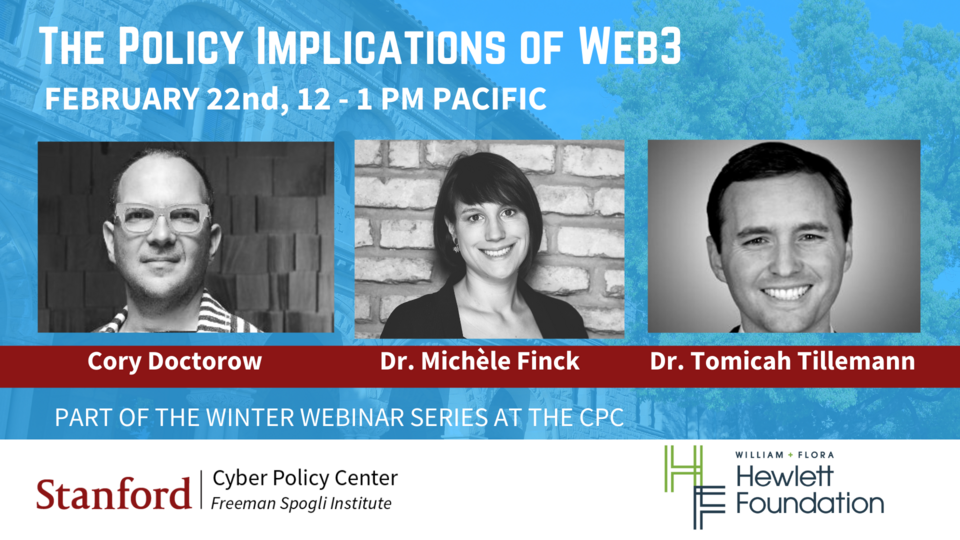
collage showing cory doctorow, Dr. Tomicah Tillemann and Michelle Finck

Join us on Tuesday, February 22 from 12 PM - 1 PM PT for a panel discussion on “The Policy Implications of Web3”, featuring Tomicah Tillemann of KRH Partners, Cory Doctorow of Craphound.com, and Michèle Finck of the University of Tübinge in conversation with Marietje Schaake of the Stanford Cyber Policy Center. This weekly seminar series is jointly organized by the Cyber Policy Center’s Program on Democracy and the Internet and the Hewlett Foundation’s Cyber Initiative.

The year 2021 marked an important moment for web3. Proponents believe the potential of web3 to democratize, decentralize and improve the internet is huge. Others argue that evangelists have yet to deliver results, and that web3 will inevitably tend towards centralization. Few however have explored the policy and political implications of the concept: how should regulators approach a potential web3 explosion? How should lawmakers think about the wider internet infrastructure? Is web3 an opportunity to reimagine the internet, or will it present even more challenges to policymakers? This webinar will explore these angles and foster a reflection on public policy by leading technologists and academics. The session is open to the public, but registration is required.

ABOUT THE SPEAKERS:


Image
cory doctorow
Cory Doctorow (craphound.com) is a science fiction author, activist and journalist. He is the author of many books, most recently Radicalized and Walkaway. He maintains a daily blog at Pluralistic.net. He works for the Electronic Frontier Foundation, is a MIT Media Lab Research Affiliate, a Visiting Professor of Computer Science at Open University, a Visiting Professor of Practice at the University of North Carolina’s School of Library and Information Science and co-founded the UK Open Rights Group. In 2020, he was inducted into the Canadian Science Fiction and Fantasy Hall of Fame.

Image
Michele Finck
Dr. Michèle Finck is Professor of Law and Artificial Intelligence at the University of Tübingen, an Affiliated Fellow at the Max Planck Institute for Innovation and Competition in Munich and the Centre for Blockchain Technologies at University College London as well as a Visiting Professor at LUISS University in Rome. She previously worked at the University of Oxford and the London School of Economics.


Image
tomicah tillemann
Dr. Tomicah Tillemann is a partner and Global Chief Policy Officer at KRH Partners, a new crypto venture fund led by former a16z General Partner Katie Haun, where he builds public policy architecture to support the next generation of the Internet. Until recently, he was the Global Head of Policy for an arm of Andreessen Horowitz. He worked in collaboration with the Rockefeller Foundation, the World Bank, MIT, and governments around the world to develop a new generation of open source technology platforms to power the public sector. He also oversaw the work of the Blockchain Trust Accelerator and the Responsible Asset Allocator Initiative.

Image
Marietje Schaake
Marietje Schaake (Moderator) is international policy director at Stanford University Cyber Policy Center and international policy fellow at Stanford’s Institute for Human-Centered Artificial Intelligence. Between 2009 and 2019, Marietje served as a Member of European Parliament for the Dutch liberal democratic party where she focused on trade, foreign affairs, and technology policies. Marietje is an (Advisory) Board Member with a number of nonprofits including MERICS, ECFR, ORF and AccessNow. She writes a monthly column for the Financial Times and a bi-weekly column for the Dutch NRC newspaper.

Seminars
0
ryu_23_headshot_1.JPG

Mi Jin is a Master’s in International Policy candidate at Stanford, where she specializes in International Security. Prior to Stanford, she has been working at the Ministry of Foreign Affairs of the Republic of Korea for six years. In 2016, she dealt with the North Korea’s 5th nuclear test. Working at the South Korean Embassy to Hungary in 2019, she was responsible for handling the ferry accident in which thirty-three South Koreans involved. From 2020 to 2021, she was in charge of inter-Korean exchange and cooperation program as well as the implementation of the UN Security Council resolutions on the DPRK. She holds a B.A. in Chinese Culture and in Economics from Sogang University, Seoul, Korea. She speaks English, Korean, and Mandarin. At Stanford, she hopes to reinforce her ability and expertise to approach the complicated and ever-changing landscape of international politics. Her academic interests include North Korean issues, arms control and disarmament, cyber security, and emerging technologies. In her free time, she loves playing golf and hiking.


Master's in International Policy Class of 2023
0
zuercher_23_headshot.jpeg

Ben Zuercher studied International Relations at Stanford University as an undergraduate and was inspired to come back as a coterm student to continue learning from the professors at Stanford. At Stanford, Ben worked with the Office of Student Engagement to help rethink alcohol policy to encourage a safer social environment for students. Additionally, he worked as a research assistant for Professor Francis Fukuyama researching the Belt and Road Initiative and collecting information for the California 100 Initiative. Outside of class, Ben also enjoyed leading the student section at men's basketball games and playing club baseball. He looks forward to continuing all these activities when he returns to campus, as well as introducing his cohort to all the opportunities Stanford has to offer. Ben plans to specialize in Governance and Development, continuing to explore effective models for sustainable development that interested him in undergrad. In his free time, Ben enjoys watching baseball and attending any Stanford sporting event on campus.

Master's in International Policy Class of 2023
Subscribe to International Relations