International Relations

FSI researchers strive to understand how countries relate to one another, and what policies are needed to achieve global stability and prosperity. International relations experts focus on the challenging U.S.-Russian relationship, the alliance between the U.S. and Japan and the limitations of America’s counterinsurgency strategy in Afghanistan.

Foreign aid is also examined by scholars trying to understand whether money earmarked for health improvements reaches those who need it most. And FSI’s Walter H. Shorenstein Asia-Pacific Research Center has published on the need for strong South Korean leadership in dealing with its northern neighbor.

FSI researchers also look at the citizens who drive international relations, studying the effects of migration and how borders shape people’s lives. Meanwhile FSI students are very much involved in this area, working with the United Nations in Ethiopia to rethink refugee communities.

Trade is also a key component of international relations, with FSI approaching the topic from a slew of angles and states. The economy of trade is rife for study, with an APARC event on the implications of more open trade policies in Japan, and FSI researchers making sense of who would benefit from a free trade zone between the European Union and the United States.

News Type
News
Date
Paragraphs

Stanford University’s Walter H. Shorenstein Asia-Pacific Research Center (Shorenstein APARC) is pleased to announce that The Washington Post’s Beijing Bureau Chief Anna Fifield is the 2018 recipient of the Shorenstein Journalism Award. The award, given annually by APARC, is conferred upon a journalist who has produced outstanding reporting on critical issues affecting Asia and has contributed significantly to greater understanding of the region.

Fifield has been selected in recognition of her exceptional work over a long career reporting on the Koreas, as well as on Japan and periodically other parts of Asia. She will receive the award at a special ceremony at Stanford on November 14, 2018. On that day, she will also headline an APARC-hosted panel discussion focusing on how North Korea is, and isn’t, changing under Kim Jong Un.

"We are delighted to honor Anna Fifield with the Shorenstein journalism award," says Gi-Wook Shin, Shorenstein APARC director. "Drawing on her knowledge of Asian societies and her remarkable ability to communicate insights to audiences all around the world, Anna exemplifies how crucial it is to get the complexities of Asia right and the profound role of journalism in shaping public and decision maker approaches to our counterparts in the region. Walter Shorenstein, APARC's benefactor and a champion of Asian-American relations, understood clearly that role. We are committed to upholding Walter's legacy with this award." 

As the Post's Tokyo bureau chief from 2014 to 2018, Fifield’s journalism focused primarily on Japan and the Koreas. During this period, she particularly concentrated on North Korea, working to shed light on the lives of ordinary people there and on how the regime managed to stay in power.

Fifield started as a journalist in her home country of New Zealand, then for 13 years was a correspondent for the Financial Times , covering nearly 20 countries and reporting from, among other places, Sydney, Seoul, Pyongyang, Tehran, Beirut, and finally Washington D.C., where she was White House correspondent and covered the 2012 President election campaign. Prior to joining The Washington Post, Fifield was a fellow at the Nieman Foundation for Journalism at Harvard University, where she studied how change happens in closed societies.

“For many years, Anna Fifield has been the premier Western reporter on Korea, setting the standard for coverage of a story that occupies our front pages," notes Daniel Sneider, a member of the jury for the Shorenstein Award and a long-time foreign correspondent. "But she has also broadened her Asian expertise, as the Tokyo bureau chief for the Post and now in Beijing. She moves easily across the digital as well as the print space and is a crusader for diversity in sourcing. Anna Fifield, in short, is the very definition of a journalist in our modern era.”

Sixteen journalists have previously received the Shorenstein award, which carries a cash prize of $10,000. Among the award’s recent recipients are Siddharth Varadarajan, founding editor of The Wire and former editor of the The Hindu; Ian Johnson, a veteran journalist with a focus on Chinese society, religion, and history; and Yoichi Funabashi, former editor-in-chief of the Asahi Shimbun.

RSVPs for the Shorenstein award panel discussion are requested.


About the 2018 Shorenstein Journalism Award Panel Discussion and Award Ceremony

Shorenstein Journalism Award winner Anna Fifield will deliver a keynote speech and join a panel discussion focusing on how North Korea is, and isn’t, changing under Kim Jong Un. The panel includes Andray Abrahamian, the 2018-19 Koret Fellow in the Korea Program at Shorenstein APARC, and Barbara Demick, New York correspondent of the Los Angeles Times, former head of the bureaus in Beijing and Seoul, and the 2012 recipient of the Shorenstein Journalism Award. The panel will be chaired by Yong Suk Lee, SK Center Fellow at Stanford’s Freeman Spogli Institute for International Studies and Deputy Director of the Korea Program at APARC.

November 14, 2018, 12:00 – 1:30 p.m. (PDT)

Fisher Conference Center at the Frances C. Arrillaga Alumni Center, 326 Galvez St, Stanford, CA 94305

The panel discussion is open to the public. The award ceremony will take place in the evening for a private audience.

RSVPs for the panel discussion are requested.


About the Shorenstein Journalism Award

The Shorenstein Journalism Award, which carries a cash prize of $10,000, honors a journalist not only for a distinguished body of work, but also for the particular way in which that work has helped audiences around the world to understand the complexities of Asia. The award, established in 2002, was named after Walter H. Shorenstein, the philanthropist, activist, and businessman who endowed two institutions that are focused respectively on Asia and on the press: the Walter H. Shorenstein Asia-Pacific Research Center (Shorenstein APARC) in the Freeman Spogli Institute at Stanford University, and the Joan Shorenstein Center on the Press, Politics, and Public Policy in the Kennedy School of Government at Harvard University. In 2010, Shorenstein APARC expanded the scope of the award that since then has recognized Asian journalists who, in addition to their professional excellence and contribution to knowledge of Asia, have helped defend and build a free media in their home countries.


Media contact:
Noa Ronkin, Associate Director for Communications and External Relations
noa.ronkin@stanford.edu
(650) 724-5667


Hero Image
Portrait of Anna Fifield.
All News button
1
616 Serra StreetEncina Hall E301Stanford, CA94305-6055
0
eun_young_park.jpg J.S.D., L.L.M.
Eun Young Park joins the Walter H. Shorenstein Asia-Pacific Research Center (Shorenstein APARC) during the 2018-2019 academic year from the law firm of Kim & Chang where he serves as a partner and co-chair of international arbitration and litigation practice group.  Dr. Park has served as Judge in the Seoul District Court during the Kim Young Sam government. After joining Kim & Chang he has focused on international dispute resolution including trade sanctions, transnational litigation, and international arbitration. He was appointed to Vice-President of the London Court of International Arbitration and a Member of the Court of Arbitration of the Singapore International Arbitration Centre. He has taught in many universities including SKK University School of Law as an adjunct professor. His research focuses on the possibility of establishing dispute resolution mechanism in the transition of East Asian countries. The research interests encompass decisions from international tribunal arising out of international and transnational disputes of various areas including boundaries, economic disputes, and reparation arising out of transitional justice; trends and efforts to establish an independent judicial body to cope with conflicts and disputes in the region. Dr. Park is an editor of Korean Arbitration Review and has published articles including "Appellate Review in Investor State Arbitration," Reshaping the Investor-State Dispute Settlement System: Journeys for the 21st Century and "Rule of Law in Korea," Taiwan University Journal of Law. He is an author of a book entitled "The Analysis of the Iran Sanctions Act of the United States and the Strategy of the Overseas Construction Project” (in Korean). 

He holds a J.S.D. and LL.M. from NYU School of Law and M. Jur. and B. Jur. from Seoul National University.

Visiting Scholar at APARC
0
Lecturer
Koret Fellow, 2018-19
andray_abrahamian.jpg Ph.D.
Andray Abrahamian was the 2018-19 Koret Fellow at Stanford University. He is also an Honorary Fellow at Macquarie University, Sydney and an Adjunct Fellow at the Griffith Asia Institute. He is an advisor to Choson Exchange, a non-profit that trains North Koreans in economic policy and entrepreneurship. He was previously Executive Director and Research Director for Choson Exchange. That work, along with supporting sporting exchanges and a TB project, has taken him to the DPRK nearly 30 times. He has also lived in Myanmar, where he taught at Yangon University and consulted for a risk management company. He has conducted research comparing the two countries, resulting in the publication of "North Korea and Myanmar: Divergent Paths" (McFarland, 2018). Andray has published extensively and offers expert commentary on Korea and Myanmar, including for US News, Reuters, the New York Times, Washington Post, Lowy Interpreter and 38 North.  He has a PhD in International Relations from the University of Ulsan, South Korea and an M.A. from the University of Sussex where he studied media discourse on North Korea and the U.S.-ROK alliance, respectively. Andray speaks Korean, sometimes with a Pyongyang accent.
-

Click here to RSVP

Abstract: In 1992, the United States stood at the pinnacle of world power and Americans were confident that a new era of peace and prosperity was at hand. Twenty-five years later, those hopes have been dashed. Relations with Russia and China have soured, the European Union is wobbling, democracy is in retreat, and the United States is stuck in costly and pointless wars.

The root of this dismal record is the foreign policy elite’s stubborn commitment to a strategy of “liberal hegemony.” Since the end of the Cold War, Republicans and Democrats alike have tried to use U.S. power to spread democracy, and other liberal values around the world. This strategy was doomed to fail, but its proponents elite were never held accountable and kept repeating the same mistakes. 

Donald Trump won the presidency promising to end these misguided policies, but his erratic style of governing and flawed grasp of world politics have made a bad situation worse. The best alternative is a return to a strategy of “offshore balancing,” eschewing regime change, nation-building, and other forms of global social engineering.  This long-overdue shift will require creating a foreign policy elite with a more realistic view of American power. 


Speaker Bio: Stephen M. Walt is Robert and Renée Belfer Professor of International Affairs at the Harvard Kennedy School. He is a contributing editor at Foreign Policy, co-editor of the Cornell Studies in Security Affairs, and was elected a Fellow of the American Academy of Arts and Sciences in May 200.  He received the ISA’s Distinguished Senior Scholar award in 2014.  His writings include The Origins of Alliances (1987) Revolution and War (1996), Taming American Power: The Global Response to U.S. Primacy, and The Israel Lobby and U.S. Foreign Policy (co-authored with John J. Mearsheimer, 2007).  His latest book is The Hell of Good Intentions: America’s Foreign Policy Elite and the Decline of U.S. Primacy (2018).

Stephen Walt Robert and Renee Belfer Professor of International Affairs Harvard Kennedy School
Seminars
-

Click here to RSVP

*Event co-hosted with the Middle Eastern Initiative

Speaker Bio: Wendy R. Sherman is Senior Counselor at Albright Stonebridge Group and former Under Secretary of State for Political Affairs.  In January 2019, Ambassador Sherman will join Harvard Kennedy School as a professor of the practice in public leadership and director of the School’s Center for Public Leadership.  She serves on the boards of the International Crisis Group and the Atlantic Council, and is a member of the Council on Foreign Relations and the Aspen Strategy Group.  Ambassador Sherman led the U.S. negotiating team that reached agreement on a Joint Comprehensive Plan of Action between the P5+1, the European Union, and Iran for which, among other diplomatic accomplishments, she was awarded the National Security Medal by President Barack Obama.  Prior to her service at the Department of State, she was Vice Chair and founding partner of the Albright Stonebridge Group, Counselor of the Department of State under Secretary Madeleine Albright and Special Advisor to President Clinton and Policy Coordinator on North Korea, and Assistant Secretary for Legislative Affairs under Secretary Warren Christopher.   Early in her career, she managed Senator Barbara Mikulski’s successful campaign for the U.S Senate and served as Director of EMILY’S list.  She served on the President’s Intelligence Advisory Board, was Chair of the Board of Directors of Oxfam America and served on the U.S. Department of Defense’s Defense Policy Board and Congressional Commission on the Prevention of Weapons of Mass Destruction, Proliferation and Terrorism.  Ambassador Sherman is the author of Not for the Faint of Heart: Lessons in Courage, Power and Persistence published by PublicAffairs, September 2018.

Abstract: During the international negotiations that resulted in the 2015 Iran nuclear deal, Ambassador Wendy R. Sherman led the team of American diplomats representing the United States. The Joint Comprehensive Plan of Action (JCPOA), as the agreement is formerly know, was not perfect, but it did offer the best possible assurance that Iran would never obtain a nuclear weapon. But in May of this year, President Trump made the decision to pull out of the deal—a move that will go down as one of the worst foreign policy blunders in U.S. history, according to Ambassador Sherman. Here, the Ambassador will discuss how the Iran nuclear deal came to be—and why we will all miss it.


Ambassador Wendy R. Sherman Senior Counselor at Albright Stonebridge Group and former Under Secretary of State for Political Affairs
Seminars
-

Image
pekida 440

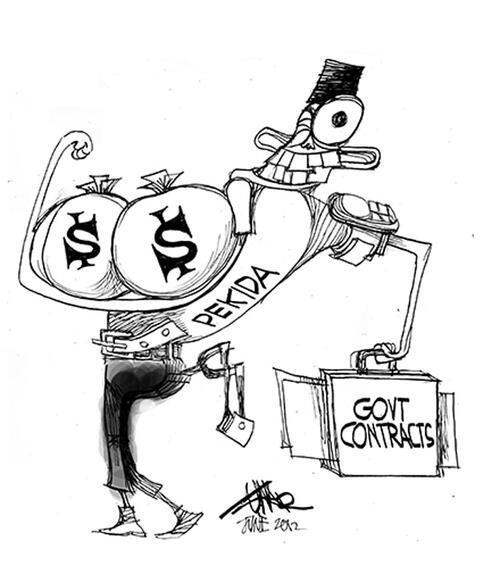
In Malaysia, criminality is a highly political question, and that is mainly why local scholarship on the topic is rare. Yet political participation by outlaws and criminalized groups is not new. Begun in 2008, Dr. Lemière’s research explores uncharted territory: how criminality related to politics in semi-authoritarian Malaysia, with a focus on the ruling party (UMNO) from 2008 to 2018.  She shows how gangs have created umbrella (Malay) NGOs, like Pekida (shown here in caricature), to formalize their ties to political parties. For gangs, political militancy has become a business; political parties (mostly UMNO) have sub-contracted political actions and violence to such groups. Dr. Lemière’s research raises question regarding the nature of civil society and democratization, and offers a new perspective of ethno-religious controversies and clashes in the 20th and 21st centuries.

Sophie Lemière is a political anthropologist at Harvard’s Ash Center for Democracy in its program on Democracy in Hard Places. Her research examines the nexus between religion, politics, and criminality in a comparative perspective. She will be at Stanford in the fall before transferring to the National University of Singapore in the spring.

Dr. Lemière has held research positions in Singapore at the Asia Research Institute (NUS) and the S. Rajaratnam School of International Studies (NTU).  She has been a visiting fellow at the University of Sydney, Cornell, UC Berkeley, and Columbia. She received her PhD from Sciences-Po in Paris. Her dissertation was the first study on the political links between gangs and umbrella NGOs in Malaysia.  Her master’s research on apostasy controversies and Islamic civil society was awarded second prize for young scholars by the International Institute for the Study of Islam in the Modern World (1998-2008) in Leiden.

Dr. Lemière believes it is essential for academics to disseminate their research findings widely, especially in the countries they study. Accordingly, her publications have been written both general and academic readers within and beyond Malaysia. She is the editor of a series of books on “Malaysian Politics and People.” Misplaced Democracy was released in 2014.  Illusions of Democracy (2017) will be re-published in 2018, and a third volume is expected in 2019, when her monograph “Gangsters and Masters: Complicit Militancy and Authoritarian Politics” will also appear. She is currently working on a political biography of Malaysia’s current prime minister during his recent campaign: “The Last Game: Malaysian Politics through Mahathir’s Eyes.”

Dr. Lemière maintains a blog on Mediapart and contributes regularly to New Mandala, The Conversation, Le Monde, and Libération among other outlets.  She has also begun to develop several documentary film projects with French production companies, including a series on arts and politics. Her first film “9/43” featuring the Malaysian cartoonist Zunar was chosen one of the 25 best movies at the French short-film festival Infracourt in 2016.

Sophie Lemière 2018-19 Lee Kong Chian NUS-Stanford Fellow on Contemporary Southeast Asia
Seminars
News Type
News
Date
Paragraphs

We are excited to announce the launch of our brand new online store! The new SPICE Store, located at spicestore.stanford.edu, has been completely redesigned to serve you better. Now it’s easier to navigate, filter, search, and find the titles you want.

To celebrate our launch, we’re holding a 15%-off sale for all curriculum ordered at spicestore.stanford.edu through September 30, 2018. Use coupon code LAUNCHSALE during checkout to redeem your discount.

Visit our new SPICE Store today!

To stay informed of SPICE-related news, follow SPICE on Facebook and Twitter.


Please note: Our old webstore is still functional currently, but we will start decommissioning it in the coming months. For all your curriculum-purchasing needs, please head to spicestore.stanford.edu. Our free multimedia material will continue to live on our main site (spice.fsi.stanford.edu).


Hero Image
Homepage of the new SPICE Store, spicestore.stanford.edu
All News button
1
-

Recent scholarship suggests that, under authoritarian regimes, quasi-democratic institutions such as elections and legislatures—the velvet gloves of autocratic rule—actually enable political stability and economic growth. The political economies of China and Vietnam are indeed remarkably stable and dynamic, and compared with China’s ostensibly democratic institutions, those in Vietnam are open and raucous. That makes Vietnam a likely place to find election and legislatures performing their hypothetically salutary functions.  But are they?

Even in Vietnam, Prof. Schuler will argue, the legislature’s main function is to convey regime strength and cow possible opposition.  Using evidence drawn from more than ten years of fieldwork, survey research, and close readings of legislative debates and the debaters’ lives, he finds that electoral and legislative activity reflect intra-party debates rather than genuine citizen opinion. His results should temper expectations that such institutions can serve either as safety valves for public discontent or as enablers of tangibly better governance. Single-party legislatures are more accurately seen as propaganda tools that reduce dissent while increasing disaffection. That said, Schuler will acknowledge that opponents of authoritarian rule may manage, under certain conditions, to repurpose seemingly democratic institutions toward undermining the regime whose longevity they were developed to prolong.

Image
schuler pic
Paul Schuler is an assistant professor at the University of Arizona, where he studies Southeast Asian politics, Vietnamese politics, and authoritarian institutions. He guest-lectures and publishes widely. His latest article is “Position Taking or Position Ducking? A Theory of Public Debate in Single-Party Legislatures,” Comparative Political Studies (March 2018). Earlier scholarship has appeared in the American Political Science Review and Comparative Politics, among other outlets. He is fluent in Vietnamese and has served as a UNDP consultant in Vietnam. His political science doctorate was earned with distinction at the University of California, San Diego.


Philippines Conference Room
Encina Hall, 3rd Floor
616 Serra Street, Stanford, CA 94305

Shorenstein APARC616 Serra StreetEncina Hall E301Stanford, CA 94305-6055
0
paul_schuler.jpg Ph.D.

Paul Schuler joins the Walter H. Shorenstein Asia-Pacific Research Center as a Lee Kong Chian Southeast Asia Fellow for 2018 from the University of Arizona's School of Government and Public Policy where he is an assistant professor. 

His research focuses on institutions and public opinion within authoritarian regimes, with a particular focus on Vietnam. During his fellowship, he will be completing a book project on the evolution of the Vietnam National Assembly since 1986, which he compares to the Chinese National People's Congress. During his fellowship, he will also begin projects examining public support in Vietnam for climate change mitigation policies as well as other research on the role of personality in determining regime support. For more information on these projects, see his website: www.paulschuler.me.

Schuler's other work has appeared in top-ranking journals such as American Political Science Review, Legislative Studies Quarterly, Comparative Political Studies, and the Journal of East Asian Studies. He holds a Ph.D in political science from the University of California, San Diego. 

2018-2019 Lee Kong Chian NUS-Stanford Fellow on Contemporary Southeast Asia, Visiting Scholar
2014-2015 Shorenstein Postdoctoral Fellow on Contemporary on Contemporary Asia
2018-19 Lee Kong Chian NUS-Stanford Fellow on Contemporary Southeast Asia
Seminars
(650) 736-6410
0
rsd20_007_0042a.jpg

Patrick manages academic programs for FSI, in addition to managing the MIP capstone program: Policy Change Studio. Patrick joined Stanford in 2017 as a Program Coordinator for the Asia-Pacific Research Center’s China Program. Since 2018, Patrick has served as academic program manager at FSI, supporting FSI’s global policy internships, mentored undergraduate research, student led initiatives, field research, and research grant programs. He joined the MIP team in 2020 to manage the capstone program. Patrick holds an MA in Asian Studies from the University of California, Santa Barbara, and a BA in International Relations from the University of California, Davis.

Academic Program Manager
Subscribe to International Relations