FSI researchers strive to understand how countries relate to one another, and what policies are needed to achieve global stability and prosperity. International relations experts focus on the challenging U.S.-Russian relationship, the alliance between the U.S. and Japan and the limitations of America’s counterinsurgency strategy in Afghanistan.
Foreign aid is also examined by scholars trying to understand whether money earmarked for health improvements reaches those who need it most. And FSI’s Walter H. Shorenstein Asia-Pacific Research Center has published on the need for strong South Korean leadership in dealing with its northern neighbor.
FSI researchers also look at the citizens who drive international relations, studying the effects of migration and how borders shape people’s lives. Meanwhile FSI students are very much involved in this area, working with the United Nations in Ethiopia to rethink refugee communities.
Trade is also a key component of international relations, with FSI approaching the topic from a slew of angles and states. The economy of trade is rife for study, with an APARC event on the implications of more open trade policies in Japan, and FSI researchers making sense of who would benefit from a free trade zone between the European Union and the United States.
Yvonne Lee, ’19, hopes to work full time in China someday. During a summer internship supported by the Shorenstein Asia-Pacific Research Center at the Freeman Spogli Institute for International Studies, Lee was able to dive into global policy issues and understand the inner workings of a global research center (and work with former NBA star Yao Ming!).
the Center on Democracy, Development and the Rule of Law
Indonesia features Southeast Asia’s most vibrant and dynamic democracy, but debilitating institutional dysfunctions persist. Age-old patronage-style practices remain commonplace, despite voter demands for governance reform. In effect, two mutually incompatible systems operate simultaneously: the rule of law on the one hand—“Ruler’s Law” on the other. The disarray provides space for mafias and Islamist fringe groups to wield clout. The contradiction tends to deter investment that Indonesia sorely needs in order to escape a “middle-income trap.” What are the prospects for change in the April 2019 national elections? Join the Indonesia political analyst Kevin O’Rourke for a presentation and discussion of poll data, political trends, and potential post-2019 scenarios in the world’s fourth most populous country.
Image
Kevin O’Rourke’s Reformasi Weekly analyzes politics and policy-making for organizations operating in Indonesia. Subscribers include embassies, NGOs, universities, and companies. His firm, Reformasi Information Services, provides political risk consulting and customized research. His latest publication, 2019 Election Primer: Players, Playing Field and Scenarios (Nov. 2018), reviews in detail the rules, issues, and possible results of the country’s nationwide elections in April 2019. Earlier writings include Who’s Who in Yudhoyono’s Indonesia (2010) and Reformasi: The Struggle for Power in Post-Soeharto Indonesia (2002). Kevin started his career in Indonesia in 1994 as an equity research analyst. He is a graduate of Harvard University with an honors degree in government.
Labor market duality refers to the coexistence of temporary workers with low dismissal costs and permanent workers with high dismissal costs within the same firms. The prevalence of temporary employment is a common feature in several countries, such as Continental European countries. Further, since the 1980s, the Japanese labor market has been experiencing a substantial increase in temporary jobs. The quality of temporary jobs tends to be lower than that of permanent jobs (e.g., the former includes lesser job security, lower wages, and fewer training opportunities compared to the latter). For this reason, the causes and consequences of widespread temporary employment have both policy and academic implications. To date, most of the research on this topic has focused on the supply side of labor markets (demographic changes in workforce), macroeconomic impacts (business cycles), and labor-market institutions. However, since the majority of temporary workers tends to be involuntary, the demand-side analysis is important, as well. It has rarely been examined how market competition would affect firms’ demand for temporary and permanent labor, particularly within the context of economic globalization.
Our study attempts to fill this gap. By proposing a heterogeneous-firm trade model with a dual labor market, we examine the relations between the demand for temporary and permanent workers and economic globalization. Our model highlights intensified product market competition as a driving force behind the shift in demand from permanent to temporary workers. In addition, our model demonstrates that international outsourcing effectively reduces labor adjustment costs, which decreases the demand for permanent workers. Using industry-level data from the Japanese manufacturing sector, we empirically test the relations between the demand for temporary and permanent workers and economic globalization and find that they support most of our theoretical predictions.
Image
Hitoshi Sato joins the Walter H. Shorenstein Asia-Pacific Research Center (Shorenstein APARC) during the 2018–2019 academic year from the Institute of Developing Economies (IDE-JETRO), a national research institute in Japan, where he currently serves as a senior chief research fellow. Sato’s field of study is international trade, and his current research interests include the relationships between internationalization of firms and labor markets. His research efforts have been published in journals, books, and policy reports, including theJournal of Japanese and International Economies. Further, Sato has been appointed as a consulting fellow by the Research Institute of Economy, Trade and Industry since 2013. He received his PhD in economics from the University of Wisconsin–Madison in 2006.
616 Serra StreetEncina Hall E301Stanford, CA94305-6055
0
hisato@stanford.edu
hitoshi_sato.jpg
Ph.D.
Dr. Hitoshi Sato joins the Walter H. Shorenstein Asia-Pacific Research Center (APARC) for the 2018 year from the Institute of Developing Economies (IDE-JETRO) in Japan, where he serves as Senior Chief Research Fellow. He will be working on the internationalization of firms, management practices, and development. Dr. Sato received his Ph.D. from the University of Wisconsin, Madison.
The faculty of the Freeman Spogli Institute for International Studies enjoyed a productive period of policy-resonant scholarship spanning from winter quarter 2017 to fall quarter 2018. This document inventories their academic publications, including books in print or under contract, Stanford courses delivered, invited talks across the globe, and activities that involve policy engagement comprising government testimony, advisement and public service, media commentary, opinion pieces, public policy training, and other efforts to translate scholarship into policy.
Stanford Korean studies expert Gi-Wook Shin has been named the William J. Perry Professor of Contemporary Korea, an endowed professorship established jointly by the Freeman Spogli Institute for International Studies (FSI) and the School of Humanities and Sciences (H&S). Shin is a professor in the Department of Sociology, senior fellow at FSI, director of the Walter H. Shorenstein Asia-Pacific Research Center (APARC) at FSI, and the founding director of the Korea Program within APARC.
“Gi-Wook is richly deserving of this appointment,” said FSI Director Michael McFaul. “He is a remarkable colleague and scholar who established a unique Korean studies program at Stanford and, within a relatively short period of time, built it into a leading research hub on contemporary Korea and U.S.-Korea relations. Grounded in the social sciences, the program’s approach to exploring issues of vital importance to policymaking in the United States and Korea from cross-regional and comparative perspectives is at the forefront of FSI’s efforts to foster global engagement through research and teaching.”
The William J. Perry professorship of contemporary Korea was established thanks to a generous gift from Jeong H. Kim, a technology entrepreneur passionate about education and public service, in honor of Professor William Perry, his mentor and friend, who played a significant role in encouraging Kim’s entrepreneurship. Perry is the Michael and Barbara Berberian Professor (emeritus) at Stanford and senior fellow at FSI. An expert in U.S. foreign policy, national security, and arms control, Perry was the 19th U.S. Secretary of Defense, serving during the 1994 crisis on the Korean peninsula. He has long worked inside and outside of government toward a peaceful resolution to the conflict on the Korean peninsula, an effort that he continues today as director of the Preventive Defense Project at FSI. Having witnessed the growth of the Korea Program under Gi-Wook Shin’s leadership, Kim decided to endow a professorship on contemporary Korea, which was named after Perry upon his retirement.
A prolific scholar, Shin is the author and editor of more than twenty books and numerous articles. Some of his recent books include Strategic, Policy and Social Innovation for a Post-Industrial Korea: Beyond the Miracle (2018); Superficial Korea (2017); Divergent Memories: Opinion Leaders and the Asia-Pacific War (2016); Global Talent: Skilled Labor as Social Capital in Korea (2015); and Troubled Transition: North Korea’s Politics, Economy, and External Relations (2013). Due to the wide popularity of his publications, many of them have been translated and distributed to Korean audiences. He frequently contributes expert commentary and analysis on the two Koreas and U.S.-Korea relations in both American and Korean news outlets.
Shin is currently leading a multi-year research cluster that advocates for a “New Asia” of social, cultural, and economic maturity. It includes several projects that analyze a host of issues, such as flows of talent across national boundaries and talent management practices and policies harnessed by leading Asia-Pacific countries to compete in the new global knowledge economy; migration and diversity programs and policies of Asia-Pacific universities, corporations, and governments, and their impact on innovation and creativity; and the interests and policy environments of the two Koreas and their neighbors in relation to the North Korean nuclear problem, the U.S.-DPRK dialogue, the U.S.-ROK alliance, the rise of China, and Korean reunification.
“I am honored to become the William J. Perry Professor of Contemporary Korea,” said Shin. “As a Korean American scholar, my mission has been to strengthen the bonds between the two countries to which I am most attached. It has been a blessing to work together with collogues, friends, and partners at Stanford and in the United States and Korea to deliver on that mission through the Korea Program research, education, and outreach. I am proud of our accomplishments to date and look forward to addressing the challenges ahead and building on our record of achievement.”
Previously Shin held the Tong Yang, Korea Foundation, and Korea Stanford Alumni Chair of Korean Studies. His appointment as the William J. Perry Professor of Contemporary Korea concludes a long search for a candidate to fill the position. “We are thankful to Gi-Wook for his patience throughout the search process,” said McFaul. “This professorship is especially important at a time when changing regional relations and geopolitical developments around the Korean peninsula are front and center to U.S. and international interests.”
Media contact:
Noa Ronkin, Associate Director for Communications and External Relations
Walter H. Shorenstein Asia-Pacific Research center
On November 29, the Korea Program at the Walter H. Shorenstein Asia-Pacific Research Center ( APARC ) welcomed the Ambassador of the Republic of Korea to the United States, Cho Yoon-je , who joined faculty members from the Freeman Spogli Institute for International Studies and other Stanford experts for a roundtable discussion about North Korea diplomacy and U.S.-ROK relations.
“We were delighted to host Ambassador Cho,” said Gi-Wook Shin , director of APARC and of the Korea Program. “The candid conversation enabled us to learn from the Ambassador about the latest developments in the North Korea denuclearization talks and to offer our perspectives and policy recommendations. Convenings of academics and government officials, which Shorenstein APARC frequently organizes, are an excellent venue for advancing dialogue with U.S. counterparts in Asia and for bringing our research to bear on pressing policy issues.”
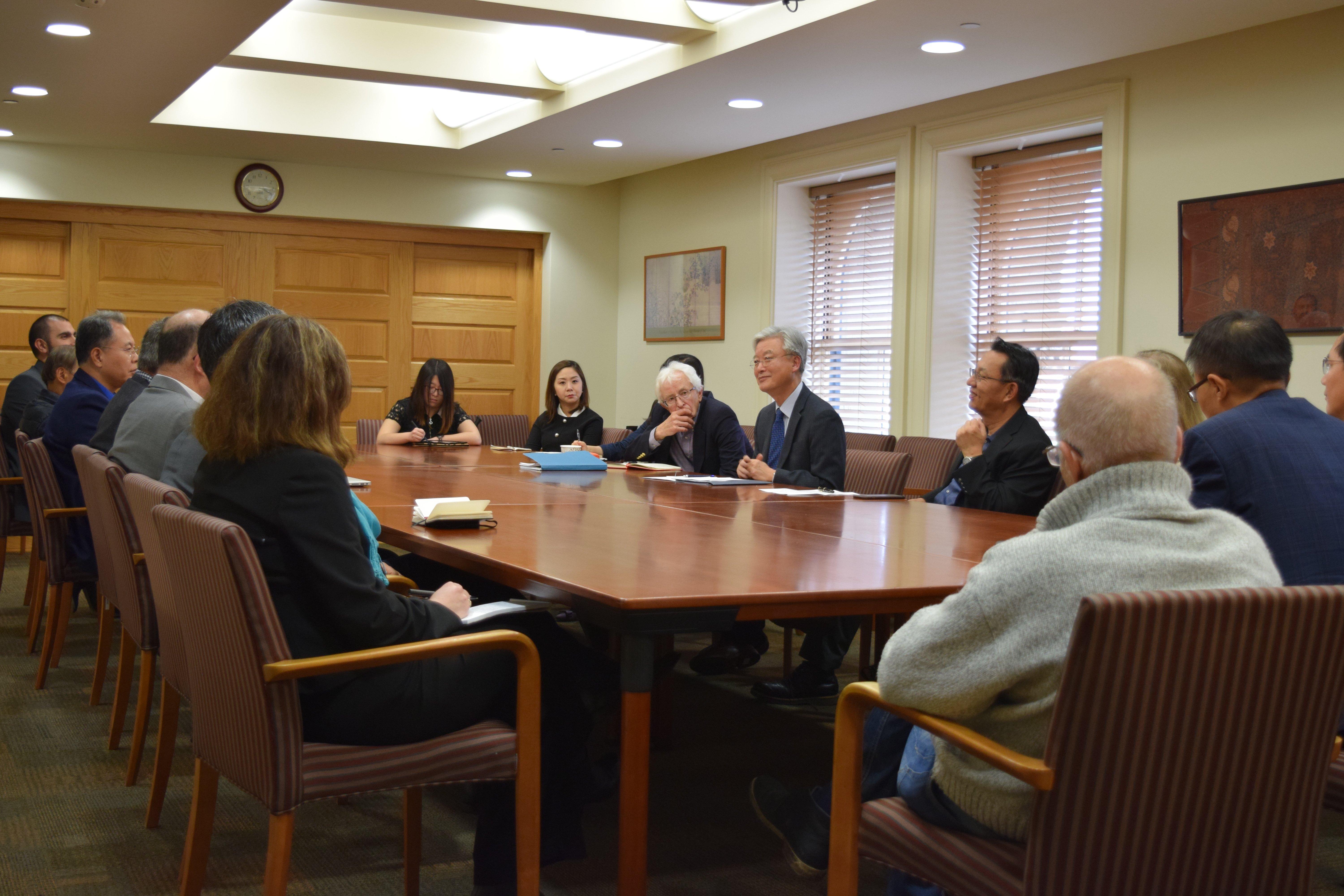
Rountable participants and Ambassador Cho at Shorenstein APARC. Photo: Thom Holme.
Ambassador Cho recently marked his first year since taking office at the height of the 2017 tensions between North Korea and the United States, when the North conducted a sixth nuclear test and several tests of intercontinental ballistic missiles with the potential to reach the U.S mainland. President Trump threatened to “totally destroy” the regime and the North Korean leader responded in kind. Then renewed inter-Korean discussions paved the way for an unprecedented U.S.-DPRK summit and following diplomatic engagement.
Ambassador Cho and the roundtable participants discussed recent reports pointing that diplomacy has stagnated in the months since the summit. The Ambassador expressed South Korea’s determination to seize the opportunity for rapprochement with the North and its commitment to the ROK alliance with the United States.
A specialist in international finance and economics, Ambassador Cho earned his MA and PhD in economics from Stanford University. Throughout his career he has held leadership positions that span both public service and academia. His former roles include the ROK Ambassador to the United Kingdom; Special Envoy to the European Union and to Germany; Senior Counselor to the Deputy Prime Minister and Minister of Finance and Economy of the ROK; Vice President of the Korea Institute of Public Finance; Senior Economist at the World Bank; Economist at the International Monetary Fund; and Director of Sogang University’s Institute for Area Studies.
Hero Image
From left to right: FSI Senior Fellow Siegfried Hecker, ROK Ambassador Cho Yoon-je, and APARC Director Gi-Wook Shin.
During the U.S.-Japan Council annual conference that was held in Tokyo on November 8 and 9, 2018, Rylan Sekiguchi was elected chair of the TOMODACHI Emerging Leaders Program (ELP). The ELP identifies, cultivates, and empowers a new generation of leaders in the U.S.–Japan relationship. Emerging Leaders participate in leadership education, design and implement original USJC programming, and develop powerful, lifelong personal and professional friendships. A new cohort of leaders aged 24–35 is selected annually through a highly competitive process. USJC Senior Vice President Kaz Maniwa, who oversees the ELP, commented, “We are delighted that Rylan Sekiguchi will lead the Emerging Leaders Program next year as the chair of the Steering Committee. Rylan has shown great passion, dedication, and commitment to the Emerging Leaders Program and we look forward to his leadership.”
Secretary Norman Mineta and Rylan Sekiguchi
During the conference, Sekiguchi gave an overview of the ELP and shared reflections of how his professional and personal lives have embraced the mission of the ELP. Sekiguchi spoke specifically about his current work at SPICE with USJC Vice Chair Norman Mineta, former Secretary of Commerce under President Bill Clinton and Secretary of Transportation under President George W. Bush. Mineta is the subject of a new documentary—An American Story: Norman Mineta and His Legacy—co-produced by Dianne Fukami and Debra Nakatomi, and Sekiguchi is finalizing web-based lesson plans that focus on the film’s key themes, including immigration, civil liberties, and leadership. The documentary was screened at the conference and is anticipated to air on PBS.
A short video that Sekiguchi shared during his speech brought applause from the audience. The video captured a snippet of a performance that he and other members of San Jose Taiko presented last year. The performance celebrated “swing music and the role it played in lifting people’s spirits amid the harsh reality of the Japanese-American internment,” shared Sekiguchi. “Through music and theater, we transported people back to a 1940s-era ‘camp dance’ to educate audiences about the painful, agonizing choices that incarcerees faced.” Mineta was a young boy when his family was uprooted from San Jose, California, and incarcerated in a camp for Japanese Americans in Heart Mountain, Wyoming. Mineta later became mayor of San Jose in 1971.
Through Sekiguchi’s reflections, audience members from both sides of the Pacific were prompted to reflect upon civil liberties during times of crisis—in this case, the incarceration of Japanese Americans following the Japanese attack on Pearl Harbor. My father was a high school student in a camp in Poston, Arizona, and the video prompted me to recall one of the few things that he shared with me about his life behind barbed wire—that camp dances and baseball brought some sense of normalcy to the lives of Japanese-American youth. By showing the video, Sekiguchi’s implicit message was clear: young Americans today—including of course, ELP members—must be aware of the sometimes fragile nature of civil liberties. I have the good fortune of working with another ELP member, Naomi Funahashi, and during the conference, it was rewarding for me to meet many ELP alumni and members of the newest cohort and to witness the beginnings of personal and professional friendships amongst them. Sekiguchi’s speech set the tone for the year ahead—like a “camp dance,” he wants the ELP members to have fun but to always remember the serious nature of what the ELP represents.
On November 25, Russian border patrol ships rammed a Ukrainian naval tug and then fired upon and seized it along with two Ukrainian gunboats that were legally attempting to pass through the Kerch Strait into the Sea of Azov. Russia then temporarily closed the strait to all Ukrainian shipping. What is the significance of these Russian actions for Ukraine and, more broadly, for the West, and how should the West respond?
Stanford's Ukrainian Emerging Leaders Program at the Center on Democracy, Development and Rule of Law, the Europe Center together with FSI faculty members has organized a special panel discussion to address these issues on Wednesday, November 28 at 4:30 pm in the Rueben Hills conference room on the 2nd floor of Encina Hall in the East Wing.
Please join Ambassador Steven Pifer, Ambassador Michael McFaul, and our CDDRL Ukrainian Emerging Leaders (Nataliya Mykolska, Ivan Prymachenko and Oleksandra Ustinova) for this special event to diagnose the situation in Ukraine and what it means from a US and Ukrainian perspective.
We look forward to seeing you there!
Rueben Hills Conference Room, 2nd floor Encina Hall
“I learned long ago to never predict anything about North Korea.”
So began the keynote address by Anna Fifield, veteran journalist and winner of the 2018 Shorenstein Journalism Award. Speaking at the Award’s seventeenth annual panel discussion “How North Korea Is, and Isn’t, Changing under Kim Jong Un,” Fifield, the Beijing bureau chief for The Washington Post , shared some of the many observations she has made since she first began covering North Korea in 2004.
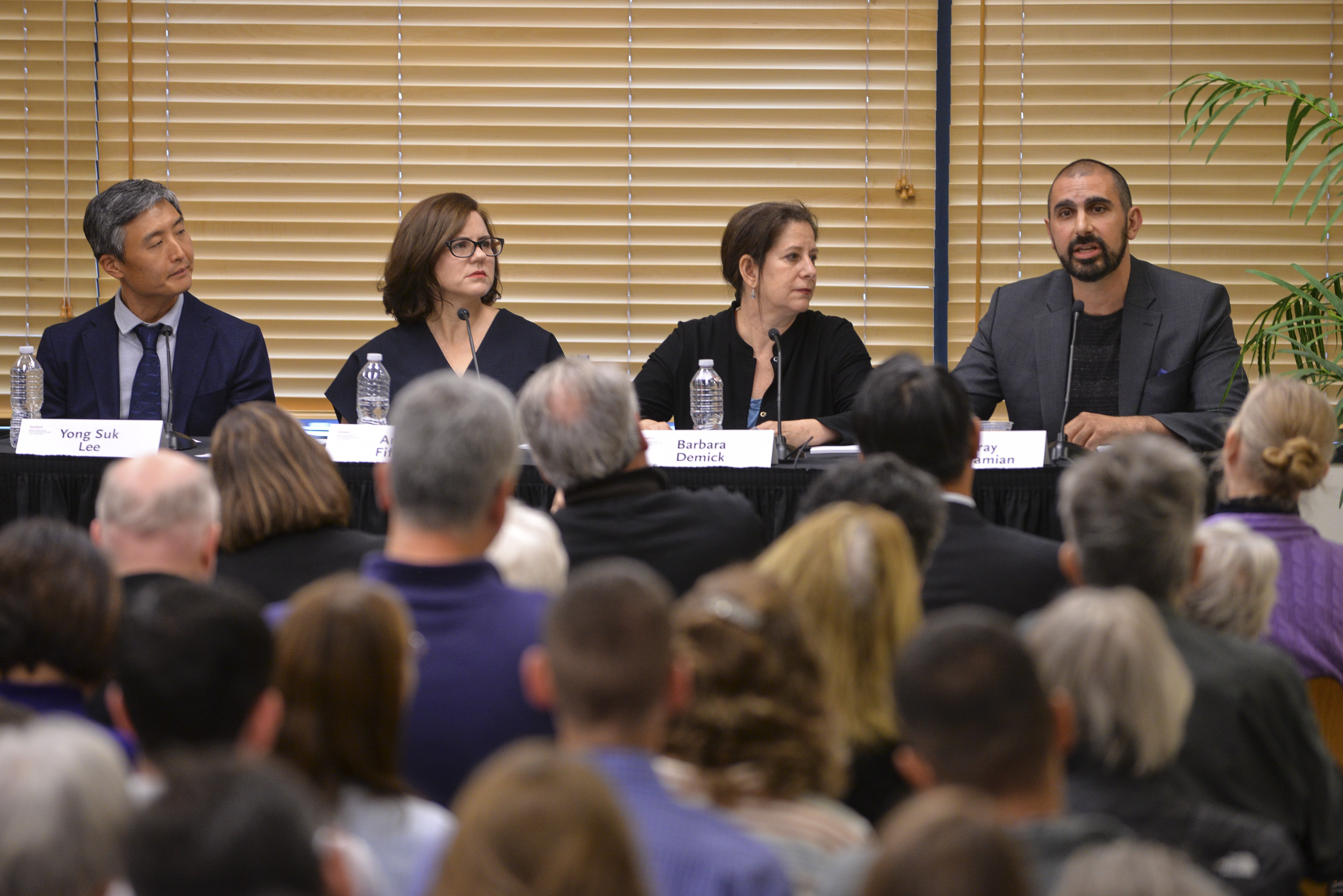
Two other North Korea experts joined Fifield at the panel: Barbara Demick, New York correspondent of the Los Angeles Times, formerly head of the bureaus in Beijing and Seoul, and the 2012 Shorenstein award winner; and Andray Abrahamian, the 2018-2019 Koret Fellow, whose previous role as executive director of Choson Exchange and other projects took him to the DPRK nearly 30 times. Yong Suk Lee, deputy director of the Korea Program at Shorenstein APARC, chaired the panel.
The presence of another person—the Dear Respected Comrade himself—was also very much felt in the room, if only in spirit.
Barbara Demick (center) speaks at 2018 Shorenstein Journalism Award.
Survival at any cost
At various points throughout its 70-year history, experts have predicted the demise of the "Hermit Kingdom." Fifield herself admitted to occasionally thinking along such terms.
And yet the country continues to prove them wrong.
“[D]uring my first stint covering North Korea, [I] just couldn’t envisage any way that this regime could survive the death of the second-generation leader and the transition to a third generation,” she said. “Kim Il Sung had created a myth of revolutionary heroism around himself, and a myth of divine selection around his son, Kim Jong Il. How could the North Korean people, who no longer live in a Hermit Kingdom, tolerate a third leader called Kim, let alone one who had no highly exaggerated or plain fictional back story?”
“Yet," Fifield continued, "here we are. Next month, Kim Jong Un will celebrate seven years in charge of North Korea.”
One prominent reason for the nation's recent survival, and an idea put forward by Fifield and supported by her co-panelists, was the development of markets in the communist state.
For decades, North Korea operated under the centrally-planned communist model. Even as China pursued reform and as the Soviet Union collapsed, the North Korean state maintained its central position in the economy.
However, following the famines of the 1990s, the state had no choice but to allow market activity to develop. Under the third Kim markets have continued to grow.
“There are now more than 400 established, state-sanctioned markets in North Korea,” said Fifield. “That’s more than double the number that existed when Kim Jong Un took over at the end of 2011.”
A side effect of this nascent market economy has been the emergence of new elites in the purported “classless” society. Fifield described the development of a capital within the capital—“Pyonghattan”—where newfound elites purchase clothes from western retailers and undergo plastic surgery for their eyelids.
Abrahamian concurred, noting that Kim Jong Un made sure to coddle this upper middle and upper class in Pyongyang. "The old way of doing that under Kim Jong Il and his father, Kim Il Sung, was very much through a loyalty and gift economy," Abrahamian said. "Money was not necessary in the old North Korea. Now it is. You do need it to get your daily necessities, and if you’re lucky enough, the products [from the “outside world”] help you to have a more pleasurable life through the market.”
At the other end of the spectrum, North Koreans turn to the markets not out of entrepreneurial zeal, but out of a need to survive. As an example, Fifield described meeting a mother and daughter living near the border with China. The mother took her daughter out of school in order to raise pigs and make tofu. Before dawn, they trekked into the mountains to tend crops of corn. It was a back-breaking existence. "If they were lucky, they made enough money each day to buy food for themselves," Fifield said. "Many days, they did all this to break even."
Andray Abrahamian responds to a question from the audience.
A smart tyrant not to be underestimated
The panel continued to focus on the man currently at the helm in North Korea.
“When I returned for my second go at covering the Koreas, I wanted to figure out how he’d done it," said Fifield. "How had this podgy young upstart with no qualifications other than being born into this family managed to take control of this regime…? How had he managed to keep intact this anachronistic system that should have died years, even decades, before?”
Fifield emphasized that her comments did not equate to admiration for Kim Jong Un. “He’s a tyrant,” she reminded the room. “But he’s a smart tyrant who’s been operating in a calculating way. To treat him as a joke or a madman is to underestimate the threat of him.”
“Kim Jong Un has not allowed these markets to flourish because he cares about the people and their wellbeing,” Fifield continued. “He has demonstrated time and time again that he doesn’t care at all about the people.”
“There’s only one thing he cares about and that is staying in power.”
Demick cautioned further against over-estimating the positive impact of market development on life in North Korea. “The people Anna interviewed for her groundbreaking series in 2017 in The Washington Post were disgusted with the system,” said Demick. “With the income inequality, with the corruption, with the controls.”
“For them, what’s the worst thing about North Korea? Simply being born there.”
The panelists participated in a lively audience Q & A.
A celebration of journalism
The Shorenstein Journalism Award, which carries a cash prize of $10,000, recognizes accomplished journalists committed to critical reporting on and exploring the complexities of Asia through their writing. It alternates between honoring recipients from the West, who mainly address American audiences, and recipients from Asia, who pave the way for freedom of the press in their countries. Established in 2002, the award honors the legacy of APARC benefactor Mr. Walter H. Shorenstein. A visionary businessman, philanthropist, and champion of Asian-American relations, Shorenstein was dedicated to promoting excellence in journalism and a deeper understanding of Asia.
While the reporting of each year's recipient focuses on different regions and areas of interest, the award consistently recognizes quality journalism. In his welcome remarks, panel chair Yong Suk Lee stated, “In the face of current attacks on journalists and on the truth in the United States and the world, [Shorenstein APARC is] even more committed to excellence in journalism, and to defending independent and free media."
Fifield’s co-panelists spoke at length about how deserving she was of the award. Before their first meeting in Seoul, Abrahamian confessed to harboring skepticism about Fifield. “I had read some of her work before and knew she had analytical chops, but thought to myself that journalists are always fighting for the next scoop.” However, after talking to Fifield for only a few minutes, Abrahamian readily dropped his guard. “I told myself, 'This is a special journalist; she's got something.’"
A previous recipient of the Shorenstein Journalism Award herself, Demick was equally enthusiastic in her praise of Fifield. “For the last four years, [Anna] had owned the North Korea story like no other journalist I’ve met, including myself.”
Fifield was presented with the Shorenstein award and prize at a private evening ceremony.
Watch Fifield’s keynote speech below. An audio version is availalbe on our SoundCloud channel.
Hero Image
Panel chair Yong Suk Lee (left) listens as 2018 Shorenstein Journalism Award winner Anna Fifield speaks to audience.
On November 14, APARC honored the 2018 Shorenstein Journalism Award recipient, Washington Post Beijing bureau chief Anna Fifield. At a Stanford event, Fifield joined a panel discussing economic changes in North Korea, as well as the country’s position in global diplomacy under the leadership of Kim Jong Un.

 FSI researchers strive to understand how countries relate to one another, and what policies are needed to achieve global stability and prosperity. International relations experts focus on the challenging U.S.-Russian relationship, the alliance between the U.S. and Japan and the limitations of America’s counterinsurgency strategy in Afghanistan.



 Secretary Norman Mineta and Rylan Sekiguchi