TRANSCRIPT:
McFaul: You're listening to World Class from the Freeman Spogli Institute for International Studies at Stanford University. I'm your host, Michael McFaul, the director of FSI.
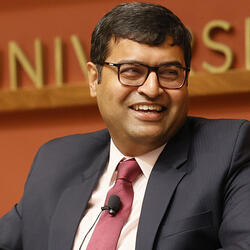
Today I'm talking to Arzan Tarapore, a research scholar at the Center on International Security and Cooperation, which is part of the Freeman Spogli Institute here at Stanford. His work focuses on India's military strategy and regional security issues in the Indo-Pacific, which is why he is the perfect person to talk with us today about the escalation earlier this year between India and Pakistan in the Kashmir region. And India's evolving military strategy more generally, as it relates to players like the United States, China, and Russia.
Arzan, welcome to World Class.
Tarapore: Thanks very much, Mike. It's good to be on.
McFaul: So, I want to start with a chat group I was on several weeks ago with a bunch of former U.S. government officials. And at one point, somebody interjected, “We are about to see the biggest military war in the world since Russia invaded Ukraine.”
And I have to tell you, I was taken aback. I don't follow issues between Pakistan and India as closely as I should, and I look forward to learning more about that now that my book is done and I have more time.
But that really startled me. Take us back to that moment. Help us understand what occurred that made people so alarmist, and then why that didn't turn out to be the case.
Tarapore: Yeah, okay, that's a very big question. Let me see if I can hit all the high spots. Look, the trigger for that comment, probably, was a terrorist attack that happened in India at a place called Pahalgam on the 22nd of April. And it was an attack that was conducted, as far as we can judge, by a Pakistan-based terrorist group that attacked innocent civilians.
And in particular, it was designed, it seems, to be as inflammatory, as provocative as possible, right? Because the terrorists were at a tourist spot, and they rounded up people and got those people to identify themselves — whether they were Hindu or Muslim — and they executed the Hindu men.
McFaul: Wow. Oh my God.
Tarapore: So it was designed to be as communal and as provocative as possible. And in that sense, it worked because the Indian government almost immediately was assumed to be poised to retaliate.
And this is interesting. This is notable, because about as recently as a decade ago, it was always an open question whether India would retaliate militarily against these types of terrorist attacks. And the situation has changed so much in the past decade that this time around it was almost assumed from the get-go that India would retaliate. And indeed they did retaliate.
McFaul: And they did.
Tarapore: And they did. And probably the reason that that member of your group chat said what they said is because India and Pakistan have, for decades, been poised with their militaries pointed at each other. These are very large militaries, very capable militaries. And nuclear armed militaries.
McFaul: Yes. Let's not leave out that small fact.
Tarapore: Exactly, right? Which is always overriding concern in Washington. So, it was President Clinton who, back in the 90s, called South Asia the most dangerous place in the world. He identified India Pakistan as the sort of scenario that if any scenario in the world was going to lead to a nuclear exchange, since the 90s there's been a strong case to be made that it would be India Pakistan. And that's always colored American thinking whenever there's a crisis between India and Pakistan and this time around was no different.
McFaul: And tell us how it played out, and how it ended.
Tarapore: So, the inevitable—that is, an Indian military attack—happened on the night of 6-7 May. So, in the very early hours of the 7th of May, local time. At about 1 a.m., India launched standoff attacks, meaning attacks launched by aircraft that did not cross into Pakistani airspace.
So the Indian aircraft stayed on the Indian side of the border and launched long-range munitions plus probably some loitering munitions, so sort of what some people call suicide drones. So, drones that are designed to go to the target and destroy the target and themselves.
S,o India launched these standoff attacks against nine terrorist targets, terrorist sites.
McFaul: And they were terrorist sites, right?
Tarapore: Yes. So there's a line of Pakistani information operations that suggests that civilians were killed. That may or may not be true. But certainly the Indian position is that they were terrorist targets and that the Indian claim is that the strike was designed to minimize civilian casualties as far as possible. Hence they attacked, for example, at 1 a.m., right, when places were probably not occupied.
McFaul: Got it.
Tarapore: So, a bunch of these sites were sort of in the countryside. And we know that because they showed the full motion video of the sites being destroyed by the missiles and they are just for some of them were just a building in the middle of the countryside or a couple of others that were terrorist headquarter complexes in the middle of cities and these are big sort of campuses that include living quarters and operation centers and mosques all on the same campus. And a couple of those sites were struck as well.
But again, at 1am and in a very targeted fashion to minimize civilian casualties. And by and large, they did a pretty good job of minimizing civilian casualties.
McFaul: So they could have done more and they chose this kind of response, right?
Tarapore: Exactly. And not only that, but they also in the subsequent press briefings, they were very clear in saying, “Listen, our quarrel is with the terrorists. We do not intend to start a war with Pakistan. We will respond if Pakistan responds to us. But we very deliberately have not struck Pakistan military targets or targets of the Pakistan state. We've only struck terrorists. And so as far as we are concerned, we have done what we needed to do. Now it's up to Pakistan to stand down and not retaliate.”
Of course, there was no chance of that happening. Pakistan did retaliate. And so then we entered a period of about three or three and a half days of tit for tat attacks between India and Pakistan. Again, all of them largely targeting each other's particular military sites; everything from sort of air defence sites to air bases on each side.
McFaul: On each side, right?
Tarapore: On each side.
McFaul: And did planes cross the line, or was it was the same kind of thing that you just described?
Tarapore: Planes never crossed the line, as far as we know. So, even though there were claims that some aircraft were shot down on the Indian side, and the Indian military leadership has subsequently conceded that, admitted that.
McFaul: So there were? That has been confirmed? I didn’t know that.
Tarapore: They have confirmed that they suffered some losses. They have not confirmed how many or what type. But it seems to be somewhere in the order of two to five Indian aircraft were shot down.
A bunch of Pakistani air bases were struck by Indian Air Force strikes. And this time around, unlike in the last crisis in 2019, the Indians were very assiduous in releasing battle damage assessment—photography and video—to prove they did actually hit these targets.
And through this whole process of about three and half days of tit for tat strikes, where the Indians scored a few big strikes against the Pakistan military and the Pakistan military did not really score any big hits against the Indian military. There were a few rounds that went astray and did sort of hit civilian targets, but by all accounts unintentionally. Through this all, the two militaries tried to keep things relatively proportionate. Neither one took big steps. They did not cross big thresholds to escalate.
But then on the last day, there were some concerns that Pakistan was in fact preparing for a bigger escalation. That's when the U.S., which had hitherto sort of tried to stay hands off, that's when the U.S. started making some phone calls to both capitals.
And then as probably prompted by that, prodded by U.S. pressure, Pakistan made a phone call to India—the Director General of Military Operations made a phone call to his opposite number in India—suggesting a ceasefire, which India agreed to. And that was the end.
So it was about a three and a half day stoush, little conflict, mostly run by missiles and loitering munitions. So no one crossed into the other country’s territory. It was a very sort of modern conflict in that sense.
McFaul: So, I want to get back to the Americans in a minute, but before that: what did you learn about Pakistani military capabilities and Indian military capabilities as a result of this?
Tarapore: So it was pretty interesting. It was very interesting, actually. Because for decades, basically throughout the 21st century, we have been worried about the prospect of a conventional war between India and Pakistan as a result of a terrorist attack.
And the mental model that we've always had is a large, combined arms, ground-centric invasion by India against Pakistan, right? Basically a war.
And for years, India has been trying to find options short of that in a way that would not prompt a Pakistan nuclear escalation. And it seems, after a couple of crises, that India has found a way to hit back at Pakistan militarily using these standoff capabilities that are relatively new in the Indian arsenal.
So, India has recently acquired a lot of these capabilities that have given it the strategic option to hit Pakistan without starting a war, So, when you ask, what did we learn about their capabilities, we learned that India has the capability to conduct these standoff attacks. And interestingly, from my point of view, the real star for the Indian military was air defense.
Whereas India managed to score a few good hits against the Pakistan Air Force and the terrorist infrastructure on day one, the really interesting thing was that despite Pakistan launching a bunch of mostly drone attacks against India, they did not score any significant hits. And this was a result of a layered air defense system that India has built up, which I was surprised by. The effectiveness was surprising.
McFaul: And where do their missile defenses come from? Are they Russian? Are they mixed?
Tarapore: I'm glad you asked Mike. They come from all over. A lot of it is indigenous.
McFaul: Indigenous! Okay, I didn't know that.
Tarapore: Some of it is indigenous, the shorter range. There's a surface-to-air missile called Akash, which is an indigenous system. There are some old legacy guns that the army operates that prove very effective.
But the really interesting thing that think that you would find in particular interesting is that the most sophisticated—which is to say, the most recently acquired and longest range system that provides the biggest bubble—was the S-400, which India acquired from Russia, much to the chagrin of the United States.
McFaul: Yes, the United States. It was a huge fight, right?
Tarapore: Yup! The U.S. threatened CAATSA sanctions against India for it.
McFaul: Tell everybody what CAATSA sanctions are. It’s a specific category of sanctions passed in the Trump administration, wasn’t it?
Tarapore: Yep, which is designed to deter countries from acquiring Russian equipment. So, the Indian deal to acquire S-400s was happening contemporaneously and the U.S. was always on the horns of a dilemma whether they should enforce CAATSA sanctions against India or issue a waiver.
As far as I recall, the U.S. decided to not make a decision. They never imposed the CAATSA sanctions, but nor did they issue an indefinite waiver. So it was always something that years ago was sort of hanging over the head of the relationship that the U.S. did not go through with sanctioning India. And the Indians now, after Op Sindoor, after this clash, now feel vindicated that in fact they acquired S-400s and you know what? They they proved to be extremely effective in protecting India.
McFaul: Super interesting. So they were right. I remember when we were trying to prevent the Russians from selling the S-400s to the Iranians during our negotiations over the Iran nuclear deal long ago. On paper, this was a significant capability. It sounds like in reality it is as well.
Tarapore: It absolutely is.
McFaul: Let's talk about the geopolitics. Let's just talk about the reaction. Walk us through U.S., China, Russia. How did they react to this conflict? And what are your takeaways in terms of the geopolitics of a very complicated set of bilateral relationships, especially with India, it seems to me, but with Pakistan as well.
How did the great powers react? And what do we learn about great power competition from this conflict?
Tarapore: So as you would know, as listeners would know, China is Pakistan's primary patron, great power patron. It provides Pakistan the bulk of its military capability. And in fact, this India-Pakistan clash was seen by some in some quarters as a test of Chinese military capability . . .
McFaul: Yes.
Tarapore: . . . because the Pakistanis operate so much Chinese equipment.
Well, I think it's not a very good test of Chinese capability for many reasons. One, because the equipment itself that Pakistan operates is lower grade export variants of what China’s is. It's not integrated into a system in Pakistan in the same way as it is in China. And it's not used with the same what we would call “multi-domain doctrine” as the Chinese use.
So it's not a very good test of the Chinese equipment.
McFaul: Okay, well that's an important point, a very important point. They don't have the best stuff.
Tarapore: Yeah, that's right. They don't have the best stuff and they don't use it “properly,” quote unquote, in the same way that the Chinese do.
So, from the Indian point of view, this is a country, India, that has always been concerned about what they call the collusive two front threat: Pakistan and China ganging up on India, where if there was a crisis or a conflict with one, then India was always concerned that the other rival would opportunistically take advantage of it and open a second front.
I've always been skeptical of that. And I think what this conflict showed was what India considers to be no longer a two front dilemma, but one reinforced front. Because in this view, Pakistan was essentially, if not an appendage of China, it was nevertheless underwritten by China.
It may, according to some accounts, have benefited from real-time Chinese support during the conflict. For example, intelligence support, electronic warfare support by China, perhaps even Chinese personnel helping to advise Pakistan on how to use its weapons and how to plan and operate them. We don't know if that's true, but that's a possibility.
McFaul: Speculation, interesting That's a big step.
Tarapore: It is a big step. And so if you ask about China's approach to this, then clearly China is not neutral in this, right? China is underwriting Pakistan in this. But openly, diplomatically, it's not going to take a position and it's not going to take advantage of this sort of conflict to cause trouble on the India-China border. It's not that sort of exploitation.
Similarly, as with the U..S, there were Russian comments throughout this conflict that either proponents of an India-Russia relationship or critics of an India-Russia relationship could use instrumentally.
Some people, sometimes some Russian officials said something about India and Pakistan sort of creating this sense of equivalence that in fact they're not on our side, that they're being ambivalent. Others would say that no, in fact, Russia was more solidly behind us than any other country was.
And the same occurred with the U.S. There were U.S. officials who commented that either India is a victim of terrorism and that Pakistan is a perpetrator of terrorism, which pleased Indians, or that this conflict is none of our business, that it's something for India to handle, which they could live with.
Or, when President Trump started talking about India and Pakistan having been at war for a thousand years or whatever he said . . .
McFaul: Thousand years, he said. Yes.
Tarapore: . . . Indians rolled their eyes and were frustrated because for decades Indian officials have been trying to get Americans to internalize this idea that India is an important partner of the U.S. and that this hyphenation between India and Pakistan is an outdated idea that no longer applies.
And now here we have a President of the United States, again talking about India and Pakistan in the same breath, talking about having mediated between them, talking about having coerced both sides using the cudgel of trade deals, and promising to get the two sides to sit down and talk about Kashmir.
All of these things to anyone who doesn't follow South Asia, prima facie sound reasonable. To anyone who follows South Asia, these are all red lines and big alarm bells, especially in India, because they go against decades of American policy.
And so it was a sense of, in the extreme, a sense of betrayal. Or at a minimum, was a sense of rolling your eyes at a president who has not been well briefed.
McFaul: Who doesn't know the details. So what do you think? Was it was he just winging it, or was this really a policy change that was scripted?
Tarapore: No. So the interesting thing is, I mean, if you look at what the United States, quote unquote, deep state did—that is, the State Department, the U.S. State Department and the Secretary of State Marco Rubio—their comments were very consistent with U.S. policy over the last couple of decades. The concern is strategic stability, that these are two nuclear armed countries, we don't want conflict escalating carelessly, and that India is in fact a victim of terrorism and that, you know, there's no role for the United States to mediate a Kashmir issue.
There was none of that sort of sense, right? The State Department and the Secretary of State played a very straight bat and were consistent. It was President Trump who spoke extemporaneously about a conflict he seems to be not well-versed in, which has raised heckles.
But also, on the one hand, we can say that this is just a president speaking extemporaneously. On the other hand, he is the commander in chief of the United States.
McFaul: Exactly, yeah, right, exactly.
Tarapore: So you can't quite ignore what he says.
McFaul: Right. And just two seconds on the Russians. You gave us a little bit of it, but did they seem pleased? Obviously, they seem pleased with how their S-400s performed. Is this another – because obviously Modi has a pretty special relationship with Putin, I would say, compared to other leaders of democracies. Is this seen as a sign of closer relations between India and Russia, or is that too far?
Tarapore: I think that's going too far. I think the broader trend of India trying to wean itself off Russia remains, but it may have been set back a little bit by this. And what I mean by that is, for example, even if you take just the S-400s themselves, India bought five regiments of them and only has taken delivery of three of them.
COVID interrupted the deal, right? COVID interrupted the deliveries and then the Ukraine war interrupted the deliveries.
McFaul: Okay, I didn't know that.
Tarapore: And so the Indians are still waiting to take delivery of two regiments. And now, again, as we've said, this conflict seems to have vindicated the Indian decision to acquire S-400s. And that in fact, you know, there may be niche military capabilities that the Russians can offer India that proved to be operationally useful. So this relationship is far from a relic, right? This relationship is very much a live relationship that yields dividends for India.
McFaul: Great point. And tragically, the Russians have learned a lot about how to use drones in Ukraine. I just talking to some officials who work on European security, and they are way far ahead of where we expected them to be in terms of that. That could be an exportable technology in the future for other countries, for sure.
Tarapore: Absolutely.
McFaul: So to close out: give us your sense of what's next. What do you think happens here? Is this just a one-off or are you worried about other escalatory events?
Tarapore: An India-Pakistan crisis is never a one-off.
McFaul: That's a good point! I shouldn't laugh, but it's been there for a long long time.
Tarapore: It's been there for a long, long time. So, the sub-conventional campaign of terrorism based in Pakistan against India will continue. And as I said at the outset, what used to be hard to think of and then became a question of uncertainty has now become a certainty that India will retaliate.
Modi, after this conflict, gave a speech where he basically pledged that any future attack against India will be met with retaliation, Indian military retaliation. So it is now a matter of policy that India will retaliate against Pakistan.
McFaul: Before go on: we have not—the United States and obviously not China—we do not have enough influence vis-a-vis Pakistan to shut those terrorist camps down, right?
Tarapore: No way. This is foundational to the Pakistan army, foundational to the most powerful political actors in Pakistan.
McFaul: Got it.
Tarapore: And I think what this latest conflict shows is that India also recognizes that it is futile to try and dissuade the Pakistani military-jihadi complex from attacking India.
That used to be what they tried to do: to dissuade them, to deter them. What we've seen in 2025 is India recognizing it cannot dissuade Pakistan. It must instead impose costs upon these terrorists, and now the Pakistan army as well, so that it just makes it harder for them to attack India, so that attacks become less frequent and less provocative.
That seems to be where India is leaning. It is expecting future attacks from Pakistan And it's correct. And it will retaliate next time. That is a highly probable eventuality.
The question for me is, okay, so we now expect this sort of conflict to recur. The question is, what does it mean for India's overall defense posture, including what lessons does India learn for deterring conflict with China on the land border. And what does it mean for India's ability to project power into the Indian Ocean region? This is a country that faces challenges, security challenges on all sides.
And every time one of these fronts becomes active and it seizes the attention of decision makers in Delhi, the concern is that India will react to it and it will over learn the lessons of the last crisis and it will come at the expense of other priorities elsewhere.
So that'll be the thing that I watch. To what extent does this cast a shadow over Indian security planning for the months and years ahead?
McFaul: Wow, it sounds super scary. It sounds like Clinton was right, what he said back then. And when you add, as you did, we're talking about two nuclear powers. Obviously, China is a nuclear power.
Tarapore: Three!
McFaul: Three. This is frightening part of the world. That's why we're grateful, Arzan, to have you on World Class! We're grateful to have you at FSI and at Stanford, because we’ve got to be following this issue. So thanks for joining World Class today.
Tarapore: Absolutely my pleasure. Thanks Mike, for bringing some attention to this issue.
McFaul: You've been listening to World Class from the Freeman Spogli Institute for International Studies at Stanford University. If you like what you're hearing, please leave us a review and be sure to subscribe on Apple, Spotify, or wherever you get your podcasts to stay up to date on what's happening in the world, and why.

 FSI researchers strive to understand how countries relate to one another, and what policies are needed to achieve global stability and prosperity. International relations experts focus on the challenging U.S.-Russian relationship, the alliance between the U.S. and Japan and the limitations of America’s counterinsurgency strategy in Afghanistan.