
Paragraphs

In June 2025, Ukraine’s security services staged an audacious strike inside Russia. They infiltrated the country and hid short-range attack drones in cargo trucks near a slew of Russian air bases as far away as the Amur region on the border with China. Most of these bases were home to Russian strategic heavy bombers—aircraft capable of carrying nuclear weapons. Using Russia’s mobile phone network, Ukrainian operatives remotely launched the drones, successfully destroying at least ten of the bombers and damaging a total of 41 planes, including some used for nuclear command and control, according to Ukrainian assessments.

Known as Operation Spider’s Web, this assault was a remarkable gambit. The most significant aspect of the attack, however, was not its astonishing cost ratio—as one analyst put it, “a single drone costing just $500 destroyed a strategic bomber worth tens of millions of dollars”—or its ingenuity in hijacking Russian telecommunications, but the fact that it could happen at all. As part of its long-standing doctrine, Moscow had insisted that a conventional attack on its strategic assets could provoke a nuclear response. But that did not stop Kyiv. Ukraine was willing to go after Russia’s nuclear capabilities, and Russia was unable to prevent their destruction.

Continue reading at foreignaffairs.com
All Publications button
1
Publication Type
Journal Articles
Publication Date
Authors
Rose Gottemoeller
Authors
News Type
News
Date
Paragraphs

1991 was a pivotal moment in history. Boris Yeltsin and other Russian democrats thwarted a coup against Mikhail Gorbachev, hastening the Soviet Union’s collapse. The new leadership embraced democratic ideals and sought to join the Western-led liberal international order.

Michael McFaul was in Moscow doing field work for his PhD. For the budding academic, it was an exhilarating time to be a political scientist, a multilateralist, an American, and a ‘small-d’ democrat. It seemed Russia wanted to join the democratic world, and China was open to the possibility. As his future Stanford colleague Francis Fukuyama argued in a famous essay, it felt like the end of history.

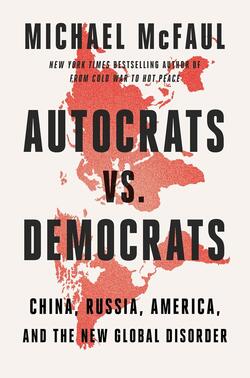
Cover of Autocrats vs Democrats Book

Today, that story looks very different. Vladimir Putin’s Russia has grown increasingly authoritarian. China under Xi Jinping has as well. And new threats to democracy have emerged worldwide.

McFaul, who has led the Freeman Spogli Institute for International Studies for 11 years and will step down as director at the end of the year, wrote Autocrats vs. Democrats: China, Russia, America, and the New Global Disorder to explain how we got to this point, how to understand today’s great-power competition, and what Americans leaders and citizens can do about it.

Below, McFaul, who is a professor of political science in Stanford’s School of Humanities and Sciences, offers five of the book’s main takeaways in his own words.

#1 Competition and confrontation are not inevitable.

When it comes to U.S.-Russia and U.S.-China history, my new book shows the relationship between power, regime type and individuals, and how they change over time. How these three variables interact determines when there have been moments of cooperation or confrontation. In the first two substantive chapters of the book, I trace U.S.-Russia and U.S.-China relations from the 18th century until today, identifying 5 distinct eras of both cooperation and confrontation.

Today we're in a period of confrontation because China is powerful, autocratic, and has a leader with global ambitions. Russia is also stronger than it was 30 years ago, is now a dictatorship again, and is ruled by a leader with global revisionist aims. This combination creates a challenge – and a confrontational atmosphere – with the United States, another great power that is still democratic.

But if you go over that history, you'll find that it wasn't always that way. Sometimes there were greater moments of cooperation, in part because of the different balance of power between the countries, but mostly because of the different regimes that undergirded those systems. When Russia was more democratic, we cooperated with them. Likewise, when China was leaning toward a less authoritarian structure there was more cooperation.

The main point of that part of the book is to underscore that it is not inevitable that we will be in competition and confrontation with China and Russia forever.

#2 Are we in a new Cold War? It’s complicated.

There are some similarities between the Cold War and today, but also important differences. On the similarities, I believe there are two superpowers emerging today – China and the United States. There's also an ideological dimension to this conflict. It is not just about power. If China were a democracy, there would likely be less conflict. The same goes for Russia. A third similarity is that both the United States and China have global agendas, not just regional ones (although President Trump recently seems to want to change that for the United States and have us focus on our hemisphere). Fourth, like the Cold War, this new era of great power competition is likely to endure for several decades.

But differences matter. First, the ideological clash between Washington and Beijing is far less intense than it was between Washington and Moscow. China is not trying to make the world communist, and it is not waging proxy wars against U.S. allies. By the way, the Cold War wasn’t that cold. Millions died. That is not happening in the U.S.-China relationship. Regarding Russia and the United States, the ideological competition is not between communism and capitalism but between illiberal nationalism and liberal internationalism. Unlike the Cold War, this ideological contest is more prevalent within countries than between them. Putinism has a lot of admirers in Europe and even the United States.

Second, China is a rising great power. But so is the United States. The China-rising/America-falling trope isn’t supported by the data. We’re rising too, just not as fast. The Chinese haven’t caught up with us yet, and may never, as I explain in the book. Add allies to the equation, and the democratic world remains stronger than the autocratic camp in military, economic, and even ideological power.

Third, the economic relationship is different. China is deeply integrated into the global – and American – economy, and its economy is far more successful than the Soviet Union’s. That creates new challenges that we never faced with Moscow. Trying to sever China from the global or U.S. economy, Cold War–style, is likely to fail. Smart policy toward China – and Russia – must account for that integration.

#3 Do not overestimate China, or underestimate Russia.

American presidents and foreign policy experts underestimated Chinese power for too long. I lay that out in the book. But now we've overshot, and we're starting to exaggerate the Chinese threat to our very existence. Containing China should be a central U.S. foreign policy objective for decades to come, and we must remain competitive – not only militarily, but economically, technologically, and educationally. But China is not an existential threat to the United States or the free world. China is not seeking to destroy us or our allies. And while highly skilled and advancing in many dimensions, in the aggregate China is still not America's equal and may never be.

Conversely, while we sometimes overestimate China, we've underestimated the Russian threat. I actually wrote the first draft of this book before Russia invaded Ukraine. My argument then, tragically true today, was that although Russia lacks China’s economic and military capabilities, Putin is an ideologically motivated autocrat whose ambitions threaten our economic, political, and security interests. The ongoing war in Ukraine is grim proof. Putin is a risk-taker, willing to deploy Russian troops aggressively to advance his agenda in ways Xi Jinping has not yet done. Therefore, we must maintain a vigilant strategy to contain the Russian threat as well, even if Russia today does not possess China’s overall power.

#4 We can learn from the Cold War to better meet the challenges today.

If there are some parallels between the Cold War and great power competition today, then we should learn from our mistakes and our successes in the past century. Three Cold War mistakes stand out. First, we overestimated the communist ideological threat, which fueled disastrous errors like McCarthyism at home and the Vietnam War abroad. We didn’t need to fight in Vietnam to win the Cold War; we shouldn’t repeat that. Second, in pursuing containment, we embraced horrific right-wing dictators – we did not need to support the apartheid regime in South Africa, for instance, to prevail. We should avoid that again in 21st-century great-power competition. Third, we overestimated Soviet economic and military strength. I’ve read those 1960s and 1970s reports predicting the Soviet economy would overtake America’s. They were wrong, and the echo of that narrative in today’s China debate should make us cautious.

At the same time, we also got important things right during the Cold War that should be replicated. By creating the U.S. Agency for International Development (USAID) in 1961, President Kennedy expanded international economic assistance to compete with Soviet aid. We need more of that now to compete with China. We also created the Voice of America, Radio Free Europe, and later Radio Free Asia. We need these tools of soft power. The Chinese and Russians are investing in them, and we should too.  During the Cold War, the U.S. also established new tools to promote democracy, including the National Endowment for Democracy. To compete effectively with authoritarian China and Russia, we need more innovative instruments for promoting our values, not fewer.

We also anchored the liberal international economic order by building institutions like the World Bank, IMF, and later the World Trade Organization to unite the free, capitalist world. We all prospered from that strategy. We need to anchor the free world again by creating, reforming, and sustaining such economic institutions.

Finally, we forged powerful alliances in Europe and Asia. Allies were our greatest advantage over the Soviets and should remain our greatest comparative advantage over China and Russia. We have to nurture those relationships to keep them strong.

#5 In the long course of history, democracies are more powerful than autocracies.

I believe that democratic ideas are more popular today than autocratic ideas. If the U.S. can unite the democratic world again, I’m much more optimistic about our ability to prevail in this new era of great-power competition. I'd much rather be on the side of the small-d democrats than the autocrats. For the details, you’ll have to read the prescriptive chapters in Autocrats versus Democrats, where I explain exactly how we can do that again. I'm excited for you to read the book and hear your thoughts on navigating this new era of global great-power competition.

Michael McFaul headshot

Professor Michael McFaul

FSI Director
"Autocrats vs. Democrats: China, Russia, America, and the New Global" is available starting October 28, 2025.
Order Now

Read More

Michael McFaul selfie in front of the Political Science department building
Blogs

How I Teach at Stanford

On his blog "McFaul's World," Professor Michael McFaul, director of FSI, reflects on thirty years of teaching at Stanford University.
How I Teach at Stanford
Larry Diamond on World Class Podcast
Commentary

How Democracy Is Doing Around the World

On the World Class podcast, Larry Diamond and Michael McFaul compare how civic discourse and political institutions are holding up in the United States, South Korea, Taiwan, and other democracies.
How Democracy Is Doing Around the World
Hero Image
Professor Michael McFaul, director of the Freeman Spogli Institute, stands in front of his desk.
All News button
1
Subtitle

Professor Michael McFaul, former U.S. ambassador to Russia, shares insights from his new book on Cold War lessons and the autocracy-democracy struggle.

Image
Professor Michael McFaul, director of the Freeman Spogli Institute, stands in front of his desk.
Title
Five Lessons on How the World’s Great Powers Compete, and Why
Date Label
Display Hero Image Wide (1320px)
No
Authors
Melissa Morgan
News Type
Commentary
Date
Paragraphs

On August 15, President Donald Trump welcomed Vladimir Putin to the Joint Base Elmendorf-Richardson in Anchorage, Alaska. It was the first time since their sideline meeting in 2019 at the G20 meeting in Osaka, Japan that the two leaders have met, and the first time Putin has traveled to the United States since the United Nations General Assembly in New York in 2015.

While President Volodymyr Zelenskyy of Ukraine met with President Trump in Washington, DC the following  week, some observers have expressed trepidation over the prospect of a deal being made between Russia and the United States without the input of Ukraine.

Writing for Brookings ahead of the summit, Steven Pifer, an affiliate at the Center for International Security and Cooperation and The Europe Center, and a former U.S. Ambassador to Ukraine warned:

“Putin will seek to trap Trump into endorsing a position that incorporates the major elements of long-standing Russian demands. If Trump agrees, he will suffer unflattering comparisons to Neville Chamberlain, who agreed to surrender a large part of Czechoslovakia to Nazi Germany in 1938. While the Czechoslovakian government concluded it had no choice and accepted the territorial loss, the Ukrainians will say no. They will not embrace their own capitulation.”

So how did the meeting in Anchorage actually play out?

In commentary on social media, FSI Director and former U.S. Ambassador to Russia Michael McFaul summarized the talks in the context of the Yalta Conference, an agreement between the United States, the United Kingdom, and the Soviet Union made in the waning months of WWII that quickly fell apart when Joseph Stalin broke promises made to Western leaders to maintain and support democratic elections in Eastern Europe.

Speaking on NPR’s Morning Edition, McFaul elaborated on his concerns: 

“What I think the worst outcome would be is if President Trump starts negotiating on behalf of the Ukrainians without the Ukrainians in the room. Trump needs something tangible, and I hope that doesn't make him too anxious to start negotiating on behalf of the Ukrainians because that would be a disaster. If he jams President Zelenskyy with something he can't accept, that would be the worst of all outcomes.”

Pifer echoed his relief about the lack of discussion over particulars about Ukraine between the two leaders, but also pointed out that the broadest goal of the meeting also hadn’t been met.

“The good news is, President Trump didn’t give away the store. I was concerned he might get into bargaining on details about Ukraine without the Ukrainians there, which would be to their detriment. But it seems Mr. Trump failed in his stated goal to achieve a ceasefire between Russia and Ukraine,” said Pifer. 

But even without a concrete policy outcome, Pifer says the Alaska meeting was an optical victory for Russia: 

“The significance for Vladimir Putin is that the meeting happened in the first place. Since Russia launched its invasion of Ukraine back in 2022, there’s been a boycott by Western leaders of any kind of face-to-face meeting with Putin. And by hosting him in Alaska, Trump broke that boycott. That is being played up in Moscow as a huge victory that Putin has been legitimized again.”

On Monday, August 18, President Zelenskyy and a cadre of other European leaders met with President Trump at the White House to discuss the Friday meeting and reinforce Europe’s positions and redlines against capitulation to Russian demands.

In analysis for Foreign Policy, Pifer outlined the stakes of this follow-up meeting for the European delegation:

“Zelenskyy and his European colleagues face a tricky challenge. They have to diplomatically offer suggestions to walk Trump back from a position that he does not appear to understand would be bad for Ukraine, bad for Europe, and bad for American interests. And they have to do so without setting off an explosion that could disrupt U.S.-Ukrainian and U.S.-European relations.”

McFaul is also cautious about the tone and tack of the discussions moving forward:

“I think it’s a good thing [the Europeans and Trump] are talking about security guarantees,“ he told Alex Witt on MSNBC. “But the devil is in the details. We keep hearing something about ‘NATO-like security guarantees.’ Why not just NATO security guarantees?"

The argument for building a lasting ceasefire in Ukraine based on NATO membership is a proposal McFaul has long supported.

“This notion that these guarantees are going to be something like NATO but less than NATO . . . if I were the Ukrainians, that would make me nervous. They had guarantees like that in 1994 called the Budapest Memorandum, and it meant nothing. It didn’t stop Putin from invading in 2014, and it didn’t stop him from launching a full-scale war in 2022,” McFaul reminded viewers.

“To me,” he argues, “it has to be NATO, not NATO-lite. The only way to do real, credible security guarantees for Ukraine is membership in NATO.”

In assessing the White House meeting with President Zelenskyy and European leadership, Rose Gottemoeller, the William J. Perry lecturer at CISAC and former deputy secretary of NATO, is cautiously optimistic. 

“This was a major step along the road, and it was vital that the Europeans were there as well as Ukraine,” she told the CBC.

A seasoned negotiator with direct experience working on high-level diplomacy with Russia, Gottemoeller is no stranger to the long process of dealmaking with the Kremlin.

“There are many steps to get through. We are not there yet. As much as Trump would like to walk out of the Oval Office and say, ‘We got the deal done,’ I think there will be many more hoops to jump through before that is possible.”


Additional insights from our scholars on the Trump-Putin summit and White House meeting with Zelenskyy and other European leaders can be found at the following links:

Russia, Ukraine, and Trump on Katie Couric
Trump Meets with Putin: Experts React in the Bulletin of the Atomic Scientists
There Are No Participation Trophies in High-Stakes Diplomacy on Substack


Stay Connected

Subscribe for email updates to stay up-to-date on commentary and analysis from FSI scholars.

Read More

2025 Strengthening Ukrainian Democracy and Development fellows
News

Ukrainian Leaders Advance Postwar Recovery Through Stanford Fellowship

Meet the four fellows participating in CDDRL’s Strengthening Democracy and Development Program and learn how they are forging solutions to help Ukraine rise stronger from the challenges of war.
Ukrainian Leaders Advance Postwar Recovery Through Stanford Fellowship
The Russian and American flags flying side by side
Commentary

Displaying Weakness to the Kremlin

For a U.S. administration claiming that it wants to restore American power in order, among other things, to negotiate from a position of strength, the past week has not advanced the cause.
Displaying Weakness to the Kremlin
James Goldgeier on the World Class podcast
Commentary

The Future of U.S.-Europe Security Partnerships

On the World Class podcast, James Goldgeier and Michael McFaul discuss how relations are evolving between the United States and Europe, and what that means for the future of Ukraine, defense strategy in Europe, and global security interests.
The Future of U.S.-Europe Security Partnerships
Hero Image
Vladimir Putin and Donald Trump in conversation on the tarmac of the Joint Base Elmendorf-Richardson on August 15, 2025 in Anchorage, Alaska.
Photo Credit: Getty Images
All News button
1
Subtitle

FSI scholars Michael McFaul, Steven Pifer, and Rose Gottemoeller analyze the Alaska meeting between Donald Trump and Vladimir Putin and its implications for Ukraine’s security and sovereignty.

Image
Vladimir Putin and Donald Trump in conversation on the tarmac of the Joint Base Elmendorf-Richardson on August 15, 2025 in Anchorage, Alaska.
Photo credit Photo Credit: Getty Images
Title
After the Trump-Putin Summit, Is Ending the Ukraine-Russia War Any Closer?
Date Label
Display Hero Image Wide (1320px)
No
Subscribe to Russia and Eurasia