-
Peter Berkowitz book launch

Join the Israel Studies Program at the Center on Democracy, Development and the Rule of Law and the Hoover Institution for the launch of Peter Berkowitz's new book, Explaining Israel: The Jewish State, the Middle East, and America, at Shultz Auditorium on Wednesday, October 29, from 4:00 - 5:30 PM, followed by a reception from 5:30 - 6:30 PM.

ABOUT THE BOOK

In this collection of 40 columns written for RealClearPolitics between 2014 and 2024, Peter Berkowitz explains Israel by reporting events, examining ideas, and placing both in their larger geopolitical context.

The senior fellow at Stanford University’s Hoover Institution draws on the great Israeli mosaic of people, opinions, and aspirations to illuminate the domestic politics, diplomatic and national security imperatives, and multivalent spirit of the Middle East’s only rights-protecting democracy.

The carefully curated collection of essays in Explaining Israel demonstrates that to understand the Jewish state, it is necessary to appreciate the nation’s accomplishments and setbacks, the sources of its political cohesiveness and the forces dividing it, and the splendid opportunities and grave threats that it confronts.

The essays commence with Israel in 2014 at the height of its prosperity and self-confidence. They explore intensifying schisms inside the country and gathering dangers on its borders and throughout the region. And they culminate in penetrating analyses of the two crises that struck Israel in 2023. In January, Prime Minister Benjamin Netanyahu’s sweeping judicial reform proposals set off bitter controversy and months of massive protests. Then on October 7, Iran-backed Hamas jihadists invaded Israel, massacred some 1,200 people, and kidnapped around 250, enmeshing Israel in a seven-front war against Iran and its regional proxies.

Berkowitz’s essays clarify the breathtaking achievements, the heartbreak, and the remarkable resilience of a nation struggling valiantly to be Jewish, free, and democratic in a dangerous region crucial to America’s interests.

ABOUT THE SPEAKER

Peter Berkowitz is the Tad and Dianne Taube Senior Fellow at the Hoover Institution, Stanford University. He is also a columnist for RealClearPolitics and serves as director of studies for The Public Interest Fellowship. From 2019 to 2021, he served as the director of the State Department’s Policy Planning Staff, executive secretary of the department’s Commission on Unalienable Rights, and senior advisor to the secretary of state. Berkowitz is a member of the American Academy of Sciences and Letters and a 2017 recipient of the Bradley Prize. He is the author of Constitutional Conservatism: Liberty, Self-Government, and Political ModerationIsrael and the Struggle over the International Laws of WarVirtue and the Making of Modern Liberalism; and Nietzsche: The Ethics of an Immoralist. In addition, Berkowitz is the editor of seven collections of essays on political ideas and institutions and has written hundreds of articles, essays, and reviews on a range of subjects for a variety of publications.

Larry Diamond
Larry Diamond
Amichai Magen
Amichai Magen

Shultz Auditorium, Hoover Institution (426 Galvez Mall, Stanford)

Registration required.

Peter Berkowitz
Lectures
Israel Studies
Date Label
-
DAL Mexico Launch

Join us in celebrating the launch of the Democracy Action Lab (DAL) at Stanford University.


The Center for International Studies at El Colegio de México and the Center on Democracy, Development and the Rule of Law (CDDRL) at Stanford University are pleased to host keynote lectures by:

  • Dr. Adam Przeworski, Professor Emeritus of Political Science, New York University
  • Dr. Beatriz Magaloni, Graham H. Stewart Professor of International Relations, Stanford University


The session will explore urgent questions at the heart of today’s global democratic challenges:

  • What have we learned — through political science and lived experience — about how democracies emerge, erode, and can be renewed?
  • What knowledge, strategies, and collective action are needed now to halt democratic backsliding and spark a new wave of democratization worldwide?


Open to the public. Especially geared toward those dedicated to strengthening democracy.


DAL Mexico Launch in Spanish

Únete a nosotros para celebrar el lanzamiento del Laboratorio de Acción en Democracia (LAD) de la Universidad de Stanford.


El Centro de Estudios Internacionales de El Colegio de México y el Center on Democracy, Development and the Rule of Law (CDDRL) de la Universidad de Stanford tienen el gusto de invitarlos a las conferencia magistrales a cargo de:

  • Dr. Adam Przeworski, Profesor Emérito de Ciencia Política, Universidad de Nueva York
  • Dra. Beatriz Magaloni, Profesora Graham H. Stewart de Relaciones Internacionales, Universidad de Stanford


El evento abordará preguntas urgentes sobre los desafíos democráticos globales actuales:

  • ¿Qué hemos aprendido —a través de la ciencia política y de la experiencia vivida— sobre cómo surgen, se erosionan y pueden renovarse las democracias?
  • ¿Qué conocimientos, estrategias y acciones colectivas se necesitan hoy para detener el retroceso democrático e impulsar una nueva ola de democratización en el mundo?


Evento abierto al público. Especialmente dirigido a quienes se dedican a fortalecer la democracia.

speakers / Ponentes

Adam Przeworski

Dr. Adam Przeworski

Carroll and Milton Professor Emeritus of Politics at New York University
Profesor Emérito Carroll and Milton de Ciencia Política en la Universidad de Nueva York
website / sito web

Adam Przeworski is the Carroll and Milton Professor Emeritus of Politics and (by courtesy) Economics at New York University. Previously, he taught at the University of Chicago, where he was the Martin A. Ryerson Distinguished Service Professor, and held visiting appointments in India, Chile, France, Germany, Spain, and Switzerland. He is a member of the US National Academy of Arts and Sciences. Among his numerous awards, in 2010, he received the Johan Skytte Prize for "raising the scientific standards regarding the analysis of the relations between democracy, capitalism, and economic development."  He has studied political regimes, democracy, autocracy, and their intermediate forms, as well as the conditions under which regimes survive and change, and their consequences for economic development and income equality. His focus is on the role of elections as a mechanism of managing societal conflicts. His current projects concern the phenomenon of "democratic backsliding" and the historical evolution of constitutional rules for electing chief executives.

Adam Przeworski es Profesor Emérito Carroll and Milton de Ciencia Política y (por cortesía) de Economía en la Universidad de Nueva York. Anteriormente, fue profesor en la Universidad de Chicago, donde ocupó la cátedra distinguida Martin A. Ryerson Distinguished Service Professor, y tuvo nombramientos visitantes en India, Chile, Francia, Alemania, España y Suiza. Es miembro de la Academia Nacional de Artes y Ciencias de Estados Unidos. Entre sus numerosos premios, en 2010 recibió el Premio Johan Skytte por "elevar los estándares científicos en el análisis de las relaciones entre democracia, capitalismo y desarrollo económico." Ha estudiado los regímenes políticos, la democracia, la autocracia y sus formas intermedias, las condiciones bajo las cuales los regímenes sobreviven y cambian, así como sus consecuencias para el desarrollo económico y la igualdad de ingresos. Su enfoque se centra en el papel de las elecciones como mecanismo para gestionar los conflictos sociales. Sus proyectos actuales se refieren al fenómeno del "retroceso democrático" y la evolución histórica de las normas constitucionales para la elección de jefes de ejecutivo.

Beatriz Magaloni

Dr. Beatriz Magaloni

Graham H. Stuart Professor of International Relations and Senior Fellow at the Freeman Spogli Institute for International Studies, Stanford University
Profesora Graham H. Stuart de Relaciones Internacionales y Senior Fellow en el Freeman Spogli Institute for International Studies, Universidad de Stanford
website / sito web

Beatriz Magaloni is the Graham H. Stuart Professor of International Relations at the Department of Political Science and a Senior Fellow at the Freeman Spogli Institute, where she holds affiliations with the Center on Democracy, Development and the Rule of Law (CDDRL) and the Center for International Security and Cooperation (CISAC). She leads the Poverty, Violence, and Governance Lab (PovGov) and co-directs the Democracy Action Lab. In 2023, she was awarded the Stockholm Prize in Criminology for her research on police violence and how it can be reduced, and in 2024, she received the Boris Mints Institute (BMI) Prize for her work on authoritarianism and its return as a global challenge. Her research focuses on the study of authoritarian regimes; violence, public security, and human rights; “non-state” forms of governance; distributive politics and the provision of public goods in Latin America.

Beatriz Magaloni es Profesora Graham Stuart de Relaciones Internacionales en el Departamento de Ciencia Política y Senior Fellow en el Freeman Spogli Institute, donde mantiene afiliaciones con el Centro sobre la Democracia, el Desarrollo y el Estado de Derecho (CDDRL) y el Centro para la Seguridad Internacional y la Cooperación (CISAC). Dirige el Laboratorio de Pobreza, Violencia y Gobernanza (PovGov) y co-dirige el Laboratorio de Acción en Democracia. En 2023 fue galardonada con el Premio de Estocolmo en Criminología por su investigación sobre la violencia policial y cómo puede reducirse, y en 2024 recibió el Premio del Instituto Boris Mints (BMI) por su trabajo sobre el autoritarismo y su retorno como desafío global. Su investigación se centra en el estudio de los regímenes autoritarios; la violencia, la seguridad pública y los derechos humanos; las formas de gobernanza "no estatales"; la política distributiva y la provisión de bienes públicos en América Latina.

Sala Alfonso Reyes del Colegio de México (Ver mapa)
Carretera Picacho Ajusco 20, Col. Ampliación Fuentes del Pedregal, C.P. 14110
Tlalpan, Ciudad de México
Tel.: +52 55 54493000

Adam Przeworski

Dept. of Political Science
Encina Hall, Room 436
Stanford University,
Stanford, CA

(650) 724-5949
0
Senior Fellow at the Freeman Spogli Institute for International Studies
Graham H. Stuart Professor of International Relations
Professor of Political Science
beatriz_magaloni_2024.jpg MA, PhD

Beatriz Magaloni Magaloni is the Graham Stuart Professor of International Relations at the Department of Political Science. Magaloni is also a Senior Fellow at the Freeman Spogli Institute, where she holds affiliations with the Center on Democracy, Development and the Rule of Law (CDDRL) and the Center for International Security and Cooperation (CISAC). She is also a Stanford’s King Center for Global Development faculty affiliate. Magaloni has taught at Stanford University for over two decades.

She leads the Poverty, Violence, and Governance Lab (Povgov). Founded by Magaloni in 2010, Povgov is one of Stanford University’s leading impact-driven knowledge production laboratories in the social sciences. Under her leadership, Povgov has innovated and advanced a host of cutting-edge research agendas to reduce violence and poverty and promote peace, security, and human rights.

Magaloni’s work has contributed to the study of authoritarian politics, poverty alleviation, indigenous governance, and, more recently, violence, crime, security institutions, and human rights. Her first book, Voting for Autocracy: Hegemonic Party Survival and its Demise in Mexico (Cambridge University Press, 2006) is widely recognized as a seminal study in the field of comparative politics. It received the 2007 Leon Epstein Award for the Best Book published in the previous two years in the area of political parties and organizations, as well as the Best Book Award from the American Political Science Association’s Comparative Democratization Section. Her second book The Politics of Poverty Relief: Strategies of Vote Buying and Social Policies in Mexico (with Alberto Diaz-Cayeros and Federico Estevez) (Cambridge University Press, 2016) explores how politics shapes poverty alleviation.

Magaloni’s work was published in leading journals, including the American Political Science Review, American Journal of Political Science, Criminology & Public Policy, World Development, Comparative Political Studies, Annual Review of Political Science, Cambridge Journal of Evidence-Based Policing, Latin American Research Review, and others.

Magaloni received wide international acclaim for identifying innovative solutions for salient societal problems through impact-driven research. In 2023, she was named winner of the world-renowned Stockholm Prize in Criminology, considered an equivalent of the Nobel Prize in the field of criminology. The award recognized her extensive research on crime, policing, and human rights in Mexico and Brazil. Magaloni’s research production in this area was also recognized by the American Political Science Association, which named her recipient of the 2021 Heinz I. Eulau Award for the best article published in the American Political Science Review, the leading journal in the discipline.

She received her Ph.D. in political science from Duke University and holds a law degree from the Instituto Tecnológico Autónomo de México.

Director, Poverty, Violence, and Governance Lab
Co-director, Democracy Action Lab
CV
Date Label
Beatriz Magaloni
Lectures
Date Label
-

Media: please reach out to cisacevents@stanford.edu

About the Event 

Jill Hruby will be this year's Drell Lecturer presenting on, "The Future of Nuclear Deterrence". The Drell Lecture is an annual public event sponsored by CISAC. By tradition, the Drell lecturer addresses a current and critical national or international security issue that has important scientific or technical dimensions.

About the Speaker

Jill Hruby served as the Under Secretary for Nuclear Security at the Department of Energy and Administrator of the National Nuclear Security Administration from July 2021 to January 2025.  Since early 2025, Jill has joined the Lawrence Livermore Board, the Anthropic National Security and Public Sector Advisory Committee, the Science and Security Advisory Board for the Bulletin of Atomic Scientists, and will join the Atomic Weapons Establishment Board in January 2026.

Prior to being a political appointee, Hruby had a 34-year career at Sandia National Laboratories retiring in 2017 as the Laboratories Director. At Sandia, Hruby held roles of increasing responsibilities in nuclear weapons systems and component design, nuclear non-proliferation, defense and homeland security technologies and systems, renewable energy, materials science, engineering sciences, and microsystems technology.

After retiring from Sandia, Hruby served as the inaugural Sam Nunn Distinguished Fellow at the Nuclear Threat Initiative from 2018-2019 and continued as a nonresident Distinguished Fellow until her appointment. In addition, she was a member of the Defense Science Board and the National Academy Committee for International Security and Arms Control. Hruby earned her bachelor’s degree from Purdue University and her master’s degree from the University of California at Berkeley, both in mechanical engineering. She has received honorary doctorate degrees from Purdue University and Michigan State University. In 2022, she was elected to the National Academy of Engineering. Jill has received the Department of Energy Secretary’s Exceptional Service Award, the National Nuclear Security Administrator’s Distinguished Service Gold Award, and Office of the Secretary of Defense Medal for Exceptional Public Service.

Please join us for refreshments in Oksenberg Hall following the conclusion of the lecture from 5:00 - 6:00 PM.  All CISAC events are scheduled using the Pacific Time Zone.

Jill Hruby Former Under Secretary for Nuclear Security of the U.S. Department of Energy and Administrator of the National Nuclear Security Administration Drell Lecturer
Lectures
Date Label
-

This event is expected to be at full capacity. Seating is available on a first-come basis.

Join us for a book talk and signing with Professor Michael McFaul, director of the Freeman Spogli Institute for International Studies, New York Times bestselling author, and former U.S. ambassador to Russia. 

Autocrats vs. Democrats: China, Russia, America, and the New Global Disorder is a clear-eyed look at how the rise of autocratic China and Russia are compelling some to think that we have entered a new Cold War—and why we must reject that thinking in order to prevail. 

Cover of Autocrats vs Democrats Book

Amid the constant party divisions in Washington, DC, one issue generates stunning consensus—China—with Republicans and Democrats alike battling over which party can take the most hawkish stance toward the ascendant superpower. Indeed, far from trying to avoid a new Cold War with China, many have embraced it, finding comfort in the familiar construct, almost willing it into existence. And yet, even as politicians and intellectuals race to embrace this Cold War 2.0, many of the perils we face today are distinctly different from those of the Cold War with the Soviets. The alliance between the autocracies of China and Russia, the nature of the ideological struggle, China’s economic might, the rise of the far right in the United States and in Europe, and the growing isolationism and polarization in American society—taken together these represent new challenges for the democratic world. Some elements of the Cold War have reappeared today, but many features of the current great power competition have no analogy from the past century.

For decades Michael McFaul, former ambassador to Russia and international affairs analyst for NBC News, has been one of the preeminent thinkers about American foreign policy. Now, in this provocative work, he challenges the encroaching orthodoxy on Russia and China, arguing persuasively that the way forward is not to force our current conflict into a decades-old paradigm but to learn from our Cold War past so that democracy can again emerge victorious. Examining America’s layered, modern history with both Russia and China, he demonstrates that, instead of simplistically framing our competition with China and Russia as a second Cold War, we must understand the unique military, economic, and ideological challenges that come from China and Russia today, and the develop innovative policies that follow from that analysis, not just a return to the Cold War playbook.

At once a clarion call for American foreign policy and a forceful rebuttal of the creeping Washington consensus around China, Autocrats vs. Democrats demonstrates that the key to prevailing in this new era isn’t simply defeating our enemies through might, but using their oppressive regimes against them—to remind the world of the power and potential that our democratic freedoms make possible. 

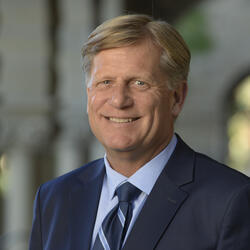
Michael McFaul headshot

Professor Michael McFaul

FSI Director
"Autocrats vs. Democrats: China, Russia, America, and the New Global" is available starting October 28, 2025.
Order Now

Hauck Auditorium, Traitel Building, 435 Lasuen Mall, Stanford, CA 94305

Encina Hall
616 Jane Stanford Way
Stanford, CA 94305-6055

0
Senior Fellow, Freeman Spogli Institute for International Studies
Ken Olivier and Angela Nomellini Professor of International Studies, Department of Political Science
Peter and Helen Bing Senior Fellow, Hoover Institution
mcfaul_headshot_2025.jpg PhD

Michael McFaul is the Ken Olivier and Angela Nomellini Professor of International Studies in Political Science, Senior Fellow at the Freeman Spogli Institute for International Studies, and the Peter and Helen Bing Senior Fellow at the Hoover Institution, all at Stanford University. He joined the Stanford faculty in 1995 and served as FSI Director from 2015 to 2025. He is also an international affairs analyst for MSNOW.

McFaul served for five years in the Obama administration, first as Special Assistant to the President and Senior Director for Russian and Eurasian Affairs at the National Security Council at the White House (2009-2012), and then as U.S. Ambassador to the Russian Federation (2012-2014).

McFaul has authored ten books and edited several others, including, most recently, Autocrats vs. Democrats: China, Russia, America, and the New Global Disorder, as well as From Cold War to Hot Peace: An American Ambassador in Putin’s Russia, (a New York Times bestseller) Advancing Democracy Abroad: Why We Should, How We Can; and Russia’s Unfinished Revolution: Political Change from Gorbachev to Putin.

He is a recipient of numerous awards, including an honorary PhD from Montana State University; the Order for Merits to Lithuania from President Gitanas Nausea of Lithuania; Order of Merit of Third Degree from President Volodymyr Zelenskyy of Ukraine, and the Dean’s Award for Distinguished Teaching at Stanford University. In 2015, he was the Distinguished Mingde Faculty Fellow at the Stanford Center at Peking University.

McFaul was born and raised in Montana. He received his B.A. in International Relations and Slavic Languages and his M.A. in Soviet and East European Studies from Stanford University in 1986. As a Rhodes Scholar, he completed his D. Phil. in International Relations at Oxford University in 1991. 

CV
Date Label
Michael McFaul
Lectures
Date Label
-
Mary Elise Sarotte — Post-Cold War Era as History

Professor Mary Elise Sarotte, award-winning historian and author of Not One Inch: America, Russia, and the Making of Post-Cold War Stalemate, will offer reflections on the difficult task of writing history that is still unfolding. Covering the pivotal years from 1989 to 2022, her work traces how early decisions at the end of the Cold War shaped the trajectory of U.S.–Russia relations and contributed to the impasse that continues to trouble the international order today. In this conversation, Sarotte will explore the historian’s challenge of disentangling myth from evidence, of balancing archival distance with contemporary resonance, and of reckoning with a legacy that remains deeply contested and urgently relevant.

The event will begin with opening remarks from Kathryn Stoner, Mosbacher Director of the Center on Democracy, Development, and the Rule of Law (CDDRL). The event will conclude with an audience Q&A.

This event is co-sponsored by the Center on Democracy, Development and the Rule of Law (CDDRL), and the Center for International Security and Cooperation (CISAC).

speakers

Mary Elise Sarotte

Mary Elise Sarotte

Johns Hopkins School of Advanced International Studies (SAIS), Kravis Professor of Historical Studies
full bio

Mary Elise Sarotte received her AB in History and Science from Harvard and her PhD in History from Yale. She is an expert on the history of international relations, particularly European and US foreign policy, transatlantic relations, and Western relations with Russia. Her book, Not One Inch: America, Russia, and the Making of Post-Cold War Stalemate, was shortlisted for both the Cundill Prize and the Duke of Wellington Medal, received the Council on Foreign Relations Arthur Ross Prize Silver Medal, and won the Pushkin House Prize for Best Non-Fiction Book on Russia. Not One Inch is now appearing in multiple Asian and European languages, including a best-selling and updated version in German, Nicht einen Schritt weiter nach Osten. In 2026, Sarotte will return to Yale for a joint appointment as a tenured professor in both the Jackson School of Global Affairs and the School of Organization and Management.

Kathryn Stoner

Kathryn Stoner

Mosbacher Director of the Center on Democracy, Development, and the Rule of Law
full bio

Kathryn Stoner is the Mosbacher Director of the Center on Democracy, Development and the Rule of Law (CDDRL), and a Senior Fellow at CDDRL and the Center on International Security and Cooperation at FSI. From 2017 to 2021, she served as FSI's Deputy Director. She is Professor of Political Science (by courtesy) at Stanford, and she teaches in the Department of Political Science, in the Program on International Relations, as well as in the Ford Dorsey Master's in International Policy Program. She is also a Senior Fellow (by courtesy) at the Hoover Institution.

Kathryn Stoner
Kathryn Stoner

William J. Perry Conference Room, 2nd Floor
Encina Hall (616 Jane Stanford Way, Stanford)

This is a hybrid event. For virtual participation, if prompted for a password, use: 123456

Mary Elise Sarotte Johns Hopkins School of Advanced International Studies (SAIS) Presenter Johns Hopkins University
Lectures
Date Label
-

Join us for a fireside chat with co-authors Ruixue Jia and Hongbin Li who will discuss their most recent book, The Highest Exam: How the Gaokao Shapes China. The fireside chat will be held in-person in the Bechtel Conference Center and livestreamed for virtual attendees. After the fireside chat, we invite in-person attendees to join us for a light reception and book signing with Hongbin Li. Order your copy of the book here.

Join the webinar to watch the event live:

Webinar ID: 985 1962 7327
Passcode: 361163


The Highest Exam book cover.

Each year, more than ten million students across China pin their hopes on the gaokao, the nationwide college entrance exam. Unlike in the United States, where standardized tests are just one factor, in China college admission is determined entirely by gaokao performance. It is no wonder the test has become a national obsession.

Drawing on extensive surveys, historical research, and economic analysis, and informed by Ruixue Jia and Hongbin Li’s own experiences of the gaokao gauntlet, The Highest Exam reveals how China’s education system functions as a centralized tournament that serves the needs of the Chinese Communist Party and drives much of the country’s economic growth. The book examines the gaokao’s far-reaching effects on China’s society and beyond. As Chinese-American families bring the expectations of the highest exam with them, their calls for objective, transparent metrics in the education system increasingly clash with the more holistic measures of achievement used by American schools and universities.


About the Authors
 

Hongbin Li

Hongbin Li is the Co-director of Stanford Center on China's Economy and Institutions, and a Senior Fellow of Stanford Institute for Economic Policy Research and the Freeman Spogli Institute for International Studies. Li obtained his Ph.D. in economics from Stanford University in 2001 before joining the economics department at the Chinese University of Hong Kong (CUHK). He was also one of the two founding directors of the Institute of Economics and Finance at the CUHK. He taught at Tsinghua University from 2007 to 2016 in the School of Economics and Management and was the founder and Executive Associate Director of the China Social and Economic Data Center. 

Li’s research has been focused on the transition and development of the Chinese economy, and the evidence-based research results have been both widely covered by media outlets and well read by policy makers around the world. He is currently the co-editor of the Journal of Comparative Economics and co-author of the book, The Highest Exam: How the Gaokao Shapes China, published by Harvard University Press.
 

Ruixue Jia headshot.

Ruixue Jia is a professor of economics at the School of Global Policy and Strategy at UC San Diego. She also serves as Co-director of the China Data Lab, executive secretary of the Association of Comparative Economic Studies (ACES) and co-chair of the China Economic Summer Institute (CESI). 

Jia’s research lies at the intersections of economics, history and politics, with a focus on how power structures evolve and shape economic development. Her recent work examines the political economy of idea formation and diffusion, including the interplay between the state, education, science and technology. She is the co-author of The Highest Exam, a book that explores how China’s education system both mirrors and molds its society.
 

Headshot of Claire Cousineau.

Claire Cousineau  is a writer and former researcher at the Stanford Center on China’s Economy and Institutions, she is currently pursuing her MBA at Duke University.

Since studying and working in Beijing and Kunming, Claire is passionate about fostering a deeper public understanding of China’s role on the global stage and creating cross-cultural relationships. Claire is the co-author of the book, The Highest Exam: How the Gaokao Shapes China, along with Hongbin Li and Ruixue Jia, published by Harvard University Press in 2025. 


Bechtel Conference Center
Encina Hall
616 Jane Stanford Way, Stanford University

or via Livestream

Ruixue Jia

John A. and Cynthia Fry Gunn Building, 366 Galvez Street
Stanford, CA 94305-6015

0
Faculty Co-director of the Stanford Center on China's Economy and Institutions
Professor, by courtesy, of Economics
Senior Fellow at the Freeman Spogli Institute for International Studies
Senior Fellow at the Stanford Institute for Economic Policy Research
Faculty Affiliate at the King Center of Global Development
Faculty Affiliate at Stanford Institute for Human-Centered Artificial Intelligence
5268-hongbinli.png PhD

Hongbin Li is the Co-director of Stanford Center on China's Economy and Institutions, and a Senior Fellow of Stanford Institute for Economic Policy Research (SIEPR) and the Freeman Spogli Institute for International Studies (FSI).

Hongbin obtained Ph.D. in economics from Stanford University in 2001 and joined the economics department of the Chinese University of Hong Kong (CUHK), where he became full professor in 2007. He was also one of the two founding directors of the Institute of Economics and Finance at the CUHK. He taught at Tsinghua University in Beijing 2007-2016 and was C.V. Starr Chair Professor of Economics in the School of Economics and Management. He also founded and served as the Executive Associate Director of the China Social and Economic Data Center at Tsinghua University. He founded the Chinese College Student Survey (CCSS) in 2009 and the China Employer-Employee Survey (CEES) in 2014.

Hongbin’s research has been focused on the transition and development of the Chinese economy, and the evidence-based research results have been both widely covered by media outlets and well read by policy makers around the world. He is currently the co-editor of the Journal of Comparative Economics and co-author of the forthcoming book, “The Highest Exam: How the Gaokao Shapes China” published by Harvard University Press.

CV
Date Label
Hongbin Li
Lectures
News Feed Image
highest_exam_book_talk.png
Date Label
-

Skyline Scholars Series


Tuesday, June 3, 2025 | 1:00-2:30 pm Pacific Time
Goldman Room E409, Encina Hall, 616 Jane Stanford Way


Post–Cold War Consensus and Strategic Dilemmas: The United States, China, and the Future of the World Order


The world is at a crossroads. What is happening in world politics today—and the changes that are about to unfold—can be roughly compared to major events such as the collapse of the Soviet Union and the end of the Cold War in 1991, or the end of World War II in 1945 and the formation of a world order centered on U.S.–Soviet competition. Although many unconventional policies since President Donald Trump’s second term have accelerated the arrival of this moment and increased uncertainty in world politics and the global economy, the roots of these developments are long-standing. They are the result of a series of major and gradual structural changes.

The purpose of this lecture is to provide a new theoretical perspective and cognitive framework for the academic community to understand the structural transformations of the world order from the post–Cold War era to the present, and thereby to initiate a dialogue with the global academic community. At the same time, it is hoped that political decision-makers will also find in this framework a useful tool to reflect on their own choices—encouraging more prudent and responsible decisions for their countries and for humanity in the long run.


About the Speaker
 

Gangsheng Bao headshot

Gangsheng Bao is a Professor of Political Science at the School of International Relations and Public Affairs, Fudan University, Shanghai, China. He is also currently appointed as a Skyline Scholar at the Stanford Center on China’s Economy and Institutions, Stanford University.

Professor Bao earned his Ph.D. from Peking University in 2012. His research interests include political theory, comparative politics, and political history, with a particular focus on theories of political modernization and democratization. He has published numerous journal articles and authored several books. His major works include: The Fate of Civilization States: From Political Crisis to Modernization (2024), Political Evolution: From Ancient Times to the 21st Century (2023), Crises and Solutions: Reflections on Political Thought in Early China (2023), Politics of Democratic Breakdown (English version, 2022; Chinese version, 2014), The Logic of Democracy (2018), and The Common Sense of Modern Politics (2015).

Professor Bao’s book Politics of Democratic Breakdown was awarded the "Best Social Science Book of the Year" in 2014 by The Beijing News and was listed among the “Nineteen Recommended Chinese Books of the Year” in 2014 by The New York Times (International Chinese Network). In 2023, Political Evolution: From Ancient Times to the 21st Century was honored as one of the “Ten Best Chinese Original Books in Humanities and Social Sciences of the Year” by Tencent and as one of the “Ten Best Books of the Year” by The China Business Network. Similarly, The Fate of Civilization States: From Political Crisis to Modernization was selected as one of the “Ten Best Books of the Year” in 2024 by the Nanfang Daily. Additionally, his work The Logic of Democracy earned him the title of "Best Author of the Year" in 2018 from The Economic Observer.


Questions? Contact Xinmin Zhao at xinminzhao@stanford.edu


Goldman Room, E409
Encina Hall, East Wing, 4th Floor

Gangsheng Bao, Skyline Scholar (2025); Professor of Political Science, Fudan University
Lectures
Date Label
-

Due to high interest for this event, we have met our space capacity and registration is now closed.


Skyline Scholars Series


Wednesday, May 28, 2025 | 1:00-2:30 pm Pacific Time
Goldman Room E409, Encina Hall, 616 Jane Stanford Way


China's Economic Development From a Perspective of Modernization


China’s economic success can be attributed to its leadership’s pragmatic approach and its respect for grassroots initiatives. The near double-digit average GDP growth during the first three decades after 1978 was achieved through bottom-up industrialization, without fundamentally altering the “ancient regime.” With industrialization largely completed—as evidenced by massive excess capacities—the country faced an urgent need to shift its growth engine from investment to innovation, a transition that demands a very different set of institutions. Delays or failures in making this shift—namely, in modernizing its institutions—may lead to the so-called “middle-income trap” and diminish hopes of becoming a leader in the global race for cutting-edge technologies. This talk explores China’s developmental trajectory through the lens of modernization theory, highlighting both the achievements and the institutional challenges that lie ahead.


About the Speaker
 

Xiaonian Xu headshot

Dr. Xiaonian Xu is Professor Emeritus at CEIBS, where he held the position of Professor of Economics and Finance from 2004 to 2018.  In recognition of his contributions, he was named an Honorary Professor in Economics from September 2018 to August 2023. He is also Skyline Scholar at the Stanford Center on China's Economy and Institutions from 2024-25 at Stanford University.

Between 1999 and 2004, Dr. Xu served as Managing Director and Head of Research at China International Capital Corporation Limited (CICC). Before joining CICC, he was a Senior Economist at Merrill Lynch Asia Pacific, based in Hong Kong from 1997 to 1998, and worked as a World Bank consultant in Washington DC in 1996. Dr. Xu was appointed Assistant Professor of Amherst College, Massachusetts, where he taught Economics and Financial Markets from 1991 to 1995. Earlier in his career, he was a research fellow at the State Development Research Centre of China from 1981 to 1985.

Dr. Xu earned his Ph.D. in Economics from the University of California, Davis, in 1991, and an MA in Industrial Economics from the People's University of China in 1981. In 1996, he was awarded the distinguished Sun Yefang Economics Prize, the highest honor in the field in China, for his research on China’s capital markets. His research interests include Macroeconomics, Financial Institutions and Financial Markets, Transitional Economies, China’s Economic Reform, Corporate Strategy and Digital Transformation. His publications include: Freedom and Market Economy (《自由与市场经济》), There has Never been A Savior (《从来就没有救世主》), The Pendulum Swinging Back (《回荡的钟摆》), The Nature of the Business and the Internet (《商业的本质和互联网》), and The Nature of the Business and the Internet, 2nd Edition (《商业的本质和互联网》第二版).

A dedicated educator, he has been recognized with the CEIBS Teaching Excellence Award in 2005 and 2006, as well as the esteemed CEIBS Medal for Teaching Excellence in 2010.


Questions? Contact Xinmin Zhao at xinminzhao@stanford.edu


Goldman Room, E409
Encina Hall, East Wing, 4th Floor

Encina Hall, East Wing, Room 014

Office Hours:
Select Mondays | 3:00-5:00 PM 
Please schedule a meeting in advance

0
Skyline Scholar (2024), Stanford Center on China's Economy and Institutions
Professor of Economics and Finance, China Europe International Business School
prof._xu_xiaonian.jpg Ph.D.

Dr. Xiaonian Xu is Professor Emeritus at CEIBS, where he held the position of Professor of Economics and Finance from 2004 to 2018. In recognition of his contributions, he was named an Honorary Professor in Economics from September 2018 to August 2023.

Between 1999 and 2004, Dr. Xu served as Managing Director and Head of Research at China International Capital Corporation Limited (CICC). Before joining CICC, he was a Senior Economist at Merrill Lynch Asia Pacific, based in Hong Kong from 1997 to 1998, and worked as a World Bank consultant in Washington DC in 1996. Dr. Xu was appointed Assistant Professor of Amherst College, Massachusetts, where he taught Economics and Financial Markets from 1991 to 1995. Earlier in his career, he was a research fellow at the State Development Research Centre of China from 1981 to 1985.

Dr. Xu earned his Ph.D. in Economics from the University of California, Davis, in 1991, and an MA in Industrial Economics from the People's University of China in 1981. In 1996, he was awarded the distinguished Sun Yefang Economics Prize, the highest honor in the field in China, for his research on China’s capital markets. His research interests include Macroeconomics, Financial Institutions and Financial Markets, Transitional Economies, China’s Economic Reform, Corporate Strategy and Digital Transformation. His publications include: Freedom and Market Economy (《自由与市场经济》), There has Never been A Savior (《从来就没有救世主》), The Pendulum Swinging Back (《回荡的钟摆》), The Nature of the Business and the Internet (《商业的本质和互联网》), and The Nature of the Business and the Internet, 2nd Edition (《商业的本质和互联网》第二版).

A dedicated educator, he has been recognized with the CEIBS Teaching Excellence Award in 2005 and 2006, as well as the esteemed CEIBS Medal for Teaching Excellence in 2010.

Date Label
Xiaonian Xu, Skyline Scholar (2024-25); Professor Emeritus, CEIBS
Lectures
Date Label
-

Please note: This event, "Major General William Bowers on the U.S. Military Posture to Maintain Peace in the Indo-Pacific," has been postponed indefinitely due to scheduling changes. Thank you for your interest.


Join Stanford's Shorenstein APARC China Program as we welcome U.S. Marine Corps Major General William Bowers, who will present on the advanced Naval bases of U.S. military forces in the Indo-Pacific, and their role in maintaining deterrence and allied security in the region.

As the Commanding General of Marine Corps Installations Pacific from 2019 to 2022, Major General Bowers oversaw all U.S. Marine Corps bases in the Pacific Area of Operations, supporting the largest U.S. military expeditionary force in the theater.  Currently, Bowers heads the Marine Corps’ Recruiting Command, where he overhauled the Corps’ recruiting, leading to record enlistment and retention.

Image
Major General Bowers

Major General Bowers was commissioned in 1990 after graduating with distinction from Virginia Military Institute with a B.A. in History.  He assumed command of Marine Corps Recruiting Command in July 2022 during a time of historic change and challenge for recruiting.  In September 2023, General Bowers led a “Strategy Conference” here at Stanford University in which members of the Stanford community partnered with Marine Corps Recruiting Command to develop and launch the “Made for This” advertising campaign focused on enduring American values.  Major General Bowers' personal decorations include the Legion of Merit (with gold star), the Bronze Star, the Defense Meritorious Service Medal (with oak leaf cluster), the Meritorious Service Medal, the Navy and Marine Corps Commendation Medal (with two gold stars), the Navy and Marine Corps Achievement Medal, and the Humanitarian Service Medal.  He was named “Combat Engineer Officer of the Year” in 1998 and has received several writing awards.

Philippines Room, Encina Hall (3rd floor), Room C330
616 Jane Stanford Way, Stanford, CA 94305

Major General Bowers, Commanding General, Marine Corps Recruiting Command; Commanding General of Marine Corps Installations Pacific (2019–2022)
Lectures
Date Label
-
Impact of the 2011 Judicial Interpretation of the Chinese Marriage Law


In this talk, Professor Emma Zang presents research on how a 2011 change to China’s Marriage Law affected property rights within households and impacted family well-being and behavior. Using national survey data and 1.5 million divorce court records, the studies compare households impacted by the law with those that were not. While much research focuses on broad gender inequality, this work looks closely at how property ownership within families affects women.

Professor Zang’s research explores the intersection of health, aging, family demography, and inequality in the U.S. and China. She investigates how family structures and policies—such as marriage laws, flexible work, and early-life experiences—influence inequality, gender dynamics, and later-life health. Her work has appeared in Nature Human Behaviour, American Journal of Sociology, Demography, JAMA Internal Medicine, and others, and has been supported by the National Institutes of Health. She is a Butler-Williams and IMPACT Faculty Scholar with the National Institute on Aging and a Next Generation Leader of the Committee of 100. Her honors include awards from the ASA, ISA, IPUMS, and the European Commission.

Reuben Hills Conference Room
Encina Hall, Second Floor, East Wing, E207
616 Jane Stanford Way, Stanford, CA 94305

Emma Zang, Assistant Professor of Sociology, Biostatistics and Global Affairs at Yale University
Lectures
Date Label
Subscribe to Lectures